

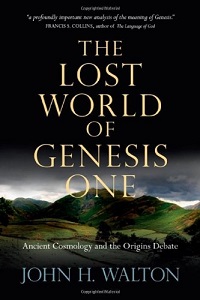
This week a new conservative Christian blog, titled Tekton Tickler, features a post by Nick Peters in which he reviews John Waltonʼs book, The Lost World of Genesis One. Nick appreciates the new vistas that Waltonʼs research has opened up, as if Walton has flung open the door to a new united creationist front, a “mere creationism” in which both young-earth creationists and old-earth creationists can finally live together in Edenic peace. Of course Walton is also popular with theistic evolutionists, as can be seen from the fact that Waltonʼs most recent videos on the meaning of Genesis 1 appear on the Biologos website.
Aside from showing enthusiasm for Waltonʼs work, Nickʼs only nagging criticism appears to be that “I [Nick] was left wondering how exactly I was to see the days of Genesis 1 in his [Waltonʼs] view… I found his position on that to be unclear.”
My criticism of Nickʼs review is whether Walton has indeed opened the door to peace between creationists, or has Waltonʼs research into the ancient Near Eastern milieu of the Bible opened a whole new Pandoraʼs box of questions (at least for conservative Christians)?
Take for instance the lack of clarity that Nick finds in Waltonʼs view of the meaning of the “days” in Genesis 1. Itʼs not confusing once you take into account ancient Near Eastern ceremonies of earthly temple inauguration and the connection that was believed to lie between them and the creation of the cosmos. The inauguration of earthly temples took place over a certain number of days, whatever the culture deemed an adequate holy number. A connection was believed to exist between the inauguration of an earthly temple (in a certain number of days) and the creation of the cosmos (in a certain number of days). In the former case the days are indeed literal, but the “days” used to depict Godʼs creation of the cosmos [cosmic temple], need not be, at least not to modern minds, though the ancients may have imagined a closer mythical identification of “literal days involved in temple inauguration” with “literal days of creation” than we are wont to today.
At least thatʼs what some ancient Near Eastern temple dedication ceremonies, accompanied by a recitation of a creation story, seem to imply.
One might even say that the idea of a connection between the construction of an earthly temple and a cosmic temple (the cosmos) is a mythical motif shared by some ancient Near Eastern cultures.
An Additional Case of a Shared Mythical Motif Related to the Building of Temples
Speaking of shared mythical motifs, the notion of a god designing their own earthly temple is not unique to the Bible. Take the OT tale about King David having received special instructions directly from Yahweh on how to build His temple. It is not the earliest known example of such a tale. King Thutmose of Egypt lived before the day of King David, and an ancient inscription says that Thutmose received instructions directly from his god, an Egyptian deity, about how His temple should be built. It would appear that both are culture-centric stories that arose to add “divine” justification for the temples each of those kings built.
Opening Up Pandoraʼs Box Further…
What Else Does Walton Say About Ancient Hebrew Views of the World?
“The Israelites [like the nations around them] did not know that stars were suns; they did not know that the earth was spherical and moving through space; they did not know that the sun was much further away than the moon, or even further than the clouds or high-flying birds. They believed that the sky was material (not vaporous), solid enough to support the residence of the deity as well as hold back waters.” (John H. Walton, The Lost World of Genesis One: Ancient Cosmology and the Origins Debate (Downers Grove, IL: IVP Academic, 2009), p. 16.)
Waltonʼs interpretation of Genesis 1 does not deny that ancient Hebrews assumed the earth was flat. Read Waltonʼs view of Passages Evidencing ‘Old World’ Science in the Bible.
Walton also wrote:
“P. Seely has amply demonstrated that the raqia [often translated as ‘firmament’], structurally speaking, was perceived by the Israelites as a solid dome.” (John H. Walton, The NIV Application Commentary on Genesis, p. 110)
Having admitted that that was how the ancient Hebrew viewed the cosmos, Walton also adds that he finds it to be of little theological importance even if they did view the cosmos in such a pre-scientific manner. See Waltonʼs lecture, Genesis and Cosmology in which he explains in detail why none of what the Bible says about such matters is important. (If your computer has difficulty loading the lecture click briefly on a different lecture on that same page, and then click back on Waltonʼs.)
I disagree with Walton. I think it is important, because if the ancient Hebrews entertained grossly false prescientific assumptions in one area, then there is at least a chance they may have held incorrect assumptions in other areas as well. For instance, the Israelites shared with their neighbors not only the assumption that the world was flat, but a belief that internal organs (other than the brain) directed them (as Walton admits in his lecture above). They also shared with their neighbors the eastward orientation of their tabernacle and temple, the placement of important cultic objects within their temples, the designation of areas of increasing holiness, rules for access to the Holy Place and Holy of Holies, as well as practices like circumcision and sacrificial offerings. But how do we know that animal sacrifices and temple building are any truer representations of the spiritual cosmos than the flat earth view is of the physical one?
Like other nations, the Hebrews also feared the anger of their god and subsequent punishment if attention was denied him. The duty of kings and priests was to ensure such attention was maintained, for the safety and security of the nation.
In other words is it possible to prove that ancient theological assumptions were any more true than ancient cosmological assumptions?
See also these recent articles on ancient Near Eastern and Hebrew worldviews.
Also note that Prof. Walton sometimes says Mesopotamian ritual is based on “common sense and experimentation” (p. 136) while biblical ritual is based on revelation (“ritual procedures [in the ancient Near East] were not the result of revelation in anything like the sense that is found in the Pentateuch [instructions from Sinai”], p. 137). However, Waltonʼs sharp distinction is questionable because cuneiform texts and incantations frequently talk about the fact that they were revealed by the gods. For further evidence see Alan Lenziʼs monograph on “secrecy” that shows how similar the Mesopotamian and Biblical mythologies of revelation actually were.
By the way, as Alan Lenzi asks, “Is there some rule that says a guy will get fired at Wheaton if he calls the Priestly account of creation a myth? The Babylonian story of creation (= Enuma Elish) is a myth. Why withhold the label from Genesis 1?”

No comments:
Post a Comment