
Showing posts with label Johns Hopkins. Show all posts

Steinmetz: Giver of Electricity to the World, and Freethinker in Matters of Religion

Steinmetz: Freethinker, Giver of Electricity to the World

Charles P. Steinmetz [above right] stands with another freethinker, Thomas Edison [above left] and Elihu Thomson as one of the founding fathers of electricity. The devices and methods that Steinmetz developed are largely concerned with those parts of electricity that are hidden from the public eye, like the invention of generators that produce electricity as well as the transformers sitting powerfully quiet in their little houses outside generating stations. Few have wondered why the high-tension lines strung on tall steel towers are seldom damaged by lightning, but again we can thank Steinmetz for that. Without Steinmetzʼs work, electricity would be about half as useful as it is. Also, Dr. Steinmetzʼs tale of escape from Prussia, battle with polio, and rise to fame in the U.S. is a classic story of survival and success.

Toward the end of his life he was asked increasingly about his religious beliefs, and he even shared an extended conversation with noted Christian fundamentalist William Jennings Bryan. More on that aspect of his life can be read below.

Key Points:

  • One of the Pioneers of AC Power. Steinmetz figured out the mathematics involved in hysteresis. Hysteresis loops show the behavior of magnetism in materials. Understanding magnetism in iron cores was and is still key to design of motors, generators, ballasts and other electrical devices. Steinmetz figured out the great mystery that has stumped all the greats of the time (Thomson, Tesla, Westinghouse, Shallenberger, Edison).

  • Became an icon as the star engineer of General Electric in the Alternating Current Age. Founder of the GE Research Lab (now GE Global Research).

  • Distinguished Professor at Union College.

  • Helped many researchers achieve success on numerous technologies without claiming credit or collecting many patents for himself.

  • A believer in socialism, he thought that through automation in factories and in our personal lives (appliances) that we could eliminate the need for ‘serfs’ doing manual labor and that governments or companies could share the profits gained from automation to support the freed ‘slaves’ of feudal systems. Little did he know that increased profits from automation benefit stock share holders most of whom are already wealthy and unwilling to share that wealth, therefore the profits do not benefit the poor but have simply made the rich richer.

Steinmetz and the Ministers

Inevitably the reporters began to ask Steinmetz for his religious articles of faith. Steinmetz in his opinions never attacked anyone. He didnʼt care enough, and definite attack was a weapon which he never used. So the ministers welcomed his comments and never denounced him as an atheist. One liberal denominational magazine, the Unitarian Christian Register, even asked him to write two articles for it on his beliefs. These articles drew the inevitable line between scientific weighing of evidence and religious taking on authority but they did it in so conciliating a way that no one got angry. Steinmetz gave to religion that minute loophole which is all it needs to ask.

“There is,” said Steinmetz, “no evidence outside of science for God, immortality, and similar conceptions,and there is evidence against these conceptions in science, and science has justified its methods and conclusions by the work it has accomplished.

“But it is hard for man to get along without belief in these conceptions. We may get along without a God but not without immortality. Our self-conceit dislikes to place so little value on ourselves, our knowledge, our skill, experience—in short our Ego to concede that all this is merely a function of the biochemical process of life which will utterly cease and vanish with the disintegration of the protoplasm of the body by death.

“But all conclusions of science depend on our observation by means of the senses. Religion deals with the infinite which cannot be conceived by the senses. Also we reason by means of logic, whose rules are only thought to be true because of experience.

“This, the negative answer of science on the question whether there are conceptive entities of infinite character, as infinite in time and space, immortality of the Ego, God, etc., is not conclusive, and the question is as open as before.

“There can be no scientific foundation of religion, and belief must always remain the foundation of religion, while that of science is logical reasoning from facts, that is, sense conception. All that he can say is that the two, science and religion, are not necessarily incompatible, but are different and unrelated activities of the human mind.”

An Insulated Conversation

Steinmetzʼs tour of speech-making carried him to nearly every town of importance on the Pacific Coast, and everywhere he was greeted with the same enthusiasm. The papers ran almost verbatim stories of his addresses and editorial after editorial appeared in praise of the man who had made hydro-electric power, which in turn had made the Pacific Coast. They take their electricity very seriously out there. It largely replaces coal and the people are duly grateful to the men who make it possible.

On the train back to Chicago he had an interesting encounter. William Jennings Bryan was on board and asked to meet him. Steinmetz was sitting alone in his stateroom looking out of the window when Bryan entered. He at once recognized the familiar face of the pseudo-statesman with the light of fanaticism burning in his eyes. He greeted him warmly and Bryan immediately broached the matter nearest his heart—the only matter which really interested him. He was looking for sentimental loopholes in Steinmetzʼs disbelief.

Bryan in private with no others present to whom he could orate was very different from Bryan on the public platform. He deplored disbelief in his rather simple-minded God but he realized there was no use displaying his feelings when he had no audience which could be induced by appeals to emotion to sympathize with him. So the discussion was calm and reasonable. Steinmetz had nothing to lose by frankness and Bryan had nothing to gain by emphasis.

Steinmetz enjoyed hugely this meeting with the leader of all that was silly in religion and politics but for the life of him he couldnʼt develop any antagonism.

Bryan was so pleasant and conciliating. They talked for a long time, coming to no agreement on anything but discounting rather than opposing each otherʼs opinions because there was no one else there to hear them disagree.

Bryan asked most of the questions, presumably because Steinmetz realized that there was no use trying to get facts, the only things which interested him, out of a reservoir which contained nothing but sentiment. Bryan was not interested in facts and Steinmetz presumably had as large a stock of sentiment as any man.

Pleasantly and reasonably Steinmetz explained the position of the orthodox scientist. He granted that the inherent irrationality of human nature left some distant field for religion but disclaimed any desire to explore that field for himself. He advocated the study of the Bible by children, for he considered it a great book and one containing remarkably little religion.

Bryan listened politely enough, rocklike in his conviction that science was a fraud and revelation the only true knowledge. The two parted in a friendly state of mind, Steinmetz to return to his somewhat dusty test tubes and Bryan to continue tilling the sterile soil of rural faith.

This meeting with Bryan is a fitting last episode in the life of the enthusiastic little scientist. His useful work was almost over now and he could afford to smile indulgently at those human weaknesses which would have aroused him to fury in earlier years. So on parting he pressed warmly the hand of the Great Mogul of bucolic bigotry who was shortly to meet his Leipsig at Madison Square Garden and his Waterloo at Dayton, Tennessee.

The End

There isnʼt much more to fell. Steinmetzʼs life is nearly over now. He is fifty-eight and his body has decided to stop running. All considered, it did remarkably well to keep going so long. At least it nourished the brain during the vital years which bore such important scientific fruit. If it had been looking for excuses it could have found plenty. Every life process had to run in zigzags.

The Pacific Coast trip was the last effort the body was able to complete. On his return to Schenectady Steinmetz sank rapidly. He found it difficult to walk from the train to the taxi and when he reached home the doctor told him to stay in bed awhile and rest.
Perhaps he recognized the death sentence so gently pronounced. Probably he did not. At any rate he stayed quietly in his room, protesting now and then because he couldnʼt go to his laboratory, but devouring scientific literature as greedily as ever.

One morning about breakfast time Hayden went up to see him. Steinmetz was awake and cheerful but he seemed uncomfortable. Hayden told him to take his heart medicine. Heʼd bring him his breakfast presently.

“Keep still. Donʼt try to do anything.”

“All right,” said Steinmetz, settling himself back on the pillow. “Iʼll lie down.” Those were his last words.

Presently up came little Billy Hayden with the breakfast tray. He found Steinmetz lying as peacefully as ever, but dead. His heart had stopped. On his face was no sign of pain or surprise. He had died as naturally as an electric motor. The current was cut off. The motor lost momentum, ran slower, and stopped. That was all. Wonderfully soon the news reached the General Electric offices and the officials of the company came up in a body to pay their respects. Telegrams began to arrive from all over the country. Scientific societies, electrical companies, and plain individuals at home and abroad sent their last thanks to the man who had made their work so much easier to do.

The funeral was almost a state function. Steinmetzʼs name had penetrated to the most preoccupied minds and everyone high and low came to see him buried. How Steinmetz would have loved it all I The reporters. The lieutenant governor. The president and chairman of the company. Scientists and magnates in flocks. All genuinely sorry and genuinely worshipful as they carried the small, light coffin to the graveyard.

SOURCE: Loki: The Life of Charles Proteus Steinmetz by Jonathan Norton Leonard, New York: Doubleday, Doran and Company Inc., 1932

See also,

The Secular Saints of Johns Hopkins… and a case of “faith in medicine” healing a paralyzed woman

John Hopkins Medical School

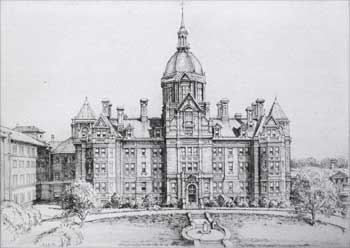
Johns Hopkins Hospital and University were the product of a great change in the direction of North American philanthropy. Throughout the nineteenth century, most giving by the wealthy had been religiously directed-to churches, seminaries, and other church-based charities. In 1867, however, the Baltimore merchant and financier Johns Hopkins-for reasons not totally known but certainly related to his being an adherent of the education-friendly Quaker sect-had drawn up a will bequeathing his then-vast fortune of $7 million (perhaps $300-$500 million in todayʼs purchasing power) to found a university and a hospital mandated to compare favorably with like institutions anywhere in the world. The Johns Hopkins institutions, created faithfully by trustees after the merchantʼs death in 1873, were secular and scientific and uncompromising in their commitment to excellence. They trained professors and scientists and doctors, not preachers.

In the late nineteenth century surgery began making spectacular progress under the double impact of the introduction of anesthesia and asepsis [keeping the surgical area and instruments relatively free of germs], that made it possible to surgeons to enter most cavities of the body and with the prospect of doing their patients more good than harm. From about the mid-1880s (appendectomies were first performed in 1886, and surgically sutured cures for hernias were first performed in 1887, saving numerous lives), surgery entered its first golden age. More than any other specialty, it became the driving force behind the transformation of hospitals from places for end-of-life care of the indigent into temples for the treatment of rich and poor alike.

Just take the case of a strangulated hernia before surgery could successfully treat it:

Natives in Central Africa suffer much oftener than Europeans from strangulated hernia, in which a portion of the intestines pokes out through the abdominal muscles and becomes blocked, so that it can no longer empty itself. It then becomes enormously inflated with gases which form, and this causes terrible pain. Then after several days of torture death takes place, unless the intestine can be got back through the rupture into the abdomen. Our ancestors were well acquainted with this terrible method of dying, but we no longer see it in Europe because every case is operated upon as soon as it is recognized…But in Africa this terrible death is quite common. There are few who have not as boys seen some man rolling in the sand of his hut and howling with agony until death came to release him. [Albert Schweitzer, On the Edge of the Primeval Forest (1961)]

Returning to the history of Johns Hopkins…When Harvey Cushing removed part of a diseased nerve from the thigh of a distinguished Johns Hopkins scientist, Simon Newcomb, the grateful patient hailed him as a miracle worker who had restored his ability to walk. “Prof. Newcomb believes himself to be entirely cured,” a newspaper reported, “and leaves his crutches at Johns Hopkins as a souvenir just as the poor cripples who are cured by miracles leave theirs at the shrine of St. ann de Beaupre.” When even scientists were said to leave their crutches at Johns Hopkins a new and powerful shrine was in the making.

Cushing also found a way to treat the extreme facial pain of trigeminal neuralgia, a condition that drove many of its victims to madness or suicide. In 1899 Cushing operated on a patient who complained that in the early stages of a spasm he could feel, “a devil twisting a red-hot corkscrew into the corner of the mouth,” and that was just the start of the suffering. Cushing completely eliminated the patientʼs pain by severing the connection between the brain and the trigeminal nerve, and he discovered a better place to sever the nerve on its way to the brain that cut the mortality rate of these operations from about 20% to near zero.

Harvey Cushing also became the first surgeon who could access the human brain at will and with the near certainty of doing more good than harm. He was able to relieve patients of torments that for many centuries had often been considered the product of demonic possession. In some cases he could literally make the lame walk and the blind see. The second patient on whom Cushing operated for trigeminal neuralgia told his surgeon that he felt “resurrected.” Cushing also began removing tumors from the brain that had caused pituitary disorders leading to severe distortions of growth, and became the worldʼs expert on the pituitary gland, previously a mysterious organ.

Meanwhile, Cushingʼs friend George Crile was making efforts to restore patients to life after their hearts had stopped beating, what he called “resurrecting” them. And the surgeons built on one anotherʼs advances.

As the gospel of the new scientific medicine spread, other philanthropists, such as the Baptist, John D. Rockefeller, began to give at least as much money to health causes as to religious ones.

Osler began to argue that medicine, a universal and borderless brotherhood, had done more than any other profession, including the church, to alleviate the ills of suffering humanity. Speaking in 1905 Osler said,

In little more than a century a united profession, working in many lands, has done more for the race than has ever before been accomplished by any other body of men. So great have been these gifts that we have almost lost our appreciation of them. Vaccination, sanitation, anaesthesia, antiseptic surgery, the new science of bacteriology, and the new art in therapeutics [one might add the discovery of necessary vitamins and minerals and treatments for their deficiences to the list] have effected a revolution in our civilisation.

At its best, Osler argued, medicine (or rather a faith in medicine) could even effect cures in the gray areas where mind and body interacted to create hysterical paralysis, neurasthenia, and like disorders. If patients had as much faith in their physicians as they did in their clergy, if they had faith in “Saint” Johns Hopkins Hospital, they would experience the same “cures” that “faith healers” offered. “I have had cases any one of which could have been worthy of a shrine or made the germ of a pilgrimage,” Osler wrote in his essay, “The Faith That Heals,” and went on to give an instance.

For more than ten years a girl lay paralysed in a New Jersey town. A devoted mother and loving sisters had worn out lives in her service. She had never been out of bed unless when lifted by one of her physicians…The new surrounding of a hospital, the positive assurance the she could get well with a few simple measures sufficed, and within a fortnight she walked round the hospital square. This is a type of modern miracle that makes one appreciate how readily well meaning people may be deceived as to the true nature of the cure effected at the shrine of a saint. Who could deny the miracle? And miracle it was, but not brought about by any supernatural means

Osler even suggested, “The less the clergy have to do with the bodily complaints of neurasthenic and hysterial persons the better for their peace of mind and for the reputation of the Cloth.”

Another example involved Oslerʼs ability to fascinate children:

[A child had severe whooping-cough and bronchitis, was unable to eat and unresponsive to parents and nurses. Recovery seemed unlikely. Osler walked in with his doctorʼs robes, and to the small child this man in the white robe fascinated him.] Osler sat down, peeled a peach, sugared it, and cut it in pieces. He then pressed it bit by bit with a fork into the entranced patient, telling him to eat it up, and that he would not be sick but would find it did him good as it was a most special fruit. The child ate. When leaving Osler patted the boyʼs father on the back and told him, “Iʼm sorry, Ernest, but I donʼt think I shall see the body again, thereʼs very little chance when theyʼre as bad as that.” Happily events turned out otherwise, and for the next forty days this constantly busy man [Osler] came to see the child, and for each of these forty days he put on his doctorʼs robes in the hall before going in to the sick room. After some two or three days, recovery began to be obvious and the small body always ate or drank and retained some nourishment which Osler gave him with his own hands. If the value of personal approach, the quick turning to effect of an accidental psychological advantage (in this case decor), the consideration and extra trouble required to meet the needs of an individual patient, were ever well illustrated, here it was in its finest flower. It would, I submit, be impossible to find a fairer example of healing as an art. [Patrick Mallan, “Billy O,” in Oxford Medicine, ed. Kenneth Dewhurst (London: Sandford, 1970, 94-99]

The great triumphs to come, in Oslerʼs view, would involve medicine actually being able to cure organic disorders, not just cut nerves to relieve excruciating pain, or remove tumors, or restart hearts (as mentioned earlier). Having witnessed the dawn of bacteriology, he could see, for example, that science would one day discover antibacterial agents that would cure tuberculosis or cholera or pneumonia.

In the 1890s experimental work in several centers discovered that patients suffering from cretinism and myxedema were suffering a thyroid deficiency, so they gave the patients thyroid extract, which came to be known as the first “miracle treatment” of an organic disorder. The unfortunate young victims of cretinism were formerly doomed to live in “hopeless imbecility” an “unspeakable affliction to their parents and to their relatives.” Before and after photos of the first patients “emphasized as words cannot the magical transformation which follows treatment.” Medical science was beginning to unravel the mysteries of the secretions of hormones from glands, raising the prospect of elevating organotherapy from quackery to serious therapy. Then Osler added, prophetically, “and as our knowledge of the pancreatic function and carbohydrate metabolism become more accurate we shall probably be able to place the treatment of diabetes on a sure foundation.”

In 1922 a substance was isolated from the pancreas that appeared to work in the treatment of diabetic animals, and it was administered to a diabetic human child with results that were immediate and spectacular-a “resurrection.”

SOURCE: The Making of Modern Medicine: Turning Points in the Treatment of Disease by Michael Bliss