

The Irreverent Musings of Harry McCall (And Others)

The Irreverent Musings of Harry McCall (former Christian seminarian, still a lover of Biblical studies, having been bitten by the “Bible bug”)

The Bible is like a senile senior citizen, semi-coherent and out of touch with reality—but his loving children (believers), via their denials and creative ingenuity, lovingly take him by the arm and theologically help him to shuffle along.
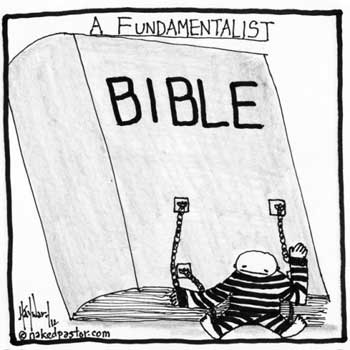

Iʼm sitting here at my keyboard thinking about my past life as an Evangelical Christian. How did I ever believe all the doctrines, and swallow the love mixed with strange fears, for decade after decade? I appear to have been victimized by a frighteningly overpowering (dare I saw psychotic) mix of something the Bible (and my church) called Godʼs “love,” mingled with that same Godʼs “eternal hatred,” and, I was also taught that I was the one to blame for this weird mix, I was the one “asking for it!”

As a Christian I heard John 3:16 run into the ground about how God so loved the world that he gave His only begotten son to die for us. Even Jesus said we should call God “Father”—a loving father who forgives us our trespasses as we forgive those who trespass against us, gives us our daily bread, sends blessed rain on the farmerʼs fields of both the just and unjust, or who would leave 99 of his sheep to hunt for the single lost one. Of course this love only lasts till judgment day (or till we die, whichever comes first). Because on that day our loving Father morphs from a kindly Dr. Jekyll into a sadistic Mr. Hyde (or maybe more like “Sybil”—as in the academy award winning movie of the same name—whose mother loved her one moment only to beat and torture her the next).

Thus, the perennial question that young believers and non-Christians ask: If God is a God of love, why does He morph into someone who demands eternal punishment, as if to say, “Remember all that stuff I said before? ‘Peace on earth goodwill toward men?’ ‘Blessed are the peacemakers?’ ‘Bless those who curse you?’ ‘Love your enemies?’ ‘Love keeps no record of wrongs… It always hopes, always perseveres. Love never fails… These three remain: faith, hope and love?’ Forget about it. Youʼre dead now, and your rear end is mine!”

Of course a common modern reply is that “God does not send anyone to Hell. We send ourselves.” Yea, right! Just like Sybil MADE her psychotic mother punish, beat and torture her.

A god who slaughters families, not to mention cities, nations, and drowns the whole world, is acting in ways itʼs difficult for any human being with an ounce of compassion to not view as reacting questionably. This is a god who also blames the victims eternally, as a way to justify the horrific gore He puts them though.

One might picture it this way: After death the Christian comes into the presence of a God who quickly begins morphing into a sadistic vampire-like character. The Christian of course canʼt hold up a cross, or use “holy water” to ward off God, instead, Christians must use the blood of Jesus to compel God to draw back from his angry wish to inflict eternal punishment (anger that God blames on the victim and that preachers insist we are asking for). God smells the aroma of Jesusʼs blood and his irrational everlasting anger abates, so the Christian can get to live with this psychotic-like God forever. Itʼs like the movie, “The Exorcist,” with the Christian driving back Godʼs unquenchably angry desire for eternal vengeance by shouting: “The blood of Christ compels Thee!” God curses and screams, drawing back.


Paul tells us in his letter to the Romans “Jesus is at the right hand of God interceding for us“ in heaven. (Romans 8:34, NIV) While Romans 14:12 tells us that each person is going to have to step up and “give account of himself to God” even though God already knows all the thoughts of our hearts (Romans 8:28). (Not that “heart” is necessarily being used as a scientific term by Paul, though it also canʼt be denied that in Paulʼs day many did believe that “hearts” had “thoughts.”)

But returning to the image or metaphor of “Jesus at the right hand of God interceding for us” in heaven. Not to be coy, but how exactly am I to imagine the need for incessant “intercession?” Didnʼt Jesus suffer, “become sin,” say “it is finished,” then die and rise from the dead, and ascend into heaven? But after he got to heaven he was assigned yet another job, which is to “intercede for us” to the Father—who apparently is still highly prone to yet more anger? Or forgetfulness?

Scene: Heaven

God: “That Christian down there is really starting to p*ss me off! I should let him slip into sin further, send him strong delusion that he might believe a lie, send in some lying spirits, and let Satan have his way with him—but save some for me to punish eternally.”

Jesus: “Forgive him father. I died for him.”

God: “Oh, yeah, I remember. O.K. But what about that other Christian right there who is…”

Jesus: “Forgive her father. I died for her.”

God: “Oh, yeah, I remember. O.K.”

And Jesus after 2,000 years and for the sixtrillionth time: “Forgive him father. I died for Him.”

And God for the sixtrillionth time: “Oh, yeah, I remember. O.K.”

Little wonder neither God nor Jesus has time to answer prayers since both now find themselves in a Catch-22 situation; one of eternal intercession:

“Blaugh, blaugh, blaugh: O.K.”
F-O-R-E-V-E-R!

Maybe this is why churches must repeat prayers over and over again in liturgical rotation from Sunday to Sunday. In a similar fashion advanced Alzheimerʼs patients must also hold to a repetitious stabilized environment.

Or maybe Jesus at some point will get tired of begging God to have mercy, and turn toward the earth, and shout, QUIT sinning you guys! Iʼve interceded enough! Give me a break! I need some “down time!”

Of course the idea of Jesus continually interceding for us also reminded me of something that St. Ansalem (sp?) wrote, that Jesusʼs love was so great he was going to “remain on the cross” until the last sinner was finally sprung “out of hell.” THAT kind of interceding makes sense if God truly “is love.” Because God and time are the best teachers.


I sometimes reflect on the way God/the Bible/a church/a theology blames its problems, difficulties and evils on humans. At the same time, we humans are never given any credit should we do something good. In short, if there is a problem, itʼs the fault of humans, but if a human being does something good, God alone gets the praise. People trained to view themselves in such an untterly “unworthy” manner will tend to assert the perfection of their particular religionʼs doctrines, and assert how utterly wrong everyone else is if they dare question the Bible or even their churchʼs interpretation of the Bible. In effect, they learn never to trust themselves, and get sucked into trusting their church, and their churchʼs particular doctrines and interpretations of its holy book, everyone else be damned.

Compare that with, say, a theology that teaches there is a spark of goodness already inside everyone, and peopleʼs “job” is to blow on that spark and brighten it further?


We come to God/the Bible/a church/a theology wanting our inmost pains healed, be they loneliness, fears, or uncertainties; and to gain protection and gain certitude; only to be handed in exchange a much larger and complex set of problems we could ever have bargained for, called “theology.” (Thatʼs whatʼs called the old “bait-and-switch.”) Itʼs like the case of a trusting child who depends on the adult to protect them and comfort them, only to be abused because the adult has much more serious, older and deeper issues than the child in his care. “God” and “theology” are complex reflections of the history of human mental agony—an agony steeped in a questionable form of “love.”


The New Testament states that Jesus “became sin” [or was “treated as sin”] while on the cross. “God made him who had no sin to be sin for us, so that in him we might become the righteousness of God.” (2 Corinthians 5:21) Did Jesus become as hated as “sin” and/or “Satan” in Godʼs eyes? Did God hate Himself? Did an infinite God wind up hating himself and released His full wrath on Himself, treating Himself as “sin,” all because some of his finite creatures ate some forbidden fruit? Sounds a bit difficult to swallow.

Harry McCall (whose testimony appears in Leaving the Fold: Testimonies of Former Fundamentalists)


Some Musings Of Others

I read in the Gospels that Jesus forgave the men who nailed him to the cross.

He even promised, “This day you shall be with me in paradise,” to a thief crucified next to him—a thief who addressed Jesus simply as a “man” rather than as “the son of God.”

Yet, today, this same Jesus cannot forgive my kindly old aunt and allow her to dwell in paradise, simply because her “beliefs” do not match Reverend So-and-Soʼs?

Arthur Silver


They say that when god was in Jerusalem he forgave his murderers, but now he will not forgive an honest man for differing with him on the subject of the Trinity.

They say that God says to me, “Forgive your enemies.” I say, “I do;” but he says, “I will damn mine.” God should be consistent. If he wants me to forgive my enemies he should forgive his. I am asked to forgive enemies who can hurt me. God is only asked to forgive enemies who cannot hurt him. He certainly ought to be as generous as he asks us to be.

Robert Ingersoll


When all has been considered, it seems to me to be the irresistible intuition that infinite punishment for finite sin would be unjust, and therefore wrong. We feel that even weak and erring Man would shrink from such an act. And we cannot conceive of God as acting on a lower standard of right and wrong.

Lewis Carroll (author of Alice in Wonderland), “Eternal Punishment,” Diversions and Digressions of Lewis Carroll


It is strange to me that people can consign others to hell without a scruple. One only has to remember a toothache, not to wish it eternally on anyone.

Lucy Daugalis (daugalis@arcom.com.au)


Given headaches, backaches, toothaches, strains, scrapes, breaks, cuts, rashes, burns, bruises, PMS, fatigue, hunger, odors, molds, colds, yeast, parasites, viruses, cancers, genetic defects, blindness, deafness, paralysis, mental illness, ugliness, ignorance, miscommunications, embarrassments, unrequited love, dashed hopes, boredom, hard labor, repetitious labor, accidents, old age, senility, fires, floods, earthquakes, typhoons, tornadoes, hurricanes and volcanoes, I can not see how anyone, after they are dead, deserves “eternal punishment” as well.

E.T.B.


When I was a boy I heard tell of an old farmer in Vermont. He was dying. The minister was at his bedside—asked him if he was a Christian, if he was prepared to die. The old man answered that he had made no preparation, that he was not a Christian, that he had never done anything but work. The preacher said that he could give him no hope unless he had faith in Christ, and that if he had no faith his soul would certainly be lost.

The old man was not frightened. He was perfectly calm. In a weak and broken voice he said, “Mr. Preacher, I suppose you noticed my farm. My wife and I came here more than fifty years ago. We were just married. It was a forest then and the land was covered with stones. I cut down the trees, burned the logs, picked up the stones, and laid the walls. My wife spun and wove and worked every moment. We raised and educated our children—denied ourselves. During all these years my wife never had a good dress, or a decent bonnet. I never had a good suit of clothes. We lived on the plainest food. Our hands, our bodies are deformed by toil. We never had a vacation. We loved each other and the children. That is the only luxury we ever had. Now I am about to die and you ask me if I am prepared. Mr. Preacher, I have no fear of the future, no terror of any other world. There may be such a place as hell—but if there is, you never can make me believe that itʼs any worse than old Vermont.”

Robert Ingersoll, “Why I Am An Agnostic”


Love is not murdering your son to appease your own vanity. Love is not hatred or wrath, “casting” billions of people into a “lake of fire whose smoke rises up forever,” because they have offended your ego or disobeyed your rules. Love is not obedience, conformity, or submission. It is a counterfeit love that is contingent upon authority, punishment or reward. True love is respect and admiration, compassion and kindness, freely given by a healthy, unafraid human being.

Dan Barker, Losing Faith in Faith: From Preacher to Atheist [Edited by E.T.B.]


Jesus loves you unconditionally, and if you do not believe it you will when you are in hell.

Source unknown


According to Christianity eternal suffering awaits anyone who questions Godʼs infinite love. Thatʼs the message weʼre brought up with, believe or die. “Thank you, forgiving Lord, for all those options.”

Bill Hicks (comedian), Rant in E-minor, CD


As a tot I was given the usual terrifying mixed message: a) God is love; and b) If you donʼt believe how much he loves you, you will stand in the corner for eternity.

James Lileks, “God Has Call Waiting,” Notes of a Nervous Man


Any religion that teaches there is only heaven or hell is gonna be a haven for manic-depressives.

E.T.B.


Do I believe in eternal punishment? Hell no. I always believed God could get his revenge in far less time.

Robert Ingersoll


God recently remodeled hell. He replaced the flames of eternal damnation with a microwave. Now, instead of taking forever, His revenge is complete in seconds. The only hard part is hanging on while the plate rotates.

E.T.B.


An idea, which has terrified millions, claims that some of us will go to a place called Hell, where we will suffer eternal torture. This does not scare me because, when I try to imagine a Mind behind this universe, I cannot conceive that Mind, usually called “God,” as totally mad. I mean, guys, compare that “God” with the worst monsters you can think of—Adolph Hitler, Joe Stalin, that sort of guy. None of them ever inflicted more than finite pain on their victims. Even de Sade, in his sado-masochistic fantasy novels, never devised an unlimited torture. The idea that the Mind of Creation (if such exists) wants to torture some of its critters for endless infinities of infinities seems too absurd to take seriously. Such a deranged Mind could not create a mud hut, much less the exquisitely mathematical universe around us.

If such a monster-God did exist, the sane attitude would consist of practicing the Buddhist virtue of compassion. Donʼt give way to hatred: try to understand and forgive him. Maybe He will recover his wits some day.

Robert Anton Wilson, “Cheerful Reflections on Death and Dying,” Gnoware, February 1999


Conservative Christian theologians teach that if you make the wrong choice and believe the wrong thing, you will be tortured for eternity in hell. Thatʼs not a “choice,” itʼs more like a man telling his girlfriend, do what you wish, but if you choose to leave me, I will track you down and blow your brains out. When a man says this we call him a psychopath.

William C. Easttom II [Edited by E.T.B]


Some Christians argue that eternal hell should be viewed as “Godʼs great compliment.” But if hell is a “compliment,” what does God do when he wants to “insult” someone?

Others argue that hell is a “loving provision,” a place where non-Christian souls are safe from the pain they would feel if they were exposed to Godʼs presence. Such apologists for “a kinder, gentler hell” seem to have forgotten their own Bible where it says Jesus visited hell and preached to the souls there. So apparently God can “tone down” His presence at will, becoming “Jesus” who mingled with “sinners and wine-bibbers” in Judea and Galilee, as well as preached to “souls in hell.” If Catholics and Lutherans are right, God can even put His “presence” in communion wafers. And most people can eat even a consecrated communion wafer without it burning their tongues (unless the person happens to have a strong allergic reaction to wheat).

By the way, those Christians who are willing to question the notion of a firey retributive hell lit by Godʼs jealousy and anger, should also take their questioning to the next level and ask why “hell” needs to be any worse than this world? We have pain and sickness here, we suffer here, but there is also room for healing, growth and education, and speaking of education, what better teachers could there be than God and time?

E.T.B.


Primates often have trouble imagining a universe not run by an angry alpha male.


Any infinite Being who feels it is their duty to torture me for eternity, should switch to decaf.

E.T.B.

Gimme That Old False Prediction, It's Good Enough For Me

False Prophecy

The author of the letter to the Hebrews began his letter, “…in these last days,” and argued on such a basis that, “He (Jesus) would have needed to suffer often since the foundation of the world; but now once at the consummation He has been manifested to put away sin by the sacrifice of Himself.” With equal fervor he employed the phrase, “as you see the day drawing near…”—and made the prediction, “…for yet a very little while, He who is coming will come, and will not delay.” (Heb. 1:2; 9:26; 10:25,37) Oops! Thereʼs been a sleight delay.

Even worse is the fact that “at the consummation” can also be translated, “at the end of the age.” What does that phrase mean, “the end of the age?” A verse in the Gospel of Matthew defines it precisely: “At the end of the age… the Son of Man will send forth his angels, and they will gather out of his kingdom all stumbling blocks, and those who commit lawlessness, and will cast them into the furnace of fire; in that place there shall be weeping and gnashing of teeth. Then the righteous will shine forth as the sun in the kingdom of their Father.” (Mat.13:40-41—the author based his description of “the end of the age” on Daniel 12, which was a description of the final judgment of mankind). So that is exactly what the author of Matthew and the author of Hebrews predicted would happen in their day, i.e., the final judgment of mankind.

Also note the logic behind the argument in Hebrews 9:26. The author argued that continuous sinning “since the foundation of the world” required blood sacrifices “often.” But God saw to it that Jesusʼs sacrifice occurred at a time when no further sacrifices would be required. That time could only be “at the consummation” or “at the end of the age” when the time of final judgment for all sinners had arrived. Thus he hoped to persuade his readers of Godʼs wonderful plan in having Jesus sacrifice himself “in these last days,” and that it was only a “very little while” before “he who is coming will come, and will not delay.” It should appear even to the most dense that the prediction as stated in the Book of Hebrews has failed. So, the author of Hebrews was a false prophet.

For more examples from the New Testament of false prophecies see, “The Lowdown on Godʼs Showdown”.

Debunking Christianity - Women Speak Out!

Deconversion of Women

Because blogs like “Debunking Christianity” are thick with male participants, some might wonder what women have written about the topic, especially women who once were conservative Christians. Below is an assortment of books, memoirs and autobiographies by women who have debunked Christianity, particularly conservative Christianity (both Protestant and Catholic). (I would also like to express my gratitude toward one female debunker in particular, Sharon Mooney—former member of the fundamentalistic inerrantist “Worldwide Church of God” sect, who left it for deism, and produced this website that features a variety of freethought articles.)

Below is a table of contents listing 21 former conservative Christian women along with their works that debunk conservative Christianity and/or their conservative Christian experience. After the initial list a longer section follows that features weblinks and additional data on each individual, as well as some Miscellaneous information related to women and Christianity.

Table Of Contents

  1. Barbara Brown Taylor—Author of Leaving Church: A Memoir Of Faith (2006). Female minister, widely revered Christian speaker, and beloved author of bestselling books on Christian spirituality, “leaves church.”

  2. Valerie Tarico—Psychologist and author of The Dark Side: How Evangelical Teachings Corrupt Love And Truth (2006). “I am an ex-fundamentalist Christian, a graduate of Wheaton College (the alma mater of Billy Graham and a bastion of Evangelical education). My favorite Christian writer was C. S. Lewis.”

  3. Carlene Cross—Author of Fleeing Fundamentalism: A Ministerʼs Wife Examines Faith (2006). Publisherʼs Weekly writes: “After indoctrination at a Bible college, Cross finds herself in a marriage from hell. Her husband, a popular young pastor [and rising star of the Religious Right], uses religion to mask the alternate reality he has created, a netherworld that will potentially destroy not only his career but the entire familyʼs safety and sanity… Her heartfelt condemnation of public hypocrisy couldnʼt be more timely. In her ex-husbandʼs own self-indicting words: ‘Isnʼt it ironic, a guy condemning sinful society and completely without a conscience himself?’” (Ms. Cross is also a former student of Christian apologist, Gary Habermas, who now teaches at Liberty University.)

  4. Julia Scheeres—Author of Jesus Land: A Memoir (2005), published in both the U.S. and Britain. In the name of religion, Scheeres and her adopted black brother, David, suffered cruel abuse, first in their Calvinist home in Indiana in the 1970s, and then, when their surgeon father and missionary-minded mother sent the teens to a fundamentalist Dominican Republic reform school that is run like boot camp.

  5. Christine Rosen—Author of My Fundamentalist Education: A Memoir Of A Divine Girlhood (2005). In many respects the Protestant fundamentalist Keswick Christian School in the 1980s was like Catholic schools of the 1950s: misbehaving students were paddled, girls forced to kneel on the floor to check skirt lengths, boys and girls required to keep a respectful six-inch distance from one another. But to Keswick students, Catholics and even some Protestants werenʼt true Christians, and it was incumbent upon the children to learn “strict morals and Bible belief” and then to “witness” to playmates and families… While young Christine was absorbing an ascetic worldview, her erratic mother was discovering—and unsuccessfully trying to interest her daughter in—Pentecostal fervor. Although today Rosen lives “an entirely secular life,” her tone is affectionate, and her subtle humor and ironically accurate descriptions will appeal to others with stringent religious backgrounds.

  6. Lanakila—Wife of a minister and “former moderator at Christian Forums where I debated atheists in the General Apologetics section. But I deconverted [from Christianity in 2003] while still taking an external degree program hosted by Liberty University (Jerry Falwellʼs fundamentalist institution). I stopped believing while taking a class called ‘Fundamental Theological Issues’ taught by Christian apologist and author, Dr. Gary Habermas.”

  7. Marlene Winell—Author of Leaving The Fold: A Guide For Former Fundamentalists And Others Leaving Their Religion (1994).

  8. Ellen Kamentsky—Author of Hawking God: A Young Jewish Womanʼs Ordeal In Jews For Jesus (1993). Former poster child for “Jews for Jesus” (whose face adorned one of their glossy ads in a major news magazine), explains why she left.

  9. Jo Ann Schneider Farris—Author of Sentenced For Life—A Story Of An Entry And An Exit Into The World Of Fundamentalist Christianity And Jews For Jesus (2002).

  10. Ruth Irene Garrett—Author (with Rick Farrant) of Crossing Over: One Womanʼs Escape From Amish Life (HarperSanFrancisco, 2003); and also, Born Amish (2004).

  11. Pauline A. Blankenship—Author of The Hellfire Preachers (ISBN: 187772906X Aardvark Publishers, 1990), a novel based on the real-life experiences of a woman who grew up in a fundamentalist church in east Texas.

  12. Marlene Oaks—Author of Old Time Religion Is A Cult (1985), whose testimony also appeared in Leaving The Fold: Testimonies Of Former Fundamentalists (1995).

  13. Sue Monk Kidd—Author of The Dance Of The Dissident Daughter: A Womanʼs Journey From Christian Tradition To The Sacred Feminine (HarperSanFrancisco, 1996). Former bestselling author of Christian spirituality leaves the fold of Christianity for a wider spiritual perspective. Her post-Christian novels are now being made into movies.

  14. Dr. Virginia Ramey Mollenkott—Author of Omnigender: A Trans-Religious Approach (2001); former professor at Bob Jones University.

  15. Dr. Daphne Hampson—Author of After Christianity (2nd Rev edition, 2003); and, Christian Contradictions: The Structures Of Lutheran And Catholic Thought (Cambridge University Press; New Ed edition (2004); former Anglican theologian.

  16. Dr. Uta Ranke-Heinemann (Uta Johanna Ingrid Heinemann)—Author of Eunuchs For The Kingdom Of Heaven: Women, Sexuality, And The Catholic Church; And, Putting Away Childish Things. She was the first ever female Catholic theologian for the world, but was stripped of her departmental chair and license to preach because she questioned doctrinal beliefs.

  17. Karen Armstrong—Author of The Spiral Staircase: My Climb Out Of Darkness; former nun; and author of the bestseller, A History Of God.

  18. Joanne H. Meehl—Author of The Recovering Catholic: Personal Journeys Of Women Who Left The Church (Prometheus Books, 1995)

  19. Julia Sweeney—Producer and star of “Letting Go of God.” Nationwide speaker for freethought; former Catholic; former cast-member of Saturday Night Live.

  20. Dr. Mary Daly—Author of Amazon Grace: Re-Calling The Courage To Sin Big (Palgrave Macmillan, 2006). Former Catholic theologian.

  21. Barbara Allen—Author of Still Christian After All These Years, about her long and painful progress from being raised in a rigid fundamentalist home to her adult embrace of a generous, loving Anglican Christianity, including her Bob Jones experience, accompanying her pastor husband to a dizzying number of small churches, etc.


Additional Links And Information On The Above Women And Their Work

  1. Barbara Brown Taylor—Author of Leaving Church: A Memoir Of Faith.
    Her Homepage
    Ten years ago Baylor University published a list of the worldʼs “most effective” English-speaking preachers and only one of the top twelve was a woman: Barbara Brown Taylor. After having had volumes of her sermons published and spoken round the country and overseas, she surprised her growing number of admirers by resigning from her church and accepting a teaching “chair of religion” at a local liberal arts college. Taylor isnʼt the first to leave parish work in search of a second career as a professor. Religion departments are full of clerics and/or former clerics, but few compose memoirs as honestly and masterfully as she, that walk the reader through the conscious and subconscious hopes and fears of all the years of “church life.” Not that Taylor betrays parishionerʼs confidences; her writing, rather, covers interior ground.—Evelyn Bence]

    Taylorʼs new revealing book is titled, Leaving Church: A Memoir Of Faith (Harper, May 2006).

    Hereʼs an excerpt:

    “By now I expected to be a seasoned parish minister, wearing black clergy shirts grown gray from frequent washing. I expected to love the children who hung on my legs after Sunday morning services until they grew up and had children of their own. I even expected to be buried wearing the same red vestments in which I was ordained.”

    “Today those vestments are hanging in the sacristy of an Anglican church in Kenya, my church pension is frozen, and I am as likely to spend Sunday mornings with friendly Quakers, Presbyterians, or Congregationalists as I am with the Episcopalians who remain my closest kin. Sometimes I even keep the Sabbath with a cup of steaming Assam tea on my front porch, watching towhees vie for the highest perch in the poplar tree while God watches me. These days I earn my living teaching school, not leading worship, and while I still dream of opening a small restaurant in Clarkesville or volunteering at an eye clinic in Nepal, there is no guarantee that I will not run off with the circus before I am through. This is not the life I planned, or the life I recommend to others. But it is the life that has turned out to be mine, and the central revelation in it for me—that the call to serve God is first and last the call to be fully human—seems important enough to witness to on paper. This book is my attempt to do that.”

    Taylorʼs website also features an address she gave at the Washington National Cathedral in June, 2006, a few paragraphs of which appear below:

    “If my other books have been whole milk books, this is my single malt scotch book, which is the main thing I want to speak with you about tonight. After twenty years of telling the public truth—the truth I believed was both true for all and good for all, or at least all within the sound of my voice—my first attempt at telling the private truth—the truth that may only be true or good for me—well, that was quite a stretch. Clergy spend a lot of time talking about what is right, in case you hadnʼt noticed. For once, I thought I would concentrate on what was true—just for me, from my limited point of view on planet Earth—in hopes that might be helpful to someone else trying to do the same thing.”

    “Making the move from sermon to memoir has been one of the more strenuous passages in my life, and it also makes the reviews a whole lot scarier to read. A couple of weeks ago I received one via e-mail with “Review of You” in the subject line. Just for the record, my mother confirms that everything in the book is true… ”

    “A preacher who wants to keep his or her job would do well to avoid trying to say anything true about sex, money, politics, war, or existential despair in church. It is also not a good idea to question established readings of scripture or tradition…”

    “While I knew plenty of clergy willing to complain about the high expectations and long hours, few of us spoke openly about the toxic effects of being identified as the holiest person in a congregation. Whether this honor was conferred by those who recognized our gifts for ministry or was simply extended by them as a professional courtesy, it was equally hard on the honorees. Those of us who believed our own press developed larger-than-life swaggers and embarrassing patterns of speech, while those who did not suffered lower back pain and frequent bouts of sleeplessness. Either way, we were deformed.”

    “We were not God, but we spent so much tending the God-place in peopleʼs lives that it was easy to understand why someone might get us confused…”

    “In 1997, after fifteen years of full time parish ministry, I left my little church in the north Georgia foothills of the Appalachians to become a college teacher. My soul was sunburned, for one thing. I thought there was a chance I had lost my vocation, for another, although I continued to preach and to teach preaching in between my undergraduate classes on everything from the religions of the world to the life and letters of Paul.”

    “The teaching was and is wonderful. I get to work with nineteen and twenty year olds—an age group I saw very little of in church. I get to ask the questions instead of providing the answers, which is a great freedom and relief. I also get to give grades, which clergy only do in their secret fantasies. (I am sorry, Mr. Smith, but your efforts have been so minimal that I am afraid you have flunked Lent.) I am still a Master of Divinity—isnʼt that an interesting name for a theological degree?—but more importantly to me now, I am a member of the Department of Humanities, whose truth-telling has taken a decidedly private turn.”

    “My last book came out six years ago—a long time, for a wordy person. When people asked me what the hold up was, I told them I had lost my long time editor at Cowley Publications, which was true, but I had also lost my voice—or my voice was changing, anyway, and I did not yet trust it enough to put anything in print. I was no longer a parish priest. Many of my old certainties about life and faith had slipped from my hands.”

    And here are a few more quotations from Taylorʼs book, Leaving Church:

    “I learned to prize holy ignorance more highly than religious certainty.”

    “I empty the bag of my old convictions on the kitchen table to decide what I will keep.” [Ultimately what Taylor keeps will not satisfy orthodox Christians, as it has more to do with faith (as a verb) than with beliefs.”—Evelyn Bence

  2. Valerie Tarico—Psychologist and author of The Dark Side: How Evangelical Teachings Corrupt Love And Truth.

    Her book is available here

    For musings of the author on life, society, and Christianity visit her blog here.

    The Preface and Chapter One of her book appear at her blog.

    Chapters of her book will also be published one weekly on ex-Christian.net through 2006.

    “I am an ex-fundamentalist Christian, a graduate of Wheaton College (the alma mater of Billy Graham and a bastion of Evangelical education). My favorite Christian writer was C. S. Lewis. Resting in the confidence that all truth is Godʼs truth, I kept asking questions:

    • “If God is good, and he made nature, why does nature so often reward strength rather than goodness?”
    • “Why do so many people, including children, suffer excruciating pain, even pain unto death?”
    • “Does it really make sense to say that Adam and Eve brought death into the world?”
    • “Why do so many scientists think the world wasnʼt made six to ten thousand years ago like my biblical genealogies suggest?”
    • “Why does the violence in the Bible still bother me, after Iʼve had it explained so many times?”
    • “How does blood atonement (salvation through the death of Jesus) work?”
    • “All of those Buddhists and Hindus on the other side of the world who are going to suffer eternally: if God decided they would be born there, how is their damnation fair?”
    • “How can heaven be perfectly joyous if it co-exists with hell?”
    • “If each Christian has the spirit of God dwelling in him or her, how come Christians are wrong so often?”
    • “Are Christians really better than other people?”
    • “Would the world truly fall into violent anarchy if the Christians werenʼt here as ‘a light shining in the darkness?’”
    • “How did we come to believe all that we do, anyway? Where did the Bible come from?”
    • “Who decided what got included, and why?”
    • “Why do I feel like Iʼm lying to myself when I try to make all the pieces fit together?”

    “I spent years contorting myself as an advocate for my beliefs, finding complex arguments to explain away the fossil record, the suffering of innocents, the capricious favoritism of my God, the logical inconsistencies of scripture, and the aberrant behavior of my fellow believers. And, rather like your average conspiracy theorist, when I went into my mental exercises with an a priori conclusion, I could make the pieces fit.”

    “Finally exhausted from the strain, I untangled myself, and looked at the pieces all together. There werenʼt many conclusions that made much sense. I no longer had clean answers about what was true, but my old ones clearly contradicted both morality and reason. The only hope I had of pursuing goodness and truth was to let those answers go.”

    “At times, when you look at an entire body of evidence, when you look at it all together, some possibilities are pretty easy to rule out. You may not know exactly what is real, but you can be confident that some things are not. So it is with Evangelical teachings. When one examines the evidence related to Evangelical beliefs—the content and history of the Bible, the structure of natureʼs design, the character of the Evangelical God, the implications of prayer and miracles, the concepts original and universal sin, the mechanism of salvation by blood atonement, the idea of eternal reward and punishment, the behavior of believers—when one examines all of these together through a lens of empiricism and logic, the composite suggests some kind of reality that is very different from the ideas that dominated my thinking for so long.”

    “Many books depict the Evangelical experience as a spiritual journey, a journey from darkness to the light of salvation. But few describe a path that leads people out of traditional faith to another place and another source of light. When ex-believers write, they usually write about the things that do make sense to them, not about the contradictions they have left behind. Rare exceptions include: Losing Faith In Faith by Daniel Barker and Annie L. Gaylor, Farewell To God by Charles Templeton, and The Event Horizon Rider by Brian Elroy McKinley. Edward Babinskiʼs book, Leaving The Fold, contains testimonials by ex-fundamentalists who have found their way to other forms of thinking.”

    “Equally rare are Christian scholars like Don Cupitt and John Shelby Spong, who, from within the faith, unflinchingly examine every dogma as a possible source of idolatry, expose each to the light of reason and compassion, and then ask what core of transcendence remains. To these voices in the wilderness, I add my own, not as an ex-minister or scholar, but as an ordinary ex-Evangelical who thought too much about questions that would not simply vanish if I applied more faith.”

  3. Carlene Cross—Author of Fleeing Fundamentalism: A Ministerʼs Wife Examines Faith, Algonquin (304 pp.) 2006

    Her Homepages are here and here.

    “A memoir of my years as a Fundamentalist ministerʼs wife, my loss of faith and my escape from religion. I went to a Bible College and married one of the Religious Rightʼs rising stars. However, after years in the movement I began to question the legitimacy of organized religion. And I watched my husband spiral secretly deeper into depression, alcoholism and sexual addiction. I finally broke free and left him and the church. After my divorce in 1990, I went back to school and completed a BA and an MA in History at the University of Washington, eventually becoming a Public Television Producer and writer.”

    Ms. Cross also sent me the following email:

    “Dear Ed [Edward T. Babinski], I was reading your website today and enjoyed reading your letter to Dr. Gary Habermas (who now teaches at Liberty University). He was an old professor of mine in the 1970ʼs at Big Sky Bible College. Even though Habermas remains a conservative Biblical inerrantist, he was a ‘liberal’ compared to the views espoused by the other professors at Big Sky!… You have written a superb critique of the resurrection. Bravo!”

    KIRKUS REVIEW, August 1, 2006

    Midwest farmerʼs daughter marries fundamentalist minister and confronts disillusionment in this brave memoir. As a girl in the late 1960s on her familyʼs Montana farm, Cross (The Undying West) wanted desperately to live a more glamorous, urban life, “where people didnʼt have to wage war against the elements of nature and spoke with proper English.” A preacherʼs visit to the farm lured her and her mother into a Protestant sect that taught that the Bible represented the exact words of God and Jesus was going to return to “rapture” faithful Christians to heaven. Instead of dreaming of travel to faraway places, young Carlene immersed herself in the Book of Revelation, and attended Big Sky Bible College; while there, she briefly served as a Bible teacher to an extremely isolated Hutterite colony and volunteered to hand out Bibles behind the Iron Curtain. Soon, she fell for college dreamboat David Brant, but she preserved her virginity until marriage. (In their case, sex turned out to not be worth waiting for.) Eventually, David was ordained and settled on a ministry at the Calvary Baptist Church in Seattle. He was a flamboyant and popular preacher, but his congregation had no idea that this father of three had a troubling obsession with pornography. He was also frequently away from home, which gave Carlene time to commiserate about her unsatisfying marriage with another unhappy wife. Susan proved to be a lifelong friend, supporting the author through the shame of scandal and divorce. Gradually, Cross got her life on track, found a job and went back to school. Now, she writes, she can recognize how the Bible has been grossly misinterpreted throughout history to gird murderous missions. She tells her story in surprisingly jaunty prose, eloquent without self-pity. Describing life as a depressed single mother on welfare, for example, she notes, “I simply needed to muster the guts to embrace lifeʼs emptiness.” A long, fraught journey into the light, chronicled with compassion and spirit. (Agent: Bonnie Solow/Solow Literary Enterprises)

    PUBLISHERʼS WEEKLY REVIEW

    The religion depicted in this absorbing memoir of falsehood and betrayal is fundamentalism gone berserk: it has turned into an inhuman, apocalyptic, darkly controlling force that reshuffles common sense. After indoctrination at a Bible college, Cross finds herself in a marriage from hell replete with abuse, addictions and mental illness. Her husband, a popular young pastor, uses religion to mask the alternate reality he has created, a netherworld that will potentially destroy not only his career but the entire familyʼs safety and sanity. With the courage of a trapped animal, Cross reinvents her life, waiting tables and going on welfare in order to earn a degree and support her three children. For a time discarding God, the Bible and organized religion along with her malevolent husband, she eventually redefines spirituality as “a road of discovery—not of submission to a rule book.”… Some readers will contend that the fundamentalism she portrays is an aberration, not the norm. Still, her heartfelt condemnation of public hypocrisy couldnʼt be more timely. In her ex-husbandʼs own self-indicting words: “Isnʼt it ironic, a guy condemning sinful society and completely without a conscience himself?”

    JOHN DE GRAAFʼS REVIEW

    (Author of Affluenza, Take Back Your Time, and award winning Television Producer of Affluenza and Escape from Affluenza, among many others.)—Wow! Thatʼs my response to Fleeing Fundamentalism. If this powerful, poignant first-person tale isnʼt a best seller, thereʼs no justice in publishing. It should be required reading for those who believe politics should be based on a literal reading of the Bible, and the rest of us must read it as a warning about where religious fanaticism might take us. Carlene Cross has seen it all from the inside, and she pulls no punches in revealing the seamy side of intolerance. But in the end, this book is inspiring, not pessimistic as the author escapes the rigid confines of fundamentalism and finds a new faith in life, love, learning, humanity and the spirit of creation.

  4. Julia Scheeres, author of Jesus Land: A Memoir, published in both the U.S. and Britain. Praised by book reviewers of major newspapers in the U.S. See the video trailer at her website!

    Julia writes, “I was born in Lafayette, Indiana. My grade school was Lafayette Christian and my church Lafayette Christian Reformed. The memoir I wrote is about my close relationship with my adopted brother David. It covers our Calvinist upbringing in Indiana and our stint at a Christian reform school in the Dominican Republic as teens. “The Program” practiced at that Christian reform school made me lose my faith. The abuse I witnessed in the name of God made me resent organized religion and especially Christian fundamentalists. Of course I pretended to believe in God to get out of there quicker—you must conform to their religious ideology to graduate. The Christian reform school to which I was sent, Escuela Caribe, is a miserable place founded on the concept that all students who are sent down there are “bad kids” who need to be punished. It doesnʼt take into consideration that many children come from homes where they were physically, sexually or emotionally abused, or that some students have documented mental health problems. NHYMʼs one-size-fits-all program is a simplistic approach to complicated issues. But itʼs also convenient dumping ground for wealthy evangelicals who donʼt want to deal with their troublesome teens. The image of the teacher punching my little brother in the stomach, and my helplessness at not being able to defend or comfort him, will haunt me forever. It reminds me why itʼs important to expose the truth about NHYM, and possibly spare other children from similar abuse”.

    From : Robert Wilbur
    Sent : Monday, June 5, 2006 1:18 PM
    Dear Mr. Babinski,
    “Thank you for your recent attention in one of your blog posts to Ms. Julia Scheeresʼ book, “Jesus Land.” This subject needs as much publicity as possible, as Escuela Caribé is but one of hundreds of such camps operating both in the U.S. and abroad under the auspices of American organizations. My fiancé is another survivor of Escuela Caribé, and I can tell you that the abuse described by Ms. Scheeres, who was a “high-leveller,” is even worse for those like my fiancé, who was a “zero-leveller.” Any publicity of the abuse perpetrated by Mr. Redwine and New Horizons Youth Ministries is welcome as another chip away at the edifice of abuse built by these horrendous people, and a step closer to outlawing these type of horrific institutions. Again, thank you for your attention to this issue.
    Sincerely yours,
    Robert Allen Wilbur”

    Stop institutionalized child abuse!

  5. Christine Rosen—Author of My Fundamentalist Education: A Memoir Of A Divine Girlhood.

    Link to her book.

    “Itʼs a touching, funny memoir of growing up in St. Petersburg, Florida, in a household, school, and town of flourishing Biblical literalism.” A recent audio presentation on All Things Considered, Dec 28th, 2005, features the author.

    Memoir Recalls “My Fundamentalist Education

  6. Lanakila—Wife of a minister, wrote,

    “I was a moderator at Christian Forums where I debated atheists in the General Apologetics section. But I deconverted while still taking an external degree program hosted by Liberty University (Jerry Falwellʼs fundamentalist institution). I stopped believing while taking a class called ‘Fundamental Theological Issues’ taught by Christian apologist and author, Dr. Gary Habermas. Back when I was a moderator for Christian Forums I started a thread on Jesus being God, using Dr. Habermasʼs book as the basis for my arguments. Habermas is an excellent debater but the facts arenʼt on his side. His ‘proof-texting’ as well as his other arguments, consisted of circular reasoning, but it took a while for me to figure that out. Lately I have been posting at some of the atheist chatrooms after letting my Christian friends at Christian Forums know about my change of mind. I just donʼt believe in the God I followed for 18 years, even after trying hard to continue to believe.”

  7. Marlene Winell—Author of Leaving The Fold: A Guide For Former Fundamentalists And Others Leaving Their Religion.

    Marlene Winellʼs website

    “Marlene is the daughter of a missionary and now a psychologist. She had a genuine ‘born again’ Christian experience and then much later went through another rebirth and found herself apart from that tradition. Today she holds counseling sessions and workshops for ‘recovering fundamentalists’ or anyone who has left an authoritarian belief system and would like to accelerate their personal growth. “I believe these belief systems foster separation—from the self, from others, and from the world. After leaving, a major task is to heal and strengthen these connections.”

  8. Ellen Kamentsky—Author of Hawking God: A Young Jewish Womanʼs Ordeal In Jews For Jesus.

    Her web site

    “Her smiling face appeared in a ‘Jews for Jesus’ advertisement in Newsweek magazine (Dec. 7, 1987). But later she wrote a book explaining why she entered and exited that ‘Messianic Jewish’ organization: ‘I handed out thousands of pamphlets and gathered hundreds of phone numbers praying that God would send open victims across my path. I was a religious fanatic. I believed all people who did not accept my truth were going to Hell. Mine was no nine to five calling. I was always on call, praying, preaching, looking for converts… Members of Jews for Jesus are masters of disguise. They hide their true nature (sometimes even from themselves) and present a carefully contrived image to the world. Groups like them work by preying on our religious doubts and exploiting our insecurities. They seek simple answers to complex questions. They use dogmatism to produce certainty. Today, I revere reasoning and celebrate my Jewishness. I hope this book encourages people to find and celebrate their own truth. Know yourself, discover your own truth, so when someone approaches you hawking God, you can say, ‘Thank you very much, but Iʼm finding my own way’.” Excerpt from Hawking God: A Young Jewish Womanʼs Ordeal In Jews For Jesus.

    Additional books and websites that contain information about ExJewsForJesus: “ExJewsForJesus: True Stories By Those Who Worked for Jews for Jesus”

  9. Jo Ann Schneider Farris—Author of Sentenced For Life—A Story Of An Entry And An Exit Into The World Of Fundamentalist Christianity And Jews For Jesus.
    Her B&N Space

    Itʼs the story of how Ms. Farris became involved with (and controlled by) organized religion. The author went from being a competitive figure skater to a cog in the wheel of born-again Christianity. You will see the inside of the Jews for Jesus ministry and learn about the abuse and control she experienced in that organization, but also laugh at the fun she experienced as a member of a group that instilled a deep sense of belonging of being “insiders,” and “saved.” Also available by digital download.

  10. Ruth Irene Garrett—Author (with Rick Farrant) of Crossing Over: One Womanʼs Escape From Amish Life; And Also, Born Amish.

    Reviews Of Her Books are here and here.

    One reviewer stated: Born Amish is a nicely balanced book. It doesnʼt hesitate to point out problems, conflicts, and contradictions in Amish society. At the same time, she doesnʼt downplay the sense of satisfaction which so many Amish experience because of the lifestyle. Small, close-knit communites can be incredibly supportive, but also incredibly repressive. For every ideal people have about mythical small towns, there is something equally awful about them.

  11. Pauline A. Blankenship—Author of The Hellfire Preachers (ISBN: 187772906X Aardvark Publishers, 1990), a novel based on the real-life experiences of a woman who grew up in a fundamentalist church in east Texas.

  12. Marlene Younger, Oaks—Author of Old Time Religion Is A Cult (1985), whose testimony also appeared in Leaving the Fold: Testimonies of Former Fundamentalists (1995).

  13. Sue Monk Kidd—Author of The Dance Of The Dissident Daughter: A Womanʼs Journey From Christian Tradition To The Sacred Feminine.

    Her web site.

    Well known in traditional Christian circles for her inspirational essays and nonfiction spiritual memoirs such as, When The Heart Waits (HarperSanFrancisco, 1991), Sue was raised in the conservative South; attended charm school; had ministers in her family,including the man she married. In fact she spent nearly her first forty years in the Baptist church where women are exhorted to “submit” to their husbands and where she heard the phrase, “second in creation, first to sin,” countless times. Disgruntled with her churchʼs stance on women, she never felt moved to rock the boat much, until one day she walked into her daughterʼs work and found two customers sexually harassing the girl. Something snapped inside Sue, and she began to question her religionʼs assumptions about gender and to seek a more feminist spirituality. She discovered an alternative religious tradition that spoke more strongly to her spiritual longings, a nontraditional feminine religious journey, encountering along the way some of the most powerful feminist religious voices of her times, from Phyllis Trible to Carol Christ. The nonfiction memoir of that journey she titled, The Dance Of The Dissident Daughter: A Womanʼs Journey From Christian Tradition To The Sacred Feminine (1996).

    In 1997 she began writing her first novel, The Secret Life Of Bees, and worked on it for the next three and a half years. Published by Viking in 2002, it became a genuine literary phenomenon. A powerful story of coming-of- age, race-relations, the ability of love to transform our lives and the often unacknowledged longing for the universal feminine divine, the novel tells the story of a fourteen year old Lily, who runs away with her black housekeeper in 1964 in South Carolina and the sanctuary they both find in the home of three eccentric beekeeping sisters. The Secret Life of Bees has sold more than 4.5 million copies, spent over two years on the New York Times bestseller list and been published in more than 23 languages.

    Sueʼs second novel, The Mermaid Chair, has sold more than 1.5 million copies since its publication in the Spring of 2005. It explores a womanʼs pilgrimage to self-belonging, the inner life of mid life marriage, and the little known region in the female soul where the sacred and the erotic intersect. Set on a South Carolina barrier island, it tells the beautiful and haunting story of 42 year old Jessie Sullivan, a married woman who falls in love with a Benedictine monk and the crisis and self-awakening this ignites. The Mermaid Chair reached the #1 spot on the New York Times bestseller list soon after publication and remained on the list for six months. Winner of the 2005 Quill Award for General Fiction, the novel is being translated into 23 languages.

    Sue also signed a contract with Riverhead Books for a new spiritual memoir to be co-written with her thirty year old daughter, Ann Kidd Taylor. They describe the book, which is yet to be titled, as a “mother-daughter, spiritual, travel memoir.” It will tell the story of a series of pilgrimages that Sue and Ann made together through Greece, France, Turkey, and Switzerland, which began when Ann graduated from college and Sue turned fifty. The journeys turned out to be powerful initiations. Ann was looking for a way to cross into young womanhood and Sue was seeking a way into older womanhood. The book will chronicle these passages and also capture the metamorphosis of their own mother-daughter relationship.

  14. Dr. Virginia Ramey Mollenkott—Author of Omnigender: A Trans-Religious Approach
    web site

    Ms. Mollenkott attended and taught at Bob Jones University and also at Shelton (Carl MacIntireʼs fundamentalist Christian school) in New Jersey. Dr. Mollenkott was a professor at BJU in the 1950s when Barbara Allen (see above) was a student there. Dr. Mollenkott reviewed Barbara Allenʼs book, Still Christian After All These Years, for The Other Side magazine. Dr. Mollenkott chose not to mention the years she taught at BJU in her curriculum vitae, though her vitae does mention the following major achievements: Professor Emeritus at the William Paterson University in Wayne, New Jersey. With Letha Dawson Scanzoni, she co-authored Is The Homosexual My Neighbor? A Positive Christian Response (1978)—available in a vastly expanded and updated edition(1994); The Divine Feminine: Biblical Imagery Of God As Female; Godding: Human Responsibility And The Bible; and, Sensuous Spirituality: Out From Fundamentalism.

    Served as stylistic consultant for the New International Version of the Bible and was a member of the National Council of Churchesʼ Inclusive Language Lectionary Committee. Her Milton Scholarship is discussed in “A Milton Encyclopedia;” her earlier writings are described in “American Women Writers.” In 1992 she received an Achievement Award from New Jerseyʼs Lesbian and Gay Coalition, and in 1999 a Lifetime Achievement Award from SAGE (Senior Action in a Gay Environment). Mollenkottʼs twelfth book, “Omnigender: A Trans-Religious Approach,” has been warmly welcomed by pastoral counselors, theologians, psychologists, and GLBT people of various religious backgrounds as well as by people working for sexual and gender justice.

  15. Dr. Daphne Hampson—Author of After Christianity (a new edition appeared in 2002, check amazon.comʼs website in the U.K., not the U.S.); and, Christian Contradictions: The Structures Of Lutheran And Catholic Thought

    Former Anglican theologian (today a university professor of theology and a feminist, but no longer a Christian). She now believes that Christianity is both immoral and untrue: “Once people form the ethical judgment that Christianity is a masculinist religion… they have clear eyes to see that Christianity cannot possibly be true.” See her book, After Christianity (a new edition appeared in 2002 from SCM Press, check amazon.comʼs website in the U.K., not the U.S.). And in 2004 Cambridge Univ. Press published Dr. Hampsonʼs, Christian Contradictions: The Structures Of Lutheran And Catholic Thought that argues Catholicism and Protestantism are not one but two highly distinctive religions (there are excerpts on the web), just google her by name.

  16. Dr. Uta Ranke-Heinemann (Uta Johanna Ingrid Heinemann)—Author of Eunuchs For The Kingdom Of Heaven: Women, Sexuality, And The Catholic Church; And, Putting Away Childish Things.

    The first female Catholic theologian for the world, she was stripped of her departmental chair and license to preach by the Cardinal of Essen after she publicly doubted Maryʼs virginity (1987). She had doubts concerning other orthodox interpretations of religious dogmas as well, and raised them in Eunuchs For The Kingdom Of Heaven: Women, Sexuality, And The Catholic Church; and in an even more intensely questioning work, Putting Away Childish Things.

  17. Karen Armstrong—Author of The Spiral Staircase: My Climb Out Of Darkness.

    Former Catholic nun in a teaching order who later pursued a doctorate at Oxford in English, then still later became the bestselling author of such works as A History Of God; The Battle For God; A Short History Of Myth; The Great Transformations: The Beginning Of Our Religious Traditions; (not to forget one of her earliest and most searing works) The Gospel According To Woman, and her memoir of life as a Catholic nun and leaving the Catholic fold, The Spiral Staircase: My Climb Out Of Darkness; Today she calls herself, “flippantly, a freelance monotheist.”

  18. Joanne H. Meehl—Editor of The Recovering Catholic: Personal Journeys Of Women Who Left The Church (Prometheus Books, 1995)—Addresses a wide variety of topics including the reasons why women begin to question their faith, the heavy burden of religious guilt, the attitudes of the Catholic hierarchy toward women, and the escalating amount of sexual abuse cases involving priests. Meehl also discusses the Churchʼs obsession with sex and the discrimination women feel because they are not included as full members of the faith. She includes some practical advice on breaking away from the Church including how to confront your family with the news that you are no longer a Catholic as well as information on choosing new spiritual outlets. Unlike other books on the Catholic Church, The Recovering Catholic is the first to focus on the individual journeys of women, who faced not only what they thought to be discriminatory practices and oppressive dogma, but the ire of family and society in their search for a spiritual happy ending. The Recovering Catholic illustrates how these women successfully left the Church and found new avenues for their faith.

    As often as not, the women quoted have already moved on, most of them into Universalist Unitarian congregations or into one of 13 other alternatives profiled briefly by Meehl, alternatives that vary from Judaism to Jehovahʼs Witnesses.

  19. Julia Sweeney—Star of her one-woman show, “Letting Go of God.” Former Catholic; former cast-member of Saturday Night Live.
    Her web site.

  20. Mary Daly—Author of Amazon Grace: Re-Calling The Courage To Sin Big.
    Her web page

    Former Catholic theologian. She obtained her B.A. in English from The College of Saint Rose, her M.A. in English from The Catholic University of America, and a doctorate in religion from St. Maryʼs College. She later obtained three doctorates in sacred theology and philosophy from the University of Fribourg, Switzerland. She also taught at Boston College for 33 years but was forcibly retired from that Jesuit-run institution in 1999 for her pro-feminist views. Mary is a prolific author (and imaginative wordsmith) who has published eight radical elemental feminist books, many of them having been bestsellers: The Church And The Second Sex; Beyond God The Father: Toward A Philosophy Of Womenʼs Liberation; Gyn/Ecology: The Metaethics Of Radical Feminism; Pure Lust: Elemental Feminist Philosophy; Websterʼs First New Intergalactic Wickedary Of The English Language (conjured in cahoots with Jane Caputi—“mercilessly exposes the patriarchal house of cards that has become common language usage”); Outercourse: The Be-Dazzling Voyage; Quintessence… Realizing The Archaic Future (And In 2006) Amazon Grace: Re-Calling The Courage To Sin Big.

  21. Barbara Allen—“I was a student at Bob Jones University [a fundamentalist Christian institution of higher learning] in 1956, married a staff member and had my first child at the Bob Jones University hospital. Divorced after 18 years, I married a Catholic dropout and found a spiritual home in the Episcopal church. I wrote a book titled, Still Christian After All These Years, about my long and painful progress from being raised in a rigid fundamentalist home to my adult embrace of a generous, loving Anglican Christianity, including my Bob Jones experience, accompanying my pastor husband to a dizzying number of small churches, having a nervous breakdown, going back to school, and taking my first halting steps toward a joyful independence. The book arose out of a series of essays I wrote as a Lenten discipline a couple of years ago, on what I believe and why. It was originally intended to be just between my priest and I, but the weekly essays morphed into a book. It has been reviewed in The Other Side magazine by feminist author Dr. Virginia Ramey Mollenkott (who taught at Bob Jones many years ago, but chooses not to advertise that fact on her curriculum vitae). Another irony, my ex-father-in-law died and, because he was dear to my heart, I wrote a short eulogy and shared it with my sons. One of them read it at the funeral at Bob Jones University. My words from that male bastion pulpit! And they wonʼt even let me past the gate because I wrote a cover story for Atlanta Magazine back when Bob Jones University had a case before the Supreme Court and, although I thought the story fair and balanced, they never forgave me. (They keep lists of nair do wells at their gates and make cars pause before they lift the gates and ask visitors their names. On the other hand, their black list reads like a Whoʼs Who of Christianity, so Iʼm sort of honored). Iʼve been wondering if there is a BJU alumnae Recovery group on the web.”

Miscellaneous

LorentzHA, Electric Kool-Aid Girl, Nov. 3, 2003 at Christian Forums, writes:

“Hi All, I am a 33 year old female. I live in Texas. I am an ex-Christian, Thank God. I really do not mind Christianity—the premise is a good one, but it rarely works that way. I really did not care for the self righteous, hypocritical people that preach love and tolerance but are anything BUT! I think Creationists who believe in a 6,000 year old Earth are absurd. I do believe in a higher power—I just am not sure whom or what that is. One saying I have encountered here in Texas that I find odd is, ‘I know you must be a Christian because you are so nice.’ So… non-Christians cannot be nice people?”


In Who Shall Lead Them? The Future Of Ministry In America

Larry A. Witham writes:

Some male preachers have assured women that motherhood is more influential, for “training in the salvation of her children is mighty and decisive; the influence of the minister over his hundreds is slight.” Yet M. Madeline Southard, who organized the American Association of Women Ministers, was not mollified by such praise for the fairer sex.

“Men were not disturbed when women washed the worldʼs dirty clothes and scrubbed dirty office floors,” she said in 1921. Only when women sought careers did “they became fearful of what would happen to their children and their femininity.”

Since the early 1980s, secular feminists have written widely about an organized “backlash” as women compete with men for professional positions or college admissions. Church feminists have argued likewise. They point to cycles of “backlash” every time women clergy entered clerical turf, usually when economic forces and womenʼs rights movements coincided (such as the 1880s, 1920ʼs, and 1950ʼs).

As feminist church writer Paula D. Nesbitt argues, “For women clergy, the good news that backlash movements offer is that women have made sufficient cultural and organizational strides in challenging the prevailing norms that they are perceived as a significant force to fend off.”


Women And The Vatican

Laywomen, who might have exerted a civilizing influence, were present in the Vatican in pitifully small numbers. The contemptuous way in which they were treated revealed the misogynist culture that prevailed. A former secretary, now living in Switzerland, reported that she was treated more like a slave than a human being and that she was literally locked in her office each day by her boss, a distinguished Dominican priest-theologian, and had to knock to be allowed to go to the bathroom.

Another told me that after she was appointed personal assistant to an archbishop, officials were in the habit of opening the door to her office and staring at her in sullen silence. When she went to the Vatican cafeteria, male bureaucrats would move away if she sat close to them.

- John Cornwell, The Pontiff in Winter: Triumph and Conflict in the Reign of John Paul II


Excerpt from The People Of Opus Dei, here.

April 15, 2006

Opus Dei requires a deep commitment - especially for members called numeraries. They live and work in Opus Dei centers like their headquarters in New York. “I would say the 20 years I was in Opus Dei was up and down. Very up and very down,” says a woman who goes by “Jane.” Jane asked CBS News to hide her identity. She joined Opus Dei right out of High School, working as a live-in cook and housekeeper at Opus Dei centers across the country. She says she handed almost every cent she earned back to the group. “The striving for perfection it becomes very all consuming to the point where common sense just doesnʼt come into play. And I donʼt think that was a good thing,” says Jane. Jane claims to have become so occupied with her work and prayer schedule that she went three years without speaking to her parents. A year ago they hired a cult-deprogrammer to convince her to quit. Now sheʼs pulling herself together in the Ozark Mountains. “When you are in Opus Dei, you are afraid to leave because you think that you are going to hell for not doing godʼs will,” she says.


For Contrast See The Book, Still Believing: Jewish, Christian, And Muslim Women Affirm Their Faith (Faith Meets Faith Series) by Victoria Lee Erickson (Editor), Susan A. Farrell (Editor) (Orbis Books, May 15, 2005), 154 pgs.

Also see, Women Who Leave The Fold by Edward T. Babinski

Salvation and Damnation: A Panoply of Moral Dilemmas (Ken Nahigian)

Salvation and Damnation

How does one obtain “salvation” and avoid eternal hell? The Bible supplies more than one answer, yet each answer raises its own moral dilemma as we shall see after first reviewing the obligatory Bible verses below. (We will also be examining a variety of Christian responses from the “freewill defense” all the way to “Calvinism.”)

Are We Saved By Belief Alone?

“Whosoever believes and is baptized will be saved, but whoever does not believe will be condemned.” (Mark 16:16)

“… whosoever believes in Him shall not perish but have everlasting life.” (John 3:16)

“Whoever believes in him is not condemned, but whoever does not believe stands condemned already because he has not believed in the name of Godʼs one and only Son.” (John 3:18)

“He that believeth on the Son hath everlasting life: and he that believeth not the Son shall not see life; but the wrath of God abideth on him.” (John 3:36)

“He that heareth my word, and believeth on him that sent me, hath everlasting life.” (John 5:24)

Jesus answered and said to them, “The only work God requires is to believe in the one he sent.” (John 6:29)

[The jailer] “brought them out, and said, Sirs, what must I do to be saved? And they said, Believe on the Lord Jesus Christ, and thou shalt be saved, and thy house.” (Acts 16:30-31)

“For it is by grace you have been saved, through faith - and this not from yourselves, it is the gift of God - not by works, so that no one can boast.” (Ephesians 2:8-9)

“… by the works of the Law no flesh will be justified in His sight.” (Romans 3:20)

“We maintain therefore that a man is justified by faith apart from the works of the law.” (Romans 3:28)

“If you confess with your mouth, ‘Jesus is Lord,’ and believe in your heart that God raised him from the dead, you will be saved.” (Romans 10:9-10)

“So that the law has become our tutor to bring us to Christ, that we might be justified by faith. But now that faith has come, we are no longer under a tutor.” (Galatians 3:24-25)

Or Are We Saved By Works Alone?

Take for instance the deed or act of forgiving others. According to the Gospel of Matthew it assures us Godʼs forgiveness for ourselves: “Forgive us our trespasses [Father God], as we forgive those who trespass against us… For if ye forgive men their trespasses, your heavenly Father will also forgive you.” (Matthew 6:12,14)

[Jesus said] “Think not that I am come to destroy the law, or the prophets: I am not come to destroy, but to fulfill. For verily I say unto you, Till heaven and earth pass, one jot or one tittle shall in no wise pass from the law, till all be fulfilled. Whosoever therefore shall break one of these least commandments, and shall teach men so, he shall be called the least in the kingdom of heaven: but whosoever shall do and teach them, the same shall be called great in the kingdom of heaven. For I say to, That except your righteousness shall exceed the righteousness of the scribes and Pharisees, ye shall in no case enter into the kingdom of heaven. Ye have heard that it was said of them of old time, Thou shalt not kill; and whosoever shall kill shall be in danger of the judgment: But I say unto you, That whosoever is angry with his brother without a cause shall be in danger of the judgment: and whosoever shall say to his brother, Raca, shall be in danger of the council: but whosoever shall say, Thou fool, shall be in danger of hell fire.” (Matthew 5:17-22)

“Therefore all things whatsoever ye would that men should do to you, do ye even so to them: for this is the law and the prophets… Ye shall know them by their fruits. Do men gather grapes of thorns, or figs of thistles? Even so every good tree bringeth forth good fruit; but a corrupt tree bringeth forth evil fruit. A good tree cannot bring forth evil fruit, neither can a corrupt tree bring forth good fruit. Every tree that bringeth not forth good fruit is hewn down, and cast into the fire. Wherefore by their fruits ye shall know them. Not every one that saith unto me, Lord, Lord, shall enter into the kingdom of heaven; but he that doeth the will of my Father which is in heaven. Many will say to me in that day, Lord, Lord, have we not prophesied in thy name? and in thy name have cast out devils? and in thy name done many wonderful works? And then will I profess unto them, I never knew you: depart from me, ye that work iniquity. Therefore whosoever heareth these sayings of mine, and DOETH them, I will liken him unto a wise man, which built his house upon a rock.”(Matthew 7:12,16-24)

The “sheep and the goats” are separated on the day of final judgment and the goats get eternally punished while the sheep are granted eternal life, based on their works/actions/deeds: “When the Son of man shall come in his glory, and all the holy angels with him, then shall he sit upon the throne of his glory: And before him shall be gathered all nations: and he shall separate them one from another, as a shepherd divideth his sheep from the goats: And he shall set the sheep on his right hand, but the goats on the left. Then shall the King say unto them on his right hand, Come, ye blessed of my Father, inherit the kingdom prepared for you from the foundation of the world: For I was an hungred, and ye gave me meat: I was thirsty, and ye gave me drink: I was a stranger, and ye took me in: Naked, and ye clothed me: I was sick, and ye visited me: I was in prison, and ye came unto me. Then shall the righteous answer him, saying, Lord, when saw we thee an hungred, and fed thee? or thirsty, and gave thee drink? When saw we thee a stranger, and took thee in? or naked, and clothed thee? Or when saw we thee sick, or in prison, and came unto thee? And the King shall answer and say unto them, Verily I say unto you, Inasmuch as ye have done it unto one of the least of these my brethren, ye have done it unto me. Then shall he say also unto them on the left hand, Depart from me, ye cursed, into everlasting fire, prepared for the devil and his angels: For I was an hungred, and ye gave me no meat: I was thirsty, and ye gave me no drink: I was a stranger, and ye took me not in: naked, and ye clothed me not: sick, and in prison, and ye visited me not. Then shall they also answer him, saying, Lord, when saw we thee an hungred, or athirst, or a stranger, or naked, or sick, or in prison, and did not minister unto thee? Then shall he answer them, saying, Verily I say unto you, Inasmuch as ye did it not to one of the least of these, ye did it not to me. And these shall go away into everlasting punishment: but the righteous into life eternal.” Matthew 25:31-46

“And behold, one came to Him and said, “Teacher, what good thing shall I do that I may obtain eternal life?” And He said to him, “…if you wish to enter into life, keep the commandments.” He said to Him, “Which ones?” And Jesus said, “You shall not commit murder; You shall not commit adultery; You shall not steal; You shall not bear false witness; Honor your father and mother; and You shall love your neighbor as yourself.” (Matthew 19:16-19)

An official asked him this question, “Good teacher, what must I do to inherit eternal life?” Jesus answered him, “… You know the commandments, ‘You shall not commit adultery; you shall not kill; you shall not steal; you shall not bear false witness; honor your father and your mother.’” And he replied, “All of these I have observed from my youth.” When Jesus heard this he said to him, “There is still one thing left for you: sell all that you have and distribute it to the poor, and you will have a treasure in heaven.” (Luke 18:18-22)

“God will give to each person according to what he has done. To those who by persistence in doing good seek glory, honor and immortality, he will give eternal life.” (Romans 2:6-7)

“…you, O Lord, are loving. Surely you will reward each person according to what he has done.” (Psalm 62:12)

Or Are We Saved By Belief And Works (With The Emphasis Being On Works, Since Belief Often Comes Way Too Easy, And Even Devils Believe)?

“What doth it profit, my brethren, though a man say he hath faith, and have not works? can faith save him? If a brother or sister be naked, and destitute of daily food, And one of you say unto them, Depart in peace, be ye warmed and filled; notwithstanding ye give them not those things which are needful to the body; what doth it profit? Even so faith, if it hath not works, is dead, being alone. Yea, a man may say, Thou hast faith, and I have works: shew me thy faith without thy works, and I will shew thee my faith by my works. Thou believest that there is one God; thou doest well: the devils also believe, and tremble. But wilt thou know, O vain man, that faith without works is dead? Was not Abraham our father justified by works, when he had offered Isaac his son upon the altar? Seest thou how faith wrought with his works, and by works was faith made perfect? And the scripture was fulfilled which saith, Abraham believed God, and it was imputed unto him for righteousness: and he was called the Friend of God. Ye see then how that by works a man is justified, and not by faith only.” (James 2:14-24)

Discussion Of The Above Means Of Salvation And The Moral Dilemmas They Provoke

If salvation were important you would think that the Bible would speak about it with greater clarity and consistently. But lurking behind the question that such apparently conflicting verses raise are other problems, deeper ones, for each alterative brings with it its own moral dilemma.

If faith/belief alone is sufficient, mass murderers like Oliver Cromwell, Torquemada or Hitler (all Christian believers) are in heaven, while compassionate non-Christians such as Anne Frank, Ghandi or Albert Einstein burn in hell. This hardly seems merciful or just.

On the other hand, if good deeds or works alone are sufficient, the practical distinction between ethical humanism and Christianity turns to vapor. Christian doctrine might well be true, but no more essential to salvation than chemistry or the binomial theorem. Instead of teaching about Jesus, Christian missionaries should try to convince people simply to be decent human beings, to love and care for each other. How many souls have they lost over the last two thousand years while pushing the wrong message? (Why do they still push it?)

If salvation requires both correct faith and good works, then Hitler and Torquemada may well be damned, but we still face the moral madness of basically good people burning in hell—Thomas Jefferson, Anne Frank, Mark Twain, Robert Frost, Albert Einstein, Luther Burbank or Buckminster Fuller, none of whom were orthodox Christian believers, as well as billions of others who were so unlucky as to be born into non-Christian cultures, down to the smallest, sweetest child. Forever. (And that means a lot of people, since the Bible seems to imply only a fraction of humankind will escape hell. See: Matt 7:13-14, Matt 22:14, Luke 13:23-24.)

Can such questions be resolved successfully and all such difficulties made to vanish? One attempt to do so involves linking faith with good works, as if sincere faith and moral behavior necessarily reflect each other. The argument, subtle and not unclever, goes something like this:

Correct & sincere faith inspires good works; good works indicate sincere & correct faith. A true believer naturally does good in order to honor and respect God. Any who claim to believe but who do evil are not truly committed in their hearts, or their faith is flawed. Moral midgets like Hitler and Torquemada did not really have faith, despite what they may have told themselves. Outstanding moral giants such as Spinoza, Anne Frank, Albert Einstein and Christopher Reeve did indeed have faith on a subconscious level, even if they were unaware. The same for innocent children and the righteous pagans. They were “Christian in their hearts.” They simply did not know it.

Clever as this is, it conflicts with what we see. In general, crime and immorality are not less in regions of deep religious belief, indeed are often higher. The American “Bible Belt” states, and religious nations such as Mexico or Brazil, have exceptionally high rates of violent crime, far higher than secular regions such as Japan or the Netherlands. This is a worldwide pattern. Among prison inmates in the United States, the measured incidence of atheism is about 1%, but in free society about 7% - 11%, suggesting religious skeptics are less likely to commit serious crimes. The sins and moral gaffes of evangelical leaders here are almost legendary. Even Billy Graham, supposedly the best of the lot, wrote a letter to Richard Nixon in 1969, demanding the bombing of farm dikes in North Vietnam – something that would have devastated the economy, constituted a war crime under international law, and killed over one million people.

As the great Christian writer C. S. Lewis wrote in a letter to a friend, “… we must fully face the fact that when Christianity does not make a man very much better, it makes him very much worse… no worse than an animal, something like a devil.”

In any case, it is difficult to swallow the claim that someone can be a religious believer without being aware of it.

The next popular rationalization comes in four flavors at least. The common thread is that God sets different conditions for different groups.

  1. God judges the ancient Jews and pagans (those who never heard of Jesus) by good works, the rest of us by faith. Innocents (those who died before they were old enough to make a decent decision) get a free ticket into heaven.
  2. God “looks into the hearts” of pagans and innocents, judging them by a general unspoken spiritual potential, an unconscious acceptance of God-seen-in-nature.
  3. God gives pagans and innocents a second chance. Immediately after death He reveals himself, then they may decide to accept or reject Him.
  4. Itʼs a mystery. God has a Secret Plan for the salvation of pagans and innocents. It is not our business to know.

These take the edge off the original dilemma, but open another can of worms: double standards. In #1 & #2, pagans clearly get the better deal, since to be saved they need only be good in a normal, everyday, human sense, or at least have a decent benevolent attitude, something most of us are inclined to anyway. Dying innocents get the best deal of all, an almost automatic ticket into heaven. It is enough to make you envious of crib-death babies; or wonder if abortion is really such a bad thing.

Likewise concerning #3 above; for in that case we struggle in a world of obscurity and doubt, stumbling in the dark, half-guessing, guided only by flawed human teachers and muddy texts two thousand years old with a hundred faiths shouting contrary interpretations in our ears. Meanwhile the pagan will get to meet God face-to-face before having to make his decision.

Such replies also make God into a “respecter of persons” (contrary to Acts 10:34-35), and to some extent salvation becomes a gamble, a matter of drawing the right straw, being born in the right time and place, or dying under just the right circumstances. Even worse, they subvert the motive for missionary work. Telling a pagan about Jesus erases the saving value of all his good works, or removes the “second chance” he is due for after death, putting him at immediate, profound risk of everlasting pain. So why tell?

Reply #4 is the most honest, and rather refreshing in its way. Yet Christians have mocked secularists for having no ready answer to highly technical questions about things like the evolution of bacterial flagellums. Now here we find a battleship-sized hole right in the heart of Christianity, a mystery concerning the salvation of 98% of all humanity—making Christianity a less certain worldview.

Beyond these, the arguments grow more surreal. One common stand is simply to shrug off the idea that God condemns people to hell. God condemns no one—rather, the damned damn themselves, they “choose” hell. Alas, this contradicts both the Bible and common sense. The Bible makes it clear that the torments of hell occur because God causes or ordains them in a very deliberate way. See Matt 7:13-14, Matt 13:41-42, Matt 25:41, Mark 9:44, Mark 9:47-48, Mark 16:16, Rev 20:10-15, Rev 21:8. Jesus “casts” souls into hell, commands them to “depart” into fire which was “prepared,” the smoke of the burning rises up “forever,” and so on and so on.

If you believe the Bible, damnation is a positive action of God, not something God is helpless to prevent. God is less like a fireman desperately running from house to house trying to put out fires— more like an arsonist throwing lit matches into the basements.

The next common plea is that eternal hell is unfortunate but necessary. Why? Because God is a God of justice as well as mercy. We canʼt have evil people in heaven. The reward of heaven would be meaningless without the alternative of hellʼs punishment. Assuming “salvation by works,” such a plea might make some sense. Even then it seems strained.

As psychologists and criminologists know, punishment is effective only if it is swift, and if it is manifested in this life and commensurate with the crime. That is why a civilized society will guarantee a speedy and public trial (our 6th Amendment) and prohibit cruel/unusual punishment (8th Amendment). But what of infinite punishment for finite crime? What of punishments meted out in an invisible, secret place, known only by rumor—punishment occurring at the end of life or the end of all time, when all decisions are made and done, and lessons and regrets are useless? That is more like what we see in societies policed by secret, terrorist death squads. Such punishment must fail as a deterrent, and can habilitate no one. The only reason for it can be revenge. And that is unworthy of a just God.

((Ironically, the concept of “hell” has been used throughout Christian history mainly to frighten some Christians away from the “heretical” beliefs of other Christians, and thus itʼs been used mainly to try and promote uniformity of belief, which however never worked, since the “heretical” Christians simply used the same “hell-laden” language to dissuade their followers from joining the other sect in return. Some big examples include the mutual excommunication of two halves of Christendom at the time of the Catholic split with the Eastern Orthodox, and later at the time of the Protestant split with Catholicism, the latter of which was followed by The Thirty Years War. Even much later, Christian denominations in America—which sprouted up interminably in this new land—competed for souls hungrily with one denomination and their seminary blaming the rest for their “heresies.” So for centuries “hell” did not prove much of an inspiration for people to avoid doing harm to one another in society in general, but provided plenty of reasons for Christians to distrust and fear each otherʼs theological differences of opinion.)

Alternatives to the “eternal hell” view of course exist. It doesnʼt seem totally unreasonable to suppose that a truly loving and resourceful God might be able to find a way to save everyone. It might involve erasing some of the memories of wicked or recalcitrant souls, continual reeducation and repeated incarnations. Eventually, by law of averages, all souls would find salvation. It may take time, but God has infinite time, and infinite resources. So no problem.

At the very least, God could simply put unsaved souls to a peaceful rest, erase them, uncreate them or suspend their consciousness. After all, human doctors can repress consciousness, perception and sensation with the simple use of general anesthesia. Does it make sense to say humans can do something that God cannot?

Some sects and denominations do, in fact, believe in universal salvation or at least the peaceful annihilation of the unsaved. These are the Universalists and the Annihilationists. Some Evangelical Christians agree with one or the other of those two viewpoints. (*See note at end of article.)

One final, desperate argument declares the whole moral issue void. God made us, so God may do with us as He wishes, save or damn on a whim. God works under no moral strictures. Indeed, His will and His actions define morality. Whatever He does is right by definition. He is the Boss.

Itʼs a very Calvinist view. And it has a certain irony. It is like a loosing chess player sweeping all the pieces off the board. After Christians work so hard to convince us that God is loving, just and good, what a letdown to learn that loving, just and good simply mean “whatever God is.” Then saying “God is good” is as empty as saying “A = A.”

Maybe it is. In that case, God may also lie and break promises with moral impunity. It would be odd to claim that eternal torture of innocents is OK for God, but lying and promise-breaking are beyond the pale. So under the God-may-do-as-he-wishes logic, the Christian automatically looses all assurances, all guarantees—including guarantees of Biblical veracity, salvation and eternal life. Anything goes. All bets are off.

In fact, if morality for God is truly arbitrary and unrestrained, He could decide, on caprice, to send all Christians to hell and all atheists to heaven. It would be the last word in moral relativism. And the richest irony of all.

Are you sure you want to go there?


Endnote

* There are Annihilationists among Evangelical Christians. For instance see the book, Four Views on Hell, part of the Counterpoints Series by the Evangelical publishing house, Zondervan Press, in which four Evangelicals debate their views of hell, one of them being Annihilationism. John Stott, author of the Intervarsity Press book, Basic Christianity, and member of the Evangelical Theological Society—is also an annihilationist. There are other annihilationist members of the ETS as well.

There are also Evangelical Christians who are Universalists. There were quite a few of them a hundred years ago who wrote popular books and preached powerful pro-Universalist sermons. It was also a view not unpopular among the earliest church fathers. Even today you can read the writings of famous Christian Universalists throughout history here; not to mention a recent book in which Evangelicals debate the topic, Universal Salvation? The Current Debate, Eds., Robin A. Parry and Christopher H. Partridge.

About the Author
Ken Nahigian is a former Christian whose story, “How I Walked Away”, appears on the Secular Web.