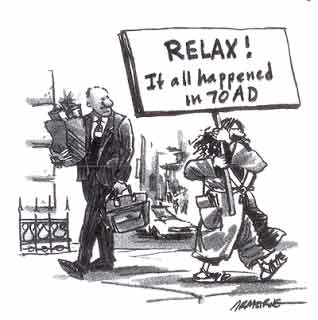
Preterism : Critiqued by Three Conservative Christians
The term preterism comes from the Latin praeter, denoting that something is “past,” signifying that either all or a majority of Bible prophecy was fulfilled by AD 70.
According to preterism:
The “tribulation” only affected the Jewish people rather than all mankind, and it occurred in 70 AD when the Roman army conquered Jerusalem and demolished the Temple. They say that what “really happened” was that God was replacing Israel with the Christian Church and demonstrating to the world that all the biblical promises to Israel now belong to the Church. Though leaving such a “divine” explanation aside, one could also say that what really happened was that the culture of Judaism with its expectation that their God must always at some point intervene to save them from remaining a merely conquered nation because He had promised them that they were “chosen” and at some point (after miracles or battle) God would rule the world supernaturally imposing order upon it with the city of Jerusalem being its most important focal point for His rule via a Jewish king or messiah who is placed in charge there, per a prophecy in Daniel [SEE NOTE BELOW]—and such expectation of divine assistance and destiny led the Jews to engage in not just one but two major revolts against Rome, one around 70 AD and again around 130 AD, and they failed both times, thus leading to the rise of two religious offshoots once the Temple and Jerusalem had been destroyed, and Jerusalem was remade into a Roman city and renamed with a Roman name. The two religious offshoots were rabbinical Judaism, and Christianity, the latter of which arose out of the apocalyptic mania of the time. But thatʼs apparently not a “divine” enough explanation for Christians, especially preterists.
So, sticking with the “divine explanation” for the destruction of Jerusalem preterists believe that in Godʼs eyes Judaism is kaput. Preterists also believe the Jews deserved everything they got, even going so far as to interpret the “fall of Babylon” in the book of Revelation as “the destruction of Jerusalem,” rather than a prophecy against Rome and judgment for what Rome was doing to Christians. And they add that Jesus “returned invisibly in the clouds” to witness the destruction of Jerusalem by the Roman army. They round out their view by claiming that Satan has been bound in the abyss ever since Jesusʼ day and cannot hinder the increasing spread of the Gospel. Yup, they say that both Satan and the Jews have been kaput in Godʼs eyes since around 70 AD—so God has a cunning plan that cannot fail now that those two have been sidelined!
Preterists also donʼt think that the founding of the nation of Israel is anything but a self-fulfilling prophecy performed by men, notably by some Christian men and also Zionists who simply wanted the Jews to get out of Europe and go back to the same land written about in their holy book, i.e., look up the Balfour Declaration in which a Bible-reading British statesman in the 1920s authorized passage to Palestine for any Jews who wished to go. Neither are preterists expecting a Jewish Temple to be rebuilt in Jerusalem or that such an act matters any longer. I tend to agree with the preterists that the return of Jews to Israel was nothing but a self-fulfilling prophecy, the result of Christian statesmen and Jews who saw so many references to Israel in their Bible they just felt that the Jews had to get there somehow. But once more and more Jews began arriving friction started between them and the Muslims who already occupied Palestine, and the British ordered a cessation of all new Jewish immigrants to Palestine and the immigrants refused to stop coming, even bombing British embassies over there, and from there things continued to escalate until by the 1940s Israel claimed nationhood.
But what about this cunning plan of God that preterists believe was accomplished when God disowned the Jews and locked Satan in hell in the first century? Well, when you look back at how Godʼs cunning plans in the past worked out you begin to notice that …
God had to toss His first two children out of a really nice garden and curse the ground, then …
…had to drown all their children but eight to cleanse the earth from sin (and we know how well that cleansing from sin turned out, why even back then Sodom and Gomorrah were built soon after the great act that was supposed to cleanse the world from sin),
had his people enslaved, then freed them only to commanded them to commit mass slaughter so that He could present them with a land flowing with dried blood and parched soil. Then…
…He sent his chosen people plagues and famines, had them deported to Babylon, then allowed them to return only in order to be conquered by Greeks and then Romans who finally knocked them senseless after two major Jewish rebellions failed, and then God supposedly started over again with The Church, and of course this time Godʼs cunning plan cannot fail. God has finally got it right. So, based on past experience what could possibly go wrong? Preterists expect the world to last for an untold number of years with Satan in prison and the Jews no longer receiving divine mercy since everyoneʼs only choice today is convert, so preterists believe Christianity must triumph over the hearts and minds of everyone on earth, increasingly so as each year passes.
However, all is not completely rosy for preterists. There are different franchises, and they are not fond of one anotherʼs “heretical” views. Partial preterists believe the Tribulation is past, while full preterists believe both the Tribulation and the Rapture are past (viz., Christians were taken up into the sky to meet their Lord in the first century).
There are also Christians who reject preterism, who reject that Jesus came invisibly in judgment against the Jews and their city in 70 AD, or who reject theonomy (who find it improbable that Christians will be ruling the earth under theonomic/Bible-based laws when Jesus returns). Those Christians have other ways of interpreting the books of Daniel and Revelation. I wonʼt get into their various schools of thought or rival interpretations within each school (Amillennialism, Millennialism, Dispensationalism, Historicism, et al) except to say that they all involve the premise that there are no significant errors in the Bible nor its prophecies, so they play at re-arranging the Bibleʼs eschatological passages like a grand puzzle game, each in their own way, stretching meanings here, ignoring implications or inconsistencies elsewhere, all the while blaming each other for putting together the puzzle the “wrong” way, or being too “creative” in doing so.
Lastly, there are even some Christians of a moderate to liberal bend who donʼt try to fit together the puzzle pieces such that all the Bibleʼs prophecies must be true, but they admit that Jesus and other New Testament writings might contain prophecies that have not proven true, including false prophesies concerning when “the Son of Man/the Lord” would return. I have collected passages from throughout the NT that illustrate this last point of view in my essay, The Lowdown on Godʼs Showdown.
I just want to add before sharing the following pieces that if nothing else they illustrate that Christians more so than anyone else, deserve the description, “debunkers of the Bible,” since they have been debunking each otherʼs interpretations for centuries, from Genesis right through to Revelation. Note the interesting questions posed to preterists in the three pieces below by some fellow conservative Christians. (The first piece is pretty involved if you have never read or studied the book of Revelation, nor Roman history, nor know anything about preterism, in which case my Lowdown on Godʼs Showdown essay might be more up your alley, or my little piece, “Two Difficulties for Preterism” that follows the three Christian pieces.)
Note To Go With the Second Paragraph Above:
First century Jews were grumbling and agitating against Roman rule before Jesus was born. Anti-Roman incidents and minor revolts meant that the Romans had to keep garrisons in Palestine. The Jews had previously survived the destruction of their first temple by the Babylonians and returned to Palestine to renew their kingdom, but then the Greek generals of Alexander took over Palestine and attempted to force the Jews to Hellenize themselves and desecrated the Jewish Temple, so the Jews revolted and after much blood was shed and hundreds of Jews crucified they won back their kingdom after a revolt led by the Maccabees, and so Jewish rulers (the Hasmoneans) ruled Palestine for a while Then the Romans arrived and the barracks of their soldiers were visible beside the Temple. The Jews were looking once again for how they might regain their kingdom, and the already mentioned incidents and revolts began to occur. “There were a variety of underlying causes that helped spark [the 70 CE] revolt; social tensions, bad Roman procurators, the divisions amongst the ruling class, the rise of banditry and poor harvests, but perhaps the most significant feature of all was the apocalyptic storm brewing over first-century Palestine.”
“Of all the messianic movements one in particular drew the most attention; the Essene sect, the community that [allegedly] wrote the Dead Sea Scrolls, based their calculations on the ʽend of daysʼ on a prophecy from the book of Daniel. Josephus says that the major impetus inspiring the Jewish revolt of 70 CE against Roman rule was an ʽoracle found in the sacred scriptures.ʼ This oracle effectively said when the time came ʽone from their own country would become ruler of the world.ʼ The writers of the Dead Sea Scrolls calculated that the year 26/27 CE would usher in the messianic age. There was never a time previously quite like it, and there has never been one since; two messiahs, one king one priest would rule over Palestine. The fervor with which many fought against the greatest power of the ancient world could only have come from such beliefs; that the end of days was nigh.” [to quote Susan Sorekʼs introduction to The Jews Against Rome: War in Palestine AD 66-73, Continuum, 2008]
Some anti-Roman Jewish extremists equated the Evil Kingdom of Danielʼs prophecy with Rome and the end of days (“In the time of those kings, the God of heaven will set up a kingdom that will never be destroyed, nor will it be left to another people. It will crush all those kingdoms and bring them to an end, but it will itself endure forever” Dan 2:44, NIV) (p. 40 of The Jews Against Rome) The book of Daniel is also a work that nobody seems to have known a thing about until the era of the Maccabean revolt against Greek rulers of Palestine, and the book itself claims it had been “sealed until the time of the end” (“He replied, ʽGo your way, Daniel, because the words are closed up and sealed until the time of the end.ʼ” Dan 12:9, NIV) That implies that the book of Daniel was “unsealed” during the era of the Maccabean revolt and continued to attract increasing interest from the era of the Maccabean revolt up till the first century growing agitations against Rome.
First Article by a Christian Debunking Preterism
Theonomy & the Dating of Revelation
by Robert L. Thomas, Professor of New Testament
In 1989, a well-known spokesman for the theonomist camp, Kenneth L. Gentry, published a work devoted to proving that John the Apostle wrote Revelation during the sixties of the first century A.D. Basing his position heavily on Rev 17:9-11 and 11:1-13, he used internal evidence within the book as his principal argument for the early date. His clever methods of persuasion partially shield his basic motive for his interpretive conclusions, which is a desire for an undiluted rationale to support Christian social and political involvement leading to long-term Christian cultural progress and dominion. If the prophecies of Revelation are yet to be fulfilled, no such progress will develop-a prospect the author cannot accept. Inconsistency marks Gentryʼs hermeneutical pattern. Predisposition keeps him from seeing the bookʼs theme verse as a reference to Christʼs second coming. His explanation of Rev 17:9-11 is fraught with weaknesses, as is his discussion of 11:1-2. Two major flaws mar Gentryʼs discussion of Johnʼs temporal expectation in writing the book. Besides these problems, five major questions regarding Gentryʼs position remain unanswered.
He makes evidence derived from exegetical data within the Apocalypse his major focus in building a case for dating the book prior to the destruction of Jerusalem in A.D. 70.2 Though acknowledging that other advocates of either a Neronic (i.e., in the 60ʼs) and Domitianic date (i.e., in the 90ʼs) for Revelationʼs composition find no such direct evidence within the book, he proceeds to find “inherently suggestive and positively compelling historical time-frame indicators in Revelation.” 3 He uses the contemporary reign of the sixth king in 17:9-11 and the integrity of the temple and Jerusalem in 11:1-13 to exemplify arguments that are “virtually certain” proof of a date sometime in the sixties.4
Hermeneutical Pattern
As Gentry weaves his case for Revelationʼs early date, the absence of a consistent set of hermeneutical principles is evident. It is most conspicuous in a number of inconsistencies that emerge in different parts of the treatment. He does not interpret the same passage in the same way from place to place, or within the same discussion differing principles take him in different directions regarding his mode of interpretation.
For instance, he accepts the principle of the symbolic use of numbers, but only for large, rounded numbers such as 1,000, 144,000, and 200,000,000. Smaller numbers, such as seven, are quite literal.12
Again, he rejects the equation of “kings = kingdoms” in 17:10,13 but in a later discussion of the Nero Redivivus myth in 17:11, he identifies one of the kings or heads of the beast in 17:10 as the Roman Empire revived under Vespasian.14 The latter is part of his strained attempt to explain the healing of the
beastʼs death-wound.
When discussing the 144,000, Gentry is uncertain at one point whether they represent the saved of Jewish lineage or the church as a whole.15 Yet just ten pages later they are definitely Christians of Jewish extraction, because he needs evidence to tie the fulfillment of Revelation to the land of Judea.16 This provides another example of his lack of objective hermeneutical principles to guide interpretation.
The forty-two months of 11:2 is the period of the Roman siege of Jerusalem from early spring 67 till September 70, according to Gentry.17 A bit earlier he finds John, even while he is writing the book, already enmeshed in the great tribulation (1:9; 2:22), a period of equal length and apparently simultaneous with the Roman siege.18 In a discussion of 13:5-7, however, he separates the Neronic persecution of Christians which constituted “the great tribulation” (13:5-7) from the Roman siege of Jerusalem in both time and place, dating it from 64 to 68 and locating it in the Roman province of Asia.19 So which is it? Is John writing during “the great tribulation” of 64`68 or the one of 67`70?
Later still, he assigns 65 or early 66 as the date of writing,20 so John predicted a forty-two month period of persecution (13:5) that was already partially past when he wrote. This is indeed a puzzling picture.
Another puzzling discussion concerns the raising of the beast from his death-wound. At one point Gentry identifies Galba as the seventh king of 17:10, in strict compliance with the consecutive reigns of
Roman emperors.21 But suddenly he skips Otho and Vitellius to get to Vespasian who is the eighth and shifts from counting kings with his identification of the healing of the beastʼs death-wound as Romeʼs survival from its civil war in the late sixties.22 This is enough to dash in pieces any effort to decipher a consistent pattern of hermeneutics, because such is nonexistent.
So much for preliminaries and generalities. The attention of the remainder of this essay will be on individual passages.
Individual Passages
The Theme Verse
All, including Gentry and Chilton,23 agree that the theme verse of Revelation is Rev 1:7: “Behold, He comes with clouds, and every eye will see Him, even those who pierced Him, and all the families of the earth will mourn over Him.” But these two theonomists do not refer this to the second coming of Christ. Rather they see it as referring to the coming of Christ in judgment upon Israel, so as to make the church the new kingdom.24 To reach this conclusion, they must implement special proposals regarding “ those who pierced Him,” “the tribes of the earth,” and “the land.”
“Those who pierced Him.”
Blame for the piercing of Jesus falls squarely and solely on the shoulders of the Jews, according to Gentry.25 He cites a number of passages in the gospels, Acts, and Paul to prove this responsibility, but conspicuously omits from his list John 19:31 and Acts 4:27 which involve the Romans and Gentiles in this horrible act.26 This determines for him that the bookʼs theme is the coming of Godʼs wrath against the Jews.27
By limiting the blame for Christʼs crucifixion to the Jews, Gentry excludes from the scope of the theme verse any reference to the Romans whom he elsewhere acknowledges to be the chief persecutors of Christians.28 He also includes the Romans elsewhere as objects of this “cloud coming” of Christ,29 and yet does not give the Romans a place in the theme verse of the book.
“The tribes of the earth.”
Without evaluating any other possibility, Gentry assigns fyl (phyl) the meaning of “tribe” and sees in it a reference to the tribes of Israel.30 This interpretation has merit because that is the meaning of the term in the source passage, Zech 12:10 ff., and in a parallel NT passage, John 19:37.31 The problem with the way Gentry construes it, however, is that if this refers to Israel, it is a mourning of repentance, as in Zechariah, not a mourning of despair as he makes it.
For this to be a mourning of despair as the context of Revelation requires (cf. 9:20-21; 16:9, 11, 21), phyl must be taken in the sense of “family” and must refer to peoples of all nations as it does so often in the Apocalypse (cf. 5:9; 7:9; 11:9; 13:7; 14:6).32 This is the only way to do justice to the worldwide scope of the book as required by such verses as 3:10, which even Gentry admits refers to the whole Roman world.33 The sense of a mourning of despair throughout the whole earth is the sense Jesus attaches to the words in His use of the Zech 12:10 ff. passage in Matt 24:30.34
“The land.”
The reconstructionists actually take “the tribes of the earth” to be “the tribes of the land,” i.e., the land of Palestine.35 It is true that g (g) can carry such a restricted meaning, but special support in its context of usage is necessary for it to mean this. The acknowledged worldwide scope of Revelation already cited rules out this localized meaning of the term in 1:7.
So Gentry strikes out on the three pitches which he himself has chosen in the theme verse of Revelation. He also leaves other unanswered questions regarding this alleged “cloud coming” in the sixties. He identifies the cloud coming against the Jews as the judgment against Judea in 67`70.36 Against the church that coming was the persecution by the Romans from 64 to 68.37 The cloud coming for Rome was her internal strife in 68`69.38 But nowhere does he tell what the promised deliverance of the church is (e.g., 3:11). It appears to be a question without a clear-cut answer as to how this “cloud coming” could be a promise of imminent deliverance for Godʼs people. All he can see in it is judgment against them and the “privilege” of being clearly distinguished from Judaism forever. He finds covenantal and redemptive import for Christianity in the collapse of the Jewish order,39 but this falls short of a personal appearance of Christ to take the faithful away from their persecution.
The Sixth King
As mentioned above, one of the two internal indicators that make the early date “virtually certain” is the identity of the sixth king in 17:9-11.40 Gentry first uses the “seven hills” of 17:9 to indicate that Rome or the Roman Empire is in view.41 Then he concludes that the seven kings of 17:9 (Greek text; 17:10 in English) are seven consecutive Roman emperors.42 He lists ten kings, beginning with Julius Caesar 49`44 B.C.) and continuing with Augustus (31 B.C.`A.D. 14), Tiberius (14`37), Gaius or Caligula (37`41), Claudius (41`54), Nero (54`68), Galba (68`69), Otho (69), Vitelius (69), Vespasian (69`79).43 The sixth in this series is Nero, so because 17:10 says “one is,” he concludes that John must have written the book during Neroʼs reign.44
Strangest of all, though, is Gentryʼs unfulfilled obligation to explain what a reference to Rome is doing in the midst of a chapter dealing with Babylon, which he takes to represent Jerusalem.50 The best he can do is theorize that the harlotʼs riding on the beast is an alliance between Jerusalem and Rome against Christianity.51 To support the existence of such an alleged alliance, he cites Matt 23:37 ff.; John 19:16-16 [sic]; Acts 17:7, none of which support his theory.52 Romeʼs prolonged siege and destruction of Jerusalem from the late 60ʼs to 70 hardly gives the impression of any alliance. The harlot sits upon or beside the seven mountains (17:9), just as she sits upon or beside “many waters” (17:1). Since the “many waters” are a symbol explained in 17:15, analogy would dictate that the seven mountains are also symbolic and not literal hills.53 The very next clause in 17:9 explains the symbolism of the seven mountains:
This calls for a mind with wisdom. The seven heads are seven hills on which the woman sits. They are also seven kings. Five have fallen, one is, the other has not yet come; but when he does come, he must remain for only a little while. The beast who once was, and now is not, is an eighth king. He belongs to the seven and is going to his destruction. [Rev. 17:9-11]
As noted above, Gentry as part of his answer to the fourth objection to the Neronian identification rejects the equating of kings with the kingdoms they rule, but later he incorporates such an equation into his explanation of the identity of the eighth head.54
Besides the tenuous nature of Gentryʼs use of the seven hills, his conclusion that Nero is the sixth or “the one [who] is” also faces serious obstacles. The greatest obstacle is his need to begin counting “kings” with Julius Caesar. He tries to defend this by citing several ancient sources,55 but the fact is that Rome was a Republic, ruled by the First Triumvirate, in the days of Julius Caesar and became a Principate under Augustus and the emperors that followed him.56 Neither does Gentry attempt to explain the thirteen-year gap between Julius Caesarʼs death and the beginning of Augustusʼ reign. They were not consecutive rulers as he makes them out to be. The exclusion of Julius Caesar makes Nero the fifth instead of the sixth “king.” This scheme is fraught with hermeneutical difficulties.
Gentryʼs further use of 666 to prove that the first beast of chap. 13 is Nero, he admits, is only corroborative and cannot stand alone. [“Fanciful” is the best description of some of Gentryʼs hermeneutical methodology to prove that 666 refers to Nero. He concludes that the beast who is Nero, like Satan himself, is a serpent because in English and in Greek (xjs [chxs]) pronunciation of the number “sounds hauntingly like a serpentʼs chilling hiss” (215). He adds that the middle number-letter even has the appearance of a writhing serpent: j (x) (ibid.). Another means of identifying Nero as the beast is his red beard that matches the color of the beast (17:3) (217).]57.
So the efficient course is to turn now to his second major item of internal evidence to prove an early date of writing.
The Contemporary Integrity of the Temple
Gentry finds indisputable evidence in Rev 11:1-2 that the temple was still standing and that the destruction of Jerusalem was still future when John wrote the book.58 He goes to great lengths to prove that it was the Herodian temple of Jesusʼ day by locating it in Jerusalem.
He is quite defensive of his hermeneutical methodology in handling these two verses, a method that involves a mixture of figurative-symbolic and literal-historical.60 He takes the measuring to represent the preservation of the innermost aspects, including the naw (naos, “temple”), altar, and worshipers, and the “casting out” (kbale [ekbale]) as indicative of the destruction of the external court of the temple complex. The former or inner spiritual idea speaks of the preservation of Godʼs new temple, the church, while the latter or material temple of the old covenant era will come to destruction. In other words, v. 1 is figurative and v. 2 literal. In yet other terms, the tn nan to ueo (ton naon tou theou, “the temple of God”) and tuysiastrion (to thysiastrion, “the altar”) are symbolic and tn aln tn jvuen to nao (tn auln tn exthen tou naou, “the court outside the temple”) is literal. Gentry justifies the radical switch in hermeneutical approaches by appealing to Walvoord and Mounce, whom he says combine literal and figurative in this passage also.61 He cites Walvoordʼs silence regarding Johnʼs literally climbing the walls of the temple to get his measurements and Mounceʼs reference to the necessity of a symbolic mixture in interpreting the passage. What Gentry does is drastically different from these two, however. He wants a figurative and literal meaning for essentially the same terminology. For example, he assigns the term naos both a literal and a symbolic meaning in consecutive verses. In fact, he refers the temple and the altar to literal structures earlier62 and to the spiritual temple of the church a few pages later.63 This compares to changing the rules in the middle of the game. Any interpretation can win that way.
His response to objections to his interpretation of 11:1-2 includes an assigning of a pre-70 date to Clement of Romeʼs epistle to the Corinthians, though its accepted dating is in the 90ʼs. He does this because Clement speaks as though the temple were still standing. Then Gentry has a lengthy discussion of the silence of the rest of the NT regarding the destruction of Jerusalem,64 during which he apparently accepts dates prior to 70 for all four gospels, including the Gospel of John, and the rest of the NT canon.65 This theory creates further problems for his case, with which he does not deal and so this discussion will not either.
Gentry does not venture an explanation of how John, isolated on the Island of Patmos so many miles from Jerusalem, can visit the literal city to carry out his symbolical task of measuring the temple. He seems oblivious to Johnʼs being in a prophetic trance (4:2) to receive this and other revelations in this visional portion of the book. His task in 11:1-2 is the first of his assigned duties to perform following his recommissioning at the end of chap. 10 (10:11). So he is not to transport himself physically across the Mediterranean Sea to Judea, but “in spirit” he is already there.
One cannot quarrel with the conclusion that Johnʼs visional responsibility of measuring points in its fulfillment to a literal temple, but it is not the Herodian temple of Jesusʼ day. His idea that the temple and the altar of v. 1 represent the church leaves no room to identify the worshipers in the same verse. His approach to symbolism is inconsistent and self-contradictory. This aspect of the description as well as v. 2 shows that the entire description is on Jewish ground and is not part Jewish and part Christian.66
Temporal Expectation of the Author
One other temporal feature that Gentry magnifies is the emphasis of Revelation on the nearness of Christʼs coming (Rev 1:1, 3, 19; 22:6, 7, 12, 20). He faults those who refer this to Christʼs second advent, noting that the “shortly” or “soon” that characterizes the coming is hardly a suitable way to speak of the already 1900-year interval that separates that coming from the writing of Revelation.68 His solution is to refer the book to the imminence of the events to come upon the Jews, the church, and the Roman Empire during the decade of the sixties, culminating in the destruction of Jerusalem in A.D. 70.69
A General Overview of the Issue
Gentryʼs book itemizes a number of other supposed supports for the early date, but admits in most cases that these are only corroborative of his main proofs and have no independent value.74
Throughout most of the work he gives the impression that he uses two criteria of independent value in dating the book, Nero as the sixth king of 17:10 and the existence of the temple and Jerusalem contemporary to the writing of the book. Yet when he arrives near the end he speaks of the “wealth of internal considerations for an early date.”75 His wealth of considerations consists of only two, both of which are useless in demonstrating his case, as pointed out above. This discussion of internal criteria for dating the book of Revelation would not be complete without posing some questions that Gentry does not answer satisfactorily in his book.
How is it that the “cloud-coming” of A.D. 70 involves no personal coming of Christ (Matt 24:30; 26:64; Rev 1:7; 2:5, 16, 25; 3:3, 11, 20; 16:15; 22:7, 12, 20), but the “cloud-coming” at the end of history does (Acts 1:11; 1 Thess 4:13 ff.)?76 Where did Christ distinguish between two such comings, and where did He say that He would personally appear at one and not at the other? The answer to both questions is “nowhere.”
How could John dwell on the prosperity of the church in Laodicea when the city had been completely destroyed by an earthquake only five years earlier? Gentry responds to this problem by suggesting that Laodiceaʼs wealth was spiritual and not material, by supposing the possibility of a quick rebuilding, and by theorizing that the earthquake did not impact the sector of the city where the Christians were.77 A careful exegesis of 3:17, however, shows that Christians in the city thought their material prosperity was equivalent to spiritual prosperity, not that they were spiritually rich while materially poor. The possibility of a quick rebuilding contradicts the facts. The rebuilding effort was still in progress as late as 79 when a gymnasium that was part of the rebuilding effort was completed.78 Also an abrupt numismatic poverty marks this period in all the cities of the Lycus district of which Laodicea was a part. This too illustrates the prolonged effect of the destructive earthquake.79 As for Gentryʼs theory that part of the city was spared the devastation that affected the whole district, this is pure speculation that belies the available facts.
Did the ministry of John overlap that of Paul in the churches of Asia? Gentryʼs reconstruction of the chronology of the period would require this. If John wrote in 65 or early 66, he must have been in Asia for at least five years prior to that to have unseated Paul as the authoritative apostle for the region and to have gained the respect of Christians throughout the whole province. It would have been necessary for him to have been there long enough to become a problem for Nero too, resulting in his exile to Patmos sometime after 64. Paul visited Ephesus at least once after this (A.D. 65), following his release from his first Roman imprisonment (1 Tim 1:3). Yet after leaving the city, he left Timothy in charge of the church and made no reference to the presence of John the Apostle and his influence on the church. If John had been there and had taken charge, why would Paul return to Asia? The answer is that he would not have, but he did, so John had not yet arrived in Asia.
When did John arrive in Asia? According to the best tradition, John was part of a migration of Christians from Palestine to the province of Asia just before the outbreak of the Jewish rebellion in A.D. 66, so he did not arrive there before the late sixties.80 A Neronic dating of the book would hardly have allowed time for him to settle in Asia, replace Paul as the respected leader of the Asian churches, and be exiled to Patmos before Neroʼs death in 68. Gentry does not respond to this problem, but his dating of the book in 65 or 66 renders its apostolic authorship impossible.
What was the condition of the churches of Asia during the sixties, that portrayed in Paulʼs epistles to Ephesians (A.D. 61), Colossians (A.D. 61), and Timothy (A.D. 65 and 67) or that in Johnʼs seven messages of Revelation 2-3? Recognizing true apostles and prophets had become a problem in the latter (e.g., 2:2, 20), but the former epistles give no inkling of this kind of a problem. In Paulʼs epistles to this area, false teaching regarding the person of Christ was a crucial issue (e.g., Col 1:13-20), but not so in Johnʼs seven messages. A need in Paulʼs epistles was strong emphasis on Christian family roles (e.g., Eph 5:22`6:9; Col 3:18,4:1; 1 Tim 6:1-2), but Johnʼs messages do not touch this subject at all. A prominent danger in Johnʼs messages is the Nicolaitan heresy (2:6, 15), but Paulʼs epistles say nothing about it. Differences of this type are almost limitless, the simple reason being that Paulʼs four epistles and Johnʼs seven messages belong to decades separated by twenty years. Gentry responds to this problem only superficially,81 and therefore ineffectively.
A Final Review
It has been impossible to deal with all the peculiar interpretations of dominion theology in the Apocalypse, because the proposed topic has been the internal evidence for dating the book. Probably when Gentry completes his forthcoming commentary, The Divorce of Israel: A Commentary on Revelation,82 further works of refutation will have to deal with Babylon a symbolic title for Jerusalem,83 why the seven last plagues are not final,84 why 19:11-16 is not the second coming of Christ to earth,85 why the state pictured in 21:9`22:5 is the church age and not the future eternal state,86 and the like.
Endnotes (Scroll Past Endnotes For Two More Pieces Plus a Piece of My Own at the End
- Theonomy-also known as “dominion theology” and “Christian reconstructionism”-is a worldview that foresees a progressive domination of world government and society by Christianity until Godʼs kingdom on earth becomes a reality. Its eschatology is essentially that of the postmillennialism so popular around the
beginning of the twentieth century.
- Kenneth L. Gentry, Jr., Before Jerusalem Fell, Dating the Book of Revelation (Tyler, TX: Institute for Christian Economics, 1989) 113, 116.
- Ibid., 119
- Ibid., 118-19.
- e.g., ibid., 153-54.
- e.g., ibid., 30-38, 168, 200, 296 n. 50. Many citations in these lists are not from primary sources.
- e.g., ibid., 203-12.
- e.g., Craig A. Blaising, “Dispensationalism: The Search for Definition,” in Dispensationalism, Israel and the Church, ed. by Craig A. Blaising and Darrell L. Bock (Grand Rapids: Zondervan, 1992) 30.
- Gentry, Before Jerusalem Fell 5 n. 12, 336-37.
- Ibid., 5 n. 12.
- Ibid., 336-37.
- Ibid., 162-63.
- Ibid., 163-64.
- Ibid., 310-16.
- Ibid., 223-24.
- Ibid., 233.
- Ibid., 250-53.
- Ibid., 234.
- Ibid., 254-55.
- Ibid., 336.
- Ibid., 158, 208.
- Ibid., 310-16.
- Ibid., 121-23; David Chilton, The Days of Vengeance (Fort Worth, TX: Dominion, 1987) 64.
- Chilton, Days of Vengeance 64; Gentry, Before Jerusalem Fell 131-32.
- Gentry, Before Jerusalem Fell 123-27.
- Robert L. Thomas, Revelation 1-7, An Exegetical Commentary (Chicago: Moody, 1992) 77-78. Even Chilton allows a reference to Gentiles here (Days of Vengeance 66).
- Gentry, Before Jerusalem Fell 127.
- Ibid., 144.
- Ibid., 143, 144.
- Ibid., 127-28.
- William Lee, “The Revelation of St. John,” in The Holy Bible, ed. by F. C. Cook (London: John Murray, 1881) 4:502; J. P. M. Sweet, Revelation (Philadelphia: Westminster, Pelican, 1979) 67; G. V. Caird, A Commentary on the Revelation of St. John the Divine, HNTC (New York: Harper and Row, 1966) 18; James Moffatt, “The Revelation of St. John the Divine,” in The Expositorʼs Greek Testament, ed. by W. Robertson Nicoll (Grand Rapids: Eerdmans, n.d.) 5:339-40; J. B. Smith, A Revelation of Jesus Christ (Scottdale, PA: Herald, 1961) 44.
- Alan F. Johnson, “Revelation,” in EBC, ed. by Frank E. Gaebelein (Grand Rapids: Zondervan, 1981) 12:423.
- Gentry, Before Jerusalem Fell 143 n. 27.
- For a fuller discussion of this issue, see Thomas, Revelation 1-7 78-79.
- Gentry, Before Jerusalem Fell 128-29; Chilton, Days of Vengeance 66.
- Gentry, Before Jerusalem Fell 143.
- Ibid., 144.
- Ibid., 144-45.
- Ibid., 144.
- Ibid., 146.
- Ibid., 149-51.
- Ibid., 151-52.
- Ibid., 152-59.
- Ibid., 158.
- Ibid., 159-64.
- Lee, “Revelation” 4:744; Johnson, “Revelation” 12:558.
- George E. Ladd, A Commentary on the Revelation of John (Grand Rapids: Eerdmans, 1972) 227.
- Martin Kiddle, The Revelation of St. John (New York: Harper, 1940) 349.
- Ladd, Revelation 228.
- Gentry, Before Jerusalem Fell 240-41 n. 26.
- Ibid.
- Ibid.
- Lee, “Revelation” 4:744.
- Gentry, Before Jerusalem Fell 163-64, 310-16.
- Ibid., 154-58.
- Collierʼs Encyclopedia 20:180, 190.
- Gentry, Before Jerusalem Fell 198.
- Ibid., 165-69.
- Ibid., 169-74.
- Ibid., 174-75.
- Ibid.
- Ibid., 169-70.
- Ibid., 174.
- Ibid., 181-92.
- Ibid., 182-83.
- J. A. Seiss, The Apocalypse, 3 vols. (New York: Charles C. Cook, 1909) 2:159; Ladd, Revelation 152.
- Henry Alford, The Greek Testament, 4 vols. (London: Longmans, Green, 1903) 4:657.
- Gentry, Before Jerusalem Fell 133-37.
- Ibid., 142-43.
- Ibid., 144.
- Ibid., 336.
- Contra ibid., 131.
- Cf. Thomas, Revelation 1-7 54-56.
- e.g., Gentry, Before Jerusalem Fell 220-21, 246 n. 44.
- Ibid., 329.
- Cf. ibid., 122-23.
- Ibid., 319-22.
- Colin J. Hemer, The Letters to the Seven Churches of Asia in Their Local Setting, JSNT Sup 11 (Sheffield: U. of Sheffield, 1986) 194.
- Ibid.
- Thomas, Revelation 1-7 22.
- Gentry, Before Jerusalem Fell 327-29.
- Cf. ibid., 241 n. 26.
- Cf. Joseph R. Balyeat, Babylon, The Great City of Revelation (Sevierville, TN: Onward, 1991) 49-142.
- Cf. Chilton, Days of Vengeance 383-84
- Cf. ibid., 481-89.
- Cf. ibid., 535-73.
Source: The Masters Seminary Journal 5/2 (Fall 1994) pp.185-202
Another Conservative Christian Critique of Preterism
The Judgment of Matthew 25
- 31 “When the Son of Man comes in his glory, and all the angels with him, he will sit on his glorious throne.
- 32 All the nations will be gathered before him, and he will separate the people one from another as a shepherd separates the sheep from the goats… .
- 46 Then they will go away to eternal punishment, but the righteous to eternal life.
The separation of the sheep and goats in Matthew 25 would seem to mitigate against the preterist view because the judgment passage comes immediately after Jesusʼ return and appears to refer to the Final Judgment. Preterists attempt to interpret this separation as not relating to the Final Judgment, but instead as a recapitulation in history of the curses and blessings described in Deuteronomy 27.26
The preterist believes that the judgment of the sheep and the goats refers to the fall of Jerusalem in fulfillment of the curses of Deuteronomy 27. But the punishments and rewards are eternal: punishment with weeping and gnashing of teeth, on the one hand, and eternal life on the other.
Indeed, if the preterist scenario were true, then the judgment was against Israel alone; no other nation was judged and no one seems to have been rewarded. Although Jews often persecuted Christians during this period, the Romans did as well. Why should Israel as a nation have been judged more severely than Rome?
By A.D. 70 Rome under Nero had persecuted Christians, killing many. Using the criteria of judgment found in Matthew 25 Rome herself should have been judged, yet history shows that she was the instrument of judgment on Israel and survived for many centuries. The preterist interpretation does not seem to measure up to the language of the passage.
Source: Answering Preterism: Did Jesus Return in A.D. 70? By Stephen Pegler
Yet Another Conservative Christian Critique of Preterism
Preterists reinterpret clear statements in Matthew 24-25 (found also in Mark and Luke) that declare Jesus will be seen. Noe [a preterist apologist] would probably say the destruction of the temple, the abomination of desolation (Mt. 24:15) in 70 AD, was certainly seen (“when you see the abomination…“), but he would then argue that Christʼs coming as the Son of Man was not actually seen but simply a spiritual coming not observed with the physical eye. But surely heʼs merely playing at stretching the meaning of words in ways that attempt to make them fit his preteristic view and has not given himself the credit for his own ingenuity in drawing such distinctions, distinctions not so visible in the text itself:
“When you see” (horao) the Abomination…” (Mt. 24:15).
“All tribes … they will themselves see (horao) the Son of Man coming on the clouds” (Mt. 24:31).
“They will see the Son of Man coming in clouds” (Mk. 13:26).
“If anyone says to you, ‘Behold (eipon, Aor. Imper. of horao), or look, here is the Christ,’ or ‘There He is…’” (v. 23), do not go with them, for “Just as the lightning comes … and flashes … so will the coming of the Son of Man be” (v. 27). Important from the Greek text: “Just as” is hosper garwith “so” meaning “just as, precisely as” (The Exegetical Dictionary of the New Testament, EDNT) (v. 27). “For just as the lightning comes from the east … so also will the coming of the Son of Man be” (v. 27).
As judgment came on the day of Noah and when fire rained down on Sodom, the same will happen “on the day that the Son of Man is revealed” (Lu.17:26,30). “Is revealed” is apokalupto. On this word, as used in this verse, the EDNT says, “The still concealed Son of Man will be revealed by God, i.e., presented publicly.” Was Jesus publicly revealed in 70 AD?
Matthew 25:31 says “when the Son of Man comes in His glory, and all the angels with Him, then He will sit on His glorious throne. And all the nations will be gathered together before Him” (Mt. 25:32). “Together” is emprosthen in Greek and means “to place before oneʼs face, in front of, in the presence of.” (EDNT) “With an emphasis on visibility, is significant.” (EDNT)
Even afterthe time of the New Testament writings the earliest Church Fathers continued to view the “coming of the Lord” as a plainly visible event, and one connected not with the destruction of Jerusalem but with the worldʼs final judgment.
The Epistle of Clement (95 AD) says,
Of a truth, soon and suddenly shall His will be accomplished, as the Scripture also bears witness, saying, ‘Speedily will He come, and will not tarry;’ and ‘The Lord shall suddenly come to His temple, even the Holy One, for whom ye look.’
In the Second Epistle of Clement we read,
Let us then wait for the kingdom of God, from hour to hour, … seeing that we know not the day of the appearing of God.
Eusebius quotes Papias as saying,
that there will be a millennium after the resurrection from the dead, when the personal reign of Christ will be established on earth.
Justin Martyr wrote
For He shall come on the clouds as the Son of Man, so Daniel foretold, and His angels shall come with Him… . I and others, who are right-minded Christians on all points, are assured that there will be a resurrection of the dead, and a thousand years in Jerusalem, which will then be built, adorned, and enlarged, [as] the prophets Ezekiel and Isaiah and others declare.
Irenaeus stated,
The millennial kingdom would begin with the Second Coming of Christ. The millennium would last 1000 years, the millennial Sabbath. The new Jerusalem would come after the millennial kingdom.
The Fatal Mistakes of Preterism Dr. Mal Couch, President Tyndale Seminary
Two Difficulties for Preterism
by Ed Babinski
Is the Destruction of Jerusalem to be Equated with “The Coming of the Son of Man?” Or Do the Gospel Authors Mention the Coming as a Separate Event After the Destruction of Jerusalem and For a Different Reason?
Peterists want to identify or connect the tribulation and destruction of Jerusalem with the “coming of the Son of Man” in Mark 13 (and in the parallel passages in Matthew 24). They say that Jesus came “in judgment” or to view the judgment on Jerusalem. But the “coming of the Son of Man” is a separate event in the Gospels and the Son of Man comes for a completely different reason that the one that preterists say he does.
Mark 13 says,
Those will be days of distress unequaled from the beginning, when God created the world, until now—and never to be equaled again. “If the Lord had not cut short those days, no one would survive. But for the sake of the elect, whom he has chosen, he has shortened them. At that time if anyone says to you, ‘Look, here is the Messiah!’ or, ‘Look, there he is!’ do not believe it. For false messiahs and false prophets will appear and perform signs and wonders to deceive, if possible, even the elect. So be on your guard; I have told you everything ahead of time. But in those days, FOLLOWING THAT DISTRESS, the sun will be darkened, and the moon will not give its light; the stars will fall from the sky, and the heavenly bodies will be shaken. At that time people will see the Son of Man coming in clouds with great power and glory. And He Will Send His Angels And Gather This Elect from the four winds, from the ends of the earth to the ends of the heavens.
Matthew 24 says,
IMMEDIATELY AFTER THE DISTRESS OF THOSE DAYS [including AFTER the conquering of Jerusalem, just as in Mark above] the sun will be darkened, and the moon will not give its light; the stars will fall from the sky, and the heavenly bodies will be shaken. Then will appear the sign of the Son of Man in heaven. And then all the peoples of the earth will mourn when they see the Son of Man coming on the clouds of heaven, with power and great glory. AND HE WILL SEND HIS ANGLES WITH A LOUD TRUMPET CALL, AND THEY WILL GATHER HIS ELECT from the four winds, from one end of the heavens to the other.
Instead of the preterist interpretation one can see that the Son of Man comes AFTERWARDS, after the Tribulation, after the destruction of Jerusalem, and FOR A DIFFERENT REASON, namely to “send forth his angels to gather his elect.”
Earlier, Matthew had made clear the meaning of the “sending forth of his angels” and “gathering of his elect”:
The harvest is the end of the age…at the end of the age…the Son of Man will send forth his angels, and they will gather out of his kingdom all stumbling blocks, and those who commit lawlessness, and will cast them into the furnace of fire; in that place there shall be weeping and gnashing of teeth. Then the righteous will shine forth as the sun in the kingdom of their Father. [Matthew 13:40-41]
Matthew is clearly echoing Daniel 12 which is NOT about the destruction of Jerusalem but about separating the lawless from the righteous in the final judgment of humanity, or as it says in Daniel 12:
Multitudes who sleep in the dust of the earth will awake: some to everlasting life, others to shame and everlasting contempt. Those who are wise will shine like the brightness of the heavens.
Hence neither Mark nor Matthew are speaking about the coming of the Son of Man as equaling the destruction of Jerusalem, the “coming” is always something that takes place afterwards and for a different reason, and that reason is the final judgment. So preterism has to try and squeeze these puzzle piece together extra hard and ignore such obvious questions.
Luke 21 changes the story a bit, adding in a “times of the Gentiles” to extend the time further between the Tribulation and the coming of the Son of Man:
This is the time of punishment in fulfillment of all that has been written. How dreadful it will be in those days for pregnant women and nursing mothers! There will be great distress in the land and wrath against this people. They will fall by the sword and will be taken as prisoners to all the nations. Jerusalem will be trampled on by the Gentiles until the times of the Gentiles are fulfilled.
But then Luke continues just as the earlier two synoptic Gospels did… depicting the coming of the Son of Man in final judgment as a separate event that follows the Tribulation:
There will be signs in the sun, moon and stars. On the earth, nations will be in anguish and perplexity at the roaring and tossing of the sea. People will faint from terror, apprehensive of what is coming on the world, for the heavenly bodies will be shaken. At that time they will see the Son of Man coming in a cloud with power and great glory. When these things begin to take place, stand up and lift up your heads, because your redemption is drawing near. He told them this parable: “Look at the fig tree and all the trees. When they sprout leaves, you can see for yourselves and know that summer is near. Even so, when you see these things happening, you know that the kingdom of God is near. “Truly I tell you, this generation will certainly not pass away until all these things have happened. Heaven and earth will pass away, but my words will never pass away. “Be careful, or your hearts will be weighed down with carousing, drunkenness and the anxieties of life, and that day will close on you suddenly like a trap. For it will come on all those who live on the face of the whole earth. Be always on the watch, and pray that you may be able to escape all that is about to happen, and that you may be able to stand before the Son of Man.
For more on the changes Luke made see The Lowdown on Godʼs Showdown.
A Second Difficulty for Preterism, Will Jesusʼ “Return” Really Be “Invisible?”
A second difficulty for preterism, especially partial preterism is how to fit the puzzle piece of Acts 1 into place along with the preterist interpretation that Jesus returned “invisibly.” Itʼs difficult to do because Acts 1 predicts that Jesus would return “in the same way you have seen him go into heaven,” which is not in an “invisible” fashion at all. Here are the relevant parts of the text:
I wrote about all that Jesus began to do and to teach until the day he was taken up to heaven … He appeared to them over a period of forty days … They asked him, “Lord, are you at this time going to restore the kingdom to Israel?” He said to them: “It is not for you to know the times or dates the Father has set by his own authority”… After he said this, he was taken up before their very eyes, and a cloud hid him from their sight. They were looking intently up into the sky as he was going, when suddenly two men dressed in white stood beside them. “Men of Galilee,” they said, “why do you stand here looking into the sky? This same Jesus, who has been taken from you into heaven, will come back in the same way you have seen him go into heaven.”
So it wonʼt be an “invisible” return after all! At least the author of that passage doesnʼt appear to have imagined it that way.


 (“Fear of the Question”)


