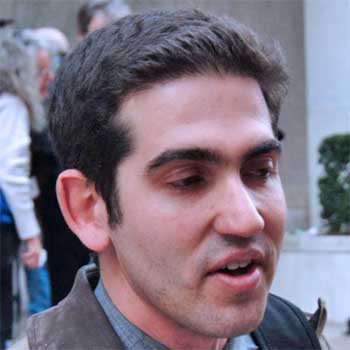

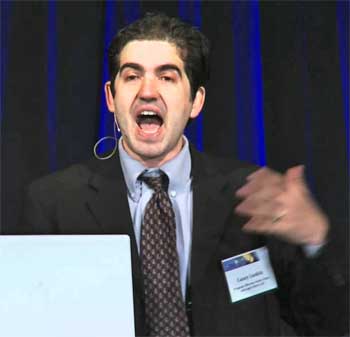
Showing posts with label Casey Luskin. Show all posts

Reply #3 to Casey Luskin of the Discovery Institute, Proponent of Intelligent Design

Casey Luskin

Casey Luskinʼs third response (indented) followed by my own is below. He does not say whether or not he has yet read my second response, especially since he admitted that he had not read my first. Gauging by his citation of “William Thomas” he apparently has not done so. Concerning his citation of Thomas, I.D.ists continue to misconstrue or attempt to bury the most obvious evidence from nature that their Designer appears at best to be a Tinkerer. They rely on the argument “thatʼs a theological, not a scientific objection,” but the Tinkerer hypothesis raises valid questions based on the evidence from nature that I cited. It also reduces the distance between a Designer and Nature alone since it lay on a spectrum between those two poles. The first three paragraphs below are Caseyʼs, followed by my latest response.

Hi Ed, If youʼve “read ID material for years,” then why do you misrepresent basic ID arguments and mis-state how ID proponents detect design? Natural evil, or “suboptimality” donʼt refute design.

If youʼve “read ID material for years,” why do you fail to engage the ID research papers I cited, instead quibbling over details of their review? (They were reviewed by qualified scientists, many of which werenʼt pro-ID.) Todd Woodʼs ideas on this are irrelevant. Your response doesnʼt address ANY of this progress. Instead, you post walls of text off-list about pesticide resistance (something ID proponents readily acknowledge, even by evolving redundant copies of the SAME GENE), neutral mutations (which arenʼt adaptive), and irrelevant points about wasted sperm.

You also mention various diseases—the very “argument from evil” William Thomas called a “theological objection, not a scientific one.” Perhaps you have “read ID material for years.” But you arenʼt engaging with that material.

Hi Casey,

I agree my points are indeed wasted, on you, because you do not understand evolution. Cornelius Hunter and the film that I.D.ists produced (see Expelled Exposed) mocks evolution as “progress” achieved via a highway of blood. But evolution defined in the largest sense is not progress in a straight line sense of the word but radiation, bushes of variant species, trial and error. And that includes species AVOIDING conflict via incessant mutations that take them in a multitude of directions not just one, which means they are filling a growing diversity of ecological niches instead of fighting constantly over a single niche. That recognition makes mincemeat out of the incessant misrepresentations of evolution by I.D.ists.

Along those same lines, evolution includes the fact that the majority of all species on earth are parasites, freeloaders on other species to some degree (including cases of mutually freeloading on each other). And the most successful and prolific parasites do NOT kill their hosts. Heck, every single eukaryote cell has many bacteria-like organelles existing inside it in the form of mitochondria. So our own cells are probably the result of bacteria that evolved a freeloading lifestyle inside a larger cell that evolved. Even viral DNA has found a way to mutually co-exist and flourish inside the eukaryote cell in the form of endogenous retro-viral DNA that has recently been found to be linked to jumping genes and stem cell regulation. So bacteria as well as viruses are living together inside our own cells which appear to have evolved a lifestyle of mutuality, and evolution appears jury-rigged, using “whatʼs there” to make something new, the larger eukaryotic cell out of the earlier prokaryotic cell (bacteria) and viruses. Thatʼs the rest of the story of evolution, that mutuality. I have also mentioned that evolution primarily involves differential reproduction, which means even competition over mates in sexually reproducing forms of life most often does not involve the death of either male competitor but a backing off of one of them.

You challenged me to “engage” when you canʼt even get past the first line of my posts. The “engagement” with the pro-I.D. papers you mentioned is already taking place, at BIOLOGOS (a pro-Christian site), and elsewhere on the web. As I said, you can use my dedicated search engine to discover where this is happening (or has already happened).

And simply writing off Todd Wood does you no good. He has an advanced degree in biology from a major secular institution and has worked with secular specialists specifically in the field of DNA research. Woodʼs own study of the human and chimpanzee genome proved to him that the genetic evidence raises problems for those who wish to deny common descent. He also admits that evolution is not a theory in crisis, but believes his case is best served by remaining calm and attempting to build up alternative interpretations, but he does not claim creationism is as comprehensive as evolutionary theories and hypotheses at present. In contrast I.D. folks like yourself seem to think and act like evolution is already past being refuted.

Speaking of which, I agree with you that “sub-optimality” does not “refute” design. But if you are willing to admit “sub-optimality,” then please admit you MAY be speaking about a Tinkerer that is not necessarily an all-knowing and all-powerful Designer who could create everything in the blink of an eye exactly as preconceived and totally optimal.

A Tinkerer fits the evidence quite well, a Tinkerer whose work required over a trillion planets and billions of years before life appeared on a few of them. A Tinkerer that required countless mutations, both natural and tinkered together, and countless generations to produce countless extinct species, including extinct cousin species, extinct cousins of cousin species, before “finishing their Grand Tinkering.”

Hypothesizing a Tinkerer may be a step up from hypothesizing that Nature was inherently the tinkerer (Naturalism), but itʼs certainly as reasonable to hypothesize a Tinkerer as it is to hypothesize an all-knowing and all-powerful Designer given all the evidence from nature that I cited in my second reply, here.

And for all we know this same Tinkerer could have been Tinkering around creating countless cosmoses just as it was tinkering around with the creation of countless planets until life arose on a few of them. If it took over a trillion planets before life could arise on a few of them in our cosmos, maybe it took countless cosmoses before one arose in which planets could also arise.

Likewise it took untold numbers of species that became extinct before the world was filled with ones that the Tinkerer felt were “just right,” and even then there remained species inimical to human life — indeed most of the cosmos remains inimical to life. And for all of the eons the Tinkerer spent tinkering with genomes, the Tinkerer left genes inside both plants and animals that were inimical to their own lives, genes for cancer and other diseases.

So my point is not that anyone has “refuted design,” but that the evidence is not so clear concerning the type of Designer that might actually exist. And a Tinkerer certainly fits natureʼs oh so visible sub-optimal ways, taken as a whole.

I also understand how difficult it is to “refute” any big idea in philosophy. Arguments over nature and supernature, monism and dualism, the one and the many, have been going on since the days of the pre-Socratic philosophers 2,500 years ago. The pieces of the philosophical pie of Big Questions have merely been cut and re-cut into ever smaller, more precisely worded slices, but the ingenuity of each defender of each slice continues the debate. With that being said, yes, “nothing refutes design,” for the simple reason nothing refutes the reply that “I believe a miracle happened here.” For all we know cork was designed in order that humans might store wine in casks and bottles. For all we know the human nose was placed squarely between the eyes in order to support eyeglasses. For all we know sand was designed so that we might build computers out of silicon chips. But what a lengthy arduous path it has been for humans to acquire such knowledge concerning how to use nature to our own ends. Is that by design, or are we each little tinkerers, tinkered together in the somewhat near image of a Great Tinkerer?

Speaking of tinkering (if our species and its civilization survives) then quantum computers might one day be linked to sensors as acute as our eyes and ears, and to a program that accumulates and compares knowledge, a learning program, thus joining our species in the long arduous quest for further knowledge. Aside from that possibility, itʼs also a big enough cosmos such that it deserves more of a look than simply peering through our narrow window pane of organisms on earth.

But, wait for it, here comes the I.D. refrain, “Look at the flagellum!” If an I.D.ist canʼt explain it nobody can. But discrete elements of the flagellum are not absent completely from other known species of bacteria on our planet. And who knows what we might discover on other planets or moons in the way of single-celled life forms? Weʼd all like to be able to look at the single-celled species of bacteria and eukaryotes in the distant past on earth but the paleontological evidence from that far back is absent aside from a few fossils of single celled species, coupled with whatever we can glean from the species today. But bacteria have been exchanging DNA in ways that sexually reproducing species cannot do, so tracing all their evolutions in the past, especially during the time when bacteria first arose and when single-celled life forms were the only ones on the planet for around 2 billion or more years, remains impossible. But that does not make modern day species of bacteria and eukaryotes that have “flagella” evolutionʼs demise. And for all we know if human civilization and curiosity last long enough we might discover at least one nearby planet or moon that contains nothing but single-celled life forms, perhaps some featuring flagella with some of their nearest cousins still around as well. The truth is that we havenʼt gotten off the cradle planet yet.

A paraphrased quotation from Mark Twain appears appropriate here: “We have all kinds of trouble solving man-made mysteries, but when it comes to the mystery of God/Designer et al vast numbers of people claim to have it figured out.”

Reply #2 to Casey Luskin of the Discovery Institute, Proponent of Intelligent Design

Caseyʼs response to my first reply appears in the two paragraphs below. He admits he never read my response here.

Thanks for the reply, Ed, but I stopped reading when I hit “I.D. has come no further.” Really? Last year ID published its 50th peer-reviewed scientific paper. Those papers show simulations of evolution require intelligence to produce new high complex and specified information (CSI), which doesnʼt arise by Darwinian processes. Some experimentally test biological systems and detect high CSI. ID is producing both empirical and theoretical research that backs its claims. Your curt denial of this progress doesnʼt negate it. For details, please see http://www.discovery.org/a/2640

Re your other comment: The fact that organisms die doesnʼt refute ID—We have TONS of experience with things that that wear out or stop working, but are designed. We detect ID by finding high CSI. You can have high CSI in an organism that dies. Youʼve put forth a straw man test of ID, and havenʼt addressed my initial rebuttal. For details, please see: http://www.evolutionnews.org/2012/02/undesirable_int056831.html

Second Response to Casey

How many of those papers were published in the new I.D. journal, peer-reviewed by other I.D.ists? And to what degree were such papers devoid of other interpretations? Those who wish to pursue individual cases should plug the names of the I.D.ists writing the papers into the dedicated search engine at the top of my blog pages. Then they will discover links to responses from non-I.D.ists. (Neither has the YEC, Todd Wood been very impressed by I.D. papers, see Toddʼs Blog, nor the ex-I.D.ist Dennis Venema who has published detailed critiques of I.D.ist arguments at BIOLOGOS, a website run by Evangelical Christians and founded by a Christian and biologist who headed the Human Genome Project and where Christians who are scientists defend misunderstandings of evolution by creationists and I.D.ists.

Some I.D.ist research resembles creationist ploys such as calculating odds of a particular protein forming. But nature takes advantage of a range of options that neither evolutionists nor I.D.ists have the capacity to fully map or predict — for instance mosquitoes that developed resistance to DDT evolved multiple copies of the esterase genes that enabled them to detoxify it; while cotton budworms evolved a different method, an alternate target for the poison, and houseflies evolved yet another method, i.e., altered proteins that transported the poison away. So calculating the odds of a particular protein evolving are not the point of evolution which takes advantage of a broader range of possible changes that we have the ability to map or predict.

We also know for a fact that the genome is mutating, especially with each meiotic division of a germ cells, so mutations are continual, generation after generation.

We also know by comparing genomes within the same species that Neutral mutations are the most plentiful, so mutations are abundant, and there are lots of neutral mutations to choose from that could one day lead to something “different.”

And we also know that each living organism has to vault over countless hurdles until it reaches its own age of reproduction and begins passing along its new mutations. And the majority of organisms never get to pass along their mutations, or the majority pass them along to a lesser degree than some minority within their own species. How Many Organisms Donʼt Pass Go? (If what happens in nature was repeated by human designers we would not consider them highly competent at their jobs, especially if they were given omnipotent powers of creation.) See these examples:

A single bacterial cell that divides every twenty minutes will multiply to a mass four thousand times greater than the earthʼs in just two days. That doesnʼt happen because of the inconceivably huge death rate of bacteria. The vast majority of them donʼt pass all the hurdles of nature. (Bacteria also illustrate enormous evolutionary adaptability since they have the ability to harbor loads of mutations even surviving large doses of radiation, and they can share genetic material, and they have short reproductive cycles and hence can form enormous populations with loads of mutations in short periods of time (a boon of asexual reproduction since each individual organism can reproduce, no sex needed), Hence, We Find That Bacteria Have Adapted To The Most Extreme Environments, i.e., extreme-o-phile species of bacteria. Thatʼs exactly what we would expect of bacterial species if evolution were true. Including the fact that bacteria are so small such that countless numbers of them exist both inside and outside of our human bodies and those of all other species. In fact bacteria are so small that thereʼs more bacteria inside and outside a human body than there are human body cells.)

A sunfish sometimes lays three hundred million eggs. The vast majority of them donʼt pass all the hurdles of nature, a huge majority fail to survive to pass along their genes.

If all the eggs from one mother housefly lived, she would produce more than five trillion offspring in just one season.

A single oyster, left to its own devices, produces more than one-hundred-twenty-five million eggs in a season. Thatʼs more than enough oysters, if none died in eight years, [10 to the 89th power number of oysters] to crowd the water out of the oceans and make it cover the earth.

A female sea turtle lays a hundred or more eggs, but after they hatch in a nest buried beneath the sand on the beach only a handful of baby sea turtles make it to the safety of the ocean.

About one hundred million sperm cells are found in each cubic centimeter of human ejaculate. Yet only one sperm lives to fertilize the femaleʼs egg. The rest die. There are equally bountiful numbers from the world of seed-bearing plants.

And speaking not just about wasted sperm, but of egg cells that are fertilized [i.e., zygotes] the pro-lifer, Dr. John Collins Harvey, admits, “Products of conception [often] die at either the zygote, morula, or blastocyst stage. They never reach the implant stage but are discharged in the menstrual flow of the next period. It is estimated that [this] occurs in more than 50 percent of conceptions. In such occurrences, a woman may never even know that she has been pregnant.” 50 percent failure.

And a fairly high percentage (20-30% or more?) of people born as single individuals used to be twins in the womb but one of them was reabsorbed into the womb or into the other twin. (See “Vanishing Twin” syndrome.)

Even after being born, please note that two hundred years ago the French naturalist, Buffon, lamented, “Half the children born never reach the age of eight.” So half of all fertilized human egg cells fail, and half of all children born never reached the age of eight until the development of modern plumbing (for water safety) and modern medical science.

Casey, What do you honestly think about a factory filled with human designers whose designs functioned on such a feeble basis?

But the questions grow even greater once you add in the countless cousin species (and cousins of cousin species) of lemurs, monkeys, apes, and apes with larger craniums than present day species of apes, and several known human species, that all went Extinct long before modern day humans appeared on the scene. Cousin species and cousins of cousin species, including some known species of apes with larger than modern day cranial sizes, and including known species of humans, that all went Extinct before we reached modern humans.

There is no firm line one can trace in the case of any so-called “design” of modern day species. Evolution looked at Big Picture wise does not resemble progress so much as fecundity and taking advantage of the widest array of possible situations. So what we see in nature fits evolution via mutation and natural selection at least as much as it fits the idea of a Designer (who has to constantly keep readjusting matters, entering and exiting the room constantly over the eons, invisibly tinkering about, and then leaving the room, and while tinkering with genes not removing genes for cancers and illnesses, not removing those). And for all such tinkering we see the failures of the majority of sperms and eggs, and newborns, and the extinction of countless cousin species and cousins of cousin species.

Letʼs get into planets as well. Talk about wasted real estate in our own solar system and probably in countless others, and our planet being in one spiral arm of but one galaxy out of a couple hundred billion galaxies with countless stars and probably countless planets too. If a human designer made that many empty planets what would one think? (The creationist ploy up till the early 1980s was to deny even the existence of other systems of planets throughout the cosmos.)

For more of my posts on I.D. please click on the “Intelligent Design” label.


A Historical Figure Worth Note

Georges-Louis Leclerc, Comte de Buffon

Georges-Louis Leclerc, Comte de Buffon
“It has been said that ‘Truly, Buffon was the father of all thought in natural history in the second half of the 18th century’.”
“…outlined a history of the Earth with little relation to the Biblical account, and proposed a theory of reproduction that ran counter to the prevailing theory of pre-existence. The early volumes were condemned by the Faculty of Theology at the Sorbonne. Buffon published a retraction, but he continued publishing the offending volumes without any change.”
Charles Darwin wrote in his preliminary historical sketch added to the third edition of On the Origin of Species: ‘Passing over… Buffon, with whose writings I am not familiar’. Then, from the fourth edition onwards, he amended this to say that ‘the first author who in modern times has treated it [evolution] in a scientific spirit was Buffon.’ But as his opinions fluctuated greatly at different periods, and as he does not enter on the causes or means of the transformation of species, I need not here enter on details”. Buffonʼs work on degeneration, however, was immensely influential on later scholars but was overshadowed by strong moral overtones.

According to Ernst Mayr:
“He was not an evolutionary biologist, yet he was the father of evolutionism. He was the first person to discuss a large number of evolutionary problems, problems that before Buffon had not been raised by anybody…. he brought them to the attention of the scientific world.”

Reply #1 to Casey Luskin of the Discovery Institute, Proponent of Intelligent Design

Casey Luskin

Hi Casey,

I recall our conversations from years ago. I.D. has come no further. And you missed the point.

Itʼs not the problem of pain and cruelty, itʼs all the “stumbling about” based on what we know about the history of how organisms arose, via reproduction and death repeated endlessly, billions of years of stumbling about, countless “tries,” and the extinctions of the vast majority of them, including the extinctions of species of upright hominids with brains larger than those of modern apes, and even the extinctions of a few early species of humans.

Note also the scattershot approach to bringing life forth in the cosmos, designing or perhaps tinkering with endless numbers of galaxies, stars, planets, just to produce one viable planet, and even then not extremely viable, since an enormous proportion of the land on earth is desert that is far from filled with life (both sandy and frozen wastelands).

As for junk DNA, The theory of evolution does not demand that a lot of “junk DNA” exist.  And neither has the idea of “junk DNA” been fully rejected by the ENCODE folks. And even the ENCODE folks admit that concerning the new functions they found for portions of DNA, that importance lies along a relative scale (some DNA is not very important at all relative to other DNA), as even a YEC like Todd Wood pointed out.

Todd should be as enthusiastic as you when it comes to every new discovery that finds some degree of functionality in various portions of DNA since heʼs a YEC, but he remains pretty calm about the whole matter, and admits there are difficulties with creationism, and that modern studies of genetics are not giving up the ghost to creationism or I.D., and that evolution is not a theory in crisis about to be overturned tomorrow. Maybe itʼs because of Toddʼs advanced degree in biochemistry and his own work with DNA?

Take for instance the new discovery that viral DNA that has been inserting itself into the germ cells of our common ancestor for untold ages, and thought useless, but has been found to be useful in stem cell differentiation. Viral DNA apparently is linked to jumping genes (which makes sense since viral genetic material once injected into a cell takes command of it, controlling DNA, and probably jumping all over a healthy cellʼs DNA). But this new discovery fits into the larger tale of the evolution of eukaryotic cells, a tale of the jury-rigged rise of eukaryotic cells. There has been evidence and discussion for a while now concerning another cellular component, the mitochrondria, and how they probably arose from a species of bacteria that wound up inside early eukaryotic cells, living together in harmony. The mitochondria in our cells resemble bacteria in that they have their own mitochondrial DNA and mitochondrial division resembles that of bacteria dividing, so they are mostly separate from the DNA found in the nucleus of a eukaryotic cell. So itʼs not unusual to now discover that eukaryotes also live symbiotically with the viral DNA that has been invading their cell walls probably ever since the first eukaryotic cells have been around. So what we are discovering is that our cells, the large cells known as eukaryotic cells, are the jury-rigged products of evolutionary symbiosis of different kinds of early organisms, both bacteria and viruses.

Thereʼs also evidence of evolutionary arms races evident throughout nature, one species prompting changes in another species, creating either further specialization in both species, or leading to jury-rigged symbiosis in both species as they each find their niches either one inside the other or beside the other.

Neither is evolution the story of “progress” as Cornelius Hunter put it recently on your blog. Itʼs the story of proliferation, of finding and filling niches via continued speciation, and when more diverse niches are filled instead of continuing to compete over a single niche, that often avoids competition. It produces as I said, a greater proliferation of species. And parasites that live off of (or freeload off of) other species in some way are the most numerous of all species per one book I read, and of course the most successful parasites are the ones that donʼt simply kill their host fast, which also kills the parasites. The most successful parasites are the ones you donʼt even know are there, like the tons of diverse parasites living on our skin, in our bodies and in our belly button. [Study finds a “rain forest” of species in our belly button.]

Dennis Venema and a host of Christians with advanced degrees in biology as well as a host of mainstream geneticists are going to always be there, and they seem to be gaining in momentum moreso than I.D. these days, what with the creation of the BIOLOGOS website, and the headlines about evolution questions continuing to heat up among Evangelicals in Christianity Today.

And Evangelical Christian theologians are also jumping into the fray, pointing out that Genesis is not about “science,” itʼs about ancient Near Eastern cosmic temple building, ancient cosmological notions that were pre-scientific.  So the impetus that creationism and I.D. once gained from the view that God was actively popping new organisms into existence, or tinkering with their genes over eons, is not necessarily supported by Evangelical theologians who are pointing out that Genesis 1 has nothing to do with science.

Also, I.D.ists are stuck like the creationists before them, complaining that evolution has not provided as detailed an explanation as they would like. But whatever evolution doesnʼt know concerning exactly how things evolved, I.D. has even less knowledge concerning how a Designer worked out inside his head how and why to make things in such and such a fashion.

Lastly, anyone wishing to read replies to the latest I.D. arguments and its claims of evolutionʼs imminent demise can look up rebuttals to I.D. arguments on my dedicated search engine at the top of all my blog pages. It includes links to pro-evolution pages by non-religious scientists as well as links to pro-evolution pages by Evangelical Christians who are scientists and theologians. You just have to type in the name of the prominent person, say an I.D.ist, and the links that appear will often lead you to responses to the latest I.D.ist arguments made by that person.