
Loading

Monday, January 30, 2012

Another "Living Fossil," the Platypus! God's Practical Joke, or, Evidence for Evolution? (Also, The Young-Earth Creationist's Long March Idea)


The platypus "almost single-handedly (or, perhaps better, single-web-footedly) overturned the earlier creationist classification of animals that followed a Great-Chain-of-Being model. With its hodgepodge of physical traits and behaviors it offered 'an unexpected bridge between the categories of mammal/quadruped and reptiles and birds.' That bridge helped set evolutionary theory on a new course. See Moyal's, Platypus: The Extraordinary Story of How a Curious Creature Baffled the World. The platypus played an explicit role in Charles Darwin's ideas on isolation, species diversity, and natural selection, and he branded it a prime example of a 'living fossil' that had managed to find an unoccupied ecological niche and live, relatively undisturbed, while fellow creatures marched toward extinction.
The monotremes, the group to which the Platypus belongs, are among the earliest forms of mammals. When the first monotreme, a platypus, was sent back to England scientists did not believe it was real, they thought it was an elaborate hoax. After all how could a mammal have a duck's bill, webbed feet, spurs on its hind legs and lay eggs? These mammals retain many reptilian characteristics in that they lay eggs, have a single genital opening, the cloaca. Even their limbs are attached to their body more like those of a reptile than a mammal. Also the male platypus is the only known venomous mammal, another reptilian trait.

Of the known living monotremes, two species, the platypus and echidna, lives in Australia while another echidna species lives in New Guinea. So they are all found in Australasia. The reason these species have survived is that when they were isolated on the Australian continent with the marsupials they adapted to very specific habitats allowing them to compete successfully with the marsupials. This specific adaptation has made them vulnerable to changes in their habitat and for this reason attention needs to be given to preserving their habitats to prevent extinction.
Until human beings brought modern day mammals to Australia it didn't have any true mammals, it just had marsupials and less than a handful of monotreme species that included the Platypus.

The Difference Between Monotremes, Mammals and Marsupials (Monotremes are the earliest of the three)

Sharing a common ancestry, marsupials and mammals evolved for millions of years in two increasingly different directions having a lot to do with changes in their reproduction systems. Marsupial species lack a womb with a placenta where the young live prior to birth, nor do they have mammary glands, instead the young are born early on and then have to climb into a pouch where they lick sweat off of hairs inside the pouch in which they continue to grow, eventually emerging from the pouch. Both marsupials and mammals feed their young via modified sweat glands. But mammals evolved in the direction of keeping their young in a watery womb with a placenta until birth, and after birth feeding them rich quantities of milk via mammary glands. But even earlier than marsupials and mammals in the fossil record are monotremes (such as the platypus which still laid eggs like a reptile).

Modern mammals (with placentas and mammary glands) spread and diversified all over the world, nudging out marsupials nearly everywhere, except in Australia, because Australia broke off from the Asian continent before modern mammals were able to reach it. Australia was the first landmass to be isolated from the supercontinent Pangaea. So Australia became an entire continent cut off from the evolutionary development of mammals. That's why Australia came to be filled with nothing but marsupials along with the only three known monotreme species (some of the most primitive of mammals, before they evolved placentas) which includes the platypus.

After the separation of Australia from the mainland of Asia marsupials diversified to fill all the niches on the new continent, i.e., marsupial rodents, marsupial dogs, gliding marsupials, bat-like marsupials, digging marsupial moles, marsupial kangaroos (including even tree kangaroos!). Interestingly, marsupials never evolved either a "bat" form, nor a "seal" form, nor a "porpoise/whale" form as mammals did.

Far fewer species of marsupial were able to survive in the mammal-dominated world of the other continents. For instance the marsupial known as the opossum inhabits the United States and another 80 or so species thrive in South America, but some 220 species are found in the Australasian region.

The Young-Earth Creationists' Long March of the Marsupials (and Monotremes)

Creationists at "Answers in Genesis" believe a hoard of marsupials and some monotremes disembarked from Noah's ark in Turkey and then promptly began a long march to Australia, the only continent where such a hoard of marsupial species are found today.
The marsupial population of Australia contains animals found nowhere else on earth--not even in fossil form. Are we to suppose that those marsupials managed to travel from the landing place of Noah’s ark to . . . Australia? What a long perilous post-Flood journey. I guess God guided them. But you don’t hear about that miracle in the Bible. Why not? It’s at least as good as the story about God herding the Israelites through the desert, only these marsupials were herded through a denuded post-Flood earth undergoing cataclysmic aftershocks. This menagerie of wombats and koalas, bandicoots and kangaroos (not to mention the flightless moa and kiwi birds of New Zealand) had to keep ahead of lions-’n-tigers-’n-bears all the way to Indonesia, and then--although the superior placental mammals could not manage it--reach the continent of Australia. As if this were not mind-boggling enough, it turns out that the types of marsupials that made it to Australia just happened to form an ensemble able to fill all the ecological niches available!

Thus, there were marsupial moles, marsupial ant-eaters, marsupial mice, marsupial grazers, marsupial carnivores, marsupial frugivores, etc.--not one of which can be found anywhere else in the world. If this highly diversified marsupial population evolved from one or a few primitive generalized marsupials that reached Australia millions of years before it separated from Indonesia (and before mammals had evolved on the mainland), then this peculiar situation is understandable. But if all these creatures had to journey from Turkey to Australia as an ensemble, it is incredible beyond computation. [Frank Zindler, “The Kiwi Question,” American Atheist, May 1988]
Molecular biology and anatomy both demonstrate that, of living marsupial groups, koalas are most closely related to wombats. And both the living species and fossilized remains of koalas and wombats are found only in Australia. In other words they evolved there from shared marsupial ancestors that had been living on that continent even before the land bridge that connected Australia with Asia had dissolved. And all of those changes, both geological and biological, took more time than young-earth creationists can find mentioned in their Bibles.
Such fragile creatures as the platypus and the blind marsupial mole raced across the land bridge to Australia quicker than the Malaysian tigers and other robust placentals? [Robert A. Moore, The Impossible Voyage of Noah’s Ark]
A "Living Fossil"

Darwin was proven right concerning his suspicion that the platypus was a "living fossil." Fossil evidence of a platypus-like jaw was discovered in Australia that dates back earlier than the fossils of any other known marsupial or modern mammalian fossil. And fossil evidence of a cousin of the platypus has even been found that's dated earlier still, before Australia broke off from Asia.

PLATYPUS GENOME SEQUENCING, AND EVOLUTION see Wikipedia


Sunday, January 29, 2012

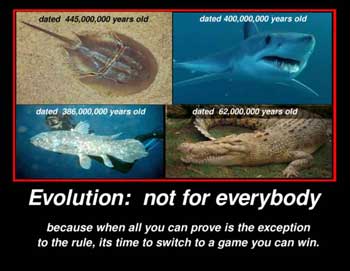
Creationists Love to Talk About "Living Fossils" Like the Coelacanth, Shark, Horseshoe Crab, etc. So Long As Evolutionists Aren't Allowed A Word in Edgewise.

Creation took six days. Evolution took billions of years. Hence it takes a bit longer to explain the Big History of the cosmos and planet earth than it does to read the creation story in Genesis chapter one. Likewise it takes a bit longer to discuss the evidence for evolution than it does to say, "God Did It." Below is a typical "argument for creationism" that amounts to "Look a Living Fossil!" The "argument" is then followed by a discussion of the evidence for evolution.
SOURCE

Added comment by an ex-creationst:
I've mentioned before that I went to a fundamentalist Baptist high school. My first introduction to the Coelacanth was through a heavily biased (and flawed) biology texbook from Bob Jones University, which (to the best of my memory) described the Coelacanth as a "living fossil" and took that description literally. Evolution couldn't possibly be real, I was told, because here was this Coelacanth, utterly unchanged 65 million years (air quotes implied) after it was supposed to be extinct. If evolution were real, why would it ignore the Coelacanth? [or the shark, the horseshoe crab, etc.?] SOURCE
RESPONSE

"Living Fossils" are the exceptions that prove the evolutionary rule. They stand out because the vast majority of species in the fossil record are NOT alive today. But as we will see such cases fit into a clear geological-evolutionary pattern.

Speaking of fish species, the most diverse and abundant species today are not the same as yesterday. The majority of fish species today are osteichthyes or bony fish, an extremely diverse and abundant group consisting of over 29,000 species--in fact they constitute the largest class of vertebrates (i.e., species with backbones) in existence today. But such was not the case in the past. There were times in the past when jawless fish filled the sea, then fish with armour, and then cartilaginous fish, in that order, before bony fish ruled the sea. There are only some cousins of the more ancient species alive today and in far less abundance than their ancestors were in the distant past.

Coelacanths

The most numerous species of fossilized coelacanth show up in the expected place in the evolutionary geological record, and also have anatomical features, that place them in the fish-to-tetrapod evolutionary bush.

The coelacanth is a type of Sarcopterygian (sometimes considered synonymous with Crossopterygian fish), an "actinist Sarcopterygii" to be exact. They used to be far more abundant in the distant past than they are today. Another group of Sarcopterygii was the "rhipidistian Sarcopterygii" which were the shallow-water group, and they are extinct, unless you count all of the land-lubbing tetrapods that evolved from them. (Therefore the Sarcopterygii didn't all remain the same. Far from it.)

As for "actinist Sarcopterygii" or coelacanths, not even all of them have remained the same. Living coelacanths found in Madagascar are neither the same type of coelacanth fossils that have been found in rocks that are 360 million years old, nor are they exactly the same type of coelacanth found in strata about 80 million years old; though the living species does resemble the younger fossil species more closely than it does the oldest known coelacanth fossil species. Hence differences are tracible through time as evolution would expect. The oldest known coelacanth species, the ones that are known from before 80 million years ago, were far more diverse (more than 120 different known fossil species) smaller, lacked certain internal structures found in modern coelacanths and belonged to a different genera and suborder. Modern coelacanths also belong to a different genera than the 80 million year genera. See the book, Coelacanth. W. W. Norton and Company, New York and London, 1991, page 78:
One point has to be emphasized; The living coelacanth is not a living fossil in the very strict sense that members of the species L. chaumnae itself have ever been found as a fossil. In fact, no other species assignable to the Genus Latimeria has been found as a fossil either. Latimeria and the Cretaceous fossil Genus Macropoma are quite closely related, and we could possibly include them in the same family. Beyond that, all fossil coelacanths belong to the order Coelacanthini. [Keith Littleton, New Orleans, LA]
Why No Coelacanth Fossils For 70 Million Years? Don Lindsay explains:
You might well ask: is it really possible for a group of species to live for millions of years and yet leave no fossils? First, note that fossil hunts are done on dry land. That's partly because it's easier, and partly because watery environments are usually undergoing deposition, which covers everything up. On land, rocks are eroding, and fossils get revealed. So, where do dry-land rocks come from? Well, some were formed on land, and some in fresh water, and some in shallow sea water. But very few were formed in deep sea water. Plate tectonics makes it clear why this should be. The deep ocean floor is constantly being destroyed, sucked down into the earth at subduction zones. It is unlikely for a piece of deep ocean floor to wind up as a dry-land rock. Now, imagine a creature that lives only in the open ocean, and is unlikely to venture close to shore. (Perhaps it lives in the depths.) That creature will leave no fossils that we are likely to find. So, the answer is, yes. It is possible to leave no fossils. Does Latimeria live in the depths? Well, close. They've been seen in caves about 200 meters down, and they die from decompression when brought to the surface. Also, if a creature lives in a small geographic area, it is possible that no one ever looked in the right place. The first colony of Latimeria is off one single island (Grand Comoro) in the Indian Ocean. And, the whole population there is only a few hundred fish. The second colony hasn't been located yet, so it can't be large. SOURCE
Living coelacanths, Latimeria chalumnae,and Latimeria menadoensis are possibly the sole remaining representatives of a once widespread family of Sarcopterygian (fleshy-finned) coelacanth fishes (more than 120 species are known from fossils). That dwindled down to only a single known fossilized Coelacanth species by the end of the Cretaceous, 65 million years ago. And likewise, only a single genus is known to still be alive today, and it more closely resembles the genus from 65 million years ago, not the over 120 different species know from 360 million years to 65 million years ago. SOURCE

Sharks

Sharks also once had their "golden age." The evolutionary record of their ancestors shows that the earliest shark-like species started out fairly small, and only grew larger over time, till the "golden age" of sharks, and then their diversity declined. SOURCE Some of the variety of ancient shark species:
While the earliest fossil sharks superficially resembled modern sharks, later species from the 'golden age of sharks' appeared in all manner of curious shapes and sizes. Top, Cladoselache; middle, Helicoprion; bottom, Stethocanthus.
Horseshoe Crabs

Kasaoka City Horseshoe Crab (kabutogani) Museum (hakubutsukan) is the only horseshoe crab museum in the world. The museum opened March 16, 1990 with the purpose of protecting and promoting the breeding of this "living fossil." This museum holds the world's foremost collection of information on the evolution of this creature.

Evolution of the Horseshoe Crab

The ancestors of the modern horseshoe crab evolved from trilobite ancestors in the Early Cambrian period approximately 550 million years ago. It was not until the Carboniferous period (354 to 290 million years ago) that the horseshoe shape developed. True horseshoe crabs do not appear until the Late Jurassic period, with fossils discovered in the Solnhofen limestone of Bavaria. dsc.discovery.com

The trilobite is an arthropod that dates back to the Paleozoic Era, and preceded not only the horseshoe crab and the sea scorpion but all other arthropods, crustacea and insects in the fossil record. (So, not all trilobites stayed the same, they evolved. *smile*) For instance trilobites preceded sea scorpions that preceded both the the scorpion and the spider in the fossil record. So the horseshoe crab's closest living cousins include spiders and scorpions. (So as I said, not all trilobites stayed the same, some trilobites evolved. *smile*)

Horseshoe crab fossils have been found in Europe and North America. The horseshoe crab evolved on the Laurasian Continent during the Paleozoic Era. The horseshoe crab reached Asia parallel to the Thetis Sea (check an ancient geology map), when the Atlantic Ocean was formed near the end the Mesozoic Era.

There are four distinct species of horseshoe crabs living on earth now. One lives on the beaches of the East Coast of the USA. Three others live in Japan and on the southeastern shore of the Asian continent.

Today there are only 3 genera and 5 species of Xiphosura (Horseshoe crabs and their extinct relatives) left alive, but they were much more numerous and diverse during the Palaeozoic era.

Surviving horseshoe crabs

(Limulus) are 'living fossils', barely changed in some 250 million years (since early Triassic time)...The exoskeleton generally consists of three parts, the large, semicircular cephalothorax, or prosoma, the usually smaller, subtriangular and in earlier forms "trilobite"-like opisthosoma, and the long stout tail-spine or telson (which is actually the end part of the opisthosoma)...The compound eyes are small (and absent in some early forms), and there are six pairs of legs (in the living Limulus) but no antennae.

Paleomerus and Lemoneites are very early forms that were either Aglaspids or transitional between the Aglaspida and the Xiphosura.

The late Cambrian (Caerfai epoch) marine family Eolimulidae is generally considered a true Xiphosuran,but again more research needs to be done if more is to be known about the early history of this interesting group.
_________

Further Creationist Questions

Question #1: In the billions of generations through the millions of years that fruit flies have had to evolve, why have they not become or at least spawned something else?

Reply: About 500 species of fruit flies are found only on the Hawaiian islands, a chain of islands whose oldest rose up from the sea approximately 8 million years ago. Concerning the evolution of new fruit fly genera. . .
Reading a book on Drosophilia, I discovered the answer to the question of why no new genera of fruit flies have evolved in Hawaii despite the hundreds of species. It is due simply to the classification approach used by Drosophilia workers. The Hawaiian lineage is apparently descended from within the genus Drosophilia, as presently defined. Based on cladistic terminology, one genus should not give rise to another genus. Rather than reclassifying the 2000 or so "Drosophilia" into multiple genera, fruit fly workers use a variety of subgenera and informal terms to group them. In fact, genus names have been proposed for some of the Hawaiian lineages. [Dr. David Campbell, Biology Department, Saint Mary's College of Maryland]
And in answer to the question, "How to test that all Hawaiian fruit flies descended from one common ancestral population that began with a founder event," the answer is to "Select many characters of Hawaiian and non-Hawaiian fruit flies, and use them to develop a phylogeny, using some related fly as an outgroup." SOURCE Such characters include the fact that Hawaiian fruit flies are larger and more brightly colored compared with the rest of the fruit flies on earth, and have even evolved a type of "song" that the mainland fruit flies never evolved. Obviously, some new morphologies and behaviors peculiar to certain species of fruit flies have evolved on the Hawaiian islands.

About 25% of all fruit fly species worldwide are found on those tiny Hawaiian islands. Ecologists believe Hawaii has so many kinds of fruit flies because the islands were isolated for millions of years and the environment varies greatly from beaches to tall mountains and lush green tropical valleys. When the first fruit flies arrived, they were able to evolve quickly because there were few competing species of flies. When people first arrived at the islands centuries ago they also found that there were thousands of unique species of birds, plants, and other life forms. While it is the fruit flies that are the best known, many other insect groups have diversified also. Hawaii boasts a carnivorous caterpillar, the happy face spider and a whole host of other fascinating endemic arthropods, many of which are brilliantly illustrated in the book, Hawaiian Insects and Their Kin by Francis Howarth and William Mull. Lush, and also in the book, Remains of a Rainbow; Rare Plants and Animals of Hawai'i by David Liittschwager and Susan Middleton. Published by National Geographic. See also Hawaiian Natural History, Ecology, and Evolution by Alan Ziegler. Published by University of Hawaii Press which traces the natural history of the Hawaiian Archipelago, such as island formation in a chain due to plate tectonics slowly moving over a lava spewing point in the ocean far below, as well as plant and animal evolution, flightless birds and their fossil sites.

Sadly, people have over time brought many new species with them to the islands, and the competition is driving most of the native species into extinction. Even the unique Hawaiian fruit flies are disappearing, replaced by flies from other parts of the world.
______________

Question #2: Consider dogs. We have St. Bernards, Chihuahuas, Great Danes, poodles, and hundreds of other breeds of dogs. But not only are those animals all mammals, they are all dogs.

Reply: Then what were the "dog-bears" of the Miocene? Dogs or bears?
_______________

For further reading see this article by ex-creationist/geologist, Glen Morton, Living Fossils: There Are None