Showing posts with label Favorite Quotations/Aphorisms. Show all posts

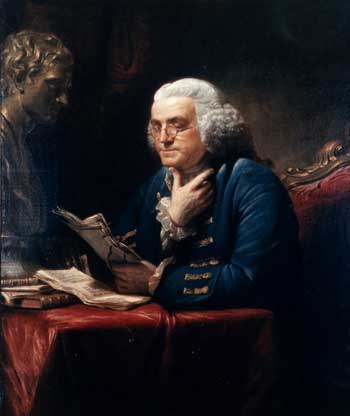
Was Benjamin Franklin a Christian? Or to be more precise, did Benjamin Franklin convert to “true Christianity” in middle-age as Christian apologist Bill Fortenberry suggests? (HT: James Patrick Holding J.P.Holding)

Was Benjamin Franklin a Christian?

Before proceeding, one might ask, does such a question matter? If you are a Christian apologist who seeks to prove that the U.S. was founded as a Christian nation, it might. But if one is trying to prove that converting to Christianity provides a great boon to every individualʼs life in this case Franklinʼs, there is little evidence of him changing much if at all (provided he did convert, which is the question at issue).

Leonardo da Vinci: Questioner of Authority, Empiricist, Anti-Flood Geologist…with Buddhist tendencies? And a link to a WTF Leonardo sketch.

Leonardo da Vinci: Questioner of Authority, Empiricist, Anti-Flood Geologist

Leonardo the Questioner

Leonardo did not seem very pleased with the Roman Catholic Church, nor very interested in theology:

“In Leonardoʼs time, the late 1400s, there was no formal scientific research. Scholars instead unquestioningly accepted the observations of nature that were passed down from Aristotle and other ancient Greeks. In fact, Pope Leo X interfered with da Vinciʼs beloved autopsies, prohibiting him from further dissections. Thus, Leonardoʼs great studies on the human body were terminated, never to be resumed with the same intensity.” (Nuland, Sherwin. Leonardo da Vinci. New York: Penguin Books, 2005, p. 94).

As Leonardo wrote:

Those who try to censor knowledge do harm to both knowledge and love, because love is the offspring of knowledge, and the passion of love grows in proportion to the certainty of knowledge. The more we know about nature, the more we can be certain of what we know, and so the more love we can feel for nature as a whole.

Of what use are those who try to restrict what we know to only those things that are easy to comprehend, often because they themselves are not inclined to learn more about a particular subject, like the subject of the human body.

And yet they want to comprehend the mind of God, talking about it as though they had already dissected it into parts. Still they remain unaware of their own bodies, of the realities of their surroundings, and even unaware of their own stupidity.

Along with the scholars, they despise the mathematical sciences, which are the only true sources of information about those things which they claim to know so much about. Instead they talk about miracles and write about things that nobody could ever know, things that cannot be proven by any evidence in nature.

Leonardo thought the Church was scamming its less sophisticated members: “Leonardo objected to the commercial exploitation of relics, religious art, and pious items, saying, ‘I see Christ once more being sold and crucified and his saints martyred.’ In his notebooks and letters, he protested the sale of indulgences, liturgical and ceremonial pomp, obligatory confessions, and the cult of the saints. He assailed the clergy—at all levels—for their lack of morality, values, and education. As a scientist, he questioned the contemporary reality of miracles performed by priests and monks.” (Apostolos-Cappadona, Diane. “Leonardo: His Faith, His Art.” Before 2 Nov. 2009. 26 Jan. 2010)

Leonardo liked to poke fun at silly religious beliefs and practices. The following jest is found in one of his notebooks:

A priest going the round of his parish on Saturday before Easter, sprinkling holy water in the houses as was his custom, came to a painterʼs room and there sprinkled the water upon some of his pictures. The painter, turning round somewhat annoyed, asked him why this sprinkling had been bestowed on his pictures; then the priest said that it was the custom and that it was his duty to do so, that he was doing good, and that whoever did a good deed might expect a return as good and better; for so God had promised that every good deed that was done on earth shall be rewarded a hundredfold from on high. Then the painter, having waited until the priest had walked out, stepped to the window above, and threw a large bucket of water to his back, saying: Here is the reward a hundredfold from on high as you said would come from the good you did me with your holy water with which you have damaged half my pictures (Gelb, Michael. Da Vinci Decoded. New York: Bantam Dell, 2004, p. 18).

Leonardo expressed doubts about the literal interpretation of the Bible. For example, in the eighteen pages of his notebooks that Bill Gates purchased for $30.8 million, Leonardo questioned the biblical story of a one-year long flood that allegedly “covered the highest mountains” all around the world:

Here a doubt rises, and that is: whether the Flood which came at the time of Noah was universal or not. And it would seem not, for the reasons which will now be given. We have it in the Bible that this deluge lasted 40 days and 40 nights, of incessant and universal rain, and that this rain rose to ten cubits about the highest mountains in the world. And if it had been that the rain was universal, it would have covered our globe which is spherical in form. And this spherical surface is equally distant in every part from the centre of its sphere; hence the sphere of the waters being under the same conditions, it is impossible that the water upon it should move, because water, in itself, does not move unless it falls; therefore how could the waters of such a deluge depart, if it is proved that it has no motion? And if it departed how could it move unless it went upwards? Here, then, natural reasons are wanting; hence to remove this doubt it is necessary to call it a miracle to aid us, or else to say that all this water was evaporated by the heat of the sun. (Gelb 16-17)

Leonardo found evidence in fossils, rock formations, and the movements of water that the Earth was much older than the Bible and Roman Catholic Church taught: “Recognizing the fossils as remains of once-living organisms,… Leonardo reasoned that such fragile shells could not have been swept so far inland and survived intact. He also noted that the fossils commonly lay in successive rock layers, evidence that they were deposited by multiple events rather than by only one. And he observed that groups of different fossil shells found together resembled the living groups assembled in coastal waters. For all these reasons, Leonardo correctly concluded that the fossils came from animals which once inhabited an ancient sea that covered the land.”

In his own words, Leonardo says:

Since things are far more ancient than letters, it is not to be wondered at if in our day there exists no record of how the aforesaid seas extended over so many countries; and if, moreover, such record ever existed, the wars, the conflagrations, the deluges of the waters, the changes in speech and habits, have destroyed every vestige of the past. But sufficient for us is the testimony of things produced in the salt waters and now found again in the high mountains far from the seas. (Nuland 106)

Perhaps most impressive is the mysterious phrase, “The sun does not move,” which stands by itself in capital letters among his writings. It is likely that da Vinci correctly concluded before Copernicus and Galileo that the sun, not the Earth, is the center of the solar system.

Leonardo the Empiricist

Marco Rosciʼs biography, Leonardo, notes that Leonardo “adopted an empirical approach to every thought, opinion, and action and accepted no truth unless verified or verifiable, whether related to natural phenomena, human behavior, or social activities.”

Leonardo wrote:

It seems to me that all studies are vain and full of errors unless they are based on experience and can be tested by experiment, in other words, they can be demonstrated to our senses. For if we are doubtful of what our senses perceive then how much more doubtful should we be of things that our senses cannot perceive, like the nature of God and the soul and other such things over which there are endless disputes and controversies.

Wherever there is no true science and no certainty of knowledge, there will be conflicting speculations and quarrels. However, whenever things are proven by scientific demonstration and known for certain, then all quarreling will cease. And if controversy should ever arise again, then our first conclusions must have been questionable.

Although nature commences with reason and ends in experience it is necessary for us to do the opposite, that is to commence with experience and from this to proceed to investigate the reason.

Study the science of art. Study the art of science. Develop your senses—especially learn to see. Realize that everything connects to everything else.

Anyone who conducts an argument by appealing to authority is not using his intelligence; he is just using his memory.

I am well aware that because I did not study the ancients, some foolish men will accuse me of being uneducated. They will say that because I did not learn from their schoolbooks, I am unqualified to express an opinion. But I would reply that my conclusions are drawn from firsthand experience, unlike the scholars who only believe what they read in books written by others.

Although I cannot quote from authors in the same way they do, I shall rely on a much worthier thing, actual experience, which is the only thing that could ever have properly guided the men that they learn from.

These scholars strut around in a pompous way, without any thoughts of their own, equipped only with the thoughts of others, and they want to stop me from having my own thoughts. And if they despise me for being an inventor, then how much more should they be despised for not being inventors but followers and reciters of the works of others.

When the followers and reciters of the works of others are compared to those who are inventors and interpreters between Nature and man, it is as though they are non-existent mirror images of some original. Given that it is only by chance that we are invested with human form, I might think of them as being a herd of animals.

Man discourseth greatly, and his discourse is for the greater part empty and false; the discourse of animals is small, but useful and true: slender certainty is better than portentous falsehood.

The greatest deception men suffer is from their own opinions.

Leonardo the “Buddhist” source

Da Vinci wrote some very Buddhist-sounding principles in his Principles for the Development of a Complete Mind:

There are three classes of people: those who see, those who see when they are shown, those who do not see.

The noblest pleasure is the joy of understanding.

The Buddhaʼs Right Intention and Right Effort focus on making a commitment to mental and ethical self-improvement. Learning to substitute desire and anger with the intention of goodwill and compassion will make us better humans. Leonardo said:

You will never have a greater or lesser dominion than that over yourself… The height of a manʼs success is gauged by his self-mastery; the depth of his failure by his self-abandonment… and this law is the expression of eternal justice. He who cannot establish dominion over himself will have no dominion over others.

And Leonardo saw the ongoing search for knowledge as a duty:

Iron rusts from disuse; stagnant water loses its purity and in cold weather becomes frozen; even so does inaction sap the vigor of the mind. So we must stretch ourselves to the very limits of human possibility. Anything less is a sin against both God and man.

[Many] have made a trade of delusions and false miracles.

Where there is shouting, there is no true knowledge.

The Buddhist idea of Right Speech encourages followers to abstain from lies, slander, gossip, and harsh language that hurts others. Rather, the goal should be to help others. Right speech to a painter would also cover his art, thus da Vinci wrote:

A painter should begin every canvas with a wash of black, because all things in nature are dark except where exposed by the light.

Art is the queen of all sciences, communicating knowledge to all the generations of the world.

Buddhaʼs Right Action, what is often referred to today as Loving-kindness, teaches us to be honest and compassionate, respect others, and abstain form taking life. Da Vinci points out that

He who does not oppose evil… commands it to be done.

I have been impressed with the urgency of doing. Knowing is not enough; we must do.

And he seemed to be encouraging Buddhist-like vegetarianism with

I have from an early age abjured the use of meat, and the time will come when men such as I will look upon the murder of animals as they now look upon the murder of men… [and that his body] will not be a tomb for other creatures.

Buddhism teaches that all life is suffering, but that we bring on that suffering ourselves by wanting something that cannot be. Life will always bring unwanted change, illness, and, eventually, death. We can suffer less by accepting that these things will happen and giving up trying to change that. We canʼt always get what we want, but that doesnʼt mean we shouldnʼt have goals. We just have to realize that things may not go as planned. Leonardo encouraged going with the flow:

As you cannot do what you want, want what you can do.

I love those who can smile in trouble, who can gather strength from distress, and grow brave by reflection. ‘Tis the business of little minds to shrink, but they whose heart is firm, and whose conscience approves their conduct, will pursue their principles unto death.’

Life is pretty simple: you do some stuff. Most fails. Some works. You do more of what works. If it works big, others will quickly copy it. Then you do something else. The trick is the doing of something else.

Consider mindfulness - the idea of devoting 100% of your attention to what you are doing at the present moment. The idea is that our minds are wandering all over the place so much of the time, worrying about what has been or what may be in the future, that we donʼt even notice what we are really doing as we move through life. The Buddha taught that we should pay careful attention to what is going on in our bodies and all around us so that we donʼt miss the opportunity to see things as they really are. Leonardo once said that

The average human looks without seeing, listens without hearing, touches without feeling, eats without tasting, moves without physical awareness, inhales without awareness of odor or fragrance, and talks without thinking.

Finally, a life dedicated to seeing and understanding the world around us, doing what we can to help those less fortunate than ourselves, and sharing love and joy and knowledge, is a life well-lived. Da Vinci may have been having similar thoughts when he said:

Just as a well-filled day brings blessed sleep, so a well-employed life brings a blessed death.

Leonardo the… WTF?!

Leonardo boasted that he once painted a Madonna so beautiful that the man who bought it was haunted by unseemly thoughts. Even after it was altered, perhaps with the addition of crosses and saintly symbols (as was done in Leonardoʼs second version of The Virgin of the Rocks), it still gave him an erection when he tried to pray. So in the end he returned the painting to Leonardo, who delighted in this pornographic triumph.

And here we have an erotic drawing by Leonardo da Vinci. Itʼs called “Angelo incarnato” or “Angel incarnate” or angel made flesh (the penis is discolored because somebody tried to erase it at some point): (Not Safe For Work Picture)

Additional sources cited:

Da Vinci the deist.

What Was Leonardo da Vinciʼs Religion?

Sir Thomas Browne: A Fascinating Early Enlightenment Christian

Myth-Buster, Word-Smith, Believer in Tolerance, Forgiveness and Opening Heavenʼs Gates Wider (but also in the reality and dangers of Witchcraft), Discoverer of Chinks in the Armor of Biblical Infallibility, An Ecclesiastes-Like Preacher of the Vanity of Life with a Few Resemblances to Lucretius the Atheist.

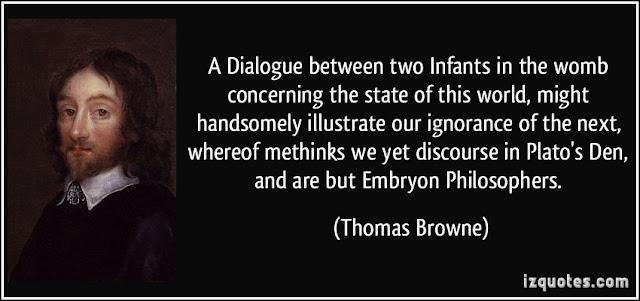
Thomas Browne Quote
  • Platoʼs den or cave refers to a famous allegory about people chained to the wall of a cave all of their lives, facing a blank wall. The people watch shadows projected on the wall from things passing in front of a fire behind them, and they begin to give names to these shadows. The shadows are as close as the prisoners get to viewing reality.

  • Embryon is roughly equivalent to our modern word, embryonic, so Browne is noting how little knowledge we have of the afterlife.

Quotations

We are ignorant of the backparts, or lower side of his Divinity.

My contact with Truth has been so fleeting and my comprehension of its mystery is so incomplete that to rush forth to its defense thus ill-prepared would be a great disservice.

Browne saw too many men who thought they had seized all of truth and who, as a result, not only missed the rightful enjoyment of a partial truth but mistook that part for the whole.

Those have not only depraved understandings, but diseased affections, which cannot enjoy a singularity without an Heresy, or be the Author of an Opinion without they be of a Sect also.

Opinions, even odd opinions, Browne does not condemn, so long as they are recognized for what they are. He recommends that they be held lightly.

The best we can do in view of the gulf fixed between our partial wisdom and the wholeness of the last Day, is to exercise manfully our reason, preserve the honesty of our enquiry, and so fulfill our human obligation even though at last we miss of truth.

We learn today what our better advanced judgments will unteach us tomorrow; and Aristotle does but instruct us, as Plato did him; that is, to confute himself. I have run through all sorts [of philosophies], yet find no rest in any: though our first studies and junior endeavors may style us Peripatetics, Stoics, or Academics [different types of philosophers]; yet I perceive the wisest heads prove, at last, almost all Skeptics, and stand like Janus in the field of knowledge. [Janus the god had two faces that peered in opposite directions at the same time.]

I have one common and authentic Philosophy I learned in Schools, whereby I discourse and satisfy the reason of other men; another more reserved, and drawn from experience, whereby I content my own.

I love to satisfy myself in a mystery, to pursue my reason to an o altitudo [feeling of spiritual exaltation, a Latin phrase that comes from Romans 11:33].

Where I cannot satisfy my reason, I love to humor my fancy.

We carry with us the wonders we seek without us.

Our ends are as obscure as our beginnings.

As reason is a rebel to faith, so passion is a rebel to reason.

Some Christians in Browneʼs day “declaimed against all Church music,” because they felt true worship should be accompanied only by sanctimonious spoken rites or silence. As for Browne:

I do embrace Church music; for even that vulgar Tavern music which makes one merry, another mad, strikes in me a deep fit of devotion, and a profound contemplation of the first Composer [God]. There is something in it of Divinity more than the ear discovers; it is an hieroglyphical [Egyptian hieroglyphs were impossible to read in his day] and shadowed lesson of the whole World, and creatures of God.

Sir Thomas Browne, Myth-Buster

Browneʼs most popular work in his lifetime is the one that is now most neglected, Pseudodoxia Epidemica, a catalogue of “vulgar errors,” urban myths of the seventeenth century. Many of these concerned silly things that people believed about animals. Browne was an astute observer of natural history (the author of a Natural History of Norfolk), and well positioned to correct such errors—the Snopes.com of his day.

Browneʼs European education exposed him to some of the latest thinking in medical practice, including training in anatomy and dissection — practices that were beginning to challenge and criticize the traditional authoritative works in medicine, such as those by Hippocrates and Galen. This included William Harveyʼs discovery of the circulation of the blood, which Browne said was a “discovery I prefer to that of Columbus.” He also kept a menagerie of exotic animals in his home, and he traced the ubiquity of the geometric pattern known as the quincunx through plants, insects and crystals. But his research might be described more accurately as nature poetry than as science, and his greatest delight seemed to be in things that defied categorization.

Is it unlucky to sneeze between midnight and noon? How to account for the “strange and mystical metamorphosis of silkworms;” or, the bizarre phenomenon of children being born with hair all over their bodies? Did Jesus laugh? Did he lie down to eat? What are the diseases associated with the climate of Iceland? What was the likely outcome if you imprison a mole, a toad and a viper together, under glass? (As it happens, the mole prevails.) Do snails have eyes? Early editions of Pseudodoxia Epidemica discuss his dissection of the horns of snails and Browne says that “I am not satisfied that these are eyes,” but by the last edition of 1672 he says he now believes, thanks to “the help of exquisite [magnifying] Glasses,” that “those black… spots or globules [are] their eyes.”

He could also pass comfortably from such questions to reflections on magnetism, coral, crystallography, ballistics, porcelain and the human eyelid. He was also obsessed with the medicinal properties and allegorical associations of plants; and had a pioneering determination to test hypotheses by the experimental method, which led him to study the effects of substances like vinegar and saltpeter on frog eggs—the earliest experiments in chemical embryology. He could also write with great verve about why most cultures buried their dead lying down, but some had the bodies standing erect; about the macabre practice of inhaling a dying personʼs last breath; and about the even more disturbing one of drinking a loved oneʼs ashes (a custom revived and adapted by Keith Richards of the Rolling Stones, who claimed to have snorted some of his fatherʼs remains.)

In arguing that the unicorn of myth doesnʼt really exist, Browne gleefully transformed the horned white horse into the lowly beetle with gentle irony:

Beside the several places of Scripture mentioning this Animal (which some may well contend to be only meant of the Rhinoceros) we are so far from denying there is any Unicorn at all, that we affirm there are many kinds thereof. We will concede no less then five; that is, the Indian Ox, the Indian Ass, the Rhinoceros, the Oryx, and that which is more eminently termed Monoceros, or Unicornis. Some in the list of fishes; as that described by Olaus, Albertus and others: and some Unicorns we will allow even among Insects; as those four kinds of nasicornous Beetles described by Muffetus.

Browne also dismantled the idea that elephants canʼt lie down or donʼt have joints: “Herein methinks men much forget themselves, not well considering the absurdity of such assertions.” On the other hand, he did not find it impossible that elephants could write and talk! “That some Elephants have not only written whole sentences… but have also spoken… we do not conceive impossible.” Browne cites “Ælian” who says he saw an elephantʼs trainer use the elephantʼs trunk to write Latin letters; presumably Greek is too refined for elephants; while Pliny VIII.6 (English by Holland, VIII.33) says that an elephant has written an entire sentence, which sentence Pliny quotes. Browne also cites “Oppianus and à Costa” who told the story of an elephant who went “Hoo, hoo.” Browne even alludes to the tale of Achillesʼs horse delivering a speech in Homer. See The Iliad xix 404ff “[Achillesʼs horse] bowed his head till his mane touched the ground and said, ‘Dread Achilles, we will indeed save you now, but the day of your death is near, and the blame will not be ours, for it will be heaven and stern fate that will destroy you… it is your doom to fall by the hand of a man and of a god.’“

In regard to the possibility of elephants speaking Browne also alluded briefly to “the Serpent that spoke to Eve,” and, “Dogs and Cats that usually speak to Witches.”

Speaking of having a soft spot for serpents, Browne defended the possible existence of the basilisk—a hybrid of a serpent and a cockerel:

17th-century depiction of a basilisk with a weasel, by Wenceslas Hollar.

Another weird creature whose existence Browne defended was the satyr—men with equine ears and tails. “Their shadowed moralities requite their substantial falsities.” In other words, their role in the myths in which they appear made them too valuable to let go.

Still, aside from his misses, he had a lot of hits. For instance he was able to show that almonds did not prevent drunkenness, and via observations he showed that earwigs have wings, and that flies donʼt hum with their mouths. The claim that bear cubs are born as formless lumps and then literally “licked into shape” by their mothers was solemnly disproved. So too was the idea that the root of the mandrake plant screams when it is pulled from the ground.

Browne was driven more by intellectual pleasures than physical ones, for he wrote at the age of 30, while still a bachelor, that he wished “we might procreate like trees, without [physical] conjunction, or that there was a way to perpetuate the world without the trivial and vulgar act of coitus; It is the most foolish act a wise man commits in his life” (which reminds one of Erasmusʼs saying, “The type of person who devotes himself to the pursuit of wisdom is most unlucky in everything, but above all in begetting children—as if Nature had taken pains, I suspect, to keep the disease of wisdom from spreading too widely among mortals”).

Nor did Browneʼs lively mind seem content with the idea of sleep stealing a large proportion of life: “Half our days we pass in the shadow of the earth, and the brother of death exacteth a third part of our lives.”

As for seeking to obtain a front row seat in heaven by dying a blessed martyr, Browne did not appear eager, not with his lively mind and tolerant personality: “It is a brave act to despise death; but where life is more terrible than death, it is then the truest valor to dare to live.”

Sir Thomas Browne, Word-Smith

Browne invented words when no others seemed to do the trick such as “medical,” “suicide,” “exhaustion,” “hallucination,” “coma,” and “prairie”. Observing the arrival of exhausted seabirds on the Norfolk coast, Browne was among the first to conclude that annual migration over huge distances must be part of their life cycle (he coined the word “migrant” and even gave several species their now familiar English names). The Oxford English Dictionary concludes that he gave the language 784 new words, and cites him as the first exemplary source for another 1,616. On the other hand, unless you use words like “eleemosynary” in casual conversation, a dictionary might help while reading Browne, not to mention the fact that you have to hack through dense forests of allusion, sentence by tangled sentence. “His prose is decidedly not Hemingway—it can be a workout,” says Stephen Greenblatt of Harvard. “But Browne is like this kind of wonderful half-open secret that runs through modernism.”

Sir Thomas Browne on Witchcraft

Browneʼs belief in witches was linked to his belief in the Devil, which in turn was linked to his belief in God. Browne, called by the prosecution as “a Person of great knowledge” in a 1662 witch trial, rendered his opinion that the two accused women, Amy Duny and Rose Cullender, had indeed enlisted the Devilʼs aid to afflict the village children, causing them to swoon, vomit up pins and so forth. Before Lord Chief Justice Hale at St Edmundsbury in 1664 Dr. Browne “was clearly of the opinion that the persons were bewitched; and said that in Denmark there had been lately a great discovery of witches, who used the very same way of afflicting persons by conveying pins into them, and crooked as these pins were, with needles and nails. And his opinion was that the Devil in such cases did work up on the bodies of men and women upon a natural foundation… for he conceived that these swooning fits were natural… but heightened to a great excess by the subtlety of the Devil, co-operating with the malice of these that we term witches, at whose instance he doth these villanies.”
[“A Psychological Parallel,” Matthew Arnold, The Contemporary Review, v.28, Nov. 1876]

Browne added: “I believe that all that use sorcery, incantations and spells are not Witches; I conceive there is a traditional Magic, not learned immediately from the Devil, but at second hand from his Scholars;… Thus I think a great part of Philosophy was at first Witchcraft, which, having afterwards derived to one another, proved but Philosophy, but was indeed no more than the honest affects of Nature; what, invented by us, is Philosophy, learned from him Magic.”

Granted, Browne, lived at the beginning of the Enlightenment in an age when the leading chemist, Boyle, was also an alchemist. But Browne looks particularly bad by contrast with another figure at the same witch trial, albeit one whose name is lost to history. This figure—referred to only as an ‘ingenious person’ in the trial record—objected that the allegedly bewitched children might be counterfeiting their symptoms. The objection led the court to perform a sort of proto-scientific experiment, the outcome of which strongly pointed to the innocence of the defendants. Yet owing to the superstitious atmosphere of the trial—an atmosphere that Browne had done his bit to establish—the two women were sent to the gallows anyway.

Sir Thomas Browne on Forgiveness, Tolerance and Opening Heavenʼs Gates Wider

Browne remained a devoted Church of England Protestant in an epoch fraught with religious controversy and hatred (Catholic versus Protestant and vice versa, Protestant versus Protestant, not to mention the Copernican controversy and witchcraft trials). He was a man of his time in some ways but ahead of the curve in others like his pleas for tolerance, humility, good works over faith. In his work, Religio Medici (roughly, A Doctorʼs Faith), Browne attempted to reconcile the religious views of his day (which were still quite conservative compared with todayʼs religious moderates and progressives) with reason. It was published in 1643, just as England was descending into a civil war conducted along Catholic-Protestant fault lines.

Forcible ways make not an end of evil, but leave hatred and malice behind them.

Persecution is a bad and indirect way to plant Religion. [Though he did not feel that way when it came to the persecution of witches and perhaps atheists as well.]

For Browne the great “virtue was charity, without which Faith is a mere notion;” his doctrine was simple:

He that giveth to the poor, lendeth to the Lord: There is more Rhetoric in that one sentence than in a Library of Sermons.

To forgive our enemies is a charming way of revenge, and a short Cæsarean conquest, overcoming without a blow; laying our enemies at our feet, under sorrow, shame, and repentance; leaving our foes our friends, and solicitously inclined to grateful retaliations. Thus to return upon our adversaries is a healing way of revenge; and to do good for evil a soft and melting ultion, a method taught from heaven to keep all smooth on earth. Common forcible ways make not an end of evil, but leave hatred and malice behind them. [Christian Morals, Pt.III, xii]…

I could never divide myself from any man upon the difference of an opinion, or be angry with his judgment for not agreeing with me in that, from which perhaps in a few days I should dissent myself: I have no genius to disputes in religion, and have often thought it wisdom to decline them… In philosophy, where Truth seems double-faced, there is no man more Paradoxical than myself; but in Divinity I love to keep the [orthodox Christian Anglican] Road… As for those wingy Mysteries in Divinity, and airy subtleties in Religion, which have unhinged the brains of better heads, they never stretched the Pia Mater of mine…

I cannot fall out, or condemn a man for an error, or conceive why a difference in opinion should divide an affection: for controversies, disputes, and argumentations, both in philosophy and in divinity, if they meet with discreet and peaceable natures, do not infringe the laws of charity. In all disputes, so much as there is of passion so much there is of nothing to the purpose; for then reason, like a bad hound, spends upon a false scent, and forsakes the question first started. And this is one reason why controversies are never determined: for though they be amply proposed they are scarce at all handled, they do so swell with unnecessary digressions: and the parenthesis on the party is often as large as the main discourse upon the subject…

I can dispense with my hat at the sight of a cross, but scarce with the thought or memory of my Savior… I cannot hear the Ave Maria bell [of the Catholics] without an elevation…

Sectarianism was not the only irrational division repugnant to him; he was as far from racial as from religious bigotry:

I feel not in myself those common antipathies That I can discover in others, those national repugnant-cies do not touch me, nor do I behold with prejudice the French, Italian, Spaniard, or Dutch; but when I find their actions in balance with my countrymenʼs I know, love, and embrace them in the same degree.

Browne was tolerant in ways that seem a century or two ahead of his time: He emphatically refuted claims that that the left-handed are wicked and Jews are cursed, and he hoped heavenʼs gates would be opened wider. On the other hand, he maintained orthodox Anglican Christian beliefs about the Devil, witches, Adam and Eveʼs special creation, a talking serpent, etc. The fallibility of human knowledge was, for him, a strong reason to cling to the faith of his fathers. This kind of skeptically based faith, known as fideism, was shared by Montaigne (in a perhaps more ironic vein), and also by John Updike (ditto).

For my Religion, though there be several circumstances that might persuade the world I have none at all, as the general scandal of my profession [the religious views of well educated people in his day were viewed with greater suspicion, living as he did at the beginning of the Enlightenment when increasing numbers of discomforting questions were being raised by scholars], the natural course of my studies, the indifferency of my behaviour, and discourse in matters of Religion, neither violently defending one, nor with that common ardor and contention opposing another; despite which I… assume the honorable style of a Christian…

Browne appreciates, though rejects, some of the customs of the Catholic religion, and he advocates tolerance. In parts of his writing he implies that he would like to subscribe to the heresy that all souls are at last saved and hence, prefers not to judge Turks and Jews who are called heretics. He accepts church doctrine as the practical course and does not wish to promote fragmentation within the church. He also judged his own soul more harshly than that of others:

The heart of man is the place the devils dwell in; I feel sometimes a hell within myself; Lucifer keeps his court in my breast; Legion is revived in me. There are as many hells as Anaxagoras conceived worlds. There was more than one hell in Magdalene, when there were seven devils; for every devil is an hell unto himself, he holds enough of torture in his own ubi; and needs not the misery of circumference to afflict him: and thus, a distracted conscience here is a shadow or introduction unto hell hereafter. Who can but pity the merciful intention of those hands that do destroy themselves?

No man can justly censure of condemn another, because indeed no man truly knows another. This I perceive in my self; for I am in the dark to all the world, and my nearest friends behold me but in a cloud. Those that know me but superficially, think less of me than I do of my self; those of my near acquaintance think more; God, who truly knows me, knows that I am nothing… Further no man can judge another because no man knows himself; for we censure others but as they disagree from that honour which we fancy laudable in ourselves, and commend others but for that wherein they seem to quadrate and consent with us.

I find there are many pieces in this one fabric of man… a… World of Contraries… Let me be nothing, if within the compass of myself I do not find the battle of… Passion against Reason, Reason against Faith, Faith against the Devil, and my Conscience against all.

Religio Medici is molded on Browneʼs religious temper not the specific doctrines of his creed. At the end of the book Browne displays conviction without dogmatism. He could envision missing the truth yet still be justified by trusting his life to the God who knows, as he can never hope to know on this earth:

Bless me in this life, with but peace of my Conscience, command of my affections, the love of Thy self and of my dearest friends, and I shall be happy enough to pity Caesar. These are, O Lord, the humble desires of my most reasonable ambition, and all I dare call happiness on earth; wherein I set no rule or limit to thy Hand or Providence. Dispose of me according to the wisdom of They pleasure: Thy will be done, though in my own undoing.

I thank God, and with joy I mention it, I was never afraid of Hell, nor never grew pale at the description of that place; I have so fixed my contemplation on Heaven, that I have almost forgot the Idea of Hell, and am afraid rather to lose the joys of the one than endure the misery of the other; to be deprived of them is a perfect hell, & needs me thinks no addition to complete our afflictions; that terrible term hath never detained me from sin, nor do I owe any good action to the name thereof: I fear God, yet am not afraid of him, his mercies make me ashamed of my sins, before his judgments afraid thereof: these are the forced and secondary method of his wisdom, which he uses but as the last remedy, and upon provocation, a course rather to deter the wicked, than incite the virtuous to his worship. I can hardly think there was ever any scared into Heaven, they go the fairest way to Heaven that would serve God without a Hell, other Mercenaries that crouch unto him in fear of Hell, though they term themselves the servants, are indeed but the slaves of the Almighty…

Some say there is no salvation to those that believe not in Christ… which makes me much apprehend the end of those honest Worthies and Philosophers who died before his Incarnation. It is hard to place those souls in Hell whose worthy lives do teach us virtue on earth…

Itʼs true we all hold there is a number of Elect and many to be saved, yet add up all of the opinions [of different Christians] together [as to who shall be saved and who not], and from the confusion thereof there will be no such thing as salvation, nor shall any one be saved; because first the Church of Rome condemns us; and we [the Church of England] likewise condemns them [the Church of Rome]; the Sub-Reformists and Sectarian Protestants [like the Anabaptists, Separatists, Brownists] sentence the Doctrine of our church as damnable; the Atomist, or Familist believe they alone know the saving truth and denounce other churches and their beliefs. Thus while the mercies of God promise us heaven, our conceits and opinions exclude us from that place. There must be therefore more than one Saint Peter [minding the pearly gates], since particular Churches and Sects usurp the gates of heaven [i.e., claim they alone can guarantee entrance], and turn the key against each other, and thus we go to heaven against each othersʼ wills, conceits and opinions, and with as much lack of charity as ignorance, err I fear in points, not only of our own, but on anotherʼs salvation…

NOTE: Atomist, or Familist might be referring to the same sect; or, the first might be referring to Mrs. Atomy or Attaway who was notorious for preaching universalism in Britain in 1644, and the second might be referring to a sect known as the “Family of Love” that started in the Netherlands before it spread to Britain—they believed that true religion consisted of love and charity independently of the form of faith, and that spiritual perfection could be obtained; they also interpreted the Bible not as a book from which to derive doctrines that must be believed but as an allegory of love.

I believe many are saved who to man seem reprobated [i.e., cast off by God, excluded from salvation], and many are reprobated, who in the opinion and sentence of man, stand elected [to gain eternal life]; there will appear at the last day, strange, and unexpected examples, both of his justice and his mercy, and therefore to define either is folly in man…

Now for that other Virtue of Charity, without which Faith is a mere notion, and of no existence, I have ever endeavored to nourish the merciful disposition, and humane inclination I borrowed from my Parents, and regulate it to the written and prescribed Laws of Charity… for I am of a constitution so general, that it consorts, and sympathizes with all things; I have no antipathy, or rather Idiosyncrasy, in diet, humor, air, anything; I wonder not at the French, for their dishes of frogs, snails, and toadstools, nor at the Jews for eating Locusts and Grasshoppers, but when I am among them, I eat what they eat; and I find such meals agree with my stomach as well as theirs; I could digest a Salad gathered in a Churchyard as well as in a Garden. I am not angrily revolted at the presence of a Serpent, Scorpion, Lizard, or Salamander; nor at the sight of a Toad, or Viper, I find in me no desire to take up a stone to destroy them. I feel not in my self those common antipathies that I can discover in others: Those national repugnant-cies do not touch me, nor do I behold with prejudice the French, Italian, Spaniard, or Dutch; but where I find their actions in balance with my Countrymenʼs, I honor, love, and embrace them in the same degree…

Salvation, which though it be not in our power to bestow, it is in our charity, and pious invocations to desire, if not procure, and further. I cannot contentedly frame a Prayer for my self in particular, without a catalog for my friends, nor request a happiness wherein my sociable disposition doth not desire the fellowship of my neighbor. I never hear the Toll of a passing Bell [which they rang when people died], though in my mirth, without my prayers and best wishes for the departing spirit; I cannot go to cure the body of my Patient, but I forget my profession, and call unto God for his soul; I cannot see one say his Prayers, but in stead of imitating him, I fall into a supplication for him, who perhaps is no more to me than a common nature: and if God hath vouchsafed an ear to my supplications, there are surely many happy that never saw me, and enjoy the blessing of mine unknown devotions. To pray for enemies, that is, for their salvation, is no harsh precept, but the practice of our daily and ordinary devotions…

Sir Thomas Browne & Chinks in the Armor of Biblical Infallibility

Browne does not suggest we ignore the writings of authority figures, but rather that we should combine their knowledge with two other ways of finding things out: reason and experiment.

For instance, on the conservative side, Browne concluded that paintings of Adam and Eve were faulty if they depicted the first human couple with navels—because the Bible declared that neither of them came out of a womb, hence neither Adam nor Eve would have had an umbilical cord or a navel.

But on the more moderate/liberal side Browne denied that salamanders live in fire (an urban legend that Augustine had had appealed to in order to defend the idea that the bodies of the damned would not simply go up in smoke in the fires of hell but remain painfully intact forever).

His knowledge of nature also raised questions concerning the story of Noahʼs ark—because there was no mention in the Bible of species of animals from the Americas, animals that had never been seen before nor mentioned in the Bible. The existence of so many new species were just beginning to come to the attention of European scholars. Surely if the native Americans had from Noahʼs descendants in the Old World they would have taken with them horses, yet the Europeans who traveled to the Americas found no horses there. “How could there be so many creatures in the Americas that are not found in Europe-Africa-Asia; which seems odd if one believes there was but one Ark and the creatures in it all began their progress together from the mountains of Ararat.” (This question would grow even more problematical after the discovery of Australia and its unique animals. Did several arks, each containing unique species of animals, land in different parts of the world after Noahʼs Flood?)

Browne was poised between two worlds, the old one of authority and the new one of inquiry, as a scientist he was tempted to find naturalistic explanations for miracles, as a Christian he conquered this temptation ‘on his knees’. He could not, however, curb a persistent tendency to notice inconsistencies and improbabilities in the minutiae of the Bible. He could at times reconcile both reason and revelation: on the relationship of diametric to circumference [2 Chron 4:2] one should “adhere into Archimedes who speaks exactly rather than the Sacred text that speaks largely [in more general less exact terms].” He might protest that he did not question the metamorphosis of Lotʼs wife into a pillar of salt, “although some conceive that expression metaphorical.” He would not deny that Absalom hung by his hair rather than by his neck “though if he had a helmet on I could not conceive it.” He did not doubt that Judas hanged himself “though there is much evidence against it.” He might declare that the Bible is “a most singular book” and aver that its seeming inconsistencies merely reflect human limitation. Whatever his protestations, the chink in the armor of Scriptural infallibility was revealed, and his questioning intellect aroused. Conscious as he was of human fallibility, he always kept his skepticism circumspect. He teased the sacred texts rather than criticized them. Just as he rejoiced in the natural world so there is no doubting his appetite for and enjoyment of the Bible: “it is one of the hardest books I have met with; I wish there had been more of it.” [Samuel Romilly]

Browne also asked, Did Lazarus have a legal right to reclaim his possessions from his heirs after he re-emerged from the grave? Were there rainbows before the Flood?

He chided those who believe that Moses had horns [a common misconception in Browneʼs day, even seen in paintings of Moses with horns, based on an obscure Hebrew term that scholars today believe referred to the alleged glow around Mosesʼs face after he allegedly met God on a mountaintop], he cautioned against “men vainly interposing their constructions.”

Unusual for a Christian who believed in individual bodily resurrection, Browne questioned what constituted a personʼs individuality, for he wrote: “Every man is not only himself; there have been many Diogenes, and as many Tymons, though but few of that name; men are lived over again… there was none then, but there hath been some one since that parallels him, and is, as it were, his revived self.”

Sir Thomas Browne, An Ecclesiastes-Like Preacher of the Vanity of Life, Resemblances to Lucretius the Atheist

As a Christian, Browne professed to care more about his place in the next life than his reputation in this one. His work, Urn-Burial, is a field guide to earthly oblivion, a poetic compendium of his obsessively collected knowledge about death, decay, burial, cremation, the vanity of monuments, and the cruel brevity of human memory. Even ‘grave-stones,’ he wrote, “tell truth scarce forty years,” adding, “At my death I mean to take a total adieu of the world, not caring for a Monument, History, or Epitaph, not so much as the bare memory of my name to be found any where.” Browne sounds almost fatalistic, but not quite: “We must be content to be as though they had not been, to be found in the Register of God, not in the record of man.” Browne recognizes how great our grief is at human loss, as well as our hope to leave something behind that endures on earth. However he also sees that the worst may be remembered longer than the best: “The iniquity of oblivion blindly scatters her poppy, and deals with the memory of men without distinction to merit of perpetuity.”

Browne also seemed aware of how his own dark ruminations about leaving nothing behind on earth might lead others to sympathize with atheists. For instance, in a letter to his son he warned of the spiritual dangers of reading the Hellenistic atheist, Lucretius, “There being divers impieties in it.” Oddly enough both Lucretius and Browne took deep pleasure in the peculiarities of the natural world. Both were fascinated by what happens when we dream; both, for different reasons, took a dim view of romantic love and of human pride. (Lucretius: “Some wear themselves to death because they wish a statue or a title.” Browne: “In vain do individuals hope for Immortality, or any patent from oblivion.”)

Browne himself has not yet been forgotten (neither has Lucretius for that matter, whose work nearly became extinct then was rediscovered in the 15th-century, and helped produce the modern world of thought). The most ambitious Browne enterprise in the works is a new edition of his complete writings, commissioned by Oxford University Press and expected to be finished in 2017, the first such edition in more than 80 years.

Sir Thomas Browne and “Atheism”

It was a common insult in Browneʼs day for Christians of rival denominations or sects to call each other ‘atheists’ for denying each othersʼ denominational or sectarian beliefs. Such a widespread and confusing use of the term went back as far as the days of Rome when Christians were labeled “atheists” because they denied the Roman gods. Browne sought to end such confusion:

“There are many… who, in the eyes of God, are not so perfect martyrs as was the wise heathen, Socrates, who suffered on a fundamental point of religion, the unity of God” [i.e., Socrates was accused of denying the existence of a plurality of the gods of Greece, and instead held to a singular Logos, a unified supreme God]… Nor was the denial of the Providence of God by the philosopher, Epicurus, atheism; Epicurus simply deemed God too majestically ‘sublime to mind the trivial actions of inferior creatures’ like we humans. The belief of Stoic philosophers that life was one long ‘fatal necessity’ that one had to grin and bear is nothing but “an acknowledgment of the immutable Law of Godʼs Will.” “The Romans, that erected a Temple to Fortune, acknowledged therein, though in a blinder way, somewhat of Divinity; for in a wise supputation, all things being and end in the Almighty.” And those Christian ‘heretics’ and/or Muslims who denied that the Holy Spirit was a distinct person and part of a Trinitarian God, or who denied that Jesus was God, were not atheists either; “for though they deny two persons in the Trinity, they hold, as we do, there is both one God.”

Browne pointed out that genuine ‘atheism’ had to be a complete denial of any God whatsoever, which he added, “is the greatest falsity, and to affirm there is no God, the highest lie in Nature.” So Brown was as unforgiving of true atheism as he was of witches.

Sir Thomas Browne, A Prediction

Lastly, Browne echoed a prediction made by Bishop Berkeley, one that not everyone would have forecast in the mid-1600s, namely that “America will be the seat of the fifth empire.”

Agnosticism compared with Religion (or compared with any other fully formed belief system)

Agnosticism

I figure there are many good people in every mass movement or belief system, but that systems requiring the highest levels of conformity tend to create difficulties for people with questions like myself, and that people devoted to sustaining each system will employ plenty of rationalizations to convince themselves of its purity and truth and never consider that the evidence may be lacking or ambiguous in many cases.

I am sure any apologetically minded Christian could produce a list of their favorite books defending their Protestant, Catholic, Pentecostal or other beliefs, and questioning every other point of view. But why didnʼt God show everyone the truth and keep Christians together? Why so many divisions and questions rather than agreed upon answers? I guess Satan is blinding everybody on all sides. Or as Benjamin Franklin once put it (without reference to Satan):

“Every other sect supposes itself in possession of the truth, and that those who differ are so far in the wrong. Like a man travelling in foggy weather they see those at a distance before them wrapped up in a fog, as well as those behind them, and also people in the fields on each side; but near them, all appears clear, though in truth they are as much in the fog as any of them.”

Personally, I tend to think of humans as primates with the tendency to leap on bandwagons and follow alpha males/females. I also agree with Eric Hoffer when it comes to humansʼ desires to join their egos to mass movements, whether such mass movements be Christian, Muslim, fascist or communist. Hofferʼs works contain some brilliant insights into the similar psychological drives that animate adherents of mass movements. As he put it, “The less justified a man is in claiming excellence for his own self, the more ready is he to claim all excellence for his nation, his religion, his race or his holy cause.” For more quotations click here.

And to expand upon Franklinʼs “they are as much in the fog as any of them” story, one need only read the testimonies of those who questioned and/or left Protestantism (click here) or Catholicism (click here) after being devoted to one or the other for decades.

Or one can read books by others who have found that like all mass movements that become institutionalized, the larger the institution the more willing it seems to make deals with the devil to retain its institutionalized existence, i.e., in the case of Catholicism such deals have been made with fascist rulers, or to keep silent concerning abuses perpetrated by members of the institution, or even deals with bankers and the Mafia, etc. (click here).

I also find that people who idolize figures in history or who idolize institutions usually donʼt know very much about them, or arenʼt willing to look at whatʼs swept under the rug so to speak, including Jesusʼs and Paulʼs apocalyptic soon final judgment predictions and cult-like teachings. Check out the new book, The Bad Jesus: The Ethics of New Testament Ethics (click here).

And check out my posts on the characteristics of Paul that strike me as indicative of cult-like behavior (click here and here).

Not to mention my older piece, The Lowdown of Godʼs Showdown.

The great irony of Christianity is that it consists of too many schisms to mention, including conservative, moderate, liberal spectrums of differences within each major denomination, yet ‘Christianity’ or rather ‘Christianities’ claims more supernatural advantages than any other movement on earth. Believers claim to possess the only inspired writings on earth, and a prayer hotline by which they may ask and receive guidance from God to lead them into all truth, and a new heart implanted inside them via divine favor=grace. Yet they have come up with countless schisms and centuries of defending intolerant and even in some cases unscientific points of view. I am not saying religion has not also done good, nor should believers deny that non-Christian doctors, inventors and politicians have also done good. You donʼt have to be a Christian to do good. My point is that Christians claim humongous supernatural advantages over every other mass movement and belief system, yet when you look at the history of Christianity it is the history of schisms too numerous to mention.

And for over 1000 years when a devout Christian (or a large majority of Christians) ruled over a city, country or nation, they instituted laws against blasphemy, heresy, witchcraft, etc., and continued to do so for centuries, from the days of the Christian Roman Emperors that later of whom wound up declaring in their famous book of law that all non-Trinitarians were ‘demented’ and that the Emperor would punish them and destroy their writings, all the way to the days of the Reformation when the same was still occurring.

  • Augustine of Hippo set forth the principle of Cognite Intrare (‘Compel them to enter,’ based on Luke 14:23). Cognite Intrare would be used throughout the Middle Ages to justify the Churchʼs suppression of dissent and oppression of difference (click here).

  • Christian persecution of pagans—exceeded the pagan persecution of early Christians (click here)

  • Christian persecution of fellow Christians—exceeded the pagan persecution of early Christians (click here)

  • Reformation Christian persecution of fellow Christians—exceeded the pagan persecution of early Christians (click here)

  • Christian persecution of American Indians—exceeded the pagan persecution of early Christians (click here)

  • Decrees of Christian Emperors against non-Trinitarians (click here and scroll to bottom of blogpost)

  • Protestant and Catholic defenses of the necessity of persecuting heretics, blasphemers, infidels, etc. (click here)

Life is confusing enough, and features enough daily disappointments and pains, and requires enough time and work obtaining necessities to exist or thrive (not to mention that we humans can seemingly get sidetracked or addicted to nearly any idea, behaviors or items, due to our large brains) that I figure most people are apt to lend their allegiance to all sorts of mass movements and belief systems. But to imagine a God tossing us primates into a place of eternal punishment—without even giving us a second chance after we have finally been shown a literal heaven, hell and angels after we have died, and without even lending a supernatural hand to heal the scars left on our psyches from life on earth, or without even lending a hand to to glue together into more meaningful focus our broken scattered painful memories from life on earth, and after only allowing each of us this brief stint of a few decades years of life or less in a ‘fallen’ cosmos—makes little sense to me. Everlasting punishment makes little sense. What does make sense to me is to honestly admit that things we donʼt know are things we donʼt know, and that confusing or ambiguous evidence is confusing or ambiguous evidence, i.e., without trying to make excuses to fill in such blanks or hazy knowledge with fully formed religious or philosophical belief systems.

Christians Say the Damnedest Things… about Hell and Faith

Augustine on the Eternal Joy that Comes From Seeing What Is Happening in Hell

Augustine of Hippo Refuting Heretic

Augustine on the Eternal Joy that Comes From Seeing What Is Happening in Hell

Augustine was the first Christian theologian to write a biblical defense of the view that the lost will suffer forever in hell. If youʼre familiar with the way that previous church fathers — even those who believed in eternal torment — wrote, youʼll recognize that this is something new. This was almost a systematic case for eternal torment, and due to its length (compared with anything that had come before) and Augustineʼs major influence, it became the standard. It took some time for dissenters to again be heard with any significant volume against this backdrop. See Augustineʼs City of God (written soon after the year 410) Book 21.

The New Advent Catholic Encyclopedia repeats some of Augustineʼs arguments when it points out:

The Holy Bible is quite explicit in teaching the eternity of the pains of hell. The torments of the damned shall last forever and ever (Revelation 14:11; 19:3; 20:10). They are everlasting just as are the joys of heaven (Matthew 25:46). Of Judas, Christ says: “it were better for him, if that man had not been born” (Matthew 26:24). But this would not have been true if Judas was ever to be released from hell and admitted to eternal happiness. Again, God says of the damned: “Their worm shall not die, and their fire shall not be quenched” (Isaiah 66:24; Mark 9:43, 45, 47). The fire of hell is repeatedly called eternal and unquenchable. The wrath of God abideth on the damned (John 3:36); they are vessels of Divine wrath (Romans 9:22); they shall not possess the Kingdom of God (1 Corinthians 6:10; Galatians 5:21), etc.
Source

But Augustine went even further. He taught that the memories of the redeemed in the future kingdom of God will be not only supernaturally maintained but enhanced such that they retain all the knowledge of their past sufferings on earth as well as knowledge of the eternal sufferings of the lost in hell, because only by carrying such knowledge around with them for eternity can they truly appreciate what their own salvation means. Otherwise at some point in eternity they might forget what they were saved from, and not remain eternally grateful to God.

To quote Augustine,

…their intellectual knowledge, which shall be great, shall keep them acquainted not only with their own past woes, but with the eternal sufferings of the lost. For if they were not to know that they had been miserable, how could they, as the Psalmist says, forever sing the mercies of God? (Psalm 89:1)… Those who shall be in torment shall not know what is going on within in the joy of the Lord; but they who shall enter into that joy shall know what is going on outside in the outer darkness.
Source 1 and Source 2

Later Christian writers would expand on Augustineʼs point but it was now new. In The Apocalypse of Peter the saved witness the torments of the damned. In the Gospel of Nicodemus, those about to be rescued watch Christ throw the wicked into the pit, Tartarus. Earlier still, there were passages in the Bible that depict something similar. You can skip to the end of this post to read them.

Thomas Aquinas would later argue, based on similar premises, to a conclusion similar to Augustineʼs. Keep in mind such a view became one of the hallmarks of Christianity as supported by some of Christianityʼs leading thinkers as we will see below.
Source

Triumph of St. Thomas Aquinas [center] over the Heretics.

Thomas Aquinas on the Eternal Joy that Comes From Seeing Perfectly the Sufferings of the Damned

According to Aquinas the blessed will not pity the unhappiness of the damned. For we choose to have compassion when we wish the suffering of others to stop, and so when we do not wish their suffering to stop, we have no such compassion. Since it is impossible to stop the suffering of the damned, and because it would in any case be contrary to Divine justice, the blessed will have no compassion for them.

Aquinas goes even further, arguing via logical propositions that we will see the damned suffering and we will rejoice:

Nothing should be denied the blessed that belongs to the perfection of their beatitude. Now everything is known the more for being compared with its contrary, because when contraries are placed beside one another they become more conspicuous. Wherefore in order that the happiness of the saints may be more delightful to them and that they may render more copious thanks to God for it, they are allowed to see perfectly the sufferings of the damned… The saints will rejoice in the punishment of the wicked, by considering therein the order of Divine justice and their own deliverance, which will fill them with joy. And thus the Divine justice and their own deliverance will be the direct cause of the joy of the blessed: while the punishment of the damned will cause it indirectly.
Source

Martin Luther on the Acme or Highest Degree of Faith

Martin Luther admitted that he could not comprehend how this God can be merciful and just who displays so much wrath and iniquity and added that Godʼs goodness appears hidden, hence the need for faith of the highest degree:

God hides his eternal goodness and mercy under eternal wrath, his righteousness under iniquity. This is the highest degree of faith, to believe him merciful when he saves so few and damns so many, and to believe him righteous when by his own will he makes us necessarily damnable, so that he seems, according to Erasmus, to delight in the torments of the wretched and to be worthy of hatred rather than of love. If, then, I could by any means comprehend how this God can be merciful and just who displays so much wrath and iniquity, there would be no need of faith. As it is, since that cannot be comprehended, there is room for the exercise of faith when such things are preached and published, just as when God kills, the faith of life is exercised in death.
The Bondage of the Will, 1525

Luther praised the love of God that might even damn him to hell, and declared in The Bondage of the Will, “God himself does evil through those who are evil.”
Martin E. Marty, “Martin Luther: A Life”

John Calvin on Godʼs “Dreadful Decree”

I again ask how it is that the fall of Adam involves so many nations with their infant children in eternal death without remedy unless that it so seemed meet to God? Here the most loquacious tongues must be dumb. The decree, I admit, is, dreadful; and yet it is impossible to deny that God foreknow what the end of man was to be before he made him, and foreknew, because he had so ordained by his decree. Should any one here inveigh against the prescience of God, he does it rashly and unadvisedly. For why, pray, should it be made a charge against the heavenly Judge, that he was not ignorant of what was to happen? Thus, if there is any just or plausible complaint, it must be directed against predestination.
Institutes of the Christian Religion Book 3, Sec. 23, 7

Speaking of this passage, nineteenth century Reformed theologian, Dr. H. J. Van Dyke, admitted:

Now let us be candid with ourselves, and even with our opponents. Historic Calvinism does include what Calvin himself calls the horribile decretum, that by the election and predestination of God many nations, with their infant children, are irretrievably doomed to eternal death.
“Variations within Calvinism,” pp.39-40

In similar fashion Calvin wrote:[When it comes to Godʼs honor] He banishes all those human affections which soften our hearts; that he commands paternal love and all the benevolent feelings between brothers, relations, and friends to cease; in a word, that He almost deprives men of their nature in order that nothing may hinder their holy zeal. Why is so implacable a severity exacted but that we may know that God is defrauded of His honor, unless the piety that is due to Him be preferred to all human duties, and that when His glory is to be asserted, humanity must be almost obliterated from our memories?
Source

God makes plain that the false prophet is to be stoned without mercy. We are to crush beneath our heel all affections of nature when His honor is involved.

Calvinʼs comment on Deuteronomy 13:

Let us also learn that nothing is less consistent than to punish heavily the crimes whereby mortals are injured, whilst we connive at the impious errors or sacrilegious modes of worship whereby the majesty of God is violated.

Calvinʼs comment on Exodus 32:29

One should forget all mankind when His glory is in question. God does not even allow whole towns and populations to be spared, but will have the walls razed and the memory of the inhabitants destroyed and all things ruined as a sign of His utter detestation, lest the contagion spread.
Defense of Orthodox Faith against the Prodigious Errors of the Spaniard Michael Servetus, published in early 1554.

Jonathan Edwards on Rejoicing Even if Oneʼs Wife, Children or Closest Friends Wind Up In Eternal Hell

Quote from Jonathan Edwards, The Life of David Brainerd about a womanʼs depth of faith:

This woman has discovered a very sweet and heavenly frame of mind… Discovering an unusual joy and satisfaction in her countenance… I inquired into the reason of it [and] she replied that God had made her feel that ‘twas right for him to do what he pleased with all things; and that ‘twould be right if he should cast her husband and son both into hell; and she saw ‘twas so right for God to do what he pleased with them, that she could not but rejoice if God should send them into hell, though ‘twas apparent she loved them dearly.

More great words of faith:

You that have godly parents… You will see them with a holy joyfulness in their countenances, and with songs in their mouths. When they shall see you turned away and beginning to enter into the great furnace, and shall see how you shrink at it, and hear how you shriek and cry out; yet they will not be at all grieved for you, but at the same time you will hear from them renewed praises and hallelujahs for the true and righteous judgments of God, in so dealing with you… After they shall have seen you lie in hell thousands of years, and your torment shall yet continue without any rest, day or night; they will not begin to pity you then; they will praise God, that his justice appears in the eternity of your misery… singing the more joyful for the glorious justice of God which they behold in your eternal condemnation. [The last sentence was from earlier in the same essay].
Jonathan Edwards,“The Ungodly Warned”

When the saints in glory… shall see how miserable others of their fellow-creatures are, who were naturally in the same circumstances with themselves; when they shall see the smoke of their torment, and the raging of the flames of their burning, and hear their dolorous shrieks and cries, and consider that they [the saints] in the mean time are in the most blissful state and shall surely be in it to all eternity; how will they rejoice!
Jonathan Edwards 1834, sec. II)

Famed Hymn Writer, Isaac Watts, “Thy Just Revenge Adore”

Thy hand shall on rebellious kings
A fiery tempest pour,
While we beneath thy sheltʼring wings
Thy just revenge adore.
[Book 1 Hymn 42]

There endless crowds of sinners lie,
And darkness makes their chains;
Tortured with keen despair they cry,
Yet wait for fiercer pains.
Not all their anguish and their blood
For their old guilt atones,
Nor the compassion of a God
Shall hearken to their groans.
[Book 2, Hymn 2]

Lord, I ascribe it to thy grace,
And not to chance as others do,
That I was born of Christian race,
And not a heathen, or a Jew.
[Divine and Moral Songs, Song 6, Praise for the Gospel]

Quotations from Christians of Lesser Prominence Than Those Above

Tertullian

What a spectacle when the world and its many products, shall be consumed in one great flame! How vast a spectacle then bursts upon the eye! What there excites my admiration? What my derision? Which sight gives me joy?… as I see… illustrious monarchs… groaning in the lowest darkness, Philosophers as fire consumes them! Poets trembling before the judgment-seat of Christ! I shall hear the tragedians, louder-voiced in their own calamity; view play-actors in the dissolving flame; behold wrestlers, not in their gymnasia, but tossing in the fiery billows… What inquisitor or priest in his munificence will bestow on you the favor of seeing and exulting in such things as these? Yet even now we in a measure have them by faith in the picturings of imagination.
[De Spectaculis, Chapter XXX]

St. Anthony Mary Claret

Once [a soul] is condemned by God, then Godʼs friends agree in Godʼs judgment and condemnation. For all eternity they will not have a kind thought for this wretch. Rather they will be satisfied to see him in the flames as a victim of Godʼs justice. (“The just shall rejoice when he shall see the revenge . . .” Psalm 57:11) They will abhor him. A mother will look from paradise upon her own condemned son without being moved, as though she had never known him.
“The Pains of Hell,” Ignatian Spiritual Exercises, consisting of thirty-five meditations from The Spiritual Exercises of Saint Ignatius as explained by St. Anthony Mary Claret. St. Claretʼs ‘explanations’ were written in Spanish in the late 1800ʼs. (www.fatima.org)

Catholic Truth Society

What will it be like for a mother in heaven who sees her son burning in hell? She will glorify the justice of God.
Catholic Truth Society pamphlet from the late 1960s, part of a catechismal teaching [cited in an essay by the English poet, Stevie Smith, “Some Impediments to Christian Commitment”]

Thomas Boston [Scottish preacher]

God shall not pity them but laugh at their calamity. The righteous company in heaven shall rejoice in the execution of Godʼs judgment, and shall sing while the smoke riseth up for ever.

William King

The goodness as well as the happiness of the blessed will be confirmed and advanced by reflections naturally arising from this view of the misery which some shall undergo, which seems to be a good reason for the creation of those beings who shall be finally miserable, and for the continuation of them in their miserable existence.
[De Origine Mali, 1702]


Something on Which Catholics and Calvinists Agreed

For centuries, Christians believed that the heavenly few would see and even rejoice at the sight of hellʼs multitude being eternally tortured. As Paul Johnson pointed out in A History of Christianity, “This displeasing notion was advanced and defended with great tenacity over several centuries, and was one of the points Catholics and orthodox Calvinists had in common.”

This “abominable fancy” (as it came to be named) was based on various Bible verses:

The righteous shall rejoice when he sees the vengeance.
Psalm 58:10

Let the wicked perish at the presence of God. But let the righteous rejoice before God: yea, let them exceedingly rejoice.
Psalm 68:2-3,22-23

In Isaiah 30:31-33 a human sacrifice takes place (the ‘man’ who is killed represents the nation of Assyria), and the act is accompanied by festival songs, gladness of heart, the sound of the flute, tambourines and lyres. Moreover, “the Lord” performs the sacrifice.

And they shall go forth, and look upon the carcasses of the men that have transgressed against me.
Isaiah 66:24

A man suffering in ‘Hades’ sees another man luxuriating in ‘Abrahamʼs bosom,’ and vice versa.
Luke, chapter 16

Ye shall see Abraham, and Isaac, and Jacob, and all the prophets, in the kingdom of God, and you yourselves thrust out.
Luke 13:28

They shall be tormented with fire and brimstone in the presence of the holy angels, and in the presence of the Lamb: And the smoke of their torment shall ascend up forever and ever. Rejoice over her, thou heaven, and ye holy apostles and prophets; for God hath avenged you on her. And again they said, Alleluia. And her smoke rose up for ever and ever.
Revelation 14:9-11; 18:20, 19:3

Having such ‘inspired’ verses behind it, this teaching did not grow out of favor with orthodox Christian theologians until the age of the Enlightenment when, for instance, Thomas Burnet punctured it with a prick of irony, “What a theater of providence this is: by far the greatest part of the human race burning in flames forever and ever. Oh what a spectacle on the stage, worthy of an audience of God and angels! And then to delight the ear, while this unhappy crowd fills heaven and earth with wailing and howling, you have a truly divine harmony.” [De Statu Mortuorum & Resurgentium Tractatus, 1720]

But even today the idea is defended even with enthusiasm as in Trevor C. Johnsonʼs thesis, Seeing Hell, which is online here, composed for his masterʼs degree in Biblical Studies at Reformed Theological Seminary in 2004. It should be noted that his doctrinal beliefs no matter how dark they may appear to some, do not seem to interfere with his desire to love and help others. Johnson is a loving and faithful Christian missionary, husband, and parent who serves some poor villagers in a potentially dangerous mission field. Trevor and I have shared emails of a pleasant nature since he contacted me first after finding some references to “the abominable fancy” in my book, Leaving the Fold: Testimonies of Former Fundamentalists.

I would like some Evangelical Christian apologists on the web who disagree with the views I have cited from Christian leaders to read Johnsonʼs masterʼs thesis which is now online (and also offered at amazon.com where some Christian readers awarded it four out of five stars) and ponder why the Holy Spirit allowed the most prominent figures in Christendom to come up with such conclusions even after praying to the Holy Spirit who is supposed to lead Christians into all truth. And think of the consequences of such teachings being held so prominently by so many Christians for so long.

Positive Amazon reviews of Seeing Hell:
By M. Pierceon
The author leads the reader through a systematic analysis of views expressed by past and present religious figures regarding his subject, and then applies Holy Writ in a convincing manner. The book persuaded me that hell is visible from heaven, and that the glory of a holy God is thereby magnified. Not for the squeamish, or for those whose god is a jolly rendition of Santa Claus.

By Ronald Miller Sr.
Donʼt leave earth without reading. A side of Godʼs glory you probably havenʼt heard. Excellent for believers & Non-believers, Biblically sound, Answers the tough “God” questions, page turner, describes attributes of God and His rational, How God has glory from those in Hell, Doctrine of Grace, What heaven will be like, Why the sight of the saints in heaven will include hell, comprehensive research, evidenced in over 200 footnotes, Joy in seeing those in hell!

By Peggion
This fellow presents a compelling case that those in heaven will be able to see those in hell and vise versa. My granddaughter recently told me her fellowship group was discussing this concept and I decided to research it. Trevor Johnsonʼs work was one of the first I came across, and I found it to be a compelling, well researched, and carefully presented case. He presents both Biblical and historical evidence for his theses. I highly recommend this book.

By Richard O. Tailleferon
The author turns to the Scriptures revealing what the Bible has to say concerning heaven and hell, and whether the saints will behold hell, and the wicked will behold heaven. The author demonstrates the Bible clearly reveals that the saints shall view the wicked in hell and glorify God for their salvation, while those in hell will see the saints in heaven adding to their torment.

Extra Credit

READ Heaven and Hell in Christian Thought at The Stanford Online Encyclopedia of Philosophy

Christian Missionaries, Vacationaries, VolunTOURism (Humor, Data, Questions Galore)

Christian Missionaries, Vacationaries

Obligatory Humorous Opening Lines

I read about an Eskimo hunter who asked the local missionary priest, “If I did not know about God and sin, would I go to hell?”

“No,” said the priest, “not if you did not know.”

“Then why,” asked the Eskimo earnestly, “did you tell me?”

Annie Dillard, Pilgrim at Tinker Creek


People need religion like they need a lift in their shoe. If it makes them feel a little taller and happier about themselves, fine. But if you keep that lift in your shoe all the time, as you walk, jog, play sports, then you can wind up sore, maybe even crippled.

And, PLEEEASE, letʼs not send folks to other countries to nail lifts onto the nativesʼ feet!

George Carlin


Hi, weʼre from America! Weʼve come to decimate your jungle, convert your youth, and make you feel inferior!

Crow, Mystery Science Theater 3000


The gods of the Disc have never bothered much about judging the souls of the dead, and so people only go to hell if thatʼs where they believe, in their deepest heart, that they deserve to go. Which they wonʼt do if they donʼt know about it. This explains why it is so important to shoot missionaries on sight.

Terry Pratchett, Eric (more wonderful Pratchett quotations)


Of all the failures of which we have any history or knowledge, the missionary effort is the most conspicuous. The whole question has been decided here, in our own country, and conclusively settled. We have nearly exterminated the Indians, but we have converted few.

There is an old story of a missionary trying to convert an Indian. The Indian made a little circle in the sand and said, “That is what the Indian knows.” Then he made another circle a little larger and said, “That is what missionary knows, but outside there the Indian knows just as much as missionary.” [From Ingersollʼs essay, “Blasphemy”]

Great minds in evangelical seminaries across the country continue to dispute among themselves as to what is to become of the heathen who fortunately died before meeting any missionary from their institutions.

Robert Ingersoll


A Christian motherʼs first duty is to soil her childʼs mind, and she does not neglect it. Her lad grows up to be a missionary, and goes to the innocent savage and to the civilized Japanese, and soils their minds. Whereupon they adopt immodesty, they conceal their bodies, they stop bathing naked together.

The convention miscalled Modesty has no standard, and cannot have one, because it is opposed to nature and reason, and is therefore an artificiality. In India the refined lady covers her face and breasts and leaves her legs naked from the hips down, while the refined European lady covers her legs and exposes her face and her breasts. In lands inhabited by the innocent savage the refined European lady soon gets used to full-grown native stark-nakedness, and ceases to be offended by it. A highly cultivated French count and countess—unrelated to each other—who were marooned in their night clothes, by shipwreck, upon an uninhabited island in the eighteenth century, were soon naked. Also ashamed—for a week. After that their nakedness did not trouble them, and they soon ceased to think about it.

Mark Twain, Letters from the Earth


Every day a Christian missionary teaches another Third World child how to read the Bible. But we at “Purity and Modesty World Ministries” send forth missionaries to stop those other missionaries! Because, letʼs be honest, once a child has learned to read the Bible whatʼs to stop them from moving on to “Letters to Penthouse?”

Wes “Duke of Doubt” Anderson


“Nearly all the money the religious givers—which in the United States comprises mostly Christians—give to their congregations appears to end up getting spent directly or indirectly on themselves.” Passing the Plate: Why American Christians Donʼt Give Away More Money by eminent sociologists of religion Michael Emerson, Christian Smith and Patricia Snell, Oxford University Press 2008

Evangelical churches on average devote only about 2% of their budgets to missions, or 2 pennies for every dollar of the church budget. More money is staying within the church to pay for things like music and technology. Empty Tomb Inc.

But 2% still constitutes billions of dollars spent on missions which makes one wonder what the churches are doing with their 98% or 98 pennies of every dollar of their budgets which constitutes hundreds of billions each year—even more when you consider all the tax free church real estate in the U.S. (Also see Charity, Religions and Non-Religious)


There are a quarter of a million missionaries in the world today; their annual expenditure is almost equal to the American foreign aid budget. To some, missionaries are heroes, representing the ideal of human endeavor. To others, they are self-righteous zealots who wreak irreparable cultural damage. BBC reporter, Julian Pettifer has filmed a six-part series, Missionaries, in which he forcefully points out that for the past 500 years at least, white Europeans have been invaders and conquerors driven equally by greed and Christian zeal.

Free on Video! Must Watch!!

Julian Pettifer OBE introduces his BBC Missionaries series 1990 1/6


How Missionaries Lost Their Chariots of Fire
Wall Street Journal article updated July 2, 2010
by Brad A. Greenberg—a Christian who writes about the intersection of faith and life for The Jewish Journal of Greater Los Angeles, and author of TheGodBlog.org

The 1910 World Missionary Conference was a watershed moment for Protestantism. Meeting in Edinburgh, Scotland, the assembled 1,200 Protestants believed that Christianity was on the cusp of spreading to every corner of the world, and that Christ would come again once every ear had heard the good news of salvation. Their master plan for missions would hasten his return.

But Edinburgh 2010, the centenary conference that concluded last month, drew only about a quarter of the crowd and received attention only from a few Christian publications. The modern master plan was less ambitious as well: a call to global missions and “to witness and evangelism in such a way that we are a living demonstration of the love, righteousness and justice that God intends for the whole world.”

This dramatic change was summed up at a small gathering of academics and missions professionals at Fuller Theological Seminary in late May. “At (1910) Edinburgh, people thought they were going to take over the world,” said C. Douglas McConnell, dean of Fullerʼs School of Intercultural Studies in his opening remarks. “And now many of our students wonder if they should even try.”…

The overwhelming majority of American missionaries today are ‘vacationaries.’ Joining mission trips of two weeks or less, they serve in locales where Christianity already predominates. The purpose, then, of their visit is to battle the ills of poverty and to stretch their own spirituality…

Says David A. Livermore, executive director of the Global Learning Center at Cornerstone University. “In a postmodern context it goes against the grain to go in and do hard-core proselytizing. To millenials, it really feels like al Qaeda in Christian wineskins.” And “thatʼs a good shift,” he adds, because “itʼs caused us to see itʼs not enough to say Jesus loves you and then jump on a plane and go home. . .”

Scott Moreau, a missions professor at Wheaton College, estimates that two decades ago half of his graduate students believed building churches abroad was their top priority. “Today, it might be 10%,” Moreau says. “Fighting trafficking, orphanage work, HIV-AIDS, poverty—that is probably 50%….”

The Pew Forum on Religion & Public Life reported in April that neither Christianity nor Islam had much opportunity for further growth in sub-Saharan Africa. At least 90% of people in the 19 countries surveyed identified themselves as Christian or Muslim, so the pool of potential converts outside those religions remains small…

Spreading Christianity through deeds alone aligns with a quote attributed to St. Francis of Assisi: “Preach the Gospel always, and if necessary, use words.” But research suggests that non-Christians often miss the message without the words. A 2006 study by Calvin Collegeʼs Kurt Ver Beek found “little or no difference” in the spiritual response between two groups of Hondurans—one which had its homes rebuilt by missionaries who did not proselytize and the other by local NGOs. Intuition would suggest as much.

Factoid: The missionary featured in the famous film, Chariots of Fire, died of cancer in China.


Vacationaries

On a mission — a short-term mission by G. Jeffrey MacDonald, Special for USA TODAY Posted 6/18/2006

Popular as they are, critics say, short-term mission trips can be counterproductive — or worse… Judd Birdsall, former managing editor of The Review of Faith & International Affairs, a Christian journal, grew up in Japan in an evangelical missionary home. Too often these days, he says, untrained short-term missioners — or ‘vacationaries’ — offend indigenous populations and undermine hard-earned relationships cultivated by long-term missionaries over many years. “At this point, it really is an out-of-control phenomenon,” Birdsall says. “Americans come in with good intentions, but they couple zeal with ignorance, and that can be a deadly combination for the folks who are on the ground slogging it out year after year.”

All too often, groups set off with scant foreign-language skills and minimal cross-cultural training, says David Livermore, author of Serving with Eyes Wide Open. Their construction projects sometimes take work away from locals or come at the expense of more pressing needs, Livermore says, but impoverished hosts dare not protest. “Often thereʼs too high a price for them to say no to this because often (hosting a group) is the means to getting the check that will help support them.”

Volunteers also run the risk of duplicating efforts in todayʼs decentralized mission environment, says Mark Oestreicher of Youth Specialties, an El Cajon, Calif.-based training firm for church youth leaders. One slum in Tijuana, Mexico, for example, now expects regular visits from mission-driven groups from Southern California. “Each of these groups will come in, do a vacation Bible school and lead the same kids to Christ over and over again,” Oestreicher says.


VolunTOURism

Rethinking short-term missions… and other forms of volunTOURism by The Tentative Apologist, Randal Rauser

Every year in the United States more than 1.5 million people spend close to $2 billion going on a short-term mission trip… However, a growing number of Christians have been expressing reservations about the trend [including the authors of] a CBC Doc Zone documentary called “Volunteers Unleashed” that examines the growing industry of “voluntourism” that integrates volunteering in a foreign territory as part of a vacation experience. [The documentary covers cases ‘in Tanzania’ where “one sees western volunteers travel, party and volunteer, among them are untrained medical volunteers eager for experience who tackle procedures beyond their training or ability, potentially putting a patientʼs life at risk. In Cambodia, one sees the link between the volunteers working in orphanages and the exploitation of the very children they have come to help. In an Ecuador animal refuge one sees a profit-driven voluntourism company preying on volunteersʼ good intentions. Volunteers Unleashed shows dramatically that going overseas with good intentions, does not guarantee good will be done.”]


Liberal, agnostic filmmaker, Amy Gattie, who was raised by conservative Christian parents explores this experience in her first documentary film, “The Greatest Commandment is to Love,” which documents mission relief trips to Kosovo that she took with her parents over several years. Gattie chronicles her journey toward understanding and communication with her parents and their beliefs, and makes some interesting discoveries about the nature of love, compassion and friendship that transcend specific belief systems. She even points point out the universal problem with self-righteousness that we all struggle with, conservative religionists and liberals alike. Amyʼs interview published in SF Gate appears here.


Missionary Miracle Story

I went on a medical missions trip with my father to Mexico. The goal of our group was to give medical care to the poor people there (for free) and teach them the Gospel (preying on the helpless- I love it!). Well, during my time there, a little girl came to one of our clinics. She had very poor eyesight, perhaps qualifying for legally blind even though she had some sense of vision. Well, a few people in the group, myself included, gathered around and prayed for her and Voila! She was healed! Her eyes cleared up and she could see perfectly!

Haha. That was the version of the story that my father took to the pulpit, along with a few other people who spread the story. Hereʼs what really happened: we prayed for her. Then, the optometrist who was with us did some eye tests on her. He then gave her a pair of eyeglasses that had a really strong focus and, wouldnʼt you know it, she could see quite a bit better than she could before. This somewhat regular occurrence turned into a big miracle story. My father even wrote an article about it entitled, “Blind Girl Receives Sight”. I couldnʼt believe that my own father would obscure the truth so blatantly and yet so sincerely. I confronted him about it, but he was completely convinced that it was a great miracle. When I realized that this story, which would eventually be widespread among our local Christian community, was so fake, I called into question all miracle stories.

Iʼm a missionary kid… and an atheist


Converting the Missionary, a chapter of Donʼt Sleep There Are Snakes—How Daniel Everett converted and deconverted from Christianity. After converting, Dan led many to the Christian faith and became an ordained minister, then became a missionary/Bible translator/linguist who took his family with him to evangelize the Pirhana in South America, one of the most remote tribes in the Amazon that had never been converted to Christianity despite former missionaries visiting the tribe. Dan spent decades of his life learning the Pirhana language to translate the Bible into it so that this remote tribe would have the Word of God in their own language, but after getting to know the tribe and hear its questions, left the fold. See this video featuring a lecture by Dan about how the tribe he was hoping to convert deconverted him.


Why I Believed: Reflections of a Former Missionary by Kenneth W. Daniels, authorʼs website and links to full book online. Another site that hosts a free online copy of his book is here. Along his journey Ken also read Leaving the Fold: Testimonies of Former Fundamentalists, the book I edited.


Church of Christ missionary/preacher in France for 12 years became an atheist and founded The Skeptical Review. Farrell Tillʼs religious journey is titled A Long Dayʼs Journey Into Light.


I donʼt think I was ever a religious addict, except maybe for a year, during high school. I had a "spiritual experience" and was "on fire for God" and took a mission trip to Paraguay. Well the mission trip changed my whole attitude towards Christianity. Here WE were, traveling to a poor, pitiful country to share our WONDERFUL religion, yet, I learned more from them I think than they learned from me. They didnʼt need anyone coming in and telling them they were wrong, they were already content with their lives. They lived peacefully in tribes. Who were we to tell them that what we had was better? I loved it so much down there, I really considered marrying the village chief so I wouldnʼt have to come home.

C. Hagen sunnyred@adelphia.net on yahooʼs exitfudyism group (28 July, 2003)


A Former Evangelical Missionary talks about entering the leaving the fold.


Additional MISSIONARY tales on EXCHRISTIAN.NET


Atheist visits Africa to teach English there, and is treated with contempt by missionaries. The missionaries he met found Kenya disgusting and only seemed to be there because they thought they were thereby getting their tickets to heaven. Meanwhile the atheist loved every minute and learned a lot. He also returned with a dozen more stories about the lack of morals exhibited by missionaries.


Missionaries: the good, the bad, and the ugly with links to further articles located on the sidebars of this page.


It's Mission Trip Time Again! by Daniel Brown


Missionaries, Their Part in Genocide of Tribal Peoples


Indians 0, Christians 1


Missionaries in Canada

Full Length Fill About a 20th Century Genocide Committed on Native American Children in Northwestern Canada.

In Canada, up until 1985, Christian churches, Catholic and other affiliated churches, ran around 100 boarding schools for aboriginal children in the Canadian Northwest. Children were even taken away by force from their native American Indian parents to fill these boarding schools. Between 100,000 and 200,000 children were forced to attend these boarding schools. (Canada probes TB ‘genocide’ in church-run schools - health - 05 …) Reportedly, around 50,000 aboriginal children died in these schools. Documents show a death rate of 50%. ( Protesters demand PM, churches reveal fates of residential school…)

“A 2001 report by the Truth Commission into Genocide in Canada documents the responsibility of the Roman Catholic Church, the United Church of Canada, the Anglican Church of Canada, and the federal government in the deaths of more than 50,000 Native children in the Canadian residential school system.”

“The report says church officials killed children by beating, poisoning, electric shock, starvation, prolonged exposure to sub-zero cold while naked, and medical experimentation, including the removal of organs and radiation exposure.” - CANADA

On 1 January 2008, the Canadian governmentʼs ‘Truth and Reconciliation Commission’ head, Bob Watts, stated that criminal acts had gone on in the schools, accounting for the deaths of ‘unknown’ numbers of children. (Epoch Times Move to Investigate Residential School Deaths …)

1. The United Church provided aboriginal children from its schools for drug-testing, and radiation experiments [their testes were irradiated, making them sterile]

Documentary filmmaker Kevin Annett estimates there are at least six burial sites at former British Columbia residential schools run by the Catholic Church. (Natives want childrenʼs remains returned) According to Annett: “We know that thereʼs mass graves behind the school in Port Alberni, in Alert Bay, in Mission, right next to the grounds of the Mission Folk Fest.” Annett said he has heard many stories of children who simply disappeared from the more than 100 residential schools for aboriginal children that operated in Canada from the 1870s to the early 1980s. Former students have told Annett they helped with burials. Many died from tuberculosis [the ill children were forced to play with the healthy ones instead of being quarantined], as well as from violence and abuse.

According to Annett: “Itʼs about genocide. Itʼs about murder…. If you do a conservative estimate, then you are talking at least 50,000 children across Canada over a century.” “The priests dug up the secret gravesite in a real hurry around 1972, when the school closed. No-one was allowed to watch them dig up those remains.” “I think itʼs because that was a specially secret graveyard where the bodies of the pregnant girls were buried. Some of the girls who got pregnant from the priests were actually killed because they threatened to talk. They were sometimes shipped out and sometimes just disappeared. We werenʼt allowed to talk about this.” (Testimony of Arnold Sylvester to Kevin Annett, Duncan, BC, August 13, 1998). (CANADA)

“I believe the conditions are being deliberately created in our Indian boarding schools to spread infectious disease. The death rate often exceeds fifty percent. This is a national crime.”

Dr. Peter Bryce, Chief Medical Officer, Department of Indian Affairs, April 15, 1907

“Then he kicked her. She went rolling down the stairs. She just lay there. She wasnʼt moving; she wasnʼt breathing. I see that all the time.”

Harriett Nahanee, eyewitness to the murder of Maisie Shaw, age 14, by Alberni Indian Residential School Principal Alfred Caldwell on December 24, 1946


Mayan scribes in Central America wrote: “Before the coming of the Spaniards, there was no robbery or violence. The Spanish invasion was the beginning of tribute, the beginning of church dues, the beginning of strife.” Missionaries fought among themselves. In Japan and China, the Dominicans fought bitterly with the Jesuits. In the Near East, the Franciscans fought with the Capuchins. And in India, the Jesuits fought several wars against the Capuchins. A Seneca Indian chief asked of a Moravian missionary in 1805, “If there is but one religion, why do you white people differ so much about it?” Missionaries often took part in the unscrupulous exploitation of foreign lands. Many became missionaries to get rich quickly and then return to Europe to live off their gains. In Mexico, Dominicans, Augustinians and Jesuits were known to own “the largest flocks of sheep, the finest sugar ingenios, the best kept estates.”

Source: Helen Ellerbe, The Dark Side of Christian History


Missionaries in the Great White North

Think of the Inuit - they had an almost total meat diet. The reason they did not get scurvy from eating no vegetables and fruit was because a lot of the meat and fat they ate was raw and contained vitamin C. Soon as the missionaries made them cook it all they started going down with scurvy.

Comment on internet by helen baillie-gutteridge


Missionaries in California, Mexico and Oregon

The Franciscans came to California not merely to convert the tribes to Christianity but to train them for life in a European colonial society. Conversion was seldom an entirely voluntary process, and converts (neophytes) were not left to return to their old ways but were required to live in the walled mission enclosure or on rancherías, separate settlements sponsored by missions although located some distance from the mission proper.


European Contact in California by Vernon T. Johnson (full-blooded Calif. Indian)

Rather than treating California Indian tribes as sovereigns and respecting members of the tribe as residents of another government, the Spaniards once again carried out their systematic colonization policies and declared California Indians to be citizens of New Spain. Missionaries worked to convert Indians to Catholicism and sought to wipe out all traces of their native beliefs and culture. To accomplish this missionaries forced the Indians to build missions where they were required to reside and submit to the demands of the Padres. Vicious punishment was meted out to those who refused to submit to the missionaries or who attempted to flee. Once Mexico gained its independence from Spain it assumed control of the missions and rewarded its supporters with huge land grants that included areas occupied by the Indians. The homeless Indians had no alternative but to become indentured to the landowners.

When gold was discovered in 1848, people in the midwest and eastern parts of the country began heading west. Here is how historian, H.H. Bancroft described the impact on Indians:

“The California Valley cannot grace her annals with a single Indian war bordering on respectability. It can boast, however, a hundred or two as brutal butchering, on the part of our honest miners and brave pioneers, as in any area of equal extent in our republic… When now and then one of them [Indians] plucked up courage to defend his wife and little ones, or to retaliate on one of the many outrages that were constantly being perpetrated on them by whiter persons, sufficient excuse was offered for the miners and settlers to band and shoot down any Indians they met, old or young, innocent or guilty, friendly or hostile, until their appetite for blood was appeased.”

During these ‘black pages’ of California Indian history the California State Legislature, meeting in their first session since being admitted to the union, passed the California Indian Indentured law which gave the white citizens the right to enslave Indian people and abuse them any way they desired. No consideration was given to the United States Supreme Court ruling that Indian tribes were sovereign nations and that their territory was not to be a part of the state surrounding it and that the state did not have jurisdiction within ‘Indian country’. Sexual abuse and even murder could be carried with impunity because Indians were not deemed to be citizens and were not afforded the right to appear in court and bear witness.

White merchants, miners, and others impatient for the new state to further their interests created citizen militias to rid the state of Indians who resisted their demands for their land, their labor, or anything else. The Pit River Rangers, the Oregon Militia and others carried out their deadly work with support from the new State of California that provided a bounty for Indian scalps. By 1859 less than a third of the Indian population in California was able to escape the bloodbath. During this period the federal government negotiated eighteen treaties with Indians that promised reservations where Indians could live in peace and economic aid and vocational training g in compensation for the lands taken from them. The California Legislature prevailed on the Senate not to ratify the treaties and the genocide proceeded. By 1900, California Indians had nearly been annihilated and the population was only 15% of what it had been in 1850. The surviving Indians had to learn to live with an alien set of beliefs and life philosophy. Indians were forced to adapt to changes in their standards of living, their ability to travel, their ability to use their own language, the way they practiced conservation, their diet, and their art forms. In other words, their way of life was forcibly taken away from them and those who rebelled were destroyed.

Towards the end of the 19th century the policy of exterminating and isolating Indians (physical genocide) changed to forcing total assimilation (cultural genocide). Because the reservations provided some territory where Indians could try to maintain their shredded identity, the United States passed the Dawes Act which took tribal ownership of the reservations away from the common tribal ownership and deeded it to individual Indians who were given the right to sell it to non-Indians.

The final stage was set when California Indians were herded on foot like animals from the various parts of California to concentration camps in northern California. Many people died on the roads and trails of California during the California “Trail of Tears” that mirrored in many respects the “Trail of Tears” followed by Indians in the southeastern United States that were forced to face unendurable hardships on their forced march to western reservations.


Missionaries in Cuba

Santeria itself developed in Cuba with the arrival of the African slaves. When they came they brought their deities, called Orisha¹, with them. The slave masters and the Christian missionaries made them convert to the Christian religion or else. They did so, but they didnʼt leave their practices behind. In a clever and successful move, the slaves started making associations between their Orisha and the catholic saints, thus giving their practice the name of Santería.


Missionaries in Africa

When the missionaries came to Africa they had the Bible and we had the land. They said, “Let us pray.” We closed our eyes. When we opened them we had the Bible and they had the land.

Source: Desmond Tutu (South African teacher, clergyman and political activist)

“Many of the Maoris used to tattoo their faces, but the religious missionaries made them feel ashamed of their traditions, especially of their tattoos…”

Source: Rebecca Aubut, “Rev. Ann Fox [Unitarian minister] Spreads Message of Peace Here and Abroad


The miniskirt is as African as they come, like the izigege Zulu girls wore before the missionaries made them cover up.


MISSIONARIES IN FUEGO

The story of the Fuegians is a sad one. In 1868 the first big sheep farm or estancia was established on the south coast of Tierra del Fuego at Harberton and many of the Indians were hired to build roads and fences. The Ona hunters killed sheep to eat as they were easier to acquire than the wild guanaco. Sheep ranchers reacted strongly by killing Indians. European sealers furthermore virtually wiped out the sea lions on which these people depended for food, harvesting as many as 800,000 sea lions and fur seals in one season in the 1880ʼs. Finally, the missionaries made them wear clothes for which their body metabolism was quite unsuited. By about 1945 alcohol and diseases to which they had no resistance had taken their toll and the Fuegians, who probably had never numbered more than 9-10,000, died out.


Missionaries in Hawaii

Although the missionaries created a written form of Hawaiian language, they did not do so to keep the language from dying. Ironically, if the missionaries had never arrived, spreading more diseases and converting natives to Christianity, there would have never been a need to convert the Hawaiian language into written text. Although admirable in their contribution, the missionaries were not needed in the matter, in truth, they simply evened out the damage they caused with their influence in the first place.

Clothing was huge issue to the missionaries, thus the issue became pertinent among Hawaiians as well. When the missionaries first arrived in 1820, Hawaiians dressed in cloths made of the bark or in no clothes at all. After the missionaries arrived and banned nudity in 1838, “most of the chiefs… [wore] a part [or] whole of the European costume” (Stewart, circa 1820). The missionaries encouraged clothing so much that the ruling monarch of the time would order 400 garments at a time. Evidently, clothing plays a large factor in colonization, for Hawaiians are encouraged to look like the foreigners, and in the process are being unconsciously trained to be ashamed of nakedness. Clothes and figures are just the beginnings of how certain aspects of Hawaiian culture were lost due to the missionaries. The effects of this tactic can still be witnessed today, as no one ever dares to walk the streets of Honolulu armed only with a malo[2].

Before there was a written Hawaiian language, “the spoken word was translated through dance and the hula” (Constantini 1). Unfortunately, the missionaries didnʼt understand this. They despised the art form of hula because they believed its only purpose was to worship the ancient Hawaiian gods. Since there was no other god save for Jehovah, hula was considered evil. One woman describes how Calvinists “made us feel shame” and how the missionaries believed that “hula [was] lascivious” (Bender 1) This is why hula was outlawed in 1838 and Hawaiians were denied yet again, the right to practice another aspect of their native heritage. Luckily, hula is one aspect of Hawaiian culture that has survived today. It was practiced in secret until the outlaw was lifted nearly fifty years later. Today it is recognized as a indigenous art form along with many other Polynesian dance forms.

Perhaps the most detrimental effect the missionaries had on Hawaiian culture was their involvement in political matters. Part of the agreement all missionaries made before actually becoming one, was to never involve themselves in matters of government. In this case, the Hawaiian government was to remain untouched by the ideals and actions of the missionaries. Alas, it was not so. Their involvement in Hawaiiʼs political scene is evident from the outlawing of nudity, the Hawaiian language, and of hula. There was more to it than that though, there was more to be gained by taking advantage of the naïve Hawaiians.

The missionaries first started by influencing Christianized monarchs to create laws that promote religious freedom. So a constitution was written, also known as the constitution of 1840. This document made the decree that all laws in Hawaii would be held in consistency with the word of Jehovah. Furthermore, it said that all men of every religion would be protected in worshipping Jehovah. This is actually not a decree of religious freedom at all. All this law guaranteed was that men that worshipped Jehovah would be protected in Hawaii. If this law had not been revised in 1852, a civil war would most likely have taken place in Hawaii as others who did not believe in Jehovah were in protest (Stauffer 1). Unfortunately, this was only the beginning.

When they realized that the Hawaiians believed the land belonged to the gods and had no concept of land ownership, many missionaries left the ministry and sent their children to be lawyers, engineers, architects and surveyors. Many of the former missionaries became advisers to the monarchs. Initially not allowed to buy land in Hawaii, the foreign former missionaries pressed for a constitutional government. The monarchs grew dependent upon the former missionaries, making them the “power behind the throne” (Crawford 28). With a new form of government, the new cabinet members convinced the monarchs, who had no experience in running this sort of government, to implement laws dividing land into fee-simple shares. Ruthlessly exploiting the Hawaiianʼs ignorance of land ownership, the foreigners greedily bought and divided the land amongst themselves. In no time at all, less than 1% of native lands was in the hands of the Hawaiian people, splitting up the Hawaiianʼs most important aspect of culture, family (Crawford 28). This injustice led to the commercialization of sugar cane. It was the children of the original missionaries that led this industry and ultimately became leaders of the overthrow of the Hawaiian Kingdom. Hawaiians are still at lost for their land even today. It got so bad that an entire sacred island was taken by the U.S. Navy so it could be used as a bomb test site. Just recently it was returned to the state of Hawaii although still riddled with bombshells and debris. The land, the livelihood of the Hawaiian people was stolen from them by the missionaries and in their honor many schools in Hawaii are named for them.


Missionaries in Samoa

A group of village dancers pose for the camera before the missionaries made them cover up.

Source: "Fashion from the "Old Days"" a American Samoa Travel Page by sennaya


How Western Christian Missionaries Divided & Conquered Armenian Christianity in the East

The Aramaean Genocide is due exclusively to Anglo-French colonial plans for domination in the Middle East, and has been executed in the span of at least four to five centuries. The Catholic and the Anglican missionaries who traveled at the times of the Ottoman and Safevid Iranian empires to parts of today´s Middle East (SE Turkey, SW Iran, Iraq, Kuwait, Jordan, Syria, Lebanon, Israel and Palestine) were criminal agents who exploited the fears and insecurities of the local Aramaean Christian minorities, and through the false promise of help, forced them to abandon their earlier — authentic — faiths and adopt the Western versions of Christianity that their forefathers had abhorrently rejected long ago. The extirpation of the Oriental Christian faith by the Western European Christian missionaries was completed with a criminal act of national dimensions perpetrated against the Aramaean Nation; placing these marginalized (in both the Ottoman and the Safevid Iranian empires) Aramaean Christian minorities in front of the dilemma ´abandonment or cooperation´, they gradually forced them to accept a false national identity. The Catholic missionaries forced the Aramaeans who accepted them to believe that they are Chaldaean; and the Anglican missionaries forced the Aramaeans who accepted them to believe that they are Assyrian. Both historical claims are absolutely false and totally disastrous because they caused a trichotomy among the Aramaeans, shaping three national groups of the same nation, namely

  1. those who rejecting the Western European fallacies preserved their Aramaean identity,
  2. those who believe that they are Chaldaean, and
  3. those who believe that they are Assyrian.

Beyond the trichotomy, the criminal Western European scheme reduced the Aramaeans to marginalized and persecuted populations, treacherously exposed them to genocide at the hands of the Kurds (1915 — 1917), and prevented them from achieving national independence.


Some early Protestant missionaries liked to aim snide remarks at Buddhism (and received more than a few in return) but generally ignored it until the early 1880s. Professor Thelle suggests that such mutual carping was part of a low-intensity spiritual war being waged between Christianity and Buddhism. Yet, too much can be read into loose statements by missionaries, for it is to be emphasized that many missionaries displayed a similar mordant characteristic in writing about other Christian denominations or, not uncommonly, their own missionary colleagues.

Andrew Hamish Ion, “First Contact: Early Protestant Missionary Views of Japanese Religions, 1859-1883,” Japanese Religions, Vol. 27, No. 2, July 2002


Missionaries in Bangladesh

In the cultural encounter between Christianity and religions of the subcontinent the missionaries failed to influence the followers of Islam. As believers in one God Muslims could not accept the doctrine of ‘Trinitarian’ Christianity. Some adverse comments about the prophet Muhammad (Sm) in a pamphlet issued from Serampore Baptist Missionary press in 1809 created a widespread commotion among the Muslims. The Seramore Trio judged the publication as an imprudent act and never again published anything which could offend the Muslims. Henceforth the Baptists became more cautious about preaching among the Muslims. The Muslim society in general remained beyond the missionary efforts and there were very few mission stations in the Muslim dominated rural eastern Bengal.


Missionaries in India

Portuguese missionaries made them their own slaves by force while British was ruling and controlling India.


Article that Generated A Lot of Buzz
Wednesday, October 8, 2008
“What made Hindus angry in Karnataka?”
Francois Gautier

I WAS born in a Catholic family. My uncle was a priest, a wonderful man of warmth and compassion and I spent most my early years in Catholic boarding schools. When I was young I wanted to become a missionary and to ‘convert’ pagans in Asia. What I was taught by priests was that Hindus worship false gods and they needed to be brought back to the True Word by Jesus Christ.

Then of course, I came to India and discovered that actually Hindus, far from being the heathens, as had been portrayed in Europe, not only believed Godʼs diversity, the wonderful concept of avatar, but had given refuge to all persecuted minorities of the world, whether the Syrian Christians, the Parsis, the Jews (India is the only country in the world where Jews were not persecuted), the Armenians, or today the Tibetans.

I am also aghast at the one-sided coverage by the Indian media of the Christian- Hindu problem: blasts after blasts have killed hundreds of innocent Hindus in Varanasi, Delhi, Mumbai train blasts, Jaipur, etc. Yet, neither Manmohan Singh nor Sonia Gandhi have pronounced once the word ‘Islamic terrorism.’ But when furious Hindus, tired of being made fun of, of witnessing their brothers and sisters converted by financials traps, of seeing a 84-year-old swami and his Mataji brutally murdered, of reading blasphemy about their Gods, vent their anger against churches, many of them makeshifts, the Indian government goes after the soft target which the Hindus are. The same thing applies to the United States: they never warned Muslim organisations in India about the killing of Hindus, but when dollars are used to buy new converts and it angers the majority community of India,Washington has the arrogance to issue a warning, and Manmohan Singh does not have the pride to tell the US to mind its own business.

Neither the Indian press nor the western correspondents bothered to write about what made Hindus angry in Karnataka: Newlife, one important westernfunded missionary centre (http://www.newlifevoice.org), began making conversions in and around Mangalore by accosting poor people in market areas, or in bus stands, befriending them and then taking them to churches to introduce them to the father.

Upon introduction they were paid Rs 2,500 per person and then taken to the Velankanni shrine, in Tamil Nadu, where they would get another Rs. 3,000. When they finally converted to Christianity by changing the name, they got an incentive of Rs 10,000 onwards. Newlife would then give them instructions to abandon wearing tilak on forehead, not to visit and offer prayers at the Hindu temples, replacing the photos and idols of Hindu gods and goddesses with a Cross, etc. But what really angered local Hindus was when Newlife went one step further and published a book in Kannada — Satya Darshini — which was widely distributed by its missionaries. Here below is the translation of some of the most abusive passages:

“Urvashi — the daughter of Lord Vishnu — is a prostitute. Vashistha is the son of this prostitute. He in turn married his own Mother. Such a degraded person is the Guru of the Hindu God Rama. (page 48). When Krishna himself is wallowing in darkness of hell, how can he enlighten others? Since Krishna himself is a shady character, there is a need for us to liberate his misled followers (page 50). It was Brahma himself who kidnapped Sita.” “Since Brahma, Vishnu and Shiva were themselves victims of lust, it is a sin to consider them as Gods. (page 39). When the Trinity of Hinduism (Brahma, Vishnu and Shiva) are consumed by lust and anger, how can they liberate others? The projection of them as Gods is nothing but a joke. (page 39). God, please liberate the sinful people of India who are worshipping False Gods. (Page 39).”

When blasphemy and much worse is brought against the most sacred Hindu Gods, Hindus are supposed to take it meekly as sheep and let themselves be converted to a foreign religion! There are more than 4,000 foreign Christian missionaries involved in conversion activities across different states.

In Tripura, there were no Christians at the time of independence. There are 1,20,000 today, a 90 per cent increase since 1991. The figures are even more striking in Arunachal Pradesh, where there were only 1,710 Christians in 1961, but 1.2 million today, as well as 780 churches! In Andhra Pradesh, churches are coming up every day in far-flung villages and there was even an attempt to set up one near Tirupati.

Christians throughout the ages have strived on the concept of persecution and as a brought up Catholic, I remember feeling bad about all those martyred saints of Christianity. Christians in India like to say that they are only two per cent and can do no harm. But it is a sham: in the Tamil Nadu coastal belt from Chennai to Kanyakumari, there must be now 10 per cent Christians posttsunami and the same may be true in other parts of south India.

My heart goes out to Karnataka Chief Minister BS Yeddyurappa who took a courageous stand against unethical Christian conversions, but is now under pressure from the Centre.

The BJP, having learnt from bitter experience that the Congress has no qualm in invoking Presidentʼs rule under fallacious pretexts in states which are ruled by non-Congress governments is in a quandary: it must show some action against militant Hindu groups while remaining true to itself.

This is why Yeddyurappa took some action against Hindu groups while saying that his government will not tolerate forcible conversions and will take stringent action against missionaries involved in conversions.

And ultimately, the blame must fall on Hindus: they are 800 million in India, the overwhelming majority; they have the brains, they have the money and they have the power. But either their intellectual and political class sides with the minorities, out of fear, inferiority complex imbedded by the British or just sheer crass political opportunism, or the bigger mass is indifferent inert, selfish, un-civic conscious. Every Hindu is the inheritor of the only surviving spiritual knowledge which at the moment is under a concerted attack by Christian missionaries, Americanisation, Marxism and Islamic fundamentalism.

see also the many comments this article has generated.

150 families return to Hinduism in Uttarakhand—January 5, 2008—By Ravindra Saini—Uttarakhand: Around 150 families from several villages, who had reportedly converted to Christianity a few years ago, were welcomed home in a ceremony…

Related Articles

» 4102 persons converted to Hinduism in Kozhikode
» Jagatguru reconverts 7,760 persons to Hindu Dharma!
» Jagatguru re-admits 131 converts to Hinduism!
» 187 Christians converted back to Hinduism

Comments—E.Raveendra—06 Jan 2008—It is good encouraging news, but it is NOT ENOUGH. With money pouring in from Christian countries, CONVERSIONS to Christianity ARE RAMPANT ALL ACROSS THE COUNTRY. More so, after Sonia and several Christian Chief Ministers have come to power. The Christian population in the country has suddenly gone up to 10% (as per New York Times report), due to rampant induced and fraudulent conversions. THE MISSIONARIES ARE GETTING BOLDER BY THE DAY and Orissa type problems will increase. RSS alone cannot do much. EACH ONE OF US MUST PLEDGE HERE AND NOW TO PREVENT FURTHER CONVERSIONS IN OUR RESPECTIVE AREAS. LET INDIA REMAIN THE LAST HINDU BASTION TO TEACH SECULARISM TO THE WORLD.


The Problem of Christian Missionaries [in India]
by Koenraad Elst 7 June 1999

My involvement

Now that the dust has settled, let us have a look at the problem of Christian missionary activities which raised a storm during the past autumn and winter. In a debate on conversions, it may be useful to hear the voice of a convert. I was raised as a Roman Catholic in Flanders, the Dutch-speaking part of Belgium, which was for centuries a Catholic frontline region against Protestant Holland and Masonic-secularist France, and a top-ranking provider of missionaries.

One of my uncles is a missionary in Brazil, another was a parish priest in Antwerp until his death. We were raised with the example impressed on our minds of countrymen like Father Constant Lievens, who built the Jesuit mission in Chotanagpur in the 19th century, and of Father Herman Rasschaert, the Jesuit who was martyred there in 1964. He had tried to prevent a tribal, largely Christian mob from killing some local Muslims in revenge for the mass-killing of Garo tribals, also mostly Christianized, by Muslims in nearby East Pakistan. His death is included as number 2 in the list of ‘atrocities on Christians’ circulated by the United Christian Forum for Human Rights. I still have the highest regard for Father Rasschaert, though I have become skeptical of the claim made in all the press reports and literary narrations of his martyrdom that he was killed by ‘Hindus’: in the Christian version, tribals are emphatically ‘not Hindus’, except when they misbehave.

In a sociological sense, I am still part of the Catholic community, meaning that my children go to a Catholic school, I am a member of the Christian-Democratic trade-union, cultural foundation and so on. I have also retained my sympathy for the causes of Catholic nations, like Quebecʼs sovereignty and the Irish cause, and I can still argue the Catholic point against Protestantism or refute the allegation that the Inquisition killed millions of people or that Pope Pius XII was a Nazi collaborator. I still think highly of the Catholic social teachings and occasionally reread passages from Saint Thomas Aquinas. And I would still feel at home in the company of a Lievens or a Rasschaert, or their successors. Nevertheless, I am no longer a Roman Catholic. I am a secular humanist with an active interest in religions, particularly Taoism and Hinduism, and keeping a close watch on the variegated Pagan revival in Europe. The reason why I became an apostate has nothing to do with revolt against Christian morality, nor with indignation at the inhuman persecutions of unbelievers in various countries and ages, nor with a rejection of the Churchʼs political alliances, Left or Right. The real reason simply is that the basic doctrine of Christianity in all its denominations is untrue. While ultimate truth may elude us, it remains perfectly possible to decide on the untruth of a given doctrine, when it is found to be contrary to reason and to observable facts.

Christianity, a mistake

The essence of Christianity is a belief, a particular truth claim: that Jesus was the sole son of God and that he redeemed mankind from sin by his crucifixion and resurrection. Modern Bible scholarship has made that belief untenable. Jesus was a troubled personality whose beliefs were entirely within the Jewish tradition, at least within its extremist fringe of people who expected Judgment Day to arrive within their own lifetime. He never founded a new religion, Saint Paul being the real inventor of Christianity as a sect separate from Judaism. The Gospels are highly doctored texts, rewritten to suit the theological developments and political needs of the budding Church. Thus, the injunction to pay taxes to the Romans (“give unto Caesar…”) and the depiction of Roman governor Pilate as innocent of Jesusʼs crucifixion were included to mollify the Romans after the defeat of the Jewish revolt in AD 70. Most importantly, Jesus never rose from the dead. The decisive difference between the dead and the living is that the living are someplace in this world, while Jesus, like all dead men, is nowhere to be found in this world. He was spirited away in the “Ascension to Heaven,” which amounts to dying: he left this world. Of course you could say that “his spirit lives on,” but that is equally true of other inspiring characters, both historical and fictional.

The reason why Christians are a shrinking minority in Europe is that an educated population, which applies its mind to religious questions, cannot keep on managing the contradiction between this faith and reason forever. This is not for want of trying: generations of Christian intellectuals have tried to harmonize faith and reason. The Saint Thomas institute (Leuven, Belgium) where I studied philosophy was founded in 1889 as an instrument to prove the basic unity between Aquinasʼs Christian philosophy and modern science. But to no avail: most professors teaching there now are no longer practicing Catholics themselves. Many moderns including myself have discovered that religion is still relevant, that the religious urge has survived the interiorization of the scientific worldview, that “the 21st century will either be religious or not be at all” (Andres Malraux); but the Christian belief cannot satisfy that religious need, because we cannot base our lives on fairy-tales anymore.

One of the great surprises which Indian ‘secularism’ offers to people familiar with genuine secularism, is that it totally shuns and even condemns the fundamental questioning of Christian (or Islamic) dogma. For ten years I have closely followed the Indian communalism debate, and not once have I seen a ‘secularist’ mentioning the debunking of Christian beliefs, still the single most revolutionary achievement of the secular study of religions. Even non-essential Christian fairy-tales like the story of apostle Thomasʼs arrival and martyrdom in South India are repeated ad nauseam in ‘secularist’ pieces on the current missionary crisis.

If Christianity were true

No less surprising is that even the Hindutva campaigners against Christian proselytization are silent about what ought to be their strongest, most peaceful yet most devastating weapon: the fictional nature of Christian dogma. On the contrary, quite a few of them have lapped up Theosophical stories about Jesus having come to India for his spiritual training, and returning there after his resurrection. Their point is that Jesusʼs message has been ‘distorted’ by the Church (which is true but hardly proves that he was somehow a Hindu), and that Jesus himself would therefore have abhorred the missionary subversion in India, his Gurubhumi. It is probable that Jesusʼs injunction to “go and teach all nations” is a Pauline interpolation, repellent to the Jewish Christians led by Jesusʼs brother James, but it is quite certain that Jesus was a preacher who wanted people to follow him.

The entire Hindutva argument against the missionaries ignores the question of the truth of Christianity. Yet, the answer to that question makes all the difference when we want to evaluate the practical problems underlying the present crisis. Consider the allegation that missionaries use material rewards to induce conversions. This is absolutely correct, as anyone from Christian countries can testify: in religion class, we were told that “material help is a necessary prerequisite for spiritual help”, so we should put some of our pocket-money into the donation box for the missions. On the Evangelical programme of Dutch television, an evangelist recently boasted how he converted Nepalese tribals at a fast rate by giving them a kind of walkman reciting the whole Bible in their own language, a modern equivalent of the trinkets given to African chieftains by Vasco da Gama. It is likewise well-attested that missionaries use deception to over-awe illiterate people, e.g. staged miracle healings. This material inducement or exploitation of gullibility may seem unethical from a non-Christian viewpoint, but it looks very different once you assume that the Christian belief is true. In that case, remaining a Pagan means eternal damnation, while conversion brings eternal salvation, and the greater good of eternal salvation amply justifies the minor evil of bribes and deception needed to lure people into the true faith.

The Sangh Parivar alleges that conversion is “anti-national,” a position supported in part by the historical fact of Christian separatism in the Northeast (and, less well-known, of 1947 intrigues between Jharkhand leaders and the Muslim League). But here again, anti-national designs should be evaluated differently if Christianity is true. In my country, secular nationalists recall with sadness that in ca. 1600, Belgium failed to gain independence from Catholic Spain while Holland succeeded, so that Holland turned Protestant while Belgium remained Catholic. The Catholic position on this national defeat is different: the Dutch heretics may have won their national struggle but they are now burning in hell, while the Belgians lost their freedom but won their eternal salvation by remaining in the true faith. Certain things are more important than nationalism. If Christianity is true, we must support the strengthening of the faith in all Christian pockets in India, if necessary by separating them from Hindu India. But the best would then be to convert the whole of India, which would turn Indian Christians into the greatest patriots.

Failure of the Hindutva critique

The Sangh Parivar is disinclined to educate its cadres on the illusory nature of Christianity, possibly because this would entail the tedious job of clearing the superstitious deadwood from Hinduism as well. It avoids polemicizing against Christianity as such and prefers to focus on the historical and contemporary misbehaviour of Christian missionaries: the Goa inquisition, the destruction of the Mylapore Shiva temple near Chennai, the expulsion of Riyang tribals from Christian-dominated Mizoram. These arguments about Christian fanaticism are valid and deserve being repeated by secularists, but to Christians they miss the point. They are well aware that all men are sinful, a basic Christian doctrine, so the sins of the missionaries do not nullify the truth of Christian dogma.

Moreover, their money and media power and their alliance with ‘secularist’ and Islamic forces allows them to trump any reference to Christian misbehaviour with impressions of far worse sins on the Hindutva side. When over a thousand Hindus are killed and a quarter million Hindus ethnically cleansed in Kashmir, the world media doesnʼt even notice, but watch the worldwide hue and cry when a few local riots take place and a few missionaries are killed by unidentified tribal miscreants. Christian Naga terrorists have been killing non-Christians for decades on end, and this has never been an issue with the world media, except to bewail the ‘oppression’ of the Nagas by ‘Hindu India’. The clumsy Sangh people cannot hope to outdo the Christian lobby at the blame game when you consider how well-crafted the recent Christian media blitz has been, how aptly designed to satisfy the needs of the world media. The India-watchers abroad were standing shamefaced because the predicted ‘fascism’ of the BJP government had failed to materialize, yielding instead a year of communal cease-fire with the lowest number of riot victims in decades. So they welcomed the ‘persecution’ of Christians as a gift from heaven.

An additional reason why Hindutva spokesmen cannot expect to convince world opinion, is that some of their allegations against the missionaries are demonstrably wrong. Most importantly, they are denying the plea that the missionaries are rendering a ‘selfless service’. To appreciate how this criticism is mistaken, let us first understand on what it is based, and in what respects it is right. The Churches as such are of course not investing all their money and manpower in Indian schools and hospitals as a matter of selfless service: they do want to gain from it, viz. a harvest of souls. The missionary network is willing to give, but just like the Devil, it wants your soul in return. Even in the elite schools where no direct proselytization is attempted, Hindu pupils are subtly encouraged towards skepticism of their own religion, and are also used as political pawns when Christian demands (e.g. reservations for Dalit Christians) are aired through pupilsʼ demonstrations or school strikes. This way, Christian schools become a power tool rather than a service, and it was to serve as a power tool that these schools were created in the first place. When the Sangh Parivar, without the benefit of foreign funding, opens schools in tribal areas, this is decried as ‘infiltration’, as creating channels of ‘indoctrination,’ but such suspicions are at least equally warranted in the case of Christian schools.

At the individual level, there is yet another gainful element in the missionary vocation except for the satisfaction of converting people. In many Protestant denominations, the mission is actually a profitable career, but more than the material aspects, there is a psychological stake involved. People who would be nobodies in Germany, the US or Australia, can derive enormous ego gratification from a missionary career: suddenly they are promoted to a frontline post in the war against idolatry, they are praised back home as messiahs to the poor lepers even when stationed in non-leprosy areas, they are revered by some of the illiterate villagers for teaching them beliefs which would only provoke laughter back home, and strangest of all, they are applauded by ‘secularists’ whose Western counterparts would prefer to put an end to the whole circus of the Christian Churches. It is rewarding to be a missionary in India, and much safer than China or Pakistan.

And yet, the element of ‘selfless service’ in the missionary project should also be acknowledged. Firstly, it is a fact that quite a few Christians sent for work in the missions in India are genuinely not interested in conversion work. A Flemish nun said on Flemish TV early this year: “I went to India to convert people. But it is India which has converted me.” Not that she turned to any Indian religion herself, but she is doing sterling social work among housemaids in Mumbai regardless of religious identities. Of course, Church strategists calculate that in spite of their non-missionary vocation, such social workers are helpful in creating goodwill towards Christianity, preparing the ground for future work by real missionaries.

Secondly, even the proselytizers are altruistic, at least subjectively: even though their desire for ‘harvesting souls’ is objectively a peculiar type of greed, they are convinced that they are only rendering a service to their converts. It is for the love of God and their fellow-men that they leave their comfortable lives in the West behind and settle in the heat and dust of a jungle village there to destroy the tribal religion. Yes, for love. If you believe that Pagans are bound for eternal hellfire, baptizing them is the greatest gift you can possibly give them. They are not evil but simply deluded, and the evil they work is the result of lack of knowledge (as Socrates already understood). So, we are again face to face with the basic issue: Christian belief. The Hindutva spokesmen are completely misconceiving the problem of proselytization unless they inform themselves about the modern evaluation of Christian beliefs.

Proselytizing and politics

Another mistake often made in Hindutva polemic against the missionaries is to deny that their motive is Christian religion. It is said that their real motive is political, that they serve the interests of a secular entity, typically European colonialism or American hegemonism. There is a historical basis for this suspicion, e.g. the militantly secularist French Third Republic (1870-1940) encouraged the missions as de facto French outposts and agents dʼinfluence in the colonies. Conversely, tribal anti-British rebellions in India typically started with attacks on mission posts. It is also likely that during the Cold War, the CIA supported attempts to set up a Christian state in Indiaʼs Northeast as an American foothold in Asia. Yet, apart from being largely anachronistic now, such scenarios simply donʼt represent the main thrust of missionary activity.

The Churches have a history of accommodating all kinds of political forces and regimes, and they can be quite patriotic too. In some countries where society was very decentralized, esp. the Germanic and Slavic parts of Europe, the Church played a decisive role in nation-building, and it is now quite hard to separate Russian patriotism from Orthodox Christianity. Even with India being predominantly non-Christian, the Churches have largely accepted the fact of India and are abstaining from risky involvements in separatism or American intrigue. It is a simple calculation: if Nagaland would manage to break away, this could hurt the position of the Churches in the rest of India.

Another historical development is that with the demographic stagnation of Christendom in Europe and North America, and with the emptying of the churches in Europe, most Churches have mentally prepared for the shift of their centre of gravity to the Third World. Very soon, the average Christian will be non-white. Already, one third of all new Jesuits are Indians. For the Catholic Church in particular, priestly recruitment is targeting India more than any other country: while most other peoples tend to dislike or ridicule the celibacy imposed on Catholic priests (which is why in Africa, many priests do have a common-law wife in defiance of Church rules), Indian culture holds it in high esteem. Of course, none of this alters the historical fact that Christianity is a foreign religion, but depicting it as something which the West is trying to force on India is anachronistic. The indigenization of missionary work has advanced to the point that all over North India, you find Christian institutions manned by Kerala Christians.

It will not do to say that “Christianity is not a religion but a political ideology masquerading as religion,” for even where Church interests are closely intertwined with certain political forces, the deeper motivation of most Church agents is definitely religious. Moreover, if American power collapses and there is no political danger anymore in a foreign connection of the missions, would that make the replacement of native religion with Christianity acceptable? At this point, the Hindutva movement has to decide whether it is a nationalist movement (as frequently proclaimed in its efforts to sound secular) or a Hindu movement. From a Hindu viewpoint, the Indian Republicʼs unity and integrity are necessary to provide Hindu civilization with a home, but lose their importance if India ceases to be Hindu. The problem with Christian proselytizers is not their degree of patriotic or foreign loyalty, but their determination to destroy the native culture.

Is violence warranted?

An aspect of the current crisis which no ‘secularist’ would dare to mention, is that the Churches have a fawning respect for strength. They lick the boot that kicks them, and bite the hand that feeds them. When millions of Christians were persecuted in the Soviet bloc, Christians in the cosy West started the quasi-Marxist fad of Liberation Theology. Now that Christians are oppressed in Islamic countries, the Christian media are full of sugary rhetoric on Muslim-Christian dialogue. In India, the Christians have formed an anti-Hindu front with Muslims and Communists, as has been obvious once again in the support which the Christians have received during the recent missionary crisis from Imam Bukhari, A.G. Noorani, Syed Shahabuddin and other veterans of the Babri Masjid cause, who gratefully remember how the Christian media supported the Muslim side in the Ayodhya conflict.

These media give far less coverage to the numerous acts of terror against Pakistani Christians, because it would only make things worse for them. So they save their fire for the propaganda war against the Hindus, who have given Christians hospitality for a full sixteen centuries, and who today give them facilities and constitutional privileges which contrast with the restraints imposed on them in most Asian countries. Since the missionaries have no hope of converting Pakistan, they concentrate on converting India and consequently vilify Hinduism much more than Islam.

So, there seems to be a connection between beating the Churches and gaining their friendship, as also between generosity to the Churches and earning their hostility. There is a name for this peculiar psychological disorder, but that need not detain us here. The point is that one could understand impatient young Hindus who conclude that force is the language which the missionaries understand best. Beat the padre and he will start praising you, right? Yet, they would be mistaken to think that force will further the Hindu interests.

First of all, there is a moral problem. Hindus are right to be skeptical of Mahatma Gandhiʼs unbalanced and masochistic rejection of the use of force in all circumstances, which amounts to submission to the aggressor. But they should not go to the other extreme. Let us take a leaf here from Saint Thomas Aquinasʼs ‘just war’ theory. The doctor angelicus taught that the use of force should not be ruled out altogether, but should always be subject to strict conditions: it should be a defensive war, all peaceful means of achieving the war aims should be exhausted first, there should be a reasonable chance of victory, the non-combatants must be spared, and so on. To a mature mind, these conditions ought to be self-evident, especially to Hindus who should recognize something of their own notion of Dharma-Yuddha here (contrary to Khalistani and ‘secularist’ usage, Dharma Yuddha is not a Hindu equivalent of Jihad, but a war restrained by a code of ethics and chivalry). How do these principles apply in the present conflict? The Hindu side is definitely on the defensive, but it cannot claim to have exhausted all peaceful means of countering the missionary offensive. It has not even challenged the missionaries to a debate on the irrational beliefs in which they try to indoctrinate Indian tribals. In Sri Lanka in the 1870s, the Buddhists challenged the Jesuits to public debates, and it is generally acknowledged that their good performance in these debates has stemmed the tide of conversions to Christianity.

Why are Hindus too lazy to follow their example? As for the chance of victory, this moral condition brings in a strategic consideration: can Hindu society gain from violent attacks on the missionaries? Lenin has observed that it is necessary to gain the moral ascendancy before starting the next phase, that of forceful action. Obviously, the Hindus do not enjoy the moral ascendancy. Destroying Hindu idols is a standard ingredient of the conversion process in tribal villages, yet it is only when a Christian church is damaged for once that the incident is even registered. There has been plenty of violence by Christian converts against their Pagan neighbours, but they have been getting away with it, their crimes go unreported and remain unpunished. Already in the 1950s, anthropologists like Verrier Elwin and Christoph von Fuehrer-Haimendorf described how conversions destroy communal life in tribal villages, yet even mentioning this widespread phenomenon is denounced as ‘anti-Christian hate propaganda.’ Christian clerics subverting tribal culture are ‘rendering selfless service,’ Hindu sadhus encouraging tribals to stand by their own traditions are ‘communal hate-mongers.’ Clearly, it is the missionaries who have the moral ascendancy, and consequently, it is they who will reap the moral and political harvest of any physical conflict between Hindus and Christians.

If Hindus want to win the war against the missionaries, they will have to start using their brains instead of their itching fists. They will first of all have to define the problem correctly. Thus, no more breath should be wasted on the discussion whether Christianity is a foreign religion. Of course, Christianity originated in distant Palestine, and the first Christian community came as hapless refugees seeking asylum in a country which they did not arrogantly claim as their own. But if some people want to deny these facts and insist that Christianity is indigenous, just let them. The question is not whether a belief system is indigenous. As Bal Thackeray has aptly said: we shouldnʼt take the Swadeshi idea too far, for then we would have to do without the electric lightbulb. The law of gravity was discovered by some paleface in distant Europe, yet even RSS schools teach it. If Christianity is true, then we should all embrace it, no matter where it originated. Conversely, if Christianity is untrue, we should inform everyone that a quack belief is being promoted, in violation of the Constitutional injunction that Indian citizens should develop the scientific temper. And we should imitate the missionaries in extending our heartfelt love to them by patiently liberating them from their false religion.

A question to the Christians

In the 4th century AD, Christianity became the dominant and then the established religion in the Roman Empire. The Sassanian rulers of Iran wisely foresaw that the Syrian Christians within their borders would develop into a fifth column of their powerful neighbor. Their solution was to persecute the Syrian Christians. Some of these Christians fled Iran and one group, led by Thomas Cananeus (whose name would later get confused with that of Thomas Didymos the apostle), arrived on Indiaʼs Malabar coast and asked for refuge. The generous and hospitable Hindus granted the wish of the refugees and honored their commitment of hospitality for more than a thousand years. The Christian world has no record at all of any such consistent act of hospitality: the only non-Christian community which they tolerated in their midst were the Jews, and the record of Jewish-Christian co-existence is hardly bright. The Hindus, by contrast, have likewise welcomed Jewish and Parsi communities. Unfortunately, the Portuguese Catholics gained a foothold on the Malabar coast and started forcing the Malabar Christians into the structure of the Catholic Church. Even so, the Christians, who had gotten indianized linguistically and racially, tried to maintain friendly relations with the Hindus. This attitude is not entirely dead yet, a recent instance is the statement by a Kerala bishop denying the false allegation that the BJP was behind the gang-rape of four nuns in Jhabua, a lie still propagated by the missionary networks till today. However, many other Malabar Christians have been integrated into the missionary project, and are now gradually replacing the dwindling number of foreign mission personnel. My question to them: donʼt you think that working for the destruction of the very religion which allowed your community to settle and integrate, is an odd way to show your gratitude?

Conclusion


Missionaries from Distant Planet Land on Earth!

They are here to spread the one and only true Gospel of the universe. They dropped by yesterday, below is the gist of my conversation with them.

Knock knock.

—Whoʼs there?

—Followers of Falz, the one true God!

—Well, hel-LLLLO! Donʼt YOU folks have a lot of eyes, and um, arms! Not from around here are you?

—Weʼre from Alpha Centauri, and weʼre here to spread the good news about Falz, the one True God.

—False?

—No, itʼs pronounced, “Falz,” is something wrong?

—Iʼll tell you later, please continue.

—Falz gloriously created the cosmos and was incarnated on our planet where he arranged that his third eye on his fourth arm be plucked out, so that all the creatures in the cosmos MAY SEE!

—And Jesus died, quite horribly in fact, that we may have life.

—What?

—Oh, nothing, just something someone told me after knocking on my door earlier today. Please tell me how you got here from Alpha Centauri, just how advanced is your civilization? And could you help us out by sharing some of your advanced science? We still havenʼt gotten off the cradle planet yet.

—Oh, not sure we could be much help. We built a large crude metal canister and filled it with ourselves and with plenty of bombs, I believe you call them nuclear bombs, and we exploded them behind the canister to propel us toward your planet after our telescopes detected that life might be on it. We are very eager to preach the good news of Falz to all sentient beings we can reach. It took us many generations to reach this world, and many of us died in that canister because our scientists had not perfected radiation shielding. So the trip was very dangerous. What was once a proud missionary fleet of canisters carrying our holy missionary brethren has been reduced to us, a few survivors who crash landed on your planet moments ago. But for the sake of the Gospel, we ventured forth beyond our star. And all the sacrifices of our brethren have led us to your door! God has rewarded us richly by filling this planet with beings to whom we can preach the good news! So we donʼt have advanced technology, but what we do have is a thousand time more precious, the story and words of Falz who sacrificed his third eye on his fourth arm that all may SEE!

—Yes, you said that already.

—And who arranged to have his fifth appendage amputated horribly that all may FEEL, and that the greatest truth of the cosmos may be known by you if you only believe in Falz. Otherwise, you may perish in the eternal black hole of Turkundra!

—Gee, you came such a long way and took such risks, how about taking a break and enjoying a meal with me and my friends?

—We would, but something in your world appears to be rotting our limbs.

—Microbes? Tiny organisms that are different on our world than on yours?

—We donʼt know about that. All we know is that we usually have more arms and eyes than you currently see. So we havenʼt much time left. So here is the Book of Falz, and we shall proceed to knock on as many doors as we can and hand out as many Books of Falz before our last appendages drop off. Hallu-Falz-Ya!

And they hobbled off to my neighborʼs door, carrying copies of their holy book, shedding body parts with each step. Wow, thatʼs what I call faith. Hallu-Falz-Ya!