Showing posts with label inspiration. Show all posts

The Apostle Paul “Winged It” According To Christian N.T. Scholar, Peter Enns, author of The Sin of Certainty (Scrivenings: Paul Fanaticus Extremis Series)

See previous parts of this series here.

According to Christian New Testament scholar, Peter Enns:

The Apostle Paul ‘Winged It’ According To Christian N.T. Scholar

As I read Romans, I donʼt walk away thinking, “My, what a carefully planned out letter.” I think more, “Paul is winging it.” I know that might not seem very reverent, especially since Romans is often thought of as the primo example of Paul at his difficult yet nevertheless logically consistent best, where he once and for all lays out the basics of the gospel for all to hear and for all time…

Prophecy about Jesus? “Mighty God, Everlasting Father” Isaiah 9:6

Prophecy about Jesus? “Mighty God, Everlasting Father” Isaiah 9:6

For to us a child is born, to us a son is given, and the government will be on his shoulders. And he will be called Wonderful Counselor, Mighty God, Everlasting Father, Prince of Peace.
Isaiah 9:6

Is the above passage a prophecy concerning the one whom

Christian Theology is All Over the Map. Part 2. How Can One Gain Eternal Life? The Synoptic Road to Salvation vs. The Roman Road to Salvation

How Can One Gain Eternal Life? The Synoptic Road to Salvation vs. The Roman Road to Salvation

Many conservative Christians stress the necessity of holding specific beliefs rather than doing and acting certain ways toward others (perhaps because many Christians are taught that holding the right beliefs about God and Jesus and what Jesus accomplished on the cross is what assures them that God will forgive them regardless of their actions, so actions are of lesser consequence than right belief). Some passages in the New Testament appear to present the same view that belief trumps actions when it comes to salvation:

“Whoever believes and is baptized will be saved, but whoever does not believe will be condemned.”
Mark 16:16

“For God so loved the world that he gave his one and only Son, that whoever believes in him shall not perish but have eternal life.”
John 3:16

“…that if you confess with your mouth the Lord Jesus and believe in your heart that God has raised Him from the dead, you will be saved.”
Romans 10:9-10

Romans 10 contains passages that some Christians have even nicknamed, “The Roman Road to Salvation.”

But looked at another way, one canʼt help but note that Mark 16:16 is not found in the earliest manuscripts of the Gospel of Mark but is part of what textual critics agree is a later added ending. While John 3:16 (from the famous “ye must be born again” dialogue) is a similarly dubious saying attributed to the historical Jesus. To see the case against its historical authenticity click here. As for Paul, he admits he never met the historical Jesus of Nazareth, the one depicted in the synoptic Gospels. Even Paulʼs interpretation of the meaning of Jesusʼs bloody death butts head with that found in Luke-Acts (See Part 1 of this series).

Give such questions, shouldnʼt one look deeper at how Jesus answered the question, “How Can I Inherit Eternal Life?” as seen in the synoptic Gospels (Mark, Matthew and Luke)? In the synoptics Jesusʼs main teaching and concern was “repent for the kingdom of God is at hand.” That was “the Gospel.” And in the synoptics you canʼt fail to notice that Jesus does little to try and get people to agree with specific beliefs “about” himself in order to gain eternal life. Jesus is depicted in the synoptics as advocating an approach to gaining eternal life that did not require outward showy religious displays or numerous rules, nor did he place major value on temple worship and blood sacrifices, instead he laid great stress on oneʼs relationships with others, as in his “Sermon on the Mount” Matt. chapters 5-7.

“In everything, therefore, treat people the same way you want them to treat you, for this is the Law and the Prophets.” Matt. 7:12

Several times in the synoptics Jesus tells people to ‘love God’ and concentrate on storing up ‘heavenly treasures’ by ‘loving others,’ and to ‘follow Jesus’ in that respect:

“Good teacher,” one person asked [Jesus], “what must I do to inherit eternal life?” “Why do you call me good?” Jesus answered. “No one is good—except God alone. You know the commandments: ‘You shall not murder, you shall not commit adultery, you shall not steal, you shall not give false testimony, you shall not defraud, honor your father and mother.’” “Teacher,” he declared, “all these I have kept since I was a boy.” Jesus looked at him and loved him. “One thing you lack,” he said. “Go, sell everything you have and give to the poor, and you will have treasure in heaven. Then come, follow me.” At this the manʼs face fell. He went away sad, because he had great wealth. Jesus looked around and said to his disciples, “How hard it is for the rich to enter the kingdom of God!”
Mark 10

Or there is the version in Matthew:

“Teacher, what good thing must I do to get eternal life?” “Why do you ask me about what is good?” Jesus replied. “There is only One Who is good. If you want to enter life, keep the commandments.” “Which ones?” he inquired. Jesus replied, “‘You shall not murder, you shall not commit adultery, you shall not steal, you shall not give false testimony, honor your father and mother,’ and ‘love your neighbor as yourself.’” “All these I have kept,” the young man said. “What do I still lack?” Jesus answered, “If you want to be perfect, go, sell your possessions and give to the poor, and you will have treasure in heaven. Then come, follow me.”
Matthew 19

There is also a Lukan version:

“Good teacher, what must I do to inherit eternal life?” “Why do you call me good?” Jesus answered. “No one is good—except God alone. You know the commandments: ‘You shall not commit adultery, you shall not murder, you shall not steal, you shall not give false testimony, honor your father and mother.’” “All these I have kept since I was a boy,” he said. When Jesus heard this, he said to him, “You still lack one thing. Sell everything you have and give to the poor, and you will have treasure in heaven. Then come, follow me.”
Luke 18

There is this additional teaching about how to gain eternal life that is also found in the synoptics:

“‘The most important one [commandment],’ answered Jesus, ‘is this: Hear, O Israel: The Lord our God, the Lord is one, Love the Lord your God with all your heart and with all your soul and with all your mind and with all your strength. The second is this: Love your neighbor as yourself. There is no commandment greater than these.’ ‘Well said, teacher,’ the man replied. ‘You are right in saying that God is one and there is no other but him. To love him with all your heart, with all your understanding and with all your strength, and to love your neighbor as yourself is more important than all burnt offerings and sacrifices.’ When Jesus saw that he had answered wisely, he said to him, ‘You are not far from the kingdom of God.’”
Mark 12

“A lawyer stood up to put him to the test, saying, ‘Teacher, what shall I do to inherit eternal life?’ He [Jesus] said to him, ‘What is written in the law? How do you read?’ And he answered, ‘You shall love the Lord your God with all your heart, and with all your soul, and with all your strength, and with all your mind; and your neighbor as yourself.’ And he [Jesus] said to him, ‘You have answered right; do this, and you will live.’”
Luke 10:25-28

Such teachings emphasize “doing” in relation to “how to gain eternal life.” This is not to say that Paul in Romans, nor the author of the Gospel of John, lack similar sayings, for they wrote:

“[God] will render to every man according to his deeds, to them who by patient continuance in well doing seek for glory and honor and immortality, eternal life….”
Romans 2:6,7

“And shall come forth; they that have done good, unto the resurrection of life; and they that have done evil, unto the resurrection of damnation.”
John 5

But, unlike the synoptics, Paul and the author of the fourth Gospel also have interpretations of who Jesus was that they tie up with their salvation messages:

“He who believes not [that Jesus is the Lamb of God who takes away the sins of the world] is damned already.”
John 3

“For the wrath of God is revealed from heaven against all ungodliness and unrighteousness of men who suppress the truth… the righteousness of God through faith in Jesus Christ for all those who believe… whom God displayed publicly as a propitiation in His blood…”
Romans 1:18; 3:22,25

But is blood sacrifice necessary for salvation? Jesus in the synoptics did not seem to think so when he instructed people to pray like this for forgiveness:

“Father… forgive us our debts, as we also have forgiven our debtors.” Matt. 6:12

“Father… forgive us our sins, for we also forgive everyone who sins against us.” Luke 11:4

Jesus in the synoptics taught that people who forgave the debts/sins of others would be forgiven by God without need of a blood sacrifice.

To sum matters up once again, as previously noted, Jesus is depicted as saying in Matthew:

“in everything, do to others what you would have them do to you, for this sums up the Law and the Prophets.”
Matthew 7:12

If that sums up the Law and the Prophets, what need is there for much more to be said?

Or consider the parable of The Good Samaritan found in Luke, that ends, “Go and do likewise.” Luke 10

Go and do. Doing is the main thing. Along with Godʼs direct and ample forgiveness regardless of oneʼs specific beliefs ‘about’ Jesus. In fact according to the Gospel of Luke one of the two thieves on the cross next to Jesus called Jesus ‘a man,’ but Jesus still promised him paradise.

Christian Theology is All Over the Map. Part 1. Must Christians believe that Jesus's bloody death had atoning power?

Must Christians believe that Jesusʼs bloody death had atoning power?

What did the author of Luke-Acts believe about the doctrine known as ‘the atonement?’ “There is at present no satisfactory consensus reached regarding the presentation of the death of Jesus in Luke-Acts. Many models have been proposed, but none seem to deal adequately with all that is going on in Luke-Acts.” See, the diversity of opinion in The Atonement in Lucan Theology in Recent Discussion Some argue that the Lucan Jesus is presented as an innocent martyr, righteous, or lowly man, or that Jesusʼs death was simply a means toward resurrection.

“Many scholars see no atoning significance in the Gospel of Lukeʼs presentation of the death of Jesus and no connection with the forgiveness of sins. There are three passion predictions (9:22; 9:44; 18:31-3), but nothing corresponding to the ‘ransom’ saying in Mark 10:45 and Matthew 20:28, and no ‘cry of dereliction’ from the cross in Luke 23. Even the citations from Isaiah 53 in Luke 22:37 and Acts 8:32-3 are said to demonstrate that Luke is interested ‘not in the atoning death of Jesus but in the fulfillment of scripture in the obedient passion (silence), death (humiliation), and resurrection (taking up from the earth) of the Servant.’” per David Peterson, Atonement in the Synoptic Gospels, who cites Conzelmann, H., The Theology of St. Luke, (trans. G. Buswell; New York: Harper & Row, 1960), 200-1; and, Sylva, D. D. (ed.), Reimaging the Death of the Lukan Jesus (Frankfurt: Anton Hain, 1990) which records a variety of ways in which the death of Jesus in Luke-Acts has been understood; and, Sylva, Reimaging, 146. In ‘Atonement Theology in Luke-Acts: Some Methodological Reflections,’ in P. J. Williams, A. D. Clarke, P. M. Head, D. Instone-Brewer (ed.), The New Testament in its First Century Setting (Grand Rapids/Cambridge: Eerdmans), 56-71.

Consider the Gospel of Luke where the author mentions that John the Baptist gave his people the knowledge of salvation through the forgiveness of sins because of Godʼs tender mercy (Luke 1:76-78), adding that the Baptist preached a baptism of repentance for the forgiveness of sins (Luke 3:2-4); and the Gospel of Luke ends the same way, by stating that “repentance for the forgiveness of sins will be preached in his [Jesusʼs] name to all nations” (Luke 24:46-48), but nothing about the atoning power of Jesusʼs blood sacrifice. Same with the prayer Jesus taught others to pray per Matthew and Luke, the ‘Our Father,’ that mentions God granting forgiveness to those who forgive others, i.e., without God requiring a blood sacrifice before forgiving sins.)

Scholars point out that the author of Luke-Acts neglected to reproduce crucial verses found in Mark//Matthew that describe Jesusʼ death as a ‘ransom.’ Luke reproduces much of Mark in his gospel, including material from immediately before and immediately after the passage below, but omits this particular passage:

“For even the Son of Man did not come to be served, but to serve, and to give his life as a ransom for many.”
Mark 10:45 / Matt 20:28

Also, Luke 22:19-20 says “And he took bread, gave thanks and broke it, and gave it to them, saying, ‘This is my body given for you; do this in remembrance of me.’” In the same way, after the supper he took the cup, saying, “This cup is the new covenant in my blood, which is poured out for you.” But some manuscripts only have “And he took bread, gave thanks and broke it, and gave it to them, saying, ‘This is my body.’” that is, they lack the bit about a “new covenant in my blood poured out for you.”

Bart Ehrman in “The Orthodox Corruption of Scripture,” makes a compelling case for why the shorter reading is the original. And this is the only passage in Luke that suggests Jesusʼ shed blood had magical atoning power.

Similar to the case found in the Gospel of Luke only a single passage in Acts suggests Jesusʼ shed blood has atoning power:

“Keep watch over yourselves and all the flock of which the Holy Spirit has made you overseers. Be shepherds of the church of God, which he bought with his own blood.” Acts 20:28

That is the only verse in Acts that suggests that Jesusʼ shed blood has atoning power, and much like the verse in Luke, there is a good case to be made that these words were not part of the original.

Without Luke 22:19b-20 and Acts 20:28 there is no concept of blood atonement in Luke-Acts. When Jesus died, according to Luke, it wasnʼt in place of sinners or on their behalf, instead, one need only repent and be baptized in most cases, to accept Godʼs direct mercy.

So if one need only repent and be baptized what is the cross about according to Luke-Acts?

Letʼs have a look at the preaching of Peter and Paul in Acts.

Peter preaches the following in Acts 2, Jesus was a man sent by God. We know he was sent by God because of the miracles. According to Godʼs plan he was killed. God raised him to life. God made him Lord and Messiah. God gave him the Holy Spirit, which he now pours out on his followers. In order to get the Spirit you need to repent and be baptized in Jesusʼs name. Peterʼs message is that forgiveness comes through repentance and baptism and then you get the Holy Spirit.

In Acts 3, Peter preaches that forgiveness comes through repentance and baptism isnʼt mentioned.

In Acts 4, Peterʼs message to the Sanhedrin is that salvation is found in Jesus, but this appears linked to his exalted current status, not to his death.

In Acts 5, Peterʼs words suggest that God exalted Jesus the role of savior after his resurrection, so it was neither the death or resurrection that has saving power, but rather Jesusʼs current exalted status.

In Acts 7 Stephenʼs preaching does not include a ‘gospel’ message, but it is clear that it is the power of the risen Jesus that matters.

In Acts 8, the topic is how you get the Holy Spirit. Again, this seems to be the objective of preaching in Acts.

In Acts 10, Peter preaches to Cornelius, informing him that what God did to Jesus after his ascension is what matters, and believing in the risen Jesus is the way to receive the Holy Spirit.

In Acts 13 Paul preaches the same message, namely that Jesus was a good man, wrongly killed, vindicated by God, raised, and then made Son of God and Savior.

In Acts 17 Paul basically repeats his message in Acts 13.

The preaching of the apostles in Acts repeats the same basic message, Jesus was a good man, wrongly killed. He was vindicated by God and raised from the dead. He became the Son of God and Savior. He can forgive the sins of the repentant and send the Holy Spirit.

Therefore, scholars have noted that a blood atonement is not the major focus of preaching in Acts. It might not be the focus at all in fact if two questionable passages that mention the ‘blood’ are later additions, as textual scholars suspect they are.

The gospel message in Luke-Acts is this: repent, be baptized in the name of Jesus and receive the Holy Spirit.

To add to the above case, note that Luke 19:19ff (NASB), talks about ‘salvation’ coming to Zaccheus after he repents and returns ill gotten gains. This understanding of salvation precedes Jesusʼ death on the cross, and as in every other case mentioned differs from the traditional Christian view that “without shedding of blood there can be no forgiveness of sins.” It also differs from the story of the rich young man in which Jesus told him to give away all of his possessions that he might have treasure in heaven and how difficult it was for a rich man to enter heaven, since Zaccheus only gives away half of what he owns, not all, and still, ‘salvation’ is his. Hereʼs the story in Luke 19:

He [Jesus] entered Jericho and was passing through. 2 And there was a man called by the name of Zaccheus; he was a chief tax collector and he was rich. 3 Zaccheus was trying to see who Jesus was, and was unable because of the crowd, for he was small in stature. [The Greek is ambiguous as to whether or not Zaccheus or Jesus was ‘small in stature,’ though the former is probably meant, though if the latter is meant, it would be the only time in the New Testament where some description of the physical Jesus is presented. Though like I said, it is probably just talking about Zaccheus.] 4 So he ran on ahead and climbed up into a sycamore tree in order to see Him, for He was about to pass through that way. 5 When Jesus came to the place, He looked up and said to him, “Zaccheus, hurry and come down, for today I must stay at your house.” 6 And he hurried and came down and received Him gladly. 7 When they saw it, they all began to grumble, saying, “He has gone to be the guest of a man who is a sinner.” 8 Zaccheus stopped and said to the Lord, “Behold, Lord, half of my possessions I will give to the poor, and if I have defrauded anyone of anything, I will give back four times as much.” 9 And Jesus said to him, “Today salvation has come to this house, because he, too, is a son of Abraham. 10 For the Son of Man has come to seek and to save that which was lost.”

Nor does the passage demonstrate that everyone is “lost,” nor do these other Gospel passages:

“And when Jesus heard it, he said to them, “Those who are well have no need of a physician, but those who are sick; I came not to call the righteous, but sinners.“ Mark 2:17

“But when he heard it, he said, ‘Those who are well have no need of a physician, but those who are sick. Go and learn what this means, “I desire mercy, and not sacrifice.’” For I came not to call the righteous, but sinners.” Matthew 9.12-13

“And Jesus answered them, ‘Those who are well have no need of a physician, but those who are sick; I have not come to call the righteous, but sinners to repentance.’” Luke 5:31-32

In fact Jesus in the Gospels of Matthew and Luke does not say everyoneʼs heart is evil and wicked above all things, but rather states:

“A good man brings good things out of the good stored up in him, and an evil man brings evil things out of the evil stored up in him.” Matthew 12:35

“A good man brings good things out of the good stored up in his heart, and an evil man brings evil things out of the evil stored up in his heart. For the mouth speaks what the heart is full of.” Luke 6:45

Jesus also says to “love God with all your heart” which seems impossible if the heart can will only evil choices and is desperately wicked in everyone at all times.

Moreover, the Bible is a big book and you can find passages that put forth the notion that God does not require blood atonement sacrifices because sometimes grain sacrifices are fine, but even more to the point are passages where God directly forgives people who repent. Such passages state outright that repentance and doing good takes the utmost precedence above all types of sacrifices, so at best atonement sacrifices are secondary in Godʼs eyes:

“For I desire mercy, not sacrifice, and acknowledgment of God rather than burnt offerings.” Hosea 6:6

“He has shown you, O mortal, what is good. And what does the Lord require of you? To act justly and to love mercy and to walk humbly with your God.” Micah 6:8

“Hear the word of the Lord, you rulers of Sodom; listen to the instruction of our God, you people of Gomorrah! “The multitude of your sacrifices—what are they to me?” says the Lord. ‘I have more than enough of burnt offerings, of rams and the fat of fattened animals; I have no pleasure in the blood of bulls and lambs and goats. When you come to appear before me, who has asked this of you, this trampling of my courts? Stop bringing meaningless offerings! Your incense is detestable to me. New Moons, Sabbaths and convocations—I cannot bear your worthless assemblies. Your New Moon feasts and your appointed festivals I hate with all my being. They have become a burden to me; I am weary of bearing them. When you spread out your hands in prayer, I hide my eyes from you; even when you offer many prayers, I am not listening. Your hands are full of blood!’” Isaiah 1:10-15

“Hear, you earth: I am bringing disaster on this people, the fruit of their schemes, because they have not listened to my words and have rejected my law. What do I care about incense from Sheba or sweet calamus from a distant land? Your burnt offerings are not acceptable; your sacrifices do not please me.” Jeremiah 6:19-21

Or, to quote Jesus himself…

“In everything, therefore, treat people the same way you want them to treat you, for this is the Law and the Prophets.”
Matthew 7:12

Thatʼs it. Sounds pretty straightforward, not like the the merry-go-round of questions Christian theologians continue to debate, involving questions like, “Do I have enough faith, love, devotion, correct beliefs, etc.” How much and how fervently and exactly what must I believe in order to be saved? How many doubts and questions can I continue to harbor and remain “saved?” etc. Also see Part 2 of this series.

Exaggerations of Biblical Proportions!

Exaggerations of Biblical Proportions!

The Bible contains the same exaggerated speech, boastful lies and holy hyperbole common for its day and age.

Jubal: he was the father of all such as handle the harp and organ [or flute, NIV]. - Genesis 4:21

“All?” Were the ancient Hebrews claiming that one person in particular brought musical instruments to the world, just as the Greeks portrayed Prometheus as the one human-like god who brought fire down from heaven and gave it to all of humanity? It would appear so, even though stringed instruments and blowing instruments were probably invented numerous times by countless numbers of people over the ages and round the world after someone plucked something or blew into something and enjoyed what they heard.


In this passage, Hebrew spies tell their desert-wandering comrades what they found in Canaan:

…all the people that we saw in it are men of a great stature. And there we saw the giants, the sons of Anak, which come of the giants: and we were in our own sight as grasshoppers, and so we were in their sight. - Numbers 13:32-33

The spies are clearly exaggerating (cf. Barker, p. 210). If “all the people” were of such great size, one wonders how to account for the apparently normal size of Rahab, the Gibeonites, and others that Joshua encounters upon entering Canaan 38 years later (cf. Joshua 6:25, 9:3-15). - Peter T. Chattaway, Giants in the Bible, RELG 303, March 10, 1994


The camels were without number as the sand of the sea.
- Judges 7:12

If the entire surface of the earth was filled with camels they would not be “without number,” nor would they be as plentiful as “the sand of the sea.”


As the host of heaven cannot be counted, and the sand of the sea cannot be measured, so I will multiply the descendants of David.
- Jeremiah 33:22

A Hebrew cultural-centric exaggeration. The number of Davidʼs descendants is nowhere near the number of stars in heaven, nor sand in the sea.


Among all this people there were seven hundred chosen men left-handed; every one could sling stones at a hairʼs breath, and not miss.
- Judges 20:16

Seven hundred who could sling stones at “a hairʼs breath,” and “not miss?” Iʼm surprised the authorʼs nose didnʼt grow when he told that one. Even the greatest sharp shooters at the turn of this century, who performed in Wild West traveling shows, and shot cards out of each otherʼs hands, did not retire with all their fingers—because they “missed” some shots by “a hairʼs breath.”


Their slain shall be cast out, and their stink shall come up out of their carcasses, and the mountains shall be melted with their blood.
- Isaiah 34:3

It would take quite a lot of blood to melt a mountain. Isaiah must have been confusing mountains with molehills.


The famine was over all the face of the earth….And all countries came unto Egypt to Joseph to buy corn; because the famine was so sore in all lands.
- Genesis 41:56,57

“Over all the face of the earth… all countries… all lands?” More exaggerated speech. Were folks in far off China and Japan and Australia and North and South America “sorely famished” and had to go to “Egypt” to buy corn?


[In one of the plagues with which the Lord smote Egypt] All the dust of the land became lice throughout all the land of Egypt.
- Exodus 8:17

Doesnʼt the Bible use the word “dust” to describe the ground, mud, and sand upon which we all walk as in “the dust of the earth?” Therefore if “all the dust of the land became lice” would not the Egyptians have drowned in lice and the pyramids been adrift in seas of lice? “Knock, knock.” “Whoʼs there?” “Lice.” “Lice Who?” “Run for your lice!”


In one plague with which the Lord smote Egypt “all the cattle of Egypt died.” But a few days after that, “all the firstborn cattle died.”
- Exodus 9:6 & 12:29

Another exaggerated way of speaking. Or perhaps the Lord resurrected the “firstborn” among the cattle just so he could smite them again?


[The Lord said to the Israelites when they were wandering in the desert] “This day will I begin to put the dread of thee and the fear of thee upon the nations that are under the whole heaven, who shall hear report of thee, and shall tremble, and be in anguish because of thee.”
- Deuteronomy 2:25

A typical Hebrew cultural-centric exaggeration, i.e., to speak of the nations “under the whole heaven… shall hear report of thee… and tremble.”


The Exaggerated Abundance of the “Promised Land”

In the year 1553 Michael Servetus was on trial for his life in Geneva, Switzerland on the charge of heresy. One point raised by the prosecution was Servetusʼs edition of Ptolemyʼs Geography, in which Judea (the “promised land” of the Jews), was spoken of, not as “a land flowing with milk and honey,” but mainly meagre, barren, and inhospitable. In his trial this simple statement of geographical fact was used against him by Protestant Refomer, John Calvin, with fearful power. In vain did Servetus plead that he had simply drawn the words from a previous edition of Ptolemy; in vain did he declare that this statement was a simple geographical truth of which there were ample proofs; it was answered that such language “necessarily inculpated Moses, and grievously outraged the Holy Ghost.”
A. D. White, A History of the Warfare of Science with Theology in Christendom, Vol. 1


Exaggerated Promise

I have set my king upon the holy hill of Zion… Ask of me, and I shall give thee the heathen [as slaves] for thine inheritance, and the uttermost parts of the earth for thy possession. Thou shalt break them with a rod of iron.
- Psalm 2:6,8,9,12

The above psalm is believed to have been sung at the coronations of Hebrew kings. Another Hebrew cultural-centric exaggeration. (Though it must be admitted that this psalm later proved popular with some Catholics and Protestants who used it to justify their “breaking” of the “heathen,” driving them into slavery and stealing their land in alleged fulfillment of this exaggerated Biblical promise.)


[Jesus said] “The Queen of the South [i.e., the Queen of Sheba] came from the uttermost parts of the earth to hear the wisdom of Solomon.”
- Matthew 12:42

The Queenʼs residence, being probably on the Arabian Gulf, could not have been more than twelve or fourteen hundred miles from Jerusalem. If that is the “uttermost parts of the earth” then it is a small world after all.


All the kings of the earth sought the presence of Solomon, to hear his wisdom.
- 2 Chronicles 9:23

“All the kings of the earth?” Another silly Hebrew cultural-centric exaggeration.


The devil took him [Jesus] up into an exceedingly high mountain, and showed him all the kingdoms of the world, and the glory of them.
- Matthew 4:8

Shown “all the kingdoms of the world” from an “exceedingly high mountain?” I suppose so, if the mountain was “exceedingly high” and the earth was flat. Verses in the Bibleʼs book of Daniel presume a flat earth the same way that verses in Matthew do:

I saw a tree in the midst of the earth, and the height thereof was great. The tree grew, and the height thereof reached unto heaven, and the sight thereof to the end of all the earth.
- Daniel 4:10-11

Instead of an “exceedingly high” mountain from which “all the kingdoms of the earth” can be seen, Daniel pictures a tree “whose height was great,” growing from the “midst” or center of the earth and “seen” to “the ends of all the earth.”


Funny how such flagrantly flat-earth verses appear in both the Old and New Testaments. “Bible believers” will of course reply that such verses are only “apparently difficult” to explain, and not the “real truth” as they see it. But it is the “apparent difficulties” that remain in the Bible, as it was written, and they will always remain there, regardless of all the ingenuity employed in explaining them away.


A decree went out from Caesar Augustus that a census be taken of all the inhabited earth.
- Luke 2:1

“All the inhabited earth?” The Romans and Hebrews indulged in the same cultural-centric exaggerations when it came to viewing their cultures as central to “all the earth.”


And there were dwelling at Jerusalem Jews, devout men, out of every nation under heaven.
- Acts 2:5

“Out of every nation under heaven?” Another exaggeration.


A great famine all over the world took place in the reign of Claudius.
- Acts 11:28

“All over the world?” Another exaggeration.


Paul the apostle wrote:

Their voice [of first-century proclaimers of the Christian Gospel] has gone out into all the earth, and their words to the ends of the world.

The mystery is now manifested and… has been made known to all the nations.

The gospel, which has come to you, just as in all the world.

The gospel… which was proclaimed in all creation under heaven, and of which I, Paul was made a minister.

- Romans 10:18; 16:25-26; Colossians 1:5-6,23

Sorry Paul, but “Their voice” (of Christians proclaiming the Gospel) had only reached a handful of churches in the Roman Empire when you wrote the above verses. The Gospel had not reached, nor been proclaimed in “all the earth,” nor “to the ends of the world,” nor “to all nations,” and certainly not “in all creation under heaven,” not like you said it “has” and “was.” (Three billion people on earth still havenʼt heard “the Gospel,” at least not according to a statement made by the Southern Baptist Convention in 2004.)

The early church father, Iraenaeus, maintained Paulʼs charade when he wrote:

“Now the Church, spread throughout all the world even to the ends of the earth;” “….even though she has been spread over the entire world;” “Anyone who wishes to see the truth can observe the apostleʼs traditions made manifest in every church throughout the whole world.” (Iraenaeus, Against Heresies, 1.10.1, 1.10.2, 3.3.1-2)

Not a very big “world,” mind you, leaving out most of Asia and Africa, not to mention the continents of Australia, North America and South America.


Summation of the “Exaggerations of Biblical Proportions”

If an all-wise God had inspired the Bible He would have been able to give its human authors a few inspired geography lessons, just to show them how big the earth really is. Instead the Bible contains the same exaggerated speech, boastful lies and holy hyperbole common for its day and age, rather than evidence of special inspiration.

Furthermore, if the Bible is speaking in an exaggerated fashion when it speaks of “all the earth,” “to the ends of the earth,” “from the uttermost parts of the earth,” “all the inhabited earth,” “in all creation under heaven,” “under all the heavens,” and, “every nation under heaven,” then how can anyone be expected to assume that the statement, “everywhere under the heavens,” as found in the tale of the Flood of Noah isnʼt also an exaggeration? (It says in Gen. 7:17, “The water prevailed… and all the high mountains everywhere under the heavens were covered.” Why couldnʼt the phrase, “everywhere under the heavens,” be another exaggeration to make the Hebrew version of the Flood story (which they stole from the Sumerians/Babylonians) sound more impressive and appeal to the cultural-centrism of the Hebrewʼs? After all, they did also change the name of the storyʼs hero and the name of the mountain upon which the boat eventually rested, just to suit their culture.

Having run across so many instances of cultural-centric exaggerated speech in the Bible one even wonders what is to become of the central Christian boast, the exaggeration par excellence, namely that Jesus died for the sins of “the world?” Believers from every sacred tradition boast that their beliefs affect “the world,” or must be taken utterly seriously by “the world.” Must they? I cannot take seriously many instances in which Biblical authors exaggerate about the extent of a famine, a census, the distance to a queenʼs residence, the extent to which a message has been spread, the extent of a flood, etc. And, didnʼt “orthodox” Christian doctrines and theology arise via exaggerating the importance of some of the alleged teachings of Jesus above others (as well as by exaggerating the importance of some interpretations of those sayings above rival interpretations)?


An Exaggeration Found at the End of the Fourth Gospel

The Gospel of John ends with this verse:

And there are also many other things which Jesus did, the which, if they should be written, every one, I suppose that even the world itself could not contain the books that should be written. Amen.
- John 21:25

“The world itself” could not contain the books of “many other things which Jesus did?” The author of the Fourth Gospel was not displaying much prophetic ability when he wrote that line, I guess he wasnʼt inspired enough to foresee that we can now store whole libraries in a single laptop computer and accompanying CDs.

Moreover, the books we do have that tell of “things Jesus did,” consist of only four slim “Gospels,” not one of them over forty pages in length. Two of them, Matthew and Luke, even repeat over 90% of what appears in Mark. So the four Gospels minus the overlapping portions would be even slimmer. Not a lot of “books” about what Jesus did Iʼm afraid. To reiterate the silly last sentence in the fourth Gospel:

And there are also many other things which Jesus did, the which, if they should be written, every one, I suppose that even the world itself could not contain the books that should be written. Amen.

Is there a less convincing way for an allegedly “inspired” book to end than with the faltering phrase, “I suppose?”

“I suppose” such a last verse made sense to believers back then, who were being regaled and entertained by ever new and fabulous tales of Jesusʼs infancy, youth and adulthood churned out by their fellows and incorporated into additional “Gospels” many of which we only know the titles of today. But ending an inspired book with such a silly exaggeration, followed by the faltering words, “I suppose,” does not make much of an impression, not even strictly literarily speaking.


Exaggerated Commands: “Cut & Pluck” to Avoid “Hell”

Take the following verses:

[Jesus said] If thy right eye offend thee, pluck it out, and cast it from thee: for it is profitable for thee that one of thy members should perish, and not that thy whole body should be cast into hell. And if thy right hand offend thee, cut it off, and cast it from thee: for it is profitable for thee that one of thy members should perish, and not that thy whole body should be cast into hell.
- Matthew 5:29-30, repeated redundantly in Matthew 18:8

[Jesus said] If thy hand or thy foot offend thee, cut them off, and cast them from thee; it is better for thee to enter life halt or maimed, rather than having two hands or two feet to be cast into everlasting fire.
- Matthew 18:8

[Jesus also taught] All men cannot receive this saying, save they to whom it is given. For there are some eunuchs… which have made themselves eunuchs for the kingdom of heaven. He that is able to receive it, let him receive it.
- Matthew 19:12

The inspired words concerning “cutting off” body parts to avoid being “cast into hell,” along with Jesusʼs praise of those who “made themselves eunuchs for the kingdom of heaven,” made a deep impression on Origin (an early church Father). He castrated himself.

During the sixteenth century both Catholics and Protestants liked to cite the verses about “cutting off body parts” as a justification behind the censoring and execution of heretics in order that heresies might not spread to the rest of the “body of Christ” and the whole of Christendom risk being “cast into hell.”

And in the 1700 to 1800s a group of Christians in Russia called the Skoptzies cut off their own testicles and scrotums. Female members mutilated their vulvas, breasts and nipples. (“For the days are coming, in the which they shall say, Blessed are the barren, and the wombs that never bare, and the paps which never gave suck.” Luke 23:29) Furthermore, they taught that if you also removed your penis (or removed both breasts if you were female) you would be granted the highest honors in heaven. Apparently with the aid of a perfect holy book like the Bible and with the promise of the Holy Spirit to “lead believers into all truth,” this was the truth that the Skoptzies came up with. Bodily sexual temptations could lead to hell, so if mutilating the body aided a person in denying those temptations, it increased oneʼs chances of avoiding hell and attaining heaven.

Maybe God could have used less emphatic language and not linked the cutting off of body parts with avoiding hell? “Let him who has ears to hear…”

“Whaaat? I canʼt hear you, I recently cut my ears off. They ‘offended’ me. And I would rather be in heaven without them than be cast into everlasting fire with them.”


Too Much Reverence For the Literal Words of the Bible Coupled with Too Much “Fear of God?”

Construction worker Thomas W. Passmore, 32, filed a lawsuit in April for $3.35 million against Sentara Norfolk, Virginia, General Hospital and four doctors over the loss of his hand. Passmore admits to having cut off the hand because he believed it to be possessed by the devil and to having refused twice to allow doctors to reattach it. However, he claims the hospital was negligent in not asking his family to overrule his poor decision.
- Tulsa World (AP), May 14, 1996

According to the story above, Mr. Passmore thought he saw the number “666” on his right hand, and, “If thy right hand offend thee, cut it off, and cast it from thee, for it is better to enter eternal life maimed than have two hands and be cast into everlasting fire.” Mr. Passmore sued the hospital for not having reattached his hand, but he is an adult and if the hospital had operated against his will he might have sued anyway for violating his wishes, or maybe even for violating his “freedom of religion,” like when Jehovahʼs Witnesses deny themselves blood transfusions, and the doctors must comply even if that person is bleeding to death, because the Jehovahʼs Witness religion interprets the Biblical passage, “the life is in the blood” to mean that blood transfusions are forbidden.

Ivan Henk, of Plattsmouth, Neb., whose son, Brendan Gonzalez, age 4, had been missing since Jan. 6, admitted in a courtroom outburst in April that he killed his son. “The reason I killed Brendan is that he was the Antichrist. He had 666 on his forehead.”
- Lincoln Journal Star, April 30, 2003

A thirty-two-year-old Filipino farmer sliced his genitals off with a machete in a fit of religious fervor because he believed his penis was leading him to sin. In a follow-up to this story: He was right, and it worked.
- Jimmy Fallon, Saturday Night Live News

Jimmy Fallonʼs joke was based on a 2002 or 2003 news story, and not that unusual for the Philippines because every Easter a number of fervent Christians in that country publicly act out Jesusʼs sufferings: They are whipped, or walk down the road carrying a cross from which they are later suspended with ropes. In a few extraordinary cases, some people have even sought to be crucified, but not to death.


An Exaggerated Command: “Give To Everyone Who Asks”

[Jesus commanded] Give to him that asketh thee, and from him that would borrow of thee turn not away.
- Matthew 5:42

Give to every man that asketh of thee; and of him that taketh away thy goods ask them not again… But love ye your enemies, and do good, and lend, hoping for nothing again; and your reward shall be great, and ye shall be the children of the Highest: for he is kind unto the unthankful and to the evil.
- Luke 6:30,35

Next time an evangelical Christian targets you with their soul-seeking missiles, tell them to look up the above verses and read them aloud. After which, ask them for their Bible. If they do not give you their Bible then ask them to please turn to the end of the same sermon in which Jesus spoke the verses above, and read aloud what Jesus said at the very end of that sermon, emphasizing the word “doeth”:

Not every one that saith unto me, Lord, Lord, shall enter into the kingdom of heaven; but he that doeth the will of my Father….Many will say to me in that day, Lord, Lord, have we not prophesied in thy name? and in thy name have cast out devils? and in thy name done many wonderful works? And then will I profess unto them, I never knew you: depart from me, ye that work iniquity. Therefore whosoever heareth these sayings of mine, and doeth them, I will liken him unto a wise man… And every one that heareth these sayings of mine, and doeth them not, shall be likened unto a foolish man.
- Matthew 7:21-24,26

Remind your evangelical friend that if they do not “doeth” what Jesus commandeth them, they risk hearing Jesus say unto them, “Depart from me, ye that work iniquity!” Is that what they want to hear Jesus say to them? Or do they want to give you their Bible, since you asked them for it?

After they have handed it over, tell them, “Thank you,” and say that you donʼt want to keep their Bible forever, nor destroy it. You would just like them to read a few books about the Bible, books that take a more “inquisitive” approach to the Bible and Christianity, like Hitting Below the Bible Belt. And then you will return their Bible to them.

Speaking of “giving to all who ask,” hereʼs an idea for the IRS to try. They should print Mat. 5:42 and Luke 6:30 on all tax forms. Beneath the verses should be a little note from the IRS that says, “We ask all Bible believing Christians, especially wealthy televangelists and pastors of mega-churches, to not claim religious tax exemptions this year.”

In fact, I invite everyone to ask their “Bible believing Christian” friends for money every day and keep asking, especially any fat cat Christian ministers they might know. Call their TV stations and radio stations, stand up in their mega-churches, etc., and quote the above verses and ask them for money. There is no limit put on the above commands.


An Exaggerated Promise: “You Wonʼt Be Hurt”

And these signs shall follow them that believe; In my name… They shall take up serpents; and if they drink any deadly thing, it shall not hurt them.
- Mark 16:17-18

This promise (which does not appear in the earliest known manuscripts of the Gospel of Mark) has inspired crippling illnesses and fatalities, including the death of the founder of the “serpent-handling” sect of Baptists who died from a poisonous snakebite.

Of course, if any Christians truly believe that “if they drink any deadly thing, it shall not hurt them,” why donʼt they move their families to homes built on toxic landfills which they could buy for a prayer?

Toxic Acres is the place for me!
Mark 16 lets me live there comfortably.
Land spreadinʼ out so cheap and wide.
Keep sin city just gimmie that DI-OXIDE!


Exaggerated Numbers of People Wandering in the Desert for Forty Years

According to the Bible the number of people who followed Moses out of Egypt during the Exodus was “about six hundred thousand on foot that were men.” (Ex. 12:37) To that number must be added women, children, and a “mixed multitude” of non-Hebrews who followed Moses out of Egypt, raising the total way above the six hundred thousand Hebrew males, and nearer to a grand total of two million men, women and children. That is like the population of New Orleans (or Columbus, Ohio, or San Antonio, Texas), being kept on the move (following “a pillar of smoke by day and a pillar of fire by night”) every day for forty years. The only day of the week they were not moving was the Sabbath day. Thatʼs a heap of packing and unpacking—of setting up “camp” and breaking it down again. Of course, God miraculously prevented the Israelitesʼ shoes and clothes from wearing out during the 40 years in the wilderness (Deut. 29:5), and their knee joints too, apparently (though the latter miracle is not mentioned). Plus we are to believe that all the men who were “warriors” walked “outside the camp” (a really huge camp) each time they had to go to the bathroom.

Moreover, there were sacrificial/sacramental duties that also needed to be performed for two million people (must have fit those in at night after they had ceased wandering each day), and the Bible only mentions Aaron and his two sons as being available to conduct all the burnt-offerings, meat-offerings, peace-offerings, sin-offerings, trespass-offerings, thank-offerings for all of the Israelites. (Num. 3:10) Just the number of pigeons to be brought as sin-offerings for newly born children, would have averaged, based on a “multitude” of nearly two million “wanderers,” more than 250 a day, not counting all the bulls, sheep, lambs, rams, goats, and turtle doves needing to be sacrificed for reasons too numerous to mention—and their carcasses having to be bled ceremonially, the fat removed meticulously, the organs burned as an offering to God, and the carcass dragged “outside the camp” to be burned (a camp of perhaps 16 miles in diameter).

Miraculously, these two million or so Israelites left no traces of their forty-years in the wilderness. No traces of encampments, tent holes, potshards (or other items discarded during their marches), nor traces of their daily sacrifices—no evidence of large charred ash deposits nor blackened stones nor bones. (Oddly enough archaeologists have discovered the remains of a small fire in the Sinai wilderness that was carbon-dated back to about that time. But one small fire could not have warmed the alleged two million who marched nearly every day for 40 years up and down the Sinai.)

So staggering are the problems raised by the exaggerated Biblical number of “600,000 males” (an embarrassingly well attested number, repeated three more times in the Bible—on each occasion each separate tribe being numbered, the sum of the results making up the whole), that even conservative Christian scholars have admitted that “600,000 men,” beside children, women, and the mixed multitude, is an exaggeration on par with many others found in ancient Near Eastern lore.

Evangelical Christian, W. M. Flinders Petrie, author of Egypt and Israel (London Society for Promoting Christian Knowledge, 1911) pointed out, “There are… two wholesale checks upon the total numbers. The land of Goshen recently supported 4,000 Bedouin living like the Israelites, or at present holds 12,000 cultivators. To get “600,000 men” with their families out of that district would be utterly impossible. Also on going south the Israelites had almost a drawn battle with the Amalekites of Sinai. The climate of that desert peninsula has not appreciably changed; it will not now support more than a few thousand people, and the former inhabitants cannot have exceeded this amount. How could the Israelites have had any appreciable resistance from a poor desert folk, if they outnumbered them as a hundred to one? Again, we are compelled to suppose that the Israelites were not more than a few thousand altogether. Thus we see that more cannot be got out of Goshen or into Sinai.”


Exaggerated Sizes of Armies in the Bible

In the 18th century, Frederick the Great had an army of 83,000 troops when he became King of Prussia. Other states—Austria, France, and Russia—fielded larger armies, but rarely did they approach 100,000 troops. Frederickʼs greatest victories—Rossbach and Leuthen—involved about 75,000 and 115,000 troops respectively on both sides. Napoleonʼs greatest victory—Austerlitz—involved about 150,000 troops total. So did Gettysburg, Americaʼs greatest Civil War battle. Alexander the Great, who controlled Greece, Macedonia, Thrace (Southern Yugoslavia), and a little bit of Western Anatolia, was able to raise between 90,000 and 100,000 troops total. Yet the Bible says that Hebrew kings, David and Saul, fielded far larger armies than those. King David had 1.57 million troops (1 Chron. 21:5)….or 340,000 plus the muster of Issacher….or 1.3 million (depending on which verses you read). While King Saul could field 210,000 troops. (1 Sam. 15:4)

Did the dry scrubland of Judea—populated by scattered villages and small settlements—raise up armies larger than the Persian Empireʼs when it faced destruction at Alexanderʼs hand, larger than Frederick the Greatʼs, larger than Napoleonʼs in all his battles save the invasion of Russia, larger than the Unionʼs and Confederacyʼs in their epic struggle? Truly such a feat must constitute one of the least heralded miracles in the Bible.

In the ancient world only the greatest powers, such as the Bronze Age Egyptians, Hittites, Assyrians, Babylonians, and later the Persians, fielded armies upward of 50,000 or more…When Egyptʼs king Ramesses II fought the Hittites at Kadesh in about 1285 B.C.E., he recorded their force as 37,000 infantrymen and 3,500 chariots and said that the Hittites mustered much of the military power of their empire, which covered most of Anatolia, Syria, and a bit of Iraq (Sir Alan Gardiner, The Kadesh Inscriptions of Ramesses II, 1975, p.41-42). Ramesses had possibly the largest army Bronze Age Egypt ever fielded. It is worth noting that in his poetic account of the battle of Kadesh, Ramesses claimed to have personally killed “hundreds of thousands” of Hittites and their allies (Ibid., pp 10-13), and Ramesses probably lost the battle. (Propaganda was invented long before the Israelites appeared.)
William Sierichs, Jr., “Those Amazing Biblical Numbers: Taking Stock of the Armies of Ancient Israel,” The Skeptical Review, Vol. 6, No. 1, 1995


Exaggerated Numbers of People Slain

According to the Bible, Abishai & Jashobeam each slew 300 men using only a spear (2 Sam. 23:8 & 1 Chron. 11:11). But thatʼs nothing, because Shamgar slew 600 men with an ox-goad (Judges 3:31). And Adino slew 800 with a spear (2 Sam. 23:8) Do ya suppose Adino was the inventor of Shish-ka-bob? Last but not least, Samson slew 1000 men with the jaw-bone of an ass (Judges 15:15). If only their techniques in the lethal arts of the “spear,” the “ox-goad” and the “jaw-bone” had been preserved for posterity, imagine what martial arts films Chinese directors could make today, featuring hundreds of deaths in one long (and obscenely bloody) scene!


Exaggerated Ages of the Biblical Patriarchs

It is certain that one cannot build up a chronology on the spans of years attributed to the Patriarchs, nor regard it as factual that Abraham was seventy-five years old when he left Harran and a hundred when Isaac was born and that Jacob was a hundred and thirty when he went into Egypt, for the evidence from the skeletons in the Jericho tombs shows that the expectations of life at this period was short. Many individuals seem to have died before they were thirty-five, and few seem to have reached the age of fifty.
- Dr. Kathleen Kenyon (the eminent excavator of the city-mound of Jericho)


Exaggerated Ages of the Sumerian/Babylonian Kings Compared with those of the Hebrew Patriarchs

According to ancient Sumerian/Babylonian “king lists,” their kings could live for tens of thousands of years, but of course the worthies of the kings lists were not merely men, but gods or demigods (“kings from heaven”), whose ages could consequently be recorded astronomically. The Hebrew authors dealt only with men, and therefore the ages they assigned to them are comparatively modest, less than a thousand years, because above one thousand years is a perspective proper to God alone. (Ps. 90:4). (The Hebrews were partial to that number, “1000,” as anyone can see who does a “search” for it throughout the Bible.)

Interestingly, both the “king lists” and the Hebrew list of the patriarchs are composed of ten kings/patriarchs. And in both lists the number of years that a king reigned (or patriarch lived) dropped after “the Flood.” (The Sumerian/Babylonians had their own “Flood” story that pre-dates the one found in Genesis.) In fact the Babylonian kingʼs ages dropped after their “Flood story” to ages appropriate to the ages of the Hebrew patriarchs before the Flood, i.e., none of the kings after the Flood reigned longer than 960 years.

Professor Bruce Vawtner in A Path Through Genesis, suggests that “Both the Hebrews and Sumerians/Babylonians knew that many more than ten generations had elapsed during these periods. To bridge over the enormous gaps in time, therefore, both of them assigned tremendous ages to the few names that they possessed. While the Babylonians simply set down astronomical figures, none of them under twenty thousand years, the Hebrew author has been comparatively moderate, and above all, he made his ten generations serve a religious purpose.”

But before discussing the ages of the Biblical patriarchs further, one must note that there are three different sources for the Hebrew Bible, the ancient Masoretic text, the Septuagint text, and the Samaritan text, and they record slightly different ages for the patriarchs, and different totals as well if you added all their ages up in a straight line one after the other. The MT gives a total of 1656 years, the Septuagint gives 2242 years, while the Samaritan text gives 1307 year. The MT is the one used in most modern day Bible translations. According to the MT text, Noah is the first man to be born (in the year 1056) after the death of Adam (in the year 930). Thus the author singles out Noah at birth as the beginning of the new generation of post-Adamic man that will follow after the Flood. This contrivance is further strengthened by the Hebrew authorʼs choice to have Methuselah, the longest lived man of the old generation (before the Flood) die precisely in the year when the Flood begins. A clean sweep, therefore, is made of all the patriarchs that preceded Noah and the Flood. And this neatly excludes any implication that the patriarchs were linked to the corrupt world that had to be destroyed, since the last, and the most aged of them dies immediately prior to the Flood. At least thatʼs according to ages given in the MT version of the Old Testament.

Secondly, in the MT the age at which the patriarchs “begot,” drops progressively till the beginning of the second half of the list is reached with Jared. Adam, who precedes the first five on the list, and Jared, who precedes the last five of the original ten patriarchs, also lives an identical length of time after “begetting,” i.e., 800 years. Jared also begins his “begetting” 32 years later than Adam, which happens to be 1/2 of the 65 years at which Mahalalel and Enoch (who come directly before and after Jared on the list) begin “begetting.” Enoch, the traditional holy man of the period, who occupies the symbolic 7th place on the list (and whom God “took”) also lived a symbolic number of years (365 being the number of days in the solar year). And simply by doubling Enochʼs year at “begetting,” you arrive at Adamʼs. In fact, all of the numbers of the MT for the ages of the patriarchs, aside from the total age of Methuselah, are in multiples of five or in multiples of five with the addition of seven (seven being the most popular number in the Bible, appearing in various capacities at total of over 500 times). The ancient Sumerian/Babylonian kings list employed a similar fancy of “adding seven” to numbers, like when in two places it explicitly stated that the total length of the monarchic period preceding the Babylonian Flood was “a great sar plus seven sar.”

Other aspects also hint of artifice: In Gen. 6:3 God “allows” man 120 years to live. (“120” is “50” plus “70,” much like the way the ages of the patriarchs in the Masoretic Text of Genesis are all divisible by “5” with the addition sometimes of “7.”) Moses, the supposed author of the passage about God “allowing” man to live 120 years, goes on to live exactly 120 years. Yet in Ps. 90:10 we are told that man lives only 70 years (ah, thereʼs that “7” again). Joseph went to Egypt, and lo, lived to be the ideal Egyptian age of 110 years; then Joshua retrieves Josephʼs bones from Egypt and also lives 110 years. Lastly, compare how awkwardly the author of Gen. 11:10-26 and Gen. 25:8 juxtaposes the scene at Abrahamʼs death with the age of his distant relative, Shem, as though he had no idea that people still lived so long as Shem. For the author states that Abraham died “at a good old age, an old man, after a full life,” while Shem, Abrahamʼs 7X great grandfather lived to SEE his 7X great grandson die “at a good old age, an old man, after a full life!” for Shem was, if we take Gen. 11:10-26 literally, alive and 565 years old when Abraham died at a mere 175 years of age.

Vawterʼs book in chapter 6 and 7 discusses some of the other artifices. All in all, the ages of the patriarchs like the ages of the Sumerian/Babylonian kings, appear mythically larger than life, growing less so the nearer each king (or patriarch) came to the authorʼs actual day. “The Flood” was of course a major disjunction in both their mythologies, separating the world of demi-god-kings (or patriarchs whose father was “born at the creation and walked with God”) with the latter world nearer to the authorʼs own day.


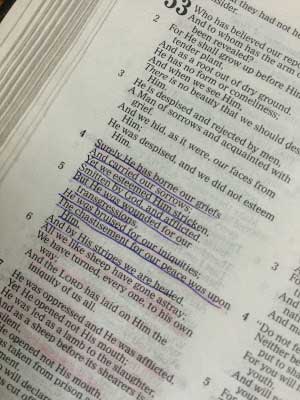
Isaiah 53 not a prophecy of Jesus

Isaiah 53

Isaiah 53 is not a prophecy of Jesus, unless you ignore its original context and only focus on the potential ‘hits’ and ignore the clear ‘misses,’ using a hazy ‘pesher’ approach to its interpretation.

The trouble for Evangelical apologists is that there are no clear ‘dying/resurrected Messiah’ passages in the OT. And Isa. 53 is only advantageous to Christian apologists if they pick and choose which parts of it to emphasize and which to de-emphasize. For instance:

  1. Was Jesus “despised [and] shunned by men?” According to Luke 4:15, he taught in the synagogue and everyone praised him. And huge crowds supposedly followed him, and he was described as making a ‘Triumphal Entry’ into Jerusalem (Matthew 21:8-11; John 12:12-13,17-19).

  2. Was Jesus ‘familiar with disease’ and ‘stricken by God’ (where the Hebrew word for ‘stricken’ is one that is used in the Hebrew Scriptures to stand only for leprosy as at Leviticus 13:3,9,20 and 2 Kings 15:5).

  3. Was Jesus silent before his accusers? In each of the four gospels Jesus opened his mouth and said something before his accusers, such as “You will see the Son of Man sitting at the right hand of the Mighty One and coming on the clouds of heaven.” Also, Jesus is accused of many things throughout the Gospels, like being a drunkard or possessed or breaking the law, or committing blasphemy and we can read his defense in each case, so Jesus had plenty of words for his accusers throughout his life per the Gospels. Christians read into the text that these were formal accusations as at a trial, but the text in Isaiah says no such thing, and as already stated, Jesus was not silent at his trial either, but is depicted as pronouncing counter judgment on his accusers by declaring that they would see the Son of Man coming soon.

  4. Was Jesusʼ “grave set among the wicked, and with the rich, in his death.” According to some Gospel passages there were no other bodies in the tomb in which Jesusʼ body was placed. So his grave was with himself, not with the wicked or with the rich. (“Among the wicked and with the rich” in Isa. 53 might also refer to two equally notorious groups if this is a Hebrew poetic parallelism). Nor does this passage say anything about a rich man providing a place for the servant. Christians read Gospel stories into such vague statements. (And perhaps the earliest Gospel author invented his story, adding “two bandits” on either side of Jesus on the cross, and having a man bury Jesus in “a tomb hewn of rock”—a tomb only a rich person could afford so that his Jesus story deliberately echoed the passage in Isaiah?)

  5. Was Jesus crushed by disease? “the Lord chose to crush him by disease, that if he made himself an offering for guilt, he might see offspring and have long life…” Did Jesus see any offspring, or have a long life?

  6. “Therefore I will allot him a portion with the great, and he shall divide the spoil with the strong.” Not sure how that applies to Jesus.

  7. Does Isaiah 53 mention the Messiah? Verse 1 does not actually say that the servantʼs message would not be believed, but merely asks, “Who can believe what we have heard?” There seems to be no prophecy there at all. Nor is there any indication that the servant would be arrested as a criminal or scourged or crucified with criminals or make intercession for his persecutors. None of that is in there. Verse 6 does say, “the Lord visited upon him the guilt of us all,” but there are other interpretations of that than the Christian one.

  8. There is a Judaic interpretation of Isaiah 53 that seems plausible. The suffering servant is the nation of Israel which is represented by King Uzziah, who was its king in Isaiahʼs time and who died of leprosy. According to Shmuel Golding, Isaiahʼs message may have been: “Here is your leprous king, who is in type suffering under Godʼs hand for you the backslidden servant nation of Israel” (which explains verse 6). Uzziah was taken away from the royal palace because of his affliction as a leper and spent his remaining years in isolation, which fits verse 8. Golding says the following:

    Israel is portrayed as a suffering servant on account of its anointed leader being stricken with leprosy. Israel, like the leper, is a suffering servant of God. Both have suffered humiliation at the hand of their fellowmen: the leper because of his unsightly appearance; Israel through its defeat at the hands of the Babylonians. The gist of the message is that Israel like the leper has suffered, but nevertheless will retain its identity in the form of the exiled Jewish people and that they will prosper in this form. [Shmuel Golding, The Light of Reason, volume II (Jerusalem: The Jerusalem Institute of Biblical Polemics, 1989), p. 36.]

    This interpretation of Isaiah 53 seems preferable to the Christian one because it does not suffer from drawbacks (1)-(6) mentioned above. It would also better explain the many changes of tense that occur in the chapter. And Israel is indeed referred to as ‘Godʼs servant’ (e.g., at Isa 49:3). However, the given interpretation does not make the chapter into a prophecy so much as an explanation of Israelʼs situation at around the time of Isaiah. At the very least, it shows, I think, that Isaiah 53 is not a clear example of a fulfilled prophecy (or set of fulfilled prophecies) in the Bible. So it is not any good support for premise (1) of the Argument from the Bible.

    Also, per Ehrman, Many readers fail to consider the verb tenses in these passages in Isa 53. They do not indicate that someone will come along at a later time and suffer in the future. They are talking about past suffering. The Servant has already suffered — although he “will be” vindicated.

Bart Ehrmanʼs Questions on Isaiah 53

Christians thought that Jesus was the messiah, and they knew that he had been crucified. And so they developed the idea that the messiah was supposed to be crucified. (And they started to appeal to non-messianic texts such as Isaiah 53 and Psalm 22 in support of their views.)… Second Isaiah (Isaiah 40-55), almost universally thought by scholars to be written by a different author from chapters 1-39 (themselves written by Isaiah of Jerusalem in the 8th c. BCE). Second Isaiah was writing after the destruction of Judah and Jerusalem (including the temple) in 586 BCE, while the leaders of the people and many of the elite had been taken into exile in Babylon, in what is known as the Babylonian Captivity… Several important points concerning Isaiah 53:

  1. It is to be remembered that the prophets of the Hebrew Bible are not predicting things that are to happen hundreds of years in advance; they are speaking to their own contexts and delivering a message for their own people to hear, about their own immediate futures;
  2. In this case, the author is not predicting that someone will suffer in the future for other peopleʼs sins at all. Many readers fail to consider the verb tenses in these passages. They do not indicate that someone will come along at a later time and suffer in the future. They are talking about past suffering. The Servant has already suffered — although he “will be” vindicated. And so this not about a future suffering messiah.
  3. In fact, it is not about the messiah at all. This is a point frequently overlooked in discussions of the passage. If you will look, you will notice that the term messiah never occurs in the passage. This is not predicting what the messiah will be.
  4. If the passage is not referring to the messiah, and is not referring to someone in the future who is going to suffer — who is it talking about? Here there really should be very little ambiguity. As I mentioned, this particular passage — Isaiah 53 — is one of four servant songs of Second Isaiah. And so the question is, who does Second Isaiah himself indicate that the servant is? A careful reading of the passages makes the identification quite clear: “But now hear, O Jacob my servant, Israel whom I have chosen” (44:1); “Remember these things, O Jacob, and Israel, for you are my servant” (44:21); “And he said to me, ‘You are my servant, Israel, in whom I will be glorified’” (49:3).

    The book of Second Isaiah itself indicates who the Servant of the Lord is. It is Israel, Godʼs people. In Isaiah 53, when the author describes the servantʼs past sufferings, he is talking about the sufferings they have experienced by being destroyed by the Babylonians. This is a suffering that has come about because of sins. But the suffering will be vindicated, because God will now restore Israel and bring them back to the land and enter into a new relationship with them.

    It may be fairly objected that the Servant is said to suffer for “our” sins, not “his” sins. Scholars have resolved that problem in a number of ways. It may be that the author is thinking that the portion of the people taken into exile have suffered for the sins of those in the land — some of them suffering for the sins of all. Those who have been taken into captivity have suffered displacement, loss, and exile for the sake of everyone else. But now the servant — Israel — will be exalted and restored to a close relationship with God — and be used by him to bring about justice throughout the earth.

    There may be problems with this interpretation — as there always are with every interpretation! — but the facts remain that the suffering servant is never described as the messiah, his suffering is portrayed as past instead of future, and he is explicitly identified on several occasions as “Israel.”

What Does Isaiah 53 Mean? How Best To Interpret it? Bibliography & Links to Online Sources

The “Servant of the Lord” in Isaiah: General Bibliography [Last updated 2015-05-18] click here.

Who Is the Servant of the Lord?: Jewish and Christian Interpretations on Isaiah 53 from Antiquity to the Middle Ages by Antti Laato, 2013, in-depth review by Alphonso Groenewald, click here.

“Kingship and Servanthood in the Book of Isaiah” by Ulrich Berges from a highly acclaimed volume published in 2014, The Book of Isaiah: Enduring Questions Answered Anew by Richard J. Bautch (Ed.), J. Todd Hibbard (Ed.), click here to read part of the article.

“For fundamentalists only: Isaiah 53 in context,” click here

Award winning Christian seminarian leaves the fold after examining the so-called Old Testament “Prophecies of Jesus” in detail: George Bethune English, The Grounds of Christianity Examined. For a bit of his story click here. For his view of Isaiah 53, click here and start reading at the paragraph beginning, “The next prophecy proposed to be considered, is the celebrated prophecy of Isaiah, consisting of part of the 52nd, and the whole of the 53rd chapter…”

Rabbi Tovia Singer (a conservative Jew who agrees that Scripture is inspired) defends Judaism against the Christian missionary selective quotation approach to the Hebrew Bible. Also does debates, and has recently re-edited his encyclopedic work that responds to numerous claims made by Christian missionaries, click here.

Fiddler Zvi disputes the Christian use of OT passages, including Isaiah 53, in an informative and entertaining fashion, click here.

Gerald Sigal, Isaiah 53: Who is the Servant? 307 pages, but a summary can be read for free by clicking here.

Uri Yosef, Counter Missionary Articles and Lessons, The Jewish Home. Click here then scroll down and click on the links to Identifying the “Suffering Servant.”

David Berger and Michael Wyschogrod, Jews & Jewish Christianity, a shorter work that discusses the use of Old Testament passages by Christians. Available for free along with many other pro-Jewish and anti-Christian missionary works, click here.

Rabbi Moshe Shulman, Judaismʼs Answer features many articles on Isaiah 53

Charles C. Hennell, An Inquiry Concerning the Origin of Christianity, 2d ed. (London: T. Allman, 1841), ch. 13, “On the Prophecies of Isaiah,” click here. See also, ch. 12, “On the Prophecies,” and ch. 14, “On the Prophecies of Daniel,” pp. 325-403

Michael Arnheim, Is Christianity True?, 1984, ch 6, “Fulfillment of Prophecy?”

Dewey M. Beegle, Prophecy and Prediction, 1978. An Evangelical Bible scholar and translator whose book on prophecy was composed in reply to various conservative views of Old Testament prophecy. Not available to read online, but copies can be obtained at oneʼs local library via inter-library loan. Info for Amazon purchase, click here. Beegleʼs testimony is also featured in Leaving the Fold: Testimonies of Former Fundamentalists.

Does “Atonement” Make Sense?

Does “Atonement“ Make Sense?

Donʼt Christians ever wonder why killing Godʼs son (whom they believe to have been “God the Son,” the second person of the “Trinity”) was not the greatest sin humans could ever commit? Humans killed God?! Isnʼt that the greatest sin anyone could possibly dream of ever committing? How could the humans who committed such a deed ever be forgiven except maybe by killing another divine savior to “atone” for killing the first one? And so on and so forth? At some point the cycle of “atonement” has to be broken by direct forgiveness. At some point direct forgiveness, not based on a bloody sacrifice, has to intervene to break the endless loop. Maybe thatʼs why Jesus himself did not believe that Godʼs forgiveness depended on a bloody sacrifice, but instead taught everyone to pray “in this way…Our Father…Forgive us our sins, as we forgive those who sin against us.” Simple. Direct forgiveness.

Has any theologian ever been able to demonstrate how “atonement” works, how physical pain unto death of an animal or person makes up for that time I talked back to my mother, or desired my neighborʼs wife or car? Sounds exactly like sympathetic magic. Or as comedian Doug Stanhope says, “‘Jesus died for your sins.’ How does one affect the other? I hit myself in the foot with a shovel for your mortgage. I donʼt get it.”

Or as my friend Tony Atkinson once asked, “How do ‘sins’ become something substantial in and of themselves? There are memories of being hurt, but ‘sins’ as substantial entities one can collect together and then place inside a body or soul? How do ‘sins’ become collected and where do they exist apart from being past acts? Are ‘sins’ the ‘bad’ memories of God? Do such memories ‘soil’ Godʼs mind? And he has to dispose of them? Is killing his own son a form of forgetfulness, a means of dissolving such memories? None of this makes sense.”

And is the Bible right about the life being “in the blood?” No, the life is in the brain and nervous system. We think nothing of blood transfusions, but cutting out part of oneʼs brain and replacing it with someone elseʼs is another more serious matter.

Also, Christianity comes along and suddenly all those bleeding animal sacrifices were for naught, because none of that animal blood did a thing, not if Christianity is true.

Also the scapegoat, the goat upon which the peopleʼs sins were placed, was NOT BLED, it “took the sins of the people” out into the desert. As for the Passover lamb in the Exodus story it did not die for anyoneʼs sins! It was so that the angel of death already saw death on the door posts of the Hebrews and didnʼt go in and kill their first born children. It was passing over those homes, but had nothing to do with any of the Jewish firstborn children inside those homes being sinners.

Though I admire Jesus for deploring the temptations of wealth, organized religion and its powerful sway, as well as hypocrisy, I no longer find the doctrines of either “original sin,” or “imputed righteousness” believable. I donʼt think the cosmos is the way it is simply because one human couple failed a test, nor do I believe that a man being executed 2000 years ago “paid the price” for the “worldʼs sins,” and we ought to “eat his flesh and drink his blood” for the forgiveness of sins, not even metaphorically. Sounds rather paganish, echoing vampirism or cannibalism, a theology taken right out of the ancient superstitious caldrons of blood sacrifice and appeasement. Sympathetic magic.

That being said, I saw the film, The Passion, and was moved when Jesusʼ mother ran toward him when he was being forced to carry the cross. As she struggled to reach out to her son who had just fallen carrying the cross she recalled the time Jesus fell as a child and she rushed to help him. My eyes teared up at that scene in the film. But the rest of the film was a blood orgy that did not move me any more than seeing any other human being unjustly tortured and murdered. I didnʼt feel ‘forgiven’ after watching the film, nor closer to God.

Though when I was young and raised Catholic I felt such a connection, and even cried after reading the Gospel stories of Jesusʼ death “for me, for me, for me.” (Ah, the self interest angle of Christianity, so prominent even in its hymns. Jesus loves me… This I know. Died for me. Me. Me. Me.) The Christian schema doesnʼt make sense to me anymore, neither intellectually nor emotionally. But direct forgiveness and people showing compassion to other people does.


Whenever I forgive someone Iʼm relatively straightforward and direct about it. But for God it takes a bloody miracle.


After the missionary explained the Bibleʼs superior civilized plan of salvation to several natives, one of them replied, “Like you, we love our gods and seek to love one another. What we do not understand is why your god tried to pin down sin by using His son as a voodoo doll.”


Christianity is merely paganism with a more successful advertising campaign.


Christianity teaches that Jesus had to die, or God couldnʼt forgive sins, not a single sin, not unless Jesus died first.

So why isnʼt Judas a “Saint?”


Conversation, A.D. 33

A: Have you heard the latest?

B: No, whatʼs happened?

A: The world has been redeemed!

B: You donʼt say!

A: Yes, the Dear Lord took on human form and had himself executed in Jerusalem; and with that the world has been redeemed and the devil hoodwinked.

B: Gosh, thatʼs simply lovely.

Arthur Shopenhauer


We relate to the suffering of a wide range of species not just human suffering. It was even discovered that deer react to the sound of a crying baby of almost any mammal species, not just the cry of a baby deer. But how does such empathy in nature provide evidence for the truth of any one religion in particular? It doesnʼt. Which reminds me of a poem…

Chipmunk Crucifixion

No chipmunk had to be crucified

on a tiny cross of twigs

To save all the other chippies,

Had to have nails pounded

through his little paws,

Had to take upon himself

all the sins of all the chippies

that ever were or would be

and die in agony

So that after they died

all the chippies

could live again forever,

But only if they believed

in all the sayings and doings

of the chipmunk crucified

on the tiny cross of twigs.

Antler, Last Words


Letʼs not forget that Jesus (after a few hours of pain) rose from the dead and ascended to a throne in heaven. So in essence, nobody really “killed” Jesus; it was more like a fraternity hazing, or an early version of the TV show, “Fear Factor,” where you endure all kinds of [fill in blank with favorite expletive] to win a valuable prize.

SOURCE: T-Shirt Hell Newsletter, 2/25/04


In the beginning God was perfect and whole, needing nothing.

Then he said, “I need an itch to scratch, Iʼll create humans. Of course I see that most of them will suffer, first on earth (where they shall be born into a world of pain, ignorance, swept up by hormonal waves of emotion, and experience uncertainty, dread, miscommunication), with eternal woes to follow for those who didnʼt ride the right waves of holy emotion by falling head over heels in love with Jesus of Nazareth and/or the writings of his disciples, nor interpret what was written with theological correctness.”

“Also, be it known that I cannot forgive anyone anything, not until Blood Is Shed. I know I had Jesus teach people that I would forgive those who forgave others—but I only truly forgive after BLOOD is shed. And a millennia of shedding animalʼs blood will be just for show, but ineffective. No genuine atonement will be achieved until Jesus of Nazareth bleeds to death. And even the blood of Jesus was shed in vain for the vast majority of doomed humanity who are going to wind up in hell anyway.”


For those who defend the idea of eternal wrath being meted out to people after mere decades spent in a “fallen,” confusing, painful and frustrating cosmos, one with fear, prejudice, cultural biases, mental blindness, ignorance, and demons running free (thank God for leaving Satan and his demons on earth), then I guess thereʼs not much in the way of reasonable conceptions of justice anyone can say to such a person. Because they believe it is perfectly just for God to arrange things such that people get born in a frying pan, only to be tossed into the fire, without reprieve, forever.

I say to such people, you can have your jealous God of wrath, who kills millions in the Bible while Satan kills a handful (and Satan even has to beg Godʼs permission to do so, so all the killings are ultimately Godʼs in the Bible).


Jews do not make material sacrifices on their holiest day of the year, the day of atonement. They offer a contrite heart on that holiest of days, based on teachings in the psalms and books of their prophets. The prophets in the Bible were at odds with the priests on the matter of the importance of material/animal sacrifices and the “shedding of blood.” Jesus himself taught people to pray, “Forgive us Father as we forgive others.”

Christians have differed in their understandings of what Jesusʼ death signified. Limited atonement or universal? Bloody or nonviolent (see the book listed at the end)? Theological brouhahas have continued throughout the history of Christian theology over the meaning and significance of Jesusʼ death. Some examples below:

  • 1500-1600s
    The Extent of the Atonement: A Dilemma for Reformed Theology from Calvin to the Consensus (1536-1675) (Studies in Christian History and Thought) by G. M. Thomas (2007)
  • 1600-1700s
    Atonement and Justification: English Evangelical Theology 1640-1790: An Evaluation by Alan C. Clifford (1990)
  • 1700s-1800s
    Atonement Controversy: In Welsh Theological Literature and Debate, 1707-1841 by Owen Thomas (2002)
  • 1800s
    Modern Anglican Theology: Chapters On Coleridge, Hare, Maurice, Kingsley And Jowett And On The Doctrine Of Sacrifice And Atonement (1859) by James H. Rigg (2008)
  • A Treatise on Atonement (1858) by Hosea Ballou. (Famed Universalist preacher from the Victorian era)
  • George MacDonaldʼs Challenging Theology of the Atonement, Suffering, and Death by Miho Yamaguchi (2007) MacDonald was a famous Victorian Universalist.
  • 1900-2000s
    Dostoevsky on Evil and Atonement: The Ontology of Personalism in His Major Fiction by Linda Kraeger and Joe Barnhart (1992) Dr. Barnhart is an ex-Christian. His testimony appears in Leaving The Fold: Testimonies Of Former Fundamentalists
  • The Atonement (Problems in Theology) by Michael M. Winter (1994)
  • Jesus and the Doctrine of the Atonement: Biblical Notes on a Controversial Topic by Gerd Lüdemann (1998) Gerd is an ex-Christian and former Lutheran theologian.
  • Cross Purposes: The Violent Grammar of Christian Atonement by Anthony W. Bartlett (2001)
  • Christus Victor: An Historical Study of the Three Main Types of the Idea of Atonement by Gustaf Aulen and A. G. Herbert (2003)
  • Problems With Atonement: The Origins Of, And Controversy About, The Atonement Doctrine by Stephen Finlan (2005)
  • The Promise of Peace: A Unified Theory of Atonement by Alan Spence (2006)
  • The Nature of the Atonement: Four Views by Thomas R. Schreiner, James Beilby, Paul R. Eddy, and Gregory A. Boyd (2006)
  • Atonement and Violence: A Theological Conversation by J. Denny Weaver, Thomas N. Finger, T. Scott Daniels, and Hans Boersma (2006)
  • Options on Atonement in Christian Thought by Stephen Finlan (2007)
  • What About the Cross?: Exploring Models of the Atonement by Waldron Byron Scott (2007)
  • The Atonement Debate: Papers from the London Symposium on the Theology of Atonement by Derek Tidball, David Hilborn, and Justin Thacker (2008)
  • Oxford Readings in Philosophical Theology: Volume 1: Trinity, Incarnation, and Atonement by Michael C. Rea (2009)
  • The Idea of Atonement in Christian Theology by Rashdall, Hastings (2009)
  • Historic Theories of Atonement by Robert Mackintosh (2009)
  • The Atonement and the Modern Mind by James Denney (2009)
  • The Atonement in modern religious thought : a theological symposium by Anonymous (2009)
  • Christus Victor: An Historical Study of the Three Main Types of the Idea of the Atonement (Spck Classics) by Gustav Aulen and A. G. Herbert (2010)
  • The Nonviolent Atonement (Paperback) Wm. B. Eerdmans Publishing Company (2010) J. Denny Weaver “Sharp debates about the death of Jesus sparked by feminist and womanist theologians are the current cutting edge of discussions about Christology and atonement”
    From Publishers Weekly: Evangelical Christians sing hymns in which blood figures prominently; one in particular is called “Nothing But the Blood.” Such Christians may have to change their tune after reading J. Denny Weaverʼs The Non-Violent Atonement, which proposes that the idea of ‘satisfaction atonement’ must be jettisoned in favor of a nonviolent approach. Jesusʼ death, says Weaver, was not planned or sanctioned by God the Father; it was the inevitable result of sinful humans taking matters into their own hands. Perhaps the new hymn can be called “Everything But the Blood”?