Showing posts with label Young-Earth Creationism. Show all posts

Leading I.D.ists & Creationists Admit Evidence that Humans & Apes Share Common Ancestry

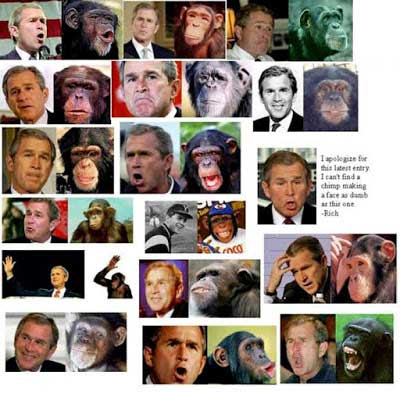
Bush and Ape
The evidence for common ancestry is so overwhelming that even the biologist Michael Behe (whose books advocate “intelligent design,” and who is a senior member at the Discovery Institute) concurs. Behe wrote in his second book:
“Evolution from a common ancestor, via DNA changes, is very well supported” (p. 12).
“[O]ne leg of Darwinʼs theory—common descent—is correct” (p. 65).

Sorry Creationists, Death Existed Since “The Beginning”

Death Existed Since “The Beginning”

I used to be a young-earth creationist, but realized I could not defend the idea of “no death before the Fall of Adam and Eve.” For instance, plants are alive, their cells have the same basic structures as those in animals, like a nucleus, cytoplasm and cell wall, and they died per Genesis 1, not because of sin, but because they were given as food. And the mere fact that ‘food’ had to be given implies that death by ‘starvation’ was also

Pawn Sacrifice. How the Bobby Fischer phenomenon inspired future grandmasters, Michael Rodhe, John Fedorowicz (The Fed), Joel Benjamin & their non-grandmaster teammate, My Three Years of Chess Bliss, 1973-1975

Bobby Fischer

The movie Pawn Sacrifice brought back a flood of chess memories… including a queen sack of mine that appeared in a syndicated chess column published in 200 papers, my Woody Allenesque piece in Chess Life magazine, “Losing is Everything,” and several future grandmasters (one of whom was inducted into the U.S. Chess Hall of Fame) against whom I competed, and also teamed up with (to come in 1st in the

Young-earth creationists, Henry Morris, Ken Ham, and Jason Lisle fail to provide insight into the cosmos. Lisle's answer to "The Distant Starlight Question" (Alternate Synchrony Convention) fails to add scientific weight to young-earth creationism

Beginning with a classic quotation from Henry Morris, founder of the Institute for Creation Research, whose book, The Genesis Flood, inspired Ken Ham to create his own young-earth organization and Creation Museum…

As far as distant stars and galaxies are concerned, there is no evidence either in science or Scripture, that any of them have planets.
—Henry Morris, The Biblical Basis for Modern Science (Grand Rapids: Bier Book House, 1984) p. 244

A year after Morris published that comment astronomers discovered…

“Beta Pictoris was one of several nearby stars embedded in clouds of dust-clouds that look very much like planetary systems in the act of formation. Furthermore, if it was simply a uniformly distributed disk of dust, then looking edge on through such a disk should block out most of Beta Pictorisʼ light. Since we can clearly see the star, the inner parts of the disk probably do not contain much dust-which is exactly what one would expect if the material had already condensed into planets.”—M. Mitchell Waldrop, “First Sightings,” Science 85, June, 1985

Young-earth creationists

As of February 1, 2017, there have been over 3,500 exoplanets in over 2,500 planetary systems and over 600 multiple planetary systems confirmed. Click here for latest listing.

The worldʼs newest and most powerful exoplanet imaging instrument, the Gemini Planet Imager (GPI), was designed to capture infrared images of exoplanets, and captured its first image Jan. 2014. But even before that Imager was implemented we had visual images of exoplanets via standard techniques:


The earth is the center of Godʼs interest in the universe, with the sun, moon, and stars merely providing various essential services for the earth and its inhabitants. —Henry Morris, The Biblical Basis for Modern Science (Grand Rapids: Baker Book House, 1984), p. 162

Doesnʼt the light of stars extend in all directions to the farthest reaches of the universe, and not merely “provide” such “service” to the “earth and its inhabitants?”

In fact countless stars blaze away countless kilowatts of energy in every corner of this vast cosmos for no apparent purpose while the earth—which God allegedly worked on for “five” out of the “six days of creation”—receives only an infinitesimal portion of the energy expended by even the nearest star, the sun.

How “essential” is the light produced by the two trillion or more galaxies (per 2017 data) that we know about in our cosmos? When you look up outside on a dark night, you can see thousands of stars. But the Milky Way has two hundred billion stars in it. Youʼre only seeing a tiny tiny fraction of the number of stars tooling around the galaxy. In fact, with only a handful of exceptions, the most distant stars you can readily see are 1000 light years away—but the cosmos contains stars starting with our nearby sun that lay only about a light minute or two away, all the way to stars that lie over 13 billion light years away. Worse, most stars are so faint that they remain invisible even when they are much closer than 1000 light years away. In fact our nearest star, the Sun, is too dim to see from farther than about 60 light years away… and the Sun is pretty bright compared to most stars. So the little bubble of stars we can see around us is just a drop in the ocean of the Milky Way. With the naked eye you can only see 0.000003% percent of the stars in the galaxy we live in, and nothing but two dim dots in the sky correspond to two galaxies one can see with the naked eye, with over two trillion more galaxies out there in the depths of space and time, each containing tens to hundreds of billions of stars.

If the light of the moon was arranged so as to provide “essential services” for people on planet earth, then why do other worlds exist with more moons than the earth? A couple thousand years after the Bible was written, astronomers discovered a curious thing about that “great lamp” the moon, which was allegedly created for “signs and seasons” on earth and to “rule the night.” They discovered that Mars has two moons. Yet Mars has no people who need their steps “lit” at night, or who need to know the “signs and seasons” [literally, times of worship]. Even more curiously, it was discovered that Neptune has four moons, Uranus has eleven, Jupiter has sixteen, and Saturn has eighteen moons (one of them, Titan, is even larger than the planet Mercury). The earth was created with just one moon, and it “rules the night” so badly that for three nights out of every twenty-eight it abdicates its rule and doesnʼt light the earth at all—at which time I suppose creationists may bump into each other in the dark.


The Distant Starlight Problem Stated:

When we look into regions or space lying more than several thousand light-years away (try tens of thousands, millions, billions of light-years away) we see two trillion or more galaxies spinning, rings of matter expanding from explosions in the distant past, pulsars pulsing, stars changing in brightness or exploding, even wandering planets that have long escaped from their orbits around distant stars. But if the speed of light takes a year to travel a certain distance then what we are observing are things that happened in the very distant past of the cosmos, a past far older than any young-earth creationist is willing to accept. To quote young-earth creationist Ken Ham,

Now - let me add this. Weʼre not going to have all the answers. There will be some things like the issue of light from the farthest star in a young universe… we donʼt have all the answers. —Ken Ham, Answers in Genesis iTunes Podcast “Sermon: Six Days & The Eisegesis Problem”, time into program: 1:09:12

Like Ham, his fellow YEC, Jason Lisle, admits that most attempts by young-earth creationists to explain away the distant starlight problem fail [see the ENDNOTE to read Lisleʼs admissions]

Lisleʼs Solution

Lisle assumes or rather guesses that maybe light travels at near infinite speeds when it is headed toward the earth from distant stars. He cites the current debate in physics over whether the speed of light is a “constant” or a “convention.” Experimentally speaking, we can apparently only measure the speed of light when it is traveling in one direction, so we will never know exactly how fast it might be traveling in the opposite direction, say between two mirrors. If the speed of light is viewed as a “convention” then measurements of the speed of light here on earth cannot by themselves resolve the issue of how fast light is traveling in any particular direction or in the cosmos at large, and neither would varying speeds of light affect other constants in the cosmos. Itʼs a complicated debate. But Jason utilizes the debate by assuming it is over, and also adds additional assumptions. He has to assume that God has rigged the cosmos since the beginning so that light travels at near instantaneous speed (simultaneously from every star) when it is traveling “toward the earth.” That assumption goes way beyond what science can actually say.

To quote Lisle:

“Itʼs possible the stars were created on Day Four… and that their light reached earth on Day Four… in the same way that a plane on earth can leave at 4:00PM and arrive at its destination at 4:00PM as long as itʼs going west, which wonʼt work going in other directions. Likewise this would only work for light coming towards the earth. But thatʼs the only place we need to get it really, cause God made those lights in the firmament to shine upon the earth anyway.”
—Dr. Jason Lisle - The Distant Starlight Mystery

Still Waiting These Past Two Years for Lisleʼs Response to the Challenge Others Have Put to His Distant Starlight Answer

Two years ago Lisleʼs alleged solution to the creationist “Starlight Problem” was challenged by the math of Einsteinʼs General Relativity. Critics confronted Lisle with a handful of different mathematical and observational arguments that refuted his alleged solution to the Starlight Problem, which he calls “ASC” [Anisotropic Synchrony Convention]— one point being that his ASC would in require a gravitational field that ought to be observable, but isnʼt observed. In his only response, two years ago today, Lisle promised to explain why old-eartherʼs are wrong and his model is the one and only true one.

Lisle: Iʼve seen this criticism [observable gravity field] but I havenʼt responded yet. It is very easy to refute. I plan on doing a series on this blog on the topic of ASC, in which I will refute this and other criticisms made by those who have not studied the topic. [Jason Lisle, comment September 11, 2012 at 6:18 pm]

Still, no response from Lisle, see here for a far more in-depth discussion of Lisleʼs attempted solution to the distant starlight problem.


Lisleʼs Additional Guesses

Among Lisleʼs added guesses is that God could have created galaxies in mid-collision, and created rings of expanding stellar matter in mid-explosion which tell the tale of an explosion long ago that never happened in reality. (One wonders how this helps creationism seem more scientific. Lisle is offering mere guesses to try and uphold his view that the cosmos is only thousands of years old. And one need not stop piling on such guesses, but might just as well continue guessing with equal abandon that maybe God created some species in the act of already going extinct [in mid-extinction], or created the earth with fossils of long dead [long exploded] species already buried in the earth that never took a breath in the first place.)

Lisle denies that any new stars are forming because Genesis 1 says that God made “the sun, moon, and the stars also,” and “set them in the firmament” on “Day four,” and God never mentions anything about new stars being created or formed after He created the heavens and the earth. So Jason denies that new stars continue to arise in various places throughout the cosmos. (I hope Jason has a Google Alert set for the phrase “star formation” because I get several hits on that topic every week from some of the best astronomy sites on the internet.)

The star-forming region, known as Monoceros R2, sits in a massive dark cloud thatʼs rich in molecules and dust. The scene is packed with massive, young stars.

The central parts of the starburst galaxy NGC 1313. The very active state of this galaxy is very evident from the image, showing many star formation regions. A great number of supershell nebulae, that is, cocoon of gas inflated and etched by successive bursts of star formation, are visible.

Lisle also continues to promote the view that the “circle of the earth” in Isaiah is a revelation from God of the earthʼs sphericity, when it is no such thing, click here for instance, though many Evangelicals have already debunked such a claim after noting how “circle of the earth” always referred to a flat earth in the ancient world.


How About the Evidence for Stellar Evolution & the Long Lives that Stars Appear to Have Behind Them as Well as Ahead of Them?

To quote one young-earth creationistʼs admission…

“Perhaps the most important remaining question [in astronomy] for [young- universe] creationists is the origin of the turnoff points in the H-R diagrams of different clusters. The stars are real physical objects and presumably follow physical laws; we would rather not take the easy way out by saying simply that ‘God made them that way.’ But if creationists take the position of rejecting stellar evolution, they should provide a feasible alternative.”
—Paul Steidl [young-universe creationist], The Earth, the Stars, and the Bible (Grand Rapids: Baker, 1979), p. 153 — as quoted by Howard J. Van Till in The Fourth Day: What the Bible and the Heavens Are Telling Us about the Creation (Grand Rapids: Eerdmans, 1986), p. 239

To quote a similar admission by another young-earth creationist…

“The theory of stellar structure appears to be founded on a good physical basis and…stellar evolution is intimately related to stellar structure… If creationists wish to scrap stellar evolution completely, then it is incumbent on us to rework stellar structure and/or physics in a convincing fashion… The standard observational tool used in studying stellar structure and evolution is the Hertzsprung-Russell (H-R) diagram… It consists of a plot of stellar luminosity increasing upward and temperature increasing to the left…Most stars are found on a roughly diagonal band called the main sequence (MS)… This agreement is quite impressive and the physical assumptions that go into it are so well founded it is doubtful that many creationists would have much to argue with in main sequence (MS) stellar structure. However, what is generally called post MS evolution is not far removed from the brief outline of stellar structure given above. The most massive stars may pass through successive steps of fusing helium nuclei with increasingly more massive nuclei up to iron…Note that these transitions have not actually been observed. However, they are based on physics principles and will naturally occur… The upshot is that the most massive stars have MS lifetimes of only a few hundred thousand years (of course, still much longer than young-age creationists would allow), while the lowest mass stars have MS lifetimes approaching 100 billion years… And evolutionary assumption concludes that the stars in a star cluster should form from a single cloud so that the members represent…a homogenous group. Different clusters should have different ages, and though they technically have different compositions, even large differences in composition do not seriously affect the overall appearance of an H-R diagram…”

“The agreement of the theory [of stellar evolution] is quite impressive…”

“[The expected evolutionary] trend between globular and open clusters is observed…”

“Evidence [exists] that the formation of planetary nebulae and the evolution of white dwarfs are related…These two ages have a very good correlation…”

“A similar relationship holds for neutron stars and supernova remnants. As with planetary nebulae, the expansion velocity and observed size of the remnant can be used to estimate the time since the explosion…Where a pulsar can be identified in a supernova remnant, the ages of the remnant and the pulsar are well correlated.”

“Very brief discussions of stellar structure and evolution have been presented. Though it would seem that creationists would not have much with which to quarrel in the former, most would largely dismiss the latter. However, the two are intimately related, and one cannot be rejected without seriously calling into question the other. We are appealing to readers to give much attention to the study of stellar evolution.”
—Danny R. Faulkner and Don B. De Young [young-universe creationists], “Toward a Creationist Astronomy,” Creation Research Society Quarterly, Vol. 28, Dec. 1991, pp. 87-91

Additional Difficulties For Young-Earth Creationism & Admissions

YECʼs admit that SN 1987A poses a problem

This webpage consists of an email thread from a discussion group at the American Scientific Affiliation website, a major national organization consisting of Christian men and women who are professional scientists, most of whom are old-earth creationists and theistic evolutionists, with some young-earthers. The ASA is older than Henry Morrisʼ ICR and Morris actually quit the ASA to form the ICR after having some of his pet young-earth and flood geology hypotheses questioned by scientists who were ASA members.

What Does the Bible Say?

The Bible does not list the number of planets in our solar system. Back then, planets were called “wandering stars” because they appeared to be tiny lights in the sky like all other “stars,” but the ancients noted that some “stars” did not rotate in the same enormous circle each night round the pole star as did all the rest. In fact, the word “planet” is derived from the Greek word for “wanderer.” The “wandering stars” known by the ancients included Mercury, Venus, Mars, Jupiter and Saturn. Add the above five “wanderers” to the sun and moon which also traced their own unique paths across the sky, and you get a total of seven major heavenly objects that stood out from the stars. The ancients imagined that these seven were special gods overseeing the earth below. For instance, the Babylonians referred to the “watchful eye” of Shamash, the sun, who notes all things; and a prayer to Nergal (Mars) states, “With Sin (the Moon) in Heaven thou perceivest all things.” Compare the Hebrew notion that “these seven [lights] are the eyes of the Lord which range [wander] to and fro throughout the earth” (Zechariah 4:10). Nor does the Bible reveal that its authors were aware of the earth being one more “wandering star” like the rest. Instead, “the heavens and the earth” are spoken of as the two halves of creation with the earth forming a firm foundation and the heavens “spread out” above it in an equally “firm” fashion.

According to Genesis 1:16 only “two” great lamps were created. The Hebrew term translated as “great lights” in Genesis, means literally, “great lamps”—the two great lamps being the “Sun” and the “moon.” (Calvin in his Commentary on Genesis, agreed that the moon shone with some light reflected from the sun, but he also stubbornly asserted that the moon “must… be a fiery body… it is also luminous.”) They had no recognition of the fact that every twinkle in the sky might be another great lamp like the sun, or that other moon existed, circling other worlds, some of those worlds having many more moons than our own. Rather, the Bible depicts stars as relatively small objects, created after the earth and “set” in the firmament above it.

Astronomers, not theologians, discovered that we live on one planet out of 9 known planets in our solar system, circling one star out of nearly a billion in our galaxy, a star that lies near the end of one curved arm of that galaxy with two trillion or more additional galaxies lying hidden in the depths of space—and only sighted recently by mankindʼs first space telescopes. Furthermore, beyond our system of planets lay a gargantuan ring of matter, i.e., the Kuiper belt (visually confirmed in the late 1990s), and our Kuiper belt resembles similar rings of matter that have been observed circling nearby stars. So it is assumed that our star looks from a distance pretty much like other nearby stars. Most recently, hundreds of planets have been detected circling nearby stars, including some visual confirmations. As astronomers continue to develop more powerful telescopes they have begun to focus on smaller planets orbiting nearby stars, planets the size of earth. As far as such scientific visions of the cosmos are concerned, one does not seek them out in the Bible. Yet many Christians today continue to seek out “scientific” truths in the Bible.

Endnote

1. Dr. Lisle points out that varying the “speed of light” part of Einsteinʼs equation, E[energy]=M[matter] times C[the speed of light] squared, would result in difficulties concerning mass and hence gravity (objects falling off the planet), or even result in difficulties concerning energy (with radioactive decay happening so fast that deadly mutations multiplied, and the planet might even melt). For instance. Lisle states,

“The speed of light might have been much greater than it is today. But thereʼs some potential problems with this model, and this is why a lot of creationists have abandoned this idea… You see, the speed of light is not arbitrary. It is linked to nature. There are a lot of things that depend on the speed of light being “just so.” Let me give you one example. Another famous equation, E=mc2, Einsteinʼs famous formula. And that equation relates energy and mass. E = the energy of something, and m = the mass that that something possesses, and those two quantities are related by the speed of light which is the c in that equation, the speed of light squared in fact, which is quite large, because the speed of light is large, the speed of light squared is very very large. Which means that if something has very little mass to it, it has an enormous amount of energy… [So if the speed of light was infinite or near infinite at creation and then slowed down to its present speed] either energy (e) had to go down or mass (m) had to go up. One of those two things would have had to have happened. So you imagine earth orbiting the sun, it orbits because itʼs got orbital energy (e) so if the speed of light decreased, the energy drops and the earth would plummet into the sun potentially, and thatʼs not good. The other possibility is that maybe the mass (m) goes up to compensate for that change in the speed of light, and that would work too, but if the earth and the sun become more massive, the gravity increases and the earth falls into the sun again. So you get sort of the same answer. So this argument only works if other constants also decreased rapidly at the same rate as a change in the speed of light… Another point is, is this testable? What would we expect to see in the universe if in fact the speed of light has decayed? Iʼve looked at a lot of images of the universe. Thereʼs nothing that shouts out to me that the speed of light has decreased in time.”
—Dr. Jason Lisle—The Distant Starlight Mystery (2/5)

Evolution Is Not a Theory in Crisis according to prominent creationists

Young Cosmos Creationists

But regardless of the general evidence not favoring their side, the more highly educated creationists invoke various ingenious explanations to explain away the evidence for an old earth and evolution. Such explanations may include the idea of “virtual history,” or, “creation with appearance of age,” and lastly, “the deliberate rejection of Godʼs word” [that does not allow secular scientists to understand and accept the true age of the cosmos]:

Aardsma & the Virtual History Hypothesis

Young-cosmos creationist, Aardsma (Ph.D. in nuclear physics from the University of Toronto) believes that his “virtual history” hypothesis is less problematic than the usual creationist excuse of “creation with apparent age.” Aardsma even admits at one point below that “I think there is enormous evidence of biological evolution (meaning extensive changes to flora and fauna)—-again, in virtual history.” But not in real history. Read his explanation of virtual history below and see if you are convinced:

“To one thinking consistently in a virtual history framework, the phrase ‘creation with appearance of age’ seems at best a redundancy, at worst a heresy, and in the middle (just to cover all the ground) an absurdity. So there are, obviously, some differences. I havenʼt had to articulate these differences to many people to the present time, so it is still not easy to explain what I can ‘see.’ In addition, it gets harder to think in the Creation with Appearance of Age paradigm the longer you think in the Virtual History paradigm —- kind of like trying to make yourself play the piano wrong after years of training to play right. So consider the following comments to be a rough draft.”

“The two ideas share some similarity, but differ at a basic level both philosophically and theologically. Creation with Appearance of Age gives the impression that God arbitrarily painted a facade of age over the creation — that He could have chosen to leave everything looking its ‘real’ created age (i.e., roughly 7000 years, by my best Bible chronology reckoning) if He had wanted to, but He chose instead to make things look much older. This immediately raises theological objections: ‘But why would God do such a thing? Isnʼt it fundamentally dishonest to make something look like it isnʼt? Isnʼt God being deceitful?’” (This is where the “heresy” mentioned above comes from.)

“The virtual history view never encounters this problem. It says that the people who are saying ‘creation with appearance of age’ donʼt understand properly what the word/idea ‘creation’ means. The virtual history view goes to the analogy of human creations to try to show what ‘creation’ means. It takes the creation of a story by a human author as (probably its best) analogy. It observes that in all such stories one always has a virtual history present—-grown characters wearing sewn garments and living in already built houses… right from page one of the story. What is implied from page one of the story is a cause-and-effect virtual history to the story, stretching back into the indefinite past. This virtual history in no way contradicts the actual date (in the story charactersʼ time) of creation of the story. (That ‘date’ we would fix at page one of the book, since that is when, in the story frame of reference, the story world comes into existence.) We find by such analogies that an ‘appearance of age’ is inherent in what ‘creation’ means.” (This is where the “redundancy” mentioned above comes from.)

“But this ‘appearance of age’ is not an add-on and is not arbitrary. Try to imagine writing a story which does not have an ‘appearance of age’. After you have completed that exercise, try to imagine writing a fiction story which has a false ‘appearance of age’. I find that it is intrinsically impossible to create such stories. I.e., you cannot have a ‘creation with an appearance of age’ if you mean by that anything other than a creation with its inherent virtual history. To ask for a creation with a false appearance of age (which includes the case of a creation having no appearance of age), is to ask for the impossible/ridiculous.” (This is where the ‘absurdity’ mentioned above comes from.)

“We are living in a ‘story’ God created. God is both author and reader of this story (e.g., ‘For in Him we both live and move and have our being.’ Acts 17:28.) (Note how this works. A story-world has no existence in the book; its existence is in the mind of the author and readers.) Page one opens about 7000 years ago our time, (the only time frame we have access to). This ‘story’ has a virtual history stretching back billions of years. We find this to be the case by computing the time it would take light to travel from remote galaxies we see in the sky, or by computing the time it would take radioactive elements, such as uranium dug from the earth in natural ores, to decay as much as they have. These great ages in no way negate the fact that page one opens 7000 years ago. Nor does our virtual history, with all its dinosaurs etc. negate the fact that we are created. All stories have virtual histories and no story yet has ever created itself—-all have had an author/creator. And the fact that our (fallen) virtual history shows eons of death and savagery and futility merely says ‘amen’ to what Romans teaches, that the whole creation has been subjected to futility by God as a consequence of the entrance of sin, in hopes of its eventual redemption (Romans 8:20). [And, if I may stray from the point a bit, the ‘story’ is still being written/read, and God allows us to take a real part in its unfolding by our prayers and actions—-so the Bible shows.]”

“This raises one more major point of difference, the handling of the Fall. Briefly, Creation with Appearance of Age runs into a theological snag with things like fossils of fish with other smaller fish in their stomachs: ‘Do you mean that God chose to paint, of all things, a facade of Suffering and Death onto the creation when He gave it this arbitrary appearance of age at the time of creation?’ The virtual history paradigm recognizes simply that all creation type miracles entail a virtual history, so the Fall, with its creation type miracles (by which the nature of the creation was changed —- ‘subjected to futility’) carried with it its own (fallen) virtual history, which is the virtual history we now see. We do not see the original utopian pre-Fall creation with its (presumably utopian) virtual history. … Yes, I believe there was an ‘ice-age’. Actually, there were several ice-ages. They were all in virtual history. The last one ended about 10,000 years ago. So it doesnʼt enter into real history, since Creation happened just over 7,000 years ago. Since my work is designed to defend the historical truth of the Bible against charges that what it reports as history is in fact fiction, I have not had much cause to talk about the ice-ages so far. (In my understanding of virtual history and the past, one can just accept what the scientists specializing in these fields are telling everyone is their best understanding/reconstruction of these past events. These reconstructions do not attack the historical integrity of the Bible in any way once one understands the concept of virtual history.)”

“Actually, I think there is enormous evidence of biological evolution (meaning extensive changes to flora and fauna)—-again, in virtual history. Note that the Bible does not say that biological evolution CAN NOT happen; it says that biological evolution Did Not happen. That is, the Bible clearly teaches that we got here by Creation, not by Evolution. ‘In the beginning God Created the heavens and the earth,’ not ‘In the beginning God Evolved the heavens and the earth.’ But none of this excludes the possibility of biological evolution in virtual history. In fact, the teaching in Romans 8:20, that the creation was subjected to futility at the time of the Fall, meshes rather well with evolution being the thing seen in the virtual history data, for the hallmark of evolution is not purpose, but random chance and meaninglessness.”

“The Grand Canyon should also be understood just as the standard scientists describe its formation. It too is a virtual history phenomenon.”

“Virtual history is not a hard idea. Just think about what it means to actually CREATE something. Creating a story is a helpful analogy. Take ‘The Hobbit’ as an example of a created entity. Now step into the book with Bilbo on page one and begin to examine the world around you. Everything you see and examine around you has already, on page one, an extensive built-in virtual history. Bilbo is in his 50ʼs as I recall. So he has a virtual history. His house has been dug back into the hill, implying someone did some digging. If you examine the tunnels you can no doubt find tool marks left by the workmen. His front door is made of wood, implying trees grown, sawn into planks, planed, and fastened together by craftsmen, all before the story begins. And on and on it goes…Bilboʼs clothing with all those stitches, and the soil in his yard and garden with humus from long-dead leaves, …”

“We are living in a Creation. The creation we are living in is a story of Godʼs making. It opens on page one 5176+/-26 B.C. (by my best reckoning so far). The story moves from Creation to Fall to Flood to Exodus to Birth of Christ to Crucifixion to Redemption to ultimate Restoration of all things. This story is our reality, but it is not ultimate reality. (God is ultimate reality—-He transcends the story just as any author transcends their created story.) And like any story, it has, necessarily, a virtual history built in from page one onward.”

“The big take-home point is that evidence of virtual history—-of even millions or billions of years of this or that process operating in the past—-does not and cannot falsify the fact of creation in a created entity. So we can let the virtual history data about the Grand Canyon or the ice ages or whatever else speak for itself and say whatever it seems to say. We do not have to resort to foolishness (e.g., denying the validity of tree-ring calibrated radiocarbon dates) to try to wipe out every trace of any natural process prior to the biblical date of Creation. We understand virtual history to be part and parcel of any created thing, so evidences of such processes do not threaten our faith or falsify the Bibleʼs claim that we got here by supernatural creation just over 7000 years ago.”
Source: “Correspondence: Virtual History”


Young Earth Creationist Todd Wood Has a Ph.D. in Biochemistry & Experience in the Field of DNA Analysis. He Admits the Same Things Aardsma Does.

Evolution is not a theory in crisis. It is not teetering on the verge of collapse. It has not failed as a scientific explanation. There is evidence for evolution, gobs and gobs of it. It is not just speculation or a faith choice or an assumption or a religion. It is a productive framework for lots of biological research, and it has amazing explanatory power. There is no conspiracy to hide the truth about the failure of evolution. There has really been no failure of evolution as a scientific theory. It works, and it works well… I say these things not because Iʼm crazy or because Iʼve ‘converted’ to evolution. I say these things because they are true. Iʼm motivated this morning by reading yet another clueless, well-meaning person pompously declaring that evolution is a failure… Creationist students, listen to me very carefully: There is evidence for evolution, and evolution is an extremely successful scientific theory. That doesnʼt make it ultimately true, and it doesnʼt mean that there could not possibly be viable alternatives. It is my own faith choice to reject evolution, because I believe the Bible reveals true information about the history of the earth that is fundamentally incompatible with evolution. I am motivated to understand Godʼs creation from what I believe to be a biblical, creationist perspective. Evolution itself is not flawed or without evidence. Please donʼt be duped into thinking that somehow evolution itself is a failure. Please donʼt idolize your own ability to reason. Faith is enough. If God said it, that should settle it. Maybe thatʼs not enough for your scoffing professor or your non-Christian friends, but it should be enough for you.”
Source: “The truth about evolution”

And see this post in which some of Toddʼs fellow creationists wonder if heʼs not a closet evolutionist for admitting thereʼs evidence for evolution.

On the other hand, see this post in which Todd discusses his view of creationism and why he doesnʼt think it is a pseudoscience but a genuine alternative to evolution that needs to develop its own hypotheses and theories related to “baraminology.”

As for Toddʼs credentials, he has a Ph.D. in biochemistry from the University of Virginia (Charlottesville, 1999). His Ph.D. advisor was Dr. William Pearson, the original developer of the widely popular FASTA suite of computer programs used for DNA analyses. When providing a reference for Todd in his subsequent academic position application, Dr. Pearson stated “he was the best graduate student I ever had.” Immediately following his Ph.D. work at Virginia, Dr. Wood accepted a position as the Director of Bioinformatics at the Clemson University Genomics Institute (Clemson, SC) which at that time, was directed by Dr. Rod Wing, a world famous scientist in the field of plant genomics. After working for about two years at Clemson University, Dr. Wood accepted a faculty position at Bryan College (Dayton, TN) in 2002 where he now serves as the Director of the Center for Origins Research and Associate Professor of Science. He helped start the Baraminology Study Group (for creationists who are trying to scientifically determine what a biblical “kind” is). Todd has organized two conferences on baraminology. He is currently an Assistant Professor at the Center for Origins Research and Education at Bryan College and is also active at church, singing in the choir and teaching Sunday school.


Kurt Wise, Another YEC with a Ph.D. Admits Some Evidence “fits the evolutionary prediction quite well.”

And “could turn against creationism.”

Segment from a NYT article (“Rock of Ages, Ages of Rock” by Hanna Rosin) in which Wise admits the fossil transitions seen throughout time in the geologic record “fits the evolutionary prediction quite well” :

The heads of all the leading scientific creationist institutes from several countries showed up for the Cedarville event, along with the movementʼs other stars: John Baumgardner, a geophysicist who worked for 20 years at Los Alamos National Laboratory; Kurt Wise, who got his Ph.D. in paleontology from Harvard in the ʼ80s as a student of Stephen Jay Gould, the nationʼs most famous opponent of creationism; and Marcus Ross, 31, the latest inductee into the movement, who got his Ph.D. in environmental science from the University of Rhode Island last summer.

Like any group of elites, they were snobs about their superior degrees. During lunch breaks or car rides, they traded jokes about the “vulgar creationists” and the “uneducated masses,” and, in their least Christian moments, the “idiots on the Web.” One leader of a creationist institute complained about all the cranks who call on the phone claiming to have seen dinosaurs or to have had a vision of Noahʼs ark. (How Noah fit the entire animal kingdom onto the ark is a perennial obsession.)

Because they have been exposed to so much standard science, the educated creationists like Kurt Wise try not to allow themselves the blind spots of their less sophisticated relations. Some years ago, for instance, fellow creationists claimed to have found fossils of human bones in Pennsylvania coal deposits, which scientists date to millions of years before humans appeared. After examining them, Wise concluded that they were “not fossil material at all” but “inorganically precipitated iron siderite nodules.” Wise later pushed to get himself appointed as scientific adviser to the new creationist museum so he could “keep out the scientific garbage.”

In a presentation at the conference, Wise showed a slide of a fossil sequence that moved from reptile to mammal, with some transitional fossils in between. He veered suddenly from his usual hyperactive mode to contemplative. “Itʼs a pain in the neck,” he said. “It fits the evolutionary prediction quite well.” Wise and others have come up with various theories explaining how the flood could have produced such perfect order. Wise is refining a theory, for example, that the order reflects how far the animals lived from the shore, so those living farthest from the water show up last in the record. But they havenʼt settled on anything yet.

“We have nothing to fear from data,” Ross told me. “If weʼre afraid, it means we donʼt trust Godʼs word.” The older generation of creationists “would come up with an explanation or a model and say, ‘This solves it!’ Iʼm a bit more cautious and at the same time more rigorous. We have lines of possibility that we continue to advance but at the same time we recognize that this is science, so the explanations are subject to change with new discoveries.”
Source: “Rock of Ages, Ages of Rock”

In a 1995 article by creationist paleontologist Kurt Wise he admitted the following:

In various macroevolutionary models, stratomorphic intermediates might be expected to be any one or more of several different forms: – … It is a Very Good Evolutionary Argument… Of Darwinismʼs four stratomorphic intermediate expectations, that of the commonness of inter-specific stratomorphic intermediates has been the most disappointing for classical Darwinists. The current lack of any certain inter-specific stratomorphic intermediates has, of course, led to the development and increased acceptance of punctuated equilibrium theory. Evidences for Darwinʼs second expectation - of stratomorphic intermediate species - include such species as Baragwanathia27 (between rhyniophytes and lycopods), Pikaia28 (between echinoderms and chordates), Purgatorius29 (between the tree shrews and the primates), and Proconsul30 (between the non-hominoid primates and the hominoids). Darwinʼs third expectation - of higher-taxon stratomorphic intermediates - has been confirmed by such examples as the mammal-like reptile groups31 between the reptiles and the mammals, and the phenacdontids32 between the horses and their presumed ancestors. Darwinʼs fourth expectation - of stratomorphic series - has been confirmed by such examples as the early bird series,33 the tetrapod series,34,35 the whale series,36 the various mammal series of the Cenozoic37 (for example, the horse series, the camel series, the elephant series, the pig series, the titanothere series, etc.), the Cantius and [p. 219] Plesiadapus primate series,38 and the hominid series.39 Evidence for not just one but for all three of the species level and above types of stratomorphic intermediates expected by macroevolutionary theory is surely strong evidence for macroevolutionary theory. Creationists therefore need to accept this fact. It certainly CANNOT said that traditional creation theory expected (predicted) any of these fossil finds. [p. 221]

In fairness, Wise goes on to claim that this evidence is “explainable” under the creation model, postulating as an alternative the scientific model that “God created organisms according to His nature” (p. 219), which apparently leads to the expectation of “high homoplasy” – because God, I assume, likes homoplasy.
Source: “Honest creationist Kurt Wise on transitional fossils”

“…creationists still struggle with defining the baramin [the biblical ‘kind’] and justifying baraminology methodology, and evolutionists have found ample opportunity for criticism.”
— Todd Charles Wood, Kurt P. Wise, Roger Sanders, N. Doran, “A Refined Baramin Concept,” Occasional Papers of the Baraminology Study Group, July 25, 2003 Number Three [To be fair the creationist authors do wind up convincing themselves by the end of their paper that they have come up with a new refined concept of “baramin” that can spark loads of convincing new creation research]

Wise sums up his view this way:

“Although there are scientific reasons for accepting a young earth, I am a young-age creationist because that is my understanding of the Scripture. As I shared with my professors years ago when I was in college, if all the evidence in the universe turns against creationism, I would be the first to admit it, but I would still be a creationist because that is what the Word of God seems to indicate. Here I must stand.”
Source: “In Six Days, Why 50 Scientists Choose to Believe in Creation”

And in his book, Faith, Form, and Time,” Wise wrote:

“A face-value reading of the Bible indicates that the creation is thousands of years old. A face-value examination of the creation suggests it is millions or billions of years old. A reconciliation of these two observations is one of the most significant challenges to creation research. Much more research must be devoted to this question to produce an acceptable resolution.”

Wise acknowledges that he embraces a minority view in scientific and academic circles, including Christian educators. At the most recent national conference of geologists, the creationists numbered a handful of the 8,000 attending; even in an Association of Christian Geologists meeting, Wise was in the minority. The overwhelming sway of evolution in public education doesnʼt bother him. But he sees little support among Christian educators for the theory he embraces. “I donʼt see a day in my lifetime when young-earth creationism will become accepted in the church,” Wise said. “I have no idea how to convince believers [the earth is young]. People who have a particular position on this issue arenʼt at all convinced by evidence.” Adding, “When I talk to an unbeliever, I donʼt want to talk about whether scientific evidence is consistent with a flood or a young earth,” Wise said. “The most important issue to speak about with unbelievers is their status before God and their eternity. [Otherwise], youʼre not talking about the most important issue.”
Source: Baptist Press, “‘Worldview shapes oneʼs conclusions about creation,’ Kurt Wise writes”

Wise also mentions the problems that evolution poses for a creationist biblical world view in his review of a book by Gould:

As [Stephen J.] Gould [one of Wiseʼs professors at Harvard] explains so well, however, a scientifically orthodox understanding of earth history includes many facts that are at odds with the idea that man was a purposeful product of the evolution. Why is it, for example, that for two thirds of the history of the earth, life proceeded no further than bacteria? Why is it that for half of the remaining one third of earth history, life remained one-celled? What is to be made of the possibility that two unsuccessful attempts at multicellularity preceded the one that finally initiated the line to humans? Why was the evolution of mammals delayed for 100 million years by the parenthetical note of the development, domination, and demise of the ‘terrible lizards’? Why is it that it took 99,999 out of the 100,000 units of time in the history of this universe for man to come about? And finally, if man is in Godʼs image, does God look like the ape who bore us? Although not expressly designed as a polemic against theological theories of accommodation, Gouldʼs arguments nonetheless bear upon them. The very nature of God comes into question if He chose evolution as a means to form man. The literal reading of the macroevolutionary history of the earth is that man is an accident—at best an afterthought of natureʼs process.
Source: “Truly A Wonderful Life” Review of: Gould, Stephen Jay, 1989


A Similar Ad Hoc Idea Was Suggested By William Dembski, Old-Earther And I.Dʼist, who suggests in his book, The End of Christianity: Finding a Good God in an Evil World, that “…at the heart of this [Dembskiʼs] theodicy is the idea that [Adam and Eve were real and lived in a paradisical creation, but…] the effects of the Fall [i.e., death, carnage in the world of living organisms] can be retroactive as well as proactive (much as the saving effects of the cross stretch not only forward in time but also backward, saving, for instance, the Old Testament saints)… An omnipotent God unbound by time can make natural evil predate the Fall and yet make the Fall the reason for natural evil.” Dembski adds that an evolutionist, supposedly a theistic one, can also employ his theodicy.

Which brings us back to the statements above by Aardsma, Wood and Wise, who claim that one can be a young-earth creationist and accept all of the data for an old-earth. To them itʼs merely a matter of the young-earther having a different interpretation of the data.

Andrew Snelling “The Creation Model: Itʼs Past, Present and Necessary Future,” at the 6th International Creation Conference, finds the problem not to be scientific so much as “spiritual, a deliberate rejection of Godʼs word”:

“What if there was absolutely no evidence that the universe was young? No scientific evidence the universe was young. Would you still believe that it was young? Why? Because Godʼs word teaches it. Thatʼs the only reason you need to have to believe the universe is young. Godʼs word says it, therefore I believe it. Thatʼs not to say the evidences are not important. Of course they are. Because weʼre commanded to have a reason for the hope, and to give reasoned answers for what we believe and why we believe it. But we must always remember our Biblical foundations.”

“So often we fight over the scientific evidence, but are we winning by leaving out our Biblical foundations? Too much of our creation apologetics has therefore been based on the evidence alone. We need to keep arguing from the level of world views. Because ultimately the problem that people have is spiritual, the deliberate rejection of Godʼs word.”

Does the Bible “Teach” Geocentrism?

Geocentrism remains a minority opinion but a lively one among some creationist Christians. See poster below advertising one of their conferences, a joint affair, featuring both Catholic and Protestant speakers:
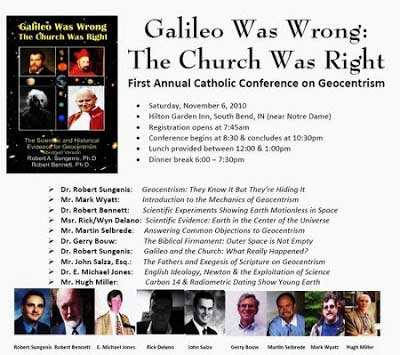
Geocentrism

Geocentrists remain hopeful even in this heliocentric age because as Gerardus Bouw (Ph.D. in astronomy, president of the Association for Biblical Astronomy and the countryʼs leading proponent of geocentrism) puts it:

“As long as people have some faith in Scripture, thereʼs a future for it.

“I would not be a geocentrist if it were not for the Scriptures.

“The only way we can know for certain whether or not geocentricity is true would be to leave the universe, take a look around outside the universe, and then come back in to tell us what is really happening in that larger scope. Since God is infinitely greater than the universe, and so extends beyond the universe, what God says must present the ultimate case … God, in His Word, consistently teaches geocentricity.”

Compare Bouwʼs words above with these:

“The only way we can determine the true age of the earth is for God to tell us what it is. And since He has told us, very plainly, in the Holy Scriptures that it is several thousand years in age, and no more, that ought to settle all basic questions of terrestrial chronology.” [Henry Morris, founder of the Institute of Creation Research]

Bouw converted to geocentrism only after meeting Walter Van der Kamp and studying Scripture further. Van der Kamp came to creationism relatively late in life and had not gotten far in his research when something began to trouble him about the relationship of creationism to heliocentrism: If Genesis 1 clearly states that God created the sun and the moon on the fourth day in order to rule an already existing day and night on an already existing earth, when did the earth begin to move, and how did we ever get the idea that it was the earthʼs rotation toward and away from the sun that caused day and night, rather than the light that God so dramatically created in Genesis 1:3? Besides, would God really have created a planet, set it into orbit around nothing, then four days later placed a random minor star at the center of that orbit? Obviously, something didnʼt add up. Unless geocentrism was true.

Robert Sungenis, another geocentrist, has an interesting past. He was raised Catholic but became an Evangelical Christian, graduated from a pro-inerrantist Reformed Christian seminary (Westminster Theological Seminary), and later returned to Catholicism before becoming a geocentrist.

Both Bouw and Sungenis admit that some of their fiercest critics are fellow creationist Christians who “want to downplay” geocentrism as much as possible.

For instance, the creationist organization, Answers in Genesis, dismisses geocentrism with several arguments including the observation that “the question of the earthʼs physical position is less important than the spiritual reality of Godʼs love for his people.” But isnʼt that similar to the way Theistic Evolutionist Christians dismiss creationism? i.e., with the observation that “the question of whether humans were created directly from the dust of the earth or not is less important than the spiritual reality of Godʼs love for his people.” Bouw points out that Answers in Genesis is not being consistent, “You canʼt say that one part of the Bible is more credible than another part simply because you feel uncomfortable with what it says.”

Bouw adds that quite a few creationists are closet geocentrists, “including some bigwigs.”

What does the Bible say? Bouw points out that it speaks with divine assurance of the earthʼs “foundations” and that God “has established the world, it shall not be moved.” Bouw asks heliocentric Christians whether they can honestly interpret such speech as Godʼs way of communicating “the relative stability of the earthʼs orbit as it follows its circuit through the heavens?”

He points out that to heliocentrists the earth remains incessantly in motion—rotating daily—revolving annually—and over longer periods of time the tilt of its axis wobbles in a small circle. Heliocentrists are forced to admit that the Scriptures never praise God for exerting His vast power to keep the earth in constant motion, but only praise Him “for establishing the world so that it can not be moved.” What does that imply about Godʼs inability to inspire human writers with true cosmic knowledge concerning creation? If all the Bibleʼs passages that assume geocentrism and daily solar movements and God directing the annual ups and downs of the constellations as they cross the horizon are all untrue—and God is NOT exerting His power to hold the earth still, and the sun is NOT moving daily across the sky, NOR is God “directing” the seasonal movements of the constellations higher or lower above the earthʼs horizons, then what about the truth of Genesis 1-11? How can Young-Earth creationists claim the authority of “Godʼs plain speech” for how THEY interpret what God uses His powers for, but geocentrists must abandon theirs?

The Scriptural Basis for a Geocentric and or Flat Earth Cosmology

Non-Canonical Religious Texts That Agree With Scriptural Ones in Assuming the Truth of a Geocentric Cosmology

The Fathers of the Christian Church Were Geocentrists

The Fathers of the Protestant Reformation Were Geocentrists:

People gave ear to an upstart astrologer who strove to show that the earth revolves, not the heavens or the firmament, the sun and the moon. Whoever wishes to appear clever must devise some new system, which of all systems is of course the very best. This man wishes to reverse the entire science of astronomy; but sacred Scripture tells us that Joshua commanded the sun to stand still, and not the earth.
Martin Luther, Table Talk

The Illustration Of The Cosmos On The Right Appeared In Lutherʼs Translation Of The Bible.

“Scripture simply says that the moon, the sun, and the stars were placed in the firmament of the heaven, below and above which heaven are the waters … We Christians must be different . . . in the way we think about the causes of things. And if some are beyond our comprehension like those before us concerning the waters above the heavens, we must believe them rather than wickedly deny them or presumptuously interpret them in conformity with our understanding.”
Martin Luther, Lutherʼs Works. Vol. 1. Lectures on Genesis, ed. Janoslaw Pelikan, Concordia Pub. House, St. Louis, Missouri, 1958, pp. 30, 42, 43.

The eyes are witnesses that the heavens revolve in the space of twenty-four hours. But certain men, either from the love of novelty, or to make a display of ingenuity, have concluded that the earth moves; and they maintain that neither the [stars] nor the sun revolves…Now, it is a want of honesty and decency to assert such notions publicly, and the example is pernicious. It is the part of a good mind to accept the truth as revealed by God and to acquiesce in it.
Melanchthon, famous Protestant Reformer and dear friend of Luther who helped carry on his legacy.

Those who assert that ‘the earth moves and turns’…[are] motivated by ‘a spirit of bitterness, contradiction, and faultfinding;’ possessed by the devil, they aimed ‘to pervert the order of nature.’
John Calvin, sermon no. 8 on 1st Corinthians, 677, cited in John Calvin: A Sixteenth Century Portrait by William J. Bouwsma (Oxford Univ. Press, 1988), A. 72

The heavens revolve daily, and, immense as is their fabric, and inconceivable the rapidity of their revolutions, we experience no concussion — no disturbance in the harmony of their motion. The sun, though varying its course every diurnal revolution, returns annually to the same point. The planets, in all their wandering, maintain their respective positions. How could the earth hang suspended in the air were it not upheld by Godʼs hand? (Job 26:7) By what means could it [the earth] maintain itself unmoved, while the heavens above are in constant rapid motion, did not its Divine Maker fix and establish it? Accordingly the particle, ape, denoting emphasis, is introduced — YEA, he hath established it.
John Calvin, Commentary on the Book of Psalms, Psalm 93, verse 1, trans., James Anderson (Eerdmanʼs, 1949), Vol. 4, p. 7

Bouw also mentions that in the modern cosmos there is no true “up” or “down.” The earth is not higher or lower than anything else in the cosmos, including the stars which “the Jews were tempted to worship” because they imagined them as being above them and divine. The earth is merely one cosmic wanderer among others, neither above nor below “the stars.” Only in a geocentric cosmos is there a firmly established sense of “up and down,” speaking of which, Bouw also introduces an argument based on the relationship between Godʼs throne in heaven and His footstool below. At the very least one can see how the metaphor of a divinely established throne with an unmoved footstool might have appealed to ancient geocentric [and/or flat earth] biblical writers. Bouw writes:

“Isaiah 66:1 and Acts 7:49 both state, ‘Thus saith the LORD, The heaven is my throne, and the earth is my footstool: where is the house that ye build unto me? and where is the place of my rest? [i.e., the Temple]’

“It is usual for thrones and footstools to be at rest relative to each another. As Professor James Hanson has put it: ‘Footstools are not footstools if they are moving.’”

“Compare Lamentations 2:1: ‘How hath the Lord covered the daughter of Zion with a cloud in his anger, and cast down from heaven unto the earth the beauty of Israel, and remembered not his footstool in the day of his anger!’”

“From I Chronicles 28:2,7 Psalm 99:5 and Psalm 132:7 we know that ‘his footstool’ is the Temple upon which ‘the LORD looks down, and beholds from heaven’ (Lamentations 3:50 and 51). This is not heliocentric talk. Godʼs footstool has not moved. It is right where he left it. The Temple mount, Mount Moriah, is still under his throne as it was at the time of Isaacʼs sacrifice (Genesis 22), at Davidʼs purchase of the threshing floor (II Samuel 24:18-25), at the destruction of the Temple (Lamentations, Jeremiah 52), and at the millennial return (Ezekiel 40-48).”

Geocentrists also also focus on verses in which the sun is commanded not to move. Job 9:7 says, God “commands the sun, and it does not rise.” This can not be a case of the sun merely “appearing” not to rise, because it is the sun to which God addresses His command. Itʼs true that this line is spoken by Job, who, as a man, may be mistaken, but Bouw believes this passage is a prophetic reference to an incident known as Joshuaʼs long day. Joshua 10 recounts a day in which, according to inspired Scripture, Joshua commanded the sun not to move, instead of the earth, and, “the sun stood still in the midst of heaven, and hasted not to go down about a whole day.” An obvious rejoinder by a heliocentrist is that if God had inspired the words, “God commanded the earth to stand still,” and, “the earth stood still,” no reader until the 16th century would have understood him. But Bouw labels this as the central heresy of the church—the heresy that the Creator of earth, sun and cosmos was incapable of inspiring human beings to say what He actually commands, moves and does. The God of the cosmos, creator of language, could not have somehow inspired His people to speak of the “circuit of the earth” instead of the “circuit of the sun?”

To quote Bouw:

“Both the anthropocentric theory of inspiration and the phenomenological-language theory are forms of accommodation where God is said to accommodate his wording to the understanding of the common man. Though that may sound good on the surface, accommodation still maintains that God goes along with the accepted story even though he really does not believe it.”

God leaves his followers with the job of continually revising the meaning of Scripture over the centuries in reaction to advances in scientific knowledge such that a rejection (in the 1600s) of geocentric biblical astronomy was only the beginning. It was followed (in the late 1700-early 1800s) by the rejection of a worldwide Flood and rejection of a young-earth. Which was followed by the rejection (in the mid-to-late 1800s) of the special creation of Adam and Eve from the dust of the earth.

Given the capitulation to heliocentrism, says Bouw, the demise of special creation was inevitable. “By the time evolution comes around, well, you gave in on the geocentric thing: Scripture doesnʼt teach how the heavens go, it teaches how to go to heaven. Fine, evolution is like that too, it has nothing to do with how to get to heaven, so thereʼs no contradiction.” Geocentrists view their work as a necessary component of creationism.

Additional Similarities Between Creationists And Geocentrists

[SOURCE: Man in the Middle: An Exclusive Cut Excerpt from Rapture Ready! by Daniel Radosh]

“Having spent a considerable amount of time talking with creationists, I recognized fundamental similarities between their approach and that of the geocentrists: the emphasis on casting doubt on established theories rather than developing their own testable hypotheses; the claim that all theyʼre asking for is an open debate. And Sungenis also echoed creationists’ assertions that they donʼt deny fossil evidence but merely interpret it in a different way. ‘We also have to backtrack on the experiments that were done that were interpreted in the heliocentric framework and ask if they can be interpreted in the geocentric framework,’ he said. ‘And we find that that is the case. That is exactly the case. All the experiments have been done for us already, its just a matter now of showing the world that those very experiments donʼt prove for modern science what they are said to prove.’”

“Another similarity between creationism and geocentrism is that when a typical scientific ignoramus — such as myself — encounters an expert in the field, he will quickly find himself drowning in a swamp of what sure sounds like science. At one point, Bouw sought to dismiss a common objection to geocentrism, which is that if the entire universe is revolving around the earth, the stars would have to be traveling faster than the speed of light in order to complete the rotations observed each day. ‘There are a couple of ways to object to that,’ Bouw explained. ‘First of all, relativity does not deal with rotation, so rotation can be beyond the speed of light. But even if thatʼs not the case — even if you just strictly take the view that all you have is gravitational rotation — because E=mc2, when you use the formula for gravity, you have to replace the m by E/c2, and so then the centrifugal energy — the energy used as the centrifugal force, the kinetic energy there — and even the potential energy — are big enough that they increase the tension so much that the speed of light changes locally. The speed of light is dependent on the strength of the gravitational field: the stronger the field, the faster it goes. And so if the universe is being held together by gravity, out beyond even twenty billion light years or so, itʼs still going to hang together. The gravitational tension is going to be huge, the speed of light is going to be tremendous — much larger, actually, than the speed of rotation — but the physics does work that way.”

“Does it? You tell me.”

“In Walter van der Kampʼs memoir there is a point when he asks himself if by clinging to geocentrism, he isnʼt merely repeating the error of ancient Christians who believed the earth was flat. And then he seems to wonder if that even was an error.”

“One should not so quickly deride these old-time pillars of staunch orthodoxy who predicted and feared that accepting the heathenish Ptolemaic sphericity in the long run would lead to the negation of Godʼs message altogether. It was Jerusalem contra Athens, revelation against human reasoning. In A.D. 748, Saint Boniface, apostle to the Germans, complained that a certain abbot, Vergilius, held the heresy of the existence of antipodes; and many of us, had we been there, might well have sided with the formerʼs literalism against the latterʼs liberalism.”

“Are there still flat-earthers? The Flat Earth Society, an organization whose name is synonymous with delusion, died in 2001 along with its final president Charles K. Johnson, although it has recently been revived with unclear earnestness. The society, founded in 1956, grew out of a movement that began in England in the mid-19th century. Like geocentrism, flat-earthism was as much a religious belief as a scientific one. Members of the Flat Earth Society — there were reportedly a few hundred in 1980 — believed in the plain language of scripture. Didnʼt God say he had “stretched out the earth” (Psalm 136:6) and could “take hold of the ends of the earth, that the wicked might be shaken out of it” (Job 38:13)? Even photographs of the planet from space — alleged photographs — could not sway them from Godʼs word.”

The late Robert Schadewald, while not an exponent of a “flat earth,” wrote several articles on its advocates, past and present, unfortunately he was not able to finish his magnum opus, a book titled, The Plane Truth: A History of Flat Earth Science. But he sent me [Ed Babinski] a couple emails in 1999 to let me know that flat earthism was not quite extinct. Robert said, “Charles Johnson of the Flat Earth Society is sort of a wacky character, but he is not really representative of flat earthers in general. The half dozen or so other flat earthers Iʼve spoken or corresponded with have included a successful Boston trial lawyer, a priest who belongs to a society devoted to the preservation and translation of ancient Coptic manuscripts, a retired financial officer from a major metropolitan school system (he thoughtfully corrected an error in Greek grammar I had copied from a flat earth source), and a young man who intended to translate an 8th century flat earth treatise by Aethicus of Istria from Latin into English. Not exactly a bunch of semiliterates!” He added, “The Antiochene Fathers of the early Christian Church more or less invented the historical-critical method of exegesis popular among modern fundamentalists within the Reformed tradition. Not surprisingly, *every* Antiochene Father whose views on the subject I have been able to discern was a flat earther! So I think it is a bit strong to suggest that this method doesnʼt have ‘anything to do with the history of Scriptural interpretation.’ It may have been moribund for a long time, but it has ancient roots.” [SOURCE: Emails dated 8/10/99 and 8/5/99 respectively from Robert J. Schadewald] See also The Flat Earth Bible by Robert J. Schadewald

Which reminds me, Evangelical theologian Ben Witherington wrote this in Bible Review in 2003:

“In the late 1960s, my car broke down in the mountains of North Carolina, and I had to hitchhike… I was picked up by an elderly couple driving an ancient Plymouth. After a little conversation, I discovered they were ‘Flat-Eathers,’ by which I mean they did not believe the world was round.

“Honest.”

“I pressed them on this and asked, ‘Why not?’”

“The elderly manʼs response was, ‘It says in the Book of Revelation that the angels will stand on the four corners of the earth. The earth couldnʼt have four corners if it was round.’”
[SOURCE: Ben Witherington III, “Asking the Right Question: To Get the Most Out of the New Testament, You Need to Know What Kind of Book Youʼre Reading,” Bible Review (April, 2003) p. 10.]

The 1920ʼs Scope Trial journalist, H. L. Mencken, ran into some flat earthers in Tennessee and they showed him a signed petition they were planning to deliver to their state congressmen to get their sacred flat earth beliefs acknowledged in public school classrooms.

Today many top notch Evangelical OT scholars have given up on attempting to squeeze history out of Genesis 1, or even out of Genesis 1-11. See the BIOLOGOS website.

What does Gerardus Bouw have to say about verses in the Bible that appear to assume a flat earth?

“I investigated it, yes,” he said. “I donʼt see that the scriptures teach a flat earth… But I have no problem defending a flat earth if I have to. Because itʼs a theoretical construct. I can defend a spherical earth too. Just pick your geometry, thatʼs all.”

To End This Blog Entry With The Question With Which It Began, “Does The Bible ‘Teach’ Geocentrism?”

Thereʼs no simple yes or no answer to such a question if only because geocentrism was so much taken for granted at that time that it could be treated as a given, a universal assumption, and thus there was no need to “teach” it. The same could be said about “flat-earth-ism” pre-600 BCE in the Near East.

Which leaves open the question of what other “assumptions” the Hebrew writers of the Bible took for granted concerning kingship, laws, gods, religious beliefs and rites? How can one know they are “true” assumptions or whether they need to be reinterpreted based on later knowledge, like the geocentric passages in the Bible? This also raises the question of whether the Scriptures can indeed “interpret themselves?” Can they?


Top 3 Things About Evolution That Revolt Creationists The Most

I suspect thereʼs more than just logic behind the way some Christians react to the idea of evolution, thereʼs also a conscious or unconscious revulsion to common ancestry, THREE of them in fact:

Top 3 Things About Evolution That Revolt Creationists The Most

Revulsion #1

“I ainʼt no Monkeyʼs Uncle!”

“1996 presidential contender, Pat Buchanan, said something along the lines of ‘You may believe that youʼre descended from monkeys, but I believe youʼre a creature of God.’ I guess that Buchanan hadnʼt considered that one of the basic tenets of Christianity is that God is the Creator of everything, including ‘monkeys.’ It seems to me that one of the basic reasons behind the so-called ‘creationism’ is the feeling that somehow parts of Godʼs creation are not worthy of being our ancestors.”
Tom Scharle

However, Christians like C. S. Lewis were not threatened by the thought of a species of thinking religious animal:

“When the rationality of the hross tempted you to think of it as a man… it became abominable—a man seven feet high, with a snaky body, covered, face and all, with thick black animal hair, and whiskered like a cat. But starting from the other end you had an animal with everything an animal ought to have… and added to all these, as though Paradise had never been lost… the charm of speech and reason. Nothing could be more disgusting than the one impression; nothing more delightful than the other. It all depended on the point of view.”
C. S. Lewis, Out Of The Silent Planet (a Christian science-fiction novel)

And certain ironies arise from denying so vehemently that one is not a “Monkeyʼs Uncle,” while affirming that humanity was created from the “dust of the earth,” because, isnʼt it just as respectable to be a “modified monkey” as “modified dirt?” Or as Will Rogers put it during the Scopes Monkey Trial in the 1920s:

“The Supreme Court of Tennessee has just ruled that you other states can come from whoever or whatever you want to, but they want it on record that they come from mud only!… William Jennings Bryan tried to prove that we did not descend from the monkey, but he unfortunately picked a time in our history when the actions of the American people proved that we did… Some people certainly are making a fight against the ape. It seems the truth kinder hurts. Now, if a man didnʼt act like a monkey, he wouldnʼt have to be proving that he didnʼt come from one. Personally I like monkeys. If we were half as original as they are, we would never be suspected of coming from something else. They never accuse monkeys of coming from anybody else… You hang an ape and a political ancestry over me, and you will see me taking it into the Supreme Court, to prove that the ape part is O.K., but that the political end is base libel… If a man is a gentleman, he doesnʼt have to announce it; all he has to do is to act like one and let the world decide. No man should have to prove in court what he is, or what he comes from. As far as Scopes teaching children evolution, nobody is going to change the belief of Tennessee children as to their ancestry. It is from the actions of their parents that they will form their opinions.”

Revulsion #2

“If you teach people theyʼre monkeys, theyʼll act like monkeys.”

A second revulsion is related to the question of the origin of ethical values. Ethical values like “forgiveness,” are assumed to be mysterious and sublime ideas that we owe primarily to a few millennia of Judeo-Christianity. However as Frans de Waal pointed out:

“Monkeys, apes, and humans all engage in reconciliation behavior (stretching out a hand, smiling, kissing, embracing, and so on), so such behavior is probably over thirty million years old, preceding the evolutionary divergence of these primates… Reconciliation behavior [is thus] a shared heritage of the primate order… When social animals are involved…antagonists do more than estimate their chances of winning before they engage in a fight; they also take into account how much they need their opponent. The contested resource often is simply not worth putting a valuable relationship at risk. And if aggression does occur, both parties may hurry to repair the damage. Victory is rarely absolute among interdependent competitors, whether animal or human.”
Frans De Waal, Peacemaking Among Primates (see also, Morton Hunt, The Compassionate Beast: What Science is Discovering About the Humane Side of Humankind; and, Alfie Kohn, The Brighter Side of Human Nature: Altruism and Empathy in Everyday Life; and see especially the chapter on “Kindness” in de Waalʼs latest work, Our Inner Ape.)

“When Washoe [the chimpanzee] was about seven or eight years old, I witnessed an event that told about Washoe as a person, as well as causing me to reflect on human nature. [The account proceeds to describe the chimp island at the Institute for Primate Studies]…One day a young female by the name of Cindy could not resist the temptation of the mainland and jumped over the electric fence in an attempt to leap the moat. She hit the water with a great splash which caught my attention. I started running toward the moat intent on diving in to save her. [Chimps cannot swim.] As I approached I saw Washoe running toward the electric fence. Cindy had come to the surface, thrashing and submerging again. Then I witnessed Washoe jumping the electric fence and landing next to the fence on about a foot of bank. She then held on to the long grass at the waterʼs edge and stepped out onto the slippery mud underneath the waterʼs surface. With the reach of her long arm, she grasped one of Cindyʼs flailing arms as she resurfaced and pulled her to the safety of the bank…Washoeʼs act gave me a new perspective on chimpanzees. I was impressed with her heroism in risking her life on the slippery banks. She cared about someone in trouble; someone she didnʼt even know that well.”
Roger Fouts, “Friends Of Washoe” Newsletter

“We are told by those who assume authority in these matters, that the belief in the unity of origin of man and brutes involves the brutalization and degradation of the former. But is this really so? Could not a sensible child confute by obvious arguments, the shallow rhetoricians who would force this conclusion upon us? Is it, indeed, true, that the Poet, or the Philosopher, or the Artist whose genius is the glory of his age, is degraded from his high estate by the undoubted historical probability, not to say certainty, that he is the direct descendant of some naked and bestial savage, whose intelligence was just sufficient to make him a little more cunning than the Fox, and by so much more dangerous than the Tiger? Or is he bound to howl and grovel on all fours because of the wholly unquestionable fact, that he was once a fertilized egg cell, which no ordinary power of discrimination could distinguish from that of the fertilized egg cell of a Dog? Or is the philanthropist, or the saint, to give up his endeavors to lead a noble life, because the simplest study of manʼs nature reveals, at its foundation, all the selfish passions, and fierce appetites of the merest quadruped? Is mother-love vile because a hen shows it, or fidelity base because dogs possess it? [As Mark Twain wrote, “Heaven goes by favor; if it went by merit, you would stay out and your dog would go in.”] The common sense of the mass of mankind will answer these questions without a momentʼs hesitation. Healthy humanity, finding itself hard pressed to escape from real sin and degradation, will leave the brooding over speculative pollution to the cynics and the “righteous overmuch.”
T. H. Huxley, Evidence As To Manʼs Place In Nature

Question: “If we think that we are just animals, wonʼt we behave like animals?”

Answer: “What animal species are you thinking of? Porpoises are gregarious, intelligent, and fun-loving. Baboons are protective of the young. They show cooperative group behavior. Gorillas are docile, family-oriented, and vegetarian. Chimpanzees form ‘bands’ of more than one family, while orangutans live alone. From an evolutionary viewpoint, natural selection has produced people who behave like people. Humans, like all other species, are unique. There is no reason why we should behave as if we were some other species… We are a highly social species. Most of our behavior is learned, not genetically determined. [Compare the behavior of a child who is raised by human beings, with one who is not raised by human beings, i.e., during the first few months or years of the childʼs life. Then you begin to realize how near to animals we really are, and what a large proportion of human behavior is learned during a long socialization process, which is itself the result of millions of years of cultural, merely biological evolution. [See Douglas K. Candlandʼs Feral Children and Clever Animals: Reflections on Human Nature.] We can learn behavior that will contribute to group well-being and our long-term survival as a species. We can even ‘unlearn’ whatever traces of instinctive behavior we may have inherited. Even if war between tribes is ‘natural’ human behavior, we can learn not to make war. Systems of morals and ethics serve, in part, to channel our behavior away from behavior that is socially and biologically destructive.”
William Thwaites, “Would We All Behave Like Animals?”

One irony of this particular revulsion is pointed out below:

“Creationists criticize evolutionists for the demeaning idea of ‘coming from apes’ and say that man is more noble than that, and then have sermons where man is called a miserable worm worthy to be burned eternally in hell.”
William Bagley

Also see The Moral Question and, How Atheists Ground Morality

Revulsion #3

“Do we have an eternal soul, or not? Animals donʼt.”

A third revulsion is related to the fact that animals die and we assume they never rise again, so if we are directly related to animals then maybe our lives will also cease with death:

“We do not like to be reminded of the ways in which we resemble animals. We sinners like to think our motives are more holy than those of animals. And since we generally assume animals cannot have eternal life with God, thinking about animal deaths and about our own place in nature frightens us.”

Ed Friedlander, Christian Perspectives On Evolution

A similar doubt is given expression within the pages of the Bible:

“I said to myself concerning the sons of men, God has surely tested them in order for them to see that they are but beasts. For the fate of the sons of men and the fate of beasts is the same. As one dies so dies the other; indeed, they all have the same breath [‘…all in whose nostrils was the breath of the spirit of life’ Gen. 6:17; 7:15,22, both man and beasts] and there is no advantage for man over beast, for all is vanity. All go to the same place. All came from the dust and all return to the dust [‘…till you return to the ground, because from it you were taken; for you are dust, and to dust you shall return’ Gen. 3:19]. Who knows that the breath of man ascends upward and the breath of the beast descends downward to the earth?”
Ecclesiastes 3:18-21

And an irony of this revulsion is pointed out below:

“A preacher thundering from his pulpit about the uniqueness of human beings with their God-given souls would not like to realize that his very gestures, the hairs that rose on his neck, the deepened tones of his outraged voice, and the perspiration that probably ran down his skin under clerical vestments are all manifestations of anger in mammals. If he was sneering at Darwin a bit (one does not need a mirror to know that one sneers), did he remember uncomfortably that a sneer is derived from an animalʼs lifting its lip to remind an enemy of its fangs? Even while he was denying the principle of evolution, how could a vehement man doubt such intimate evidence?”
Sally Carrighar, Wild Heritage