
On the Creativity of the Author of Matthew's Gospel, Especially When it Comes to Tales of Jesus' Infancy

The Infancy Narratives Of Jesus In The Gospels Of Matthew And Luke

There are several ways to view the infancy stories (stories that only appear in two out of four NT gospels, not in Paul, nor in the ostensibly earliest Gospel, Mark). Among the different ways to view the stories there are…

  1. Attempts to harmonize them. But if a lawyer in courtroom responded with possible ways to try and harmonize every discrepancy between witnesses, claiming that every witness he called to the stand was giving inerrant/inspired testimony, who would take such a scenario seriously?

  2. Stressing what points both stories share. Not an inerrantist approach but seeking commonalities between stories. A reasonable method, but in the case of comparing Gospel stories we are dealing with ancient documents rather than first-person flesh and blood witnesses who can be cross examined. So we have to begin by asking where such stories originated. From oral sources? Were the oral sources sharing eyewitness testimony or hypotheses and attempts to aggrandize a cult-hero, i.e. stories crafted to answer questions raised by pious believers in a pious manner, or in a manner that could claim one-up-manship over Roman tales involving their own divine emperor, or even one-up-man-ship over Israelite heroes and miracle-working prophets of the past, so as to attract more followers in either case? And how can we trace possible changes in such tales during their oral period of transmission? How many people were telling such stories, exchanging them, before the stories reached the ear of the Gospel writer? And what might the Gospel writer himself have changed, added or subtracted? How many separate stories from how many people might have been combined to form the ones in Matthew and/or Luke? Itʼs also possible that conscious or unconscious exaggerations could have been involved, as well as spiritual insights being relayed and concretizing in story form (midrash), as well as new interpretations of OT passages being used to color or even generate aspects of a story (pesher). In the case of the Gospels we have only the written product, we donʼt know what went on before the writing or even during it.

    But judging by the Gospel of Matthew it appears like the author was taking Deuteronomy 18:15-18 (“I will raise them up a Prophet from among their brethren, like unto thee [Moses]…”) even more seriously than Mark had, especially by adding a nativity story that involved the following parallels between Jesus and Moses:

    • Just as Pharaoh (the King of Egypt ca. 1300 BC) killed all the male babies of the Hebrews, and only Moses was saved (Exod 1:22-2:10), so also Herod (the King of Israel at the birth of Jesus) killed all the male babies in Bethlehem, and only Jesus was saved (Matt 2:13-18).

    • When Mosesʼ life was in danger he fled from Egypt to Israel, but returned to Egypt after many years (Exod 2:15; 7:6-7); when Jesusʼ life was in danger, his parents took the reverse itinerary: from Israel to Egypt and years later returned to Israel (Matt 2:13-21). And that was not merely a reverse itinerary, but it also enabled the author to fit in another parallel between Jesus and Moses: Just as the Old Testament Joseph went to Egypt to free/save his people, the father of Jesus, also named Joseph, went to Egypt to keep Jesus safe, so that Jesus could “come out of Egypt” like Moses had with his people. In both cases this led to peopleʼs freedom/salvation, as depicted by the authors of both the Moses and the Jesus story.

    • Also interesting, we do not read in earlier works like the Pauline letters or the Gospel of Mark the name of Jesusʼ father. The Gospel of Mark only mentions a “Joseph” who buried Jesus. So the name of Jesusʼ father first appears in the Gospel of Matthew, a Gospel soaked in parallels to Moses and the Exodus story. The Gospel of Matthew even says that Josephʼs father was Jacob (Heli in Lukeʼs Gospel) just as the Old Testament Josephʼs father was Jacob, again pointing to a possibly exaggerated emphasis found in the Gospel of Matthew more than all the rest, that the life of Jesus paralleled that of Moses.

    • Also only in Matthew is Jesus depicted delivering a long sermon “on the mount.” Just as Moses goes up to a mountain to receive the Law (incl. the Ten Commandments) from God (Exod 19:3), so also Jesus goes up to a mountain to give a new Law (incl. the Nine Beatitudes) to the people (Matt 5:1).

    • Just as Moses was thought to have written the first five books of the Hebrew Bible (Gen, Exod, Lev, Num, Deut), so also the teaching of Jesus is contained in five speeches or extended “discourses” in Matthew (ch. 5–7, 10, 13, 18, 23–25).

    • The Matthean Jesus also explicitly upholds the law of Moses, rather than abolishing it (5:17-20; 22:35-40; etc.)

    • See R. H. Gundry, Matthew: A Commentary on His Literary and Theological Art. Gundry is an Evangelical who was voted out of the Evangelical Theological Society for suggesting that the nativity stories in Matthew were inspired midrash rather than inerrant history, but who was later invited back to speak at ETS events. Gundry has composed interesting works of theology and biblical studies besides his commentary. Also see, Dale C. Allison, Jr., The New Moses: A Matthean Typology (Minneapolis: Fortress Press, 1993), more on that below in the ADDITIONAL INFORMATION section.

      But getting back to the topic at hand, which is “How does one view Matthewʼs nativity story?” If itʼs true that Matthew was attempting to write a Gospel that specifically emphasized parallels between Jesus and Moses (emphasizing such parallels to a greater extent than the author of Mark, Luke or John did), then it is interesting that the six parallels above are found first in Matthew, or only in Matthew, including major elements of such parallels being found in Matthewʼs nativity story. Are those elements historical? How could one be certain they were when it appears to be this particular Gospel authorʼs intent precisely to demonstrate such parallels?

  3. Granted that one can find points of overlap between the Matthean and Lukan nativity stories, one cannot help but notice that Matthew and Luke also diverge most from each other in exactly those places where neither could follow the Markan outline, which was precisely in their nativity and post-resurrection sightings stories, both of which Mark lacked. How much historical memory remains in the nativity stories and post-resurrection-sighting stories if those are among the stories that diverge the most between Matthew and Luke? Doesnʼt that recognition raise questions?

  4. One might add that the stories at both the beginning and the end of Matthewʼs Gospel have raised eyebrows even among conservative Evangelicals like Gundry and Licona. Licona pointed out that there are good historical critical reasons to doubt the historicity of the tale found only in Matthew of the “raising of many saints.”

  5. The biblical scholar Mark Goodacre suggests that perhaps the Gospel stories grew over time in a linear fashion with Mark being the earliest, then Matthew, and then Luke which contains re-edits and new material in its retelling of both the nativity and post-resurrection sightings. Goodacre suggests reasons why the Lukan author might have decided not to go with the Mathean “magi” and the “child slaughter” story and “trip to Egypt,” and also why the Lukan author might have decided not to go with the first post-resurrection sighting being in Galilee as Matthew stated. Goodacre discusses such things in his works and in his wonderful free podcast, NTPod.


Additional Information

  • Mark Goodacreʼs NTPod shows dealing with the birth narratives.

  • The Case Against Q website

  • Professor Philip A. Harland and his podcast, Religions of the Ancient Mediterranean, Podcast 2.4: Matthewʼs portrait of Jesus - New Moses (part 1)

  • Dale C. Allison, Jr. supports the idea of Jesus as a Moses figure in his book The New Moses: A Matthean Typology, asserting that Matthew uses special words and even particular grammatical patterns found in Mosesʼ books, including a narrative structure that is reflective of Exodus. Of course, as Allison points out, most great figures in Jewish history were compared to Moses at some point and in some way, but Matthew seems to do it at great length. In addition to the above examples, Allison cites the narratives of Jesusʼ birth and infancy, his temptation by Satan, his transfiguration and the appointment of his successor as places in the Gospel where the similarities between the two emerge. An example of a place where he feels a direct parallel to Moses is the infancy story, where Jesus narrowly escapes death from a madman ruler named Herod (Matt. 2:12-16), just as Moses also barely escaped imminent death himself when Pharoh ordered all Hebrew children to be killed (Ex. 1:22 - 2:3).

    Detractors have pointed out that many of Matthewʼs references to Moses have in fact come from Mark and Q, but details and changes to these texts made by Matthew are indicative of his intentions. While the Sermon on the Mount is clearly from Q (as it is a set of sayings, most of which also appear in Luke), Lukeʼs version is the Sermon on the Plain. Itʼs a small change that Matthew has made, but a telling one that he has made it on a mountain, in order to parallel the aforementioned story of Moses bringing the Commandments down from the mountain (Ex. 34:29). [Though if Goodacre is right and there is no Q that would also explain how a Christian pro-Torah author of the Gospel of Matthew came to put together sermons that loosely paralleled teachings of Moses.]
    (Source).


Jesus as Moses and More

Another Device Employed by the Author of Matthew to Portray Jesus as Israel

Jesus as Israel: The Typological Structure of Matthewʼs Gospel by Peter J. Leithart

Matthew, in contrast to the other synoptics, gathers Jesusʼ teaching into large “blocks” of teaching… That this was a deliberate device [employed by the author of the Gospel of Matthew] is evident from the repetition of the concluding (or “transitional”) formula (7:28-29; 11:1; 13:53; 19:1; 26:1-2). Repetition as a structuring device is common in the Old Testament,15 and given Matthewʼs evident immersion in the Hebrew Scriptures it is entirely plausible that he would have borrowed this literary device, just as he cites Old Testament texts as prophetic types of Jesus. That Matthew employed this formula five times to mark off five sections of teaching also provides evidence that Matthew intended the structure of his gospel to underscore his theme that Jesus is the fulfillment of Torah (and of all the Scriptures).16 The value of Baconʼs five-discourse structure is most evident when integrated with Matthewʼs typological hermeneutic, as examined in Dale Allisonʼs richly detailed, deeply researched, and theoretically sophisticated study, The New Moses. Allisonʼs book is not only stimulating, but utterly compelling. Typology is clearly central to Matthewʼs presentation of Jesus…

Allison finds allusions to various passages in Deuteronomy in the closing section of the Sermon on the Mount,21 suggests that the “transitional formula” first used in 7:28-29 echoes Deut 31:1, 24; 32:45,22 and notes verbal and conceptual links between Matt 9:35-38 and Num 27:15-17 (“sheep without a shepherd”) that point to connections between Jesusʼ commissioning of the twelve and Mosesʼ commissioning of Joshua (Matt 10:1-3 with Num 27:18).23 Matthew 10:1-3 in fact conflates Num 27:18 with Num 13:1. From the latter it borrows “sending” (αποστελον in both the LXX and Matthew), while from the former it borrows conferral of authority (LXX: δοξα; Matthew: εξουσια). The twelve disciples-made-apostles are “spies” who see that the land can be conquered despite Satanʼs presence and mastery; they are also “Joshuas” in their authority and faithfulness.

These hints suggest the possibility that the “Pentateuchal” section of Matthewʼs gospel concludes somewhere near chapter 10, and from that point we move from a Moses/Exodus typology into a Joshua/conquest typology. Given the fact that Joshua is himself typologically compared to Moses,24 it is not surprising that traces of Mosaic typology continue into chapter 10, but these traces become faint because Matthew has brought another typology to the forefront and allowed the Mosaic typology to recede to the background.25 As Matthewʼs story moves on, he makes similar transitions at various points, moving sequentially through the history of Israel with the five discourses, and the surrounding narrative, marking out major periods of Israelʼs history.26 This suggestion may not mark an epochal advance in Matthean studies, but it accounts more fully for the structure of Matthew than any alternative proposals yet made.27

The early chapters of Matthew provide prima facie evidence of the plausibility of this scheme. First, the sequence of events in Matthew 1-7 closely mimics the sequence of the Pentateuch. Matthew begins his gospel with an overt quotation from the LXX of Genesis: He is writing the βιβλοσ γενεσεωσ of Jesus, just as Genesis records the βιβλοσ γενεσεωσ of heaven and earth (Gen 2:4) and of Adam (5:1). Matthew follows with a genealogy, like the numerous genealogies of Genesis (4:16-26; 5:1-32; 10:1-32; 11:10-32; 36:1-43),28 recounts a miraculous birth (cf. Isaac, Jacob) to a dreamer named Joseph.29 Israel has become an Egypt, her king the child-slaying Herod, and Jesus has to escape “by night” (cf. Exod 12:30) to safety, an event that Matthew sees as a fulfillment of a passage from Hosea that speaks of the exodus (Matt 2:15; Hos. 11:1). After his watercrossing in baptism (3:13-17), He is tempted in the wilderness for forty days, where He quotes from passages referring to Israelʼs forty-year sojourn (4:1-11). Ascending a mountain, He instructs His disciples in the righteousness that surpasses that of the scribes and Pharisees (Matt 5-7), laying before Israel the choice between life and prosperity, death and disaster, a choice between maintaining their “house” and seeing it dismantled by a rising “river” (cf. Isa 8).30

Schematically, the opening chapters of Matthew follow the first two Books of Moses as follows:

  • 1:1: Book of genesis = Gen 2:4; 5:1

  • 1:1-17: son of Abraham = Gen 12-26

  • 1:18-25: Joseph the dreamer = Gen 37

  • 2:1-12: Magi = Nations to Egypt for Joseph; promise to Abe

  • 2:13-15: Herod kills children = Exod 1-2: Pharaoh kills children

  • 2:14: Jesus rescued, flees = Exod 2: Moses rescued, flees

  • 2:19-23: Jesus returns to Israel = Exod 3-4: Moses returns to Egypt

  • 3:1-12: John announces judgment = Exod 5-12: Moses/Aaron bring judgment

  • 3:13-17: Jesus passes through waters = Exod 16: exodus

  • 4:1-11: temptation in wilderness = Exod 17-19: travel to Sinai

  • 4:18-22: Jesus calls disciples = Exod 18: Moses appoints rulers chs. 5-7 Sinai and the giving of Torah

Much of this is old hat, and so self-evident that even scholars who resist typological interpretation have a hard time ignoring it. What is often missed, however, is what this implies about the logic of Matthewʼs typology. Though there are certainly “Mosaic” dimensions to the typology throughout these chapters, the typological thread that provides the continuity is overwhelmingly Jesus-as-Israel.31 Matthew 1:1-17 does not mention Moses, and its allusions to Genesis draw on the pre-Mosaic history of the people. Jesus is “son of Abraham” (1:1), who is the father of Israel (Rom. 4:1) and not the father of Moses. Though Allison is probably right to discern some hints of Mosaic typology in Matthewʼs birth narrative, the emphasis on Josephʼs role keeps the later chapters of Genesis firmly in mind. Mosaic typology becomes stronger in chapter 2, but even here Jesus is as much Israel as Moses — He does not lead a people out of Egypt-Israel, but is an infant taken, like the surviving firstborn sons of Israel, out of the land.32 All Israel is baptized in the sea (cf. 1 Cor. 10:1-4), and all Israel is tempted in the wilderness. When He teaches from the mountain, He is surely a Mosaic figure, but He is also much more, for He does not deliver words from Yahweh but speaks with an apparently underived authority (7:29).

Not only does Matthew repeatedly treat Jesus as the embodiment of the nation, but the sequence of Matthewʼs narrative is following the order of Old Testament history quite exactly. A few pericopes, to be sure, have are more loosely connected to this typological sequence (e.g., Johnʼs ministry, 3:1-13), but all the sections that are evidently typological are arranged in the same order they are found in the Old Testament. Matthew 1-7 is the most obviously typological section of his gospel, and if in this section Matthew follows a Jesus-as-Israel typology that is, in its general outlines, chronologically arranged, it is plausible that he would continue that typology straight through.

For Footnotes & More, See

Jesus as Israel: The Typological Structure of Matthewʼs Gospel
Peter J. Leithart


Bishop Spong discusses how Matthew divided his work into 5 books “in a deliberate attempt to model the form of the 5 books of the Jewish Torah,” thus employing “the rabbinical device of numbers in his teaching,” which is seen elsewhere in Matthew as well:

  • 3 temptations (Matt. 4)
  • 3 examples of righteousness (Matt. 6:1-18)
  • 3 prohibitions (6:19; 7:6)
  • 3 injunctions (7:7-20)
  • 3 healings together (8:1-15)
  • 3 miracles demonstrating the authority of Jesus (8:23; 9:8)
  • 3 restorations (9:18-24)
  • 3 ‘fear nots’ (10:26, 28, 31)
  • 3 types of persons unworthy of Jesus (10:37, 38)
  • 3 sayings about little ones (18:6, 10, 14)
  • 3 questions in the Passion Narrative (22:15-40)
  • 3 prayers in Gethsemane (26:36-46)
  • 3 denials of Peter (26:57-75)
  • 3 questions of Pilate (27:15-26)
  • 7 woes (23:13)
  • 7 demons could repossess an exorcised man (12:43-45)
  • Asked a 70 times 7 fold pardon (18:21-22)
  • referred to 7 brethren (22:25)
  • 7 loaves (15:34)
  • 7 baskets of fragments (15:37)

Spong adds that zeal appears to have overwhelmed the rationality of the author of the Gospel of Matthew:

[I]n Matthewʼs eagerness to fashion his story to his Jewish audience, he violated the meaning of his Hebrew text time after time. The enigmatic text in Isa. 11:1, for instance, that referred to a branch out of Jesse could hardly be used to undergird the fact that Jesus went to live in Nazareth, yet that appears to be the way Matthew used it… The details of the crucifixion and burial were not predicted by Psalm 22 so much as they were deliberately shaped by that psalm. The servant passage of Isaiah, the son of man passages of Ezekiel and Daniel, the triumphant passage from Zechariah, the shepherd and Bethlehem passage from Micah all became vital and valuable tools for understanding and interpreting Jesus in the Jewish context. In each instance Matthew altered the original meanings of these texts to suit his own needs. His zeal overwhelmed his rationality. (p. 164)

A greater than Moses …

Thus, explains Spong, Moses, Solomon, the Temple and Jonah became models of the story, also.

If Jews believed Moses had been the greatest religious leader in history, then Jesus must be portrayed as one greater than Moses. This was the guide to the narrating of the Sermon on the Mount.

If Jews believed Solomon had been the wisest man in history, then Jesusʼ wisdom needed to be greater than Solomonʼs. (Matt. 12:42)

If the Temple was believed to have been the place where God made his divine presence known to mankind, then Jesus had to be portrayed in terms of the Temple. One greater than the Temple had come. (Matt. 12:6)

If Jonah stood in Jewish folklore as one who had died and come to life again through the innards of a fish, then the story of Jesus who entered death and conquered it must be told in terms of Jonah. One greater than Jonah had come. (Matt. 12:41)


Thus concludes some of the evidence that the Gospel of Matthew might be the product of greater creativity than conservative Evangelicals are wont to admit.


Intelligent Design vs. The Questions That Arise After A Purely Scientific Look At The Paleontological Evidence Over the Past 500 Million Years

Scientific Look At The Paleontological Evidence

The “Intelligent Design” hypothesis seems counter-intuitive to me, like a clock maker who builds a clock but has to keep walking back into the room to add parts and keep altering it over billions of years, and move its tiny hands so they keep proper time … by analogy one might call it the “time” of an organismʼs changes in embryological development, and appearance on earth, but the clock maker also has to keep himself busy spending time shooing away any predators, deadly parasites, microbes, or natural events that might delete his specially fiddled-with organisms from the gene pool, otherwise whatʼs the point of making such changes in the first place, unless you can also ensure that the genes are carried forth to the next generation?

Evolutionists work with what they can see in the rocks, they look for evidence where there is light, in the last 500 million years of geologic time. They have the bones, the geologic periods, the comparative anatomies, physiologies, DNA, and behaviors, of fish, amphibians, reptiles, mammals, monkeys, apes, and humans (though the line leading to humans is merely one of many lines in nature).

I would be more impressed “design-wise” if we lived in a cosmos with multiple “highly sentient” species. Maybe if different highly sentient species of humans survived, or even a few highly sentient species of elephants and dolphins. It would make inter-religious dialogue more interesting as well. *smile* So would the visitation of alien species from other worlds.

If an infinite Designer had the last standing species of humanity in mind all along, we canʼt prove via the evidence we possess that that is what such a Designer had in mind. There have been other species, cousin species to humans, including cousin species of upright primates that preceded humans and which had larger brains than any known species of living apes, and they all died out. So if one thinks that the present day human species that survived is what the Designer had in mind, then you have not taken a look at all those dead cousin species along the way, which, to use an analogy is kind of I.D.istʼs claiming that “the Designer hit a bullʼs eye” by shooting a bullet at a blank wall and THEN going over and drawing a bulls eye around the bullet hole (viz., we are the remaining large-brained mammal left standing in the “advanced sentience zone,” even the remaining human species, the rest are extinct). So scientifically speaking we canʼt tell that a Designer had our species in mind all along.

The “design” of the only human species remaining on the planet certainly wasnʼt a very straightforward plan judging by the countless “cousin species” that died out over the past 500 million years of geologic time at every step of the way from the Cambrian till today. If Paleyʼs “Watchmaker” had a definite straightforward plan, the rocks donʼt show it, because what we see is a Mt. Everest of discarded “watches” (cousin species of cousin species all extinct). And sometimes this Watchmaker discards mountains of watches (species) in mass extinction events, several mass extinction events fact. That is the opposite of straightforward aiming at a particular target.

And where is there a testable or provable hypothesis in the world of I.D.? While in the world of non-supernatural genetics (I donʼt even need to say “evolutionary” genetics) we see the natural duplication of genetic material via mutations, and we see changes in gene frequency occur statistically, and we see that genes are carried from generation to generation by the purely natural act of reproduction, not via any supernatural acts of reproduction, and we see that animals produce much more young in general than can survive to pass along their genes to the next generation.

Thus, Stephen Schaffner, statistical geneticist at the Whitehead/MIT Center for Genome Research…points out why he finds the evidence for evolution compelling and the arguments for interpreting genetic changes via I.D., non-existent. Schaffner (who is a Christian) asks:

Where is the creationist or I.D.ist model that explains the following types of observed genetic data? Such a model should produce estimates of the following measurable genetic data for modern humans:

  1. The minor allele frequency spectrum.
  2. The relationship between minor allele frequency and probability that the minor allele is the same as the chimpanzee base at that site.
  3. The ratio of transition (purine<->purine or pyrimidine<->pyrimidine) polymorphisms to transversion (purine<->pyrimidine) polymorphisms.
  4. The ratio of polymorphisms at CpG sites to the overall polymorphism rate.
  5. The distance over which significant linkage disequilibrium extends in a chromosome.
  6. The genetic distance (difference in allele frequencies) between African and non-African populations.
  7. The difference between African and non-African populations in the extent of linkage disequilibrium.
  8. The distance over which significant autocorrelation in heterozygosity extends in a chromosome.
  9. The ratio of fixed transition to transversion differences between humans and chimpanzees.
  10. Same as (9), but for CpG sites. There are other possible questions, but these are a reasonable starting point, since the quantities in question are all ones that I routinely use evolution to predict or interpret. If the claim is true that creationists/I.D.ists look at the same data and just interpret it differently, there should be no difficulty in providing the creationist interpretation of these data.(Note that the answers should be derivable by anyone using the same model.)

Iʼm happy to answer questions about my list (which is deliberately terse … I didnʼt feel like writing a survey of population genetics). Young-earth creationists should have the most trouble meeting my challenge. As you allow more and more time, and more and more evolution, it becomes harder to distinguish special creation from evolution. In the extreme case where all God does is cause a small number of critical mutations in the development of humans, the results will look exactly like evolution (provided the mutations occur in a fairly large population). In that case, of course, you have to wonder why those mutations also couldnʼt have happened on their own, since every other mutation can.
[End of Schaffner quotation]

Intelligent Design might be a philosophical hypothesis, or a religious one, since itʼs something we canʼt prepare a real test for or see, like we can in modern genetics as outlined above.

But thereʼs so little going for I.D. right now that it is like I.D.ists are looking at nature and claiming:

“Those things fit together nicely, must have come together via a miracle instituted by a super intelligent Being who shall remain nameless. Oh, and that dark period of earthʼs history, the pre- and early Cambrian must be where the super intelligent Being hides his most astounding miracles of intervention.”

But if a Designer HAS hidden them there, then they remain, well, “hidden.”


  • Click here for Poems about Science, Evolution, Creation, Intelligent Design, and a short story, The Watchmaker.

  • Click here for Why Arenʼt More Biologists Intelligent Design Advocates? Hereʼs 6 Likely Reasons

Poems about Science, Evolution, Creation, Intelligent Design, and a short story, The Watchmaker

Geological Timescale

Click here for Mark Twain Questions The Intelligent Design Hypothesis


Paradox [how science works, pragmatically]

Not truth, nor certainty. These I forswore
In my novitiate, as young men called
To holy orders must abjure the world.
‘If…,then…,’ this only I assert;
And my successes are but pretty chains
Linking twin doubts, for it is vain to ask
If what I postulate be justified,
Or what I prove possess the stamp of fact.

Yet bridges stand, and men no longer crawl
In two dimension. And such triumphs stem
In no small measure from the power this game,
Played with the thrice-attentuated shades
Of things, has over their originals.
How frail the wand, but how profound the spell!

Clarence R. Wylie Jr.


Fear of God

Galileo was chided by the God-fearing for observing that the solar system is Copernican, not Ptolemaic. And yet… the wanderers did and do move about the sun.

Newton was chided by the God-fearing for describing all motions with mathematics, not with divine will. And yet…measurements in mechanics could and can be predicted with precision through calculation.

Lavoisier was chided by the God-fearing for explaining chemistry as quantative reactions, not as miracles or magic. And yet…substances did and do appear and disappear with predictable regularity in labs everywhere.

Darwin was chided by the God-fearing for showing the diversity of life resulting from ecological factors and adaption to them, not from theistic interventions. And yet…life had and has a single structure and has changed and does change forms in time.

Einstein was chided by the God-fearing for demonstrating the democracy of observers, not the absolute Godʼs-eye view. And yet…space and time have changed and do change from frame of reference to frame of reference, and the laws of nature have been and are the same for all frames.

Perhaps the God-fearing are right to fear God. If God is the source of reality, they have been fighting or ignoring Godʼs facts for four hundred years!

Ronnie J. Hastings, Ph.D. (1983)


The Watchmaker

While walking through the park, I found a watch. Watches (in my experience) do not simply spring into existence alongside the path. Someone of fairly high intelligence must have made the watch, then left it there. Wondering why someone might do such a thing, I decided to find the Watchmaker.

Luck was with me. On the way home I saw an advertisement for similar watches available free (with the purchase of a meal) at a popular fast-food chain. I went to the nearest franchise and asked to see the Watchmaker. The counter-person was not helpful. “Dude, thereʼs no Watchmaker here, we just pull ʻem out of a box.”

I expressed my conviction that the watch could not simply happen. There must be a Watchmaker. The manager (who took an interest when I began to raise my voice) was able to shed some light on the matter. “Sir, we receive these watches from corporate headquarters in Vermont. If you want to find the Watchmaker, you will have to contact them.”

A very nice person at corporate headquarters was able to refer me to her contact at an import company, who referred me to his contact at a Far-Eastern manufacturing firm. Once I convinced him that I was not investigating his companyʼs employment practices, he was kind enough to provide me with a description of their manufacturing process.

The watches were assembled by unskilled workers paid the equivalent of about two dollars a day. (For some reason my contact thought it was important to point out that this is nearly one-and-a-half times the local minimum wage.) The watch band, case, and face were injection molded in an automated process. The electronic portion of the watch was purchased in bulk from another company.

Contacting that company, I found that the electronic portions were produced on an assembly-line using a combination of industrial robots and semi-skilled labor.

The microchips were cut from blanks grown from vats of molten silicon and traces of other elements. The machinery that did this is impressive, but it did not build the blanks so much as control the environment so that the silicon could assemble itself.

The control circuitry is photo etched on to the silicon chips. The photo etchers are fairly complex, as machines go, but hardly intelligent. The operators of these machines are better trained than the laborers who assemble the finished product. However, their knowledge is limited to running the machines. They had nothing to do with the design of the watch.

The doohickey that counts off the seconds is a small bit of quartz. Quartz is a naturally occurring crystal that vibrates at a constant rate when an electric current passes through it.

Iʼm sure all the folks involved in the manufacture of the watch were quite competent. Many of the folks I talked to seemed quite intelligent; but none of the people directly involved in the watchʼs manufacture would have been able to make a watch themselves from scratch. No one I had talked to so far was truly the Watchmaker.

The engineer who actually produced the design was knowledgeable and helpful. Unfortunately, his enthusiastic description of the process of circuit design was largely beyond me. I was able to glean two important facts: First, he used a computer aided design system. Second, his design was an enhancement of a previous design by another engineer, who based her design on an even earlier design, and so on; back through several decades.

The engineer was also able to provide me with a very interesting pamphlet entitled A brief history of time-keeping. This pamphlet traced the development of quartz clocks and watches back to a team of designers in the sixties. It went on to trace time-pieces in general back to the water-clocks of the ancient Greeks. It even contained a little speculation about the prehistoric people who built Stonehenge.

The watch was the product of intelligent design and construction, but there was no single Watchmaker. The watch embodies the combined intelligence of countless entities over the course of millennia, from the geniuses who invented the semi-conductor, to the minuscule “intellect” of the silicon and quartz crystals, back to the Babylonian scribe who invented astronomy, and even the purely mechanical motions of the heavenly bodies that inspired him.

Seeking respite from thoughts of watches and Watchmakers, I returned to the park. As I walked along, I found a flower. Flowers (in my experience) do simply spring into existence. The flower grew from a seed, which grew on a flower, which grew from a seed, and so on. The flower is its own manufacturer. This makes the initial design of the flower all the more impressive.

Before researching the Watchmaker, I might have supposed the flower had a single, super-human designer. With the Watchmakers firmly in mind, I contacted the nursery that produced the flower.

A staff member described the process. The flowers indeed grew from seeds. When I asked about the design of the flower, I was surprised to hear that they were a patented variety developed by a midwestern firm specializing in such things.

A botanist developed this variety from existing varieties by selective breeding. The botanist knew what he wanted, but had no way of making the design changes directly. There was also no way to communicate his desires directly to the plant. For that matter, there was no way for the plant to make the changes had there been a method of communication. There were small changes in each generation of plant, but these mutations were random.

Together the botanist and the plants were able to make deliberate, intelligent changes through a process similar to a game of twenty questions. The variations in each new generation were the previous generationʼs way of asking “How should I change?” The botanist supplied the answer by growing the next generation using seeds from the plants representing the closest guess.

In times past, gardeners made it a practice to save seeds from the best flowers to use in planting next yearʼs garden. In hindsight, I saw that this was a kind of selective breeding.

Again the development was a cooperative effort between humans, and the existing varieties of flower. The gardeners had only a general idea of what they wanted, namely better flowers. The variety still asked the question “How should I change?” Humans still supplied the answer by growing the next generation using seeds from the plants representing the best guess.

There was a blight at the turn of the century that nearly caused this species of flower to become extinct in North America. For several years the American population of this flower declined, then it leveled out, then it started a slow climb. Eventually the flower returned to its previous numbers. Seeds imported from Europe continued to do poorly against the blight. Americans had to rely on their new, blight-resistant varieties.

There was no intelligent botanist or gardener, but the development of blight resistance was, in a sense, still an intelligent design choice. The variety still asked the question “How should I change?” The blight supplied the answer by destroying a greater proportion of the plants representing the wrong answer, leaving a greater proportion of plants representing the correct answer to provide the seeds that would grow into the next generation.

Blight was not the only non-human quiz master. Insects, other plants, higher animals, cooperative microbes, and many, many others all contributed their limited intelligence to the plantsʼ design. Even the Sun, rain, and soil (literally dirt-dumb) made a contribution.

Even discounting the human intellect of the botanists and gardeners, the flower is the product of intelligent design and construction of a sort. There was no single Designer. The flower embodies the combined intelligence of countless entities, over the course of billions of years; from the tiny intelligence of the bee, to the minuscule “intellect” of various microbes; and even the nearly mechanical actions of wind and rain.

Returning to the park I contemplated this process of evolution. I marveled at the diversity and complexity of the life it creates. I considered the process of evolution itself. I meditated on its elegant simplicity, and sublime design.

Old habits die hard. Soon I found myself wondering if there wasnʼt some subtle intelligence behind the design of evolution. Suspecting the answer almost at once, I was able to complete my research quickly.

Sexual reproduction, one of the key elements in the whole process, was itself a mechanism that evolved from a simpler process of asexual reproduction. If the process of evolution itself can evolve, it requires no great leap of imagination to trace the process back through the ages to processes so basic that they are none other than the laws of physics.

The process goes the other way, too. The learning ability of higher animals is essentially an improved form of evolution; able to make improvements in less than a single generation. Our own natural intellects are yet a further enhancement. Beyond even that, we develop better ways of learning, and of sharing our knowledge, nearly every day.

I am able to make it back to the park before nightfall. I watch the Sun set, then I watch the stars come out. I am a direct descendant of the laws of physics, the product of intelligent design and construction, but with no single Creator. I embody the combined intelligence of countless entities since the beginning of time, from the first primates who used stone tools, back to the first creatures to experiment with sex, forward to my college instructors, and back again to the laws of physics themselves.

The stars are out in all their glory. As I stargaze, I think how lucky I am that the universe is a place where the laws of physics allow life and intelligence to evolve. I wonder, for just a moment, if those laws just happened, or if they were the product of intelligent design. I laugh, and go back to stargazing. I do catch-on eventually; given enough time.

By James Huber, “The Watchmaker”


At first men try with magic charm
To fertilize the earth,
To keep their flocks and herds from harm
And bring new young to birth.

Then to capricious gods they turn
To save from fire or flood,
Their smoking sacrifices burn
On altars red with blood.

Next bold philosopher and sage
A settled plan decree,
And prove by thought or sacred page
What Nature ought to be.

But Nature smiles — a Sphinx-like smile —
Watching their little day,
She waits in patience for a while
Their plans dissolve away.

Then come those humbler men of heart
With no completed scheme,
Content to play a modest part,
To test, observe and dream.

Till out of chaos come in sight
Clear fragments of a Whole;
Man, learning Natureʼs way aright,
Obeying, can control.

The great Design now glows afar;
But yet its changing Scenes
Reveal not what the Pieces are
Nor what the Puzzle means.

And Nature smiles — still unconfessed
The secret thought she thinks —
Inscrutable she guards unguessed
The Riddle of the Sphinx.

William Cecil Dampier (published in A History of Science and Its Relations with Philosophy and Religion)


So Far, So Good

From Labrador to Coral Sea
Our lives were stunted, bleak, unfree.
We shared our huts with rats and fleas
And lost our children to disease.
(Our holy men would sigh and nod
and tell us, “Thatʼs the will of God.”)
But then, with steam, vaccines and votes,
Our fortunes rose like tide-raised boats.
Weʼd more to eat; drew breath more years;
Dethroned (or worse) our tsars, emirs;
Sent men and mirrors as our eyes
To search the black galactic skies;
And in our cells, till then unseen,
We found our Fates, our djinns: our genes.
The worldʼs still cruel, thatʼs understood,
But once was worse. So far so good.

James C. Davis (from the Epilogue to The Human Story: Our History, From The Stone Age To Today by James C. Davis, James Cushman Davis)


Creation

For the discoverer of the Grotte de Lascaux, Marcel Ravidat, 1923-1995

On all the living walls
of this dim cave,
soot and ochre, acts of will,
come down to us to say:

This is who we were.
We foraged here in an age of ice,
and, warmed by the fur of wolves,
felt the pride of predators
going for game.

Here we painted the strength of bulls,
the grace of deer, turned life into art,
and left this testimony on our walls.
Explorers of the future, see how,
when our dreams reach forward,
your wonder reaches back, and we embrace.
When we are long since dust,
and false prophets come,
then donʼt forget that we were your creators.
So build your days
on what you know is real, and remember
that nothing will keep your lives alive
but art - the black and ochre visions
you draw inside your cave
will honor your lost tribe,
when explorers in some far future
marvel at the paintings on your walls.

Philip Appleman, New and Selected Poems, 1956-1996


What is Man?

Not a superman who stumbles,
but an ape with makeshift manners
in whose nickel-plated jungles
roam mechanical bananas.

William Tenn (famously funny sci-fi writer)


Design

The poet, Robert Frost once wrote a little gem, titled, “Design,” in which he described a “fat, dimpled spider” sitting on a flower, having just finished devouring a moth, “itʼs dead wings carried like a paper kite.” Frost pointed out that this “snow-drop spider” was of the same white hue as the flower it sat upon, so it could lie in wait without being detected. The flowerʼs sweet scent attracted moths to dine at the very place where the moths then became the dinner of the camouflaged spider. Frost asked:

What brought the kindred spider to that height,
Then steered the white moth thither in the night?
What but design of darkness to appall?—
If design govern in a thing so small.


Oh Rose, thou art sick;
The invisible worm,
That flies in the night,
In the howling storm,
Hath found out thy bed
Of crimson joy,
And his dark, secret love,
Doth thy life destroy.

William Blake


Hornworm: Autumn Lamentation

Since that first morning when I crawled
into the world, a naked grubby thing,
and found the world unkind,
my dearest faith has been that this
is but a trial: I shall be changed.

In my imaginings I have already spent
my brooding winter underground,
unfolded silky powdered wings, and climbed
into the air, free as a puff of cloud
to sail over the steaming fields,
slighting anywhere I pleased,
thrusting into deep tubular flowers.

It is not so: there may be nectar
in those cups, but not for me.
All day, all night, I carry on my back
embedded in my flesh, two rows
of little white cocoons,
so neatly stacked
they look like eggs in a crate.
And I am eaten half away.

If I can gather strength enough
Iʼll try to burrow under a stone
and spin myself a purse
in which to sleep away the cold;
though when the sun kisses the earth
again, I know I wonʼt be there.
Instead, out of my chrysalis
will break, like robbers from a tomb,
a swarm of parasitic flies,
leaving my wasted husk behind.

Sir, you with the red snippers
in your hand, hovering over me,
casting your shadow, I greet you,
whether you come as an angel of death
or of mercy. But tell me,
before you choose to slice me in two:
Who can understand the ways
of the Great Worm in the Sky?

Stanley Kunitz


A Mouse that prayed for Allahʼs aid
Blasphemed when no such aid befell;
A Cat, who feasted on the mouse,
Thought Allah managed vastly well.

Saki, “For the Duration of the War” 1915


The Flea

I think that I shall never see
A God so cruel
heʼd make a Flea!

A Flea whose hungry mouth is pressed
Against my dogʼs
hot itching breast.

A Flea that looks for dogs all day
And jumps three feet
to land its prey.

My dog (who may in summer wear
ten nests of Fleas
deep in his hairs)

Upon his bosom they have lain,
He intimately lives
with pain!

[And humans too:

Brave doubts are born in fools like me:
There is no god
whoʼd make a Flea!

Rosemary E. Morgan (1965)


Itʼs a Long Way from Amphioxus

Photo of an organism called, Amphioxus:

Oh a fish-like thing appeared among the annelids one day
It hadnʼt any parapods nor setae to display
It hadnʼt any eyes or jaws or ventral nervous chord,
But it had a lot of gill slits and it had a notochord.

(CHORUS)

Itʼs a long way from Amphioxus
Itʼs a long way to us,
Itʼs a long way from Amphioxus
To the meanest human cuss.
Well, itʼs good-bye to fins and gill slits,
And itʼs welcome lungs and hair,
Itʼs a long, long way from Amphioxus
But we all came from there.

Photo of an organism called, Pikaia, an Amphioxus-like organism from the Middle Cambrian, about 500 million years ago:

It wasnʼt much to look at and it scarce knew how to swim,
And Nerius was very sure it hadnʼt come from him
The molluscs wouldnʼt own it and the arthropods got sore,
So the poor thing had to burrow in the sand along the shore.

(CHORUS)

He burrowed in the sand before a crab did nip his tail,
And he said, “Gill slits and myotomes are all to no avail,
Iʼve grown some metoplural folds and sport an oral hood,
But all these fine new characters donʼt do me any good.”

(CHORUS)

He sulked a while down in the sand without a bit of pep,
Then he stiffened up his notochord and said “Iʼll beat ʻem yet,
Let ʻem laugh and show their ignorance I donʼt mind their jeers,
Just wait until they see me in 100 million years!”

(CHORUS)

“My notochord shall change into a chain of vertebrae,
And as fins my metoplural folds shall agitate the sea;
My tiny dorsal nervous chords shall be a mighty brain,
And the vertebrae shall dominate the animal domain.”


Evolution

When you were a tadpole and I was a fish
In the Palaeozoic time,
And side by side, on the ebbing tide,
We sprawled through the ooze and slime,
Or skittered with many a caudal flip
Through the depths of the Cambrian fen,
My heart was rife with the joy of life,
For I loved you even then.

Mindless we lived and mindless we loved,
And mindless at last we died;
And deep in a rift of the Caradoc drift,
We slumbered side by side.
The world turned on in the lathe of Time,
The hot lands heaved amain,
Till we cought our breath from the womb of death,
And crept into light again.

We were Amphibians, scaled and tailed,
And drab as a dead manʼs hand:
We coiled at ease ʻneath the dripping trees,
Or trailed through the mud and sand,
Croaking and blind, with our three-clawed feet,
Writing a language dumb,
With never a spark in the empty dark
To hint at a life to come.

Yet happy we lived and happy we loved,
And happy we died once more:
Our forms were rolled in the clinging mold
Of a Neocomian shore.
The æons came and the æons fled,
And the sleep that wrapped us fast
Was riven away in a newer day,
And the night of death was past.

Then light and swift through the jungle trees
We swung in our airy flights;
Or breathed in the balms of the fronded palms,
In the hush of the moonless nights.
And oh, what beautiful years were these,
When our hearts clung each to each;
When life was filled, and our senses thrilled
In the first faint dawn of speech!

Thus life by life, and love by love,
We passed through the cycles strange;
And breath by breath, and death by death,
We followed the chain of change;
Till there came a time in the law of life
When over the nursing sod
The shadows broke, and the soul awoke
In a strange, dim dream of God.

I was thewed like an Auroch bull,
And tusked like the great Cave Bear;
And you, my sweet, from head to feet,
Were gowned in your glorious hair.
Deep in the gloom of a fireless cave,
When the nights fell oʼer the plain,
And the moon hung red oʼer the river bed,
We mumbled the bones of the slain.

I flaked a flint to a cutting edge,
And shaped it with brutish craft:
I broke a shank from the woodland dank,
And fitted it, head to haft.
Then I hid me close to the reedy tarn,
Where the Mammoth came to drink:
Through brawn and bone I drave the stone,
And slew him upon the brink.

Loud I howled through the moonless wastes,
Loud answered our kith and kin:
From west and east to the crimson feast
The clan came trooping in.
Oʼer joint and gristle and padded hoof,
We fought and clawed and tore,
And cheek by jowl, with many a growl,
We talked the marvel oʼer.

I carved that fight on a reindeer bone,
With rude and hairy hand:
I pictured his fall on the cavern wall,
That men might understand.
For we lived by blood, and the right of might,
Ere human laws were drawn,
And the Age of Sin did not begin
Till our brutal tusks were gone.

And that was a million years ago,
In a time that no man knows;
Yet here tonight, in the mellow light,
We sit at Delmonicoʼs.
Your eyes are deep as the Devon springs,
Your hair as dark as jet:
Your years are few, your life is new,
Your soul untried, and yet —

Our trail is on the Kimmeridge clay,
And the scarp of the Purbeck flags:
We have left our bones in the Bagshot stones,
And deep in the Coralline crags.
Our love is old, our lives are old,
And death shall come amain:
Should it come today, what man may say
We shall not live again?

God wrought our souls from the Tremadoc beds,
And furnished them wings to fly:
He sowed our spawn in the worldʼs dim dawn,
And I know that it shall not die;
Though cities have sprung above the graves
Where the crook-boned men made war,
And the ox-wain creeks oʻer the buried caves,
Where the mummied Mammoths are.

For we know that the clod, by the grace of God,
Will quicken with voice and breath;
And we know that Love, with gentle hand,
Will beckon from death to death.
And so, as we linger at luncheon here,
Over many a dainty dish,
Let us drink anew to the time when you
Were a tadpole and I was a fish.

Langdon Smith


Fiddling

Evolution doesnʼt make things new from scratch.
It takes a lot of work to find something that works
and then it fiddles with it and makes variations on it
forever.

We
are a result of that fiddling.
Consciousness
is a result of that fiddling.

So now we —
late bright fiddlers on the scene —
find ourselves in the midst
of a timed test,
to see if we can fiddle more consciously,
intensely, brilliantly aware of
how
we are fiddling.

But first, it seems, sadly,
we must fiddle drunk while burning
our own earth empire,
barely aware
of what we are doing.

Deep inside our collective noise,
I hear the greatest music teacher,
Natural Selection,
reminding us, sternly,
to get serious soon
and practice, practice, practice
fiddling consciously,
awake, sober, wise…

Because as Evolution
comes awake,
we become its playing.
And if it rolls back to sleep
weʼll be gone.

Tom Atlee


Thanksgiving

O let us give thanks for the glorious spasm
that spurted atoms on an endless quest
for the far edge of everything, letʼs
praise the ancient heave and buckle,
the burn, blister, and boil
that birthed our blue-green planet,
be grateful for the lucky spark
that seasoned our primal soup,
and honor the ultimate sacrifice
of the creeping pioneers
who dragged us up onto dry land.
Letʼs be thankful for the heroism
of all those fallen fathers
who bequeathed to us these novelties,
our clever arms and legs,
thankful too for the company
of moles and manatees, sloths and seals,
horses and hedgehogs - and thankful for
the monkeys, gibbons, and gorillas
who once upon a time set off
on gambles of their own, aping our long,
long hunger, vines
choking trees to reach the sun,
predators lurking at water holes.
Now, somewhere out there, the atoms race on,
still searching for the edge of everything,
but here, snug in our tundra and grassland,
our forest and savanna, let us thank
the furry ancestors who brought us
along this way, and now stay at our side
as we press on to some great adventure
just beyond our dreams.

Philip Appleman


Our Intelligent Designer

Our Intelligent Designer,
Who art in the unspecified-good-place,
Unknown be Thy name.
Thy flagella spin, Thy mousetraps snap,
On Earth, as it is in the
Unspecified-good-place.
Give us each day our unchecked apologetic.
And forgive us our invidious comparisons,
As we smite those iniquitous Darwinists
With rhetoric.
And lead us not into encounters with people
Who ask us to state our theory,
But deliver us from biologists
Who know what weʼre up to.
For Thine is the irreducible complexity,
And the wiggly parts of bacterial bottoms,
And the inapplicable theorems,
Now and forever.
Amen.

Wesley Elsberry (on The Pandaʼs Thumb blog)


IDʼs ID
by Tom McIver

ID, ID, burning bright,
Rescue us from Darwinʼs fright,
Beastly origin of our race,
Evolutionʼs dread embrace.

But what science or what art
Frames immortal hand, eye, heart?
Can we force religionʼs claim,
Dare pronounce His very name?

Yahweh, Zeus, or Allah, then?
Yaldaboath, Urizen?
Raëlʼs ET DNA?
Hosts of deities at play?

Ask the Ichneumonidae
Did he who made the lamb make thee?
Who created Heavʼn and Hell,
Human creativity?

IDʼs ID burning bright
Through obscuring fog and night,
Whether wielding Wedge or prism
ID is: Creationism.

Christian Forgeries, the Endings of the Gospel of Mark, The Implications

Christian Forgeries, the Endings of the Gospel of Mark

The “Strange” Ending of the Gospel of Mark and Why It Makes All the Difference

James Tabor presents a new look at the original text of the earliest Gospel [I added some edits and some information at the end, Ed Babinski]

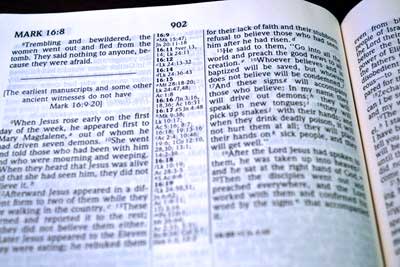
The last verse in the Gospel of Mark (16:8) reads…

“And they went out and fled from the tomb, for trembling and astonishment had seized them, and they said nothing.”

The problem with the Gospel of Mark for the final editors of the New Testament was that it was grossly deficient. First it is significantly shorter than the other Gospels—with only 16 chapters compared to Matthew (28), Luke (24) and John (21). But more important is how Mark begins his Gospel and how he ends it.

He has no account of the virgin birth of Jesus — or for that matter, any birth of Jesus at all. In fact, Joseph, husband of Mary, is never named in Markʼs Gospel at all—and Jesus is called a “son of Mary,” see my previous post on this here. But even more significant is Markʼs strange ending. He has no appearances of Jesus following the visit of the women on Easter morning to the empty tomb!

Like the other three Gospels Mark recounts the visit of Mary Magdalene and her companions to the tomb of Jesus early Sunday morning. Upon arriving they find the blocking stone at the entrance of the tomb removed and a “young man”—notice—not said explicitly to be “an angel” nor “two angels” as in later Gospels—tells them:

“Do not be alarmed. You seek Jesus of Nazareth, who was crucified. He has risen; he is not here. See the place where they laid him. But go, tell his disciples and Peter that he is going before you to Galilee. There you will see him, just as he told you.” And they went out and fled from the tomb, for trembling and astonishment had seized them, and they said nothing. (Mark 16:6-8)

And there the Gospel simply ends!

Mark gives no accounts of anyone seeing Jesus as Matthew, Luke, and John later report. In fact, according to Mark, any future epiphanies or “sightings” of Jesus will be in the north, in Galilee, not in Jerusalem.

This original ending of Mark was viewed by later Christians as so deficient that not only was Mark placed second in order in the New Testament, but various endings were added by Christians in some manuscripts to try to remedy things. The longest concocted ending, which became Mark 16:9-19, became so treasured that it was included in both Catholic and Protestant Bibles (including the King James Version) and considered part of the holy canon of inspired Scriptures. Here is that forged ending of Mark, added after the women fled and “told no one”:

“Now when he rose early on the first day of the week, he appeared first to Mary Magdalene, from whom he had cast out seven demons. She went and told those who had been with him, as they mourned and wept. But when they heard that he was alive and had been seen by her, they would not believe it. After these things he appeared in another form to two of them, as they were walking into the country. And they went back and told the rest, but they did not believe them. Afterward he appeared to the eleven themselves as they were reclining at table, and he rebuked them for their unbelief and hardness of heart, because they had not believed those who saw him after he had risen. And he said to them, “Go into all the world and proclaim the gospel to the whole creation. Whoever believes and is baptized will be saved, but whoever does not believe will be condemned. And these signs will accompany those who believe: in my name they will cast out demons; they will speak in new tongues; they will pick up serpents with their hands; and if they drink any deadly poison, it will not hurt them; they will lay their hands on the sick, and they will recover. So then the Lord Jesus, after he had spoken to them, was taken up into heaven and sat down at the right hand of God. And they went out and preached everywhere, while the Lord worked with them and confirmed the message by accompanying signs.”

This long added ending is not found in our earliest and most reliable Greek copies of Mark.1 Clement of Alexandria and Origen (early 3rd century) show no knowledge of the existence of these verses; furthermore Eusebius and Jerome attest that the passage was absent from almost all Greek copies of Mark known to them. The language and style of the Greek is clearly not Markan, and it is pretty evident that what the forger did was take sections of the endings of Matthew, Luke and John (marked respectively in red, blue, and purple above) and simply create a “proper” ending.

Even though this longer ending became the preferred one, it was not the only such ending added to Mark! A different ending that was shorter, as well as an expansion added to the end of the longer ending also were found in ancient manuscripts:

[1] “But they reported briefly to Peter and those with him all that they had been told. And after these things Jesus himself sent out through them, from east to west, the sacred and imperishable proclamation of eternal salvation.”

[2] ‘This age of lawlessness and unbelief is under Satan, who does not allow the truth and power of God to prevail over the unclean things of the spirits [or, does not allow what lies under the unclean spirits to understand the truth and power of God]. Therefore reveal your righteousness now’ — thus they spoke to Christ. And Christ replied to them, ‘The term of years of Satanʼs power has been fulfilled, but other terrible things draw near. And for those who have sinned I was handed over to death, that they may return to the truth and sin no more, in order that they may inherit the spiritual and incorruptible glory of righteousness that is in heaven.’

That being said, what implications can we draw from the existence of additions to the original ending of Mark? (If you recall, the earliest manuscripts end simply with the women exiting the empty tomb and “telling no one.”) The implications challenge naive understandings of Christian origins which ignore the development and trajectory of tales about the “resurrected” Jesus that grew over time. I have dealt with this issue more generally in my post, “What Really Happened on Easter Morning” that sets the stage for the following implications.

In Mark, on the last night of Jesusʼ life, he told his intimate followers following their meal, “But after I am raised up, I will go before you to Galilee” (Mark 14:28), which was repeated at the tomb by the “young man,” who tells the women, “Go, tell his disciples and Peter, ‘He is going ahead of you into Galilee. There you will see him, just as he told you.’” What Mark believes is that Jesus has been “lifted up” or “raised up” to the right hand of God and that the disciples would “see” him in Galilee. Mark knows of no accounts of people encountering the revived corpse of Jesus, wounds and all, walking around Jerusalem as in the two last Gospels written, Luke and John. The story in Mark is that the disciples experienced their epiphanies of Jesus once they returned to Galilee after the eight-day Passover festival and had returned to their fishing to ponder the death of their leader, whose cause they had hoped would succeed, and who had originally abandoned their livelihoods to follow. They probably could not imagine the time spent following their leader had been in vain, and thatʼs when they had their “epiphanies,” whatever they may have been. But there is little evidence to suggest such epiphanies/early appearance tales were the same as in the latter most Gospels, which either changed or deleted the messages in both Mark 14 and Mark 16. Those messages in Mark were that “He would go before them to Galilee” and be seen “there,” rather than in Jerusalem.

The faith that Mark reflects, namely that Jesus has been “raised up” or lifted up to heaven, is precisely parallel to that of Paul—who is the earliest witness to this understanding of Jesusʼ resurrection. You can read my full exposition of Paulʼs understanding “the heavenly glorified Christ,” whom he claims to encounter, here. And notably, he parallels his own visionary experience to that of Peter, James and the rest of the apostles. What this means is that when Paul wrote, in the 50s CE, this was the resurrection faith of the early followers of Jesus! Since Matthew, Luke and John come so much later and clearly reflect the period after 70 CE when all of the first witnesses were dead—including Peter, Paul and James the brother of Jesus, they are clearly 2nd generation traditions and should not be given priority.

Mark begins his account with the line “The Gospel of Jesus Christ the Son of God” (Mark 1:1). Clearly for him, what he subsequently writes is that “Gospel,” not a deficient version that needs to be supplemented or “fixed” with later alternative traditions about Jesus appearing in a resuscitated body Easter weekend in Jerusalem.

James D. Tabor [with some edits by Ed Babinski, and additional information at the end]


Two Quotations Concerning the Added Ending of Mark from N.T. Textual Scholar & Christian Bruce Metzger

The last twelve verses of the commonly received text of Mark are absent from the two oldest Greek manuscripts (א and B), 20 from the Old Latin codex Bobiensis, the Sinaitic Syriac manuscript, about one hundred Armenian manuscripts, 21 and the two oldest Georgian manuscripts (written a.d. 897 and a.d. 913).
--Bruce Metzger, A Textual Commentary on the Greek New Testament, 2nd edition

Since Mark was not responsible for the composition of the last twelve verses of the generally current form of his Gospel, and since they undoubtedly had been attached to the Gospel before the Church recognized the fourfold Gospels as canonical, it follows that the New Testament contains not four but five evangelic accounts of events subsequent to the resurrection.
--Bruce B. Metzger The Text of the New Testament Oxford: OUP, 1992, 229.

So Metzger pointed out that the church canonized four Gospels and one mini-post-rez-Gospel story. Ha.

The most significant NT textual variants, including the added long and short endings to Mark, appear to be these.

What such variants demonstrate is that by the time the Christian churches finalized their New [and Improved] Testament it was 300 years after Jesus had died and they were editing it right up to the last minute--adding multiple endings to the last chapter of Mark, adding explicit Trinitarian passages to one letter, adding entire letters that appeared so late that the apostles who allegedly wrote them were already dead. For additional “last minute” changes see, The Orthodox Corruption of Scripture: The Effect of Early Christological Controversies on the Text of the New Testament, and, Misquoting Jesus, both by Bart D. Ehrman.


Larry Hurtado (N.T. Scholar & Christian) on How Stories Changed Over Time from Gospel to Gospel

“Mark was significantly re-shaped by the authors of Matthew and Luke, which is well analyzed in modern redaction-critical and literary-critical studies. For example, Matthew embodies about 90% of Mark and generally retains the Markan order of the material taken over from Mark, but this material is wedded with much additional material (the “Q” and “M” material), and is appropriated in a narrative with additional components producing a significantly different narrative plan (e.g., the “birth narrative” in Matthew 1-2, the resurrection appearances and “great commission” in Matthew 28). Moreover, Matthew exhibits frequent and well-known modification of the Markan material appropriated (cf. Mark 6:45-52/ Matt 14:22-33), and a considerably different cluster of thematic concerns (e.g., lessened negative portrayal of disciples, greater emphasis on Jesus as a teacher of specific rules of life as in 5:19-48 and 18:7-35, and a more positive emphasis on Peter as in 16:16-20, etc.)

“The adaptation of Markan material in Luke is probably even more thorough. In Luke one finds only about 60% of Mark, and, as in Matthew, the Markan material is joined by a large body of “Q” material as well as a sizable amount of “special” Lukan material (e.g., Luke 1-2, the mission of the 70 in 10:1-20, parables in 15:8-32, the post-resurrection narratives in Luke 24, etc.). In addition, as in Matthew, the Markan material has often been modified in style, content, and emphases, producing significantly different versions of the incidents and sayings taken over from Mark (e.g., the Lukan eschatological discourse in 21:5-38); and the material is submerged in an account that has a distinctive narrative shape (e.g., the “travel narrative” of 9:51-19:27, and the beginning and ending of Luke) as well as distinctive emphases and narrative devices (e.g., the chronological concerns in 2:1-2 and 3:1-2).

“Also, as studies of the use of the Q material in Matthew and Luke have shown, the authors apparently felt free to adapt their other written source similarly.”

“As another example of the way ancients often provide significantly new renditions of texts, we may note Tatianʼs Diatessaron, in which the material in the four canonical Gospels was woven creatively into a new continuous sequence producing an account of Jesusʼ ministry that was thereby markedly different from any one of the four sources. Though the Diatessaron is the most well known ancient Gospel “harmony,” indications are that this was not the first or only such literary creation. The ancient Gospel harmonies show that the textual integrity of Mark and the other Gospels was not always important to at least some Christians, and that they felt free to draw upon the Gospels as sources to create their own compositions and renditions of the story of Jesus. This freedom can be demonstrated in the ancient handling of other texts as well, such as the radical abbreviation and modification of Jason of Cyreneʼs five-volume work by the author of 2 Maccabees.”

“In addition to the ancient freedom to give new renditions of ancient texts, we must also reckon with the freedom some ancient copyists exercised in transmitting texts. Although NT textual criticism appears to be regarded by some as an arcane and uninteresting area, a better familiarity with the manuscript tradition would perhaps help NT scholars develop a better grasp of ancient textuality.”

“In the ancient setting, where texts were transmitted by being copied by hand, the transmission often involved a considerable freedom in modifying the text being copied. Modern research has shown that, while some copyists apparently practiced their craft with great care for exactness, many others made all sorts of changes: stylistic modifications, frequent harmonization (especially harmonization of Mark with parallels in the other Synoptics), deletions (e.g., the so-called ‘Western non-interpolations’ in Luke), insertions (e.g., the famous pericope of the adulteress added after John 7:53, or 7:36 or 21:25 or after Luke 21:38), and modifications of a doctrinal nature (e.g., the several variations in Mark 3:21 and 13:32).

“Perhaps the most extensive example of the somewhat free textual transmission of the NT is the so-called Western text of Acts, which is nearly one-tenth longer than the more familiar Alexandrian text. In particular, E. J Epp has called for more attention to the modification of the NT text of a thematic nature exhibited in the western text of Acts.”

“But there is, of course, a major example of the somewhat fluid nature of ancient textuality that we can note directly pertaining to Mark: the several scribally-supplied endings to Mark, all of which are significant modifications of the shape of the Markan narrative. [For a review of the variations, see Metzger, Textual Commentary, 122-26. See also J. L. Magness, Sense and Absence: Structure and Suspension in the Ending of Markʼs Gospel (Atlanta: Scholars Press, 1986). For an innovative study of the ‘long ending’ to Mark, see P. A. Mirecki, ‘Mark 16:9-20: Composition, Tradition and Redaction,’ (Ph.D. diss., Harvard University, 1986).] These scribal innovations in the ending of Mark show how free some ancient Christians felt to modify even those texts deemed to have some sort of authority; and the reshaping of the Markan ending is only the most well-known example of the fluidity of ancient texts.”

“We must beware of assuming that the concern for exactness characteristic of the printed text or attributed to the Massoretic copying of the Hebrew Bible was shared by ancients in general. That was manifestly not the case.”

A section in Hurtadoʼs online paper, “Greco-Roman Textuality and the Gospel of Mark A Critical Assessment of Werner Kelberʼs The Oral and the Written Gospel,” Bulletin for Biblical Research 7 (1997) 91-106.


The latest issue of New Testament Studies, 2011, raises a further question:

“Matthewʼs Use of Mark: Did Matthew Intend to Supplement or to Replace His Primary Source?*” by David C. Sim [School of Theology/Centre for Early Christian Studies, Australian Catholic University] The abstract reads: “Most scholars acknowledge Matthewʼs debt to Mark in the composition of his own Gospel, and they are fully aware of his extensive redaction and expansion of this major source. Yet few scholars pose what is an obvious question that arises from these points: What was Matthewʼs intention for Mark once he had composed and circulated his own revised and enlarged account of Jesusʼ mission? Did he intend to supplement Mark, in which case he wished his readers to continue to consult Mark as well as his own narrative, or was it his intention to replace the earlier Gospel? It is argued in this study that the evidence suggests that Matthew viewed Mark as seriously flawed, and that he wrote his own Gospel to replace the inadequate Marcan account.”


The mere fact that Mark, ostensibly the earliest Gospel, lacked a birth narrative and a post-resurrection narrative, while those were added to later Gospels (Matthew and Luke), and that Matthew and Luke disagree the most in exactly those birth and post-resurrection stories that they added to the Markan narrative, raises questions as to the validity of such tales.

The Search for Connections That Is “Science” (Compared with the Intelligent Design Hypothesis)

Search for Connections

I donʼt mind if someone is an I.D.ist who believes a Designer spent eons “tweaking” DNA base pairs. Maybe the Designer also spent eons tweaking the paths of asteroids, planetoids and planets, as well as the paths of suns and black holes (once you hypothesize “tweaking” why limit yourself just to a Designer who only tweaks DNA base pairs? Even Isaac Newton hypothesized that God was required from time to time to tweak planetary orbits (without invoking at least that a minimal degree of divine intervention one might dare to conclude that planets orbited entirely by themselves, a rather “godless” idea of how the cosmos functioned according to many of Newtonʼs fellow theists, and in fact I think I read the atheist, Laplace, was referring to Newtonʼs “tweak” hypothesis when Laplace said, “I have no need of that hypothesis”).

Of course itʼs unfalsifiable and probably unprovable whether a Designer has invisibly tweaked things or not. Neither does it lead to new scientific knowledge, since thereʼs always more to be studied concerning possible Connections throughout the natural world, rather than sitting back and claiming a universal negative, that no such connections will ever be found, between lifeless molecules and self-reproducing ones (though we have already found connections that explain how the simplest molecules, hydrogen and helium, gave birth to all the rest, look up nucelosynthesis, a natural process).

Another nonfalsifiable hypothesis is that of Rupert Sheldrakeʼs “morphogenetic fields,” namely that all living things have undetectable morphogenetic fields (undetectable by present day instruments) that interact in an invisible fashion with other fields of members of the same species and allow permanent evolutionary structural or behavioral changes to be handed down from generation to generation. Unlike I.D. this hypothesis involves changes that take place between organisms, information being exchanged “horizontally,” compared with say, “top down” changes being instituted directed by a Designer from “on high.” But if there are other “morphogentic” energies outside of the known ones that make up the electro-magnetic spectrum, we have not detected them yet, though we also still donʼt know exactly how gravity fits in with the electro-magnetic spectrum of energies, and neither are we sure what dark matter and dark energy is.

As for myself, Iʼm not eagerly placing bets or trying to prove the existence of anything supernatural to other people, neither I.D. nor morphogenetic fields. Because I figure that “mysteries of nature” only get solved via hard work after long periods of experimentation, investigation, and scholarly debate over how to interpret the data. Speaking of which, scienceʼs track record continues to grow. For instance the means by which an animalʼs body type and some behaviors is inherited from its parents used to be a total mystery, but the discovery of Mendelian genetics as well as the DNA molecule and the human genome project have continued to show us more and more about how the inheritance of body types and some behaviors occurs. Embryogenesis used to be a total mystery, but we have begun to discover how certain biomolecules are released in one cataract spilling over into another, like one sprung mousetrap setting off others, and how different gradients of certain chemicals in certain parts of the growing embryo lead to the differentiation of different body parts, and how the same genes that catalyzed the embryonic formation of “eyes” were found in both fruit flies and humans and that such genes appear way back in our shared ancestral trees. Photosynthesis used to be a mystery of nature, but we discovered the structure of the chlorophyll molecule and quantum mechanics, and together they explained how photons striking the chlorophyll molecule imparted energy that was stored biochemically in other molecules in the plant cell (I believe in ATP-like molecules). Itʼs not magic. But it took hard work to discover such Connections:

  1. How atoms of far greater sizes and with new properties arose from hydrogen and helium the smallest of atoms (nucelosynthesis).
  2. How inheritance works (the DNA molecule).
  3. How embryology works.
  4. How plants obtain energy from sunlight. All considered such unfathomable mysteries in the past that only “miracles” could explain them all, from the formation of elements to the formation of people in the womb to the ability of plants to grow from sunlight, water and some minerals. But such gains in scientific knowledge came about because scientists were seeking to discover how things in nature were Connected, not disconnected.

Letʼs say an I.D.ist goes to heaven and gets to meet God (aka “the Designer”) and He admits “I was constantly tweaking things, invisibly for over 10 billion years.” If the I.Dʼist is also a scientist thatʼs not all he would want to know. Because as a scientist he would still be curious about the Connections behind each tweak, “Yes, God, but what individual reasons were there for tweaking things That particular way instead of some other? What were the Connections in nature that you saw that made you tweak things in such and such a way, and how did you determine the ripeness of time and place for each tweak based on how it connected with changing circumstances? What kind of grand schematic inside your head were you following out, Connecting this tweak with that change and how each tweak would affect further changes down the line? I am very interested in particular examples! And have an eternity to learn more about such Connections inside your mind! Itʼs all so fascinating to me, a scientist!” So again, a scientific mind would wish to find out more about the Connections rather than the disconnections.

Seeking to learn more about Connections is what science is about. How do rainbows form out of sunlight, air and water and the eyeʼs ability to see perceive colors? What Connections exist? How did stars as well as stars that go nova produce all the elements out of mere hydrogen and helium? How do those elements naturally form molecules in space, congealing together on asteroids, planetoids and planets? Can those molecules then form reproducing units? Letʼs look into all the possible Connections.

New Testament Questions Galore, Free Audio

Audio

For those who enjoy listening to free NT scholarship.

I think listening to these sites and podcasts beats listening to the maximally conservative Evangelical scholarship over at Apologetics 315. The questions raised, the uncertainties pointed out by the following scholars are well worth pondering. (Iʼve heard them all, great stuff).

I had heard Dale Martin via his free NT lectures at itunes U, so it was refreshing to see him debate Licona. After you listen to Daleʼs questions regarding the NTʼs resurrection stories you might want to read my post, A Carnival of Questions for Resurrection Apologists, which was posted before I had listened to the debate, though my questions mirror many of Daleʼs points.

Examples of Later Additions to Scripture, Including Pauline Interpolations

Also, there are some things even an Evangelical apologist canʼt help but notice and hence needs to try and explain away, like the endings that later Christians added to Mark (of which there are more than one, and even those appear in variant forms in different early texts).

Speaking of adding to Scripture, there is also evidence that Paulʼs letters feature interpolated material (1 Corinthians 14:34-35 and 1 Thessalonians 2:14-16). See this fascinating discussion and link to a slide show: http://richardcarrier.blogspot.com/2011/06/pauline-interpolations.html These are basic questions raised by Pauline scholars, and arranged well by Richard Carrier. Worth pondering, along with William O. Walkerʼs arguments concerning additional interpolations in Paulʼs letters.

Furthermore, the Gospels, Matthew and Luke, Differ Most From Each Other in exactly those places where the ostensibly earliest Gospel, Mark, was silent, i.e., in their tales of Jesusʼ infancy and post-resurrection appearances (where Mark was silent, so neither Matthew nor Luke could maintain their closeness to one another by following Mark in those areas, hence they diverge the most from each other in exactly in those places).

Gospel Trajectories

Later Gospel stories certainly appear to depend on earlier ones, starting with Mark (with of course, a few later urban myths/tall tales about Jesus added to each freshly written Gospel as each appeared). Tracing obvious Gospel trajectories (developments in the story from Mark, Matthew, Luke and finally John).

Thereʼs even a trajectory in the Gospels involving the Judas character.

Gospel Improbabilities

Carnival of Questions for Resurrection Apologists

Fear the Question (“Fear of the Question”)

Why does Christianity need apologists if the evidence for the resurrection is as undeniable and unquestionable as apologists claim it is? They say “itʼs a fact!” (Really? An infinite Being couldnʼt provide any more evidence than cult-written second-hand sources? And also expect everyone to believe in heaven and hell, sight unseen? And believe in all the related doctrines and practices of Christianity with few questions asked?) Instead, when I think of Christian apologetics I think of this quotation from a personal letter by C. S. Lewis:

I envy you not having to think any more about Christian apologetics. My correspondents force the subject on me again and again. It is very wearing, and not v. good for oneʼs own faith. A Christian doctrine never seems less real to me than when I have just (even if successfully) been defending it. It is particularly tormenting when those who were converted by my books begin to relapse and raise new difficulties.

C. S. Lewis to Mary Van Deusen, June 18, 1956

What Exactly Do Apologists Mean When They Claim to Have Provided Evidence for the Resurrection? Especially in Light of…

  1. The Disharmony of the death and resurrection tales.

  2. The Trajectory from early to late NT sources that suggests the death and resurrection tales grew in the telling, not just in length (and in the number of words allegedly spoken by the resurrected Jesus) but also grew via enhancements that believers added over time to make the tales appear more impressive, convincing. Jesus is also portrayed as more in control, more philosophical, regal or divine in the last two written Gospels and their versions of his capture, death and burial. (Even the stories in which Jesus commands others to come back to life follow a trajectory of enhancement, and grow less secretive, more public, more impressive, and play a more important role in the story when you read them starting with earlier Gospels and ending with the fourth Gospel).

  3. The Lack Of First Hand Testimony. The documents we possess are all second hand information produced by members of the Jesus cult. Paulʼs extremely brief statement, “he appeared to me,” is first hand but thatʼs the only “first hand” statement we possess. (1 Peter is disputed.) I guess an infinite Being with infinite resources wanted things that way. All apologetic works that claim the “evidence” is enough for a successful “court case” flounder on the fact that courts require first hand testimony.

  4. The Lack Of Open Public Demonstration, Just Secret Sightings Claimed By Cult Members. The book of Acts only mentions sightings of Jesus granted to a limited number of apostles without any mention of an appearance to “over 500 brethren.” Neither was that appearance open to the public at large, just to “brethren.” In fact when Paul stated that Jesus “appeared” to “over 500 brethren at once” (1 Cor. 15:6), that would have been to a far greater number than the “120 brethren” mentioned in Acts after Jesus had allegedly ascended bodily into heaven, i.e., “In those days Peter stood up among the believers, a group numbering about a hundred and twenty.” That is the total number that Acts gives after “Jesus was taken up from us.” (Acts 1:9,14-15,22)

    Acts goes on to say:

    He was not seen by all the people, but by witnesses whom God had already chosen—by us who ate and drank with him after he rose from the dead. Acts 10:41

    After giving instructions… to the apostles he had chosen… he presented himself to them [the apostles only]… He appeared to them over a period of forty days… On one occasion, while he was eating with them… they gathered around him… [and] he was taken up before their very eyes [those of the apostles alone], and a cloud hid him from their sight. They were looking intently up into the sky as he was going. Acts 1:1-11

    By the time the resurrection tale was told in Luke the message at the tomb had undergone a distinct change (The raised Jesus was no longer “going before them to Galilee to be seen there,” as in Mark and Matthew, but instead only the word, “Galilee,” remained in the Lukan version with no mention of where Jesus was going or where he would be seen.) The author of the third Gospel has the resurrected Jesus appear to all the apostles not in Galilee but in Jerusalem, and eat fish, say he is “not a spirit” but has “flesh and bone,” afterwards Jesus “led them to Bethany,” from the city of Jerusalem to a nearby town. But in this moment of triumph, beating death, sin, hell (which surely trumps Jesusʼ entry into Jerusalem) we find no crowds, no shouts of Hosanna. If such a tale were true then surely the silence concerning this moment of triumph is deafening, especially since moments before Jesus had been intent to prove he was not a spirit, but had bones and ate fish, and then decided to “lead them” on a trip through Jerusalem. “Nothing to see here, move along.”

  5. Damned For Not Believing? Even if all the appearance and resurrection tales by Jesus cultists were harmonizable and true (they appear to be more a mixed bag, “I didnʼt recognize him!” “He was suddenly just there.” “He ate fish and talked and dined with us for weeks on end and walked out of Jerusalem with us” which are what one might expect from second hand accumulations of tales by people trying to convince others that their cult or master they followed was the best), I still would not expect any truly ethical God who knows the limitations of human knowledge to demand that literally everyone must believe such stories or be damned eternally. And when one notes Matthewʼs embellishment of Mark, his insertion of the brief “many raised saints” passage, and his “angel coming down out of the sky to sit atop the rock outside the tomb,” it makes me wonder what Jesus cultists were NOT capable of adding to the story to try and make it sound more grandiose, or what people back then were NOT willing to believe.

    Some of the questions above are fleshed out further in posts below.

Carnival of Posts on the Resurrection & Evangelicalism

(Click on the final word(s) of each title to visit the article or post)

  • Miracles from all religions (including amazing coincidences that seem to just happen and are not related to a religion), when viewed together, provide a crazy mixed bag of “evidence.” So how can “God or WhateverIsOutThere” expect us to know what to make of them? (One does not need to claim that everyoneʼs religious experiences are false in order to ask, How can God expect us to know exactly what to make of the wide diversity of religious beliefs and miracle stories?

  • Richard Carrierʼs Five Questions Concerning “The Resurrection”

  • “Eyewitness” Reports of Jesus's Resurrection? Or Gospel Trajectories? (Based on an exchange I had with resurrection apologist Dr. Gary Habermas)

  • “No Stomach” for N.T. Wright (and the questions that raises concerning the life of the world to come

  • Scent from heaven? Who nose? Do tales of Jesusʼ anointing, resurrection & bodily ascension, bear the aroma of truth?

  • Has Michael R. Licona considered the raising of many saints story in Matthew in light of questions of Markan priority?

  • Yet More on The “Many Resurrected Saints

  • Did the historical Jesus speak about the necessity of being “born again?” Questions raised by David A. Croteau, Bart Ehrman & David Friedrich Strauss. Bart Ehrmanʼs Question

  • Evangelicalism: What Is One To Make of the Phenomenon? [a collection of quotations]

  • Crisis After Crisis Among Evangelicals Concerning Biblical Authority

  • Evangelical Christian publishers admit Christianityʼs “image problem,” “postmodern turn,” differing rival “views” within the Evangelical fold, and speak about “hopeful skepticism” and “questions” rather than dogmatic truth


Further Thoughts

What if the NT Gospels, Especially Matthew, Were Totally True? Jesus dies, suddenly the sky is darkened for three hours, an earthquake shakes the city, splitting the very rocks, an earthquake so violent it opens graves (and probably does a lot more damage than that), undead Jews crawl out of their graves and are seen by the Roman guards overseeing Jesusʼ crucifixion, who are terrified, and cry out in unison (Matt), “This was the son of God.” But the undead then take a sabbatical, waiting till Sunday morning* to enter the holy city and show themselves to many. Naturally all this crazy stuff caused the Jews to worry that if the disciples were to steal Jesusʼ body, then that might convince people that a miracle had occurred. All that other stuff going on, and THATʼs what they fear might convince people that a miracle had occurred? [Richard Carrier, my paraphrase, Click Here for the original statement by Carrier]

*The Greek in Matthew states literally that the graves were opened and the saints were raised at the time of Jesusʼ death, but that they didnʼt enter the holy city and show themselves to many until “after his resurrection” on Sunday morning. Why? Apologist J.P. Holding suggests itʼs because they were obeying the Sabbath day of rest. Really? Acts mentions that Jews Could travel on the sabbath for a limited distance, but probably enough to reach the holy city. In Luke that distance was called “a sabbath dayʼs journey.” And why couldnʼt someone from the city simply walk over to the graves? Others suggest that some scribe added the phrase to Matthew, “after his resurrection” so that Jesus would rise before the saints, i.e., that Jesus would be the first fruits of the resurrection, but that little phrase also forces them to hang round in the graveyard for a day and a half. For more on the raised saints tale, Click Here.

And if the Resurrection Tales were totally Harmonized… Click Here to read the article.