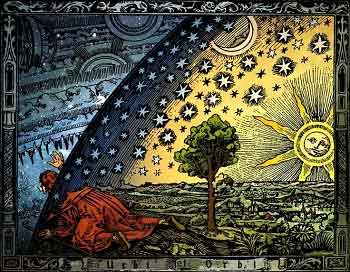


Another Brawl at the Church of the Holy Sepulchre (a church allegedly built on the site where Jesus was buried)

Holy Temple

April 21, 2008, the headlines read:

Orthodox groups clash in Church of the Holy Sepulchre
Christians fist fight at Jerusalemʼs Holy Sepulchre
Police breaks off clash at Church of Holy Sepulchre
Priests exchange blows over religious rights

Earlier Fight At Holy Site

Six Christian denominations jealously guard their rights at the Church of the Holy Sepulchre in Jerusalem, so when one denomination moved a chair into a spot claimed by another, it was a declaration of war (a violation of the “status quo” law as enshrined in a 1757 Ottoman declaration). About eleven monks were taken to hospital after being hit by rocks, metal rods and chairs that they threw at each other. Christian monks from rival denominations [Ethiopians and Egyptian Copts] have been warring for more than a century over the roof of the shrine which the Ethiopians call the “House of Sultan Solomon” because they believe the biblical King Solomon gave it as a gift to the Queen of Sheba. The Ethiopians lost control of the roof during an epidemic in the 19th century which enabled the Copts to take over. But in 1970, during a brief absence by Coptic priests from a rooftop chapel, the Ethiopian clerics returned and have been squatting there ever since. An Ethiopian monk huddles in the corner of the chapel day and night to guard the squattersʼ claim. The Egyptian monk, who has been living with them on the roof since the 1970 takeover to assert the Coptsʼ rights, decided to move his chair out of the sun during a hot Jerusalem day. “They (the Ethiopians) teased him,” said Father Afrayim, an Egyptian Coptic monk at the next door Coptic monastery. “They poked him and brought some women who came behind him and pinched him,” he said. Each side accuses the other of throwing the first blow in the fist-fight and stone throwing that ensued. Police eventually broke up the brawl but by all accounts many of the protagonists were already wounded.
Reuters, July 29, 2002


Another Fight At Holy Site

Greek Orthodox and Catholic Franciscan priests got into a fist fight at the Church of the Holy Sepulcher in Jerusalem, Christianityʼs holiest shrine, after arguing over whether a door in the basilica should be closed during a procession. Dozens of people, including several Israeli police officers, were slightly hurt in the brawl at the shrine, built over the spot where tradition says Jesus was crucified and buried. Four priests were detained, police spokesman Shmulik Ben-Ruby said. Custody of the Church of the Holy Sepulcher is shared by several denominations that jealously guard territory and responsibilities under a fragile deal hammered out over the last centuries. Any perceived encroachment on one groupʼs turf can lead to vicious feuds, sometimes lasting hundreds of years.
Mondayʼs fight broke out during a procession of hundreds of Greek Orthodox worshippers… Church officials, speaking on condition of anonymity, said that at one point, the procession passed a Roman Catholic chapel, and priests from both sides started arguing over whether the door to the chapel should be open or closed. Club-wielding Israeli riot police broke up the fight…
In 2003, Israeli police threatened to limit the number of worshippers allowed to attend an Easter ceremony if the denominations did not agree on whom would lead the ceremony… But a year earlier, the Greek patriarch and Armenian clergyman designated to enter the tomb exchanged blows after a dispute over who would be first to exit the chamber.
Associated Press, 2004


Mark Twainʼs Experiment

Consider my experiment. In an hour I taught a cat and a dog to be friends. I put them in a cage. In another hour I taught them to be friends with a rabbit. In the course of two days I was able to add a fox, a goose, a squirrel and some doves. Finally a monkey. They lived together in peace; even affectionately. Next, in another cage I confined an Irish Catholic from Tipperary, and as soon as he seemed tame I added a Scotch Presbyterian from Aberdeen. Next a Turk [Muslim] from Constantinople; a Greek Orthodox Christian from Crete [Greece]; a Methodist from the wilds of Arkansas; a Buddhist from China; a Brahmin [Hindu priest] from Benares. Finally, a Salvation Army Colonel from Wapping. Then I stayed away two whole days. When I came back to note results, the cage of animals was all right, but in the other there was but a chaos of gory odds and ends of turbans and fezzes and plaids and bones and flesh…not a specimen left alive. These Reasoning Animals had disagreed on a theological detail and carried the matter to a Higher Court.
Man is the only animal that has religion, even the True Religion…several of them.
Mark Twain, “Manʼs Place in the Animal World,” 1896


A Real Life Version Of Mark Twainʼs Experiment

In the middle of the 20th century in the eastern European country of Rumania (that was communist at the time), anyone whom the government considered “anti-communist” was imprisoned. In one case ministers of different religions were imprisoned together in the same close quarters:

In the hour which the priestsʼ room had set aside for prayer, Catholics collected in one corner, the Orthodox occupied another, the Unitarians a third. The Jehovahʼs Witnesses had a nest on the upper bunks; the Calvinists assembled down below. Twice a day, our various services were held: but among all these ancient worshippers I could scarcely find two men of different sects to say one ‘Our Father’ together. Far from fostering mutual understanding, our common plight made for conflict. Catholics could not forgive the Orthodox hierarchy for collaborating with Communism. Christians of minority beliefs disagreed about ‘rights.’ Disputes arose over every point of doctrine. And while discussion was normally conducted with genteel malice, as learnt in seminaries on wet Sunday afternoons, sometimes tempers flared. [Rev. Richard Wurmbrand, In Godʼs Underground (London : W. H. Allen, 1968), p.218, 232)]

Their “quarrels…came to a halt” only after loudspeakers were put in their cells that blared communist slogans day and night, and they were forced to attend lectures advocating communism. That was when the priests and ministers “learned that all our denominations could be reduced to two: the first is hatred, which makes ritual and dogma a pretext for attacking others; the second is love, in which men of all kinds realize their oneness and brotherhood before God.” But if the communists had not added those blaring speakers and forced them to attend lectures, would the pastors and priests have all joined together against their common enemy and “learned” how to avoid “disputing over every point of doctrine?”


“Equustentialism” By Emo Philips

(Excerpts from his 1985 comedy CD for Epic Records, E=MO2)
Emo: I was walking across a bridge one day, and I saw a man standing on the edge, about to jump off. So I ran over and said “Stop! donʼt do it!”
Jumper: “Why shouldnʼt I?” he said.
Emo: “Well, thereʼs so much to live for!”
Jumper: “Like what?”
Emo: “Well…are you religious or an atheist?”
Jumper: “Religious.”
Emo: “Me too! Are you a Christian, Jew, or something else?”
Jumper: “A Christian.”
Emo: “Me too! Protestant or Catholic?”
Jumper: “Protestant.”
Emo: “Me too! What franchise?”
Jumper: “Baptist.”
Emo: “Wow! Me too! Northern Baptist or Southern Baptist?”
Jumper: “Northern Baptist.”
Emo: “Me too! Northern Conservative Baptist or Northern Liberal Baptist?”
Jumper: “Northern Conservative Baptist.”
Emo: “Me too! Northern Conservative Fundamentalist Baptist or Northern Conservative Reformed Baptist?”
Jumper: “Northern Conservative Fundamentalist Baptist.”
Emo: “Me too! Northern Conservative Fundamentalist Baptist Great Lakes Region or Northern Conservative Fundamentalist Baptist Eastern Region?”
Jumper: “Northern Conservative Fundamentalist Baptist Great Lakes Region.”
Emo: “Me too! Northern Conservative Fundamentalist Baptist Great Lakes Region Council of 1879 or Northern Conservative Fundamentalist Baptist Great Lakes Region Council of 1912?”
Jumper: He said, “Northern Conservative Fundamentalist Baptist Great Lakes Region Council of 1912.”
Emo: And I said, “Die, heretic!” And pushed him off the bridge.


But if you will recall the history of our civil troubles, you will see half the nation bathe itself, out of piety, in the blood of the other half, and violate the fundamental feelings of humanity in order to sustain the cause of God: as though it were necessary to cease to be a man in order to prove oneself religious!
Denis Diderot (1713-1784), cited in Against the Faith by Jim Herrick


Men have gone to war and cut each otherʼs throat because they could not agree as to what was to become of them after their throats were cut.
Walter Parker Stacy (1884-1951)

Thereʼs a tendency [in religion] to declare that there is more backsliding around than the national toboggan championships, that heresy must be torn out root and branch, and even arm and leg and eye and tongue, that itʼs time to wipe the slate clean. Blood is generally considered very efficient for this purpose.
Terry Pratchett, Small Gods


Religious tolerance has developed more as a consequence of the impotence of religions to impose their dogmas on each other than as a consequence of spiritual humility.
Sidney Hook, The Partisan Review, March, 1950


The only reason the Protestants and Catholics have given up the idea of universal domination is because theyʼve realized they canʼt get away with it.
W. H. Auden, in Alan Arisen, ed., The Table-Talk of W. H. Auden (1990), quoted from Jonathon Green, The Cassell Dictionary of Cynical Quotations


Everyoneʼs A Skeptic (About Someone Elseʼs Religion)

  • Millions of Hindus pray over statues of Shivaʼs penis. Do you think thereʼs an invisible Shiva who wants his penis prayed over…or are you a skeptic?
  • Mormons say that Jesus came to America after his resurrection. Do you agree…or are you a doubter?
  • Floridaʼs Santeria worshipers sacrifice dogs, goats, chickens, etc., and toss their bodies into waterways. Do you think Santeria gods want animals killed…or are you skeptical?
  • Muslim suicide bombers who blow themselves up in Israel are taught that “martyrs” go instantly to a paradise full of lovely female houri nymphs. Do you think the dead bombers are in heaven with houris…or are you a doubter?
  • Unification Church members think Jesus visited Master Moon and told him to convert all people as “Moonies.” Do you believe this sacred tenet of the Unification Church?
  • Jehovahʼs Witnesses say that, any day now, Satan will come out of the earth with an army of demons, and Jesus will come out of the sky with an army of angels, and the Battle of Armageddon will kill everyone on earth except Jehovahʼs Witnesses. Do you believe this solemn teaching of their church?
  • Aztecs skinned maidens and cut out human hearts for a feathered serpent god. Whatʼs your stand on invisible feathered serpents? Aha!…just as I suspected, you donʼt believe.
  • Catholics are taught that the communion wafer and wine magically become the actual body and blood of Jesus during chants and bell-ringing. Do you believe in the “real presence”…or are you a disbeliever?
  • Faith-healer Ernest Angley says he has the power, described in the Bible, to “discern spirits,” which enables him to see demons inside sick people, and see angels hovering at his revivals. Do you believe this religious assertion?
  • The Bible says people who work on the Sabbath (Saturday) must be killed: “Whosoever doeth any work in the Sabbath day, he shall surely be put to death” (Exodus 31:15). Should we execute such people…or do you doubt this scripture?
  • At a golden temple in West Virginia, saffron-robed worshipers think theyʼll become one with Lord Krishna if they chant “Hare Krishna” enough. Do you agree…or do you doubt it?
  • Members of the “Heavenʼs Gate” commune said they could “shed their containers” (their bodies) and be transported to a UFO behind the Hale-Bopp Comet. Do you think theyʼre now on that UFO…or are you a skeptic?
  • During the witch hunts, inquisitor priests tortured thousands of women into confessing that they blighted crops, had sex with Satan, etc. then burned them for it. Do you think the church was right to enforce the Bibleʼs command, “Thou shalt not suffer a witch to live” (Exodus 22:18)…or do you doubt this scripture?
  • Members of Spiritualist churches say they talk with the dead during worship services. Do you think they actually communicate with spirits of deceased people?
    Millions of American Pentecostals spout “the unknown tongue,” a spontaneous outpouring of sounds. They say it is the Holy Ghost, the third god of the Trinity, speaking through them. Do you believe this sacred tenet of many Americans?
  • Scientologists say each human has a soul which is a “Thetan” that came from another planet. Do you believe their doctrine…or doubt it?
  • Ancient Greeks thought a multitude of gods lived on Mt. Olympus…and some of todayʼs New Agers think invisible Lemurians live inside Mt. Shasta. Whatʼs your position on mountain gods…belief or disbelief?
  • In the mountains of West Virginia, some people obey Christʼs farewell command that true believers “shall take up serpents” (Mark 16:18). They pick up rattlers at church services. Do you believe this scripture, or not?
  • Indiaʼs Thugs thought the many-armed goddess Kali wanted them to strangle human sacrifices. Do you think thereʼs an invisible goddess who wants people strangled…or are you a disbeliever?
  • Tibetʼs Buddhists say that when an old Lama dies, his spirit enters a baby boy being born somewhere. So they remain leaderless for a dozen years or more, then they find a pubescent boy who seems to have knowledge of the old Lamaʼs private life, and they anoint the boy as the new Lama (actually the old Lama in a new body). Do you think that dying Lamas fly into new babies, or not?
  • In China in the 1850s, a Christian convert said God appeared to him, told him he was Jesusʼs younger brother, and commanded him to “destroy demons.” He raised an army of believers who waged the “Taiping Rebellion” that killed 20 million people. Do you think he was Christʼs brother…or do you doubt it?

    James A. Haught, “Everyoneʼs a Skeptic…About Other Religions” [Originally delivered as a talk to Campus Freethought Alliance, Marshall University, Huntington, WV, July 12, 1998]

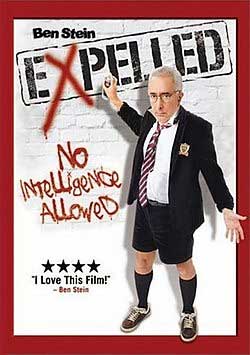
Expel the Lies (or, “Win Ben Stein's Career!”) : Selections from recent reviews of the movie Expelled, starring Ben Stein

Expelled

Expelled: No Intelligence Allowed, opens with Ben Stein addressing a packed audience of adoring students at Pepperdine University. The biology professors at Pepperdine assure me that their mostly Christian students fully accept the theory of evolution. So who were these people embracing Steinʼs screed against science? Extras. According to Lee Kats, associate provost for research and chair of natural science at Pepperdine, ‘the production company paid for the use of the facility just as all other companies do that film on our campus’ but that ‘the company was nervous that they would not have enough people in the audience so they brought in extras. Members of the audience had to sign in and a staff member reports that no more than two to three Pepperdine students were in attendance. Mr. Steinʼs lecture on that topic was not an event sponsored by the university.’

Expelled trots out some of the people whom it claims have been persecuted. First among them is Robert Sternberg, former editor of the peer-reviewed Proceedings of the Biological Society of Washington, who published an article on ID by Stephen C. Meyer of the Discovery Institute. Sternberg tells Stein that he subsequently lost his editorship, his old position at the Smithsonian Institutionʼs National Museum of Natural History and his original office.

What most viewers of Expelled may not realize—because the film doesnʼt even hint at it—is that Sternbergʼs case is not quite what it sounds. Biologists criticized Sternbergʼs choice to publish the paper not only because it supported ID but also because Sternberg approved it by himself rather than sending it out for independent expert review. He didnʼt lose his editorship; he published the paper in what was already scheduled to be his last issue as editor. He didnʼt lose his job at the Smithsonian; his appointment there as an unpaid research associate had a limited term, and when it was over he was given a new one. His office move was scheduled before the paper ever appeared. [For more details see Ben Stein Launches a Science-free Attack on Darwin by Michael Shermer.]

Steinʼs case for conspiracy centers on a journal article written by Stephen Meyer, a senior fellow at the intelligent design think tank Discovery Institute and professor at the theologically conservative Christian Palm Beach Atlantic University. Meyerʼs article, ‘The Origin of Biological Information and the Higher Taxonomic Categories,’ was published in the June 2004 Proceedings of the Biological Society of Washington, the voice of the Biological Society with a circulation of less than 300 people. In other words, from the get-go this was much ado about nothing.

Nevertheless, some members of the organization voiced their displeasure, so the societyʼs governing council released a statement explaining, ‘Contrary to typical editorial practices, the paper was published without review by any associate editor; Sternberg handled the entire review process. The council, which includes officers, elected councilors and past presidents, and the associate editors would have deemed the paper inappropriate for the pages of the Proceedings.’ So how did it get published? In the words of journalʼs managing editor at the time, Richard Sternberg, ‘it was my prerogative to choose the editor who would work directly on the paper, and as I was best qualified among the editors, I chose myself.’ And what qualified Sternberg to choose himself? Perhaps it was his position as a fellow of the International Society for Complexity, Information, and Design, which promotes intelligent design, along with being on the editorial board of the Occasional Papers of the Baraminology Study Group, a creationism journal committed to the literal interpretation of Genesis. Or perhaps it was the fact that he is a signatory of the Discovery Instituteʼs ‘100 Scientists who Doubt Darwinism’ statement.

Meyerʼs article is the first intelligent design paper ever published in a peer-reviewed journal, but it deals less with systematics (or taxonomy, Sternbergʼs specialty) than it does paleontology, for which many members of the society would have been better qualified than he to peer-review the paper. (In fact, at least three members were experts on the Cambrian invertebrates discussed in Meyerʼs paper).

Meyer claims that the ‘Cambrian explosion’ of complex hard-bodied life forms over 500 million years ago could not have come about through Darwinian gradualism. The fact that geologists call it an ‘explosion’ leads creationists to glom onto the word as a synonym for ‘sudden creation.’ After four billion years of an empty Earth, God reached down from the heavens and willed trilobites into existence ex nihilo. In reality, according to paleontologist Donald Prothero, in his 2007 magisterial book Evolution: What the Fossils Say and Why it Matters (Columbia University Press): ‘The major groups of invertebrate fossils do not all appear suddenly at the base of the Cambrian but are spaced out over strata spanning 80 million years—hardly an instantaneous ‘explosion’! Some groups appear tens of millions of years earlier than others. And preceding the Cambrian explosion was a long slow buildup to the first appearance of typical Cambrian shelled invertebrates.’ If an intelligent designer did create the Cambrian life forms, it took 80 million years of gradual evolution to do it.

Stein, however, is uninterested in paleontology, or any other science for that matter. His focus is on what happened to Sternberg, who is portrayed in the film as a martyr to the cause of free speech. ‘As a result of publishing the Meyer article,’ Stein intones in his inimitably droll voice, ‘Dr. Sternberg found himself the object of a massive campaign that smeared his reputation and came close to destroying his career.’ According to Sternberg, ‘after the publication of the Meyer article the climate changed from being chilly to being outright hostile. Shunned, yes, and discredited.’ As a result, Sternberg filed a claim against the Smithsonian National Museum of Natural History (NMNH) for being ‘targeted for retaliation and harassment’ for his religious beliefs. ‘I was viewed as an intellectual terrorist,’ he tells Stein. In August 2005 his claim was rejected. According to Jonathan Coddington, his supervisor at the NMNH, Sternberg was not discriminated against, was never dismissed, and in fact was not even a paid employee, but just an unpaid research associate who had completed his three-year term!

The rest of the martyrdom stories in Expelled have similar, albeit less menacing explanations, detailed at www.expelledexposed.com, where physical anthropologist Eugenie Scott and her tireless crew at the National Center for Science Education have tracked down the specifics of each case. Astronomer Guillermo Gonzalez, for example, did not get tenure at Iowa State University in Ames and is portrayed in the film as sacrificed on the alter of tenure denial because of his authorship of a pro—intelligent design book entitled The Privileged Planet (Regnery Publishing, 2004). As Scott told me, ‘Tenure is based on the evaluation of academic performance at oneʼs current institution for the previous seven years.’ Although Gonzales was apparently a productive scientist before he moved to Iowa State, Scott says that ‘while there, his publication record tanked, he brought in only a couple of grants—one of which was from the [John] Templeton Foundation to write The Privileged Planet—didnʼt have very many graduate students, and those he had never completed their degrees. Lots of people donʼt get tenure, for the same legitimate reasons that Gonzalez didnʼt get tenure.’

Tenure in any department is serious business, because it means, essentially, employment for life. Tenure decisions for astronomers are based on the number and quality of scientific papers published, the prestige of the journal in which they are published, the number of grants funded (universities are ranked, in part, by the grant-productivity of their faculties), the number of graduate students who completed their program, the amount of telescope time allocated as well as the trends in each of these categories, indicating whether or not the candidate shows potential for continued productivity. In point of fact, according to Gregory Geoffroy, president of Iowa State, ‘Over the past 10 years, four of the 12 candidates who came up for review in the physics and astronomy department were not granted tenure.’ Gonzales was one of them, and for good reasons, despite Steinʼs claim of his ‘stellar academic record.’

The most deplorable dishonesty of Expelled, however, is that it says evolution was one influence on the Holocaust without acknowledging any of the other major ones for context. Rankings of races and ethnic groups into a hierarchy long preceded Darwin and the theory of evolution, and were usually tied to the Christian philosophical notion of a ‘great chain of being.’ The economic ruin of the Weimar Republic left many Germans itching to find someone to blame for their misfortune, and the Jews and other ethnic groups were convenient scapegoats. The roots of European anti-Semitism go back to the end of the Roman Empire. Organized attacks and local exterminations of the Jews were perpetrated during the Crusades and the Black Plague. The Russian empire committed many attacks on the Jews in the 19th and early 20th century, giving rise to the word ‘pogrom.’ Profound anti-Semitism even pollutes the works of the father of the Protestant Reformation, Martin Luther, who reviled them in On the Jews and Their Lies and wrote, ‘We are at fault in not slaying them.’ I donʼt think Protestantism is accountable for the Holocaust, either, but the focus on ‘the Jews’ as scapegoats, and the added idea that their ‘bad non-Aryan blood’ had to be eliminated by killing them, were not Darwinʼs ideas.

The weakness of the logic of Expelled is beside the point, however. No one who is familiar with the evidence for evolution is likely to leave the theater shaken. Some people with looser understandings of the science or the legal issues might buy into its arguments about ‘fairness’ and protecting religion against science. Expelled is nonetheless mostly a film for ID creationismʼs religious base. That audience has seen one setback after the next in recent years, with science rejecting ID as useless and the courts rebuffing it as for a constitutional violation in public education. For them, Expelled is a rallying point to revive their morale.

The Golden Compass by Philip Pullman, Christian Objections (with Responses)

The Golden Compass

Three objections that Iʼve heard concerning Pullmanʼs “Golden Compass” (the movie), and “His Dark Materials” trilogy:

Objection #1: Catholics object to the authorʼs use of the phrase, “The Magisterium”

Objection #2: Protestants object to the way John Calvin is portrayed in the novels as being connected with “children” being “killed.”

Objection #3: Protestants and Catholics both object to the way “Original Sin” is portrayed as somehow being connected with adolescent sexual awakening.

Objection #1: Catholics object to the authorʼs use of the phrase, “The Magisterium” to depict the governing body on his alternate earth. According to Catholics using such a term is an affront to “The Magisterium” which is defined today as the living teaching authority of the Catholic church. So using such a term to depict the controlling forces of a totalitarian society in Pullmanʼs fiction is a form of bigotry and prejudice.

Response to Objection #1: Even the late Pope John Paul II admitted that the Catholic church had a lot to apologize for over the centuries, including a thirst for political influence, wealth, power, totalitarian-like teachings and activities. Hence the late Pope John Paul II set up a commission to tally up the churchʼs questionable teachings and misdeeds over the centuries, though it remains doubtful that they will ever formally complete such a task. But if anyone wishes to study the question of totalitarianism and the Bible and the church fathers, then a prime example of the type of reasoning employed can be found in/

De Laicis — Saint Robert Bellarmineʼs Treatise on Civil Government by Saint Robert Bellarmine Doctor of the Universal Church.

Just read chapters 18-22:
The Defense of Religion Pertains to the Political Magistracy
It is not Possible for Catholics to be Reconciled with Heretics
The Books of Heretics Should Be Abolished
Can Heretics Condemned by the Church Be Punished with Temporal Penalties and even with Death
The Solution of Difficulties

Bellarmine covers a host of questions any Christian might ask pertaining to how one can interpret the Bible and the church fathers and arrive at something akin to totalitarianism.

Objection #2: Protestants object to the way John Calvin is portrayed in the novels as being connected with “children” being “killed.”

Response to Objection #2: True, the historical John Calvin in our cosmos was not known for killing children willy nilly. And even in Pullmanʼs fiction there is a reason or threat that the Magisterium finds compelling enough to make them conduct experiments on children that lead sometimes to a their deaths—though killing the children is not the object of such experiments which are attempts to find a way to avoid people attracting “dust.”

On the other hand, the historical John Calvin did teach that the disciplining of unruly children was necessary, even unto death. Some modern day Calvinists agree, even unto the death penalty for disobedient children in their mid-teens. See the materials below, beginning with verses from the O.T. that Calvin himself is known to have cited and expounded upon:

He that strikes his father or his mother shall die the death.
-Exodus 21:15

He that curses his father or his mother shall die the death.
-Exodus 21:17

If any man has a son that is stubborn and disobedient, which will not hearken unto the voice of his father, nor the voice of his mother, and they have chastened him [The Hebrew word for “chasten” means literally “chasten with blows.”], and he would not obey them, Then shall his father and his mother take him, and bring him out unto the Elders of his city, and unto the gate of the place where he dwells, And shall say unto the Elders of his city, This our son is stubborn and disobedient, and he will not obey our admonition; he is a glutton, and a drunkard. Then all the men of the city shall stone him with stones unto death: so thou shalt take away evil from among you, that all Israel may hear and fear.
-Deuteronomy 21:18-21

How Children Were Treated At The Height Of Calvinism In Geneva

In 1563, a girl named Genon Bougy, who had insulted her mother by calling her “japa,” was condemned to three days in prison on bread and water, and she had to make a public apology after worship services. In 1566, Damian Mesnier, a child from the village of Genthod, for insulting his mother by calling her “diablesse, hérège, larronne” and by throwing stones at her, was whipped in public and then hanged from the gallows with the rope passed under his arms, as a sign of the death he had deserved, but which was spared him because of his youth. Philippe Deville was beheaded in1568 for having beaten his father and step-mother. Four years later, a 16-year-old child tried to strike his mother, and was also condemned to death; but the sentence was reduced in light of his young age, and he was only banished, after being whipped in public with a rope around his neck. [SOURCE: Jean Picot [Professeur dʼhistoire dans la faculte des lettres de lʼAcademie de cette ville] Histoire de Geneve, Tome Second (Published in Geneva, i.e., A Geneve, Chez Manget et Cherbuliez, Impreimeurs-Libr. 1811) p. 264]

“Girl” (?) Beheaded

A child was whipped for calling his mother a thief and a she-devil (diabless). A girl was beheaded for striking her parents, to vindicate the dignity of the fifth commandment. [SOURCE: Philip Schaff [Professor of Church History in the Union Theological Seminary, New York] Modern Christianity: The Swiss Reformation = Vol. VIII of History of the Christian Church (Grand Rapids, Michigan: Wm. B. Eerdmanns, third edition revised, 1910) — Schaff does not footnote the “beheading” incident, though he does provide on that page and the next a few footnotes regarding other incidents of prohibitions and their penalties in Geneva. He also lists the sources he consulted when writing his book (sources are listed at the beginning of each section). In this case, judging by nearby footnotes and by his source list for that particular section, he most likely obtained his information from either the Registers of the Council of Geneva, or, “Amedee Roget: Lʼeglise et lʼetat a Geneve du vivant de Calvin. Etude dʼhistoire politico-ecclesiastique, published in Geneve, 1867 (pp. 92). Compare also his Histoire du people de Geneve depuis la reforme jusquʼa lʼescalade (1536-1602), 1870-1883, 7 vols.”]

[Picot and Schaff do not agree on the gender of the beheaded child, and my first source, Dr. Henry, only mentions that it was a “child,” not specifying its gender. Picotʼs History of Geneva provides the most complete information concerning the incident, including the childʼs name and the date of the beheading. The archives of Geneva are vast and include not only the Registers of the Council and the Registers of the Consistory, but many other records as well (that the Calvin scholar, Robert Kingdon, lists by category in Vol. 1 of his English translation of the Registers of the Consistory). Though massive, the Genevan archives could probably be searched by focusing on the year of the beheading and the childʼs name that Picot has given, and they could probably supply more information, such as the childʼs age when s/he was beheaded. — E.T.B.]

Calvinʼs Teaching On The Execution Of Rebellious Children From Calvinʼs Day To Our Own

The same year that the Libertines were overthrown (1555) and pro-Calvinists ruled Geneva, Calvin preached on the execution of rebellious children in a sermon that advocated it (in order to “remove the evil from among you” as it stated in Deuteronomy). The sermon was recorded (by a secretary in shorthand) and later published and is even available today in English on the internet at a site run by Theonomist Evangelical Christians who are some of Calvinʼs biggest modern day admirers. In his sermon Calvin cited verses from the Bible that taught that parents should both love and discipline their children, advice that you would normally hear in any sermon or read in a Parenting magazine today, with one crucial difference of course, the added Biblical necessity of having some disobedient, parent-dishonoring, rebellious children executed “to remove the evil from among you.”

Also during the 1550s many editions of French Bibles were printed in Geneva that contained notes based on Calvinʼs teachings. In 1560 an English translation of the Bible was published in Geneva, the famous “Geneva Bible.” Like the earlier French Bibles it featured notes that reflected the teachings of Calvin and Calvinism. Each book in the Geneva Bible was preceded by an opening “argument” — for instance the books of Exodus and Deuteronomy were preceded by “arguments” that said the laws revealed to Moses were “temporal and civil ordinances,” “necessary for a commonweal,” and to “govern” His “Church.” And a note in the Geneva Bible, concerning the command in Deuteronomy to execute rebellious children, added: “Which death was also appointed for blasphemers and idolaters: so that to disobey the parents is most horrible.”

Robert Kingdon [a modern day Calvin scholar who not only edited the Registers of the Consistory of Geneva, but also wrote a book about Adultery in Calvinʼs Geneva], noted that during the early 1560s: “We find in the surviving dossiers of Genevan criminal trials a cluster of several cases of adultery punished with the death penalty in 1560 and 1561. That was when the Calvinist Reformation was at its peak… Calvin too, was at the peak of his career, with a new and definitive edition of his masterwork, The Institutes of the Christian Religion, just off the [Genevan] press.”

In 1563, Calvinʼs Commentary on the Five Books of Moses was also published in Geneva and it reiterated what he had previously taught in his sermons in 1555 concerning the necessity of following Godʼs rules of discipline and the necessity of magistrates to obey and enforce Biblical laws, including the execution of rebellious children. It was soon after that when the harsh public disciplinary actions toward children took place. Moreover, during those same years, a string of witches were killed (not a one was banished, all executed, one right on the spot), several adulterers were executed, and a few people even committed suicide rather than face the Consistory. It was Calvinism in its most heightened state of belief and triumph.

In January of 1998 the Rev. William Einwechter composed an article titled, “Stoning Disobedient Children,” that was published in Chalcedon Report. The Reverendʼs article raised some eyebrows in the world of “church and state news” since it advocated the execution of rebellious children who were “in their middle teens [15-17?] or older.” The Reverend responded to his critics in a second article. Both of his articles can be googled easily since they are posted at various websites. I emailed the Reverend, asking him why he chose the “mid-teens” as a cut off point for execution when Exodus mentions executing children twice, once for “cursing” their parents, and once for “striking” their parents, but in neither case does it specify the “age” of “executable” children. In fact in some places the Bible says God himself killed, or commanded his people to execute, infants and pregnant women. Therefore, the “age” of a child does not appear to have played a very large factor when it came to the necessity of removing “evil” from the sight of God:

Their fruit shalt Thou destroy from the earth, and their seed from among the children of men.
- Psalm 21:10

The wicked are estranged from the womb: they go astray as soon as they are born… let every one of them pass away: like the untimely birth of a woman, that they may not see the sun.
- Psalm 58:3,8

As for Israel, their glory shall fly away like a bird, and from the womb, and from the conception… Give them, O Lord: what will Thou give? Give them a miscarrying womb and dry breasts… they shall bear no fruit…
- Hosea 9:11-16

Every living thing on the earth was drowned [which no doubt included pregnant women and babies]… Noah only remained alive, and they that were with him in the ark.
- Genesis 7:23

Thus saith the LORD… Slay both man and woman, infant and suckling.
- 1 Samuel 15:3

Joshua destroyed all that breathed, as the LORD commanded.
- Joshua 10:40

The LORD delivered them before us; and we destroyed the men, and the women, and the little ones.
- Deuteronomy 2:33-34

Kill every male among the little ones.
- Numbers 31:17

The wind of the LORD shall come up from the wilderness, and his spring shall become dry, and… Samaria shall become desolate… they shall fall by the sword: their infants shall be dashed in pieces, and their women with child shall be ripped up.
- Hosea 13:15-16

With thee will I [the LORD] break in pieces the young man and the maid.
- Jeremiah 51:22

Happy shall he be, that taketh and dasheth thy little ones against the stones.
- Psalm 137:9

I added in my email to Rev. Einwechter that Calvinist Christians whose “fear of God” ran deep could cite scriptures like those above and argue for executing rebellious children of a far younger age than he suggested in his article. Apparently the Reverend did not wish to argue the question of “age” any further with me, since he never replied to the second email I sent him.

This subject also brings to mind the related question of the Bibleʼs rules for the disciplining of children:

Chasten thy son while there is hope, and let not thy soul spare for his crying.
- Proverbs 19:18 (The Hebrew word for “chasten” means literally “chasten with blows.”)

The blueness of a wound cleanses away evil: so do stripes the inward parts of the belly.
- Proverbs 20:30 (The Hebrew word translated “stripes” means “beating.”)

Withhold not correction from the child: for if thou beats him with the rod, he shall not die. Thou shalt beat him with the rod, and shall deliver his soul from Sheol.
- Proverbs 23:13-14

As a man chasteneth his son, so the Lord thy God chasteneth thee (with blows).
- Deuteronomy 8:5

For whom the Lord loves he chasteneth, and scourges every son whom he receives.
- Hebrews 12:6 (The Greek word translated “chasteneth,” also means “beating.”)

Objection #3: Protestants and Catholics both object to the way “Original Sin” is portrayed as somehow being connected with adolescent sexual awakening.

Reply to Objection #3: In Pullmanʼs trilogy (His Dark Materials) “dust” is a powerful force, which causes the alethiometer to operate, flows around the Aurora Borealis, passes between parallel universes, and adheres to adult humans (but not to animals and not to juveniles whose daemons have not yet settled into final form). And because it is intimately connected to the changes that take place at puberty, which in the eyes of the Church (in Lyraʼs world) are a manifestation of Original Sin, it is seen by the Church and its Oblation Board as evil; therefore they want to find a way to protect humans from its actions.

“Dust is the embodiment of either Original Sin or the creative energy of humankind, which may be the same thing in Pullmanʼs world.” (Jacobs)

“Dust is only a name for what happens when matter begins to understand itself.” (Pullman, The Subtle Knife)

In “His Dark Materials” trilogy Pullmanʼs interpretation of the garden of Eden tale is that after eating the forbidden fruit Adam and Eve were awakened to full consciousness, curiosity, including sexual curiosity. Pullmanʼs explanation in the story is that “dust” is drawn to humans at the point where childhood turns into early-adulthood/adolescence, and that the moment of awakening [which some Protestants might call the “age of accountability”] is a sort of replay of the awakening of Adam and Eve in the garden of Eden when “their eyes were opened,” and they gained “knowledge.”

For instance In the Genesis story the immediate consequence of eating from the tree of “knowledge of good and evil” was their awareness of being “naked,” and the first action reported after the expulsion from the garden is Adamʼs “knowing“ Eve.
(Genesis 4:1).

[Explanatory note in case someone brings up the “be fruitful and multiply” command in Genesis chapter 1 and uses it to argue that Adam and Eve had sex in Eden before they sinned, and thus sexual awakening had nothing to do with original sin. Genesis 1 which contains the “be fruitful” command is a story that contains evidence of later concerns, even ideas absorbed during the Babylonian exile, and it is more fully monotheistic as well, a later development in Israelite religion. Thus Genesis 1 is a later tale, so whatever it may say about God commanding the first man and woman to “be fruitful and multiply” that appears to be a later embellishment. While the earlier creation story found in Genesis 2-4 has God walking naked in the garden with Adam and Eve who are like children running around naked and doing some gardening—though the garden watered itself it was said from rising mists—and then the couple ate of the forbidden fruit (attaining knowledge—a more adult and mature view of things for the first time) and their eyes were opened and they hide their nakedness in shame and begat children after leaving the garden. Of course even in the later tale of the creation of man and women in which they are commanded to “be fruitful” the metaphor of “fruit” is employed and hearkens back to ancient Near Eastern sexual metaphors, as pointed out by Dr. Ronald A. Veenker (Post-doctoral Fellow, Hebrew Union College-Jewish Institute of Religion, Rabbinic Literature (Tannaitic Midrash), Cantillation of Torah, Sumerian Grammar and Syntax, 1977), in his paper presented at The Society of Biblical Literature in 1993, Forbidden Fruit: Ancient Near Eastern Sexual Metaphors.

As for verses in the Bible and teachings of theologians and monks in the early church regarding celibacy as an extremely important means for attaining holiness, pleasing God and being in His presence, below are examples. Keep in mind while reading these examples that just because the author of the Song of Songs praised “well favored” women with “breasts like towers,” is no reason to think “the Lord” finds “favor” with them. Heʼs into virginity—into it deeper than any Protestant ever imagined. Take the following heavenly scene:

I heard the voice of harpers harping with their harps: And they sung as it were a new song before the throne [of the Lord]…and no man could learn that song but the hundred and forty and four thousand, which were redeemed from the earth. These are they that were not defiled with women; for they are virgins.
-Revelation 14: 2-4

Why is it important that the 144,000 male harpists not be “defiled” with women? Likewise, why did Moses feel it was important for Israelite men to “come not at their wives” before “meeting the Lord?” (Exodus 19:15,17) What exactly is so bad about having a little nookie before meeting the Lord?

And why did Paul teach: “It is good for a man not to touch a woman [sexually]… Are you loosed from a wife? seek not a wife… The time is short: it remains that they that have wives be as though they had none.” (1 Cor. 7) And finally, why did Jesus say, “Some have made themselves eunuchs for the kingdom of heaven?” (Mat. 19:12) Whatʼs the lesson behind all this?

There appears to have been some ancient taboo about a woman “spiritually defiling” a man by having sex with him. (I wonder if a single Protestant Christian still believes this or worries about any such biblical lessons? Do they “come not at their wives” before traveling to the annual Southern Baptist Convention? I doubt it.)

Further Teachings From Paul And Other Early Theologians And Monks

It is good for a man not to touch a woman [sexually]… For I would that all men were even as I myself… I say therefore to the unmarried and widows, it is good for them if they abide even as I… But if they cannot contain, let them marry: for it is better to marry than to burn… I suppose therefore that this is good for the present distress, I say, that it is good for a man so to be… Are you loosed from a wife? seek not a wife… The time is short: it remains that they that have wives be as though they had none… He that is unmarried cares for the things that belong to the Lord, how he may please the Lord: But he that is married cares for the things that are of the world, how he may please his wife. There is difference also between a wife and a virgin. The unmarried woman cares for the things of the Lord, that she may be holy both in body and in spirit: but she that is married cares for the things of the world, how she may please her husband. And this I speak for your own profit… that you may attend upon the Lord without distraction.
-1 Corinthians 7:1,7,8-9,26-27,29,32-35

In the first times, it was the duty to use marriage… chiefly for the propagation of the human race. But now, in order to enter upon holy and pure fellowship… they who wish to contract marriage for the sake of children, are to be admonished, that they use rather the larger good of continence. But I am aware of some that murmur, “What if all men should abstain from all sexual intercourse, whence will the human race exist?” Would that all would… Much more speedily would the City of God be filled, and the end of the world hastened. For what else does the Apostle Paul exhort to, when he says, “I would that all were as myself;” or in that passage, “But this I say, brethren, the time is short: it remains that both they who have wives, be as though not having: and they who weep, as though not weeping: and they who rejoice, as though not rejoicing: and they who buy, as though not buying: and they who use this world as though they use it not. For the form of this world is passing away.” (1 Cor. 7:7-8, 29-31) [SOURCE: Saint Augustine (c. 354-430), On the Good of Marriage, Sections 9-10]

In Eden, it would have been possible to beget offspring without foul lust. The sexual organs would have been stimulated into necessary activity by will-power alone, just as the will controls other organs. Then, without being goaded on by the allurement of passion, the husband could have relaxed upon his wifeʼs breasts with complete peace of mind and bodily tranquility, that part of his body not activated by tumultuous passion, but brought into service by the deliberate use of power when the need arose, the seed dispatched into the womb with no loss of his wifeʼs virginity. So, the two sexes could have come together for impregnation and conception by an act of will, rather than by lustful cravings. [SOURCE: Saint Augustine, The City of God, Book 14, Chapter 26]

Nothing so casts down the manly mind from its height as the fondling of women and those bodily contacts that belong to the married state. [SOURCE: Augustine, De Trinitate]

I am aware that some have laid it down that virgins of Christ must not bathe with eunuchs or married women, because the former still have the minds of men and the latter may present the ugly spectacle of swollen [pregnant] bellies. For my part I say that mature girls must not bathe at all, because they ought to blush to see themselves naked.
- Saint Jerome (c. 342-420)

Saint Jerome conquered his carnal visions of dancing maidens by throwing himself in tears before a crucifix, beating his breast with a stone, and fleeing into the desert.
- John Dollison, Pope-Pourri

Saint Bernard of Clairvaux threw himself into half-frozen ponds to free himself from sexual temptation. He also wrote lengthy commentaries on the Bibleʼs Song of Songs (also called “The Song of Solomon”) “to prove it was not about sex”

Edward T. Babinski 12/5/2007

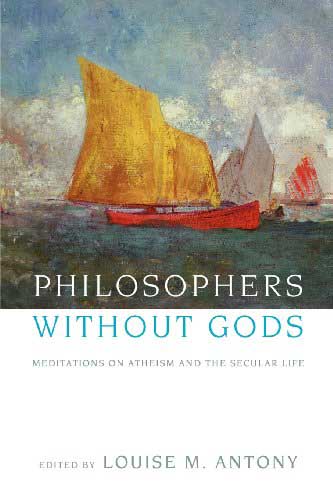
New Book: Philosophers without Gods (nineteen leading philosophers open a window on the inner life of atheism)

Philosophers without gods

Philosophers without Gods: Meditations on Atheism and the Secular Life by Louise M. Antony (Oxford University Press, 2007)

Book Description [from the publisher]
Atheists are frequently demonized as arrogant intellectuals, antagonistic to religion, devoid of moral sentiments, advocates of an “anything goes” lifestyle. Now, in this revealing volume, nineteen leading philosophers open a window on the inner life of atheism, shattering these common stereotypes as they reveal how they came to turn away from religious belief. These highly engaging personal essays capture the marvelous diversity to be found among atheists, providing a portrait that will surprise most readers. Many of the authors, for example, express great affection for particular religious traditions, even as they explain why they cannot, in good conscience, embrace them. None of the contributors dismiss religious belief as stupid or primitive, and several even express regret that they cannot, or can no longer, believe. Perhaps more important, in these reflective pieces, they offer fresh insight into some of the oldest and most difficult problems facing the human mind and spirit. For instance, if God is dead, is everything permitted? Philosophers Without Gods demonstrates convincingly, with arguments that date back to Plato, that morality is independent of the existence of God. Indeed, every writer in this volume adamantly affirms the objectivity of right and wrong. Moreover, they contend that secular life can provide rewards as great and as rich as religious life. A naturalistic understanding of the human condition presents a set of challenges—to pursue our goals without illusions, to act morally without hope of reward—challenges that can impart a lasting value to finite and fragile human lives. Collectively, these essays highlight the richness of atheistic belief—not only as a valid alternative to religion, but as a profoundly fulfilling and moral way of life.

About the Author
Louise M. Antony is Professor of Philosophy at the University of Massachusetts, Amherst. She is the author of A Mind of Oneʼs Own and Chomsky and His Critics.

Related Works

The Cambridge Companion to Atheism
Cambridge Companions to Philosophy
(published Oct. 2006)
by Michael Martin

Atheists: A Groundbreaking Study of Americaʼs Nonbelievers
by Bruce E. Hunsberger & Bob Altemeyer

Like Rolling Uphill: Realizing The Honesty Of Atheism
by Dianna Narciso

Nothing: Something to Believe in
by Nica Lalli

My Pilgrim Way,
The Case Against God,
Something Understood—An Autobiography,
Who needs the Church? (The 1982 Barclay lectures), all by Gerald Priestland

What I Believe
by Anthony John Patrick Kenny

Works that Contains A Wider Range of Testimonies

Leaving the Fold: Testimonies of Former Fundamentalists
(nearly three dozen testimonies edited by Edward T. Babinski)

Leaving Fundamentalism (to be published Dec. 2007)
(fifteen testimonies edited by philosophy professor, Dr. G. Elijah Dann)

Walking Away from Faith:
Unraveling the Mystery of Belief and Unbelief
by Ruth A. Tucker

Amazing Conversions:
Why Some Turn to Faith & Others Abandon Religion
by Bob Altemeyer & Bruce Hunsberger

The Courage of Conviction [a collection of varied testimonies from the Dalai Lama to Jane Goodall to Billy Graham]
editor Phillip L. Berman

This I Believe [a collection of varied testimonies]
editors Jay Allison & Dan Gediman

What I Believe:
13 Eminent People of Our Time Argue for Their Philosophy of Life
editor Mark Booth

Journeys in belief (Unwin forum, 2)
editor Bernard Dixon

New Book: Leaving Fundamentalism (fifteen testimonies edited by philosophy professor, Dr. G. Elijah Dann)

New Book: Leaving Fundamentalism

Leaving Fundamentalism will be published Dec. 2007 by Laurier University Press. Itʼs editor, professor G. Elijah Dann, is not only a former fundamentalist but also had as his thesis advisor, Gabriel Vahanian. (At Princeton in 1961 Professor Vahanian wrote the ground-breaking book, The Death of God.) After Professor Dannʼs studies in France, he was awarded a predoctoral fellowship from the Center for Philosophy of Religion at the University of Notre Dame. Besides Prof. Dannʼs story (“Confessions of an Ex-fundamentalist”)and a chapter on the history of fundamentalistic types of Christianity, the book includes:

The Slippery Slope of Theology by Jeffrey W. Robbins [an American Continental philosopher of Religion. He received his B.A. from Baylor University (1994), his M.Div. from Brite Divinity School, Texas Christian University (1997), and his Ph.D. in Religion from Syracuse University (2001). His dissertation was entitled “The Problem of Philosophical Theology.” He is the author of two books, Between Faith and Thought, and, In Search of a Non-Dogmatic Theology, and is editor of After the Death of God. Oddly enough Dr. Robbins is not a big fan of Christopher Hitchensʼ recent atheist bestseller, God is Not Great.]

The Jesus Lizard by James Fieser [whose exact identity I am currently checking, but who may be the same “James Fieser” who is author, co-author, and editor of seven textbooks, including Moral Philosophy through the Ages, A Historical Introduction to Philosophy (Oxford University Prss, 2003), Socrates to Sartre and Beyond (McGraw Hill, 2003), and Philosophical Questions (Oxford University Press, 2005), editor of the ten-volume Early Responses to Hume (Thoremmes Press, 1999-2003) and the five-volume Scottish Common Sense Philosophy; and founder and general editor of The Internet Encyclopedia of Philosophy web site.]

Fantastic Voyage: Surviving Charismatic Fundamentalism by David L. Rattigan [Former Pentecostal and evangelical, as well as one-time associate pastor, Dave is now an openly gay liberal Anglican, and actively involved at lay-level in his local Church of England parish. He has a BA (Hons) in Biblical-Theological Studies. Some excellent online essays by Mr. Rattigan include, “Worldviews, Stories and Why Leaving Fundamentalism Hurts,” “The Bible and Me: Two Friends on a Curious Journey” in which Dave explains how he lost his belief in the inerrancy of the Bible; and, “Do Evangelicals Really Believe in Hell?” Dave also manages (with some friends and co-contributors) a website titled Leaving Fundamentalism “…to aid people making the difficult and often painful journey away from conservative Christianity. It can be a time of confusion, hurt and frustration, but itʼs important to know that you are not making the journey alone. Thousands of others have been right where you are today. The site offers support and encouragement to anyone in the midst of leaving fundamentalism, whether they choose to remain within a Christian tradition or leave Christianity altogether.” Check out the Frequently Asked Questions at Leaving Fundamentalism.]

“More Catholic than thou”: One Manʼs Journey through Roman Catholic Fundamentalism by Andrea Lorenzo Molinari [Ph.D., in Theology (N.T. and Early Christianity), Marquette University; expert on the Nag Hammadi documents; Catholic educator; click on his name for further information]

From There to Here by L. A. Livingston

My Mother, My Church by Margaret Steel

The Ministry Revisited by Keith Dixon

Rapture, Community, and Individualist Hope
by Joseph Simons

Looking Back at Sodom: My Evangelical and Lesbian Testimonies by Julie Rak [Associate Professor of English, University of Alberta; and, Finalist for the 2006 Raymond Klibansky Prize for the Best Book in the Humanities (English Language)]

Life Stages by Jacob Shelley

Inching Along by Beverley Hardy

From Fear to Faith: My Journey into Evangelical Humanism by Glenn A. Robitaille

“Are you a ‘real’ Christian?” by Leia Minaker

The Naked Empress, Queen of Fundamentalism by Anonymous

The Above Book is Being Mentioned on Blogs:

Blog owner of Sub Ratione Dei writes:

One of the essays in Leaving Fundamentalism is by former pastor, David Rattigan, an old college friend from my two year stint at Theological College before I saw the light and got the hell away from the place. Also, he writes very well.

Alexis adds:

I also had a brush with Fundamentalism in the early 90s (and I still have emotional scars). Today I still am a person of faith, but Iʼve found that the (majority of the) fundamentalist/charismatic movement has become so entrenched in the modern Christian church (and divisive to the public discourse) that I stopped going. As a result of my own inquiry, research, and exposure to other spiritual traditions, my faith today is a mixture that most closely resembles Zen Christianity.

Michael Behe's version of Intelligent Design, Retracing Denton's course?

Michael Behe

The Evolution of Beheʼs Views: Francis S. Collins, the head of the Human genome project (who is both a Christian and an evolutionist), critiqued Beheʼs earlier hypothesis (that Behe has since dropped), namely of a “super cell” in the beginning thatʼs frontloaded with excess DNA to be put into use much later as the world evolves. Collins pointed out such a hypothesis did not make sense because if a super cell was indeed filled with tons of information to be used “much later” that information would have to be supernaturally preserved over long periods of time because unused portions of the genome are known to undergo continual mutations.

Behe once wrote, “If random evolution is true, there must have been a large number of transitional forms between the Mesonychid [a whale ancestor] and the ancient whale. Where are they?” Behe assumed such forms would not or could not be found, but three transitional species were identified by paleontologists within a year of that statement.

In Darwinʼs Black Box, Behe posited that genes for modern complex biochemical systems, such as blood clotting, might have been “designed billions of years ago and have been passed down to the present… but not ‘turned on’.” This is known to be genetically impossible because genes that arenʼt used will degenerate, but there it was in print. And Beheʼs argument against the evolution of flagella and the immune system have been dismantled in detail and new evidence continues to emerge, yet the same old assertions for design reappear here as if they were uncontested.

Behe now admits in his latest book, The Edge of Evolution, that almost the entire edifice of evolutionary theory is true: evolution, natural selection, common ancestry. His one novel claim is that the genetic variation that fuels natural selection–mutation–is produced not by random changes in DNA, as evolutionists maintain, but by an Intelligent Designer, The Great Mutator.

Beheʼs current situation reminds me of a similar situation in the past that the true father of the I.D. movement, Michael Denton, got himself into. After he wrote his first anti-evolutionary book, Evolution: A Theory in Crisis, he was praised by the folks at Access Research Network (editors of the flagstaff I.D. publication, Origins & Design), and became a member of the Discovery Institute. Then Denton admitted in an interview that he had not even known about the fossil evidence of inbetween species, like mammal-like reptiles. He also wrote his book before the various genome identification projects had taken off. Dentonʼs views were altered significantly by the time he wrote his second book, Natureʼs Destiny, in which he admitted that the genetic distance between species even between humans and chimpanzees was relatively small (as I like to point out, that genetic distance between humans and chimps is smaller than the genetic distance between near identical sibling species of fruit flies), and so Denton now accepts that evolution has taken place. He also had his name removed as a member of the Discovery Institute.

Christian and biologist, Ken Miller, responds to Behe

The continuing dismemberment of Behe (Links to reviews of his new book)

Pushing Behe over the edge

Malaria according to Nat. Geog. (& Behe)

Behe blows it

Silence over Beheʼs book

We don’t have an intelligent designer (ID), we have a bungling consistent evolver (BCE). Or maybe an adaptive changer (AC). In fact, what we have in the most economical interpretation is, of course, evolution.
—Lisa Randall, physicist

Moral Objectivity, Victor Reppert, Edward T. Babinski

Moral Objectivity

Dear Victor Reppert

I enjoyed reading your discussion at your blog on moral objectivity, along with comments left by others.

Is it me, or are you asking more philosophical questions concerning moral objectivity than you have in the past? Asking questions and analyzing the answers (interminably so, especially when such questions are large overarching ones) appears to be what philosophy does best.

On the question of “moral objectivity,” I think that the most objective thing any of us can say with anything near certainty as fellow philosophical debaters is that we each like being liked and hate being hated.

We certainly like having our particular thoughts appreciated by others. And we are a bit perturbed when others donʼt “get” what weʼre saying, so we continue trying to communicate our views in ways we hope others might understand.

I also assume each of us generally prefers not having lives nor property taken from them, and generally prefer not being abused either psychologically nor physically.

I also assume that when one person has something in common with another, be it a love of a game (chess, golf, soccer), a song, the sight of a sunset/sunrise, a philosophical point of view concerning the big questions, or a religion, that liking the same thing tends to bring people together and increase their joys.

Therefore, Iʼm not sure that “objectivity” is necessarily what I am primarily after, nor what most people are primarily after.

But I will say that there is a marvelous article in this weekʼs Discover about animals with feelings. One anecdote from the article involved a magpie (freshly deceased from an accident with a car) that lay by the side of the road surrounded by four live magpies that went up and pecked gently at it, then two flew off and came back with some tufts of grass in their beaks and laid it beside the dead magpie. Then they stood beside it for a while until one by one the four magpies flew off.

This anecdote sparked my own memory of another one that I read in a turn of the century book titled Mutual Aid by the Russian evolutionist, Kropotkin (his theory of evolution emphasized the benefits of mutual aid & cooperation). Kropotkin cited Australian naturalists and farmers who observed the way parrots cooperated to denude a farmerʼs field of crops. The parrots sent out scouts, then rallied the other birds, and they would swoop down quickly and devour the crops, but sometimes some of them got shot, and rather than simply fly off altogether the birds “comrades” (remember, this is a Russian biologist speaking) would squawk in a fashion of bereavement, trying to remain as long as possible fluttering near the fallen friend and group member.

I also have read stories about the intelligence of crows, even their sense of humor. One naturalist mentioned seeing three crows on a wire, and one of them slipped, seemingly intentionally, and held himself upside down by one claw, which apparently amused the others. (Iʼd also read about experiments and anedcotes involving birds with amazing memories and vocabularies, even speaking and acting in ways one would consider appropriate for brief human-to-human exchanges.)

Elephants and llamas were some of the other animals mentioned in the Discover piece that reacted strongly to the death of members of their own species. Elephants have come back a year later to the spot where another elephant has died (as seen on Animal Planet) and they react strongly to the bones. I also recall reading in a Jan Goodall book about a young chimp (fully grown, not a baby) reacting so strongly to the death of his mother, that he simply climbed a tree and wouldnʼt come down and eat until he himself had died, apparently of grief.

The works of Frans de Waal (a famed primatologist), contain some touching stories about the compassionate behaviors of primates, notably of the most peace loving chimp species, the bonobo. When Frans took his own baby son (who was sitting in a forward facing harness strapped round Fransʼs chest) to visit some chimps at a zoo where Frans had gotten to know the chimps well, a mother chimp with her own young one saw Frans holding his baby up to the viewing glass, and the mother took her own babyʼs arms and twisted her baby around in a single movement so it was facing outward, and held her baby up to the glass so that the two babies could eye each other. Frans and the mother chimp also exchanged glances. Frans mentioned a case of a female photographing chimps on their little chimp island that had a moat around it. They were bonobos, a female dominated society, and food had just been given them, and they were portioning it out amongst themselves. The photographer wanted to get a shot but the chimps had their backs to the camera and were facing the food that had been delivered instead of facing the moat with the photographer on the other side, so the photographer started to wave her hands and scream and jump up and down to get the attention of the chimps. The other chimps looked round, except one who was suspicious and didnʼt turn around. So the female photographer continued waving her hands and shouting until finally that last female chimp turned around, and tossed the photographer a handful of food! The chimp apparently thought she was being asked to share her food! And well, she did.

In another case Iʼve read about, Washoe the chimp was on a chimp island with other chimps, one of which climbed the fence and started wadding out into the moat surrounding the island (chimps canʼt swim, they sink, their bodies are denser than human beings since they have far less body fat). This chimp started to flail around in the water, drowning. Washoe saw this, clamored over the fence, and held onto some tall grass with one hand while extending the other to the drowning chimp, who was saved.

Meanwhile Robert Hauser (Harvard prof and author of Moral Minds) has asked a lot of people a lot of tough moral questions and found out how similar their responses were across the board regardless of whether the person was religious or not.

I have responded to the question of “moral objectivity” elsewhere on Victor Reppertʼs Dangerous Idea blog, and cited statements by philosophers and primatologists from Mary Midgley to Frans de Waal to Einstein. Anyone can view my responses by clicking here and here and here and here.
Edward T. Babinski

Flat Earth? Flood Geology? Young-Earth? Steve Hays & Edward T. Babinski discuss Steve Austin, Kurt Wise, Henry Morris & Henry Gee

Flat Earth and Ancient Hebrew Cosmology

Steve Hays of Triablogue is a young-earth creationist with whom Iʼve been having a bit of a discussion since I too used to be a young-earth creationist. In his blog entry, “Babel, Babble, & Babinski,” he told me that he read John Waltonʼs NIV Application Commentary On Genesis (2002) in which Walton pointed out that “Moses used architectural metaphors [in the creation story of Genesis, chapter 1] to foreshadow the tabernacle. That would also fit with the literary unity and intertextuality of the Pentateuch.” Therefore, the flat-earth creation account in Genesis 1 is an accommodation to Mosesʼs “flat-tent” view of the cosmos—strictly metaphorically speaking that is.

Hays also stated, “Iʼm more concerned with exegeting Scripture than exegeting Steve Austin.” (Austin is a Ph.D. geologist who is a formal member-teacher at the Institute for Creation Research, a young-earth organization).

Hays ended his blog entry with mention of the pro-evolutionary geologist Dr. Henry Gee, “who has documented at length that the fossil records is not a continuous sequence frozen in rock, but discontinuous data-points which are rearranged into a continuous sequence by a value-laden reconstruction of the record that is enormously underdetermined by the actual state of the evidence. A thousand theoretical interpolations to every isolated bone fragment. Of course, Gee isnʼt trying to undermine evolution. Rather, like so many others, heʼs trying to retrofit the theory. But to clear the ground for cladistics, he must slash and burn phenetics [=the phylogenetic ancestor-descent trees involving arrows showing which fossilized creature descended from which other fossilized ancestor], and itʼs quite a spectacle to see how little is left over after his scorched earth policy. So now we have another outbreak of the Darwin Wars.”

My response follows on those three topics that Hays raised:

Steve Austin, Kurt Wise, Henry Morris, The Genesis Flub

I brought up Steve Austin and Kurt Wise because they are two of the most prominent young-earth creationists in the entire U.S. who have also published a lot since the 1970s in creationist books and magazines. They are also among the few young-earth creationists in the world with Ph.D.s in geology and paleontology, repsectively. (Henry Morris who wrote The Genesis Flood and founded The Institute for Creation Research [ICR] only has a Ph.D. in hydrology.) I say “few” because I once checked the ICR and Answers in Genesis lists of young-earth creationists who work for both institutes and who had advanced degrees, and I counted only about 8 scientists there with Ph.D.s in geology, and no Ph.D.s in paleontology other than Wise. And they both agreed that Morrisʼs attempt in The Genesis Flood to cite the Lewis Mount Overthrust (the largest such “reversal of fossil layers” found anywhere in the world) as not a genuine overthrust, was a failure.

Yet it was Henry Morrisʼs book, The Genesis Flood, along with the founding of ICR, that is credited at ICR as being Godʼs means to bring back Flood Geology (from the grave in which it had lain since Christian geologists of the 1800s had proven it to be indefensible). Unfortunately for Morris, his book has since been thoroughly discredited, and found to consist of unchecked folk science tales, strung together with faulty photos, and mistaken geological assertions. If thatʼs the book that “God used” to give “Flood geology” a recharge (and “the book that God used to get Ken Ham [of Answers in Genesis and the Creation Science museum in the U.S.] in creation ministry”) then it seems more like the devilʼs book, full of lies spoken in Godʼs name to embarrass the Christian faith. At least thatʼs what some of my old-earth creationist friends might say. And since then, creationists have continued to back down from a host of ridiculous assertions that formerly were touted as disproving modern geology. Just read the Answers in Genesis online piece, “Arguments We Think Creationists Should Not Use.” Instead, modern young-earth creationism tries to invent accommodations with modern geological evidence of an old-earth. It does not try to disprove it like it once did. Both ICR and Answers in Genesis admit that the search for “pre-Flood” human remains and artifacts or any new startling evidence of a young-cosmos, is probably hopeless: “Where are all the human fossils?” by Don Batten (editor), Ken Ham, Jonathan Sarfati, and Carl Wieland. The final line of that article is classic: “When God pronounced judgment on the world, He said, ‘I will destroy [blot out] man whom I have created from the face of the earth’ (Gen. 6:7). Perhaps the lack of pre-flood human fossils is part of the fulfillment of this judgment?”

Or perhaps God just didnʼt want to supply young-earth creationists with the evidence they so desperately crave?

And what about the new “Creation Museum” museum opening soon in the U.S. with its exhibits of humans alongside dinosaurs? The folks who built that museum admit that pre-flood human fossils have not been discovered, but they built exhibitions showing humans alongside dinosaurs. How scientific of them!

And speaking of the age of the earth what about the evidence of an old-earth from a variety of sources like Lake Suigetsu, Ice Cores, The Greenriver formation and what about the way radiometric dating has been done on individual varve layers, individual ice layers, individual tree rings (in three known series of tree rings that each stretch back in time at least 10,000 years), individual sections of sea floor that arose via the expanding molten rifts from the center of the Atlantic as it continues to spread—and in each case the processes of lake varves forming, ice layers forming, tree rings growing, and sea floors spreading, continue to take place today at known rates of formation that show agreement with the radiometric dating of individual portions of older sections of those formation? What are the odds that a load of coincidences would match up? See here and here and here. And my own story, here.

John Walton And His NIV Application Commentary On Genesis

Walton admits in his commentary that the ancient Hebrews, and the author of Genesis, assumed a flat cosmos and a solid firmament.

Whether or not one also assumes that the creation story in Genesis may be interpreted as a metaphor of the tabernacle-tent spoken of in Exodus is another question. Such a view of the cosmos as a house or tent (built flatly and on a firm foundation) does not lay outside of ancient near eastern assumptions in general, for instance note the ‘wall-ring’ representations of the firmament lying above a flat earth in ancient Egyptian iconography, or ancient mestopotamian cosmologies in general.

And more importantly, the lack of any insight into how the cosmos is truly shaped, means that the ancients wrote and assumed things on par with the pre-scientific knowledge of their day, and not a sign that one can cite that Genesis demonstrates in was composed via special inspiration.

Henry Gee, Creationism, And I.D.

Lastly, about Henry Gee. Creationists and I.D.ists donʼt understand correctly what heʼs saying, as Gee himself has complained about numerous times, even directly to creationists and I.D.ists. I have some of his correspondence with them from 2006. Heʼs describing the difficulties of dating the exact chronological order of fossils that lay relatively close together in the geological record, and advocating a greater use of cladistics to aid in determining the order of relationships in such cases. (Note: The way evolution works is that populations split from one another, then the more robust sections of a population grow more numerous and more widely established in different places round the world, which increases the odds of the new speciesʼs fossilization, but by the time the new species has spread far and wide enough to increase its chances of being fossilized, it is not likely to simply be the direct descendant of species that precede it in the fossil record, but a cousin. Hence, Geeʼs complaint about the drawing of direct lines between species in textbooks. The actual evolutionary lines of descent are more complex, and what we have are the fossils of the most robust cousin species that were living during certain overlapping eras.)

Henry Geeʼs Response

Henry Gee (henrygee) wrote,
@ 2006-06-12 22:43:00:
“I have become somewhat irked lately at the way that some creationists continue to attribute beliefs to me to which I do not subscribe. For example, creationists of the ‘intelligent design’ tendency have used my book Deep Time (sold in the US as In Search of Deep Time) to suggest that whereas I donʼt support their views, my own work somehow legitimizes them… even though I have explicitly refuted this attempt at hijack, many years ago.

“I pointed this out recently to creationist Jonathan Witt at ID The Future and as a result have had a civil and gentlemanly email exchange with him (and by extension his colleague Jonathan Wells, who has also quoted from my book).”

See also this discussion at the Quote Mine Project of the use that creationists/I.D.ists have tried to make of some Gee quotations.

C. S. Lewis Resources… Pro And Con

  1. Christians Who Praise C. S. Lewisʼs Writings
  2. Christians (Lying To The Right of Lewisʼs Views) Who Criticize Lewisʼs Presentation of Christianity & Liberal Ideas
  3. Admiring Readers of C. S. Lewis Who Later Left Christianity
  4. Critiques of C. S. Lewisʼs Arguments
  5. C. S. Lewis: Provocative, Poignant, & Profound Words

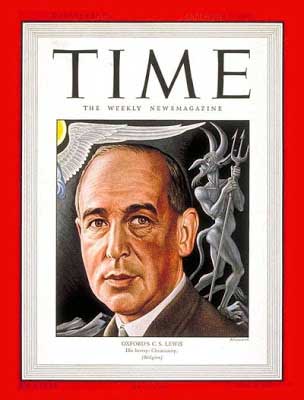
C. S. Lewis Time Magazine
  1. Christians Who Praise C. S. Lewisʼs Writings

    (Forgive the shortness of part 1., there are nearly 1 & 1/2 million hits for “C. S. Lewis” on the web, and the vast majority of them are from people who praise his writings. So, I shall name a few fairly prominent representatives who have praised Lewis recently.)

    • Josh McDowell — Author of Evidence That Demands a Verdict, apologist/evangelist for Campus Crusade

    • Rev. N.T. Wright — Anglican Bishop of Durham, England, and author of scholarly and popular books, most recently, Simply Christian. Wrightʼs address, Simply Lewis, was delivered at the annual meeting of the Society of Biblical Literature in mid-­November, 2006, and besides praise, it contains a few paragraphs critical of some aspects of Lewisʼs argumentation, especially Lewisʼs Lord, Lunatic or Liar argument.

    • Dr. Francis Collins — Head of The Human Genome Project, and author of The Language of God: A Scientist Presents Evidence for Belief. See his debt to Lewis here and here.

    • Tom Tarrants — Raised Southern Baptist, became KKK terrorist, read the Bible in prison and converted to Christianity, now head of the C. S. Lewis Institute in Washington, D.C.

  2. Christians (Lying To The Right of Lewisʼs Views) Who Criticize Lewisʼs Presentation of Christianity & Liberal Ideas

  3. Admiring Readers of C. S. Lewis Who Later Left Christianity

    • “J Milton” [a pseudonym], and his brief testimony, Paradise Lost — posted Thursday, October 26, 2006 — “I… came to the Christian faith via more of an intellectual, mystical path… through the writings of John Milton, Edmund Spenser, C.S. Lewis, and the spiritualist and mystic Renaissance man known as William Blake… If you havenʼt read Paradise Lost, I highly encourage you to do so. It truly is wonderful… as is the Faerie Queene by Edmund Spenser as well as Lewisʼ Narnia series… they all create mythological worlds on top of the bible, and in my mind, make it all come to life… I still believe in the ethereal plane, sans any man-applied dogma. John Milton will always mean something to me and Paradise Lost will always have a place in my heart… [But I am a] freethinker… exchristian.”

    • Valerie Tarico — Psychologist, author, graduate of Wheaton College, her favorite Christian author during her Evangelical years was C. S. Lewis (Wheaton College features one of the most impressive collections of “Lewisiana” in the world). Chapters of her book about leaving the fold were published on ex-Christian.net. Her blog. Chapters of her book can also be found here, here, and here.

    • Edward T. Babinski — If It Wasnʼt For Agnosticism I Wouldnʼt Know What to Believe, a chapter in Leaving the Fold: Testimonies of Former Fundamentalists.

    • Ken Daniels — From Missionary Bible Translator to Agnostic (2003)

      Mentions his earnest love of Lewisʼs writings, and how they saved him from apostatizing even earlier than he eventually did. He also mentions having read my own book, Leaving the Fold, mentioned directly above. Later, Ken expanded his testimony into a full length book thatʼs available free online, Why I Believed: Reflections of a Former Missionary.

    • John Stephen Ku — Philosophy PhD student, Started Fall 2002, U of Mich. — C. S. Lewis and the Search for Rational Religion: A Memoir — a memoir that is no longer on web, but which might still be on the Way Back Machineʼs Internet Archive.

    • Kendall Hobbs — Why I Am No Longer a Christian (2003)

    • Dr. Robert M. Price — Former campus minister, now a theologian with two PhDs and an author, wrote in Beyond Born Again, “…C. S. Lewisʼs The Screwtape Letters considerably advanced my progress in piety,” though later Price would leave the fold.

    • A cold and broken alleluia: How did a former minister become an atheist?

    • Chris Hallquist — College student. Read The Screwtape Letters a month before becoming an atheist, see his blog entry, How I Became an Atheist [Oddly enough, Chris seems to have read the same passage in The Screwtape Letters that the ex-minister did in the testimony directly above this one, and that passage influenced both of them to become atheists.]

    • Posted by Hawk on August 17, 1999 at 18:23:55:
      “I [was raised Christian, but] shrugged off Christianity around age 16 after a teacher told me that Moses created monotheism. David Koresh was running around claiming to be divine about the same time, so I figured Jesus was some nut like Koresh. I got real into philosophy in general, and I am an engineering student, so I have taken plenty of science classes, but I never got into creationism or philosophy of religion. I was never a serious Christian as a kid, so when I read Pascalʼs ‘Thoughts,’ I decided to give church a try. Well I was 19 1/2, and the places here on campus were nothing like any church I had ever been to. I read C.S. Lewis, William Lane Craig, Schaeffer, Geisler, Moreland and all those guys. I became converted. Unfortunately, I read up on atheistic arguments and evolution, for the purpose of crushing the atheists on this board with my arguments. I lost faith finally a few months ago. I guess I am sort of a donʼt know donʼt care agnostic right now, who just enjoys studying religion. My religious time only lasted about 3 years.”

  4. Critiques of C. S. Lewisʼs Arguments

    • Philosopher John Beversluis composed in 1985 what has become the leading (and perhaps only) book-length critique of the apologetics arguments of C. S. Lewis, a book that also includes Lewisʼs replies to letters Beversluis wrote him. The book is titled, C. S. Lewis and the Search for Rational Religion, and a revised and updated edition appeared in 2007 — In it Beversluis critically yet sympathetically examines Lewisʼs “case for Christianity,” including Lewisʼs “argument from desire” — the “inconsolable longing” that he interpreted as a pointer to a higher reality; his moral argument for the existence of a Power behind the moral law; his contention that reason cannot be adequately explained in naturalistic terms; and his solution to the Problem of Evil. In addition, Beversluis considers issues in the philosophy of religion that developed late in Lewisʼs life. He concludes with a discussion of Lewisʼs crisis of faith after the death of his wife. Finally, in this second edition, Beversluis replies to critics of the first edition. {250pp, July 2007; Prometheus Books }

      Joe Edward Barnhard (philosophy professor, author and a former Christian whose testimony appears in Leaving the Fold: Testimonies of Former Fundamentalists), has an article online titled, “The Relativity of Biblical Ethics” that includes quotations from a few of C. S. Lewisʼs letters to John Beversluis. [at the site, located here, scroll down the page till you get to Barnhardʼs article]

    • Francis Collins, the theistic evolutionist author of books about God and science, and who heads the Human Genome project, employs C. S. Lewisʼs argument concerning the miracle of morality. Collinsʼs Lewisian argument is critiqued here.

    • C.S. Lewis, Instinct, and the Moral Law — Discusses an argument by C.S. Lewis that aimed to show that we must believe in God because nothing else could explain the high levels of intersubjective agreement on moral issues we(apparently) observe.
      Source: Philosophy Carnival #33

    • N. F. Gier — author of God, Reason, and the Evangelicals (University Press of America, 1987), chapter 10, Theological Ethics

    • Dr. Robert M. Price on C. S. Lewisʼs arguments — Google Robert Price (or Robert M. Price) and C. S. Lewis together to find where Price mentions and critiques statements by C. S. Lewis for instance, Lewisʼs misunderstanding of Hume is mentioned in Priceʼs article, Glenn Miller on Miracles.

    • Jack D. Lenzo “The Jackal” (Murrieta, CA USA), in his review of The Born Again Skepticʼs Guide To The Bible by Ruth Hurmence Green (raised Methodist): “Iʼve read much of CS Lewis and considered him the ‘thinking manʼs’ proponent to Christianity. After reading ‘The Book of Ruth (Hurmence),’ I feel logically duped by Lewisʼ Mere Christianity. Ruth sets it straight using the Bible itself. A divinely inspired book should not have to use subtle logic employed by Lewis. I wonder what he would say to Ruthʼs clear, dead on approach that he hasnʼt said about Freud? Hmmm…”

    • Edward T. Babinski on C. S. Lewisʼs views:

  5. C. S. Lewis: Provocative, Poignant, & Profound Words