What Polls Show About U.S. Christianity, According to Professor of Sociology, Bradley R. E. Wright

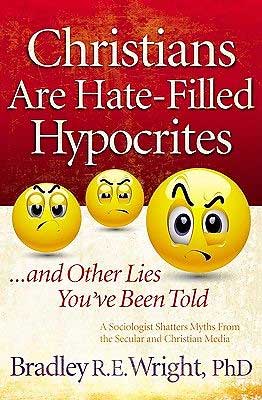
Christians are Hate-filled Hypocrites

Christian and Professor of Sociology, Bradley R. E. Wright (pictured on left) was interviewed in Christianity Today concerning his book (pictured at right), and had this to say:

My goal was to follow the data, not so much to disprove anyone. [Thereʼs a lot of good news out there concerning the state of Christianity. But] If youʼre wondering what I was hoping would be good news but wasnʼt, itʼs race. I thought we [Christians] were doing better. But white evangelicals have more racially prejudiced attitudes toward African Americans than do white non-evangelical Christians and (especially) white non-Christians.

I was also dismayed about our attitudes toward gays. Iʼm not talking about whether gay sex is appropriate, but the standard “social distance” questions in sociology, like whether someone should be allowed to give a talk in public or have their book in a library or, “How do you feel about this kind of person?”

Also, evangelicals have much more negative attitudes toward atheists and non-Christians than non-Christians have about us.

[Dr. Wright also noted that in the Evangelical community, talk of “failure” sells]

What we [Christians] hear is, “Christianityʼs going to fail. Youʼre all a bunch of failures. But if you buy my book, listen to my sermon, or go to my conference, Iʼll solve everything.” These fear messages demoralize people… and hide real problems.

Wrightʼs analysis, above, agrees in places with that of church historian (and fellow Christian) Mark Noll, who wrote:

We [Evangelicals] remain inordinately susceptible to enervating apocalyptic speculation, and we produce and consume oceans of bathetic End Times literature while sponsoring only a trickle of serious geopolitical analysis.

We are consistently drawn to so-called “American Christianities” — occasionally of the left, more often of the right—that subordinate principled reasoning rooted in the gospel to partisanship in which opponents are demonized and deficiencies in our friends are excused…

Capitulation to disembodied ideals of spirituality incapacitates our struggling band of novelists and poets.

And far too many of us still make the intellectually suicidal mistake of thinking that promoting “creation science” is the best way to resist naturalistic philosophies of science.

Evangelical higher education in North America remains a fragmented enterprise, both nourished and impeded by the sectarian character of American religion…

This picture is, of course, a generalization…

Mark Noll (Christian and professor of Christian history at Wheaton College — Billy Grahamʼs alma mater — though he now teaches at the University of Notre Dame), “The Evangelical Mind Today,” First Things, No. 146, Oct. 2004

Evidence of Belief in a Three-Tier Cosmos, Or Purely Metaphorical “Burial Language?”

Jesus Descends into Sheol

Paul wrote of beings existing “under the earth.” Paulʼs Hellenistic and Jewish readers were familiar with underworlds in which beings lived, i.e., the Greek Hades, the Roman Tartarus (both terms appearing in the Gospels themselves) and the shadowy Sheol of the Hebrew Bible:

The departed spirits tremble under the waters and their inhabitants. Naked is Sheol before Him [Yahweh].
Job 26:5-6

A witch in Endor calls up Samuel from Sheol. (She is not calling him up from his personal burial site because he was not buried in Endor.)
1 Sam. 28:3,12ff

The dead are not simply lying dead in the earth but “under the earth” and remaining active in some sense, if only in a shadowy sense in the case of early Greek and Hebrew views of Hades and Sheol. Below are verses from Paul and Revelation that mention beings living under the earth. Consider them from the viewpoint of a first century Hellenistic convert:

That at the name of Jesus every knee should bow, in heaven and on earth and under the earth.
Philippians 2:10

English Bibles fail to render fully the meaning of “under the earth” in the above verse—the Greek word katachthonion refers to “the beings down (kata) in the chthonic (chthovios) or subterranean world.” The Anchor Bible translation is “those in the world below,” with the added comment, “katachthonioi was a designation for the dead in the underworld [the commentary then cites sources from Hellenistic antiquity]… The meaning is spirits above, humans on earth, and the dead in Hades, appropriate for ‘the Roman milieu of Philippi.’ … The full phrase came naturally for Christians there to describe the universe… Those in the heavens [several ‘layers,’ 2 Cor. 12:2 ‘the third heaven’]; on earth [1 Cor 8:5; 10:26; 15:47]; and in the world below, Sheol or Hades.” [John Reumann, Philippians, The Anchor Yale Bible, 2008, p. 357-58]

The book of Revelation features a similar notion:

No one in heaven or on earth or under the earth could open the scroll or even look inside it. Revelation 5:3 … Then I heard every creature in heaven and on earth and under the earth and on the sea, and all that is in them, singing: “To him who sits on the throne and to the Lamb be praise and honor and glory and power, for ever and ever!” Revelation 5:13

Also consider how a Hellenistic convert might read these verses, starting with talk of a “prince of the power of the air,” and also about “descending into the lower parts of the earth”:

…in which you formerly walked according to the course of this world, according to the prince of the power of the air, of the spirit that is now working in the sons of disobedience. Ephesians 2:2 … That the manifold wisdom of God might now be made known through the church to the rulers and the authorities in the heavenly places. Ephesians 3:10 … Now this expression, “He ascended,” what does it mean except that He also had descended into the lower parts of the earth? He who descended is Himself also He who ascended far above all the heavens, so that He might fill all things. Ephesians 4:9-10 … Our struggle is not against flesh and blood, but against the rulers, against the powers, against the world forces of this darkness, against the spiritual forces of wickedness in the heavenly places. Ephesians 6:12

Interestingly, a different letter says that these “things in heavenly places” were reconciled to God:

… and through him to reconcile to himself all things, whether things on earth or things in heaven, by making peace through his blood, shed on the cross.
Colossians 1:20

Further Information On Sheol In The OT

Sheol is typically depicted as a place to which one “goes down” (urd; see Num 16:30;Job 7:9; Isa 57:9; cf. Isa 29:4; Ps 88:3-4). It represents the lowest place imaginable (Deut 32:33; Isa 7:11) often used in contrast with the highest heavens (Amos 9:2; Ps 139:8; Job 11:8). To emphasize further the depth of Sheol we also find it modified by tahtit/tahtiyyot (e.g. Deut 32:22; Ps 86:13; Ezek 31:14-18), usually translated “the lowest parts of the underworld.”

Sheol is also associated with terms for chaotic waters, including Sea, River, breakers, waves, and the deep. So Sheol is associated with primeval waters lying beneath the earth as well as with judgmental waters loosed by God (water that God is depicted elsewhere as miraculously holding back in order to maintain creation, see “The Cosmology of the Bible” chapter in The Christian Delusion). Ancient Near Eastern imagery also links a crossing of water with oneʼs travel to the underworld and the imagery is so common from Mesopotamia to Greece that it probably played a role in the Hebrew linkage of water with the land of the dead.

The inhabitants of Sheol are called the Rephaim, and a great deal of literature has been written on the nature of the Rephaim since the publication of Ugaritic texts where they are mentioned extensively.

As already stated, it is not a matter of being forced to choose between totally metaphorical usage versus all other usages or understandings. In early usage Sheol is like a metaphor for the Uber-grave, but even metaphors do not preclude other meanings, depictions, definitions rather than purely “burial imagery.” In fact, recognition of ideas shared by biblical and ANE sources makes the likelihood of belief in a three-tier cosmos more likely, not less so. Same goes for NT conceptions, see below.

Further Information On The Underworld In The NT

The underworld is depicted not only as “Hades” in the NT (into which Christ descended in order to preach to the spirits of the dead, 1 Pet 3:18-20; 4:6—such a “descent into hell” becoming part of the Apostleʼs Creed), but the underworld is also depicted as the “Abyss” (abussos), often translated as “Bottomless Pit” (Luke 8:31; Rom 10:7; Rev 9:1-2,11; 11:17; 17:18; 20:1,3). “Tartarus” is another word derived from Greek mythology and employed by NT authors, itʼs a place that Greeks depicted as lying as far below Hades as earth is below the heavens, so much so that an anvil could fall for nine days and nights until it reached it. Tartarus is described as a prison with gates and sometimes personified (as was Hades, and also Sheol in the OT). The author of 2 Peter 2:4 mentions rebel angels being cast into Tartarus, based on a story found in the inter-testamental work, 1 Enoch (or at least based on a general knowledge of the “Watchers” myth in 1 Enoch):

1 Enoch 10:2-3, 10:11-14 — A deluge [Flood] is about to come upon the whole earth … And the Lord said unto Michael: ‘Go, bind [the evil angels] in the valleys of the earth till the day of their judgment … is consummated. In those days they shall be led out to the abyss of fire: and to the torment and the prison in which they shall be confined for ever.’

Compare 2nd Peter 2:4-5 — God spared not angels when they sinned, but cast them down to hell, and committed them to pits of darkness [Tartarus], to be reserved unto judgment; and spared not the ancient world, but preserved Noah … when he brought a flood …

Portions of the Book of Enoch can also be found in the NT books of Jude and Revelation. Interestingly, 1 Enoch depicts a flat earth.

[Much of the information in the above sections on Sheol and the NT underworld was derived from Theodore J. Lewis, “Dead, Abode of the,” Anchor Bible Dictionary, Vol. 2, Doubleday, 1992]

Final Point Of Interest: Did The Ancient Israelites View Sheol As Real Or Not?

“A cursory overview of modern interpretation of biblical thanatology quickly reveals the lack of current consensus among scholars. There is pressing need for further study and clarification. Was Sheol real or not for ancient Israelites? If it was real, were all souls expected to end up imprisoned there? How did Israelites interact (or refrain from interacting) with the shades of the dead?”—Stephen L. Cook

Cookʼs complete paper is online: Funerary Practices and Afterlife Expectations in Ancient Israel

Prior to the publication of his paper Stephen L. Cook also composed these shortened presentations of various points:

  1. To Be Gathered To Oneʼs People
  2. Burial and Afterlife in Yahwism, Part 2
  3. Burial and Afterlife in Yahwism, Part 3
  4. Burial and Afterlife in Yahwism, Part 4
  5. Burial and the Hereafter in Yahwism, Part 5
  6. Burial and the Hereafter in Yahwism, Part 6
  7. Yahwism and Life after Death: Part 7
  8. Life after Death, Part 8

See also this new book on the afterlife, L’homme face à la mort au royaume de Juda: Rites, pratiques et représentations by Hélene Nutkowicz. Cook comments: “Nutkowicz suggests that the Hebrew people believed in amortality. At first glance, it seems to me that this might be a helpful term, since it stresses that the soul does survive death, but it does not view death as positive or beatific as might be implied by the term immortality. N. also discusses the relationships between the living and the dead, the repa’im [also spelled, Rephaim], the ’elohim, the practice of necromancy, the duties toward the dead and toward the living, inscriptions, and the cult of the dead and of the ancestors.”

Exaggerations of Biblical Proportions, Hyperbole, Genocide and Paul Copan (hat tip: Matt Flannagan, MandM, Jeremy Pierce, to name a few)

Chuck Norris

Chuck Norris jokes often involve extreme exaggeration or hyperbole—which is the topic of this post—so letʼs begin with a few laughs:

  • Chuck Norris is the reason why Bigfoot is always hiding.

  • Chuck Norris beat the sh*t out of his shadow because it was following too close. It now stands a safe 30 feet behind him.

  • Some kids p*ss their name in the snow. Chuck Norris can p*ss his name into concrete.

  • Chuck Norris doesnʼt sweat. He forces the air around him to cry and uses its tears to cool himself.

  • On the first day God made Chuck Norris and told him to take it from there.

  • Chuck Norris came up with the “Big Bang Theory” … His round house kick is why we have the cosmos.

  • There is no Life or Death, only Chuck Norris roundhouse-kicking you in the face.

  • The reason newborn babies cry is because they know they have just entered a world with Chuck Norris.

  • At night the Boogeyman checks his closet for Chuck Norris.

  • Chuck Norrisʼ tears cure cancer. Too bad he has never cried. Ever.

  • Chuck Norris built a time machine and went back in time to stop the JFK assassination. As Oswald shot, Chuck Norris met all three bullets with his beard, deflecting them. JFKʼs head exploded out of sheer amazement.

  • Chuck Norris can count to infinity.

  • Chuck Norris doesnʼt cheat death. He wins fair and square.

  • Chuck Norris once punched a man back into a monkey. Therefore proving evolution at the same time.

  • Chuck Norris only gives one Xmas present. He allows you to live.

  • Jesus can walk on water, but Chuck Norris can swim through land.

Iʼve brought up “hyperbole” (starting with Chuck Norris jokes) because Christian apologist, Paul Copan defends God as presented in the Hebrew scriptures from the charge of genocide by claiming that Godʼs commands to wipe out Canaan and not leave anyone standing, including women, children, and even livestock are hyperbole and that such expressions were commonly used to indicate a severe attack but did not mean that literally no one at all would survive.

Unfortunately that appears to be the best defense that apologists have come up with, and I agree with Copan that the Bible features hyperbole as weʼll see below. But in my opinion thereʼs too many “God directly killed,” and also “God told me to kill” verses in the Bible, and they arenʼt all directed at Canaanites. Anyone can google up verses in the OT in which Godʼs jealousy and or wrath drowns everyone in the world (even Copan probably admits that the flood story sounds a bit massive, even genocidal if you interpret such a judgment as taking place worldwide rather than locally); or, God sends plagues, famines and armies (not to mention poisonous snakes and even opening up the ground) to kill some of His own people; or, God has some chosen people kill other chosen people; or, God has his chosen people kill unchosen people.

Even the NT reflects the leftover stench of some of those jealous and wrathful OT portraits of God such as in 1 Cor. 11:29-30 where Paul claims “… anyone who eats and drinks without recognizing the body of the Lord eats and drinks judgment on himself. That is why many among you are weak and sick, and a number of you have fallen asleep [died].” So, Paul says God still sent illnesses and death, even to his newly chosen people, Christians, based on how badly they mismanaged their celebration of the Lordʼs supper. While Acts tells how a married couple were both struck dead for lying about giving everything they had to their local friendly Christian commune. They gave something, but apparently they lied about having given literally everything. Maybe God didnʼt understand that they were not lying, but just practicing a little hyperbole of their own when they stated that they had “given all?” Either way, boom, both fell instantly dead. Or take the book of Revelation where Jesus and God bring peace on earth by way of unleashing hell on earth first. See also these verses from Jesus in the Gospels, “Do you suppose that I [Jesus] came to grant peace on earth? I came not to bring peace, but a sword” (Mat. 10:34); or, “Do you suppose that I came to grant peace on earth? I tell you, no, but rather division … I have come to cast fire on the earth and how I wish it were already kindled.” (Luke 12:49,51)). Therefore, whether or not Godʼs commands in the OT constitute utter and complete genocide rather than merely “severely murderous attacks” upon lots of people (including his own chosen people) is not exactly going to restore my faith in either God or the Bible. Instead I want to bring up another point, namely wide spread use of hyperbole in the Bible, and the Bibleʼs cultural-centrism as well, since the Israelites shared with their neighbors a willingness to go “all the way” verbally, to try and make their beliefs/culture/god(s)/people appear like the world revolved around them and their god and their laws, etc.

So in my opinion questions related to hyperbole in the Bible merely raise more questions for Christians who believe in the Bibleʼs special inspiration, and provide yet more evidence that the books of the Bible are ancient Near Eastern documents, and contain the same exaggerated speech, boastful lies and holy hyperbole common for that day and age.

Take the case of King Hammurabi of Babylon and his Code of Laws compared with Moses and his laws. Even by conservative scholarʼs reckoning Hammurabi lived prior to Mosesʼ day. And a stele was discovered that contains the law code of Hammurabi

and on top of the stele is the carved image of Shamash, the supreme sun god and judge, who is seen offering to Hammurabi a rod and ring that symbolize authority. These two symbols are apparently derived from buildersʼ tools—measuring stick and coiled rope. The implication is that the king is to build social order. The reference to buildersʼ tools reminds us of the importance of building as another means of giving physical testimony to a rulerʼs power. The stele thus asserts the divine sanction of Hammurabiʼs power, and that the social order he constructs is a reflection of a divine order.

The story of Moses is similar, since Moses meets with his god and receives two objects from him (stone tablets) and then proceeds to compose laws suitable for a nation. Both stories strike one as ancient Near Eastern attempts to explain the origin of laws and add authoritative backing to them. But since we donʼt believe that Hammurabiʼs story literally happened, what about the later story, the one involving Moses?

Another example of an ancient Near Eastern culture-centric justification story is the OT tale about King David having received special instructions directly from Yahweh on how to build His temple. Just as in the case of Hammurabi and Moses above, a non-Hebrew tale preceded the Hebrew one. King Thutmose of Egypt lived before the day of King David, and an ancient inscription says that Thutmose received instructions directly from his god, an Egyptian deity, about how His temple should be built. Since we donʼt believe that an Egyptian god actually spoke to Thutmose telling him how he wanted his temple designed, why should we treat the later Hebrew story as if it was literally true? Again, they could both be culture-centric stories that arose to add “divine” justification for the temples each of those kings built.

And ancient Near Eastern comparisons donʼt cease there.

The Bible begins with the exaggerated ages of biblical patriarchs. But ANE king lists also featured exaggerated ages.

And speaking of exaggerations letʼs focus again on some of the hyperbole that I mentioned could be found in the Bible, stuff that I think raises more questions than answers concerning alleged claims of the Bibleʼs “inspiration.” After all, maybe even the claim that the Bible is “inspired” is hyperbole?

The Bible features exaggerated numbers of people wandering in the desert for forty years and exaggerated tales related to such massive numbers of desert wanderers, such as the story about them traveling every day and night, following a pillar of smoke by day and a pillar of fire by night, and their clothing never wearing out during those forty years of incessant “wandering.” For more on exaggerations related to the Bibleʼs Exodus story click here.

And thereʼs the exaggerated abundance of the Promised Land, a land “flowing with milk and honey?” Certainly it was more abundant than a Middle Eastern desert, but compared with a lush tropical island or even compared with Europe, the Promised Land appears relatively meager, barren, and features a parched wilderness as well as a Dead Sea. (Europe on the other hand truly is a promised land as it happens to be the only continent that doesnʼt have a desert.)

Ancient Near Eastern records include exaggerations concerning the size of armies, and numbers of people slain. So does the Bible since it states that King David and King Saul fielded armies larger than those of Alexander the Great, larger than those that battled in Europe and America in the 18th and 19th centuries. Did King David have 1.57 million troops (1 Chron. 21:5)…or 340,000 plus the muster of Issacher…or 1.3 million (depending on which verses you read). While King Saul could field 210,000 troops? (1 Sam. 15:4) Hyperbolic numbers most likely.

Did the Hebrew warriors Abishai & Jashobeam each slay 300 men using only a spear (2 Sam. 23:8 & 1 Chron. 11:11)?

But thatʼs nothing, because Shamgar slew 600 men with an ox-goad (Judges 3:31).

And Adino slew 800 with a spear (2 Sam. 23:8) Do ya suppose Adino was the inventor of Shish-ka-bob?

Last but not least, Samson slew 1000 men with the jaw-bone of an ass (Judges 15:15). Iʼd say more hyperbole.

“Among all this people there were seven hundred chosen men left-handed; every one could sling stones at a hairʼs breath, and not miss.” Judges 20:16 Yet more hyperbole. Even the greatest sharp shooters at the turn of the last century, who performed in Wild West traveling shows and who shot cards out of each otherʼs hands, did not retire with all their fingers—because they “missed” some shots by “a hairʼs breath.”

Or take this nauseatingly hyperbolic passage, not the only such passage in the Bible:

“Their slain shall be cast out, and their stink shall come up out of their carcasses, and the mountains shall be melted with their blood.” Isaiah 34:3

And speaking of the Bibleʼs use of the word “all,” itʼs practically everywhere. Take Genesis 4:21, “Jubal: he was the father of all such as handle the harp and organ [or flute, NIV].” “All?” Were the ancient Hebrews claiming that one person in particular brought musical instruments to the world, just as the Greeks portrayed Prometheus as the one human-like god who brought fire down from heaven and gave it to all of humanity? It would appear so, even though stringed instruments and blowing instruments were probably invented numerous times by countless numbers of people over the ages and round the world after someone plucked something or blew into something and enjoyed what they heard.

Another biblical passage states: “… all the people that we saw are men of a great stature. And there we saw the giants, the sons of Anak, which come of the giants: and we were in our own sight as grasshoppers, and so we were in their sight.” Numbers 13:32-33 But if “all the people” were of such great size, one wonders how to account for the apparently normal size of Rahab, the Gibeonites, and others that Joshua encounters upon entering Canaan 38 years later (cf. Joshua 6:25, 9:3-15).—Peter T. Chattaway, Giants in the Bible

“The famine was over all the face of the earth … And all countries came unto Egypt to Joseph to buy corn; because the famine was so sore in all lands.” Genesis 41:56,57

“All the kings of the earth sought the presence of Solomon, to hear his wisdom.” 2 Chronicles 9:23

In the Bible thereʼs also exaggerated promises such as “I have set my king upon the holy hill of Zion… Ask of me, and I shall give thee the heathen [as slaves] for thine inheritance, and the uttermost parts of the earth for thy possession. Thou shalt break them with a rod of iron.” Psalm 2:6,8,9,12 Such a psalm is believed to have been sung at the coronation of Hebrew kings. But itʼs a wild exaggeration, no? Though it must be admitted that this psalm later proved popular with some Catholics and Protestants many centuries later who cited it as at least partial justification for “breaking” of the “heathen,” driving them into slavery and stealing their land in alleged fulfillment of this exaggerated Biblical promise.

“This day will I begin to put … the fear of thee upon the nations that are under the whole heaven, who shall hear report of thee, and shall tremble, and be in anguish because of thee.” Deuteronomy 2:25 [under the whole heaven?]

“A decree went out from Caesar Augustus that a census be taken of all the inhabited earth.” Luke 2:1

“A great famine all over the world took place in the reign of Claudius.” Acts 11:28

“The devil took him [Jesus] up into an exceedingly high mountain, and showed him all the kingdoms of the world, and the glory of them.” Matthew 4:8 “All” from an exceedingly high mountain? Perhaps thatʼs how the ancients pictured the earth, namely that “all” of it was within their “view?” Compare the preceding statements, and those below as well.

Exaggerated promises and commands are also found in the NT like the command to pluck out oneʼs eye, hate oneʼs father and mother, or the command to give to all who ask, asking nothing in return. And the promise that you wonʼt be hurt.

And thereʼs the exaggeration with which the fourth Gospel ends, “And there are also many other things which Jesus did, the which, if they should be written, every one, I suppose that even the world itself could not contain the books that should be written. Amen.” John 21:25

In Paulʼs letters he spoke in hyperbolic fashion concerning the Gospel having reached the whole earth, Romans 10:18; 16:25-26; Colossians 1:5-6,23. But, “Their voice” (of Christians proclaiming the Gospel) had only reached a handful of churches in the Roman Empire when Paul wrote the above verses. The Gospel had not reached, nor been proclaimed in “all the earth,” nor “to the ends of the world,” nor “to all nations,” and certainly not “in all creation under heaven,” not like Paul said it “has” and “was.” (Three billion people on earth still havenʼt heard “the Gospel,” at least not according to a statement made by the Southern Baptist Convention in 2004. Though that could be a slight counter exaggeration *smile* depending on the inclusivity of oneʼs theology).

Summation Of “Exaggerations Of Biblical Proportions”

If an all-wise God had inspired the Bible He would have been able to give its human authors a few inspired geography lessons, just to show them how big the earth really is. Instead the Bible appears to contain the same exaggerated speech, boastful lies and holy hyperbole common for its day and age, rather than evidence of special inspiration.

Furthermore, if the Bible is speaking in an exaggerated fashion when it speaks of “all the earth,” “to the ends of the earth,” “from the uttermost parts of the earth,” “all the inhabited earth,” “in all creation under heaven,” “under all the heavens,” and, “every nation under heaven,” then how can anyone be expected to assume that the statement, “everywhere under the heavens,” as found in the tale of the Flood of Noah isnʼt also an exaggeration? (It says in Gen. 7:17, “The water prevailed … and all the high mountains everywhere under the heavens were covered.” So why canʼt Young-Earth Creationist “Flood geologists” admit that the phrase, “everywhere under the heavens,” might very well be another form of exaggerated hyperbole to make the Hebrew version of the Flood story (which they adapted from the Sumerians/Babylonians) sound impressive and appeal to the cultural-centrism of the Hebrewʼs? After all, the Hebrews did also change the name of the storyʼs hero and the name of the mountain upon which the boat eventually rested, to suit their culture.

Having run across so many instances of cultural-centric exaggerated speech in the Bible and in the ancient world in general, one even wonders what is to become of the central Christian boast, an exaggeration par excellence, namely that Jesus died for the sins of “the world?” Believers from every sacred tradition boast that their beliefs affect “the world,” or must be taken seriously by “the world.” Must they? I cannot take seriously many instances in which Biblical authors exaggerate concerning the extent of a famine, a census, the distance to the queen of Shebaʼs residence “lying at the uttermost ends of the earth,” the extent to which the Gospel message itself has “already been” spread, the extent of a flood, etc. And, didnʼt “orthodox” Christian doctrines and theology arise via exaggerating the relative importance of some NT writings and teachings above others (as well as by exaggerating the importance of some interpretations of those sayings above rival interpretations)?


“Stick to the issues, debate them forcefully and charitably, and let the conversions fall where they may.” Victor Reppert (Christian philosopher)

Religious Conversion and Disaffiliation

Victor Reppert: Let the conversions and deconversions fall where they may.

Edʼs Response: We know where the conversions fall, statistically speaking, which tells us that the continuance of Evangelical Christianity depends heavily on adolescents who “accept Christ” before they reach the age of 18. And adolescents do not know much about the Bible, history, science, psychology or religion; they are far from having peaked in their acquisition of worldly wisdom; and they are not known for their emotional maturity. Therefore, we have reason to doubt that such “decisions for Christ” are well informed. Yet Evangelical Christianity relies heavily on such decisions in order to continue at all.

Below is the statistical data, shared from articles that appeared in Christianity Today:

“85 percent of all people who accept Christ do so before the age of 18.”

“…through surveys, personal interviews, and statistical analysis, I compared the faith experiences of more than 3,000 believers from 31 states and a dozen denominations.”

“84.5 percent of evangelicals accept Christ before the age of 18. However, the statistic only holds true if they were raised in a home where both parents were [Evangelical] Christians with either a high or moderate level of spiritual activity. If, however, they were raised without that benefit, the percentage drops by two-thirds.

“My final discovery was that, of those Christians with an unchurched background, most (56 percent) report coming to faith in the midst of a significant transition or crisis. Most often itʼs family-related—either transitioning into parenthood or coping with a marriage crisis. But other times the crisis may relate to addiction, illness, death, finances, even world catastrophes. The transition may be into a new relationship, a new community, or a new career.”

How Outsiders Find Faith: What I discovered was different from what I had always been told. By Mike Fleischmann (Christianity Todayʼs website)


“In the late 1800s, Edwin Starbuck conducted ground-breaking studies on conversion to Christianity. Ever since then, scholars, attempting either to verify or disprove his findings, have repeatedly demonstrated them to be accurate. Most observers agree that what Starbuck observed is to a large extent still valid. From these studies we learn two significant things: the age at which conversion to Christianity most often occurs, and the motivational factors involved in conversion. Starbuck noted that the average age of a person experiencing a religious conversion was 15.6 years. Other studies have produced similar results; as recently as 1979, Virgil Gillespie wrote that the average age of conversion in America is 16 years.

Starbuck listed “Eight Primary Motivating Factors”:

  1. fears
  2. other self-regarding motives,
  3. altruistic motives,
  4. following out a moral ideal,
  5. remorse for and conviction of sin,
  6. response to teaching,
  7. example and imitation, and
  8. urging and social pressure.

“Recent studies reveal that people still become Christians mainly for these same reasons.

“What conclusions can be drawn from this information? First, the average age of conversion is quite young. Postadolescent persons do not seem to find Christianity as attractive as do persons in their teens. Indeed, for every year the non-Christian grows older than 25, the odds increase exponentially against his or her ever becoming a Christian.

“Second, the reasons people become Christians appear to have at least as much to do with sociological factors as with purely ‘religious’ factors (for example, conviction of sin).”

The Adult Gospel: The average convert to Islam is 31 years old. Why does Christianity attract mostly teens? By Larry Poston (Christianity Todayʼs Website)

The Golden Rule & Christian Apologetics (C. S. Lewis, William Barclay, Peter May, Bob Passantino, J. P. Holding & Steve Hays)

Golden Rule

The Golden Rule was original to Christ and is unprecedented and unparalleled in the history of ethics.”
—Peter May, Testing the Golden Rule

“Almighty God and Christianity and the Bible professes ‘DO unto others,’ not, ‘do NOT do unto others.’”
—An Evangelical Christian explaining why he thinks Christianity alone is positive while all other teachings appear negative

Not a few evangelical Christian apologists argue that their religion is superior because Jesus preached the Golden Rule, “All things therefore that you want people to DO to you, DO thus to them” (Matthew 7:12), while other ancient teachers merely taught the negative version of that rule: “Do NOT do unto others what you would NOT like done to yourself.” Christian apologists C.S. Lewis and William Barclay even cited numerous quotations of the negative Golden Rule from ancient sources to make the contrast appear more stark between what Christianity taught and what the rest of the world taught:

“Do not impose on others what you do not desire others to impose upon you.” (Confucius, The Analects. Roughly 500 BCE.

Hindu sacred literature: “Let no man do to another that which would be repugnant to himself.” (Mahabharata, bk. 5, ch. 49, v. 57)

“Hurt not others in ways you yourself would find hurtful.” (Udana-Varga, 5.18)

Zoroastrian sacred literature: “Human nature is good only when it does not do unto another whatever is not good for its own self.” (Dadistan-I-Dinik, 94:5; in Muller, chapter 94, vol. 18, p. 269)

Buddhist sacred literature: “Hurt not others in ways that you yourself would find hurtful.” (Udanavargu, 5:18, Tibetan Dhammapada, 1983)

The Greek historian Herodotus: “If I choose I may rule over you. But what I condemn in another I will, if I may, avoid myself.”
(Herodotus, The Histories, bk. III, ch. 142. Roughly 430 BCE.)

Isocrates, the Greek orator: “What things make you angry when you suffer them at the hands of others, do not you do to other people.”

Christian apologists add that it is not (in their opinion) difficult to honor a negative Golden Rule, but it is “exceedingly” difficult to live by the positive Golden Rule Jesus taught. Such apologists seem to forget that a lot of Judeo-Christian morality is based on the “Ten Commandments,” which are almost all negative rules, “Thou shalt NOT…“ etc. Such apologists even forget that Jesus and Saint Paul are said to have struggled hard to resist temptation and resist sinning, i.e., to NOT do things they were tempted to do, again a negative task. The whole story of Job is about a man tempted to “curse God,” but he resists. So, for Jesus, Paul, Job and other Biblical heroes, there appears to be just as much “difficulty” involved in avoiding sinful behaviors as practicing positive ones, (perhaps even greater “difficulty”) regardless of what the apologists state.

Indeed, the so-called “negative” Golden Rule is itself a part of Christianity. It is found in pre-Christian Jewish writings as well as in the Catholic Bible and in a textual variant in the Book of Acts, see these examples:

Philo, a Jewish philosopher in Alexandria, wrote, “What you hate to suffer, do not do to anyone else.”

Hillel, a Jewish rabbi who lived just before Jesusʼ day, taught, “What is hateful to thee, do not to another. That is the whole law and all else is explanation.” (b Shabbatt 31a; cf. Avot de R. Natan ii.26)

Even earlier than the saying by rabbi Hillel, the negative Golden Rule is found in Tobit, an apocryphal book that is included in the Catholic Bible: “What you hate, do not do to anyone.” (Tobit 4: 14-15. 2nd century BCE.)

The negative golden rule is also found in the Book of Acts: “Textual variants in Acts 15 :20,29 & 21:25 are quite involved… various Western texts add the Negative Golden Rule, ‘Do not do unto others…’ which is attributed to the first century Jewish rabbi Hillel and also quoted in The Didache (a second century Christian text believed to consist of teachings of the earliest Christian Fathers and used to teach new converts) i.2.” [from Tim Hegg and Beit Hallelʼs online article, “Acts 15 and the Jerusalem Council: Did They Conclude the Torah was Not For Gentiles?” copyright 2001 www.torahresource.com]

But what about the claim made by Christian apologists, such as William Barclay, who argued, “The very essence of Christian conduct is that it does not consist in not doing bad things, but in actively doing good things.” Was Barclay unaware of the fact that teachings that advocate “actively doing good things” are found in other ancient literature besides the New Testament?

Ancient Babylonian sacred teaching from two thousand years before Jesus was born: “Do not return evil to your adversary; Requite with kindness the one who does evil to you, Maintain justice for your enemy, Be friendly to your enemy.” (Akkadian Councils of Wisdom, as cited in Pritchardʼs Ancient Near Eastern Texts)

Buddhist holy teaching: “Shame on him who strikes, greater shame on him who strikes back. Let us live happily, not hating those who hate us. Let us therefore overcome anger by kindness, evil by good, falsehood by truth.” (written centuries before Jesus was born)

Buddhist holy teaching: “In this world hate never yet dispelled hate. Only love dispels hate. This is the law, ancient and inexhaustible.“ (The Dhammapada)

Taoist holy teaching: “Return love for hatred. Otherwise, when a great hatred is reconciled, some of it will surely remain. How can this end in goodness? Therefore the sage holds to the left hand of an agreement but does not expect what the other holder ought to do. Regard your neighborʼs gain as your own and your neighborʼs loss as your own loss. Whoever is self-centered cannot have the love of others.” (written centuries before Jesus was born)

The Greek poet Homer: “I will be as careful for you as I should be for myself in the same need.” (Calypso, to Odysseus, in Homer, The Odyssey, bk. 5, vv. 184-91. Roughly late 8th century BCE.).

Excerpts from a paganʼs prayer: “May I be the friend of that which is eternal and abides…May I love, seek, and attain only that which is good. May I wish for all menʼs happiness…May I reconcile friends who are wroth with one another. May I, to the extent of my power, give all needful help to all who are in want. May I never fail a friend in danger…May I know good men and follow in their footsteps.” (“The Prayer of Eusebius,” written by a 1st-century pagan, as quoted in Gilbert Murray, Five Stages of Greek Religion. Interesting Note: A few Christians on the internet have incorrectly attributed this prayer to a 3rd-century Christian also named Eusebius. They should read Murrayʼs book instead of assuming that everything positive has to be “Christian.”)

Islamic holy teaching: “That which you want for yourself, seek for mankind.” (Sukhanan-i-Muhammad, 63)

The Positive Golden Rule is also found in Jewish literature (Mishneh Torah ii: Hilekot Abel xiv.I)

Lastly, there appears to be a flaw in the Golden Rule itself. If you simply try to “do unto other as you would like them to do unto you” then you could wind up doing things to others they might not enjoy as much as you do! For instance, think of all the things you like and think what would happen if you started “doing them” to others without first considering whether or not those others like all of the same things you do. People have different “likes” in clothing, food, music, books, and religion, and so doing to others what YOU like might not be something THEY like. (One hypothetical worst case scenario of attempting to “do unto others what YOU would like done unto yourself,” might be if someone LIKES heaven but fears they will be sent to eternal hell for doubting a particular religious belief, so they might hypothetically agree that they LIKE the idea of having others coerce them to “correct” their beliefs to avoid hell and get to heaven. In that hypothetical case the Golden Rule would imply that other people would be equally appreciative of being “corrected”—even via coercion—rather than “risk eternal hellfire.”) So perhaps we need both the Golden Rule and also the “negative” Golden Rule, working together, to avoid imposing our LIKES on others who do not share them.

An even more finely tuned rule might be what some call “The Platinum Rule,” namely, “Do Unto Others as THEY Would Have You Do Unto Them.” In other words, take time to learn about your neighborʼs tastes, their mood, their nature, and their temperament, before you start “doing” things “unto them.” Treat others the way THEY want to be treated.

In all three cases — the Golden Rule, the negative Golden Rule (also nicknamed the “Silver Rule”), and the “Platinum Rule” — our shared biological and social/psychological structure ensures that we share similar desires and fears. And such similarities are what allow each of us a window into each othersʼ inner self. Very few people enjoy being lied to, called names, stolen from, injured, or otherwise provoked. While almost every last one of us loves having friends, sharing experiences, good health, good meals, etc. Those are part of who we all are. Hence, “you” have an inner window on what other people would like done to them. Just keep in mind that the exact “scene” that is displayed most prominently inside each personʼs “inner window” may differ from person to person, and should be taken into account before you “do unto them” as “they” would like.


Addenda

For some Christian online apologists, following the “Golden Rule” applies to how one ought to conduct oneʼs self in discussion with others, even when contending for the faith with atheists and people of other religions. See for instance, The Golden Rule Apologetic by Bob Passantino.

But other Christian online apologists such as J.P. Holding at Theology Web, and Steve Hays at Triablogue, revel in name-calling and mockery when contending for the faith with atheists, Catholics (and each other, as one can see in a debate that took place between Holding and Hays on predestination). Holding finds precedent for his "riposte" style in the Scriptures themselves, in the manner in which OT prophets, as well as Jesus and Paul in the NT, spoke against those with other beliefs.

So what does the Bible really teach concerning the Golden Rule and Christian practice in debate? Whose interpretation is correct? Passantinoʼs or Holdingʼs?

Timothy J. McGrew versus Edward T. Babinski on the reliability of the New Testament / the Resurrection

Tim McGrew

Dr. Timothy McGrew is Professor of Philosophy at Western Michigan University. He also is directing the development of an online Library of Historical Apologetics, and has a number of Christian apologetic publications to his credit including a recent article titled The Argument from Miracles: A Cumulative Case for the Resurrection of Jesus of Nazareth, composed with Lydia McGrew that appeared in the Blackwell Companion to Natural Theology, 2009.

Like Vic Reppert, who initiated this discussion, all three of us happen to be past and/or present chess enthusiasts. One note, Vic titled this as a “versus” match of sorts, and Iʼve copied Vicʼs title (lengthening it a bit), but Iʼd sooner think of this simply as a discussion and seek to avoid heat in favor of light.

Vic published my original blog comments followed by Tim McGrewʼs replies, and now I am replying in turn to TMʼs first few lines, nothing more at present. Though I suspect the discussion may involve both of us pointing out each otherʼs assumptions behind our replies/rationalizations, back and forth, such that neither of us convinces the other of much except how many questions remain concerning “the otherʼs” assumptions/rationalization — though such a discussion might help demonstrate the lack of convincing proof concerning this topic, a topic that philosophers, theologians, and members of different religions have debated for centuries. If only “many saints” were raised from graves on different occasions throughout history, and each case witnessed to the truth only of Christianity, or, Jesus showed himself in some undeniable form to all, then maybe McGrew could strike some solid blows for dogmas and doctrines that he believe sum up whatʼs behind the metaphysical curtain. But for myself, more questions remain than answers, and the metaphysical curtain remains opaque, or the evidence for what lay behind it (NDEʼs, visions, miracles) points in diverse directions.

Anyway, here is a reply to Tim McGrewʼs first few lines as they appeared this evening at Vicʼs blog:

EB: 1 Cor. is the earliest and also the most sparse example. All it tells us is that “Jesus appeared.”

TM: … to Peter, and to the twelve, and to five hundred people at once, and to James — all of which means just what it sounds like it means.

EB [Further Reply]: What does the word “appeared” mean exactly? I read in Carnelyʼs book on the resurrection that the term can apply to something less than physical.

As for appearing to Peter first of all, thatʼs not in the Gospels. Neither is a lone appearance to James. (Neither is an appearance to over 500. But more on that below.)

Letʼs say that Jesusʼ core group of initial followers returned to Galilee, mourning the loss of their leader, and Peter had a post-mortum appearance-experience (not unheard of), and the rest of the apostles WENT ALONG with it, saying, “Oh yes, the Lord appeared to Peter and the rest of us also.” And perhaps by saying such a thing they originally only meant that THEY BELIEVED that the Lord had appeared to Peter and he was their leader? And suppose other followers of Jesus tended to view James as a leader at least equal to Peter, and they saw how the notion of an “appearance” to Peter rallied the Jesus movement round him, and so a story arose that James saw the Lord too—“and then the apostles,” just as in the case of Peter, making them equal. In other words Iʼm suggesting that an early story grew, prompted by questions of leadership. As for the idea of miracle stories growing, an examination of the NT itself provides prima facie evidence of the addition, growth and change of miracle stories over time. If TM wishes to disavow my case and instead conduct his own based on harmonizing tales, thatʼs his prerogative. But Iʼd say from my perspective that the prima facie evidence and each question raised by such evidence, comes first.

And what I meant by sparse evidence in the beginning is that no description is given of WHERE such appearances took place, nor WHEN, nor any particulars beyond saying they saw “Jesus,” nor any description of anything being SAID by the alleged appearances of Jesus. Speaking of sparse, neither Paul nor Josephus mention an “empty tomb.” So all we have are some very non-descript stories concerning “appearances” in 1 Cor. Thatʼs our earliest chronological starting point:

  • to Cephas,

  • then [he appeared] to the Twelve,

  • then he appeared to more than five hundred brethren at one time,

  • most of whom are still alive,

  • though some have fallen asleep,

  • then he appeared to James,

  • then [he appeared] to all the apostles.

Dr. Robert M. Price also notes that a host of questions have been raised by theologians concerning the above passage in 1 Cor.

Price states:

Since the focus of the tradition seems to be on notable leaders of the community [Peter, James, the Twelve], the mention of the 500 anonymous brethren seems to be an intrusion [sandwiched as it is between appearances to Peter & James, as if Jesus would have shown himself to five hundred anonymous brethren before appearing to James--ETB]. Beyond this, though, the reference to the 500, most still available for questioning, raises another question: what was the intended function of the list? Was it, as Bultmann holds, a piece of apologetics trying to prove the resurrection? Or is Wilckens right, in which case the list is a list of credentials? One who claimed an apostolate had better have seen the Lord (cf. 1 Cor. 9:1). These had. The reference to the 500 unnamed witnesses certainly implies, as Sider argues, that the list is an apologetical device, especially with the note of most of the crowd still being available for corroboration. But the focus on community leaders seems to me to demand Wilckensʼs view. It is therefore not unlikely that the list began as a list of credentials for Cephas, the Twelve, James, and the other apostles, but that subsequently someone, reading the list as evidence for the resurrection, inserted the reference to the 500 brethren.

Price continues:

I judge the very notion of a resurrection appearance to 500 at one time to be a late piece of apocrypha, reminiscent of the extravagances of the Acts of Pilate. If the claim of 500 witnesses were early tradition, can anyone explain its total absence from the gospel tradition? E. L. Allen sees the problem here:

Why did not the evangelists include the appearances of 1 Cor. XV? It is difficult to understand why the tradition behind 1Cor. XV should be passed over if it was known. Was it then lost?

His answer is, “The Gospel narratives of the Resurrection are governed by another set of needs and meet another situation than those of the first kerygma” but this is unsatisfactory on his own accounting, since all the apologetical and liturgical motives Allen sees at play in the gospels may be paralleled in the various functions suggested by scholars for the 1 Corinthians 15 list itself. Again, “If we suppose, as we well may, that this incident [the appearance to the 500] is to be located in Galilee, it is not difficult to imagine why it was not taken up into the mainstream of tradition.” But clearly the whole point of 1 Cor 15:11, and at least the clear implication of verses 5-7, is that the quoted creed is the mainstream of the tradition.

Barrett, on the other hand, counsels that “it may be better to recognize that the Pauline list and the gospel narratives of resurrection appearances cannot be harmonized into a neat chronological sequence.” But Barrettʼs agnosticism itself functions as a harmonization. It implies there is a great cloud of unknown circumstance: if we knew more we might be able to see where it all fits in. But in fact we know enough. It must at least be clear that if such an overwhelmingly potent proof of the resurrection had ever occurred it would have been widely repeated from the first. Surely no selection of resurrection appearances would have left it out. The story of the apparition to the 500 can only stem from a time posterior to the composition of the gospel tradition, and this latter, in comparison with Paul, is already very late.

True, ever since Christian Hermann Weisse some scholars have tried to see the episode of the 500 dimly reflected in the Pentecost story of Acts 2. Fuller, representing this position, asks, “Could it not be that, at an earlier stage of the tradition, the [Pentecost] pericope narrated an appearance of the Risen One in which he imparted the Spirit to the +500, as in the appearance to the disciples in John 20:19-23?” But despite the considerable expenditure of scholarly ink the suggestion has generated, including its recent espousal by Gerd Lüdemann, its epitaph must be the words of C. H. Dodd: “it remains a pure speculation.”

In fact, would it not be far more natural to suppose that if any connection existed between the two passages, the relation must be just the opposite? That, rather, an originally subjective pneumatic ecstasy on the part of a smaller number at Pentecost has been concretized into the appearance of the Risen Lord to a larger group on Easter? But then we are simply underscoring more heavily the apocryphal character of the result. Lüdemann unwittingly confirms this: “The number ‘more than 500 brethren’ is to be understood as ‘an enormous number’, i.e., not taken literally. (Who could have counted?)” It is just this sort of detail that denotes the fictive character of a narrative. It is like asking how the narrator knew the inner thoughts of a character: he knows them because he made them up! No more successful is the suggestion that the appearance to the 500 be identified with Luke 24:36ff. The same question presents itself: if there were as many as 500 present on that occasion, how can the evangelist have thought this “detail” unworthy of mention? And if we suppose he did include it, what copyist in his right mind would have omitted it?

Some might challenge my ascription of the 500 brethren note to a later period in view of the challenge to the reader to confirm the testimony of the 500 for himself. But the whole point is that the interpolation is Paulinist pseudepigraphy; the actual author (the anonymous interpolator) did not intend for the actual reader to interview the 500 in his own day. His invitation is issued by the narrator (Paul) to the narratees, the fictive readers, the first-century Corinthians. His point is that had the actual readers been lucky enough to live in Paulʼs day, we might have checked for ourselves.

End of Price quotation, though his entire article, that also examines the appearances to Cephas and James, is online.

For literalists, let me add that when Paul states that Jesus “appeared” to “over 500 brethren at once” (1Cor. 15:6), that would have been to a greater number of “brethren” than were mentioned at the time of Jesusʼ alleged bodily ascension into heaven because Acts 1:9,14-15,22 mentions only “120 brethren” meeting together in Jerusalem just prior to Jesusʼ bodily ascension. Acts also limits the number of people who saw the body of Jesus ascend into heaven to just the apostles (Luke 24:49-53 & Acts 1:2-9 ). But I donʼt want to rush to discussing Luke-Acts since we still havenʼt discussed Mark and Matthewʼs tales of the post-resurrection Jesus yet, which most scholars would admit were probably composed sometime between 1 Cor. and Luke-Acts.


TM: It isnʼt the point of a creed to give a lengthy description of all that Jesus did and said after his resurrection. This one circulated in the 30s; one of the purposes, plainly, was to list the people of whom one might inquire.

EB [Further Reply]: The point is not that it was an “early creed,” the point is How Can We Know For Sure How Such A Creed Originated? We canʼt know, we donʼt have any evidence BUT this early creed. And it is sparse evidence indeed. So unless you are assuming a harmonization stance to begin with, you donʼt know either. My view considers the evidence in chronological order, and the most obvious questions that come to mind — prima facie evidence of what appears to be legendary additions, growth, changes in the story over time. For further reading along such lines I suggest:

Dr. Habermas - Babinski: Final Letter On The Resurrection Sent To Dr. Habermas Dr. Gary Habermas is a Professor of Philosophy and Apologetics at Liberty University, and also the author of Did Jesus Rise from the Dead (a book that arose from a debate Dr. Habermas had with the famed British philosopher Antony Flew). Edward T. Babinski is the editor of Leaving the Fold: Testimonies of Former Fundamentalists.

Eight Books Every Christian Should Read

Inspiration and Incarnation

Dialogues need not start with “Godʼs existence,” because if you are dialoging with a member of a revealed religion with a particular Holy Book, itʼs really “their God” that they are discussing whenever they mention “God,” and “their holy revelation of that God” as revealed in their particular holy book. But how do we know such books are holy? And why only those books?

What questions do such books raise concerning their origin, editing, questionable teachings, errors, etc.? How do we know thereʼs only one way of interpreting them? Lastly, why doesnʼt God inspire all devout Christians, Muslims, Jews, who pray for holy guidance, to agree on which holy books are indeed holy and also come to the same conclusions regarding their teachings?

The books Iʼve suggested ought to be read in order since the topics grow more complex and challenging. The first two are by Evangelical Christian biblical scholars who admit that non-Evangelical biblical scholarship has raised valid questions:

  1. Inspiration And Incarnation by Peter Enns

  2. Godʼs Word In Human Words by Kenton L. Sparks (goes into a bit more depth than Ennsʼ book)

  3. The Human Faces Of God: What Scripture Reveals When It Gets God Wrong (And Why Inerrancy Tries To Hide It) by Thom Stark Thom examines in detail some of the stickiest (and most emotionally jolting ways) in which biblical scholarship calls into question the notion of “biblical inerrancy.” I had the pleasure of reading the manuscript. For me it was like reading James Barrʼs classic work, FUNDAMENTALISM, but updated and with more rigorous questions. See Thomʼs book page in which he answers reviewerʼs questions. And see his new website, Religion at the Margins.

  4. Beyond Born Again An early work by theologian Robert M. Price written not many years after he began recognizing that many of the arguments employed by his favorite Protestant apologists were far from being slam dunks but left much unproven or assumed. He discusses the “born again” experience as well as arguments employed by Evangelical Christian apologists from the last generation, i.e., prior to Lee Strobel. (Reading this work and Priceʼs newest one below, one can see that the apologists are still attempting to prove the same unprovable things).

  5. Scripting Jesus: The Gospels In Rewrite by L. Michael White (Chair in Classics and Christian Origins and director of the Institute for the Study of Antiquity and Christian Origins at the University of Texas at Austin). Covers a host of essential topics. This work and the one directly below are more challenging than previous books on this list in terms of both their length and level of ideas. I would also suggest reading these books in the same order in which they are listed.

  6. Constructing Jesus: Memory, Imagination, And History by Dale C. Jr. Allison (Prof. of New Testament Exegesis and Early Christianity at Pittsburgh Theological Seminary). A forthcoming work that looks to be his magnum opus. A highly revered scholar open to miracles as well as historical criticism. His previous fascinating works include: The Historical Christ and the Theological Jesus; and, Resurrecting Jesus: The Earliest Christian Tradition and Its Interpreters (Journal for the Study of the Pseudepigrapha Supplement).

    The last two works are perhaps the most controversial. I would not suggest that a Christian begin by reading them:

  7. The Christian Delusion, ed. by John Loftus [a collection of essays on basic psychological, historical and sociological questions related to Christianity; recent biblical studies are cited in the endnotes]. By the same author: Why I Am An Atheist, and, The End of Christianity [a forthcoming collection of essays by multiple authors].

  8. The Case Against The Case For Christ by Robert M. Price Unless the previous books are read and understood, this one may not be fully appreciated. Price is not arguing his own theses in this work but sticks pretty much to advocating in favor of the host of questions raised by mainstream biblical scholarship versus Lee Strobelʼs Evangelical apologetic arguments. (See also Priceʼs annotated list of must read works on the historical study of the Bible.)

The eight works above should spark questions, even in the minds of Evangelical apologists. The point is not to supply all the answers since no one has them, as even Sparks and Enns, the two Evangelicals above, admit. The point is that questions remain, many unknowns. And belief in itself does not cross the bridge of questions, while reasoning might not even take a person halfway across that bridge, depending on just how many questions one notices and acknowledges. Neither do such questions have to do with whether or not “God” exists. These questions are matters of debate concerning “revealed religions” with their “holy books.”

Luke, Acts, Dates, History, and other Questions (a list of modern and classic resources)

Luke, Acts, Dates, History and Other Questions

The Dating Game: Acts of the Apostles

Posted by Mike Koke in Gospel of Luke/Acts

Scholars have assigned a date for Luke-Acts as early as 60 CE and as late as 150 CE. This should immediately alert us to the fact that dating a text is more of an art and definitely not an exact science. I want to go over the various external and internal evidence that scholars must weigh in attempting to date the book of Acts.

The earliest external evidence: The earliest extant manuscript is p75 which includes the title euangelion kata loukan and the Muratorian canon assigns the work to Luke the Physician and companion of Paul (see also anti-Marcionite prologues). Our earliest external attestation for the authorship of Luke as companion of Paul appears in Irenaeus (Adv. Haer. 3.1.1; 3.14.1), which also sets a terminus ad quem for the work (cf. also possibility Justin Martyr knows Luke-Acts in 1 Apol. 50:12).

Do the “we passages” in Acts reflect the perspective of a first-hand witness and companion of Paul on his travels, reveal the authorʼs use of earlier sources or utilize a conventional narrative device? Along the same lines, does the narrative in scenes such as the final sea voyage reflect a sense of “immediacy” as well as the historical verisimilitude in details throughout Acts demonstrate an eyewitness account?

The absence of any mention of Paulʼs martyrdom or the destruction of the Temple in 70 CE as a past event may suggest an early date before these events occurred. On the other hand, the author makes explicit references to the destruction of Jerusalem and the Temple (Luke 19:43-44; 21: 20-24 – note especially how Luke historicizes Markʼs obscure “abomination of desolation” as Roman armies surrounding Jerusalem) and the main purpose of Acts is the extension of the Gospel from Judaea, Samaria, to the ends of the earth (Acts 1:8) and thus concludes with Paul in the capital of the Roman Empire (Acts 28:16-31).

In Acts, Christians are always found generally innocent before Roman courts. For instance, the proconsul Galio dismisses the charges against Paul as merely an internal dispute over matters concerning the Jewish Law (Acts 18:12-17). Does this mean that Acts had to be written before official state suppression as reflected in the correspondence between Pliny and Trajan in 112 ca (ep. 10.96-97) or does Acts presentation reflect an apologetic directed to the Roman authorities that Christians are not a political threat or an internal means to legitimate the Christian community in the context of the Roman Empire?

Does the author of Acts know or use Paulʼs letters? On the one hand, many of Paulʼs major emphases seem to be absent and Acts generally restricts the title of “apostle” to the Twelve. One would not even know that Paul wrote letters if all we had to go by was Acts! On the other hand, compare the similarities and differences between the accounts of the “Jerusalem Council” in Gal 2 and Acts 15 or the one mention of “justification” which correctly appears on the lips of Paul (Acts 13:39).

Does the author of Acts know or use Josephus Antiquities (e.g., Acts 5:35-39 & Ant. 18.1-10, 23; 20.97-102; Acts 21:37 & Ant. 20.169-172)? While there seems to be serious chronological differences between Acts and Josephus in regards to Judas the Galilean and Theudas (see my post here), Josephus does narrate his account of Theudas and Judas in reverse order (possibly influencing the order in Gamalielʼs speech in Acts).

Does Luke-Acts reflect growing concerns among proto-orthodox (or “centrist”) Christians in the second century for a single Christian church governed by a hierarchical order of bishops and supported by the idea of apostolic succession? Acts presents the history of the church as a story of pristine origins in Jerusalem governed by the twelve apostles (with Peter as the figurehead) and with a trajectory leading to Rome. Paul also establishes overseers (episkopos) to guard the flock from false teachers in the church in Ephesus (Acts 2o:28).

In Acts, Peter initiates the Gentile mission in the conversion of Cornelius and defends the Law-free mission to Gentiles in Acts 15. Meanwhile, Paul proudly identifies as a Pharisee (Acts 23:6), educated by the esteemed Gamaliel and zealous for Torah (Acts 22:3), and remains observant in spite of contrary reports (Acts 21:17-26). His fidelity to Torah is displayed when he circumcises Timothy (Acts 16:3) or when he agrees to help some men undertake a purification ritual (Acts 21:26). Does Acts reflect a mixed Christ community of Jewish and Gentile God-fearers (the major converts in Acts) or is this a later “centrist” attempt to reconcile divergent wings of “Christianity”? Is it possible that the emphasis on Paulʼs Jewish piety and parallelism with Peter is a response to an early Marcionite challenge?

In conclusion, one could theoretically interpret these lines of evidence as supporting an early, intermediate or late date for the book of Acts. So on the basis of these arguments, where would you date the Acts of the Apostles? A sample of works to consult:

  • Esler, Philip. Community and Gospel in Luke-Acts: The Social and Political Motivations of Lucan Theology. Cambridge and New York: Cambridge University Press, 1987.

  • Harnack, Adolf. The Date of Acts and of the Synoptic Gospels. New York: Putman, 1911.

  • Hemer, Colin. The book of Acts in the Setting of Hellenistic History. Tubingen: Mohr Siebeck, 1989.

  • Malina, Bruce J. and Pilch, John J. Social-Science Commentary on the Book of Acts. Minneapolis: Fortress Press, 2008

  • Pervo, Richard. Dating Acts: Between the Evangelists and the Apologists. Santa Rosa: Polebridge, 2006.

  • Robbins, V. K. “The We Passages in Acts and Ancient Sea Voyages”, Biblical Research 20 (1975): 5-18.

  • Robinson, John A.T. Redating the New Testament. Wipf & Stock, 1976.

  • Tyson, Joseph B. Marcion and Luke-Acts: A Defining Struggle. Columbia: University of South Carolina Press, 2006.

  • Witherington III, Ben. The Acts of the Apostles: A Socio-Rhetorical Commentary. Grand Rapids: Eerdmans, 1998.


Do the Pastorals reflect Paulʼs concerns near the end of his life to establish qualified leadership in his churches that would faithfully pass on received traditions, or do they reflect a secondary stage of development in proto-orthodox circles in the second century in the concern for a hierarchical church structure supported by apostolic succession as a way to safeguard ”orthodoxy” (cf. 1 Clement, Ignatius, etc.)? Does Luke-Acts reflect the views of a close companion of the apostle Paul (based on patristic tradition and the “we” speeches in Acts) and written as early as 60s CE, or could it be written as late as the early-to-mid Second Century in a proto-orthodox attempt to narrate church history as a story of pure apostolic origins and singular trajectory from Jerusalem to Rome. I would note a sample of excellent posts in the past by April DeConick, Mark Goodacre or James Crossley which lay out how they date the crucial texts and how it influences models of Christian origins.


Reviews Of Books On Acts Published Online By The Society Of Biblical Literature


Suggested Reading On The Acts Of The Apostles (From A Reading List Compiled By Dr. Robert M. Price)

  • *Edward Zeller, The Contents And Origin Of The Acts Of The Apostles - Vol I. A classic of Tübingen criticism! As good as F.C. Baur if not better!

  • *Ernst Haenchen, Acts of the Apostles: A Commentary. Worthy of Baur and Zeller—great stuff!

  • Hans Conzelmann, Acts of the Apostles: A Commentary on the Acts of the Apostles (Hermeneia: a Critical and Historical Commentary on the Bible). Info-packed, comprehensive. Read it with Haenchen as I did in grad school.

  • Kirsopp and Lake, The Beginnings of Christianity: The Acts of the Apostles : Vol.1 (4 vols., though this link is for the first volume. All volumes are recommended.) A feast of informative articles.

  • *Henry Cadbury, The making of Luke-Acts. Wow! What didnʼt this guy know about Luke-Acts and its intricacies!

  • Leander E. Keck and Louis Martyn, eds., Studies in Luke-Acts Many important articles, including Vielhauerʼs “On the ‘Paulinism’ of Acts,” where he shows the author of Acts cannot have known Paul.

  • Gerhard Lohfink, The Conversion of St. Paul: Narrative and History in Acts Great study of one tradition complex.

  • J.C. OʼNeill, The Theology of Acts in its Historical Setting, Virtually proves Acts was written in the 2nd century.

  • Martin Dibelius, Studies in the Acts of the Apostles Historic study made absolutely clear the literary (not historical) character of both narratives and speeches of Acts.

  • Jack T. Sanders, The Jews in Luke-Acts Shows Luke was pretty darn anti-Semitic.

  • Gerd Lüdemann, Early Christianity According to the Traditions in Acts: A Commentary Interesting treatment, examining each episode in Acts and trying to boil it down to a possible historical core.

  • Richard I. Pervo, Profit With Delight: The Literary Genre of the Acts of the Apostles. Shows the kinship of Acts with both the ancient novels and the Apocryphal Acts of the Apostles.

  • *Richard I. Pervo, Dating Acts: Between the Evangelists and the Apologists. Acts was written in the 2nd century—case closed. Pervo is like Michael Ciscoʼs The Divinity Student—with texts for innards!

  • Charles H. Talbert, ed., Perspectives on Luke-Acts (Perspectives in Religious Studies : Special Studies Series, No. 5) A number of illuminating studies. Did Luke write the Pastorals? Do the “we” passages of Acts imitate ancient sea-voyage narratives?

  • *Joseph B. Tyson, Marcion and Luke-acts: A Defining Struggle. Acts as a response to Marcion. (Peter represents not “Jewish Christianity” which wanted to keep the Torah, as Baur supposed, but Catholicism which didnʼt want to follow Marcion in cutting loose the OT!)

  • *Ferdinand Christian Baur, Paul, the Apostle of Jesus Christ: His Life and Works. His famous treatment of Epistles versus Acts, Peter (Torah-Christianity) vs. Paul (Gentile Christianity), Paulʼs authorship only of the Hauptbriefe (Romans, Galatians, Corinthians), etc. Not based on Hegelianism, despite what ad hominem apologists always bark.

  • Dennis R. MacDonald, Does the New Testament Imitate Homer?: Four Cases from the Acts of the Apostles. A big yes.

  • Eric Franklin, Christ the Lord: A Study in the Purpose and Theology of Luke-Acts. Argues that Luke wrote, accentuating the Ascension as the dawn of a special intermediate period of hidden glory to encourage suffering Christians in the wake of the delay of the Parousia.

  • Charles H. Talbert, Luke and the Gnostics;: An Examination of Lucan Purpose. Shows how Luke-Acts has an agenda precisely like that of the 2nd-century apologists: anti-Gnostic, anti-docetic. Pagels and James M. Robinson will have more to say.

  • David L. Tiede, Prophecy and History in Luke-Acts


[The construction of the above list of resources was inspired by questions raised by my friend, Christian philosopher Victor Reppert at his blog Dangerous Idea, who seems to be arguing that William Ramsayʼs study of the world of the author of the Book of Acts constitutes a form of positive evidence concerning the supernatural truth of the story of Christian origins, when at most itʼs evidence of historical matters that could have been less correctly related, and not proof of positive evidence. To say a work meets historical requirements is not to say such a work constitutes proof of the supernatural stories it contains, nor of the truth of the theology and creeds that developed out of it.]

The Trinity, Three States of Water, Bill Maher, Religulous, Other Questions Concerning the Trinity

The Trinity

Just as water can be in three forms, liquid, steam, ice, so the Trinity can be one, yet in three forms.
A Christian in the film Religulous explaining to Bill Maher how the idea of a Triune God can make rational sense.

One shortcoming of the above analogy that even some Christian apologists recognize (like C. Michael Patton at Parchment and Pen), is that the above view constitutes an understanding of the Trinity called Modalism that was condemned as heresy in the third century at the council of Antioch. To quote Michael, “God is not one God in three forms, but one God in three persons… Furthermore, in modalistic terms, ice, steam, and liquid are examples of the same nature which at one time or another has a particular mode of existence. Sometimes it is liquid, sometimes it is ice, and sometimes it is steam. But Christians do not believe God is sometimes Son, sometimes Father, and sometimes Spirit. God is eternally each, always at the same time.”

So if someone attempts such an explanation of the Trinity, keep a canister handy full of water and ice (and point out that thereʼs also an invisible layer of water vapor near the liquidʼs surface), and hold it up to demonstrate how one person of the Trinity freezes, melts, and evaporates to form other members of the Trinity. And make sure you have multiple ice cubes in the canister so you can point to extra members of the Trinity (chips off the old “Son”) floating around in one member of the Trinity.

And point out that water is not one thing in and of itself but consists of two types of atoms, and atoms consist of smaller parts (protons, electrons and neutrons), and those consist of even smaller parts (quarks, leptons, and sub-atomic energy-particles). The number of things something in nature consists of different depending on the level of observation. Also, in 2016 an international team of scientists found evidence of a new state of water that behaves unlike known solid, liquid and gaseous forms (google: new state of water).

And where does the “God-Man” notion of Jesus fit into discussions of The Trinity? If one person in the Trinity is also a full and complete human being, doesnʼt that introduce a fourth state to the Trinity, that of “humanity?” Jesus is the God-Man, fully God and fully Man, but since heʼs also part of a Trinity, he introduces his full manhood into the Trinity, a trinity with a little extra something, a fourth something, making it what, a Quaternity?

The “three states of water” analogy is also the result of picking and choosing because there are other types of molecules that exist in more than just three states. In fact looking at matter as a whole, it has been found to exist in FIVE states, namely, solids, liquids, gases, plasmas, and Bose-Einstein condensates.

Also, the Trinity is a metaphysical puzzler with different “persons” proceeding from and/or through each other. Catholics and Orthodox Christians still canʼt agree on whether the Holy Spirit proceeds from just the Father, or, from both the Father and the Son.

“Scripture reveals that the Spirit proceeds from the Father and the Son. The external relationships of the persons of the Trinity mirror their internal relationships. Just as the Father externally sent the Son into the world in time, the Son internally proceeds from the Father in the Trinity. Just as the Spirit is externally sent into the world by the Son as well as the Father (John 15:26, Acts 2:33), he internally proceeds from both Father and Son in the Trinity. This is why the Spirit is referred to as the Spirit of the Son (Gal. 4:6) and not just the Spirit of the Father (Matt. 10:20). The quotations below show that the early Church Fathers, both Latin and Greek, recognized the same thing, saying that the Spirit proceeds ‘from the Father and the Son’ or ‘from the Father through the Son.’ These expressions mean the same thing because everything the Son has is from the Father. The proceeding of the Spirit from the Son is something the Son himself received from the Father. The procession of the Spirit is therefore ultimately rooted in the Father but goes through the Son. However, some Eastern Orthodox insist that to equate ‘through the Son’ with ‘from the Son’ is a departure from the true faith.“
Source

Some Bible-revering theists reject the Trinity—from the Arian churches of early Christianity, to Reformation era Socians, to 1700-1800 Unitarian-Universalist churches that continue today, to Christian philosophy professor Dale Tuggy whose research into the theological question has proven voluminous and upset his own previously orthodox perspective, to Oneness Pentecostals (presently over 2 million worldwide), some Messianic Jewish groups, some primitive Baptist groups, some ‘cults,’ etc. And letʼs not forget Judaism, Godʼs chosen people, who were taught “The Lord Your God is One God.”

Edward T. Babinski

Condemnations of Non-Trinitarians by Two Rulers of the Roman Empire, Both Christian Rulers, Theodosius & Justinian. These Condemnations Appear at the Very Beginning of the Famed “Law Code of Justinian” That Was Carried Along With the “Holy Scriptures” Throughout Europe, Even After the Fall of Rome”

We desire that all peoples subject to Our benign Empire shall live under the same religion… we should believe that the Father, Son, and Holy Spirit constitute a single Deity, endowed with equal majesty, and united in the Holy Trinity… considering others as demented and insane, We order that they shall bear the infamy of heresy; and when the Divine vengeance which they merit has been appeased, they shall afterwards be punished in accordance with Our resentment, which we have acquired from the judgment of Heaven.
Dated at Thessalonica, on the third of the Kalends of March, during the Consulate of Gratian, Consul for the fifth time, and Theodosius, 380 C.E.

Let no place be afforded to heretics for the conduct of their ceremonies, and let no occasion be offered for them to display the insanity of their obstinate minds… He who is a… true believer… believes that Almighty God and Christ, the son of God, are one person… and let no one, by rejection, dishonor the… belief in the undivided substance of a Holy Trinity, which true believers indicate by the Greek word These things, indeed do not require further proof, and should be respected… Let those who do not accept those doctrines… be branded with their open crimes, and, be utterly excluded from churches, as We forbid all heretics to hold unlawful assemblies within cities. If, however, any seditious outbreak should be attempted, We order them to be driven outside the walls of the City, with relentless violence, and We direct that all Catholic Churches, throughout the entire world, shall be placed under the control of the orthodox bishops who have embraced the Nicene Creed.
Given at Constantinople, on the fourth of the ides of January, under the Consulate of Flavius Eucharius and Flavius Syagrius. Source: Corpus Juris Civilis (The Civil Law, the Code of Justinian), by S.P. Scott, A.M., published by the Central Trust Company, Cincinnati, copyright 1932, Volume 12 [of 17], pages 9-12, 125.

Any person who blasphemes God, denies that Jesus was the Savior and Son of God, denies the Trinity, or utters “reproachful” words concerning the Trinity “or any of the three persons therein,” shall be executed and forfeit their estates.

Colonial Marylandʼs “Act Concerning Religion,” passed in 1649, which supposedly instituted “freedom of religion” for the first time in an American colony, freedom at least for Trinitarian Christians of different denominations.

They say that when god was in Jerusalem he forgave his murderers, but now he will not forgive an honest man for differing with him on the subject of the Trinity.

Robert Ingersoll

Further Quotations & Questions Regarding the Trinity

“Christ, according to the faith, is the second person in the Trinity, the Father being the first and the Holy Ghost third. Each of these persons is God. Christ is his own father and his own son. The Holy Ghost is neither father nor son, but both. The son was begotten by the father, but existed before he was begotten—just the same before as after. Christ is just as old as his father, and the father is just as young as his son. The Holy Ghost proceeded from the Father and Son, but was equal to the Father and Son before he proceeded, that is to say, before he existed, but he is of the same age as the other two. So it is declared that the Father is God, and the Son and the Holy Ghost God, and these three Gods make one God. According to the celestial multiplication table, one times one is three, and three times one is one, and according to heavenly subtraction if we take two from three, three are left. The addition is equally peculiar: if we add two to one we have but one, each one equal to himself and to the other two.”

Robert Ingersoll, Ingersollʼs Works, Vol. 4, p. 266-67

The Trinitarian believes a virgin to be the mother of a son who is her maker.

Francis Bacon

People who do not live in Rome
but pretend to
are called Roman Catholics.

And they have a great many fathers
who dress like ladies
and do not have children.

This is so that ladies who have children
without a father
can call them God.

Edwin Brock, Paroxisms: A Guide to the Isms

Reason, observation, and experience; the holy trinity of science.

Robert Ingersoll

Anyone who can worship a trinity and insist that his religion is a monotheism can believe anything… just give him time to rationalize it.

Robert A. Heinlein, JOB: A Comedy of Justice