Showing posts with label atheism. Show all posts

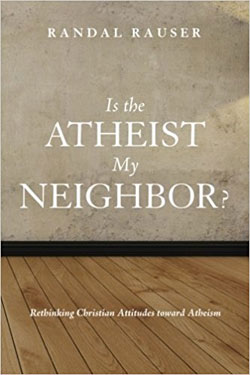
Is the Atheist My Neighbor? a book by Randal Rauser, reviewed by Edward Babinski

Is the Atheist My Neighbor?

Dr Randal Rauser is Professor of Historical Theology at Taylor Seminary and blogs at The Tentative Apologist. In his book, Is the Atheist My Neighbor? Randal denounces the narrow “rebellion thesis,” i.e., that atheists moreso than any other people are in rebellion (often conscious direct rebellion) against the one true God and one true religion.

Violence, Primate Psychology, Mass Movements in Religion and Politics

Violence, Primate Psychology, Mass Movements in Religion and Politics

Violence is common to our species. We still follow alpha males (sometimes alpha females too) in religion and politics. And everyone wants to claim more for themselves or their beliefs, secure more territory. The poor many want something for nothing, but it seems the rich will stop at nothing till they get everything. And each group or mass movement desires more converts, more power and influence. Churches have continued to seek power in various ways from the time of Christian Roman Emperors and Medieval rulers to todayʼs Religious Right. But deistic rationalism and scientific advances dethroned the authority of certain biblical tales and helped defang religion in the West. Still we are primates who desire greater control to assuage our fears about lifeʼs uncertainties, and we are eager to join our egos to mass movements, political parties, or to become enthralled with nationalistic fervor, or racist fervor, or other kinds of fervor and lose ourselves in such fervor, a trait we should question if we want greater peace on earth.

Some mass movements claim to hold the key to paradise on earth or in heaven and seek to outlaw all the rest. Marx promised a workerʼs paradise on earth. Religions promise eternal paradise. One at least understands the attraction of grandiose promises—especially when they are accompanied by grandiose fears as well, like eternal hell.

Some apologists for Christianity fear competition from something they call ‘scientism.’ Science has at least greatly increased our food production, introduced vaccines and antibiotics, and along with health and safety and plumbing regulations, increased the average human lifespan by several decades in many countries. Can science create utopia? I doubt any scientist is liable to make such a promise as they are also aware of all the ways nature bites back and ways nature can kill us. Though there are some who promise a singularity is near. But most scientists admit they remain worried about how things can go wrong, how our future technologies can create problems, not only solve them. Science is generally humbler than say, Marxism.

I hold no grudge against any belief system that encourages acts of kindness toward others and eschews violence. But when speaking about the horrors of say, communism, itʼs good to at least level the playing field and also consider the long Criminal History of Christianity (a multi-volume set with that title is available but only in German).

Christians persecuted Hellenists, Jews and rival Christians for centuries.

And the one continent most heavily steeped in Christian churches and prayers for the most centuries was Europe, the same continent that proceeded to blow itself up with a Thirty Years War, and endless smaller wars before and after that one, wars between nations whose people agreed on such beliefs as the Trinity and even creationism. During the 20th century Europe also suffered two World Wars. Germany was still quite Christian at that time, maybe not in the cities as much as the countryside, but there was more countryside back then as well. The votes of Christians in the countryside put Hitler ahead of the rest of the other candidates who were all neck and neck in the cities. Christians elected Hitler to power. The Nazi party itself was founded in a heavily Catholic (and Jew-hating) city in Germany.

European nations have seen more relative peace in the seven or so decades after the second World War, i.e., after the average Europeanʼs religious faith had grown far weaker, than it ever saw during its previous centuries when its religious faith remained much stronger. Of course there has been more peace around the world in general after World War II, with the larger nations concentrating on business ventures rather than military ones.

As for the French Revolution, the Russian communist revolution, and the Chinese communist revolution, true they were all mega-bloody. And often took place in peasant economies where resentments had risen far past the boiling point such as in pre-industrial France, and nineteenth-century Russia and China.

In comparison the American Revolution was also bloody but benefited from the fact that Britain was so far away, and France and Britain had been fighting for centuries, so the revolutionaries in America were able to get France to help them. Also, after the revolutionaries won they were only able to throw out the British soldiers but could not then sail to Britain to overthrow that king and other royals. That is because our revolution did not take place on the same continent or inside the same country like in the French, Russian and Chinese Revolutions. Also keep in mind that America did suffer a bloody war insider her own borders, a Civil War, with Christian ministers being some of the loudest in favor of secession. And the toll of all the Americans killed in that conflict exceeded all the U.S. soldiers killed in both World Wars, Korea, Nam and the first Gulf War. And letʼs not forget all the natives of North and South America and all the African natives who were enslaved persecuted or killed by European colonists for centuries. Europeans who came from the continent with the most churches and most prayers echoed for the most centuries since the birth of Christianity has plenty of blood on its hands. And one can only wonder what the Thirty Years War would have been like if the Catholics and Protestants had had access to modern weapons communications and transportation and if the cities back then were just as populated as in the 20th century.

I suggest reading Eric Hoffer for more information on the similar psychological drives that animate adherents of mass movements be they Christian, Fascist or Communist.

One should also read about Christianityʼs past, because it was Christian rulers who instituted the idea of thought control, who attempted to force specific theological beliefs upon the whole populace, and who claimed that denying such specific theological beliefs was tantamount not just to heresy but to treason. Right at the beginning of the Roman Emperor Justinianʼs famed book of Laws are his declarations concerning religion and how non-Trinitarian Christians must be judged demented and insane and worthy of the Emperorʼs temporal punishment. Theologians for their part pointed out that spreading heretical views was tantamount not just to murdering childrenʼs bodies, but murdering their souls eternally. And a father had a biblical right to protect his child against murder, even the right to kill anyone who dared attack his child. And the ruler was the father figure for his people. Christian popes, as well as the great Reformers Luther and Calvin agreed that magistrates MUST persecute heretics. Click on the highlighted words at the beginning of this list.

See also these declarations by theologians.

Also see, The Great and Holy War: How World War I Became a Religious Crusade (received Christianity Todayʼs Book Award of Merit for 2015).

And see, Is Religion Connected to Violence?

Also check out, The Uniqueness of the Christian Experience?

Christian Defenses of Atheism (Christians Who Have Defended Atheism, or Respect What Some Atheists are Saying or Doing)

Christian Defenses of Atheism
I retain a profound respect for [atheismʼs] aspirations for humanity and legitimate criticisms of dysfunctional religion… There is something about human nature which makes it capable of being inspired by what it believes to be right to do both wonderful and appalling things. Neither atheism nor religion may be at fault.
Alister McGrath (Oxford Professor and Christian apologist), The Twilight of Atheism: The Rise and Fall of Disbelief in the Modern World, 2007

Skepticism and atheism are, at least in their highest manifestations, noble, precious, and even necessary traditions, and even the most fervent of believers should acknowledge that both are often inspired by a profound moral alarm at evil and suffering, at the corruption of religious institutions, at psychological terrorism, at injustices either prompted or abetted by religious doctrines, at arid dogmatisms and inane fideisms, and at worldly power wielded in the name of otherworldly goods. In the best kinds of unbelief, there is something of the moral grandeur of the prophets—a deep and admirable abhorrence of those vicious idolatries that enslave minds and justify our worst cruelties.
David Bentley Hart (Eastern Orthodox theologian, philosopher, and cultural commentator), “Believe It or Not,” First Things, May 2010

Iʼve found self-deception as much among Christians as among atheists and agnostics. In fact, Iʼve come to like dealing with secularists better than with Christians who use religion as a cloak to cover their pride and absence of love. Secularists are at least more likely to admit that theyʼre being bad. Christians, especially American evangelical Christians, with pietism and puritanism always in the background, have to pretend to be good.
William A. Dembski (Christian and Intelligent Design advocate), William Dembski Interview published by TheBestSchools.org in January 2012; updated May 2016

Atheism tends to be a term of disrepute in the Western world, but we ought to do all we can to change this situation. The honest atheist is simply a person who has looked out upon the world and has come to believe that there is no adequate evidence that God is, or that there is good evidence that God is not. Very seldom does this make a man happy or popular… A man who has no practical belief in God may nevertheless be a good man. Sometimes it is the very goodness of a man which makes him an unbeliever; he is so superlatively honest, so eager not to accept anything without adequate evidence, so sensitive to the danger of believing what is comforting, merely because it is comforting… Such a man we can only honor.
Elton Trueblood (Quaker theologian), Philosophy of Religion

Not one man in a thousand has either strength of mind or goodness of heart to be an Atheist.
Samuel Taylor Coleridge (Christian poet, philosopher and literary critic who had deistic and Unitarian leanings but died a liberal Anglican), Letter to Thomas Allsop, c. 1820 (Note: Twenty years earlier in his life Coleridge wrote very negatively about atheism)

An atheist may be simply one whose faith and love are concentrated on the impersonal aspects of God.
Simone Weil (Christian mystic)

A Catholic Defense of Atheism

Atheism is clearly always a permissible view of man in a world in which God is not immediately evident.
20th Century Encyclopedia of Catholicism

A Christian Philosopher Tries to Explain Why There Are Still Atheists

Shouldnʼt we take seriously biblical portrayals of divine silence and hiddenness?… The Psalms are replete with references to divine silence and hiddenness. (See, for example, Psalm 10:1; 22:1-2; 30:7; 44:23-24; and 88:13-14.) The prophet Isaiah puts it bluntly: “Truly you are a God who has been hiding himself, the God and Savior of Israel” (45:15). Saint Anselm, the eleventh century archbishop of Canterbury, asks, “Why did he shut us away from the light, and cover us over with darkness?” Mother Teresa knew this darkness all too well, and it apparently prompted her at some points to doubt the existence of God. In a letter to a friend, she writes, “Jesus has a very special love for you. As for me, the silence and the emptiness is so great that I look and do not see, listen and do not hear.” What seems obvious here is that Godʼs existence is not obvious, even to some devout followers. As the seventeenth century French mathematician and philosopher Blaise Pascal writes, “As God is hidden, any religion that does not say that God is hidden is not true… What can be seen on earth points to neither the total absence nor the obvious presence of divinity, but to the presence of a hidden God.”
Perhaps some atheists happen to be people particularly impressed by the dreadful silence of God—and unimpressed by the noisy, idle chatter expressed by far too many theists… We should acknowledge that we have our own powerful non-rational motivations for belief… We need to grant that our God is a God who sometimes hides and is silent. Finally, we need to concede that all of this does make a genuine evidential difference for plenty of atheists. Maybe that helps to explain why there are atheists.
Shawn Graves (Assist. Prof. of Philosophy at Cedarville University and a Christian), Why There Are Still Atheists: The heavens arenʼt the only proclaimers (and are sometimes silent), Christianity Today, March 28, 2011

A Leading Figure in the “Emergent” Church Movement Who Defends Atheism

I am so grateful for the edited collection of essays, God Is Dead and I Donʼt Feel So Good Myself: Theological Engagements with the New Atheism (pub. 2005). Atheism isnʼt just something to oppose or refute—it also can be a mirror, with much to teach us believers about ourselves and our distorted and unworthy ideas about God and religion. The atheist too is our neighbor, and God may want to speak to us all through the incisive insight of an honest atheist.
Brian McLaren, 2005
Nearly all religions—and certainly all monotheistic religions—seem at time hell-bent on inspiring people to kill each other, making atheism sometimes seem a more ethical alternative to conventional violence-prone belief. So we ask: Why does God seem so violent and genocidal in many Bible passages? Does God play favorites? Does God choose some and reject others? Does God [p. 20] sanction elitism, prejudice, violence, or even genocide? Is God incurably violent and is faith capable of becoming a stronger force for peace and reconciliation than it has been for violence in the past?… Nowhere in the Hebrew Scriptures do I find anything as horrible as… a deity who tortures the greater part of humanity forever in infinite eternal conscious torment… For this reason, I would grimly prefer atheism to be true than for the Greco-Roman Theos narrative to be true… On the subject of hell, see my “The Last Word and the Word After That,” and an extremely helpful and concise article by Nik Ansell, “Hell: The Nemesis of Hope” in which he quotes Evangelical patriarch John Stott as saying, of the conventional view of hell, “Emotionally, I find the concept intolerable and do not understand how people can live with it without either cauterizing their feelings or cracking under the strain.”
Brian McLaren, A New Kind of Christianity, pg. 19-20, 98-99, Chapter 10, and Endnote 1,pg. 272

Christians Who Admit An Atheist Can Be a Truth Seeker

As you try to figure out what exactly his [atheist Hemant Mehtaʼs] agenda is, youʼll probably arrive at the same conclusion I did. I think heʼs simply after the truth.
Rev. Rob Bell in the forward to Mehtaʼs book, I Sold My Soul on eBay: Viewing Faith Through an Atheistʼs Eyes (2007)
If you blink, you might miss the significance of Bellʼs statement. So let me underscore it. He believes Mehta isnʼt sinfully suppressing belief in God. Rather, he really does want to know the truth. At first blush, this might seem too obvious to mention. But set against the stock Christian attitudes toward atheism and it really does constitute a quiet revolution.
Randal Rauser, author of the book, Is the Atheist My Neighbor? Rethinking Christian Attitudes toward Atheism (2015).

A Deist Who Asked, “Who is Responsible for Atheists?”

If there are atheists, who is responsible but the mercenary tyrants of souls who say: “Believe a hundred things in the Bible either manifestly abominable or mathematically impossible; otherwise the God of mercy will burn you in the fires of hell, not only for millions of billions of centuries, but for all eternity.”
Voltaire, Philosophical Dictionary, entry under “Atheist, Atheism,” Second Section

A Deist Who Defended Heretics

All the heretics I have known have been virtuous men. They cannot afford to be deficient in any of the other virtues, as that would give advantage to their many enemies; and they have not, like orthodox sinners, such a number of friends to excuse or justify them.
Benjamin Franklin as quoted in Benjamin Franklin: His Wit, Wisdom, and Women by Seymour Stanton Block

A “Rational Christian” Who Preferred Atheism Over the Fear That One Might Be Asking Questions That Were Too Bold

Fix reason firmly in her seat, and call to her tribunal every fact, every opinion. Question with boldness even the existence of a god; because, if there be one, he must more approve the homage of reason, than that of blindfolded fear.
Thomas Jefferson, Letter to Peter Carr, dated August 10, 1787 (Jefferson favored something he called “rational Christianity,” a deistic view of Christianity)

He who begins by loving Christianity better than truth, will proceed by loving his own sect or church better than Christianity, and end in loving himself better than all.
Samuel Taylor Coleridge, Aids to Reflection, “Moral and Religious Aphorisms,” aph. 25 (1825)
Whenever philosophy has taken into its plan religion, it has ended in skepticism; and whenever religion excludes philosophy, or the spirit of free inquiry, it leads to willful blindness and superstition.
Samuel Taylor Coleridge, cited in Allsopʼs Letters, Conversations with Recollections of Samuel Taylor Coleridge, 1836

A Believer in God Asks, “What Difference Does it Make?”

I believe in God, although I live very happily with atheists… It is very important not to mistake hemlock for parsley; but not at all so to believe or not in God…
One day a man was asked if there were any true atheists. Do you think, he replied, that there are any true Christians?
Denis Diderot (1713-1784), cited in Against the Faith by Jim Herrick

Is It Ever Proper to Act As If God Did Not Exist?

There is a wonderful Hasidic story about a rabbi who was asked whether it is ever proper to act as if God did not exist. He responded, “Yes, when you are asked to give to charity, you should give as if there were no God to help the object of the charity.”
Alan Dershowitz, Letters to a Young Lawyer

Should We Use the Concept of God To Make a Better World?

I am not of the opinion that we should make use of the concept of God in striving for a better world. This, it seems to me, is incompatible with the integrity of a modern cultured person.
Albert Einstein

What Have Atheists (And Others Who Are Not “Orthodox Evangelical Christians”) Done For Mankind?

If it were not for a host of scientists who happened to be either lapsed churchgoers, unorthodox Christians, heretics, apostates, infidels, freethinkers, agnostics, or atheists, and their successes in the fields of agricultural and medical science, hundreds of millions would have starved to death or suffered innumerable diseases this past century. Those agricultural and medical scientists “multiplied more loaves of bread” and “prevented/healed more diseases” in the past hundred years than Christianity has in the past two thousand.
Also, it has not always been the most orthodox of Christians who have changed the face of charity worldwide for the better. Florence Nightingale (the lady who helped make nursing a legitimate profession, and taught that no one should be refused admittance to a hospital based on their religious affiliation, and no patient should be proselytized in a hospital, but instead they should be allowed to see whichever clergyperson they preferred) was not an orthodox Christian, but instead a freethinking universalist Christian. (Ms. Nightingale also wrote a few steamy letters that suggest she may have been bi-sexual or a lesbian.) The founder of the International Red Cross (now called the International Red Cross and Red Crescent), Andre Dunant, was gay. Clara Barton, founder of the American Red Cross, was another freethinking universalist Christian. Dr. Albert Schweitzer, who spend years in Africa as a doctor and helped to publicize the plight of suffering Africans, was a liberal Christian and author of The Search of the Historical Jesus in which he concluded that Jesus was a man who preached that the world was going to end soon. And, Helen Keller (the woman who lost her sight and hearing to a bout with Scarlet Fever when she was very young, but who learned how to communicate via touch, and who proved an inspiration to several generations of folks suffering from severe disabilities) was both a Swedenborgian, and a member of the American Humanist Society.

Atheists on Atheism

A person holding or doing something they love is not meaningless in the absence of any gods; on the contrary, the absence of any gods requires that we find meaning in precisely what we can hold and do. My views donʼt leave me with nothing - instead, they leave me with quite a lot which I can hold and do.
Austin Cline, Mailbag: Meaning of Life Sunday September 30, 2007
Let a woman (or a man) be on the Earth, and let them be surrounded by family, friends, and opportunities for growth and understanding. Let them live a human life with access to a range of human goods. How can a theist argue that such a life is meaningless? Even given the atheistʼs belief in lifeʼs finitude, such a life would still contain many important goods capable of carving a niche for meaningfulness in the face of suffering that that woman (or man) may endure along the way. Relationships, understanding and love are the ultimate sources of meaning for a human life. By themselves they give our lives their significance and value, so much so that even theists craft their idea of eternal beatitude from the idea of a life where the supply of these goods never ends.
-Di Muzio, Gianluca. “Theism and the Meaning of Life,” Ars Disputandi 6:1 (2006), pp. 138-139 [edited by EB]

An Atheist Who Prefers the Term “Earthling”

I give blood. I volunteer my organs. I donate to charities. I return my shopping cart. I never needed religion to puppeteer me through life and tell me how to feel about gays, abortion, and capital punishment or how to raise my kid. When people ask me what I am, I say Earthling.
William P.OʼNeil, “Playing the God Card,” Chicago Tribune, Feb. 10, 2000

An Atheist Who Argues That Donating Blood Makes Greater Practical & Moral Sense Than the Idea of “Blood Atonement”

I just returned from the Blood Connection in my home town where I spent an hour giving red blood cells and having the plasma pumped back into my arm. I was told that my blood might help save someoneʼs life. And, if it was someone injured by doing something stupid (such as driving while intoxicated and getting in an accident), I have (in effect) given my blood so they might have life, which is what Christians proclaim Jesus did. He shed his blood for our “sins” in which we “damaged our souls” irrevocably by breaking Godʼs law. The theological term here is “vicarious atonement” where one sheds oneʼs blood for the “sins” of others so that they may “live” and not “die eternally.” (I used the plural word, “others,” because I was told that products produced from my blood or plasma might be used to save the lives of more than one individual). And I have mentioned the parallels between my real-life blood donation and blood-letting metaphors in the Bible because I used to be a Baptist preacher, and spent six years in colleges and seminaries. In 1997 I was elected “Man of the Year” were I worked, however the supervisor told his secretary that he would not hand over the “Man of theYear” award to a “damned atheist.” So he gave the award to a Christian on the staff (so much for the separation of Church and State). Now nearly a decade later things are looking up for Harry the “damned atheist.” The Christian whom my supervisor gave the “Man of the Year” award, was fired; the supervisor died; yet here I am still alive and giving blood to save the lives of others.
Harry McCall, contributor to Leaving the Fold: Testimonies of Former Fundamentalists [In all modesty, Harry, above, who is a friend of mine, neglected to add that he also gave one of his kidneys to save the life of one of his daughters.—E.T.B.]

Doubt may have “some divinity” about it.
Atheism may be comparatively popular with God himself.
Let God alone if need be. Methinks, if I loved him more, I should keep him-I should keep myself, rather-at a more respectful distance. It is not when I am going to meet him, but when I am just turning away and leaving him alone, that I discover that God is. I say, God. I am not sure that is the name. You will know whom I mean.
When a pious visitor inquired sweetly, “Henry, have you made your peace with God?” he replied, “We have never quarreled.”
Henry David Thoreau as quoted in Henry David Thoreau: What Manner of Man? By Edward Wagenknecht

Believing hath a core of unbelieving.
Robert Williams Buchanan: Songs of Seeking

I donʼt believe anything, but I have many suspicions.
I suspect that this world shows signs of an… intelligence [that] acts via feedback from all parts to all parts and without centralized sovereignity, like Internet; and that it does not function hierarchically, in the style of an Oriental despotism, an American corporation or Christian theology.
I somewhat suspect that Theism and Atheism both fail to account for such decentralized intelligence, rich in circular-causal feedback.
I more-than-half suspect that all “good” writing, or all prose and poetry that one wants to read more than once, proceeds from a kind of “alteration in consciousness,” i.e. a kind of controlled schizophrenia. (Donʼt become alarmed — I think good acting comes from the same place.)
I sometimes suspect that what Blake called Poetic Imagination expresses this exact thought in the language of his age, and that visits by"angels" and "gods" states it an even more archaic argot.
These suspicions have grown over 72 years, but as a rather slow and stupid fellow I do not have the chutzpah to proclaim any of them as certitudes. Give me another 72 years and maybe Iʼll arrive at firmer conclusions.
An evangelical Christian once told me, “Only Jesus Christ can save man and restore him to his lost state of peace with God, himself and others.” Yeah, sure, and only new Pepsi can make you feel really happy, and only our brand is better than the competition, and only our country is the best country. It is truly amazing to me that people can utter such arrogant nonsense with no humor, no sense of how offensive they are to others, no doubt or trepidation, and no suspicion that they sound exactly like advertisers, con-men and other swindlers. It is really hard to understand such child-like prattling. If I were especially conceited about something (a state I try to avoid, but if I fell into it.), if for instance I decided I had the best garden or the handsomest face in Ireland, I would still retain enough common sense to suspect that I would sound like a conceited fool if I went around telling everybody those opinions. I would have enough tact left, I hope, to satisfy my conceit by dreaming that other people would notice on their own that my garden and/or my face were especially lovely. People who go around innocently and blithely announcing that they belong to the Master Race or the Best Country Club or have the One True Religion seem to have never gotten beyond the kindergarten level of ego-display. Do they have no modesty, no tact, no shame, no adult common sense at all? Do they have any suspicion how silly their conceit sounds to the majority of the nonwhite non-Christian men and women of the world? To me, they seem like little children wearing daddyʼs clothes and going around shouting, “Look how grown-up I am! Look at me, me, me!”
There are more amusing things than ego-games, conceit and one-upmanship… I suspect that people stay on that childish level because they have never discovered how interesting and exciting the adult world is.
If one must play ego-games, I still think it would be more polite, and more adult, to play them in the privacy of oneʼs head. In fact, despite my efforts to be a kind of Buddhist, I do relapse into such ego-games on occasion; but I have enough respect for human intelligence to keep such thoughts to myself. I donʼt go around announcing that I have painted the greatest painting of our time; I hope that people will notice that by themselves. Why do the people whose ego-games consist of day-dreaming about being part of the Master Race or the One True Religion not keep that precious secret to themselves, also, and wait for the rest of the human race to notice their blinding superiority?
The experts on Heaven disagree about which conglomeration of religious believers will qualify, but they always seem to think that they personally belong to that elite group. An eternity with people that conceited seems intolerable to me.
An idea, which has terrified millions, claims that some of us will go to a place called Hell, where we will suffer eternal torture. This does not scare me because, when I try to imagine a Mind behind this universe, I cannot conceive that Mind, usually called “God,” as totally mad. I mean, guys, compare that “God” with the worst monsters you can think of-Adolph Hitler, Joe Stalin, that sort of guy. None of them ever inflicted more than finite pain on their victims. Even de Sade, in his sado-masochistic fantasy novels, never devised an unlimited torture. The idea that the Mind of Creation (if such exists) wants to torture some of its critters for endless infinities of infinities seems too absurd to take seriously. Such a deranged Mind could not create a mud hut, much less the exquisitely mathematical universe around us.
If such a monster-God did exist, the sane attitude would consist of practicing the Buddhist virtue of compassion. Donʼt give way to hatred: try to understand and forgive him. Maybe He will recover his wits some day.
Thoughts of Robert Anton Wilson

We are children of this planet… we have come forth from it. We are its eyes and mind, its seeing and its thinking. And the earth, together with its sun… came forth from a nebula; and that nebula, in turn, from space. No wonder then, if its laws and ours are the same.
Joseph Campbell

You are an aperture through which the universe is looking at and exploring itself… We do not ‘come into’ this world; we come out of it, as leaves from a tree. As the ocean ‘waves,’ the universe ‘peoples.’ Every individual is an expression of the whole realm of nature, a unique action of the total universe…
Itʼs like you took a bottle of ink and you threw it at a wall. Smash! And all that ink spread. And in the middle, itʼs dense, isnʼt it? And as it gets out on the edge, the little droplets get finer and finer and make more complicated patterns, see? So in the same way, there was a big bang at the beginning of things and it spread. And you and I, sitting here in this room, as complicated human beings, are way, way out on the fringe of that bang. We are the complicated little patterns on the end of it. Very interesting. But so we define ourselves as being only that… as one very complicated little curlique, way out on the edge of that explosion. Way out in space, and way out in time. But billions of years ago, you were a big bang, and now youʼre a complicated human being. We donʼt feel that weʼre still the big bang. But you are… Youʼre not just something thatʼs a result of the big bang. Youʼre not something that is a sort of puppet on the end of the process. You are also still the process. You are the big bang, the original force of the universe, coming on as whoever you are. When I meet you, I see not just what you define yourself as—Mr so-and- so, Ms so-and-so, Mrs so-and-so—I see every one as the primordial energy of the universe coming on at me in this particular way. I know Iʼm that, too. But weʼve learned to define ourselves as separate from it.
Alan Watts

The Oddness of Existence

The extreme oddness of Existence is what reconciles me to it.
I got up with Stoic fortitude of mind in the cold this morning; but afterwards, in my hot bath, I joined the school of Epicurus. I was a Materialist at breakfast; after that an Idealist; and as I smoked my first cigarette I transcendentally turned the world to vapour. But when I began to read The Times I had no doubt of an externally existing world.
So all the morning and all the afternoon opinions kept flowing into and out of my mind; till by the time the enormous day was over, it had been filled by most of the widely-known Theories of Existence, and emptied of them.
When, now and then, on a calm night I look up at the Stars, I reflect on the wonders of Creation, the unimportance of this Planet, and the possible existence of other worlds like ours. Sometimes the self-poised and passionless shining of those serene orbs is what I think of; sometimes Kantʼs phrase comes into my mind about the majesty of the Starry Heavens and the Moral Law; or I remember Xenophanes gazing up at the broad firmament, and crying, ‘The All is One!’ and thus, in that sublime assertion, enunciating for the first time the great doctrine of the Unity of Being.
But these Thoughts are not my thoughts; they eddy through my mind like scraps of old paper, or withered leaves in the wind. What I really feel is the survival of a much more primitive mood-a view of the world which dates indeed from before the invention of language. It has never been put into literature; no poet has sung of it, no historian of human thought has so much as alluded to it; astronomers in their glazed observatories, with their eyes glued to the ends of telescopes, seem to have had no notion of it.
But sometimes, far off at night, I have heard a dog howling at the Moon.
Thoughts of Logan Pearsall Smith, All Trivia

Peopleʼs Beliefs Are Multi-Faceted

There appear to be multiple sides or facets to all of our beliefs and how we feel about things. Thatʼs because our minds are constantly in motion, weighing, assessing, hypothesizing, re-weighing, re-assessing, re-hypothesizing, over and over again.
As Neil Gaiman puts it…
I can believe things that are true and things that arenʼt true and I can believe things where nobody knows if theyʼre true or not.
I believe in a personal god who cares about me and worries and oversees everything I do. I believe in an impersonal god who set the universe in motion and went off to hang with her girlfriends and doesnʼt even know that Iʼm alive. I believe in an empty and godless universe of causal chaos, background noise, and sheer blind luck.
I believe that anyone who claims to know whatʼs going on will lie about the little things too.
I believe in absolute honesty and sensible social lies.
I believe that life is a game, that life is a cruel joke, and that life is what happens when youʼre alive and that you might as well lie back and enjoy it.
Neil Gaiman, American Gods

Which of These Four Gods Do You Believe In?

Using conclusions drawn from the Baylor Religion Survey first published in 2006, two Baylor University professors theorize that Americansʼ view of God can be characterized as one of four basic types:
  • Authoritative (different from Authoritarian?)
    28% of Americans believe in an authoritative god that is very judgmental and engaged in the world. These types of believers tend to be evangelical and male.
  • Benevolent
    22% of Americans believe in a benevolent god that is very involved in the world, but is loving and not stern. These tend to be evangelical women.
  • Critical
    21% of Americans believe in a critical god who is removed from daily events but will render judgment in the afterlife. There is a tendency for African Americans and people who have lower levels of income and education to believe in the critical god.
  • Distant
    24% of Americans believe in a distant god who set the universe in motion but then disengaged. People who say that they are spiritual but not religious tend to believe in the distant god.
By knowing which of the four types of God an American believes in, these scholars can predict that personʼs views on many of the pressing issues facing the country.
As an antidote to the prevailing but simplistic dichotomy between religious and nonreligious Americans, this thesis is more nuanced. But it, too, has its limitations. Itʼs not clear that people stick to one view their whole lives, and it doesnʼt fully account for the views of those who occupy middle ground, somewhere between a judgmental and forgiving God. Still, the fourfold God typology is a step toward better understanding how Americans regard morality, how they understand the presence of evil, and what narrative they tell about their lives. See also the review here.
Albert Mohler, president of The Southern Baptist Theological Seminary, stated in response to such research that God encompasses all of the four types. Though I hope Mohler also admits that human beings do not appear to encompass all four types of God equally in their minds. Perhaps Mohler himself does not. I wonder what his results would be if he took the online test to determine which type of God he envisioned?

“The most zealous defenders of the inspiration of the Bible admit that there are parts of it of less importance than others. This is a great admission, because another is involved in it, namely that we ourselves must be judges of the comparative importance of these different parts.”
Thomas Erskine, Scottish Christian

What Could Be More Divisive Than The Gap Between Theists & Atheists? How About the Gap Between Exclusivists & Inclusivists? Between Damnationists & Universalists?

Some believe that people get sorted into one of two radically different places after they die, with no hope of repentance, learning their lessons, or resumption of harmonious relations throughout eternity.
Others believe or at least hope that the vast majority, if not everyone, will eventually arrive at the same destination after they die.
  • Type a) includes conservative religious believers or spin offs from conservative religious belief.
  • Type b) includes very moderate to liberal, or highly inclusivist to hopeful universalist religious believers.
  • Type a) often have trouble understanding, empathizing or getting along with people in “rival” religions and “cults,” or even with those in their own Christian denomination or church whose “rival” biblical interpretations or views of ecclesiastical authority can often escalate into fears that “others” (including close family or friends) might be on a slippery slope into “hell” for disagreeing with them on this or that matter of faith or practice.
For instance, Christians have remained throughout history the foremost debunkers of each otherʼs biblical interpretations, ecclesiastical rites, and social agendas. See, “Are You a True Christian?
  • Meanwhile, Type b)ʼs tend to get along well with people in other religions as well as with atheists. Those who are highly inclusivist, or universalists (including those who hope that the vast majority, if not all, will eventually wind up in heaven) even seem to get along well with agnostics and atheists.


People who don't know me often call me an atheist. But in all honesty... the scientific and NT questions simply run too deep for me to recite with both head and heart any of the creeds of Christianity

People who don't know me often call me an atheist. But in all honesty

I want to believe in God and a personal afterlife, and like Frank Schaeffer, author of “Why I am an Atheist Who Believes in God: How to give love, create beauty and find peace” (son of the apologist Francis Schaeffer), I do not deny myself prayers to God. I try in all ways to learn what is true, including prayer to God during times of questioning, questing and need. But both the cosmos and the Bible raise many questions of pain and suffering as well as competency of the Designer (who is possibly a Tinkerer), including whether the human species will even last. The stars have billions of years of life left in them since they burn via nuclear fusion and more stars continue being born in distant clusters. One can easily imagine the stars outlasting humanity by far. I also wonder how much truth lay behind the stories of Jesusʼ miracles in the Gospels. Regarding the latter question, Jesus was probably an apocalyptic prophet, but I tend to doubt the resurrection and other miracle stories, in fact you can see certain stories about Jesus grow in the telling from Mark to Matthew, Luke and John: Gospel Trajectories & The Resurrection (questions as well as sources to read or listen to)”

Furthermore, almost all the miracles occurred either in some unspecified “wilderness” or in small towns in Galilee, i.e., Jesus never visited the largest cities of Galilee nor is spoken of as having performed miracles in them such as Sepphoris which was located near Nazareth, nor did he perform miracles in other large cities like Caesarea Philippi, Tiberius, Hippos (the last two being on the shores of the Lake of Galilee). Instead, three smaller cities, mere towns, Chorazin, Bethsaida, Capernaum encompassed the area where Jesus performed most of his miracles, which scholars have appropriately nicknamed “the Evangelical Triangle.” Even after the people of those towns allegedly saw Jesusʼ miracles the citizens did not hail Jesus and start to follow him. So the Gospels have Jesus denouncing the three towns where he allegedly performed most of his miracles, and warning that judgment would fall on them. As for Jesusʼ greatest nature miracles, they were only said to have been seen by a few apostles in a boat (stilling a storm, walking on water), or on an unnamed mountaintop (the transfiguration, three apostles were allegedly there). Interestingly, the fourth Gospel, allegedly written by the same John who was one of the three apostles who viewed the transfiguration, does not mention that particular miracle at all. The only large city Jesus visits is Jerusalem where he is captured and crucified, and he performs no public healings there per the synoptic Gospels but merely preaches (except for one miracle of healing in Jerusalem mentioned in the late fourth Gospel). Even the late added narrative of the bodily ascension of Jesus in Luke-Acts, is said to have only been seen by the remaining eleven apostles. Here is a guy rising into the clouds, but apparently doesnʼt want everybody to see it. Even weirder is how in Luke the raised Jesus proves he is flesh and bone and then “led them out” of Jerusalem to Bethany, but with no mention of anybody noticing, no mention of people spying the raised Jesus, or the apostles shouting Hosanna as this resurrected flesh and bone Jesus allegedly is leading his apostles out from one large city to a nearby town (compare all the Hosannas when Jesus entered the city). In other words, Jesusʼ exit is very hush hush. And as I said Jesusʼ alleged miracles are only said to have happened in out of the way places, like some unspecified “wilderness” or on an unspecified “mountaintop” or in three towns in particular (not even cities) in Galilee (where they rejected him), or the most spectacular miracles are only seen by a few apostles. Not sure I believe such stories, including the raising of Lazarus tale in the fourth Gospel which seems to have resulted from combining earlier tales in earlier Gospels, resulting in a new story: “Scent from heaven? Who nose? Do tales of Jesusʼ anointing, resurrection & bodily ascension, bear the aroma of truth?”

Add to that the way the resurrection tales contradict one another, and how nobody sees Jesus exit the tomb. His bodily resurrection is an implied miracle in the first and earliest Gospel but is declared in the two last-written Gospels of Luke and John to be a very physical resurrection. The earliest telling in Mark says only that the tomb is declared empty. The closest we come to a first person letter from someone saying they saw the raised Jesus is where Paul mentions in two letters that “he appeared to me,” thatʼs all he says about it, and lists some appearances to others, with no times or places mentioned nor anything that was said or heard. And Paul says Jesus had a “spiritual body” instead of mentioning that Jesus had “flesh and bone” like in the last Gospels written, Luke-Acts. The earliest Gospel, Mark, does not have a post-resurrection appearance story. It just ends with the women fleeing an empty tomb, frightened, and telling no one anything (the Greek is highly emphatic, involving a repetition of the same Greek word to emphasize that the women did not say “anything” to “any[one]” [the Greek reads, oudeis oudeis], so how and when did the story about the discovery of an empty tomb arise? One wonders, since the text states emphatically that the women did not say “anything to anyone” about such a discovery. Sounds like even the empty tomb story might have arisen later. Paul certainly doesnʼt mention it, or the women. But later Gospels build considerably on that tale in Mark). Meanwhile the number of words and lessons allegedly taught by the resurrected Jesus AFTER he was raised, continued to rise in number from Mark to Matthew, and then reach their peak in Luke-Acts and John. Obviously the story was growing over time. “The Word About The Growing Words Of The Resurrected Jesus”.

Also see “New Testament Questions Galore From a Wide Range of Christian and Non-Christian Biblical Scholars”

So I donʼt know what to believe. Because nature contains a variety of pains that humans have struggled to bypass or avoid via intelligence, city planning, safety regulations, modern medicine and dentistry, and advanced detection devices that predict the weather and other changes in the environment (including marking danger zones), rather than accept such pains as part of Godʼs wonderful design. And itʼs not “sinners” who are plagued most by natureʼs pains but people unlucky enough to be in the paths of disasters and epidemics, or unintelligent enough not to take safety measures, or economically impoverished so their city or country cannot afford modern safety techniques and conveniences. Therefore natureʼs pains are not focused on “sinners.”

Also, the human species seems destined to perish while the cosmos goes on, and we might not even be the coolest species in the cosmos. Meanwhile the Gospels plead “mystery,” and Jesus says in places that he spoke to crowds (in those towns I mentioned) in ways “that they might not understand,” then then damned them for not hailing him and following him.

Ah, but there are miracles around the world if you read some Christian apologists. Especially in South America, where Catholicism is huge, or where the Pentecostal revival in the Philippines took place. Though other Christians doubt and question the wealth of Catholic miracles, and still other Christians doubt the alleged miracles in the Philippines. And we see the web articles and books by Joe Nickell who has been investigating a lot of allegedly Catholic miracle stories. While Keith Augustine has a web article about NDEs that raises many questions Hallucinatory Near-Death Experiences. (Keith also has a book coming out in 2015, co-authored with Michael Martin on NDEs) Endless debates.

I figure that if there really was an infinite Being, one that did not want to remain very mysterious and behind the scenes, and/or that wanted everyone to be “saved” via trusting in tales of one true religion, wouldnʼt it be plainer?

So Iʼm agnostic, painfully so as I grow older, since I canʼt help but wish that this life and its memories does not end like everything else I see ending around us. I have lived long enough to see the next generation grow up ignorant of many of the key moments in history, song, literature, comedy and drama from my generation. The past seems doomed to be forgotten, along with the individuals in it. Cultural movements being and then end. Ideas change as well as styles. My own memories of earlier decades has declined, which I notice when I talk with friends from decades past. Iʼll keep praying and hoping. Add to that some meditating (hat tip Will Bagley).

See also this blog post with links to Miracles from all religions (including amazing coincidences that seem to just happen and are not related to a religion), when viewed together, provide a crazy mixed bag of “evidence.” Miracles from all religions (including amazing coincidences that seem to just happen and are not related to a religion), when viewed together, provide a crazy mixed bag of “evidence.” So how can “God or WhateverIsOutThere” expect us to know what to make of them?

On Recovering from Alcoholism, Drug Addiction, Schizophrenia, and… Addiction to Religious Certainties

Recovery

Famed Christian faith healer, Rev. A. A. Allen, died an alcoholic when his liver and/or heart finally gave out. Rev. Allen was also a yearly Bible Conference speaker at Bob Jones University and president of the Fundamental Baptist Fellowship. Allen was addicted equally to spirits from the bottle and to his fundamentalist beliefs and died an alcoholic in his hotel room hours after bragging on radio that people were lying about his addictions and that he would be appearing at an Evangelistic conference that night. In other news, Dr. Rod Bell, the outgoing president of the FBFI (Fundamental Baptist Fellowship International), also is suffering from addiction to alcohol according to Dr. John Vaughn, the new president of the FBFI.

One can only be grateful to some Christians for helping some people get hooked on Christianity rather than alcohol or drugs. In a similar fashion one can only be grateful to some Scientologists for helping some people get hooked on Scientology rather than alcohol or drugs. But even converts to Christianity and/or Scientology have gone back to their addictions. Of course neither Christianity nor Scientology publicize such failures.

And sometimes former addicts to alcohol or drugs go further still, and after adopting religious certainties in place of alcohol or drugs, learn to question even those new found certainties (without feeling the need to revert back to alcohol, drugs, or religious certainties).


Casper Rigsby from, “Diary of a Christian Schizophrenic”:

I have mild schizophrenia. Itʼs easily treatable, and with medication Iʼm an average person. Iʼm not ashamed in the least to tell you this. It isnʼt something to be ashamed of because it isnʼt my fault. It wasnʼt caused by something I did or some supernatural force. But for a long time I was ashamed of it and I did think that it was my fault somehow… When the visual hallucinations began and I started catching shapes out of the corners of my eyes, I became afraid. I wasnʼt afraid that someone was messing with me, rather I was convinced that Satan had besieged me and had infected me with demons. This may seem an absolutely foolish notion to those of you not raised in an evangelical Christian home, but for those who were, you likely understand my fear all too well… When I was 16 it had gotten so bad that Iʼd began drug and alcohol abuse. I would use methamphetamine daily to get my mind going a mile a minute and this would overwhelm the voices and visions to some degree. It wouldnʼt get rid of them altogether, but it clouded things well enough for me to “function”… [Casper was arrested for possession of some meth and marijuana and spent three years in prison, but the prison included] a good staff of general health personnel, and a mental health staff. After being isolated and given a mental health evaluation where for the first time I actually told someone what was going on, I was started on medication and counseling. For the first time since it had begun the voices and visions went away. I was able to sleep and rest. My paranoia and anxiety diminished. I didnʼt feel like I needed to escape some demon that was chasing me… Understanding is something my former religion robbed me of as a youth. It gave me an unrealistic perception of reality and caused me to blame myself for something that wasnʼt my fault. It made me feel scared and alone because I was confused and even more scared to seek out an answer. When people get upset about atheists such as myself stating without hesitation that religion causes harm, I think of the harm it caused me. I think of the fear that I felt. I think of how I considered suicide at just 14 because I just didnʼt know what to do or where to turn. Most of all I think of how I wasnʼt alone in feeling that way then and that there are many who feel that way now. If you are suffering from mental problems, be it depression, anxiety, or something worse, do not resort to prayer or religion in hopes to fix something that they quite honestly are not mentally equipped to deal with. Seek professional help. Talk to someone and please remember that you arenʼt alone and this isnʼt your fault.


David J. from, “Tell me about that hell part again”:

When I believed the Bible was infallible, it felt hopeless, and I drank to drown that out. Now that I see it has mistakes and has been severely altered by men, the constant fear and depression is gone. It is ironic to think back a few years to me quoting scripture to try and stay sober. Now that my beliefs have changed, I have absolutely no desire to drink. I still believe in God and donʼt know what to believe about Christianity. I will continue to read about both as I did about the Bible and see where the evidence takes me.


from “Scratching Walls”:

I went from one of the top students at my high school to a needle junkie to a real holy roller within the space of about a year… I think itʼs clear that a drug addict, and most especially a very young one, is not exactly what I would call a “clear-thinking individual”. When we consider the sorts of decisions this person has been making up to the present time-stealing, lying, cheating, slowly killing their bodies…it seems obvious that they are not in a correct frame of mind to make thoughtful decisions… So now this line of thought becomes personal: I was a drug addict, I needed to change my lifestyle, worldview, etc., but I needed help doing it. For me, help came in the form of a sort of religious quasi-boot camp. The name of this loveshack is Appalachian Teen Challenge (ATC). My brief testimony on their webpage (written a while back) was posted by the director, Jim Nickels. At the time I last emailed him (according to my records, summer of 04, since the testimony has this timeframe), I was already at a stage of escape from this darkness that Jim would consider heresy-to him, I was “backslidden”. However, I felt a deep discord at the idea of revealing the depth of my progress to him, (as I see it) and opted instead for a generic report about how god was really helping me and mostly focused on my goals and plans and marriage, see the letter I recently wrote him for more… One of the most interesting things about the Christian culture is their tendency to bury the wounded. What they see as “lost souls” are ripe for evangelism and discipleship, but those who “fall away”, especially those like myself, who spent quite a few years teaching/preaching the faith, are often, as the Bible instructs (Heb. 6:4-6, 1 Jn 2:19), abandoned. Besides giving up hope for a backsliderʼs salvation, there are also a number of scriptural precedents for booting people who lose faith from the fold (1 Cor. 5:1-13; 1 Tim. 1:19-20; 2 Thes. 3:6; 2 Cor. 6:14-15; Job 24:13). So, I guess I shouldnʼt be surprised at the response I receive(d) from Christian friends and family… I will write more about my deconversion, and edit this accordingly, but suffice it to say that although I am open to new evidence and arguments in favor of godʼs existence and in the religion of Christianity, I think Iʼve already heard the “best” there is to offer, and I find it, on the whole, unconvincing.


from “Fear leads to the dark side”:

I became a Christian as a result of a burnout on drugs (hash,opium) that I had at the ripe old age of 16 while living in Europe. After experiencing a great deal of paranoia and instability, I encountered a pastor of a newly developing church called International Christian Fellowship. Basically this was a spin-off of the Assemblies of God, made for the European market. Being so young and impressionable I believed all this, burned my albums (ouch!) cut my hair (Oh no Delilah!) and basically became a completely brainwashed Evangelical. We would preach to people of all nations, creeds and backgrounds through our church and I became what others considered to be the best at Christian Apologetics. It seemed as if I had an answer for every argument against Christianity at the time. When the church began to indoctrinate us further and require classes for all assistant pastors I complied and became fully immersed in it. I stopped sleeping with my girlfriend who also became a Christian (what was I thinking?), I stopped smoking (not bad I admit), and became the perfect “soldier for Christ” The church used “before and after” photos of me to show the transforming power of Jesus. Heavy rocker to Christian. Whoopee! But all was not well in paradise. As I became more and more involved in learning about the religion and being a defender of it I became aware of…


Daniel M, from “Returning to Sanity”:

At 16, I had already developed pretty deep doubts about godʼs existence and attributes. When my father got cancer (a devout Xian) I lost all faith in the idea of a personal god. Unfortunately, I was also quite immature and emotionally unstable, and I started using pretty hard drugs during this time of intense confusion and pain. To get “clean,” a court and my parents decided a Xian rehab named “Teen Challenge” was the best answer for me. After 14 months there, this young, confused, hurting person came out a devout Xian again. I had stability in what I believed, and the evidence for godʼs existence was the “change” that god wrought in me. After all, I was drug free!! Nevermind that I was seriously programmed, and that during that 14 months there was absolutely no way I couldʼve gotten drugs had I wanted to. Nevermind that my problem was a mental and philosophical crisis rooted in confusion and disillusionment, and not the drugs themselves. Nevermind that deep down, I never bought into the creationism because I already knew enough about science and reason to reject a literal reading of Genesis. I was 19, and fresh out of Christian boot-camp/rehab. After slowly regressing over the period of years to a moderate Xian, I found I finally had the courage to acquire books…


x-ray man from “I Tried, I Really Tried…”:

Many of my best friends also fell into serious alcohol addiction. Gary one of my oldest and dearest friends from childhood finally stopped drinking and found God. Almost over night he became a preachy born again Christian. I really wasnʼt too fond of his ways, yet he did succeed in putting the cork in the jug. I continued to drink heavily. He always said that Jesus was the way to overcome my addiction. At age 27 I was married with a small child when I finally hit a complete rock bottom. My drinking took me as low as a man could go. On a March night in 1991, I was alone in my house shaking uncontrollably in a pool of cold sweat, with the DTʼs. I had been drunk with a friend for a week straight. When the money ran out and the booze ran dry, I had the worst withdrawals any human ever had. My mind and body were in peril. I decided it was time for me to surrender to Jesus. It was my only hope. This was your typical addict finding God story in the making, and I was the main character. I called the 700 club prayer line, and got on the phone with a prayer counselor and asked Jesus to come into my life. I got down on my knees and prayed with all my heart. I wanted to be saved from the misery so bad. Well, as I was praying and pleading with God, I felt… nothing. Absolutely nothing. No spirit, no uplifting experience. No sense that everything would be OK. Not even a little twinge of evidence that God was with me. I even remember the prayer counselor getting a little short with me, like as in “Hey buddy Iʼve got other calls.” Well for the next few days I continued going through the serious withdrawals. I didnʼt sleep for two nights. It was the worst experience my body had ever endured. The religious experience I had hoped for didnʼt come close to happening. I have never drank again since that experience, but it wasnʼt because I was saved by God, it was because I never wanted to feel that way again. Many will say that it was God, but I know better. It was me finally wanting to turn my miserable life around. Years later I tried to find God again. My wife and I decided to join a local church and get the kids baptized…


The life of the late evangelist A.A. Allen is proof that one can preach Christ and drink himself to death at the same time. His last months were living in a drunken state in a run down hotel room making audio evangelistic tapes for his radio broadcasts while in a drunken state:

On June 14, 1970, listeners in the United States, the United Kingdom, and the Philippines were hearing a recorded message from A. A. Allen on his radio program saying: “This is Brother Allen in person. Numbers of friends of mine have been inquiring about reports they have heard concerning me that are not true. People as well as some preachers from pulpits are announcing that I am dead. Do I sound like a dead man? My friends, I am not even sick! Only a moment ago I made a reservation to fly into our current campaign. Iʼll see you there and make the devil a liar.” At that moment, at the Jack Tar Hotel in San Francisco, police were removing A. A. Allenʼs body from a room strewn with pills and empty liquor bottles. The man who had once said that “the beer bottle and gin bucket” should have been on his family coat of arms was dead at 59 from what was said to be a heart attack but was in reality liver failure brought about by acute alcoholism. (p.88)

SOURCE: The Faith Healers by James Randi, section on Asa Alonzo Allen (1911-1970). Prominent, flamboyant and controversial Pentecostal “healing evangelist” of the 1940s-1960s. Allen made many outrageous, unsubstantiated claims of miracles.

Harry McCall, ex-fundamentalist seminarian, and son of an alcoholic parent, adds this

If a person can get to a place where alcohol hurts more than it helps, they can quit. Hindus, Buddhists, Taoists and any other non-“Jesus” religions can and do put depressed people on a spiritual journey and often apart from any god in the sky.

The fact is, when one is burned out by a section of their life of drugs and alcohol and their body is shutting down, what else can one do but to either change or die.

Call it “god” of self determination…both seem to work and boil down to that if help has a social support context, itʼs religion; if not, itʼs self determination.

What do Christians want? What do atheists want? What is the meaning of life for Christians and atheists?

Meaning of Life

First, what do Christians want? Christians (and other believers in a personal higher power) want clarity, fewer grey areas, more black and white regions, a roadmap to life, a roadmap to eternity, certainty. Feeling one is certain about something is an addictive feeling that tends to reinforce itself, and people argue the most over topics where certainty does not exist such as religious and political views—perhaps because people are capable of living in many different types of societies and holding a wide varieties of beliefs including a firm belief in how things must turn out in the future provided we do such and such.

Christians donʼt want to be alone, they want a person who is guaranteed to be with them always, who hears their cries, even If those cries are not always answered, even if the Xn has to interpret what the answer to their prayers are (such as answered quickly, slowly, fully, partially, or, keep praying and maybe they will be answered, or, forget about that prayer and start praying for something else), but regardless of having to interpret such answer to prayer for themselves, the Christian is sure someone is there, so they are never alone.

Christians want all human suffering and pain to make sense, to eventually be accounted for, either in the form of punishment for the person who has made others suffer, or as blessings granted sooner or later to the one who has suffered, or if not added blessings, then they want such suffering to have been a soul building experience rather than a soul weakening or deconstructing experience like post traumatic stress disorder (or to coin a more Christian sounding term, “post traumatic spiritual stress disorder”). And they want not just a balanced account book for human suffering, an eye for an eye, but something more—forgiveness and healing for all of their own sins, feelings of guilt and pain.

Lastly, the Christian wants human death to be an illusion (some also want the death of believed pets to be an illusion). They want to be immortal like the personal higher power they worship.

What do atheists want?

Do atheists want the reverse of what Christians want? No. Atheists like feeling certain about many things, they prize knowledge, they donʼt want to be alone, and as humanists they are in favor of justice, equality, reducing suffering, aiding healing, and human life extension. Atheists however hold more modest views in those areas than those who are certain that a higher power exists.

Atheists and Christians also agree to some extent that there are plenty of people with their own individual concerns who fail to live up to humanist or Christian ideals, who fail to think big, embrace larger visions, wider feelings of empathy. Those people might be caught up in a daily struggle to make ends meet, wage slaves who earn only a few dollars a day in third world countries, migrant workers in the U.S., or even people with well paying jobs but whose debts or hospital bills have risen and they are struggling to keep their heads above financial water. While other people are locked into repetitious jobs for decades that no longer feed their mental reservoir of wider interests, curiosities and knowledge they possessed when they were young and which continue to atrophy away, so there are plenty of people who might never develop much of a thirst for knowledge, certainty or global justice. While still other people grow addicted to a wide variety of beliefs, thoughts, substances and behaviors, overlooking broader concerns or the needs of others, since the brain can reward itself with little blasts of pleasurable chemicals for all kinds of thoughts and behaviors, including many that do not benefit either the individualʼs health or well being, or society as a whole.

In fact, religions and philosophies (notably political philosophies) of various types can be so addictive that attempting to win an argument is more important than maintaining a friendship, a family, or peace on earth.

Religious people like everyone else can also fall into repetitious patterns that slowly rob them of flexibility of mind, or they can fall into addictive behaviors of all sorts. They can become beer and football Christians, nominal churchgoers. There are also plenty of discouraged Christians, some suffering post traumatic faith disorders. Not to mention the existence of many restless, semi-disenchanted, questioning, progressive, humanistic, very moderate to liberal or even universalist and mystical Christians,

On what I would call the brighter side, many Christians are mingling with atheists than ever before, not just on the internet, but you sometimes find churches opening their doors to a discussion of uncertainties of belief, even inviting debates with atheists. People are getting to know one another, atheists and Christians, sharing fears, failures, wishes, hopes and dreams.

What I find ironically hopeful is that no matter what side one is on in a religious or political debate, both sides are often full of energy and happy, knowing the challenge ahead, of trying to fully communicate their point of view, all they know and believe about a topic, in summary of course, to people who are less than eager to agree with it. Humans enjoy not simply holding ideas in their heads, but sharing them with others, and it is a joy when given the chance to do so. Also, for those who love a challenge, “preaching to the choir” appears to be less of a joy than engaging in a debate.

What is the meaning of life for Christians and atheists?

Christians think of meaning as coming from an eternal God. Things that do not last, called temporal things, have little meaning. However, many ancient Jewish writings depict human life as temporary, all die and go to the same place, a land of shadows called “Sheol” (with only a few exceptions like Enoch or Elijah who get to live with Yahweh in heaven, but even the Greeks had a few exceptions, with everyone else winding up in Hades after they die). The immortality of humans is not assumed throughout ancient Jewish writings, many writers of whom found meaning in temporal existence, looking forward to blessings from Yahweh in this life and then blessings on oneʼs descendants, nation, people, race that live on after one has died.

Also, many Christians believe that worshiping God is not enough to give oneʼs life meaning, because it has to be the right God, the Trinitarian creedal Christian God, otherwise one risks being damned eternally (universalist Christians would not agree with that statement, but most Christians are not universalists). So the meaning of life consists largely in avoiding hell and being assured of heaven by worshiping the one true God, and nothing in life matters more or holds more meaning than making a “decision” to follow and believe in the Trinitarian creedal Christian God, the author of such assurances.

Atheists do not find meaning in becoming an adherent of a belief system that must continue being “sold” in all of its original exclusivity because if no further “sales” are made then many wonderful and interesting people one has grown to love and respect will be damned for eternity. That sounds too much like a pyramid scheme erected on fear.

The atheist idea of meaning is more modest, along the lines of using reason and foresight to obtain the necessities and joys of life for themselves and others. Many atheists are also happy simply to see more moderate points of view in religion flourishing.

Atheists also recognize that most experiences in life are temporary, like enjoying ice cream. Memories tend to fade over time. And we see living things dying all around us. But that does not make such experiences, memories and life, meaningless, but precious.

Randal Rauser and Ed Babinski: On Storytelling, Atheism, Christianity, God, the Cosmos, Miracles, Near Death Experiences, Scientific Hypotheses and Religious Beliefs

Randal Rauser
Randal Rauser

Randal, Thanks for your kind words here concerning something I wrote. You think I am a “great storyteller?” I think ancient Hebrews were “great storytellers” and I suspect you agree with me there, especially concerning the primeval history section of Genesis from the six-day creation to the Garden of Eden, Flood, and Tower of Babel stories.

Two items to clear up before proceeding further:

  1. Please call me “Ed,” rather than “Dr. Babinski.” I do not hold a doctorate only a bachelorʼs in biology.

  2. I am not an “atheist.” I am a former born again Christian who experienced what some call “charismatic/Pentecostal” phenomena, such as the “baptism in the Holy Spirit” and “speaking in tongues,” see here. As a Christian I was very interested in apologetics and a big fan of the Inklings (C. S. Lewis, Charles Williams, Tolkien), George MacDonald, G. K. Chesterton, Francis Schaeffer, InterVarsity Press authors who wrote works on apologetics, and, Josh McDowell. After leaving the fold I was invited to reply to McDowellʼs claim that the Christian experience was “unique,” and did so here. Today, I am an agnostic who hopes for an afterlife (that is, if a God or some sort of cosmic consciousness exists).

    I edited a book, Leaving the Fold: Testimonies of Former Fundamentalists, click here, that includes testimonies of people who left conservative Christianity for more moderate pastures, or liberal pastures, or who became adherents of other religions, or agnostics, or atheists. I also wrote a chapter on “The Cosmology of the Bible,” click here, and click here to read some of the replies the chapter received, as well as counter-replies by my atheist friend Ben.


Ed Babinski (circa 1995)

Randal, Your Comments to Me From Your Blog Appear Below, Followed by My Responses Which Are Indented

Ed, youʼre a great story teller. Your Achillesʼ heal is in moving from story telling to formal argument. How do you move from “This is the ‘natural history’ of human origins and the human place in the universe” to “Therefore, there is no God”?

Randal, Itʼs “heel,” not “heal.” And your own Achilleʼs heel consists in missing my point that stories raise questions, and questions precede formal arguments. Nor do formal arguments have any advantage over informal ones as told in stories, not when it comes to the crucial matter of basic intuitions--the same basic intuitions that constitute the demarcation lines where even formal arguments either convince or fail to do so.

I did not declare, “There is no God.” Nor is there any need to do so. My point was that before any debate begins there are points about the cosmos we may agree on, points based on scientific investigation, points that are unsettling and that even make a Divine Tinkerer Hypotheses appear as likely as a Divine Designer Hypothesis.

In fact, knowing the cosmic story and humanityʼs place in it is a necessary precursor to arguing formally about it. I would like us to begin by agreeing that the cosmos has a story, see The Great Story site here, or see The Big History Project here.

Daily life for most involves long stretches of repetitive events that have minimal emotional, philosophical, or religious impact. It is in between such long stretches that the high drama takes place like being born/dying, getting wed/divorced, graduating/dropping out, getting hired/fired, holiday cheers/jeers, sporting event cheers/jeers, days of grand beauty/days of natural disasters, wonderful health/catastrophic illness, or, changes in oneʼs world view. A story can compress into a few hours the peak events in a personʼs life, the lives of a generation, a country, empire, planet or galaxy.

Stories let us see through other peopleʼs eyes the ways humans affect one another and the ways nature affects us. Stories are how we learn about the world and others.

The story I shared with you is that we live in a cosmos where life is in equilibrium with death, in which living organisms arise on infinitesimally small quaking planets that orbit stars that emit dangerous solar flares, all of which lay in the asteroid-strewn and radiation-filled vacuum of space. And life arises at the expense of high mortality rates of the young per each generation, such as the enormous percentages of dying zygotes and dying young of all species, not to mention mass extinction events. See my comments here on mortality rates, extinction events, and the questions they raise for the Intelligent Design hypothesis. Nor are those the only questions that a study of science raises, there are questions concerning how efficiently and/or beneficently the cosmos was “designed,” click here for examples. Astronomers have mapped out the lifetimes of stars depending on their mass and numerous corroborating stellar observations, and determined that stars are born and die (our own sun is a second-generation star, made partly from the exploded remains of a supernova whose explosion forged the heavier elements found on our planet). And our star, following the lifetime of others of similar size and mass, will one day expand in size to a red giant and burn up the earth long before the cosmos as a whole comes to an end. Though before our sun expands to become a red giant the Andromeda galaxy is due to collide with our own Milky Way galaxy since they are on a collision course -- but Iʼm speaking about a billion years from now. (Speaking of which “heat death” is no longer the only option as to how the cosmos will end, see here -- the leading hypothesis is the Big Rip in which time and space continue to expand at the current rate of measured acceleration till they rip apart at the edges like a balloon pumped with too much air or a Hippo leaping into a pair of size 12 khakis.

Scientific knowledge in areas as diverse as physics, astronomy, chemistry, geology and biology continues to expand like the surface area of a balloon being pumped each year with greater knowledge and inter-disciplinary research is common. But is that what we see in the religious world where adherents of rival religions, denominations, sects, and offshoots abound? Even focusing on Christianity alone, do Christians exhibit as much unity throughout their history as one might expect given the list of divine advantages that they claim they alone possess? Christians claim they possess

  1. the worldʼs only truly divinely inspired writings,
  2. the Holy Spirit guiding them into truth, and,
  3. the personal gift of special divine grace.

Scientists make no claim to such supernatural advantages. But Christians do claim such advantages, yet Christianity consists of divisions too numerous to mention and Christians remain the greatest debunkers of the views of other Christians, including todayʼs rival interpretations of the authority of the Bible, rival views concerning a wide range of theological questions and divisions still unsettled, rival views of spiritual or sacramental authority, sanctification, purity, divine commands and laws. To see some recent examples in print click here. As someone told me, “The ‘no-true-Christian-would-do-or-believe-XYZ” game is one of the more popular among, well, Christians.”

Put another way, religious believers remain convinced on the basis of

  1. personal or internal experiences that are not shared by (or remain invisible to) those of other religions, and,

  2. holy doctrines, dogmas and sacraments that appear unfalsifiably true to the religious believer but not shared by those of other religions. Hence, in religion, “Blessed are those who did not see, yet believe”. But that doesnʼt do much for people of other religions who believe in theirʼs without seeing, and it does even less for people with questions. The cosmic questions are obvious, while questions pertaining to the diversity and rivalries of religions raise yet more questions and add more confusion. Nor do I have to claim that everyoneʼs personal or internal religious experiences are false in order to ask, How can God expect me/us/everyone to know what to make of the diversity of religious beliefs and stories? We are presented with a mixed bag of evidence here as well as in the case of what we see in the cosmos. But letʼs look at some personal experiences below to illustrate what I mean.

  1. Amazing healings. (Craig S. Keenerʼs book on Miracles is top heavy with tales of Protestants and Pentecostals who say they have been miraculously healed, though it appears light on stories from Catholics [Marian and saintsʼ miracles], Muslims, Hindus, Buddhists, Native Americans, New Agers, Wiccans, Scientologists, Tribalists or Aborigines. It also does not discuss cases of spontaneous remission from terminal cancers that happen on a statistical basis, see here. Or, herbal and nutritional supplements claimed by some to be involved in their remissions. Yes people tell stories that involve amazing healings. One such tale comes out of Cambodia concerning a three-year-old healer whom multitudes are flocking to see. But what does this demonstrate concerning the truth of any one religion? And why are there no cases of a limb being regrown in Keenerʼs book though he has scoured the literature worldwide? So what does God expect us to believe?

  2. Amazing, astonishing coincidences. Do they point in the direction of one religion being true? See here, here, here, here, here, here, and lastly see, This Is My Lucky Day, a video featuring jaw-dropping scenes in the lives of people walking or driving who are very nearly killed, and in the final scene some bank robbers in their escape vehicle are literally surrounded when several police vehicles arrive, but the police donʼt realize they have surrounded the robbers, so the police all leave their cars simultaneously and rush into the bank together, leaving the police cars empty, so the robbers simply drive off!) Yes, there are amazing coincidences. Certainly Iʼd expect Christians to have them too, not just bank robbers. And see the other cases above! The trouble is interpreting the full width and breath of such data. Or as someone once said, the basis of all superstition is recalling all the hits that affected you (or your beliefs) the most, and forgetting all the misses and near hits everyone is subject to in real life each day.

  3. And what to make of UFO sightings, including first person tales of abductions or contacts with aliens? A college professor and his son had a long experience they wrote about in detailed form. Thereʼs annual conferences concerning the latest UFO evidence and contact stories. Thereʼs generals who have made pro-UFO statements. Thereʼs video footage and first-person testimonies of sightings from around the world. What about tales of ghostly apparitions that range from minor to major sightings, and benign to frightening stories? What about stories people recount of seeing beings of light, angels, demons, deities other than the Christian variety, or even those who say they saw the sun come down out of the sky and dance beside them (I know a Catholic couple who told me first hand that they experienced this along with other Catholic travelers on a Marian pilgrimage). What does “God” expect us to make of such stories?

  4. Near Death Experiences (NDEs) and/or Out of Body Experiences (OBEs), see here. NDEs have been experienced by people of all religions or none. Atheists experience NDEs as often as other groups, percentage-wise, see here. (Though people of all groups whose heart are restarted usually say that they recall nothing, just as in dreamless sleep. What is one to make of that? Is God squandering a possible opportunity to reach more people?)

The majority of NDEs (and of course, OBEs) involve leaving oneʼs body, hovering for a while then returning again. NDEs in which people go to another realm and actually meet a Being of light, are rarer, and the Being of light is most often interpreted as another human who had gone on before, or a deceased loving relative, rather than a specific religious figure. Also, NDEs most often lessen a personʼs fear of death.

The rarest NDEs involve long memorable excursions in other realms. Sometimes Evangelical Christians claim to have experienced such an NDE, and they write a Scripture-packed bestseller about their visits to heaven and/or hell and believe their conservative religious interpretations have been vindicated.

Other Evangelical Christians after their NDE have grown convinced that God will include more people in heaven rather than fewer. For instance, see in the case of Mary C. Neal, here. She became convinced that everyone is given a “choice” what to believe not only in this life but also after they have died and seen for themselves the next life.

Sadhu Sundar Singh was raised a member of the Sikh religion in India but converted to Christianity in his teens after hating it at first, but then had a vision of Jesus and became a missionary to Tibet where he suffered persecution and imprisonment, but continued to return there to preach. Reading about him reminds one of the conversion story of Paul in the New Testament. Sundarʼs fame grew in India and he toured Europe as well, but on the way to Tibet for one last missionary trip he was never seen again. He wrote a few small books featuring simple lessons and stories of his journeys. He claimed to have visited a Maharishi who was over 300 years old, and he used to fast for tens of days at a time, during which he experienced OBEs and says he visited heaven and hell, and he wrote about such visits in Visions of the Spiritual World (London: Macmillan, 1926). But he was also a universalist who believed even those in hell would one day be saved, see here.

Howard Storm thought little of religion prior to his experience (which was perhaps an OBE--since no one can verify that his heart stopped that night he was in hospital for a severely bleeding ulcer), but it was such an overpowering experience that he afterwards quit his well paid job as Chair of an Art Dept., attended a seminary and became a Christian minister. His experience began when a trip to a hellish place, then he prayed the only prayer he could remember, “Jesus loves me,” and a Being of light appeared overhead and lifted Howard out of that place. Then he met with other Beings of Light and asked them questions, including “Is there life elsewhere in the cosmos?” (He was shown both humanoid and non-humanoid forms of intelligent life.) And, “Whatʼs the best religion?” (They replied, “Whichever one brings you closest to God.”) I heard two different testimonies he taped concerning his experience, that were recorded over a decade earlier that his book, and perhaps before all of his seminary education had been completed. At that time he made it sound like people raised in other religions might also draw near to God via which ever religion they were most familiar with and that brought them closest, like the view of C.S. Lewisʼ lifelong friend, Don Bede Griffiths, who ran a Christian-Hindu ashram in India for decades. Howard even said at that time that he believed God would make the transition comfortable for each person, altering what they first saw depending on their previous lives and religious beliefs. But after years of preaching, Rev. Howard Storm now seem more enamored with conservative Evangelicalism.

Betty Eadie, whose story happened to become a bestseller, is one of many who felt great love during their journey to the other side, and she does not fear death, her religious beliefs were also transformed in the process.

Dannion Brinkley, another whose story happened to become a bestseller, experienced a lengthy afterlife excursion that convinced him to become spiritual but not religious. Afterwards he spent time comforting people who were dying from terminal illnesses, and heʼs worked with Dr. Raymond Moody (the bestselling author of, Life after Life) at Moodyʼs institute.

As already mentioned, NDEs are experienced by people of other religions. Mormons experience as high a number as others, but there is no rush by such people to leave Mormonism and convert to Evangelical Protestantism. One Buddhist in Thailand says he met a talking turtle that was divine. Another fellow was revived from a major heart attack by an Evangelical Christian cardiologist who gave the paddles once last time after praying, but while on the other side he didnʼt meet angels or Jesus or God, but met “Bob” who comforted him. One famous atheist philosopher, A. J. Ayers, had an NDE in which he says, here, that he met “two creatures who had been put in charge of space. These ministers periodically inspected space and had recently carried out such an inspection. They had, however, failed to do their work properly, with the result that space, like a badly fitting jigsaw puzzle, was slightly out of joint. A further consequence was that the laws of nature had ceased to function as they should.” Pretty odd! Dannion Brinkley, previously mentioned, says he spoke with some Beings of light who admitted they had failed in their mission. Apparently World War 1 was a plan concocted by heaven to end all wars, but, they admitted sorrowfully, the plan failed (Iʼm recalling that last bit from memory.)

During an NDE some have seen and heard crazy looking beings and other things that do not harmonize well with any particular religion, see here. See also this paper that raises questions concerning NDEs from a non-supernatural perspective. And this paper as well, by Neuroscientist, Sam Harris.

My point is that religions, denominations, holy books and their rival interpretations are just as diverse and confusing as the array of weird and amazing tales people tell about their first hand experiences. So if one were to take into account the sum total of evidence one might have to conclude that God mumbles, or that God chooses to mumble for some “reason” that is just as incoherent to us as a genuine mumble might be.


To Continue with What Randal Said & My Further Response, Indented Beneath It.

Take Carl Saganʼs famous statement that the cosmos is all there is or was or ever will be. That goes beyond what is “universally apparent” too. Now some cosmologists speak of multiple universes as a way of explaining apparent cosmic fine-tuning. And by doing so they (1) falsify Saganʼs claim even as they (2) embrace premises about things not universally apparent.

So hereʼs what Iʼd like you to do Ed. Donʼt just tell a story for me. Take the next step to articulate your worldview based on your story. Go out on a limb. Explain to us how you think this natural history of human origins and the human place in the universe that youʼve described entails a set of claims like “Therefore, there is no God” and “Therefore, human beings cease to exist when they die” and “Therefore, Christianity is false” and whatever else.

I did not say “the cosmos is all that ever was or will be.” Nor must I get you to say it. The questions Iʼve raised above are ones that raise themselves.

Nor did I claim “Christianity is false.” I said letʼs begin with knowledge we both have access to, such as knowledge about the cosmos, and that life and death are at best in equilibrium in it, as well as the evidence of inefficient designs, and evidence that the vast majority of the cosmos is deadly to life, which only arises on infinitesimally small quaking planetoids near flame-stars, as well as noting the lack of clear evidence of beneficence. See examples by clicking here. Instead we observe a cosmos that is a mixed bag in which life may arise, but dies in large numbers each generation, even in mass extinction events. Thatʼs the kind of evidence thatʼs visible to both of us. And I added that this evidence could be explained just as well by the existence of a Divine Tinkerer rather than a Divine Designer.

I suggested we also look at first hand stories from around the world by people who claim to have experienced amazing healings, coincidences, visions, NDEs. But again we see a mixed bag. I added that Christians were the greatest debunkers of each otherʼs views, and wondered about that in light of the fact that Christians claim they have the worldʼs most inspired book, and the Holy Spirit to lead them into truth, and Godʼs grace at work in their lives, advantages that they claim believers of no other religions have. So the question remains, what does God expect us to believe in lieu of such a mixed bag of testimonies from the cosmos and other people, and religious disagreements?


Randalʼs Last Paragraph & My Response in the Indented Paragraph Beneath It

Once youʼve done that we will no longer have my apple compared to your orange. Instead we will have two apples that can be compared for their respective strengths and weaknesses. And in particular we will be able to see where you follow me, and Sagan, and cosmologists who endorse multiple universes, in going beyond “things not universally apparent” in the articulation of your worldview.

I do not need to have an orange to compare to your apple. I was pointing out that evidence from the cosmos, as well as from the variety and diversity of personal stories, as well as the fact that Christians claim to have the greatest supernatural advantages but have been constantly debunking each otherʼs views since Christianity began (and it doesnʼt look like itʼs going to get any better since the arrival of freedom of belief and inquiry), presents us with a mixed bag. And, How can God expect me/us/everyone to know what to make of such a mixed bag?