
Showing posts with label Martin Luther. Show all posts

Christians Say the Damnedest Things… about Hell and Faith

Augustine on the Eternal Joy that Comes From Seeing What Is Happening in Hell

Augustine of Hippo Refuting Heretic

Augustine on the Eternal Joy that Comes From Seeing What Is Happening in Hell

Augustine was the first Christian theologian to write a biblical defense of the view that the lost will suffer forever in hell. If youʼre familiar with the way that previous church fathers — even those who believed in eternal torment — wrote, youʼll recognize that this is something new. This was almost a systematic case for eternal torment, and due to its length (compared with anything that had come before) and Augustineʼs major influence, it became the standard. It took some time for dissenters to again be heard with any significant volume against this backdrop. See Augustineʼs City of God (written soon after the year 410) Book 21.

The New Advent Catholic Encyclopedia repeats some of Augustineʼs arguments when it points out:

The Holy Bible is quite explicit in teaching the eternity of the pains of hell. The torments of the damned shall last forever and ever (Revelation 14:11; 19:3; 20:10). They are everlasting just as are the joys of heaven (Matthew 25:46). Of Judas, Christ says: “it were better for him, if that man had not been born” (Matthew 26:24). But this would not have been true if Judas was ever to be released from hell and admitted to eternal happiness. Again, God says of the damned: “Their worm shall not die, and their fire shall not be quenched” (Isaiah 66:24; Mark 9:43, 45, 47). The fire of hell is repeatedly called eternal and unquenchable. The wrath of God abideth on the damned (John 3:36); they are vessels of Divine wrath (Romans 9:22); they shall not possess the Kingdom of God (1 Corinthians 6:10; Galatians 5:21), etc.
Source

But Augustine went even further. He taught that the memories of the redeemed in the future kingdom of God will be not only supernaturally maintained but enhanced such that they retain all the knowledge of their past sufferings on earth as well as knowledge of the eternal sufferings of the lost in hell, because only by carrying such knowledge around with them for eternity can they truly appreciate what their own salvation means. Otherwise at some point in eternity they might forget what they were saved from, and not remain eternally grateful to God.

To quote Augustine,

…their intellectual knowledge, which shall be great, shall keep them acquainted not only with their own past woes, but with the eternal sufferings of the lost. For if they were not to know that they had been miserable, how could they, as the Psalmist says, forever sing the mercies of God? (Psalm 89:1)… Those who shall be in torment shall not know what is going on within in the joy of the Lord; but they who shall enter into that joy shall know what is going on outside in the outer darkness.
Source 1 and Source 2

Later Christian writers would expand on Augustineʼs point but it was now new. In The Apocalypse of Peter the saved witness the torments of the damned. In the Gospel of Nicodemus, those about to be rescued watch Christ throw the wicked into the pit, Tartarus. Earlier still, there were passages in the Bible that depict something similar. You can skip to the end of this post to read them.

Thomas Aquinas would later argue, based on similar premises, to a conclusion similar to Augustineʼs. Keep in mind such a view became one of the hallmarks of Christianity as supported by some of Christianityʼs leading thinkers as we will see below.
Source

Triumph of St. Thomas Aquinas [center] over the Heretics.

Thomas Aquinas on the Eternal Joy that Comes From Seeing Perfectly the Sufferings of the Damned

According to Aquinas the blessed will not pity the unhappiness of the damned. For we choose to have compassion when we wish the suffering of others to stop, and so when we do not wish their suffering to stop, we have no such compassion. Since it is impossible to stop the suffering of the damned, and because it would in any case be contrary to Divine justice, the blessed will have no compassion for them.

Aquinas goes even further, arguing via logical propositions that we will see the damned suffering and we will rejoice:

Nothing should be denied the blessed that belongs to the perfection of their beatitude. Now everything is known the more for being compared with its contrary, because when contraries are placed beside one another they become more conspicuous. Wherefore in order that the happiness of the saints may be more delightful to them and that they may render more copious thanks to God for it, they are allowed to see perfectly the sufferings of the damned… The saints will rejoice in the punishment of the wicked, by considering therein the order of Divine justice and their own deliverance, which will fill them with joy. And thus the Divine justice and their own deliverance will be the direct cause of the joy of the blessed: while the punishment of the damned will cause it indirectly.
Source

Martin Luther on the Acme or Highest Degree of Faith

Martin Luther admitted that he could not comprehend how this God can be merciful and just who displays so much wrath and iniquity and added that Godʼs goodness appears hidden, hence the need for faith of the highest degree:

God hides his eternal goodness and mercy under eternal wrath, his righteousness under iniquity. This is the highest degree of faith, to believe him merciful when he saves so few and damns so many, and to believe him righteous when by his own will he makes us necessarily damnable, so that he seems, according to Erasmus, to delight in the torments of the wretched and to be worthy of hatred rather than of love. If, then, I could by any means comprehend how this God can be merciful and just who displays so much wrath and iniquity, there would be no need of faith. As it is, since that cannot be comprehended, there is room for the exercise of faith when such things are preached and published, just as when God kills, the faith of life is exercised in death.
The Bondage of the Will, 1525

Luther praised the love of God that might even damn him to hell, and declared in The Bondage of the Will, “God himself does evil through those who are evil.”
Martin E. Marty, “Martin Luther: A Life”

John Calvin on Godʼs “Dreadful Decree”

I again ask how it is that the fall of Adam involves so many nations with their infant children in eternal death without remedy unless that it so seemed meet to God? Here the most loquacious tongues must be dumb. The decree, I admit, is, dreadful; and yet it is impossible to deny that God foreknow what the end of man was to be before he made him, and foreknew, because he had so ordained by his decree. Should any one here inveigh against the prescience of God, he does it rashly and unadvisedly. For why, pray, should it be made a charge against the heavenly Judge, that he was not ignorant of what was to happen? Thus, if there is any just or plausible complaint, it must be directed against predestination.
Institutes of the Christian Religion Book 3, Sec. 23, 7

Speaking of this passage, nineteenth century Reformed theologian, Dr. H. J. Van Dyke, admitted:

Now let us be candid with ourselves, and even with our opponents. Historic Calvinism does include what Calvin himself calls the horribile decretum, that by the election and predestination of God many nations, with their infant children, are irretrievably doomed to eternal death.
“Variations within Calvinism,” pp.39-40

In similar fashion Calvin wrote:[When it comes to Godʼs honor] He banishes all those human affections which soften our hearts; that he commands paternal love and all the benevolent feelings between brothers, relations, and friends to cease; in a word, that He almost deprives men of their nature in order that nothing may hinder their holy zeal. Why is so implacable a severity exacted but that we may know that God is defrauded of His honor, unless the piety that is due to Him be preferred to all human duties, and that when His glory is to be asserted, humanity must be almost obliterated from our memories?
Source

God makes plain that the false prophet is to be stoned without mercy. We are to crush beneath our heel all affections of nature when His honor is involved.

Calvinʼs comment on Deuteronomy 13:

Let us also learn that nothing is less consistent than to punish heavily the crimes whereby mortals are injured, whilst we connive at the impious errors or sacrilegious modes of worship whereby the majesty of God is violated.

Calvinʼs comment on Exodus 32:29

One should forget all mankind when His glory is in question. God does not even allow whole towns and populations to be spared, but will have the walls razed and the memory of the inhabitants destroyed and all things ruined as a sign of His utter detestation, lest the contagion spread.
Defense of Orthodox Faith against the Prodigious Errors of the Spaniard Michael Servetus, published in early 1554.

Jonathan Edwards on Rejoicing Even if Oneʼs Wife, Children or Closest Friends Wind Up In Eternal Hell

Quote from Jonathan Edwards, The Life of David Brainerd about a womanʼs depth of faith:

This woman has discovered a very sweet and heavenly frame of mind… Discovering an unusual joy and satisfaction in her countenance… I inquired into the reason of it [and] she replied that God had made her feel that ‘twas right for him to do what he pleased with all things; and that ‘twould be right if he should cast her husband and son both into hell; and she saw ‘twas so right for God to do what he pleased with them, that she could not but rejoice if God should send them into hell, though ‘twas apparent she loved them dearly.

More great words of faith:

You that have godly parents… You will see them with a holy joyfulness in their countenances, and with songs in their mouths. When they shall see you turned away and beginning to enter into the great furnace, and shall see how you shrink at it, and hear how you shriek and cry out; yet they will not be at all grieved for you, but at the same time you will hear from them renewed praises and hallelujahs for the true and righteous judgments of God, in so dealing with you… After they shall have seen you lie in hell thousands of years, and your torment shall yet continue without any rest, day or night; they will not begin to pity you then; they will praise God, that his justice appears in the eternity of your misery… singing the more joyful for the glorious justice of God which they behold in your eternal condemnation. [The last sentence was from earlier in the same essay].
Jonathan Edwards,“The Ungodly Warned”

When the saints in glory… shall see how miserable others of their fellow-creatures are, who were naturally in the same circumstances with themselves; when they shall see the smoke of their torment, and the raging of the flames of their burning, and hear their dolorous shrieks and cries, and consider that they [the saints] in the mean time are in the most blissful state and shall surely be in it to all eternity; how will they rejoice!
Jonathan Edwards 1834, sec. II)

Famed Hymn Writer, Isaac Watts, “Thy Just Revenge Adore”

Thy hand shall on rebellious kings
A fiery tempest pour,
While we beneath thy sheltʼring wings
Thy just revenge adore.
[Book 1 Hymn 42]

There endless crowds of sinners lie,
And darkness makes their chains;
Tortured with keen despair they cry,
Yet wait for fiercer pains.
Not all their anguish and their blood
For their old guilt atones,
Nor the compassion of a God
Shall hearken to their groans.
[Book 2, Hymn 2]

Lord, I ascribe it to thy grace,
And not to chance as others do,
That I was born of Christian race,
And not a heathen, or a Jew.
[Divine and Moral Songs, Song 6, Praise for the Gospel]

Quotations from Christians of Lesser Prominence Than Those Above

Tertullian

What a spectacle when the world and its many products, shall be consumed in one great flame! How vast a spectacle then bursts upon the eye! What there excites my admiration? What my derision? Which sight gives me joy?… as I see… illustrious monarchs… groaning in the lowest darkness, Philosophers as fire consumes them! Poets trembling before the judgment-seat of Christ! I shall hear the tragedians, louder-voiced in their own calamity; view play-actors in the dissolving flame; behold wrestlers, not in their gymnasia, but tossing in the fiery billows… What inquisitor or priest in his munificence will bestow on you the favor of seeing and exulting in such things as these? Yet even now we in a measure have them by faith in the picturings of imagination.
[De Spectaculis, Chapter XXX]

St. Anthony Mary Claret

Once [a soul] is condemned by God, then Godʼs friends agree in Godʼs judgment and condemnation. For all eternity they will not have a kind thought for this wretch. Rather they will be satisfied to see him in the flames as a victim of Godʼs justice. (“The just shall rejoice when he shall see the revenge . . .” Psalm 57:11) They will abhor him. A mother will look from paradise upon her own condemned son without being moved, as though she had never known him.
“The Pains of Hell,” Ignatian Spiritual Exercises, consisting of thirty-five meditations from The Spiritual Exercises of Saint Ignatius as explained by St. Anthony Mary Claret. St. Claretʼs ‘explanations’ were written in Spanish in the late 1800ʼs. (www.fatima.org)

Catholic Truth Society

What will it be like for a mother in heaven who sees her son burning in hell? She will glorify the justice of God.
Catholic Truth Society pamphlet from the late 1960s, part of a catechismal teaching [cited in an essay by the English poet, Stevie Smith, “Some Impediments to Christian Commitment”]

Thomas Boston [Scottish preacher]

God shall not pity them but laugh at their calamity. The righteous company in heaven shall rejoice in the execution of Godʼs judgment, and shall sing while the smoke riseth up for ever.

William King

The goodness as well as the happiness of the blessed will be confirmed and advanced by reflections naturally arising from this view of the misery which some shall undergo, which seems to be a good reason for the creation of those beings who shall be finally miserable, and for the continuation of them in their miserable existence.
[De Origine Mali, 1702]


Something on Which Catholics and Calvinists Agreed

For centuries, Christians believed that the heavenly few would see and even rejoice at the sight of hellʼs multitude being eternally tortured. As Paul Johnson pointed out in A History of Christianity, “This displeasing notion was advanced and defended with great tenacity over several centuries, and was one of the points Catholics and orthodox Calvinists had in common.”

This “abominable fancy” (as it came to be named) was based on various Bible verses:

The righteous shall rejoice when he sees the vengeance.
Psalm 58:10

Let the wicked perish at the presence of God. But let the righteous rejoice before God: yea, let them exceedingly rejoice.
Psalm 68:2-3,22-23

In Isaiah 30:31-33 a human sacrifice takes place (the ‘man’ who is killed represents the nation of Assyria), and the act is accompanied by festival songs, gladness of heart, the sound of the flute, tambourines and lyres. Moreover, “the Lord” performs the sacrifice.

And they shall go forth, and look upon the carcasses of the men that have transgressed against me.
Isaiah 66:24

A man suffering in ‘Hades’ sees another man luxuriating in ‘Abrahamʼs bosom,’ and vice versa.
Luke, chapter 16

Ye shall see Abraham, and Isaac, and Jacob, and all the prophets, in the kingdom of God, and you yourselves thrust out.
Luke 13:28

They shall be tormented with fire and brimstone in the presence of the holy angels, and in the presence of the Lamb: And the smoke of their torment shall ascend up forever and ever. Rejoice over her, thou heaven, and ye holy apostles and prophets; for God hath avenged you on her. And again they said, Alleluia. And her smoke rose up for ever and ever.
Revelation 14:9-11; 18:20, 19:3

Having such ‘inspired’ verses behind it, this teaching did not grow out of favor with orthodox Christian theologians until the age of the Enlightenment when, for instance, Thomas Burnet punctured it with a prick of irony, “What a theater of providence this is: by far the greatest part of the human race burning in flames forever and ever. Oh what a spectacle on the stage, worthy of an audience of God and angels! And then to delight the ear, while this unhappy crowd fills heaven and earth with wailing and howling, you have a truly divine harmony.” [De Statu Mortuorum & Resurgentium Tractatus, 1720]

But even today the idea is defended even with enthusiasm as in Trevor C. Johnsonʼs thesis, Seeing Hell, which is online here, composed for his masterʼs degree in Biblical Studies at Reformed Theological Seminary in 2004. It should be noted that his doctrinal beliefs no matter how dark they may appear to some, do not seem to interfere with his desire to love and help others. Johnson is a loving and faithful Christian missionary, husband, and parent who serves some poor villagers in a potentially dangerous mission field. Trevor and I have shared emails of a pleasant nature since he contacted me first after finding some references to “the abominable fancy” in my book, Leaving the Fold: Testimonies of Former Fundamentalists.

I would like some Evangelical Christian apologists on the web who disagree with the views I have cited from Christian leaders to read Johnsonʼs masterʼs thesis which is now online (and also offered at amazon.com where some Christian readers awarded it four out of five stars) and ponder why the Holy Spirit allowed the most prominent figures in Christendom to come up with such conclusions even after praying to the Holy Spirit who is supposed to lead Christians into all truth. And think of the consequences of such teachings being held so prominently by so many Christians for so long.

Positive Amazon reviews of Seeing Hell:
By M. Pierceon
The author leads the reader through a systematic analysis of views expressed by past and present religious figures regarding his subject, and then applies Holy Writ in a convincing manner. The book persuaded me that hell is visible from heaven, and that the glory of a holy God is thereby magnified. Not for the squeamish, or for those whose god is a jolly rendition of Santa Claus.

By Ronald Miller Sr.
Donʼt leave earth without reading. A side of Godʼs glory you probably havenʼt heard. Excellent for believers & Non-believers, Biblically sound, Answers the tough “God” questions, page turner, describes attributes of God and His rational, How God has glory from those in Hell, Doctrine of Grace, What heaven will be like, Why the sight of the saints in heaven will include hell, comprehensive research, evidenced in over 200 footnotes, Joy in seeing those in hell!

By Peggion
This fellow presents a compelling case that those in heaven will be able to see those in hell and vise versa. My granddaughter recently told me her fellowship group was discussing this concept and I decided to research it. Trevor Johnsonʼs work was one of the first I came across, and I found it to be a compelling, well researched, and carefully presented case. He presents both Biblical and historical evidence for his theses. I highly recommend this book.

By Richard O. Tailleferon
The author turns to the Scriptures revealing what the Bible has to say concerning heaven and hell, and whether the saints will behold hell, and the wicked will behold heaven. The author demonstrates the Bible clearly reveals that the saints shall view the wicked in hell and glorify God for their salvation, while those in hell will see the saints in heaven adding to their torment.

Extra Credit

READ Heaven and Hell in Christian Thought at The Stanford Online Encyclopedia of Philosophy

Christians 0, Christians 0… From The Reformation To Today

Anabaptists

The burning of Anabaptist Christians, the 16th Century

It is startling how much the first half of the 16th century calls to mind the 20th and 21st centuries. Islamic jihad threatens the West, even laying siege to great cities like Vienna (in 1529). Central Europe—the Holy Roman Empire—is divided into warring and bloodthirsty factions. There is widespread racial and religious distrust, often leading to military action and ruthless ethnic cleansing (the expulsion of the Moors from Spain, the forced conversion of its Jews, the burning of heretics). Arrogant civic leaders behave like swaggering bravos wholly convinced that God is on their side, or even in their pocket. New communications technology—the printing press—speeds the dissemination of information and subversive ideas. Visionaries like Savanorola and John Calvin call for a total recasting of society, a return to fundamentalist principles and a rejection of the modern worldʼs gross secularism. Other dogmatists, fanatics and martyrs arise, reinforcing the eraʼs disorientation, pervasive uneasiness and latent hysteria. Inevitably, extremism results in heavy-handed government regulation and a call for order from the lofty ecclesiastical powers that be. More and more people choose to die for principles and beliefs that strike an outsider as utterly trivial, if not insane. It is widely believed that the world is coming to an end.

— From a review of Diarmaid MacCullochʼs The Reformation: A History that appeared in The Washington Postʼs Book World (See also MacCullochʼs more recent work, Christianity: The First Three Thousand Years)


There was a time [during the Reformation] when religion played an all-powerful role in European politics with Protestants and Catholics organizing themselves into political factions and squandering the wealth of Europe on sectarian wars. English liberalism emerged in direct reaction to the religious fanaticism of the English Civil War. Contrary to those who at the time believed that religion was a necessary and permanent feature of the political landscape, liberalism vanquished religion in Europe. After a centuries-long confrontation with liberalism, religion was taught to be tolerant.

In the sixteenth century, it would have seemed strange to most Europeans not to use political power to enforce belief in their particular sectarian faith. Today, the idea that the practice of religion other than oneʼs own should injure oneʼs own faith seems bizarre, even to the most pious churchmen. Religion has been relegated to the sphere of private life—exiled, it would seem, more or less permanently from European political life except on certain narrow issues like abortion.

Religion per se did not create free societies; Christianity in a certain sense had to abolish itself through a secularization of its goals before liberalism could emerge.

Political liberalism in England ended the religious wars between Protestant and Catholic that had nearly destroyed that country during the seventeenth century: with its advent, religion was defanged by being made tolerant.

— Francis Fukuyama, The End of History and the Last Man


The Thirty Yearsʼ War: The Worst Thus Far in European History?

By the division of Christianity at the Reformation, religious authority itself became the cause of conflict. The Protestant states thereafter rejected the right of the Universal Church to judge their actions, while the Catholic states took that rejection as grounds to make war against them in clear conscience. The outcome was the Thirty Yearsʼ War, the worst thus far in European history, which may have killed a third of the German-speaking peoples and left Central Europe devastated for much of the seventeenth century.

— John Keegan, War and Our World (the Reith Lectures, 1998, broadcast on the BBC, recorded at the Royal Institution, the Royal Military Academy Sandhurst, Kingʼs College, London)


The last great spasm of the Reformation was its worst. The Thirty Yearsʼ War, from 1618 to 1648, killed millions in Central Europe and left Germany a wasteland of misery. It began because Catholic Habsburg rulers of the Holy Roman Empire tried to suppress growing Calvinism in regions already smoldering with Catholic-Lutheran tensions. Evangelical princes formed a defensive alliance, the Protestant Union. The other side formed the Catholic League. They faced each other like ticking bombs—which finally exploded over a trifle: Protestant nobles entered the imperial palace in Prague and threw two Catholic ministers out a window onto a dung heap, touching off war.

Catholic armies quickly slaughtered the Protestant forces. The conflict might have ended then, but Catholic Emperor Ferdinant II decided to eradicate Protestantism entirely. The faith was outlawed and cruel persecution was inflicted.

Protestants appealed for foreign help, and Protestant King Christian IV of Denmark, sent an army to their rescue. Lutheran and Calvinist German princes joined him. Once again the Protestants were defeated, once again Ferdinand resumed religious oppression, and once again the victims sought outside aid.

Next, Protestant King Gustav Adolph of Sweden marched into Germany to rescue his fellow believers. His soldiers sang Martin Lutherʼs hymn “Ein Feste Burg” in battle. Terrible slaughter occurred. A Catholic army captured Magdeburg and massacred its Protestant residents. King Gustav was killed, and his troops weaked vengeance on Catholic peasants.

Eventually the war turned more political than religious. Catholic France entered on the side of the Protestants, in an attempt to cripples the rival Habsburgs. The killing dragged on decade after decade until both sides were too exhausted to continue.

The Thirty Yearsʼ War was a human catastrophe. It settled nothing, and it killed uncountable multitudes. One estimate says Germanyʼs population dropped from 18 million to 4 million. Hunger and deprivation followed. Too few people remained to plant fields, rebuild cities, or conduct education or commerce. This disaster helped break the historic entwinement of Christianity and politics. The concluding Peace of Westphalia prescribed an end to the popeʼs control over civil governments.

— James A. Haught, Holy Horrors: An Illustrated History of Religious Murder and Madness (Buffalo, N.Y.: Prometheus Books, 1990)


The terrible Thirty Yearsʼ War had evolved out of religious as well as political differences. It ended in 1648 with the Peace of Westphalia. The provisions of the Treaty having an effect upon the idea of tolerance were few. In the first place, all stipulations regarding tolerance that the Peace produced pertained only to the Christian denominations; these were the religious parties that were granted equality in the eyes of the law. Only the Reformed (Zwinglians and Calvinists), the Catholics, and those who associated themselves with the Augsburg Confession (the Lutherans) were to enjoy equality and religious liberty according to the provisions of the Peace. As for all other faiths, Article VII, 2, expressly declared, “Besides the above-mentioned religions no other ones may be introduced into or tolerated within the Holy Roman Empire.” It was on this account that Pope Innocent X, in the Bull Zelo domus dei of Nov. 20, 1648, protested that dissidents were being allowed to express their heresies freely… The idea that religious liberty is an inalienable right of man, first officially pronounced by a state in North America, was doubtless an effect of the Enlightenment. It influenced the French Nation Assemblyʼs famous Declaration on Human Rights of Aug. 26, 1789. The Assembly also demanded freedom of religion and worship as human rights.”

— Gustav Mensching [one of Europeʼs most respected comparative religionists], Tolerance and Truth in Religion, trans., Hans-J. Klimkeit (Alabama: The University of Alabama Press, 1971), p.98, 99.


Herbert Langer in The Thirty Yearsʼ War, says that more than one quarter of Europeʼs population died as a result of those thirty years of slaughter, famine and disease. Ironically, the majority of Europeans who killed each other shared such orthodox Christian beliefs as Jesusʼs deity, the Trinity, and even “creationism.” So you cannot blame the horrific spectacle of the Thirty Yearsʼ War on modern day scapegoats like atheism, humanism or the theory of evolution. Such a war demonstrates that getting nations to agree on major articles of faith does not ensure peace, far from it. Some of the most intense rivalries exist between groups whose beliefs broadly resemble one another but differ in subtle respects.

— E.T.B.


The Anabaptists

Although Catholic and Protestants were mortal enemies during most of the Reformation, they united to kill certain Christians [named derogatorily, “Anabaptists”] for the crime of double baptism. “A larger proportion of Anabaptists were martyred for their faith than any other Christian group in history—including even the early Christians on whom they modeled themselves,” British scholar Bamber Gascoigne wrote. [p.109]

— James A. Haught, Holy Horrors: An Illustrated History of Religious Murder and Madness (Buffalo, N.Y.: Prometheus Books, 1990)


It is a fact recognized by many recent historians that the persecution of the Anabaptists surpassed in severity the persecution of the early Christians by pagan Rome. Persecution began in [Protestant] Zurich soon after the [Anabaptist] Brethren had organized a congregation. Imprisonment of varying severity, sometimes in dark dungeons, was followed by executions. Felix Manz was the first martyr to die in Zurich, but at least two Brethren had been martyred earlier in other cantons of Switzerland by Roman Catholic governments. Within a short period the leaders of the Brethren lost their lives in the persecution…

Anabaptism was made a capital crime. Prices were set on the heads of Anabaptists. To give them food and shelter was a made a crime. In Roman Catholic states even those who recanted were often executed. Generally, however, those who abjured their faith were pardoned except in Bavaria and, for a time, in Austria and also in the Netherlands. The duke of Bavaria, in 1527, gave orders that the imprisoned Anabaptists should be burned at the stake, unless they recanted, in which case they should be beheaded. King Ferdinand I of Austria issued a number of severe decrees against them, the first general mandate being dated August 28, 1527. In Catholic countries the Anabaptists, as a rule, were executed by burning at the stake, in Lutheran and Zwinglian states generally by beheading or drowning. [p.299-302]

Persecution, a chapter in Mennonites in Europe (Rod & Staff Publishers)


During the Reformation, Protestants rejected early cures for malaria and syphilis because Catholics were the first to come up with them.

From a review (of Diarmaid McCullochʼs The Reformation: A History) that appeared in The Washington Postʼs Book World


In 1844 in Philadelphia, the “city of brotherly love,” Protestants besieged Catholic neighborhoods with cannon fire and pistols, and also set houses aflame, because the Catholics had protested the use of the Protestantʼs King James Bible in public schools. Martial law was declared, and it took two thousand federal troops to quell the rioting; eighteen people were killed and scores more were injured.

— Michael Feldberg, The Philadelphia Riots of 1844: A Study of Ethnic Conflicts


Neighbors say the trouble began eight years ago when a second storefront church opened next door to an existing one in Brooklyn. From that time on there were accusations of slashed tires, hung-up phone calls, and parking in each otherʼs driveways. The differences were resolved, however, when the pastor of the Prince of Peace Disciples and his three sons confronted members of the Church of the Lord Jesus Christ and accused them of firing gunshots at their building. The pastorʼs sons then took out their guns and fired away, killing one of the parishioners and wounding the other two.

A holy war was set off in Brazil when a Pentecostal pastor, opposed to the “image-worship” of the nations 110,000 Catholics, displayed a statue of a black version of the Virgin Mary called Our Lady of Aparecida, and referred to it as “a horrible, disgraceful doll” while kicking and slapping it. Screaming, rock-throwing crowds surrounded the church of the Pentecostal pastor while thousands of Catholics protested by carrying images of the Virgin through the streets.

— J. D. Bell, “Nuts in the News,” The American Rationalist, May/June 1997


There has never been a kingdom given to so many civil wars as that of Christʼs.

— Charles de Montesquieu

Satan

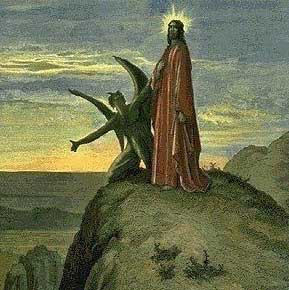
Temptation of Jesus

(See also Exorcisms, click here).

“Satan,” According To Harperʼs Bible Dictionary

(In Job 1-2 and Zechariah 3:1-2) Satan is depicted as a member of Godʼs court whose basic duty it was to “accuse” human beings before God. He is clearly not at this point an enemy of God and the leader of the demonic forces of evil, as he becomes later… It should be noted that ‘the serpent’ of Genesis 3 is never in the O[ld] T[estament] identified as Satan.

It is during the late postexilic period (after ca. 200 B.C.) and in the intertestamental literature that one first finds the development of the idea of Satan that is assumed in the New Testament writings. Probably under the influence of Persian ideology, there developed in Hebrew thought the idea of a dualism rampant in the created order—a dualism of good versus evil. There existed already the idea that God had a heavenly host, a group of messengers to carry out his work and orders. The Persians also believed in a ruler over the powers of evil, who had many servants in this realm known as demons. The Hebrews could easily understand and assimilate such thinking into their already existing ideas, but they had not yet developed any idea of a major being as a leader of the forces of evil…

Satan and his cohorts then came to represent the powers of evil in the universe and were even known in Jesusʼ time as the Kingdom of Satan, against which Jesus had come to fight and to establish the Kingdom of God…


Former Satanists Who Became Evangelical Christians & The “Satanic Panic” of The 1980s

The testimonies of “former Satanists who became evangelical Christians” have raised questions even among fellow Christians. Take Mike Warnke, the “former Satan worshiper” whose “autobiography,” The Satan Seller, became a Christian best seller. Two Christians interviewed numerous people from Warnkeʼs past and soon discovered that he had had a long history of being a “storyteller” and the tales in his book conflicted seriously with what other people said Warnke was doing at that time in his life. I recommend the book those Christians wrote, Selling Satan: The Tragic History of Mike Warnke by Hertenstein and Trott.

Presumably it was those same reporters (working for the Christian magazine, Cornerstone) who investigated Lauren Stratfordʼs claims in her Christian best seller, Satanʼs Underground. “They turned up so many contradictions that it became clear that little if anything in the book could be trusted as the literal truth. In fact not even the authorʼs name was real, it was Laurel Rose Wilson, and she came from a strict Christian family and only began claiming she had been the victim of a satanic cult in 1985, when two sensational cases surfaced in the national news. Though she displays scars on her body, claiming they were inflicted during rituals by satanic-cult members, the reporters state that they found witnesses who had seen her inflict the wounds herself. At one point she claimed to be blind, but it was discovered that she could see. There was no medical evidence that she had ever been pregnant (which was significant because Ms. Wilson claimed that two of her own babies had been sacrificed in snuff films). The publishers withdrew Satanʼs Underground from publication in January 1990.” (Laurence Gonzales, “Satanic Panic”)

Another “Satan seller” is Dr. Rebecca Brown. Her tales of “Satanic cult abuse” (He Came To Set The Captives Free) were published by Jack Chick, who specializes in publishing mini-comic books portraying demons and hellfire. “Dr. Rebecca Brown” was originally “an Indiana physician named Ruth Bailey, who had her license removed by the Medical Licensing Board of Indiana for a number of reasons. Among the boardʼs seventeen findings are: Bailey knowingly misdiagnosed serious illnesses, including brain tumors and leukemia, as ‘caused by demons, devils, and other evil spirits;’ she told her patients that doctors at Ball Memorial Hospital and St. Johnʼs Medical Center were ‘demons, devils, and other evil spirits’ themselves; and she falsified patient charts and hospital records. The boardʼs report states: ‘Dr. Bailey also addicted numerous patients to controlled substances which required them to suffer withdrawal and undergo detoxification, and that she self-medicated herself with non-therapeutic amounts of Demerol which she injected on an hourly basis.’ A psychiatrist appointed by the board to diagnose Bailey described her as ‘suffering from acute personality disorders including demonic delusions and/or paranoid schizophrenia.’ Refusing to appear before the board, Bailey moved to California, changed her name to Rebecca Brown, and began working with Jack Chick.” (David Alexander, “Giving the Devil More Than His Due: For Occult Crime ‘Experts’ and the Media, Anti-Satanist Hysteria Has Become A Growth Industry,” The Humanist, March/April 1990) Jack Chick recently stopped publishing Brownʼs books, “We used to publish her books. Then the Lord told us he didnʼt want us to put ʻem out anymore.” (Jack Chick, speaking to Dwayne Walker in 1997)

Even the editors of Christianity Today praised a book in which well-documented research showed that the problem with the “Satanic panic” of the 1980s was that “rumor was prevailing over truth, and people, particularly Christians, are too believing.” The Christian book reviewer cited a case in a megachurch in Chicago where one man was “disfellowshipped” because a female in the congregation “freaked out” whenever she saw him on Sunday mornings, claiming he was a “Satanic cult leader” who had “ritually abused her.” “The man was not allowed to face his accuser, nor would they discuss with the man any specific dates or events of alleged crimes. Though the man denied the allegations, and the elders and pastor of the church saw no evidence of sin in the manʼs life, they felt compelled to protect the accuser.” The review continued, “To date there has been no investigation that has substantiated the claims of alleged Satanic abuse survivors. Recovered ‘memories’ are the only evidence any specialist will offer…Well-meaning but uncritical therapists have validated, if not helped to construct, vile fantasies that foment a terror of Satan rather than confidence in God…In periods of rising concern over actual child abuse and sexual immorality the historical tendency has been to find scapegoats for social ills. A despised segment of society is depicted as the perpetrator of a villainous conspiracy. Romans accused the early Christians of wearing black robes, secretly meeting in caves, and performing animal and baby mutilation. In the Middle Ages, the scapegoat was the Jews. In America of the 1830s and 40s, kidnapping and murder of children were said to be the work of the Catholics. A best-selling book of the time, The Awful Disclosures of Maria Monk, chronicled the atrocities committed by priests and nuns at a particular convent. That account sparked myriad copycat claims by other young women.” (Susan Bergman, “Rumors from Hell,” Christianity Today, Vol. 38, No. 3, March, 1994—a review of Jeffrey S. Victorʼs, Satanic Panic)

The modern “Satanic cult hysteria” only began in 1981 with the publication of the best-seller, Michelle Remembers. “Prior to 1981 there were no reports of ‘satanic-cult torture and murder.’ We have none on record, and I challenge you to find any in the psychiatric or scientific literature.” So says F.B.I. Special Agent Kenneth Lanning (who has a masterʼs degree in behavioral science and whose published work on the sexual victimization of children is well-known in the law-enforcement and psychology fields). There are indeed practicing “Satanists” in America, but the F.B.I. has been studying ritual criminal behavior for many years and has not found evidence of any organized “satanic menace.” According to Lanning, “I started out believing this stuff [about ritual murders by organized satanic-cults]. I mean, I had been dealing with bizarre crimes for many years and I knew from experience that almost anything is possible… But I canʼt find one documented case [of satanic-cult victimization], and Iʼve been looking for seven years or more. I personally have investigated some 300 cases—and there is not a shred of evidence of a crime.” He mentioned how psychiatric patients [and/or people who undergo hypnosis to “recover memories”] are the ones claiming such crimes took place, but when the alleged crime scene is investigated there is never a trace of blood or bone, though the F.B.I. has many means to detect even the faintest traces of splashed blood, and whole lawns and farm fields have been dug up in search of bones and bone fragments though none were found.

Satan-mongers inflate statistics, claiming that “according to the F.B.I., two million children are missing each year.” “Itʼs wrong,” said Lanning. The Justice Department (Juvenile Justice Bulletin, January 1989) reported that between 52 and 58 children were kidnapped and murdered by non-family members in 1988. The “Cult Crime Network” claims that “50,000 human sacrifices” are being performed each year by “satanic cults.” But there are only 20,000 murders, total in the U.S. each year, and that figure accounts for all the gang, drug, domestic, and “regular” murders in the country.

People do commit strange crimes. Some may even be committing human sacrifice in the name of Satan. But there is absolutely no evidence of any widespread, organized satanic movement. At one conference on satanism in America in 1989 the same photo of a boy whose death was “linked to satanism” was dragged out by just about everyone interviewed by a reporter covering the conference, implying that was the one and only corpse in the U.S. that could be traced to satanic-cult activity, and it was the result of an isolated incident that could not be connected in any way with an organized group.

As Lanning sums things up, “The fact is that more crime and child abuse has been committed by zealots in the name of God, Jesus, and Muhammad than has ever been committed in the name of Satan.” [Kenneth Lanning, “Satanic, Occult, Ritualistic Crime: A Law Enforcement Perspective,” The Police Chief (Fall 1989)]

E.T.B.


Some Christians like to pretend that the majority of the United States is comprised of “Satanists.” That way they can excuse the fact that Christianity doesnʼt work.

Fredric Rice (featured at holysmoke.org/quotes.htm)


Devils Devils Everywhere, So Throw A Pot Of Ink!

The Father of Protestant Christianity, Martin Luther, saw “Satan” lurking everywhere and once boasted about throwing an inkpot at old Split-foot himself. (The following quotations, unless otherwise stated, are from Table Talk, a volume in The Collected Works of Martin Luther):

Snakes and monkeys are subjected to the demon more than other animals. Satan lives in them and possesses them. He uses them to deceive men and to injure them.

In my country, upon a mountain called Polterberg, there is a pool. If one throws a stone into it, instantly a storm arises and the whole surrounding countryside is overwhelmed by it. This lake is full of demons; Satan holds them captive there.

Demons are in woods, in waters, in wildernesses, and in dark pooly places ready to hurt and prejudice people; some are also in thick black clouds, which cause hail, lightning and thunder, and poison the air, the pastures and grounds.

How often have not the demons called “Nix,” drawn women and girls into the water, and there had commerce with them, With fearful consequences.

I myself saw and touched at Dessay, a child that had no human parents, but had proceeded from the Devil. He was twelve years old, and, in outward form, exactly resembled ordinary children.

A large number of deaf, crippled and blind people are afflicted solely through the malice of the demon. And one must in no wise doubt that plagues, fevers and every sort of evil come from him.

Our bodies are always exposed to the attacks of Satan. The maladies I suffer are not natural, but Devilʼs spells.

As for the demented, I hold it certain that all beings deprived of reason are thus afflicted only by the Devil.

Satan produces all the maladies that afflict mankind for he is the prince of death.

(Who needs modern medicine or sanitation practices? What we really need, according to Luther, are more exorcists to heal “all the maladies which afflict mankind.” Yet even the “apple” of “Godʼs eye,” the ancient Hebrews, did not enjoy unparalleled good health judging by the lengthy number of illnesses mentioned in the book of Deuteronomy. And what about Luther and Calvinʼs devilishly recurring stomach and bowel problems? Dare I suggest that the early invention of Ex-lax and Pepto-Bismol might have proven more helpful to mankind than some of Luther and Calvinʼs teachings?—E.T.B.)

I would have no compassion on a witch; I would burn them all. (Luther, Table Talk)

When I was a child there were many witches, and they bewitched both cattle and men, especially children. (Luther, Commentary on Galatians)

The heathen writes that the Comet may arise from natural causes; but God creates not one that does not foretoken a sure calamity. (Luther, Advent Sermon)

Martin Luther

[For further quotations like those above, see Heiko Oberman, Luther: Man Between God and the Devil]


The long list of “doorways,” or entry points for demons, make daily life awkward for some Christians. Members of one North London Church have to avoid, among other things, Care Bears (because they do rituals for healing without invoking the name of Christ), the film E.T., Cabbage Patch Dolls (because they encourage people to treat toys as human), figurines of unicorns (mythological), and frogs (“And I saw three unclean spirits like frogs come out of the mouth of the dragon, an out of the mouth of the beast, and out of the mouth of the false prophet;” Rev.16:13). One woman owned a china tea set, passed down in the family as an heirloom; she was persuaded to smash it by another church member, who noticed there was a Chinese dragon in the pattern. A woman who looked after the church childcare was found to be teaching the children relaxation exercises; she was thrown out. All these things, the church elders suppose, might bring demonic influence into the congregationʼs lives.

Gareth J. Medway, Lure of the Sinister: The Unnatural History of Satanism
(New York University Press, 2001)


Some people believe in the Devil. So do I, in a way. He could be nothing more than one of Godʼs staff members, the one who on Judgment Day will take the fall for war, famine, tooth decay, etc. (In fact, “Armageddon” is probably Aramaic for “reshuffling the cabinet.”) He could be just random badness, the absence of goodness: evil doesnʼt have to unionize to be effective. I just do not believe that old Splitfoot has a hot line to everyoneʼs id and makes us go all steamy with evil thoughts when the fancy strikes him.

James Lileks, “The Devil, You Say,” Fresh Lies


Anybody who listens to rock albums backwards deserves to hear a message from Satan.

Brad Stine


Christians say multitudes of people are already in hell for “not having accepted Jesus”or for “falling away” after having tasted salvation (see the Book of Hebrews), or for petty offenses like adopting “unorthodox creeds” such as Unitarianism instead of Trinitarianism, or for being descended from two folks in “Eden” who ate “forbidden fruit,” an offense to which God reacted quickly, not allowing them to eat the fruit of eternal life and staining the souls of their childrenʼs children forever with “original sin.”
(“Original sin” is not a Jewish concept by the way, but a Christian one, thanks to St. Augustine who also came up with the concept of “infant damnation” as a corollary.)

Keeping in mind the shortness of Godʼs temper in the Bible, how He punished human beings without waiting very long, compare that with the fact that God continues to give “Satan” a free pass, letting Satan remain “the prince of this world,” a being who has allegedly offended God since before creation, and in more than just petty ways, like attempting a direct overthrow of heaven (or so goes the myth).

How did the Devilʼs name get pushed to the last page of Godʼs “Must Remember to Chain Up in Hell List,” instead of the first? According to Christians, a vast multitude of human beings are already roasting in hell. So why does God show so much long suffering toward the Devil—a being who presumably knew better about good/evil, God and the truth, long before anyone else? Yet this same God has demonstrated far less relative patience with us lowly mortal humans who arenʼt “in the know” concerning nearly as many things as Devil is, and who couldnʼt have offended God nearly as badly as Satan, i.e., how do you compare taking a bite out of a piece of fruit with a full scale attack on heaven?

Also, some verses in the Bible state that God Himself sent lying spirits, plagues, curses, and also set up temptations to humanity, which raises the question, what if God had something to do with Satan being tempted to “fall” in the first place?

And is “evil” really the perfect device for polishing human beings such that God “in his wisdom” had to keep the Devil around to “polish” humanityʼs souls? If so, then why is Satan called “evil” and not “Godʼs Course Scrubbing Pad and Soul Polisher that really Gets the Rust Out?” Heck, why not make Satan a saint since God apparently “needs” Satan to stick around doing “Satanic” things, inspiring and doing enough “evil” for His “Divine Plan” to work correctly?

With Godʼs temper flared so easily, it does seem that the Devil would have pissed the Lord off supremely by now, and wound up roasting like a chestnut on Godʼs open fire, or chained to the edge of a black hole for eons, and not allowed any further contact with any other parts of Godʼs creation. But instead God “needs” him around? Hmmm. Maybe God Himself needs a scapegoat? Or maybe Judeo-Christian theological God-talk evolved during the time of inter-testamental Judaism (a time when they began elevating “Satan” to the god of this world) and Christian times, and they discovered that a theological scapegoat was needed to keep their Biblical Godʼs hands looking relatively clean.

Sharon Mooney (edited by E.T.B.)


The Christian Bible says the most injurious things about Satan, but we never hear his side. We have none but the evidence for the prosecution, and yet we have rendered the verdict.

And who prays for Satan? Who, in eighteen centuries, has had the common humanity to pray for the one sinner that needed it most?

We may not pay him reverence, for that would be indiscreet, but we can at least respect his talents. A person who has for untold centuries maintained the imposing position of spiritual head of four-fifths of the human race, and political head of the whole of it, must be granted the possession of executive abilities of the loftiest order. Not only that, but Satan hasnʼt a single salaried helper, while the Opposition employs a million.

Mark Twain


May The Higher Power Win

I cannot find either Satan or Him
In this troubled heart.
Nor have I found a concrete way
To tell the two apart.

Through the myths, I hear the legends.
Through the songs I hear the praise.
Through “Glory God” and “Satan Rules”
I still hear but one phrase.

Have mercy on my troubled soul,
Whoever bids the lot.
And may the Higher Power win,
If itʼs a soul I got.

Norbert Thiemann


Dyslexic Christians Sell Their Souls to “Santa.”

Indiana Jones and the Quest for the Holy Foreskin

Circumcision of Jesus

Amazing info about incredible holy relics from Christianityʼs great age of faith.

According to Austin Cline at about.com: The power and popularity of relics in Medieval Europe was dependent upon the saintliness of the original “owner.”

The ultimate source of relics, of course, was Jesus himself. But there was just one problem: it is clear in the New Testament that after his resurrection, Jesus was “carried up to Heaven.” Thus, there just wasnʼt any possibility of a church acquiring Jesusʼ head or foot, as happened with various saints. For the most part, the only Jesus relics available were things like his crown of thorns, his robe, his sandals, or even pieces of the “True Cross.”

But then some astute theologian — or was it a businessman? — realized that not all of Jesusʼ body could have been actually transported up to Heaven. Jesus was, after all, a faithful Jew, and as such, he would have been circumcised like every other boy. So where was his foreskin? Whatever happened to that bit of divine flesh?

And thus began a search for a very odd “Holy Grail” which resulted in not one, but up to a dozen different holy foreskins, each competing to be the genuine article. Of course, one presumes that they could not all be genuine and I am not aware of anyone who tried to argue that the unusual bounty was a miracle akin to the loaves and fishes.

In France, Charroux claimed that they inherited their foreskin from Charlemagne. In the early twelfth century they took it to Rome and paraded it through the streets alongside one of those pieces of the True Cross and Jesusʼ sandals, bringing them before Pope Innocent III.

At the same time, however, the parish of Calcata north of Rome also claimed to possess Jesusʼ foreskin. Then there was the abbey of Coulombos in the diocese of Chartres claiming that they were the owners of the True Foreskin. Other claimants included Puy, Metz, Anvers, the church of Notre-Dame-en-Vaux, and Hildersheim.

It shouldnʼt be surprising that all of these strongly disputed the claims of everyone else. Pope Innocent III decided not to become involved and refused to judge who was right. According to him, only God could know the truth about such a “delicate” matter. Itʼs probably better for his legacy that he didnʼt become involved — who would want to become known as the Foreskin Pope?

Imagine what it would have been like had they chosen to rule on the issue! Can you see them peering into the reliquaries, attempting to determine if the foreskin before them was from Jesusʼ or just some leperʼs? By what standards would they have made their judgments? Sight? Texture? Smell? Unfortunately, the popeʼs reluctance to become involved just led to the “discovery” of several more “real” foreskins.

In the end, it was Charroux who “won” the battle of the foreskins when Pope Clement VII (1523-1534) issued a bull granting indulgences to any and all who made a pilgrimage to the Charroux foreskin. Just think — you could have sins forgiven by God just for getting a glimpse at a bit of severed genitalia!

But then tragedy struck: the foreskin went missing! The relic disappeared from Charroux for centuries and was thought to have been stolen. What kind of a sicko would steal a foreskin? (Of course, the same could be asked of anyone who would display one for money.)

Then, in 1856, a lucky workman discovered the reliquary hidden inside a wall, perhaps put there to protect it during the many religious wars. I wonder if that workman had his sins forgiven for the discovery? Nineteenth century Catholics hadnʼt grown out of their taste for relics, and a new church was built to house the tiny ringlet of flesh. Monsignor Pie, who spoke at the dedication ceremony, informed the excited crowd that if they looked closely, they could still see a bit of coagulated blood on the holy flesh.

For some strange reason, however, the Vatican grew less and less supportive of relics, particularly foreskins. In 1900 the Vatican suggested that foreskins encouraged “irreverent curiosity” and that, somehow, this was a bad thing. Generally the foreskin fever died down with the lack of official encouragement, although it didnʼt disappear entirely. One church in Italy kept up the worship right through the 1980s — and each year the relic was exposed to the adoring crowds during the Feast of the Circumcision. (I wonder — what was served?)

But in 1983, thieves broke in and stole the 300 year-old jewel-encrusted reliquary and the holy flesh it contained. Presumably they only wanted the case — but what on earth did they do with the foreskin? Is it sitting in someoneʼs basement right now?

Maybe Steven Spielberg should look upon this as a movie idea: Indiana Jones and the Quest for the Holy Foreskin!

See Also Wikipediaʼs Article, “Holy Prepuce.”


A 14Th Century Miracle Of The Holy Foreskin

The story of St. Blannbekin (died in Vienna 1315); (Zilchʼs translation from a book in German located here.)

“This person [Agnes Blannbekin] had the habit, starting almost in childhood, to weep profoundly at the Feast of the Circumcision, touched to the heart by the blood spent by Christ, who deigned to suffer so early…. Thus she started to wonder, where the prepuce might be. And lo and behold! Soon she felt a little skin on her tongue, like the skin of an egg, full of great sweetness, and she gulped it down. Hardly had she swallowed it, when she felt the little skin again, and so she swallowed it once more. And she did so a good hundred times…. And it was revealed to her, that on the Day of Resurrection the prepuce was also resurrected. So great was the sweetness when she swallowed this little skin, that in all her limbs and in all the muscles of her limbs she felt a sweet transformation…”

St. Agnesʼ confessor added after this chapter the note:

“I was greatly comforted, that the Lord would reveal himself to people this way, and burned to hear more.”


They Cut Off His Thing

(sung to the tune of “My Favorite Things” from the Sound of Music)
by Alex Murphy

They didnʼt save blood
that He sweat in the Garden
Or teardrops in temples
For Jewish hearts hardened,
No skin off His back from the Roman scourging
But they saved skin that was cut off of His thing

His first baby teeth
No oneʼs tried to fence ʻem
No first diaper movements
on eBay for ransom,
No babyʼs first zwieback, spit up on Mary
But they saved skin, cut off during His bris

Every nose hair
Each ounce of earwax
Drool by the gallon, man!
Each burst of methane from out of His being
It came from the Son of Man!

Psoriasis that fell from atop His melon
His fingerprints, taken by Romans (a felon)
Each Relic demands veneration, ka-ching!
Especially skin that was cut off of His thing

Dried up kleenexes
And half-eaten matzos
A Holy Quest is on for
His baby bottles
Dirt from the bath when He left a scum ring
If it fell off Him, itʼs a Holy thing

Underarm hairs
Sand from his eyes
Every picked off scab
Just get a receipt when you turn in some meat
The foreskin will be so glad


In Case Jesusʼs Foreskin Wasnʼt Relic-Enough For You… Thereʼs These

Two of the relics that the Patriarch of Jerusalem gave to King Charlemagne and that recall “with profound reverence events in the history of salvation,” include fragments of the newborn Jesusʼ diapers, and the cloth Jesus wore around his waist on the cross, both of which one might presume to have once contained remnants of Jesusʼs feces. See this article:

Catholic Communities Have Unique Link With Rome And Jerusalem

John Paul IIʼs Letter for 1,200 Years of Aachen Cathedral
VATICAN CITY, JAN 31 (ZENIT)-- John Paul II referred to the ties that unite the Catholic community spread over the world with the Church of Rome and the Holy City of Jerusalem, in a letter to commemorate 1,200 years since the construction of Aachen Cathedral, an event which was celebrated last Saturday and Sunday in this historic German locality. The Popeʼs special envoy to the celebration was Cardinal Darío Castrillón Hoyos, prefect of the Congregation for the Clergy. The Holy Father addressed the letter to Bishop Heinrich Mussinghoff of Aachen. John Paul II pointed out that the Cathedral, dedicated to the Virgin, was built at the request of Charlemagne. That same year, 800, the emperor was crowned in Rome by Pope Leo III in the Vatican Basilica. This historical event reflects the closeness that existed between that local Church and the diocese of Rome. But Aachen Cathedral has yet “another link” that carries it “with heart and mind” to the Holy City. These are 4 precious relics that Jerusalem gave to Charlemagne and that recall “with profound reverence events in the history of salvation.” The 4 relics are fragments of the newborn Jesusʼ diapers, the cloth Jesus wore around his waist on the cross, the dress Mary wore on Christmas Eve, and the cloth of John the Baptistʼs beheading.


Selections From An Official Catalog Of Relics From Pre-Protestant Germany

The Castle Church at Wittenberg, where Martin Luther probably posted his ninety-five theses, was famous for its extensive collection of relics, as the following excerpt from what might be called the official catalogue shows:

“… Three pieces of the city where the Virgin Mary was born. One piece of a yarn which she spun. One piece of the house where she lived at the age of fourteen. Two pieces of the city of Mt Zion where Mary lived. Two pieces of the room where Mary was greeted by the angel. Five particles of the milk of the Virgin Mary. One piece of the tree where Mary nursed the Lord near the Garden of Balsam. Four pieces of the hair of Mary. Three pieces of the shirt of Mary. Three pieces of one robe of Mary. Eight pieces of other robes of Mary. Four pieces of the belt of Mary. Seven pieces of the veil of Mary. Two pieces of the veil of Mary which was sprinkled with the blood of Christ under the Cross. One piece of the city where Mary died. One piece of the wax candle given to Our Lady when she died. Six pieces of the grave of Mary. Two pieces of the earth of the grave of Mary. One piece of the place where Mary ascended into heaven.

VI. A silver picture of the little baby Jesus. Four pieces of the city where the Lord Jesus was born. One piece of the diaper in which he was wrapped. Thirteen pieces of the manger of Jesus. One piece of the cradle. Two pieces of the hay. One piece of the straw on which the Lord lay when he was born. One piece of the gold and of the myrrh which the Three Kings offered unto the Lord. One piece of the city where the Lord Jesus was circumcised.

VII. Four pieces of the mountain on which the Lord Jesus fasted. Two pieces of the city where Christ preached the Lordʼs Prayer. One piece of the stone on which Jesus stood while weeping over Jerusalem. One piece of the stone from which Christ got on the donkey. Two pieces of the ground where the Lord Christ was arrested.

VIII. Five pieces of the table on which the Lord Christ held the Last Supper with his disciples. One piece of the bread of which Christ ate with his disciples during the Last Supper.

IX. One piece of the land which was bought for the thirty pieces of silver for which Christ was betrayed. One piece of the Holy Land. Three pieces of the stone where the Lord sweated blood. One piece of the ground where the Lord sweated blood. One piece of the stone sprinkled with the blood of Christ.

X. Three pieces of the Mount of Olives and of the rod of Aaron. Two pieces of the rod of Moses. One piece of the burning bush which Moses saw. One piece of an object sprinkled with the blood of Christ. Eleven pieces of Mount Calvary. Two pieces of the Mount of Olives. XI. One piece of the cloth with which the Lord wiped his disciplesʼ feet. One piece of the robe of Christ: One piece of the seamless robe of Christ. One piece of the robe of Christ. One piece of his purple robe. Two pieces of the cloth which St Veronica received from the Lord. Three pieces of the white robe in which the Lord was ridiculed by Herod . Three pieces of the cloth with which our Lordʼs holy eyes were blindfolded. One piece of the beard of the Lord Jesus.

XII. One piece of the wax of the candles which touched the sudarium of Christ. One piece of the wedge with which the cross of Christ was held. Three pieces of the stone on which the cross stood. Three pieces of the place where the cross of Christ was found. Twelve pieces of the column where the Lord Christ was scourged and flogged.

The Eight Aisle. I. One piece of the rope with which Jesus was tied. Three pieces of the rod with which the Lord Jesus was scourged. Three pieces of the whip with which the Lord Jesus was flogged. One piece of the stone upon which the Lord Jesus sat when he was crowned. One piece of the stone which was crushed while the Lord carried the cross. One piece of the sponge with which the Lord was given vinegar and gall….

III. Two pieces of the crown of the Lord Jesus. Eight complete thorns of the crown of the Lord Jesus. IV. One large piece of one nail which was driven through the hands or feet of the Lord Jesus. V. A thorn which wounded the holy head of the Lord Jesus.

VI. One piece of the holy cross….

VII. Three pieces of the holy cross.

VIII. Three pieces of the three kinds of wood of the cross of Christ.

IX. A particularly large piece from the holy cross.

X. Twenty-five pieces of the holy cross.

XI. One piece of the stone which lay on the grave of Christ. Twenty-two pieces of the grave of Christ. One piece of the stone from which Christ descended into heaven.

XII. A casket lined with silver in which are found sixteen hundred and seventy-eight pieces. Seventy-six pieces of holy remains. Bones from holy places which on account of faded writing can no longer be read and identified. All in all : five thousand and five pieces. An indulgence of one hundred days for each piece. There are eight halls and each hall has an indulgence of one hundred and one days in addition. Blessed are those who participate therein.

Source: Hans J. Hillerbrand, ed. The Reformation: A Narrative History Related by Contemporary Observers and Participants (Harper and Row, Inc. 1964, Reprint Baker Book House, 1978) pp. 47-49.