Showing posts with label The Damned Say The Damnedest Things. Show all posts

Serpent-Handling Christians [an anthology of quotations]

Serpent-Handling Christians

“They Shall Take Up Serpents”

And he [Jesus] said unto them, Go ye into all the world, and preach the gospel to every creature. He that believeth and is baptized shall be saved; but he that believeth not shall be damned. And these signs shall follow them that believe; In my name shall they cast out devils; they shall speak with new tongues; They shall take up serpents; and if they drink any deadly thing [poison], it shall not hurt them; they shall lay hands on the sick, and they shall recover. So then after the Lord had spoken unto them, he was received up into heaven, and sat on the right hand of God. And they went forth, and preached everywhere, the Lord working with them, and confirming the word with signs following. Amen.
- Mark 16:15-20 (KJV)

[Scholars doubt the authenticity of the above verses since they are not found in the earliest known manuscripts of Mark. Indeed, three different added endings to Mark have been found in later manuscripts, so perhaps early Christians were trying to make up for the lack of a proper ending in the original. But none of these textual questions discourage serpent-handling Christians who believe that their faith and practice demonstrates the authenticity of Mark 16:15-20 and the miraculous foundations of their particular faith and church.]


Excerpts From the Serpent-Handlers: Three Families & Their Faith

[In His Own Words, Joe Robert Elkins] “Lot of people think all we do is handle serpents. We pray for the sick. Theyʼs some sick people thatʼs healed here. We drink the strychnine [poison]. We donʼt deny none of the five Signs. We do our best to put all five in action, because He said “these” Signs. We donʼt just pick out praying for the sick or speaking in tongues, but all five Signs is going to be made manifest in Godʼs church. You are either a believer or an unbeliever, and the unbeliever is going to hell. I believe they are going to burn…

The Bible says to pray without ceasing. See, you go with a prayer in your mind all the time, lest you enter in the temptations. Prayer is what keeps the temptation away. When you are approached by the devil, you pray. God moves that thing. He said to resist the devil, and he would flee from you… God talks to people, if they would just slow down and listen. God talks. I hear Him. He speaks to you through the heart. It is a small, still voice. It is real quiet. It speaks within you. You hear it… But it ainʼt every spirit that talks to you that is God… People think we are crazy, but it is a wise man who fears the Lord and keeps His Commandments.”

[Introduction to the book, The serpent handlers practice their religion daily in though, word, and deed. When they fail, they suffer, pray, and try harder the next day. Their religion demands a price too high for most of us to pay. Imagine having enough faith to pick up a deadly reptile to confirm Godʼs Word, knowing that a bite could be crippling or even fatal. What about the miracles? How can they be explained? We have seen people hold flame in their hands and dance on fire without being burned. We have witnessed believers drinking strychnine with no ill effects and handling poisonous snakes without being bitten. Other miracles are related in this book—healings, casting out devils, baptism by an unseen spirit. Even these stories seem plausible because we believe in the veracity of the people who witnessed such events firsthand.]

[In Her Own Words, Cynthia Church] “This religion is not David Copperfield. Itʼs not smoke and mirrors and magic. … It makes me angry when people think serpent handlers are ignorant rednecks from Appalachia. The way people talk here is cultural. Just because some of them are uneducated doesnʼt mean they are ignorant, but that is the way they are portrayed by most of the press… Mamaw had the gift of fire. She would pour kerosene on a little white handkerchief—you know, the kind ladies used to carry—and she would set it on fire and burn it in her hand. The hankie would burn with fire and smoke, and Mamaw held that fire in her hand for about fifteen minutes while she danced [in the spirit]. Finally, she closed her other hand down over it and put the fire out, and her hand was not even burned, and the handkerchief was not even burned or scorched.”

[In Her Own Words, Linda Turner Coots] “They were handling serpents. My brother-in-law was handling fire. And Joyce leaps up shouting, speaking in tongues, and Gregʼs dad, he held up his hand and wanted everybody to listen. And he said, ‘Thereʼs something that just donʼt sound right.’ Joyce was speaking in tongues, but it wasnʼt God. And when he pointed a finger at her, she just fell on the floor. And then he begin to pray for her, and that devil was talking, and it was saying that Jesus was the devil. And he cast the devil off her. Joyce repented of her sins, but somewhere, that devil took over, and she didnʼt know how to resist him…Hayden, Gregʼs dad, prayed for him one night at my momʼs and cast the devil out of him. He told the devil to go into the dog that was outside. And when he done that, the dog howled, made the awfulest, pitiful sound. It went mad a few days after that, and my uncle had to kill it. He had to destroy the dog…Yeah, I been to a lot of baptizings. Iʼve seen the Lord baptize Gregʼs dad one Sunday: They was about fifteen people being baptized that Sunday, and he baptized every one of ʻem, and then he was just standing in the water after everybody else walked out, and it was just like something just laid him down in the water and brought him back up.It was beautiful. He never said anything [about that experience]. We watched it. It was amazing…I just know that the Word of God is the truth. They say that speaking in tongues is evidence of the Holy Ghost, but I believe the real gift of God is eternal life. I wish everybody could see heaven, but they canʼt. Itʼs not for everybody. Itʼs only for a chosen few. Everybodyʼs not going to see Him. I have friends who say theyʼre Christians, but the way I feel about it, they donʼt believe in the full Gospel, and theyʼre not gonna make it. Theyʼre not gonna go where Jesus is… I just want to make it [to heaven]. Love. Thatʼs the most important thing, to have that love.”

[In His Own Words, Charles Church] “Miracles are performed every day in the church. Ceilʼs mother, Barbara, had the gift of fire. She had a great anointing to handle it. She used to dip her hands into a coal stove and carry out hot coals with her hands, and she was never burned. Ceil has that gift too. She says the fire feels cool. Barbara would actually pour kerosene on the floor and set it on fire and dance barefooted in the fire and never be burned. Once, I saw her hold out a sinner manʼs tie and put that torch under it, keep it there for five minutes, and it didnʼt ever burn… And when Brother Raford Dunn was bitten in Brother Carl Porterʼs church, we took him downstairs, and he was laying on a bed. Lydia was sitting next to him and praying for him, and she said she could actually feel his heart beating. And then she felt it quit beating. We prayed for him down there, and he came back to life.”

[In His Own Words, Dewey Chafin, born 1933] “The first time I ever handled a serpent, the anointing felt just like it does now. It starts in my stomach, the feeling does. It works different in different people, but I get a little feeling right here [in the pit of my stomach], and it just gets bigger and bigger and bigger, and from there on up through my chest and my shoulders. It is a good feeling, a warm feeling. You can feel it… Over the years I have been bitten 133 times… Some people donʼt understand our religion, but it determines everything I do in life. I donʼt drink coffee. I donʼt chew gum. I donʼt smoke cigarettes, argue, fight, cuss. If you start an argument with me, just start, and Iʼll be out of your way in less than a minute. Cussing is definitely a no-no. People take cussing being just one thing, like using Godʼs name in vain. But cussing is a lot more than that. There are a lot of ways you can cuss without using Godʼs name in vain.”

The rules of the church hang above the pulpit, their supporting Bible verses listed in parentheses. They read, “Women are not allowed to wear short sleeves, jewelry and makeup (I C 3; I Tim. 2:9); No gossiping (James 1:26); No tale-bearing (Prov. 18:8); No lying (Col. 3:9, Rev. 21:8); no backbiting (Rom. 1:30); No bad language (Col. 3:8); No tobacco users (II Cor. 7:1, I Cor. 3:17). Men are not allowed to have long hair, mustaches or beards (I Cor. 11:14); Men are not allowed to wear short sleeves; Women not allowed to cut hair (I Cor. 11:15); and wear dresses above the knees (Tim. 2:9).” At the bottom of the sign, in parentheses, it says, “Members only,” meaning that visitors are excluded from adhering to these mandates…

Since his evangelist brother, Punkin, died from snakebite in 1998, Mark Brown is the lone surviving child of one of the best known serpent-handling families in the Southeast. Now Mark is more wary, but not afraid… He believes that he has a personal mandate from God, told through a prophecy related to him by family friend Cameron Short. “The Lord told me that my hands would do the work of the Signs.”

Fred Brown and Jeanne McDonald, “The Serpent Handlers: Three Families and Their Faith” (Winston-Salem, North Carolina: John E. Blair Publisher, 2000)


The Church of the Lord Jesus, Jolo, West Virginia

The Church of the Lord Jesus, a Pentecostal serpent-handling, or “signs-following” church deep in the coal fields of southern West Virginia, is one of the most eminent churches of its kind…

Almost all of the men and some of the women in the church of the Lord Jesus, exhibit some sort of deformity on their hands and fingers from a past serpent bite. An atrophied finger, the loss of movement in part of a hand, or simple scars from a serpentʼs fangs, are proudly exhibited by these church members when they are asked about their “battle scars.” According to Brother Bob, Pastor of the church, the serpents “are the visible sign of the devil,” and when one has power over these serpents through the anointing of the Holy Spirit, he or she is, in effect, exerting control over the devil. None of the church members seeks medical attention when bitten by a poisonous snake; in fact, Brother Bobʼs stepdaughter was killed by a serpent bite in the 60s.

Brother Ray was eighty-two years old and had been with the church almost since its beginning in the late 40s…Rayʼs right hand was bitten over twenty years ago by a diamondback rattlesnake and became extremely atrophied. His index and middle fingers were completely unusable, and both of his hands had a swollen appearance. Ray had been bitten 89 times throughout the almost fifty years that he had been with the church. During that Sunday morning, while holding a handful of copperheads, Ray was bitten five more times on both of his hands…At the end of the service, Rayʼs hands had swollen a great deal, but he wasnʼt feeling sick, nor did he exhibit any effects other than being a little “itchy.” He stood up to testify and said, Iʼd like to praise God for being here… thank Him for the Spirit. Iʼd like to thank him for the bites I got today, all five of them. I praise Him for it because theyʼre not hurtinʼ—theyʼre itchinʼ, but theyʼre not hurtin.ʼ Theyʼre swellinʼ…” Ray felt that there was a reason for what, to an outsider, would appear to be a “breakdown” in the power of the Spirit. His getting bitten was not a breakdown at all but was Godʼs way of showing Ray that He would still take care of him, even though Ray was an “old man.” According to the members of the Church of the Lord Jesus, God has a reason for everything that He does, and they as His children must simply trust that will, even if they do not understand it.

Brother Dewey came out from behind the pulpit and took three serpents and began to preach, asserting that the Bible “didnʼt say these snakes wouldnʼt bite you or wouldnʼt hurt you.” He continued, “[The Lord] said, ‘these signs shall follow them that believe.’ These are the signs nobody wants to follow.” In other words, because the Word says those who believe in the Lord “shall follow” the signs in Mark, the Jolo church members feel that it is a command that they handle serpents. In an interview with Brother Bob, he added to this point: “If weʼre led by the Spirit and it [the serpent] bites us, then it was Godʼs will.” Furthermore, if it bites you and youʼre under the anointing, and you die, youʼve just done Godʼs will. That was your way to go. That was just your way to go. Because thereʼs going to be something that takes everybody out of this world. To me, itʼs fulfillment of the Word… the Bible says, “happy are you if you die in the Lord.” What better way would you find to die than doing what God said to do?

Shannon Bell, “Brother Rayʼs Serpent Bites” & “A Changing Approach,” copyright, 2000


Rattler-handling Rev. Dwayne Long of Rose Hill, Va., died in mid-April, 2004, after being bitten by a snake during an Easter Pentecostal church service and refusing medical treatment.


Linda Long, 48, of London was bitten by a snake during a church service at the East London Holiness Church she attended. Neighbors of the church told the newspaper the church practices serpent handling. Handling reptiles as part of religious services is illegal in Kentucky. Snake handling is a misdemeanor and punishable by a $50 to $100 fine. Police said they had not received any prior reports about snake handling at the church. Lt. Ed Sizemore of the Laurel County Sheriffʼs Office said friends went with Ms. Long to the University of Kentucky Medical Center. She died about four hours after the bite was reported, the Lexington Herald-Leader reported. Church officials could not be reached for comment. The funeral was scheduled for 2 p.m. Wednesday at the Arthurʼs Chapel Church in Rosehill, Va., according to the Rosehill Funeral Home.

E.T.B. [rewritten but based on an AP news report dated Nov. 7, 2006, London, Kentucky]


I saw in McDowell County, (where the Jolo church is located) that the unemployment rate is 260.8% of the national average, and the 1990 Census reported a poverty rate at 287.5% of the national average…Though the Jolo people may not have as much money as a great deal of Americans, one of the women in the church pointed out to me, “There are no homeless people here.” This simple statement made me re-think my definition of poverty and oppression because it was true, I had not ever seen a homeless person anywhere in McDowell County. “You want to know why?” she asked me, “itʼs because we take care of each other. We make sure that everyone has a roof over their head.” From her comment, I kind of got the feeling that it was I that was the deprived one, living in a world of assumptions and stereotypes.

Shannon Bell, “A Changing Approach,” copyright, 2000


After I wrote news accounts of the serpent-handling churches, sociologists visited and studied the congregations. One administered a psychological test to the Scrabble Creek flock, and gave the same test to a nearby Methodist congregation as a control group. The serpent-handlers came out mentally healthier.

James A. Haught, “Adventures in the Bible Belt” (1997), adapted from a Gazette column, Dec. 7, 1993.


One of the authors of The Psychology of Religious Fundamentalism, Williamson, is also a former minister in the Church of God (of Prophecy) from which the serpent-handling sects split; he conducted extensive interviews with 16 serpent handlers and commented on personal experiences with scores of others. One common thread through these interviews was the interpretation of snake bites during handling. Every instance of a bite was interpreted in one of three ways. First, it could be a sign to unbelievers that the serpent was indeed poisonous, proving that there were no tricks involved. Second, it could be divine retribution for disobedience and sin, as well as a reminder to keep your life in order because you never know when it will be your time to go. And finally, if neither of these interpretations seemed appropriate, the third interpretation was used, namely that the snake bite was simply the unknown will of God. This worldview leaves no room for the interpretation that maybe serpent handling is not a good idea.

In fact, serpent handlers are fully cognizant of the dangers of their practice, and they do not claim to have any special powers to ward off or survive snake bites. All the participants Williamson interviewed had witnessed a fatal snake bite, and eleven of them had been bitten themselves, some disfigured as a result. The interviewees were quick to point out that Mark 16:18 commanded them to handle serpents as a sign of true belief, but that it did not promise them no harm would come to them.

The advantage snake-handling Christians and other fundamentalist Christians have is that “They lay claim to absolute values with clear-cut answers to what others may find problematic” or questionable. (Though of course different fundamentalisms can and do propose different beliefs and clear-cut answers.)

David Ludden, “In the Beginning was the Word,” a book review of The Psychology of Religious Fundamentalism by Ralph W. Hood, Jr., Peter C. Hill, and W. Paul Williamson (Guilford Press, 2005). (Final paragraph edited by E.T.B.)


Read Luke 10:19, “Behold I give unto you power to tread on serpents and scorpions… and nothing shall… hurt you.” Funny, they donʼt seem too keen on treading on scorpions.

David Windhorst, “God May Kill You For Reading This… And Iʼm A Little Nervous Myself”

Evangelicalism: What Is One To Make of the Phenomenon?

Evangelicals

The Evangelical Mind

We who are in pietistic, generically evangelical, Baptist, fundamentalist, Restorationist, holiness, “Bible church,” megachurch, or Pentecostal traditions face special difficulties when putting the mind to use. Taken together, American evangelicals display many virtues and do many things well, but built-in barriers to careful and constructive thinking remain substantial. These barriers include an immediatism that insists on action, decision, and even perfection right now, a populism that confuses winning supporters with mastering actually existing situations, an anti-traditionalism that privileges oneʼs own current judgments on biblical, theological, and ethical issues (however hastily formed) over insight from the past (however hard won and carefully stated), and a nearly gnostic dualism that rushes to spiritualize all manner of bodily, terrestrial, physical, and material realities (despite the origin and providential maintenance of these realities in God). In addition, we evangelicals as a rule still prefer to put our money into programs offering immediate results, whether evangelistic or humanitarian, instead of into institutions promoting intellectual development over the long term.

These evangelical habits continue to hamper evangelical thinking. We remain inordinately susceptible to enervating apocalyptic speculation, and we produce and consume oceans of bathetic End Times literature while sponsoring only a trickle of serious geopolitical analysis. We are consistently drawn to so-called “American Christianities”—occasionally of the left, more often of the right—that subordinate principled reasoning rooted in the gospel to partisanship in which opponents are demonized and deficiencies in our friends are excused… Capitulation to disembodied ideals of spirituality incapacitates our struggling band of novelists and poets. And far too many of us still make the intellectually suicidal mistake of thinking that promoting “creation science” is the best way to resist naturalistic philosophies of science. When it comes to the life of the mind, in other words, we evangelicals continue to have our problems…

Evangelical higher education in North America remains a fragmented enterprise, both nourished and impeded by the sectarian character of American religion…

Pentecostals, Southern Baptists, members of Holiness movements, seeker-sensitive churches, dispensationalists, Adventists, African-American congregations, radical Wesleyans, and lowest-common-denominator evangelicals have great spiritual energy, but they flounder in putting the mind to use for Christ. On the other side, Lutherans, Catholics, Anglo-Catholics, the Reformed, and the Eastern Orthodox enjoy incredibly rich traditions that include sterling examples of Christian thought, but they often display a comatose spirituality. This picture is, of course, a generalization…

—Mark Noll [Christian and Professor of History at Wheaton College—Billy Grahamʼs alma mater], “The Evangelical Mind Today,” First Things, No. 146, Oct. 2004


Jack Kelley, an Evangelical Christian and star reporter with USA Today, resigned in January after admitting he fabricated many of his sensational stories covering war and terrorism. His admission of guilt came after USA Todayʼs investigative team found major fabrications and plagiarisms in Kellyʼs stories. The same Jack Kelley told Christian Reader magazine recently: “God has told me to proclaim truth,” and, he teaches at the World Journalism Institute, whose mission is “presuppositional reporting” from an “unapologetic Christian point of view.”

—E.T.B., based on an article in Christianity Today


I believe part of the appeal of the evangelical religion is for offering certainty, not faith, certainty about what is doctrinally correct. I think one of the dangers of religion is to believe we have got God all buttoned down. I believe just the opposite. I believe in the freedom and mystery of God that doesnʼt allow us to be certain but allows us to be loving. To put it in street talk, I look more to how people live than what they say they believe.

Rev. Albert Pennybacker [Pastor in Lexington, Kentucky, and head of the Clergy Leadership Network, a cross-denominational group of liberal and moderate religious leaders seeking to counter the influence of the Religious Right and to mobilize voters to change leadership in Washington. http://www.clnnlc.org/]


Evangelical Christianity = Being made to feel sinful and guilty for not having felt sinful and guilty, in order that one might experience release from sin and guilt; Like donning lead boots and walking about in them until totally exhausted in order to have the exhilarating experience of taking them off again.

—Conrad Hyers, Once-Born, Twice-Born Zen [Hyers is a moderate Evangelical Christian and former Chair of Religion at Gustavus Adolphus College]


Is the Heart of Man Deceitful Above All Things & Desperately Wicked?

According to the Gospel of Matthew, Jesus taught, “If you see a woman and lust after her, I say that you have already committed adultery in your heart.” In other words, even if you donʼt commit adultery “in the flesh,” youʼve committed it just by lusting after someone. Now suppose you see someone in need, who could use some cash or a kind word, and you yearn in your heart to give it to them (but for whatever reason are unable to give it to them). Does that mean you have “already committed charity in your heart?” Think about it. If a lust-filled yearning (not the act of sex, but just the yearning), is evidence of how bad the human heart is, then what about the yearnings people feel to help and support one another? Might they not be an indication of goodness in peopleʼs hearts?

Gandhi, the famous Hindu peace-activist, taught that people should seek out what was best in their own religions and hearts. Even Jesus put a positive spin on “the heart” when he taught that “The good man brings good things out of the good stored up in his heart” (Luke 6:45 & Mat. 12:35), and when he taught that people ought to “Love God with all their heart,” (Mat. 22:37). How is that possible if the “heart” is “wicked and deceitful above all things?”

No doubt the “wickedness” of the “heart” as depicted in the book of Jeremiah, chapter 17, verse 9 (“The heart is deceitful above all things and desperately wicked”) applies to some people at some times whenever they act deceitful and wicked, especially when they are at their lowest and weakest points. But to take the book of Jeremiahʼs exaggerated ancient Near Eastern way of speaking, and bake it in an oven until it becomes as dry and hard as a brick of dogma, and make that brick a cornerstone of your theology, well, to do that takes a “heart” relatively dry of compassion and fair appraisals of othersʼ beliefs and actions.

—E.T.B.


Christianity Can Magnify Harmless Actions into Deadly Offenses

One of Christianityʼs chief offenses is not that it has enlisted the services of bad men, but that it has misdirected the energies of good ones. The kindly, the sensitive, the thoughtful, those who are striving to do their best under its influence, are troubled, and consequently often develop a more or less morbid frame of mind. The biographies of the best men in Christian history offer many melancholy examples of the extent to which they have falsely accused themselves of sins during their “unconverted” state, and the manner in which harmless actions are magnified into deadly offenses.

—Chapman Cohen, Essays in Freethinking


On “Revivals”

In the days of my youth, ministers depended on revivals to save souls and reform the world. The emotional sermons, the sad singing, the hysterical “Amens,” the hope of heaven, the fear of hell, caused many to lose what little sense they had. In this condition they flocked to the “mournerʼs bench”—asked for prayers of the faithful—had strange feelings, prayed, and wept and thought they had been “born again.” Then they would tell their experiences—how wicked they had been, how evil had been their thoughts, their desires, and how good they had suddenly become.

They used to tell the story of an old woman who, in telling her experience, said, “Before I was converted, before I gave my heart to God, I used to lie and steal, but now, thanks to the grace and blood of Jesus Christ, I have quit ʻem both, in a great measure.”

Well, while the cold winter lasted, while the snows fell, the revival went on, but when the winter was over, the boats moved in the harbor again, the wagons rolled, and business started again, most of the converts “backslid” and fell again into their old ways. But the next winter they were on hand again, read to be “born again.” They formed a kind of stock company, playing the same parts every winter and backsliding every spring.

I regard revivals as essentially barbaric. The fire that has to be blown all the time is a poor thing to get warm by. I think they do no good but much harm; they make innocent people think they are guilty, and very mean people think they are good.

—Robert Ingersoll, “Why I am An Agnostic”


I had what I consider a “spiritual epiphany” regarding “evangelicalism” in high school when a group of friends and I drove to an evangelistic rally and heard the preacher rail on and on against the evils of drinking, smoking, and other things. The evangelist was a spectacular showman and implored the audience to take heed, come forward, let go of any liquor bottles or packs of cigarettes in their possession, repent, and sin no more with Godʼs power. Each word of the evangelist blazed with the certainty that God would heal His peopleʼs sinful ways and a choir was singing with trumpets blaring and the audience grew very excited. My friends all deposited their packs of cigarettes on the growing pile in the center of the rally and prayed with the ushers and pleaded with me to do so as well for the good of my soul.

I refused.

No sooner had the emotion-filled rally ended, no sooner had we traveled a few blocks in our car, than my friends bummed cigarettes off me.

—Dr. C. Brewer, Prof of Psychology (as told to E.T.B. 7/18/06)


How Different Are Most “Converted” People?

Were it true that a converted man as such is of an entirely different kind from a natural man, there surely ought to be some distinctive radiance. But notoriously there is no such radiance. Converted men as a class are indistinguishable from normal men.

By the very intensity of his fidelity to the paltry ideals with which an inferior intellect may inspire him, a saint can be even more objectionable and damnable than a superficial “carnal” man would be in the same situation.

—William James, The Varieties of Religious Experience


How to Spot Christians

One Sunday afternoon my cousin and I were eating at a restaurant. He paused, and started pointing at people. “Heʼs a Christian… Heʼs a Christian… So is she, and she, and that other guy.”

I asked how he was so sure.

His reply? “I was a hard-core Evangelical Christian for a few years, remember? Itʼs not hard to see once you know what to look for. Look for someone who looks like theyʼre wearing clothes just a little bit nicer than theyʼre comfortable in, that have a smile on their face. It wonʼt look like a happy smile, itʼll look kind of contrived and forced, like theyʼre trying to convince themselves theyʼre happy and rich.”

—Justice McPherson


Many of the most cordial Christians either hum hymns or listen to contemporary Christian music, or repeat Scripture in their heads, and wonder what they can do next to make someone think that theyʼre a “good little Christian.”

I used to do the same thing, and now people wonder why I do not shower them with praise and gifts to make them think that I am a “good little Christian.” I used to go to peopleʼs houses and work and they would try to pay me, But No! I would not take a dime, because I wanted to emblazon on their brains the idea that I was a “good little Christian.” (The “people-pleasing-for-Christ” part of my life ended over 15 years ago.) Thatʼs what many Christians are, people pleasers, God pleasers, Jesus pleasers, preacher pleasers.

Jesus was a people pleaser, thatʼs why he was so willing to die, either to please God or his ignorant followers.

—Ben at http://www.exchristian.net/ [edited by E.T.B.]


Converted or Addicted?

Psychotherapists will tell you that in dealing with an addict, you have to understand that the personʼs primary relationship is with the drug. The drug has the ability to control the addictʼs thinking to a remarkable degree, and you must understand that any relationship you may feel with the addict is a distant second to the one they have with their drug. The most devout Evangelical Christians are open and unabashed about this. Their “relationship with Jesus” as they use the term, is the primary relationship in their lives. There is even a scripture that goes something like, “Not unless you hate your mother and father can you be my disciple,” and, “Who are my mother and father? But he who hears and words of God and does them.” Jesus even suggested to one disciple that he ought not return home to help bury a dead family member, instead he ought to “Let the dead bury the dead.” In other words, Evangelicals stress that oneʼs love for Jesus ought to be so strong that relatively speaking, oneʼs love for even close family members, must not compare. You may love your mother but you should love Jesus so much more that in comparison itʼs like you hate her. Doesnʼt this sound an awful lot like a drunkʼs love for the bottle?

It may be helpful when trying to have a relationship with a believer to remember that you and their relationship with you means very little to them compared to their need to continue in their thought addiction. In fact “true believers” may happily sacrifice a relationship with their own spouses or children should those family members refuse to convert, or become “unbelievers.” In such cases the “true believer” feels they are making the ultimate sacrifice in “serving God rather than man.”

Evangelical beliefs may promise you comfort, security and power just like the ads for alcohol link its consumption with sexiness, sports activities, and a rippinʼ good time, but the promises in both cases often grow sour as the addict grows more hardened and insistent.

Some people have an instant “conversion” to alcoholism. They take their first drink, or have their first good drunk and understand (in the words of a very young alcoholic client I once had) “This (drinking) is what I was put on this world to do.”

For some people their religion is an illness they are trying to recover from and the recovery process is more difficult than recovering from alcoholism.

—Saint Vilis at the Yahoo Group, ExitFundyism


Evangelical Ego-Games

An evangelical Christian once told me, “Only Jesus Christ can save man and restore him to his lost state of peace with God, himself and others.” Yeah, sure, and only new Pepsi can make you feel really happy, and only our brand is better than the competition, and only our country is the best country. It is truly amazing to me that people can utter such arrogant nonsense with no humor, no sense of how offensive they are to others, no doubt or trepidation, and no suspicion that they sound exactly like advertisers, con-men and other swindlers. It is really hard to understand such child-like prattling. If I were especially conceited about something (a state I try to avoid, but if I fell into it…), if for instance I decided I had the best garden or the handsomest face in Ireland, I would still retain enough common sense to suspect that I would sound like a conceited fool if I went around telling everybody those opinions. I would have enough tact left, I hope, to satisfy my conceit by dreaming that other people would notice on their own that my garden and/or my face were especially lovely. People who go around innocently and blithely announcing that they belong to the Master Race or the Best Country Club or have the One True Religion seem to have never gotten beyond the kindergarten level of ego-display. Do they have no modesty, no tact, no shame, no adult common sense at all? Do they have any suspicion how silly their conceit sounds to the majority of the nonwhite non-Christian men and women of the world? To me, they seem like little children wearing daddyʼs clothes and going around shouting, “Look how grown-up I am! Look at me, me, me!”

There are more amusing things than ego-games, conceit and one-upmanship. Really, there are. I suspect that people stay on that childish level because they have never discovered how interesting and exciting the adult world is.

If one must play ego-games, I still think it would be more polite, and more adult, to play them in the privacy of oneʼs head. In fact, despite my efforts to be a kind of Buddhist, I do relapse into such ego-games on occasion; but I have enough respect for human intelligence to keep such thoughts to myself. I donʼt go around announcing that I have painted the greatest painting of our time; I hope that people will notice that by themselves. Why do the people whose ego-games consist of day-dreaming about being part of the Master Race or the One True Religion not keep that precious secret to themselves, also, and wait for the rest of the human race to notice their blinding superiority?

—Robert Anton Wilson


Many Christians who canʼt even get members of their own family to agree with them on trifling matters are currently seeking to evangelize the world and tell everyone “whatʼs what.”

—E.T.B.


Your Own Personal Jesus

Many evangelical Christians boast that they have a “personal relationship” with Jesus. What makes it so “personal?” Well, they say, we have the words attributed to Jesus in the four Gospels. But there are so few of them, a couple thousand. You could fit all of Jesusʼs words into a small 16-page booklet. And they are subject to interpretation.

Well, they say, there are “answered prayers.” But again, that is a matter of interpretation, because no matter what happens, an evangelical Christian interprets it as “Jesusʼs will,” even when bad things happen to good people and good things happen to bad people.

Whenever I have a “personal relationship” with someone it does not consist of a few thousand words spoken two thousand years ago, recorded accurately (or inaccurately) by someone else, and which require interpretation from third parties for me to “truly” understand them (especially when the third parties disagree concerning the meaning and intent of those words).

Neither should a “personal relationship” depend on me having to interpret the results of every prayer uttered. And the range of interpretations covers every conceivable outcome: “strongly positively answered,” “weakly positively answered,” “strongly negatively answered,” “weakly negatively answered,” or even, “try again later when you have more faith.”

—E.T.B.


Question: Whatʼs the difference between a trained psychologist and a born again Christian?

Answer: A trained psychologist can read a person like a book, but a born again Christian reads a book like itʼs a person.

—E.T.B.


Knock! Knock!

Two evangelical Christians at the door: May we come in and share some good news with you?

Me: Donʼt you mean, “May we blatantly disregard your privacy for a few minutes in order to further our own personal goals?” Tell me, which denomination do you belong to, and when was it founded? Thatʼs Protestant, isnʼt it? I bet the Pope has rings older than your denomination. I bet your denomination numbers a couple million at most. Catholics number far more. In fact, if you added up every member of every Protestant denomination on earth, the Catholics equal or exceed that number. You say thatʼs a logical fallacy, truth is not determined by sheer numbers? Thatʼs what all small denominations say. Heck, maybe youʼre knocking on doors because youʼre bored seeing the same faces in church or you fear your heaven wonʼt have enough folks in it to form a decent choir. I have a hot tip for you, youʼll be happier if you seek out people whom you admire—and things you enjoy—on an individual basis, rather than try to pour yourself and the whole world into a “one size fits all” religious Jello mold.

—E.T.B.


Evangelist = A bearer of good tidings, particularly (in a religious sense) such as assure us of our own salvation and the damnation of our neighbors.

—Ambrose Bierce, The Devilʼs Dictionary

Christians 0, Christians 0… From The Reformation To Today

Anabaptists

The burning of Anabaptist Christians, the 16th Century

It is startling how much the first half of the 16th century calls to mind the 20th and 21st centuries. Islamic jihad threatens the West, even laying siege to great cities like Vienna (in 1529). Central Europe—the Holy Roman Empire—is divided into warring and bloodthirsty factions. There is widespread racial and religious distrust, often leading to military action and ruthless ethnic cleansing (the expulsion of the Moors from Spain, the forced conversion of its Jews, the burning of heretics). Arrogant civic leaders behave like swaggering bravos wholly convinced that God is on their side, or even in their pocket. New communications technology—the printing press—speeds the dissemination of information and subversive ideas. Visionaries like Savanorola and John Calvin call for a total recasting of society, a return to fundamentalist principles and a rejection of the modern worldʼs gross secularism. Other dogmatists, fanatics and martyrs arise, reinforcing the eraʼs disorientation, pervasive uneasiness and latent hysteria. Inevitably, extremism results in heavy-handed government regulation and a call for order from the lofty ecclesiastical powers that be. More and more people choose to die for principles and beliefs that strike an outsider as utterly trivial, if not insane. It is widely believed that the world is coming to an end.

— From a review of Diarmaid MacCullochʼs The Reformation: A History that appeared in The Washington Postʼs Book World (See also MacCullochʼs more recent work, Christianity: The First Three Thousand Years)


There was a time [during the Reformation] when religion played an all-powerful role in European politics with Protestants and Catholics organizing themselves into political factions and squandering the wealth of Europe on sectarian wars. English liberalism emerged in direct reaction to the religious fanaticism of the English Civil War. Contrary to those who at the time believed that religion was a necessary and permanent feature of the political landscape, liberalism vanquished religion in Europe. After a centuries-long confrontation with liberalism, religion was taught to be tolerant.

In the sixteenth century, it would have seemed strange to most Europeans not to use political power to enforce belief in their particular sectarian faith. Today, the idea that the practice of religion other than oneʼs own should injure oneʼs own faith seems bizarre, even to the most pious churchmen. Religion has been relegated to the sphere of private life—exiled, it would seem, more or less permanently from European political life except on certain narrow issues like abortion.

Religion per se did not create free societies; Christianity in a certain sense had to abolish itself through a secularization of its goals before liberalism could emerge.

Political liberalism in England ended the religious wars between Protestant and Catholic that had nearly destroyed that country during the seventeenth century: with its advent, religion was defanged by being made tolerant.

— Francis Fukuyama, The End of History and the Last Man


The Thirty Yearsʼ War: The Worst Thus Far in European History?

By the division of Christianity at the Reformation, religious authority itself became the cause of conflict. The Protestant states thereafter rejected the right of the Universal Church to judge their actions, while the Catholic states took that rejection as grounds to make war against them in clear conscience. The outcome was the Thirty Yearsʼ War, the worst thus far in European history, which may have killed a third of the German-speaking peoples and left Central Europe devastated for much of the seventeenth century.

— John Keegan, War and Our World (the Reith Lectures, 1998, broadcast on the BBC, recorded at the Royal Institution, the Royal Military Academy Sandhurst, Kingʼs College, London)


The last great spasm of the Reformation was its worst. The Thirty Yearsʼ War, from 1618 to 1648, killed millions in Central Europe and left Germany a wasteland of misery. It began because Catholic Habsburg rulers of the Holy Roman Empire tried to suppress growing Calvinism in regions already smoldering with Catholic-Lutheran tensions. Evangelical princes formed a defensive alliance, the Protestant Union. The other side formed the Catholic League. They faced each other like ticking bombs—which finally exploded over a trifle: Protestant nobles entered the imperial palace in Prague and threw two Catholic ministers out a window onto a dung heap, touching off war.

Catholic armies quickly slaughtered the Protestant forces. The conflict might have ended then, but Catholic Emperor Ferdinant II decided to eradicate Protestantism entirely. The faith was outlawed and cruel persecution was inflicted.

Protestants appealed for foreign help, and Protestant King Christian IV of Denmark, sent an army to their rescue. Lutheran and Calvinist German princes joined him. Once again the Protestants were defeated, once again Ferdinand resumed religious oppression, and once again the victims sought outside aid.

Next, Protestant King Gustav Adolph of Sweden marched into Germany to rescue his fellow believers. His soldiers sang Martin Lutherʼs hymn “Ein Feste Burg” in battle. Terrible slaughter occurred. A Catholic army captured Magdeburg and massacred its Protestant residents. King Gustav was killed, and his troops weaked vengeance on Catholic peasants.

Eventually the war turned more political than religious. Catholic France entered on the side of the Protestants, in an attempt to cripples the rival Habsburgs. The killing dragged on decade after decade until both sides were too exhausted to continue.

The Thirty Yearsʼ War was a human catastrophe. It settled nothing, and it killed uncountable multitudes. One estimate says Germanyʼs population dropped from 18 million to 4 million. Hunger and deprivation followed. Too few people remained to plant fields, rebuild cities, or conduct education or commerce. This disaster helped break the historic entwinement of Christianity and politics. The concluding Peace of Westphalia prescribed an end to the popeʼs control over civil governments.

— James A. Haught, Holy Horrors: An Illustrated History of Religious Murder and Madness (Buffalo, N.Y.: Prometheus Books, 1990)


The terrible Thirty Yearsʼ War had evolved out of religious as well as political differences. It ended in 1648 with the Peace of Westphalia. The provisions of the Treaty having an effect upon the idea of tolerance were few. In the first place, all stipulations regarding tolerance that the Peace produced pertained only to the Christian denominations; these were the religious parties that were granted equality in the eyes of the law. Only the Reformed (Zwinglians and Calvinists), the Catholics, and those who associated themselves with the Augsburg Confession (the Lutherans) were to enjoy equality and religious liberty according to the provisions of the Peace. As for all other faiths, Article VII, 2, expressly declared, “Besides the above-mentioned religions no other ones may be introduced into or tolerated within the Holy Roman Empire.” It was on this account that Pope Innocent X, in the Bull Zelo domus dei of Nov. 20, 1648, protested that dissidents were being allowed to express their heresies freely… The idea that religious liberty is an inalienable right of man, first officially pronounced by a state in North America, was doubtless an effect of the Enlightenment. It influenced the French Nation Assemblyʼs famous Declaration on Human Rights of Aug. 26, 1789. The Assembly also demanded freedom of religion and worship as human rights.”

— Gustav Mensching [one of Europeʼs most respected comparative religionists], Tolerance and Truth in Religion, trans., Hans-J. Klimkeit (Alabama: The University of Alabama Press, 1971), p.98, 99.


Herbert Langer in The Thirty Yearsʼ War, says that more than one quarter of Europeʼs population died as a result of those thirty years of slaughter, famine and disease. Ironically, the majority of Europeans who killed each other shared such orthodox Christian beliefs as Jesusʼs deity, the Trinity, and even “creationism.” So you cannot blame the horrific spectacle of the Thirty Yearsʼ War on modern day scapegoats like atheism, humanism or the theory of evolution. Such a war demonstrates that getting nations to agree on major articles of faith does not ensure peace, far from it. Some of the most intense rivalries exist between groups whose beliefs broadly resemble one another but differ in subtle respects.

— E.T.B.


The Anabaptists

Although Catholic and Protestants were mortal enemies during most of the Reformation, they united to kill certain Christians [named derogatorily, “Anabaptists”] for the crime of double baptism. “A larger proportion of Anabaptists were martyred for their faith than any other Christian group in history—including even the early Christians on whom they modeled themselves,” British scholar Bamber Gascoigne wrote. [p.109]

— James A. Haught, Holy Horrors: An Illustrated History of Religious Murder and Madness (Buffalo, N.Y.: Prometheus Books, 1990)


It is a fact recognized by many recent historians that the persecution of the Anabaptists surpassed in severity the persecution of the early Christians by pagan Rome. Persecution began in [Protestant] Zurich soon after the [Anabaptist] Brethren had organized a congregation. Imprisonment of varying severity, sometimes in dark dungeons, was followed by executions. Felix Manz was the first martyr to die in Zurich, but at least two Brethren had been martyred earlier in other cantons of Switzerland by Roman Catholic governments. Within a short period the leaders of the Brethren lost their lives in the persecution…

Anabaptism was made a capital crime. Prices were set on the heads of Anabaptists. To give them food and shelter was a made a crime. In Roman Catholic states even those who recanted were often executed. Generally, however, those who abjured their faith were pardoned except in Bavaria and, for a time, in Austria and also in the Netherlands. The duke of Bavaria, in 1527, gave orders that the imprisoned Anabaptists should be burned at the stake, unless they recanted, in which case they should be beheaded. King Ferdinand I of Austria issued a number of severe decrees against them, the first general mandate being dated August 28, 1527. In Catholic countries the Anabaptists, as a rule, were executed by burning at the stake, in Lutheran and Zwinglian states generally by beheading or drowning. [p.299-302]

Persecution, a chapter in Mennonites in Europe (Rod & Staff Publishers)


During the Reformation, Protestants rejected early cures for malaria and syphilis because Catholics were the first to come up with them.

From a review (of Diarmaid McCullochʼs The Reformation: A History) that appeared in The Washington Postʼs Book World


In 1844 in Philadelphia, the “city of brotherly love,” Protestants besieged Catholic neighborhoods with cannon fire and pistols, and also set houses aflame, because the Catholics had protested the use of the Protestantʼs King James Bible in public schools. Martial law was declared, and it took two thousand federal troops to quell the rioting; eighteen people were killed and scores more were injured.

— Michael Feldberg, The Philadelphia Riots of 1844: A Study of Ethnic Conflicts


Neighbors say the trouble began eight years ago when a second storefront church opened next door to an existing one in Brooklyn. From that time on there were accusations of slashed tires, hung-up phone calls, and parking in each otherʼs driveways. The differences were resolved, however, when the pastor of the Prince of Peace Disciples and his three sons confronted members of the Church of the Lord Jesus Christ and accused them of firing gunshots at their building. The pastorʼs sons then took out their guns and fired away, killing one of the parishioners and wounding the other two.

A holy war was set off in Brazil when a Pentecostal pastor, opposed to the “image-worship” of the nations 110,000 Catholics, displayed a statue of a black version of the Virgin Mary called Our Lady of Aparecida, and referred to it as “a horrible, disgraceful doll” while kicking and slapping it. Screaming, rock-throwing crowds surrounded the church of the Pentecostal pastor while thousands of Catholics protested by carrying images of the Virgin through the streets.

— J. D. Bell, “Nuts in the News,” The American Rationalist, May/June 1997


There has never been a kingdom given to so many civil wars as that of Christʼs.

— Charles de Montesquieu

Indians 0, Christians 1

Native American Indian Genocide

The film Unrepentant: Kevin Annett and Canadaʼs Genocide documents the “deliberate and systematic extermination” of non-Christian indigenous people within the Indian residential school system by the Catholic, United, Presbyterian and Anglican churches, in collusion with the federal government. First-hand testimonies from residential school survivors are interwoven with Annettʼs own story of how, as a United Church minister in Port Alberni, he was fired, publicly defrocked, and had his reputation maligned by church officials after he uncovered evidence of murder and other crimes committed by the church through its Indian boarding schools.

Around 1929, the churches were given legal guardianship of all the children who attended the schools, and Annett says this gave school staff free rein to perpetrate any atrocity upon their wards without having to answer to anyone.

The list of crimes is long, and includes beatings, electric shocks, forced sterilization, medical experimentation, starvation, rape as well as various other forms of sexual abuse, and murder.

As the residential school survivors in Unrepentant tell their stories, the pain evident on their stoic faces, an understanding of what went on in those institutions gradually emerges. Some spoke of young girls becoming pregnant as a result of rape, or nuns becoming pregnant after sexually abusing boys; some described being made to dig graves for the babies who would be killed after birth.

Rick Lavalee talked about hearing the agonized cries of his only brother as he was being tortured with a cattle prod. The boy died on the spot. Belvy Breber recounted how her brother was hanged in the gym of the Kuper Island school. She was told heʼd committed suicide, but she didnʼt believe it. While the boy was still hanging, the other kids were paraded through the gym as a warning that this could happen to them if they didnʼt behave.

Of the 100,000 who went through the schools, it is estimated that at least 50,000 were killed. Many of those who died were buried in unmarked graves on or around the school grounds; most of the bodies were never returned to the families.

Harriet Nahanee, who spent five years at the Alberni Residential School, said she remembered the RCMP arriving at her village in a gunboat to round up the children who were to be taken to the school. Children as young as three were often taken even though the schools werenʼt supposed to accept anyone under the age of seven. If the parents fought this abduction of their children, they were liable to be arrested under the provisions of the Indian Act, something Annett calls “a piece of race-based legislation” in that it almost completely took away the rights of the native peoples.

Germ warfare was also used. Narrator Lori OʼRorke said deliberately-spread smallpox epidemics in the 1700s and 1800s killed “untold millions” of the worldʼs indigenous people and wiped out many Canadian aboriginals even before the residential schools began operating. Annett says approximately 98 percent of native populations on the west coast were decimated by smallpox. Survivors in Unrepentant describe how, during a tuberculosis outbreak, they were made to play and sleep with infected children so that they too would become infected with the highly contagious disease.

While most of the schools had closed by 1984, the last federally run facility, the Gordon Residential School in Saskatchewan, closed in 1996. The legacy of Canadaʼs residential schools, says Annett, is evident in the high rates of suicide, substance abuse and poverty seen in aboriginal communities across the country.

Unrepentant: Kevin Annett and Canadaʼs Genocide is written by Kevin Annett and Louie Lawless, directed by Louie Lawless, and produced by Kevin Annett, Louie Lawless and Lori OʼRorke. For more information go to: hiddenfromhistory.org


They came with a Bible and their religion—stole our land, crushed our spirit, and now tell us we should be thankful to the “Lord” for being saved.

Chief Pontiac, American Indian Chieftain, died 1769

[See Missionary Conquest: The Gospel and Native American Cultural Genocide by George Tinker; A Violent Evangelism: The Political and Religious Conquest of the Americas by Luis N. Rivera; and, “Satanizing the American Indian,” New England Quarterly, Vol. 67, No. 4, Dec. 1994]


On average two thirds of the native population were killed by colonist-imported smallpox before violence began. This was a great sign of “the marvelous goodness and providence of God” to the Christians of course, e.g., the Governor of the Massachusetts Bay Colony wrote in 1634, as “for the natives, they are near all dead of the smallpox, so as the Lord hath cleared our title to what we possess.”

Although none of the settlers would have survived winter without native help, they soon set out to expel and exterminate the Indians. Warfare among (North American) Indians was rather harmless, in comparison to European standards, and was meant to avenge insults rather than conquer land. In the words of some of the Pilgrim fathers: “Their Wars are far less bloody,” so that there usually was “no great slaughter of either side.” Indeed, “They might fight seven years and not kill seven men.” What is more, the Indians usually spared women and children.

In the spring of 1612 some English colonists found life among the (generally friendly and generous) natives attractive enough to leave Jamestown—”being idle…did run away unto the Indians”—to live among them. “Governor Thomas Dale had them hunted down and executed: ‘Some he appointed to be hanged. Some burned. Some to be broken upon wheels, others to be staked and some shot to death.’” Such were the measures reserved for fellow Englishmen “who wished to act like Indians.” But “for the native people of Virginia” methods were different: “When an Indian was accused by an Englishman of stealing a cup and failing to return it, the English response was to attack the natives in force, burning the entire community” down.

On the territory that is now Massachusetts the founding fathers of the colonies were committing genocide in what has become known as the Peqout War. The killers were New England Puritan Christians, refugees from persecution in their own home country England. When however, a dead colonist was found, apparently killed by Narragansett Indians, the Puritan colonists wanted revenge. Despite the Indian chiefʼs pledge they attacked. Somehow they seem to have lost the idea of what they were after, because when they were greeted by Pequot Indians (long-time foes of the Narragansetts) the troops nevertheless made war on the Pequots and burned their villages. The puritan commander-in-charge, John Mason, wrote after one massacre: “And indeed such a dreadful Terror did the Almighty let fall upon their Spirits, that they would fly from us and run into the very Flames, where many of them perished…God was above them, who laughed his Enemies and the Enemies of his People to Scorn, making them as a fiery Oven…Thus did the Lord judge among the Heathen, filling the Place with dead Bodies.” So “the Lord was pleased to smite our Enemies in the hinder Parts, and to give us their land for an inheritance.” Because of his readersʼ assumed knowledge of Deuteronomy, there was no need for Mason to quote the words that immediately follow: “Thou shalt save alive nothing that breatheth. But thou shalt utterly destroy them…” (Deut. 20) Masonʼs comrade Underhill recalled how “great and doleful was the bloody sight to the view of the young soldiers” yet reassured his readers that “sometimes the Scripture declares women and children must perish with their parents.” Other Indians were killed in successful plots of poisoning. The colonists even had dogs especially trained to kill Indians and to devour children from their mothers breasts, in the colonistsʼ own words: “blood Hounds to draw after them, and Mastiffs to seize them.” In this way they continued until the extermination of the Pequots was near. The surviving handful of Indians “were parceled out to live in servitude. John Endicott and his pastor wrote to the governor asking for ‘a share’ of the captives, specifically ‘a young woman or girl and a boy if you think good.’”

Other tribes were to follow the same path. Comment the Christian exterminators: “Godʼs Will, which will at last give us cause to say: How Great is His Goodness! and How Great is his Beauty!” “Thus doth the Lord Jesus make them to bow before him, and to lick the Dust!” Moreover, “Peace treaties were signed with every intention to violate them: when the Indians ‘grow secure upon (sic) the treaty’, advised the Council of State in Virginia, ‘we shall have the better Advantage both to surprise them, & cut down their Corn.’”

In 1624 sixty heavily armed Englishmen cut down 800 defenseless Indian men, women and children. In a single massacre in “King Philipʼs War” of 1675 and 1676 some “600 Indians were destroyed. A delighted Cotton Mather, revered pastor of the Second Church in Boston, later referred to the slaughter as a ‘barbecue.’”

To summarize: Before the arrival of the English, the western Abenaki people in New Hampshire and Vermont had numbered 12,000. Less than half a century later about 250 remained alive—a destruction rate of 98%. The Pocumtuck people had numbered more than 18,000, fifty years later they were down to 920—95% destroyed. The Quiripi-Unquachog people had numbered about 30,000, fifty years later they were down to 1500—95% destroyed. The Massachusetts people had numbered at least 44,000, fifty years later barely 6000 were alive—81% destroyed. These are only a few examples of the multitude of tribes living before Christian colonists set their foot on the New World. All this was before the smallpox epidemics of 1677 and 1678 had occurred. And the carnage was not over then. All of the above lay only at the beginning of European colonization before the frontier age actually had begun. A total perhaps exceeding 150 million Indians (of both Americas) were destroyed from 1500 to 1900, on average two thirds by smallpox and other epidemics, that leaves some 50 million killed directly by violence, bad treatment and slavery.

Reverend Solomon Stoddard, one of New Englandʼs most esteemed religious leaders, in “1703 formally proposed to the Massachusetts Governor that the colonists be given the financial wherewithal to purchase and train large packs of dogs ‘to hunt Indians as they do bears.’”

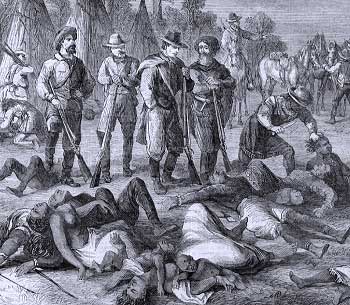
Massacre of Sand Creek, Colorado 1864: Colonel John Chivington, a former Methodist minister and still elder in the church (“I long to be wading in gore”) had a Cheyenne village of about 600, mostly women and children, gunned down despite the chiefsʼ waving with a white flag: 400-500 killed. From an eye-witness account: “There were some thirty or forty squaws collected in a hole for protection; they sent out a little girl about six years old with a white flag on a stick; she had not proceeded but a few steps when she was shot and killed. All the squaws in that hole were afterwards killed.”

In the 1860s in Hawaii “the Reverend Rufus Anderson surveyed the carnage that by then had reduced those islandsʼ native population by 90 percent or more, and he declined to see it as tragedy; the expected total die-off of the Hawaiian population was only natural, this missionary said, somewhat equivalent to ‘the amputation of diseased members of the body,’”

Kelsos, Victims of the Christian Faith

Much of the information for the above was derived from D. Stannard, American Holocaust, Oxford University Press 1992

Christians 0, Christians 0 (The Early Church)

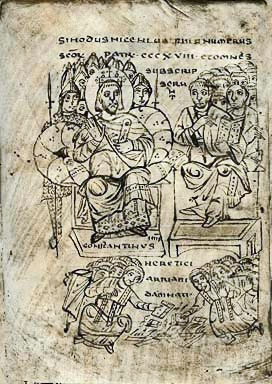
Burning of Arian books at Nicaea

Burning of Arian books at Nicaea (illustration from a compendium of canon law, ca. 825, MS. in the Capitular Library, Vercelli)

Churches were cleft by rivalry and schism in the days of Paul, as well as in the days of Roman persecution. Only after a Christian became Emperor did the Roman government cease persecuting Christians. But this wasnʼt good enough because Christians soon beseeched the government to settle their rivalries via Imperial decrees and coercion.

— E.T.B.


In the century opened by the Peace of the Church, more Christians died for their faith at the hands of fellow Christians than had died before in all the persecutions.

— Ramsay MacMullen, Christianity and Paganism in the Fourth to Eighth Centuries


The grateful applause of the clergy has consecrated the memory of a Christian Emperor who indulged their passions and promoted their interest. Constantine gave them security, wealth, honors, and revenge; and the support of the orthodox faith was considered as the most sacred and important duty of the civil magistrate. The “Edict of Milan,” the great charter of religious toleration, had confirmed to each individual of the Roman world the privilege of choosing and professing his own religion. But this inestimable privilege was soon violated. With the knowledge of “truth” the Emperor imbibed the maxims of persecution; and the sects that dissented from the Catholic church were afflicted and oppressed by the triumph of Christianity.

— Edward Gibbon, The Decline and Fall of the Roman Empire, Chapter 21


The privileges that have been granted in consideration of religion must benefit only the adherents of the Catholic faith. It is Our will moreover, that heretics and schismatics shall not only be alien from these privileges but shall also be bound and subjected to various compulsory public services.

— Letter of Constantine to his Vicar of the Praetorian Prefect, 326 A.D.; as cited in A New Eusebius: Documents Illustrating the History of the Church to AD 337, Ed., J. Stevenson, newly revised by W. H. C. Frend


The First Ecumenical Church Council—Held At Nicea

From the very first the Church was faced with the task of establishing dogmas. For Christianity abounds in problems more hinted at than answered in the New Testament…The first ecumenical church council, the Council of Nicea, assembled in the year 325 in the imperial palace of the first Christian emperor, Constantine. Once the discussions started the participants threw their episcopal dignity to the wind and shouted wildly at each other. They were concerned primarily with improving their positions of power.

[(Concerning such “power”) we must remember that Constantine built some impressive churches and they did not stand alone…They usually stood in a complex of buildings…that included an audience hall in which the bishop presided as judge, an extensive bishopʼs palace, warehouses for supplies for the poor, and, above all, an impressive courtyard, of the sort which stood in front of a noblemanʼs town house…Such building complexes made palpable the emergence of a new style of urban leadership…Christians themselves built countless other churches of more moderate size, that reflected the ability of the local clergy to mobilize local loyalties and to appear to local pride…Bishops and clergy received immunities from taxes and from compulsory public services. In each city, the Christian clergy became the only group that expanded rapidly, at a time when the strain of empire had brought other civic associations to a standstill. Bound by oath to “their” bishop, a whole hierarchy of priests, deacons, and minor clergy formed an ordo in miniature, as subtly graded as any town council, and as tenaciously attached to its privileges. Furthermore, Constantine expected that the bishop would act as exclusive judge and arbiter in cases between Christians, and even between Christians and non-Christians. Normal civil litigation had become prohibitively expensive. As a result, the bishop, already regarded as the God-like judge of sin among believers, rapidly became the ombudsman of an entire community. Besides this, the imperial supplies of food and clothing, granted to the clergy to distribute to the poor, turned the ferociously inward-looking care of fellow-believers for each other, which had characterized the Christian churches of an earlier age, into something like a public welfare system, designed to alleviate, and to control, the urban poor as a whole.

— Peter Brown, The Rise of Western Christendom, 2nd Ed., (Malden, MA: Blackwell Publishing, 2003), p.78]

Thus at the Council of Nicea diplomacy was wielded as a weapon, and intrigues often replaced intelligence. There were so many ignorant bishops that one participant bluntly called the council “a synod of nothing but blockheads.”

[The bishops at the Council of Nicea condemned and forbade kneeling at prayer on Sundays, and also on any day between Easter and Whitsunday.]

— Walter Nigg, The Heretics


The Major Theological Debate That Took Place at the Council of Nicea

At the Council of Nicea a theological debate took place that set the stage for disputations and even riots between Christians in the following centuries. Bishop Athanasius of Alexandria defended his own teaching that Jesus was of the same exact essence (Homoousios) as the Father. Taking the other side of the debate, bishop Eusebius of Nicomedia endorsed the position of a theologian named Arius (who saw himself as defending the position of early church fathers like Origen and Tertullian, who did not speak of Jesus being of the same exact essence as the Father.) As with all theological debates, the council reached a deadlock.

It was at this point that the Emperor Constantine, who had convened the council, stepped in and sided with Athanasius. He argued that everyone present should sign the new creed that stated Jesus was of the same exact essence (Homoousios) as the Father: “Jesus Christ, the Son of God, begotten not made, by the Father as his only Son, of the same essence (Homoousios) with the Father, God of God, Light of Light.”

Constantineʼs desire to deify Jesus was not in the least surprising. It was a natural carry over from his pagan past when he had his father, Constantius, deified. It is thus natural that he would want to see the founder of his new religion put on the same pedestal as well.

Constantine added that whoever agreed to the new creed would be invited to his twentieth anniversary celebration, while those who did not agree would face immediate banishment. As a result, all but seventeen die-hard Arians signed the new creed. One can only speculate how many of the bishops signed due to Constantineʼs threat. We do know that many of the bishops who agreed initially, due to the emperorʼs threat, withdrew their agreements after returning to their own cities. Thus Eusebius, one of the signatories to the new creed, wrote (on behalf of himself and two other bishops) to Constantine upon return to Nicomedia: “We committed an impious act, O Prince, by subscribing to a blasphemy for fear of you.”

Whatever may be the reaction of the bishops who signed the formula unwillingly, the emperor was quick to act. He ordered the banishment of Arius and the burning of his writings. The leading Arian bishops were also deposed.

— “The Arian Controversy” [Online at The Rejection of Pascalʼs Wager]


“If any treatise composed by Arius should be discovered, let it be consigned to the flames, in order that no memorial of him may be by any means left. This therefore I [Constantine] decree, that if any one shall be detected in concealing a book compiled by Arius, and shall not instantly bring it forward and burn it, the penalty for this offence shall be death; for immediately after conviction the criminal shall suffer capital punishment.”

— Letter of Constantine To the Bishops and People, c. 333 A.D. in which he proscribed the works of Arius [a Christian] and in which he also proscribed the works of the pagan scholar Porphyry [who questioned Christianity], as cited in A New Eusebius: Documents Illustrating the History of the Church to AD 337, Ed., J. Stevenson, newly revised by W. H. C. Frend


The Trouble With Scripture

Both Arius and Athanasius thought the Scriptures could settle their disagreement. The Arians quoted a text from Proverbs to support their view:

The Lord created me at the beginning of his work, the first of his acts of old.

—Proverbs 8:22

To the modern scholar, the “me” refers to a pre-Christian notion of Godʼs Wisdom, but to the Arians and Athanasians alike, many Old Testamentʼs verses were interpreted as being about Jesus, and this passage, they agreed, referred to Jesus. The difference came in their interpretation of its meaning. The Arians claimed that the passage proved Jesus was created by God. But the Athanasians argued that the word “create” did not mean “coming into being.” To them the passage referred to the creation of all mankind through the resurrection of Jesus.

Another passage the Arians quoted was from the gospel of Luke, which referred to the growth of Jesus:

And Jesus increased in wisdom and stature, and in favor with God and man.

—Luke 2:52

The Arians argued, God obviously could not have “increased in wisdom and stature” for he is a perfect being. Jesus, because he could increase in wisdom and stature, could not be God. The Athanasians countered by saying that the Scriptures contain a “double account” of Jesus Christ. Some passages refer to Jesus as man, and others refer to him as God. The passage from Luke refers to the part of Jesus that is a man; so said the Athanasians.

— Wilken, The Myth of Christian Beginnings, p. 90-93


As is now widely recognized, the Scriptures and their interpretations… were the source of the “Arian controversy.”

As Robert C Gregg and Dennis E. Groh have observed, “It has been easy to overlook the degree to which appeal to the Scriptures was fundamental for Arius,” and, it might be added, the later Arians. R. P. C. Hanson in particular has said in The Search for the Christian Doctrine of God, “When arguing about the career and character of Jesus Christ himself depicted in the Gospels,” the Arians “are usually on much firmer footing than their [‘orthodox’] opponents,” in fact, “both Athanasius and Hilary are driven to take refuge in the most unconvincing arguments.” Ambroseʼs [‘orthodox’] interpretations are also, in general, “fantastic nonsense woven into purely delusive harmony.” The Arian exegesis of the first three Gospels is “confident” and “embarrassing” to their [Athanasian] opponents who treat the crucial verses in those Gospels in “uncertain” and “strained” ways. Maximinus even told the church father, Augustine, “The divine Scripture does not fare badly in our [Arian] teaching, such that it has to receive correction [Latin, ‘emendationem’] from us.”

— Kevin Madigan, “Christus Nesciens? Was Christ Ignorant of the Day of Judgment? Arian and Orthodox Interpretation of Mark 13:32 in the Ancient Latin West,” Harvard Theological Review, Vol. 96, no. 3 (2003)


“Arianism” Used To Be Just As Popular as the Doctrine that Jesus is Fully God

Arianism, which orthodox Christians now consider the archetypal heresy, was once at least as popular as the doctrine that Jesus is God… Ordinary trades people and workers felt perfectly competent—perhaps even driven—to debate abstract theological issues and to arrive at their own conclusions… Disputes among Christians, specifically arguments about the relationship of Jesus Christ the Son to God the Father, had become… intense. [p.7]

[Throughout the city everything is taken up by theological discussion: the alleyways, the marketplaces, the broad avenues and city streets; the hawkers of clothing, the moneychangers, foodsellers. If you ask for change, they philosophize about the Begotten and the Unbegotten. If you ask the price of bread, you are told, “The Father is greater and the Son inferior” If you ask, is the bath ready yet? They say “The Son was created from nothing.”
— Gregory of Nyssa, Constantinople, 381 C.E.]

The anti-Arians… demanded that Christianity be “updated” by blurring or even obliterating the long-accepted distinction between the Father and the Son. From the perspective of our time it may seem strange to think of Arian “heretics” as conservatives, but emphasizing Jesusʼs humanity and Godʼs transcendent otherness had never seemed heretical in the [eastern half of the Roman Empire]. [p.74]

The Great Council of Nicaea… was the largest gathering of Christian leaders, up to that time with 250+ bishops in attendance, almost all of them from the Eastern Empire… To some extent, this Eastern predominance can be attributed to the westernerʼs lack of interest in the Arian controversy, which still seemed to them an obscure “Greek” matter.

[The controversy over Arianism was most virulent in Greek-speaking areas, where the language lent itself to fine distinctions, and the involvement of the emperors, whose aims were usually social unity rather than theological truth, complicated matters. Often the churchmen who prevailed were those who had the emperorʼs ear. It is only with hindsight that bishops can be readily assigned to one or the other camp in the controversy: there were many gradations within the “Arianizing” outlook.—Desmond OʼGrady, Beyond the Empire: Rome and the Church from Constantine to Charlemagne (New York: Crossroad Publishing Company, 2001), p.16]

The Council of Nicaea, then, was not universal. [There were in fact over 1800 bishops in the Christian church and only 250-300 of them attended the Council of Nicea]…Several later gatherings would be more representative of the entire Church; one of them, the joint council of Rumini-Seluicie (359), was attended by more than five hundred bishops from both the East and West. If any meeting deserves the title “ecumenical,” that one seems to qualify, but its results…the adoption of an Arian creed—was later repudiated by the Church. Councils whose products were later deemed unorthodox not only lost the “ecumenical” label but virtually disappeared from official Church history. [p.74]

[After the Council of Nicaea, Constantine exiled Arian theologians.] But within three years, Arius, Eusebius, and their fellow exiles would be forgiven by Constantine and welcomed back to the Church. Eusebius would become Constantineʼs closest advisor, and would insist that Athanasius, now bishop of Alexandria, readmit Arius to communion in that city as well. A decade after that, Bishop Athanasius himself was exiled, and Arianism was well on its way to becoming the dominant theology of the Eastern Empire. [p.84]

The Council of Nicaea was the last point at which Christians with strongly opposed theological views acted civilly toward each other. When the controversy began, Arius and his opponents were inclined to treat each other as fellow Christians with mistaken ideas. Constantine hoped that his Great and Holy Council would bring the opposing sides together on the basis of a mutual recognition and correction of erroneous ideas. When these hopes were shattered and the conflict continued to spread, the adversaries were drawn to attack each other not as colleagues in error but as unrepentant sinners: corrupt, malicious, even satanic individuals. [p.84-85]

Athanasiusʼs ambition was endless; and he was very much at home in the “real” world of power relations and political skullduggery…Athanasius would soon be recognized as the anti-Ariansʼ champion. But first, he had to become bishop of Alexandria. [p.104-105]

Athanasius sent gangs of thuggish supporters into the Melitian Christian district, where they beat and wounded supporters of the Melitian leader, John Arcaph, and, according to Arcaph, burned churches, destroyed church property, imprisoned and even murdered dissident priests. [p.106]

Constantine ordered a council of bishops to meet in Tyre [concerning charges leveled against Athanasius]…Athanasius reacted with desperation…He had his agents terrorize those who might have provided evidence against him and prevented them from leaving the country…The pro-Athanasius bishops who attended the council at Tyre behaved so disruptively that the council later cited their activities as proof of Athanasiusʼs unfitness for office…The debate at the council was stormy, with many witnesses contradicting each otherʼs stories, and much name calling…After weeks of squabbling the bishops decided to send a commission to the region to interview witnesses there and the decide the truth of various accusations…The investigative commission left for Egypt… accompanied by a company of imperial troops… For the next two months Egypt was in an uproar. The Athanasians charged that the commission was obtaining evidence by means of threats and torture. The commissioners charged that Athanasiusʼs supporters were intimidating and kidnapping witnesses. By the end of the investigation it was clear that the commissionʼs report would indict Athanasius, who fled the city by night…The Bishops in Tyre condemned Athanasius for specific acts of violence and disobedience. [p.123-125]

When Constantine convened the Great Council of Nicea, he could not have imagined that the bishops would be meeting almost every year to rule on charges of criminal activity and heresy. Partisan control of these gatherings virtually guaranteed that condemned churchmen would attempt to rehabilitate themselves and punish their enemies by denying the authority of “illegitimate” councils and convening new ones. The emperor probably considered this a temporary problem. Surely, after blatant troublemakers and fanatics like Bishops Athanasius and Marcellus were removed from office, reasonable churchmen could learn to live together despite occasional differences of opinion! But this was to repeat the original mistake made at Nicea. It was to assume that doctrinal differences among Christians were not that important, that they did not reflect serious divisions of class, culture, and moral values within the community, and that they could be resolved by discovering the correct form of words. [p.133]

[More and more Christians started disavowing the “Nicene creed,” and Arianism experienced a resurgence. By the year 329 Arianism had such widespread support that Constantine became persuaded that his earlier decision was a mistaken one. In 336, the former exile, Arius, on the eve of being readmitted to membership in the church at Alexandria, was found dead on the floor beside a toilet. Poisoning is one possibility to account for the timing and manner of his passing.] However, Athanasius used Ariusʼs death as a public relations opportunity. He announced that the cityʼs prayers had been answered and “the Arian heresy was unworthy of communion with the Church.” Most telling is the language Athanasius used in describing the manner of Ariusʼs death: “Arius… urged by the necessities of nature, withdrew, and in the language of Scripture, ‘fell headlong, and burst asunder in the midst,’ being deprived of both communion and his life together.” [The Biblical reference Athanasius employed was to Judasʼs death, the apostle who betrayed Jesus, Acts 1:18] [p.137]

[Even after Ariusʼs death, Arianism remained, for there remained other more influential Christian leaders who dominated the movement.] Moreover, another death was of greater consequence than Ariusʼs. The death in question was Emperor Constantineʼs…Eusebius [an Arian Bishop] heard the Emperorʼs confession, and administered the last rites…and a decree was made that permitted all exiled bishops to return to their sees…

Athanasius [who was in exile at that time] returned to Alexandria after making a political tour of several provinces. Everywhere he rallied the anti-Arian forces and helped return exiles to power, organized opposition to “heretical” bishops, and intervened actively in local disputes. Violence dogged his steps, since both sides had organized popular support and were quite ready to use angry mobs to expel churchmen they despised or defend friendly incumbents. The result in a number of key cities was something close to civil war…Finally, Athanasius returned to Alexandria where, according to his enemies, ‘he seized the churches…by force, by murder, by war.’” [p.141-142]

Soon afterwards a large council of bishops met in Antioch [in 338] to declare that Athanasius had committed new atrocities…The leaders of the church met again in Antioch in the winter of 338-339. With the new Emperor, Constantineʼs son, Constantius [who openly embraced Arianism] in attendance, they convicted Athanasius of violence and mayhem, and ordered him deposed…Warned by his agents, Athanasius fled, and rioting and arson (which had also accompanied his return) erupted across the city… The Church of Dionysius was burned, a number of people on both sides were injured and killed, and fighting even broke out on Easter Sunday in the Church of Quirinius. Several weeks later, the mobs supporting Athanasius had been suppressed, at least for the time being.

What really happened in Alexandria during this stormy month? Athanasius in a letter charged that “Arian madmen” incited pagans, Jews, and “disorderly persons” to attack the faithful, set churches on fire, strip and rape holy virgins, murder monks, desecrate holy places, and plunder the churchesʼ treasures. He presents pictures designed to horrify and madden his readers: Jews, for example, are presented as cavorting naked in the churchesʼ baptismal waters. And, of course, he says nothing about any violence that his own supporters may have offered in his defense or in opposition to the installation of the new bishop.

Athanasius had always had a following in Alexandria, but Arius was also an Alexandrian with his share of supporters…The truth seems to be that in Alexandria and many other cities large groups of militant fighters could be mobilized by both sides, and that both sides made frequent use of them in the confused period following Constantineʼs death… What is most striking is the closeness and bitterness of the conflict in important cities like Constantinople, Antioch, Ancyra, Caesarea, Tyre, and Gaza. [p.143-144]

[Probably more Christians were slaughtered by Christians in two years [A.D. 342-343, during the Arian controversy] than by all the persecutions of Christians under the Romans during the previous three hundred years.

— Will Durant, The Story of Civilization, Vol. 4, The Age of Faith]

But what caused this deep division?…The split between Nicene and Arian Christians seems to reflect a rough division between those more in need of a powerful, just ruler and those more in need of a loving advocate and friend. Neither side in the controversy could afford to turn its back entirely on either image: the Athanasians therefore called Jesus “God from God.” And the Arians called him “a paradigm and an example.” Each side put its primary emphasis on one image while paying lip service to the other, and each side was prey to fears that the other side was aiming to obliterate “its” Jesus. While Athanasians denounced the Arians for lowering Christ to the point that his majesty and saving power would be lost, the Arians accused Athanasius and Marcellus of raising him to the point that his love (and Godʼs majesty) would be lost…

The violence in the Eastern cities ended for the time being with the forcible eviction of major anti-Arian bishops and their exile to the Western half of the Roman Empire. Many were arriving in Rome, where Athanasius had already fled. But the uncalculated efforts of these deportations would be to make the Pope of Rome a major participant in the controversy, to embroil the Western bishops, and, finally, to dive a wedge between the Christian churches of the Greek East and the Latin West [which latter would excommunicate each other]. [p.146-147]

[The Arians split into three factions: the Anomeans, the extreme party which stressed the difference between Father and Son; the Homoeans, which simply affirms that the Son is similar to the Father “in accordance with the scriptures”; and the Semi-Arians which favored the term homoiousion (Greek for “of like substance”) as expressing both the similarities and the differences between Father and Son. In 359 two simultaneous councils were held; one for the eastern bishops (in Seleucia) and one for the western bishops (in Ariminum). Both councils adopted the Homoean formula. However, this victory for Arianism frightened the Semi-Arians back into the ranks of the Athanasian fold. The death of Constantius in 361 also deprived the Arians of political support and they began to lose ground to the Athanasians.

— Livingstone, Dictionary of the Christian Church, p.33.]

[It was at this time, 361 A.D., that the Emperor Julian “the Apostate,” though raised a Christian, came to power and declared himself a pagan.] He reflected the common peopleʼs distaste for the scandalous disunity of the Church. Christianity had conspicuously failed to bring the empire together or to secure it from enemy attack. As the contemporary historian Ammianus said, “no wild beasts are such enemies to mankind as are most Christians in their deadly hatred of one another.” He deprived the Christian clergy of the special privileges [and tax exemptions] bestowed on them by his predecessors, and also took steps to re-inflame the Arian controversy by permitting Athanasius and other anti-Arians to return from exile. Violence between competing Christian groups broke out almost immediately…Bishop George of the city of Alexandria was murdered [along with several of his fellows]…by a mixed mob of pagans and anti-Arian Christians. The Bishopʼs body paraded through the streets on the back of a camel and burned. [p.195] Back around 150 A.D., Christians in Alexandria, inspired by anti-Jewish preaching, had rioted against the Jewish community. Two hundred years later those who called Jesus “Lord” were battling each other in the streets…and lynching bishops. By the time bishop George of Alexandria met his grisly death, religious riots had become commonplace throughout the region. [p.6]

[In 363, after reigning a mere three years, Julian “the Apostate” was killed in battle, after which Christian Emperors were once again the rule, one of the most intolerant of whom was Emperor Theodosius] Theodosius banned Arianism and officially declared Christianity the religion of the Roman Empire. [p.226]

In his edict of 378, Theodosius issued an order compelling all people under his rule to embrace the Catholic faith. (Codex Theodosianus XVI, I, 2) Any doctrines deviating from the Churchʼs teachings were declared criminal, those responsible for such doctrines deserving punishment.

— Gustav Mensching, Tolerance and Truth in Religion, trans., Hans-J. Klimkeit (Alabama: The University of Alabama Press, 1971), p.44.

And in 380 A.D. a decree from Theodosius read: “We shall believe in the Holy Trinity. We command that those persons who follow this rule shall embrace the name of Catholic Christians. The rest, however, whom We adjudge demented and insane, shall sustain the infamy of heretical dogmas, their meeting places shall not receive the name of churches, and they shall be smitten first by divine vengeance and secondly by the retribution of Our own initiative, which We shall assume in accordance with the divine judgment.”

— J. N. Hillgarth, The Conversion of Western Europe

Since Arianism was now identified with the “barbarians” who were its main advocates, the remaining Arians within the empire, now split into small, powerless sects, were also fair game for Christian avengers. And the struggle to uproot paganism, conducted sporadically ever since the days of Constantine the Great, now resumed in earnest.

Was the Arian controversy resolved?…Unresolved issues, appearing in changed form, continued to produce serious religious conflicts…that ended in the Great Schism separating the Roman Catholic and Orthodox churches. [p.226-227]

In the Greek-speaking lands, the end of the Arian controversy triggered more than two centuries of intense conflict [over the question of the relationship between Jesusʼs human and divine natures]. Once again, bishops met in councils to proclaim the orthodoxy of their views and to excommunicate their opponents. Once more the East knew depositions and exiles, riots and assassinations. Each side accused the other of Arianism. The Second Council of Ephesus (449) condemned the school of Antioch; the Great Council of Chalcedon (541) condemned the Alexandrians; numerous emperors intervened on one side or the other; and the controversy did not end until the one-nature “Monophysites” were driven from their own churches, many of which exist to this day.

— Richard E. Rubenstein, When Jesus Became God: The Epic Fight over Christʼs Divinity in the Last Days of Rome


It was only later agreed, by the victorious “Nicene” party, that Athanasius had been the hero of a Christian orthodoxy laid down once and for all at Nicea. But the story of Athanasius and of his defense of the “Nicene Creed” gained in the telling. It did so especially in the Latin West. By the end of the fourth century, the “Arian Controversy” was narrated in studiously confrontational terms: it was asserted that “orthodox” bishops had defeated “heretics;” and, in so doing they had offered heroic resistance to the cajolery and, at times, to the threats, of “heretical” emperors. This view of the “Arian Controversy” was constructed after the event. It contains little truth.

— Peter Brown, The Rise of Western Christendom, 2nd Ed., (Malden, MA: Blackwell Publishing, 2003), p.80

Both sides of the Arian-Athanasian controversy apparently made changes to Scripture to help cement their view of the truth. See The Orthodox Corruption of Scripture: The Effect of Early Christological Controversies on the Text of the New Testament by Bart D. Ehrman (New York: Oxford University Press, 1993).

For more on the development of Christian doctrine see, The Making of Christian Doctrine, (Cambridge, 1967); The Remaking of Christian Doctrine (London, 1974); Working Papers in Doctrine (London 1976) by Maurice Wiles.


The Donatist Controversy

Donatists throughout North Africa vied with Catholics to be the major denomination… The Donatist schism had lasted almost a century, splitting the church and society and dividing families. Augustine himself had Donatist relatives. The movement, named after a bishop Donatus, had arisen out of a refusal to recognize a bishop of Carthage (Cecilian) because one of those who consecrated him had allegedly compromised his faith during Diocletianʼs persecution by offering homage [to a pagan Roman Emperor]. Eighty bishops had appealed to Emperor Constantine, who referred the matter to the church of Rome. It rejected the appeal on the grounds that a sacramentʼs validity did not depend on the celebrantʼs worthiness. But the Donatists retained a strong following for mixed religious and social motives: they claimed to be a continuation of the church of the martyrs uncompromised with the empire. The Donatists were particularly strong among the rural underprivileged, and the Berbers who did not welcome Roman suzerainty.

They considered themselves the Church of the Perfect and the Pure, who had preserved ritual purity and the Law in its entirety. Arrogantly they asked whether Catholics wanted to become Christians. One of their bishops claimed that the Donatist Church was the Ark of Noah “well tarred inside and out to keep within itself the good water of baptism and repel the world-defiling waters.” [p.72]…

North African ecclesiastical struggles were fierce: during the Donatist crisis, there was physical violence on both sides. Donatists not only whitewashed Catholic churches to purify them but killed some Catholic priests and blinded many more, using quicklime and vinegar… Squads of Donatist thugs aimed to kill a Catholic for Christ and then be killed in turn to attain martyrdom. For religious motives, they did not use swords, but had no compunction about wielding clubs or other weapons.

In 398 the most influential Donatist bishop made the fatal mistake of aligning himself with a usurper who was defeated. The religious rebels could now be considered also as traitors. From Ravenna in 405, the Catholic emperor, Honorius, issued a decree against Donatists as heretics, but was probably concerned principally, about the social disorder they fomented… Subsequent anti-Donatist rulings were extremely strict. Initially, the law decreed that the Donatist Church be disbanded: it was deprived of its bishops, its churches, and its funds while its membersʼ civic rights were restricted. Outside the city the law was not applied immediately, but laity who did not become Catholic were liable to fines. Like other North African Catholic bishops, Augustine, who hated violence, was uneasy about these measures at first but when he found coercion brought genuine conversions he justified it, adducing the biblical wedding parallel in which people were compelled to come to the banquet. He claimed that “correction” could aid the will to make a choice… He ruled out torture but, using the model of a father of a family and mindful that his hated schooldays had produced benefits later, he argued that “the rod has its own kind of charity.” [p.74]…

Augustine was endorsing coercion of those at least as numerous as Catholics who had set altar against altar, claiming to be the authentic church. Donatists were… co-religionists, not followers of other religions… Donatists and others objected that it was contrary to Christianity to impose conversion. Augustine reminded them of their violence and that they themselves had appealed to civic authorities first as well as coercing those who had broken away from Donatism. [p.75]

— Desmond OʼGrady, Beyond the Empire: Rome and the Church from Constantine to Charlemagne (New York: Crossroad Publishing Company, 2001)


The Donatist Controversy (Continued)

[Various controversial issues within Christianity] led to a schism between Donatist Christians and mainstream Christians of North Africa. Saint Augustine advocated violent suppression of the Donatists [since they wanted to “secede from the union” so to speak, to form their own “true and pure” churches]. Thus he justified massacres in the name of Christian unity. Armed [Donatist] groups, called the Circumcellions, formed to defend the “pure” [Donatist] churches, and perpetrated acts of terrorism in their name, and some committed mass suicide rather than yield to the forces [of the Christian Roman Emperors] whom they identified as “Antichrist.” The virtual civil war among North African Christians would not end until the fifth century, when invading Vandals suppressed all the churches, Donatist and orthodox alike. [p.39]

— Richard E. Rubenstein, When Jesus Became God: The Epic Fight over Christʼs Divinity in the Last Days of Rome


Increasing Persecution of Donatists

Constantine had tried persecution of the Donatists, but the sect continued to flourish and he abandoned the effort. In 398 Honorius repealed the legislation (from the short-lived pagan Emperor Julian) allowing Donatists the right of assembly, excluded them from testamentary rights, and imposed fines on them. (Clyde Pharr, trans. and ed., The Theodosian Code and Novels [Princeton Univ. Press, 1952], Book XVI, Title VI, p.464.) Augustine approved of this.

In 430 Honorius passed the death sentence on Donatists for their “criminal audacity in meeting in public.” In 413 he and Theodosius: “Anyone who baptizes someone the second time [as the Donatists were doing, baptizing people into the Donatist Christian church], he together with him who induced him to do this shall be condemned to death.” (Samuel Scott, trans. and ed. The Civil Code [Cincinnati: Central Trust, 1932], XII, 72.)

Finally in 514 Honorius threatened with death all those who dared celebrate the Donatist religious rites.

— William K. Boyd, The Ecclesiastical Edicts of the Theodosian Code [“Studies in History, Economics, and Public Law,” edited by the political science faculty of Columbia University, Vol. XXIV, Nr. 2 (New York, 1905)], p.55.


Saint Augustine on How To Treat the Donatists

“It is indeed better (as no one ever could deny) that men should be led to worship God by teaching, than that they should be driven to it by fear of punishment or pain; but it does not follow that because the former course produces the better men, therefore those who do not yield to it should be neglected. For many have found advantage (as we have proved, and are daily proving by actual experiment), in being first compelled by fear or pain, so that they might afterwards be influenced by teaching, or might follow out in act what they had already learned in word.”

—Saint Augustine, Treatise on the Correction of the Donatists

“The wounds of a friend are better than the kisses of an enemy. To love with sternness is better than to deceive with gentleness…In Luke [14:23] it is written: “Compel people to come in!” By threats of the wrath of God, the Father draws souls to his Son.”

—Saint Augustine

[Setting forth the principle of Cognite Intrare (“Compel them to enter”), a church mandate that all must become orthodox Catholic Christians, by force if necessary. Cognite Intrare would be used throughout the Middle Ages to justify the Churchʼs suppression of dissent. Walter Nigg, The Heretics: Heresy Through the Ages (1962), p.138, quoted from Helen Ellerbe, The Dark Side of Christian History, critical editing by Cliff Walker.]


Augustine was at his most disagreeably impatient when faced by groups whom he saw as self-regarding enclaves, deaf to the universal message of the Catholic Church. He insensibly presented the Church not only as the true Church, but as potentially the Church of the majority of the inhabitants of the Roman world. He was the first Christian that we know of to think consistently and in a practical manner in terms of making everyone a Christian. This was very different from claiming, as previous Christians had done, that Christianity was a universal religion in the sense that anyone in any place could, in theory at least, become a Christian. Augustine spoke of Christianity in more concrete, social terms: there was no reason why everybody in a given society (the Jews excepted) should not be a Christian. In his old age, he took for granted that the city of Hippo was, in effect, a Christian city. He saw no reason why the normal pressures by which any late Roman local community enforced conformity on its members should not be brought to bear against schismatics and heretics. He justified imperial laws that decreed the closing of temples and the exile and disendowment of rival churches [Donatist and other churches]. Pagans were told simply to “wake up” to the fact that they were a minority. They should lose no time in joining the Great Majority of the Catholic Church. In fact, the entire world had been declared, more than a millennium before by the prophets of Israel, to belong only to Christ and to his Church, and Augustine quoted the second Psalm as proof: “Ask of me, and I shall give thee the heathen for thine inheritance, and the uttermost parts of the earth for thy possession. Thou shalt break them with a rod of iron.” [Psalm 2:6,8,9,12].

[Of course not everyone was swayed by Augustineʼs arguments.] We have a recently discovered letter that Augustine wrote at the end of his life to Firmus, a notable of Carthage. Firmus had attended afternoon readings of Augustineʼs City of God. He had even read as far as book 10. He knew his Christian literature better than did his wife. Yet his wife was baptized, and Firmus was not. Augustine informed him that, compared with her, Firmus, for all his culture, even his sympathy for Christianity, stood on dangerous ground as long as he remained unbaptized.

— Peter Brown, The Rise of Western Christendom, 2nd Ed., (Malden, MA: Blackwell Publishing, 2003), p.91, 92


After Donatist Christians were persecuted by anti-Donatist Christians of the Empire, leaving their fertile province pillaged with fire and sword, the Donatists welcomed the Vandal invaders of their province with joy, and North Africa was lost to Rome.

Disputes of the third and fourth general Christian councils alienated Egyptian Christians from the Christians of Asia Minor and Constantinople. The Emperor Justinian enacted measures to win back the Egyptians to orthodoxy. But that only infuriated them more, and, when the Arabs invaded Egypt the Egyptians received them as deliverers, and fell in fury on their Greek defenders, and drove them into the sea. One Egyptian Christian said to Amrou, the Saracen general, “With the Greeks I desire no communion, either in this world or the next, and I adjure forever the Byzantine tyrant, and his Christian synod of Chalcedon.”

Nestorian Christians were forced from the Empire, and went into Asia, establishing what became for a while the largest church in Christendom. “Under the rod of persecution, Nestorian and Monophysite Christians degenerated into rebels and fugitives; and the most ancient and useful allies of Rome were taught to consider the emperor not as the chief, but as the enemy of Christians.” (Gibbon, The Decline and Fall of The Roman Empire)

Differences of opinion regarding the date of Easter grew in intensity over time, and constituted a factor in bringing about the separation of the churches of Rome (Catholic) and Constantinople (Orthodox) that exists today.

Ebionite Christians and Gnostic Christians were treated poorly, although Ebionites were in all likelihood adherents of primitive Christianity, and the Gnostics were the “Christian humanists” of their day.

The hatred between Christian groups was extraordinary. In the middle of the fifth century they disputed whether the words, “who was crucified for us” should be added to the Trisagion (the “Holy, holy, holy” song sung eternally in heaven according to Isaiah and the book of Revelation). Over this dispute, the city of Constantinople suffered a series of riots … and many … Christians on the wrong side of the argument were slain.

— Madalyn Murray OʼHair, “Gibbon, the Historian, and Christianity,” An Atheist Speaks


At the church council held at Ephesus in 449 the discussion became so inflamed that the delegates went at one another with clubs, until one party held the field and could enforce the decree it desired. Fanatical bands of monks terrorized the assembly of Church notables. Envoys from the church at Rome were set upon and soundly thumped. Leo the Great called it “The Robber Council,” nor was this the only one of its kind. There were other councils at which the Church Fathers became so incensed that they hurled the Bible at each otherʼs heads.

— Walter Nigg, The Heretics


After one “election meeting” in a church, in October 366, the “ushers” picked up from the floor one hundred and sixty Christian corpses! It is sheer affectation of modern Roman Catholic writers to question this, as we learn it from a report to the emperor of two priests of the time. The riots of the Christians that filled the streets of Rome with blood for a week, are, in fact, ironically recorded by the contemporary Roman writer, Ammianus Marcellinus.

In one day the Christians murdered more of their brethren than the pagans can be positively proved to have martyred in three centuries, and the total number of the slain during the fight for the papal chair (in which the supporters of Pope Damasus literally cut his way, with swords and axes, to the papal chair through the supporters of the rival candidate Ursicinus) is probably as great as the total number of actual martyrs. If we add to these the number of the slain in the fights of the Arians and Athanasians in the east and the fights of Catholics and Donatists in Africa, we get a sum of “martyrs” many times as large as the genuine victims of Roman law; and we should still have to add the massacre by Theodosius at Thessalonica, the massacre of a regiment of Arian soldiers, the lives sacrificed under Constantius, Valentinian, etc.

This frightful and sordid temper of the new Christendom is luridly exhibited in the murder of Hypatia of Alexandria in 415. Under the “great” Father of the Church, Cyril of Alexandria, a Christian mob, led by a minor cleric of the church, stripped Hypatia naked and gashed her with oyster shells until she died [though I have read that she was clubbed to death before her flesh was stripped off her bones—E.T.B.]. She was a teacher of mathematics and philosophy, a person of the highest ideals and character. This barbaric fury raged from Rome to Alexandria and Antioch, and degraded the cities with spectacles that paganism had never witnessed.

Salvianus, a priest of Marseilles of the fifth century, deplores the vanished virtue of the pagan world and declares that “The whole body of Christians is a sink of iniquity.” “Very few,” he says, “avoid evil.” He challenges his readers: “How many in the Church will you find that are not drunkards or adulterers, or fornicators, or gamblers, or robbers, or murderers—or all together?” (De Gubernatione Dei, III, 9) Gregory of Tours, in the next century, gives, incredible as it may seem, an even darker picture of the Christian world, over part of which he presides. You cannot read these truths, unless you can read bad Latin, because they are never translated. It is the flowers, the rare examples of virtue, the untruths of Eusebius and the Martyrologies, that are translated. It is the legends of St. Agnes and St. Catherine, the heroic fictions of St. Lawrence and St. Sebastian that you read. But there were ten vices for every virtue, ten lies for every truth, a hundred murders for every genuine martyrdom.

— Joseph McCabe, How Christianity Triumphed