
The Famous “Burgh - Spinoza” Exchange (Almost As If Spinoza Was Speaking to Present Day Christian Apologists

Spinoza - World's Great Letters

Below are a pair of letters exchanged between the philosopher Baruch Spinoza and a young friend who had converted to an evangelical form of Catholicism (so evangelical that the young man almost sounds like a modern day Evangelical Christian, especially at the end of one paragraph in which he tells Spinoza, “Give in, turn away from your errors and your sins; put on humility and be born again,” or in another place when he compares the evidence for the truth of his beliefs with the evidence that “Julius Caesar lived,” or when he writes of the “wretched and restless life of Atheists”).

Their exchange — on the topic of Christianity versus Spinozaʼs philosophy — parallels todayʼs feisty (at times fiery) debates on the internet (and in places makes one chuckle at the young manʼs endorsement of a few supernatural tales no longer heard these days, such as “the restoration of plants and flowers in a glass phial after they have been burnt; Sirens; pygmies very frequently showing themselves, according to report, in mines.” (I mean who can explain that last one? Perhaps the translator messed up and should have used the word “dwarf” — as in the dwarfs who lived in mountains per “Lord of the Rings” — instead of “pygmies?”) Goethe, the famed German poet and natural philosopher, declared that Spinozaʼs correspondence with his friends and disciples was “the most interesting book one could read in the world of uprightness and humanity.” But first… a little background before presenting Burghʼs letter and Spinozaʼs reply.

Born in 1632, Spinoza lived most of his life at The Hague, earning a bare subsistence as a lens grinder, yet his works influenced Descartes, Leibnitz, Hobbes and many among others (even Einstein compared his “God” to Spinozaʼs ideas of God). Spinoza helped give birth to modern biblical criticism and to the idea of separation of church and state. He was also focused on philosophy so much that neither wealth, fame, nor even marriage, could tear him away, much like some ancient Greek philosophers.

When a prince, the Elector of Palatine, offered Spinoza a professorship in philosophy at the University of Heidelberg and thus promised him freedom from financial cares, Spinoza, unwilling to make any promise to refrain from “disturbing the publicly established religion,” graciously but firmly refused. When Louis XIV of France offered him a pension, in return for the dedication of his next book, he again refused. Obstinately, but quietly, serenely, even graciously and elegantly, Spinoza rejected the advice of “worldlings and careerists” and spurned “the spurious immortality of popular acclamation.” The easy security of a comfortable post offered by His Electoral Highness or His Imperial Majesty could not lure him. The truth Spinoza sought would be found only in solitude — and besides he needed every year, every day, every precious hour to finish his Ethics, undistracted by fame, free from royal favor.

Spinozaʼs integrity met the supreme test when he was cast out from the Jewish religion and reviled by the synagogue of his forefathers for heresies springing from his thirst for truth. His denial of immortality won him the hatred alike of Jews and Christians.

The only books published by Spinoza in his lifetime were The Principles of Cartesian Philosophy (1663) and Tractatus Theologico-Politicus: A Critical Inquiry Into the History, Purpose, and Authenticity of the Hebrew Scriptures, which appeared anonymously in 1670. This was promptly honored with a place in the Index Expurgatorius — a list of books banned by the Catholic Church; it dates back to 1559 and was prompted not so much by the occult but by the rise of Protestantism.

Spinoza had many friends among the influential governing classes at The Hague. Among them was Conrad Burgh, one of the wealthiest citizens of Amsterdam, who in 1666 (the “666” being merely a coincidence) held office as Treasurer General of the United Netherlands. His son, Albert Burgh, was a pupil of Spinoza. Young Burgh continued his study of philosophy in Italy, and finally turned to the Catholic faith with fanatical zeal. Burghʼs family was disturbed by this and persuaded Spinoza to write to Albert.

When Spinozaʼs books were banned by the civic authorities, many of his friends and disciples carried on the resulting theological controversy both in person and by correspondence. Spinoza received many letters “intended to reform him.” Typical of them was the one he recʼd from young Albert Burgh, his old friend and former pupil — a letter some students of church history believe was officially prompted or at least encouraged by the ecclesiastical authorities of the time.

Young Albert Burgh To Spinoza:

“…You Wretched Little Man, Vile Worm Of The Earth, Ay, Ashes, Food For Worms…”

To The Very Learned and Acute Baruch Spinoza:
Many Greetings.
When Leaving my country, I promised to write to you if anything noteworthy occurred during my journey. Since, now, an occasion has presented itself, an one, indeed, of the greatest importance, I discharge my debt, and write to inform you that, through the infinite Mercy of God, I have been restored to the Catholic Church, and have been made a member thereof [later Burgh even entered the Franciscan Order—E.T.B.]. You may learn the particulars of the step from a letter which I have sent to the distinguished and accomplished Professor Craanen of Leyden. I will therefore, now only add a few remarks for your special benefit.

The more I formerly admired you for your penetration and acuteness of mind, the more do I now weep for you and deplore you; for although you are a very talented man, and have received a mind adorned by God with brilliant gifts, and are a lover of truth, indeed eager for it, yet you suffer yourself to be led astray and deceived by the wretched and most haughty Prince of evil Spirits. For, all your philosophy, what is it but a mere illusion and a Chimera? Yet you stake on it not only your peace of mind in this life, but also the eternal salvation of your soul. See on what a miserable foundation all your interests rest.

You assume that you have discovered the true philosophy. How do you know that your philosophy is the best of all that ever have been taught in the world, are now being taught, or ever shall be taught? Passing over what may be devised in the future, have you examined all the philosophies, ancient as well as modern, that are taught here, and in India, and everywhere throughout the whole world?

Even if you have duly examined them, how do you know that you have chosen the best? You will say: “My philosophy is in harmony with right reason; other philosophies are not.” But all other philosophers except your own followers disagree with you, and with equal right say of their philosophy what you say of yours, accusing you, as you do them, of falsity and error. It is clear therefore, that before the truth of your philosophy can be made manifest you must put forth arguments not common to other philosophies, but which can be applied to yours alone. Otherwise you must admit that your philosophy is as uncertain and as worthless as the rest.

However, restricting myself to that book of yours with an impious title (Tractatus Theologico-Politicus) and taking your philosophy together with your theology, for you yourself blend them altogether with diabolic cunning, you pretend to show that each is separate from the other, and that they have different principles, I proceed thus—

Perhaps you will say: “Others have not read Holy Scripture so often as I have; and it is from Holy Scripture, the acknowledgment of which distinguishes Christians from the rest of the world, that I prove my doctrines.” But how? “By comparing the clear passages with the more obscure I explain Holy Scripture, and out of my interpretations frame dogmas, or else confirm those that are already produced in my brain.”

But I adjure you seriously to consider what you say. How do you know that you have correctly applied your method, or again, that your method is sufficient for the interpretation of Holy Scripture, and that you are thus interpreting Holy Scripture on a sound basis? Especially since Catholics say, and it is very true, that the whole Word of God is not given in writing, so that Holy Scripture cannot be explained through Holy Scripture alone, I will not say, by one man, but not even by the Church itself, which is sole authorized interpreter. For the Apostolic traditions must likewise be consulted. This is proved from Holy Scripture itself, and by the testimony of the Holy Fathers, and it is in accord not only with right reason but also with experience. Thus, as your first principles are most false and lead to perdition, what will become of all your doctrine, built up and supported on so rotten a foundation?

So then, if you believe in Christ crucified, acknowledge your most evil heresy, recover from the perversion of your nature, and be reconciled with the Church.

For do you prove your views in a way that is different from that in which all the Heretics who have left Godʼs Church in the past, or are leaving it now, or will leave it in the future, have done, do, or will do? For they all employ the same principle as you do, that is they make use of Holy Scripture alone for the formation and confirmation of their dogmas.

Do not flatter yourself because, perhaps, the Calvinists, or the so-called Reformers, or the Lutherans, or the Mennonites, or the Socinians, etc., cannot refute your doctrine: for all these, as has already been said, are as wretched as you are, and, like you, are seated in the shadow of death.

If you do not believe in Christ you are more wretched than I can say. But the remedy is easy. Turn away from your sins and consider the deadly arrogance of your wretched and insane reasoning. You do not believe in Christ. Why? You will say: “Because the teaching and the life of Christ, and also the Christian teaching concerning Christ are not at all in harmony with my principles, nor is the doctrine of Christians about Christ consistent with my doctrine.” But I repeat, do you then dare to think yourself greater than all those who have ever arisen in the State or Church of God, than the Patriarchs, Prophets, Apostles, Martyrs, Doctors, Confessors, and Holy Virgins innumerable, and in your blasphemy, even than Our Lord Jesus Christ Himself? Do you alone surpass all these in doctrine, in manner of life, in every respect? Will you, wretched little man, vile worm of the earth, ay, ashes, food of worms, dare, in your unspeakable blasphemy, to put yourself above the Incarnate, Infinite Wisdom of the Eternal Father? Will you alone, consider yourself wiser and greater than all those who from the beginning of the world have belonged to the Church of God and have believed, or still believe, that Christ would come or has already come? On what do you base this bold, made, pitiable and inexcusable arrogance?

You deny that Christ is the son of the living God, the Word of the eternal wisdom of the Father, made manifest in the flesh, who suffered and was crucified for the human race. Why? Because all this does not correspond to your principles. But, besides the fact that it has now been proved that you have not the true principles but false, rash and absurd ones, I will now say more, namely that even if you had relied on true principles and based all of your views on them, you would not be more able to explain, by means of them, all things that exist, or have happened, or happen in the world, nor ought you to assert boldly that something is really impossible, or false, when it seems to be opposed to these principles.

For there are many, indeed innumerable things that you will not be able to explain, even if there is some sure knowledge of natural things; you will not even be able to remove the manifest contradictions between such phenomena and your explanations of the rest, that are regarded by you as quite certain.

From your principles you will not explain thoroughly even one of those things that are achieved in witchcraft and in enchantments by the mere pronunciation of certain words, or simply by carrying about the words or characters, traced on some material, nor will you be able to explain any of the stupendous phenomena among those who are possessed by demons, of all of which I have myself seen in various instances, and I have heard most certain evidence of innumerable happenings of the kind from very many most trustworthy persons, who spoke with one voice.

How will you be able to judge of the essences of all things, even if it be granted that certain ideas that you have in your mind, adequately conform to the essences of those things of which they are the ideas? For you can never be sure whether the ideas of all created things exist naturally in the human mind, or whether many, if not all, can be produced in it, and actually are produced in it, by external objects, and even through the suggestion of good or evil spirits, and through a clear divine revelation.

How, then, without considering the testimony of other men, and experience of things, to say nothing now of submitting your judgment to the Divine omnipotence, will you be able, from your principles, to define precisely and to establish for certain the actual existence, or nonexistence, the possibility, or the impossibility, of the existence of, for instance, the following things (that is, whether they actually exist, or do not exist, or cannot exist, in Nature), such as divining rods for detecting metal and underground waters; the stone that the Alchemists seek, the power of words and character; the apparitions of various spirits both good and evil, and their power, knowledge, and occupation; the restoration of plants and flowers in a glass phial after they have been burnt; Sirens; pygmies very frequently showing themselves, according to report, in mines; the Antipathies and Sympathies of very many things; the impenetrability of the human body, etc.?

Even if you were possessed of a mind a thousand times more subtle and more acute than you do possess, you would not be able, my Philosopher, to determine even one of the said things. If in judging these and similar matters you put your trust in your understanding alone, you no doubt already think in this way about things of which you have no knowledge and no experience, and which you, therefore, consider impossible, but which in reality should seem only uncertain until you have been convinced by the testimony of very many trustworthy witnesses. Thus, I imagine, would Julius Caesar have thought, if someone had told him that a certain powder could be made up, and would become common in subsequent ages, the strength of which would be so effective that it would blow up into the air castles, whole cities, even the very mountains, and such too that wherever it is confined, which ignited, it would expand so suddenly to a surprising extent, and shatter everything that impeded its action. Julius Caesar would in no wise have believed this; but he would have derided this man with loud jeers as one who wanted to persuade him of something contrary to his own judgment and experience and the highest military knowledge.

But let us return to the point. If you do not know the aforementioned things (divining rods, alchemy, etc.), and are unable to pronounce on them, why will you, unhappy man swollen with diabolical pride, rashly judge of the awful mysteries of the life and passion of Christ that Catholic teachers themselves pronounce incomprehensible? Why, moreover, will you rave, chattering foolishly and idly about the innumerable miracles, and signs, which, after Christ, his Apostles and Disciples and later many thousands of Saints performed in evidence and confirmation of the truth of the Catholic Faith, through the omnipotent power of God, and innumerable instances of which, through the same omnipotent Mercy and loving kindness of God, are happening even now in our days, throughout the whole world? If you cannot contradict these, as you surely cannot, why do you object any longer? Give in, turn away from your errors and your sins; put on humility and be born again.

But let us also descend to truth of fact, as it really is the foundation of the Christian religion. How, if you give the matter due consideration, will you dare to deny the efficacy of the consensus of so many myriads of men, of whom some thousands have been, and are, many miles ahead of you in doctrine, in learning, in true and rare importance, and in perfection of life? All these unanimously and with one voice declare that Christ, that incarnate son of the living God, suffered, and was crucified, and died for the sins of the human race, and rose again, was transfigured, and reigns in heaven as God, together with the eternal Father in the Unity of the Holy Spirit, and the remaining doctrines which belong here; and also that through the Divine power and omnipotence there were performed in the Church of God by this same Lord Jesus, and afterwards, in his name, by the Apostles and the other Saints, innumerable miracles, that not only exceeded human comprehension but were even opposed to common sense (and of these there remain even to this day countless material indications, and visible signs scattered far and wide throughout the world) and that such miracles still happen.

Might I not in like manner deny that the ancient Romans ever existed in the world, or that the Emperor Julius Caesar, having suppressed the Liberty of the Republic, changed their form of government to a monarchy, if I disregarded the many monuments evident to all, that time has left us of the power of the Romans; if I disregarded the testimony of the most weighty authors who have ever written the histories of the Roman Republic and Monarchy, wherein they particularly treat of Julius Caesar; and if I disregarded the judgment of so many thousands of men who have either themselves seen the said monuments, or have put, and still put, their trust in them (seeing that their existence is confirmed by countless witnesses) as well as in the said histories, on the ground that I dreamed last night that the monuments, that have come down from the Romans, are not real things, but mere illusions; and similarly, that those stories that are told of the Romans are just like the stories that the books called Romances relate, puerile stories about Amadis of Gaul and similar Heroes; also that Julius Caesar either never existed in the world, or if he existed was a melancholic man, who did not really crush the Liberty of the Romans, and raise himself to the Throne of the Imperial Power, but was induced to believe that he had performed these achievements, either by his own foolish imagination or by the persuasion of friends who flattered him…

Lastly, reflect on the very wretched and restless life of Atheists, although they sometimes make a display of great cheerfulness of mind, and wish to seem to spend their life joyfully, and with the greatest internal peace of mind. More especially consider their most unhappy and horrible death, of which I have myself seen some instances and know with equal certainty of many more, or rather of countless cases, from the report of others, and from History. Learn from their examples to be wise in time.

Thus you see, or at least I hope you see, how rashly you entrust yourself to the opinions of your brain (for if Christ is the true God, and at the same time man, as is most certain, see to what you are reduced; for by persevering in your abominable errors, and most grave sins, what else can you expect but eternal damnation? How horrible this is, you may ponder for yourself) how little reason you have for laughing at the whole world with the exception of your wretched adorers; how foolishly proud and puffed up you become with the knowledge of the excellence of your talents, and with admiration for your very vain, indeed quite false, and impious doctrine; how shamefully you make yourself more wretched than the very beasts, but depriving yourself of the freedom of the will; nevertheless, even if you do not actually experience and recognize this, how can you deceive yourself by thinking that your works are worthy of the highest praise, and even of the closest imitation?

If you do not wish (which I will not think) that God or your neighbor should have pity on you, do you yourself at least take pity on your own misery, whereby you endeavor to make yourself more unhappy than you are now, or less unhappy than you will be, if you continue in this manner.

Come to your senses, you Philosopher, and realize the folly of your wisdom, the madness of your wisdom; put aside your pride and become humble, and you will be healed. Pray to Christ in the Most Holy Trinity, that he may deign to commiserate your misery, and receive you. Read the Holy Fathers, and the Doctors of the Church, and let them instruct you in what you must do that you may not perish, but have eternal life. Consult Catholics profoundly learned in their faith and living a good life, and they will tell you many things that you have never known and whereat you will be amazed.

I, for my part, have written this letter to you with truly Christian intention, first that you may know the great love I bear you [Did Burgh forget that earlier in the same letter he illustrated his “great love toward Spinoza” with the words, “…You Wretched Little Man, Vile Worm Of The Earth, Ay, Ashes, Food For Worms”—E.T.B.] although a Gentile [since I guess in Burghʼs day “Gentiles” did not normally bear “great love&rduqo; toward Jews like Spinoza]; and secondly to beg you not to continue to pervert others also.

I will therefore conclude thus: God is willing to snatch your soul from eternal damnation if only you are willing. Do not hesitate to obey the Lord, who has so often called you through others, and now calls you again, and perhaps for the last time, through me [how humble of Burgh to think so—E.T.B.], who, having obtained this grace [again how humble of Burgh to think heʼs obtained Godʼs special approved grace through the Catholic Church and believing what it tells him, while everyone else is going to catch hell come judgment day—E.T.B.] through the ineffable Mercy of God Himself, pray for the same for you with my whole heart [“…You Wretched Little Man, Vile Worm Of The Earth, Ay, Ashes, Food For Worms”]. Do not refuse, for if you will not hear God now when He calls you, the anger of the Lord Himself will be kindled against you, and there is the danger that you may be abandoned by His Infinite Mercy, and become the unhappy victim of the divine Justice that consumes all things in its anger. May the omnipotent God avert this fate to the greater glory of His name, and to the salvation of your soul, and also as a salutary and imitable example for your most unfortunate Idolaters, through our Lord and Savior, Jesus Christ, who with the Eternal Father lives and reigns in the Unity of the Holy Spirit as God for all eternity. Amen. [Why did Burgh stop repeating the liturgy formula there? Why didnʼt Burgh just end his letter by writing down the WHOLE liturgy of the Catholic Mass? Kind of like an exorcism Mass in letter form to try and “save” Spinozaʼs soul from “the Evil One” whom Burgh mentioned earlier had power over Spinoza?—E.T.B.]

Florence, (Sept. 3, 1675.)


Spinozaʼs Reply

“…How Do You Know That You Have Chosen The Best?”

Baruch Spinoza Sends Greetings
To the Very Noble Young Man Albert Burgh:
What I could scarcely believe when it was related to me by others, I at least understand from your letter; that is, that not only have you become a member of the Roman Church, as you say, but that you are a very keen champion of it and have already learned to curse and rage petulantly against your opponents. I had not intended to reply to your letter, being sure that what you need is time rather than an argument, to be restored to yourself, and to your family, to say nothing of other grounds that you once approved when we spoke of Stenonius (in whose footsteps you are now following). But certain friends who with me had formed great hopes for you from your excellent natural talent, earnestly prayed me not to fail in the duty of a friend, and to think of what you recently were rather than of what you now are, and similar things. I have been induced by these arguments to write to you these few words, earnestly begging you to be kind enough to read them with a calm mind.

I will not recount the vices of Priests and Popes in order to turn you away from them, as the opponents of the Roman Church are wont to do. For they are wont to published these things from ill-feeling, and to adduce them in order to annoy rather than to instruct. Indeed, I will admit that there are found more men of great learning, and of an upright life, in the Roman than in any other Christian Church; for since there are more men who are members of this Church, there will also be found within it more men of every condition. You will, however, be unable to deny, unless perhaps you have lost your memory together with your reason, that in every Church there are many very honest men who worship God with justice and charity; for we have known many men of this kind among Lutherans, the Reformers, the Mennonites, and the Enthusiasts, and to say nothing of others, and know of your own ancestors who in the time of the Duke of Alva suffered for the sake of their Religion every kind of torture with both firmness and freedom of mind. Therefore you must allow that holiness of life is not peculiar to the Roman Church, but is common to all.

And since we know through this (to speak with the Apostle John, the First Epistle, Chapter 4, verse 13) that we dwell in God and God dwells in us, it follows that whatever it is that distinguishes the Roman Church from others, it is something superfluous, and therefore based merely on superstition.

For, as I said with John, justice and charity are the only and the surest sign of the true Catholic faith, and the true fruits of the Holy Spirit, and wherever these are found, there Christ really is, and whence they are lacking, there Christ also is not. For by the Spirit of Christ alone can we be led to the love of justice and of charity. If you had been willing duly to ponder these facts within yourself, you would not have been lost, nor would you have caused bitter sorrow to your parents who sorrowfully lament your lot.

But I return to your letter in which you first bewail the fact that I suffer myself to be deceived by the Prince of evil Spirits. But I beg you to be of good cheer, if I am not mistaken, you used to worship an infinite God, by whose power all things absolutely come into being, and are preserved, but now you dream of a Prince, an enemy of God, who, against the will of God, misleads and deceives most men (for good men are rare), whom God consequently delivers up to this master of vices to be tortured for all eternity. Thus divine justice permits the Devil to deceive men with impunity, but does not permit the men who have been miserably deceived and misled by this same Devil to go unpunished.

These absurdities might still be tolerated if you worshiped a God infinite and eternal, and not one whom Chastillon in the town of Tienen gave with impunity to the horses to eat. [Spinoza is speaking about a consecrated host from a Catholic Mass being fed to horses — by a Protestant I presume. Catholics believe during Mass the host becomes consecrated, turning into the literal (but invisible) body and blood of Jesus. I might add for my Protestant friends that even the apostle Paul writing to the earliest Christian churches took the idea of the Lordʼs Supper so seriously as to believe God was punishing “many” Corinthian Christians with “illnesses” and even striking some “dead” for not celebrating the Lordʼs supper the right way. See 1 Cor. 11:27-30: “Whoever eats the bread or drinks the cup of the Lord in an unworthy manner, shall be guilty of the body and the blood of the Lord. But a man must examine himself, and in so doing he is to eat of the bread and drink of the cup. For he who eats and drinks, eats and drinks judgment to himself if he does not judge the body rightly. For this reason many among you are weak and sick, and a number sleep. But if we judged ourselves rightly, we would not be judged.” I also assume from Spinozaʼs story about the horse being fed the host that both rider and horse survived. Otherwise Iʼm sure that Catholics living back then, including Burgh, might have cited the illness or deaths of horse or rider as yet another reason to become a Catholic.—E.T.B.]

And do you, unhappy one, weep for me? And do you call my Philosophy, which you have never seen, a Chimera? O brainless youth, who has bewitched you, so that you believe that you swallow the highest and the eternal, and that you hold it in your intestines? [Spinoza is again speaking about a consecrated Catholic host.—E.T.B.]

Yet you seem to want to use your reason, and you ask me, how I know that my philosophy is the best among all those that have ever been taught in the world, or are taught now, or will be taught in the future? I could ask you the same question with far better right. For I do not presume that I have found the best Philosophy, but I know that I think I have found one that pursues truth. If you ask me how I know this, I shall answer, in the same way that you know that the three angles of a triangle are equal to two right angles. That this is enough no one will deny whose brain is sound, and who does not dream of unclean spirits who inspire us with false ideas that are like true ones, for the truth reveals itself and the false.

But you who presume that you have at last found the best religion, or rather the best men, to whom you have given over your credulity, how do you know that they are the best among all those who have taught other Religions, or are teaching them now, or will teach them in the future? Have you examined all those religions, both ancient and modern, that are taught here and in India and everywhere throughout the world? And even if you have duly examined them, how do you know that you have chosen the best? For you can give no reason for your faith. But you will say that you assent to the inward testimony of the Spirit of God, while the others are cheated and misled by the Prince of evil Spirits. But all those outside the Roman Church make the same claims with the same right for their Churches as you do for yours.

As to what you add about the common consent of myriads of men, and of the uninterrupted succession of the Church, etc., this is the same old song of the rabbis/Jewish teachers/Pharisees. For there also, with no less confidence than the adherents of the Roman Church, produce their myriads of witnesses, who relate what they have heard about, with as much pertinacity as do the witnesses of the Romans, just as if they themselves had experienced it.

They trace back their lineage to Adam. They boast with equal arrogance that their Church maintains its growth, stability, and solidity to this very day, in spite of the hostility of the Heathen and the Christians. Most of all do they take their stand on their antiquity. They declare with one voice that they have received their traditions from God Himself, and that they alone preserve the written and unwritten word of God.

No one can deny that all heresies have left them [the Jews were fairly well united in doctrine, moreso than the Christians, generally speaking—E.T.B.], but that they have remained constant for some thousands of years without any imperial support or compulsion [such as Christianity received after Constantineʼs conversion to Christian and also received from the Christian Emperors that followed in his wake—E.T.B.], but rather through the mere power of superstition. The miracles they [the Jews] relate are enough to weary a thousand gossips. But what they chiefly pride themselves on is that they number far more martyrs than any other nation and daily increase the number of those who with extraordinary constancy of mind have suffered for the faith that they profess. And this is not untrue. I myself know [have heard], among others, of a certain Judah, whom they call the Faithful, who in the midst of the flames, when he was believed to be dead already, began to sing the hymn that begins, “To Thee, O God, I commit my soul,” and died in the middle of the hymn. [The person to whom Spinoza is referring was a Spanish nobleman who was converted to Judaism via the study of Hebrew and who had adopted the named “Judah” as his Hebrew name. His given name was Don Lope de Vera y Alarcon de San Clemente, and he was burnt at Valladolid, July 25, 1644 according to Gratzʼ book Gesch. der Juden x. 101. This reminds me also of the famous story of a rabbi facing the Inquisition who was asked to deny his faith. He requested time to think it over. The next morning he said, “I will not become a Catholic, but I have a last request — before Iʼm burnt at the stake my tongue should be cut out for not replying at once. To such a question ‘No!’ was the only answer.”—E.T.B.]

The order of the Roman Church, which you so greatly praise, I confess, is politic and lucrative to many. I should think that there was none more suited to deceive the people and to constrain the minds of men, were there not the order of the Islamic Church, which far surpasses it. For from the time that this superstition began there have arisen no schisms in their Church. [Spinoza means I suppose that in the history of Christianity there have been many major ruptures — from early church theological differences resulting in violence like the Arian vs. the Athansians, or the Catholics vs. the Donatists — to such major schisms as the Catholic-Orthodox split that arose after the whole eastern half of the Christian Roman Empire excommunicated the entire western half, and vice versa — to the Great Schism within Catholicism itself whereby two and then three popes existed simultaneously — to the Reformation — and a host of other “heresies” arising during each age. While Islam like Judaism has never complicated its central formula though even in Islam a big schism (the Sunni-Shia schism) occurred when the Islamic prophet Muhammad died in the year 632, leading to a dispute over succession to Muhammad as a caliph of the Islamic community. Over the years Sunni-Shia relations have been marked by both cooperation and conflict. Today there are differences in religious practice, traditions, and customs as well as religious belief. Though the Shia now only constitute about 15% of all Muslims. —E.T.B.]

If therefore, you calculate correctly, you will see that only what you note in the third place is in favor of the Christians, namely, that unlearned and common men were able to convert almost the whole world to the faith of Christ. But this argument militates not only for the Roman Church, but for all who acknowledge the name of Christ.

But suppose that all the arguments that you adduce are in favor of the Roman Church alone. Do you think that you can thereby mathematically prove the authority of the Church? Since this is far from being the case, why then do you want me to believe that my proofs are inspired by the Prince of evil Spirits, but yours of God? Especially so, as I see and your letter clearly shows that you have become a slave of this Church, under the influence not so much of the love of God as of the fear of hell, which is the sole cause of superstition. Is this your humility, to put no faith in yourself, but only in others, who are condemned by very many? Do you regard it as acquiesce in that true Word of God that is in the mind and can never be depraved or corrupted? Away with this deadly superstition, acknowledge the reason God has given you, and cultivate it, if you would not be numbered among the brutes. Cease, I say, to call absurd errors mysteries, and do not shamefully confuse those things that are unknown to us, or as yet undiscovered, with those that are shown to be absurd, as are the horrible secrets of this Church, which, the more they oppose right reason, the more you believe they transcend the understanding.

For the rest, the basis of the Tractatus Theologico-Politicus, namely, that Scripture must only be explained through Scripture, which you so boldly and without any reason proclaim to be false, is not merely assumed, but apodictically proved to be true or well established, chiefly in Chapter 7 [On the Interpretation of Scripture], where the opinions of opponents are also refuted. Add to this what is proved at the end of Chapter 15 [Theology Does Not Assist Reason, Nor Does Reason Aid Theology. Of the Grounds Of Our Belief in the Authority of the Sacred Scriptures].

If you will consider these carefully, and also examine the Histories of the Church (of which I see you are most ignorant), in order to see how false are many of the Pontifical traditions, and by what fate and with what arts the Roman Pontiff, six hundred years after the birth of Christ, obtained sovereignty over the Church, I doubt not that you will at least come to your senses. That this may be so, I wish you from my heart. Farewell, etc.

B. d. Spinoza [the Hague, Dec. 1675]


What Became Of Spinoza And Burgh?

Spinoza died two years later, in 1677, at the age of forty-five. Albert Burgh died in a monastery in Rome [I wonder, was he ever reunited with his family?]. A little over two hundred years later, in 1882, a statue was unveiled of Spinoza at The Hague, and Renan (the French theologian and author) gave an address at its unveiling, calling Spinoza, “The greatest Jew of modern times,” adding, “Ages hence, the cultivated traveler, passing by this spot, will say in his heart, ‘The truest vision ever had of God came, perhaps, here.’”

While Einstein wrote: “I believe in Spinozaʼs God who reveals himself in the orderly harmony of what exists, not in a God who concerns himself with the fates and actions of human beings.” [Albert Einstein, following his wifeʼs advice in responding to Rabbi Herbert Goldstein of the International Synagogue in New York, who had sent Einstein a cablegram bluntly demanding “Do you believe in God?”]

Einstein even wrote a brief poem about Spinoza (here).

How much do I love that noble man
More than I could tell with words
I fear though heʼll remain alone
With a holy halo of his own.

Spinozaʼs portrait was featured prominently on the Dutch 1000-guilder banknote, legal tender until the euro was introduced in 2002. And the most generous and prestigious scientific award of the Netherlands is named the Spinoza prijs (Spinoza prize).

To Find Out More, See This Great Little Commentary On Tne Burgh-Spinoza Exchange.

See Also Spinozaʼs Wikipedia Page, And Also This Online Book Review: Michael Dirda, Expelled from the Jewish community of his day, Spinoza went on to construct a lasting philosophy. A review of Rebecca Goldsteinʼs 2006 work, Betraying Spinoza: The Renegade Jew Who Gave Us Modernity.

Indiana Jones and the Quest for the Holy Foreskin

Circumcision of Jesus

Amazing info about incredible holy relics from Christianityʼs great age of faith.

According to Austin Cline at about.com: The power and popularity of relics in Medieval Europe was dependent upon the saintliness of the original “owner.”

The ultimate source of relics, of course, was Jesus himself. But there was just one problem: it is clear in the New Testament that after his resurrection, Jesus was “carried up to Heaven.” Thus, there just wasnʼt any possibility of a church acquiring Jesusʼ head or foot, as happened with various saints. For the most part, the only Jesus relics available were things like his crown of thorns, his robe, his sandals, or even pieces of the “True Cross.”

But then some astute theologian — or was it a businessman? — realized that not all of Jesusʼ body could have been actually transported up to Heaven. Jesus was, after all, a faithful Jew, and as such, he would have been circumcised like every other boy. So where was his foreskin? Whatever happened to that bit of divine flesh?

And thus began a search for a very odd “Holy Grail” which resulted in not one, but up to a dozen different holy foreskins, each competing to be the genuine article. Of course, one presumes that they could not all be genuine and I am not aware of anyone who tried to argue that the unusual bounty was a miracle akin to the loaves and fishes.

In France, Charroux claimed that they inherited their foreskin from Charlemagne. In the early twelfth century they took it to Rome and paraded it through the streets alongside one of those pieces of the True Cross and Jesusʼ sandals, bringing them before Pope Innocent III.

At the same time, however, the parish of Calcata north of Rome also claimed to possess Jesusʼ foreskin. Then there was the abbey of Coulombos in the diocese of Chartres claiming that they were the owners of the True Foreskin. Other claimants included Puy, Metz, Anvers, the church of Notre-Dame-en-Vaux, and Hildersheim.

It shouldnʼt be surprising that all of these strongly disputed the claims of everyone else. Pope Innocent III decided not to become involved and refused to judge who was right. According to him, only God could know the truth about such a “delicate” matter. Itʼs probably better for his legacy that he didnʼt become involved — who would want to become known as the Foreskin Pope?

Imagine what it would have been like had they chosen to rule on the issue! Can you see them peering into the reliquaries, attempting to determine if the foreskin before them was from Jesusʼ or just some leperʼs? By what standards would they have made their judgments? Sight? Texture? Smell? Unfortunately, the popeʼs reluctance to become involved just led to the “discovery” of several more “real” foreskins.

In the end, it was Charroux who “won” the battle of the foreskins when Pope Clement VII (1523-1534) issued a bull granting indulgences to any and all who made a pilgrimage to the Charroux foreskin. Just think — you could have sins forgiven by God just for getting a glimpse at a bit of severed genitalia!

But then tragedy struck: the foreskin went missing! The relic disappeared from Charroux for centuries and was thought to have been stolen. What kind of a sicko would steal a foreskin? (Of course, the same could be asked of anyone who would display one for money.)

Then, in 1856, a lucky workman discovered the reliquary hidden inside a wall, perhaps put there to protect it during the many religious wars. I wonder if that workman had his sins forgiven for the discovery? Nineteenth century Catholics hadnʼt grown out of their taste for relics, and a new church was built to house the tiny ringlet of flesh. Monsignor Pie, who spoke at the dedication ceremony, informed the excited crowd that if they looked closely, they could still see a bit of coagulated blood on the holy flesh.

For some strange reason, however, the Vatican grew less and less supportive of relics, particularly foreskins. In 1900 the Vatican suggested that foreskins encouraged “irreverent curiosity” and that, somehow, this was a bad thing. Generally the foreskin fever died down with the lack of official encouragement, although it didnʼt disappear entirely. One church in Italy kept up the worship right through the 1980s — and each year the relic was exposed to the adoring crowds during the Feast of the Circumcision. (I wonder — what was served?)

But in 1983, thieves broke in and stole the 300 year-old jewel-encrusted reliquary and the holy flesh it contained. Presumably they only wanted the case — but what on earth did they do with the foreskin? Is it sitting in someoneʼs basement right now?

Maybe Steven Spielberg should look upon this as a movie idea: Indiana Jones and the Quest for the Holy Foreskin!

See Also Wikipediaʼs Article, “Holy Prepuce.”


A 14Th Century Miracle Of The Holy Foreskin

The story of St. Blannbekin (died in Vienna 1315); (Zilchʼs translation from a book in German located here.)

“This person [Agnes Blannbekin] had the habit, starting almost in childhood, to weep profoundly at the Feast of the Circumcision, touched to the heart by the blood spent by Christ, who deigned to suffer so early…. Thus she started to wonder, where the prepuce might be. And lo and behold! Soon she felt a little skin on her tongue, like the skin of an egg, full of great sweetness, and she gulped it down. Hardly had she swallowed it, when she felt the little skin again, and so she swallowed it once more. And she did so a good hundred times…. And it was revealed to her, that on the Day of Resurrection the prepuce was also resurrected. So great was the sweetness when she swallowed this little skin, that in all her limbs and in all the muscles of her limbs she felt a sweet transformation…”

St. Agnesʼ confessor added after this chapter the note:

“I was greatly comforted, that the Lord would reveal himself to people this way, and burned to hear more.”


They Cut Off His Thing

(sung to the tune of “My Favorite Things” from the Sound of Music)
by Alex Murphy

They didnʼt save blood
that He sweat in the Garden
Or teardrops in temples
For Jewish hearts hardened,
No skin off His back from the Roman scourging
But they saved skin that was cut off of His thing

His first baby teeth
No oneʼs tried to fence ʻem
No first diaper movements
on eBay for ransom,
No babyʼs first zwieback, spit up on Mary
But they saved skin, cut off during His bris

Every nose hair
Each ounce of earwax
Drool by the gallon, man!
Each burst of methane from out of His being
It came from the Son of Man!

Psoriasis that fell from atop His melon
His fingerprints, taken by Romans (a felon)
Each Relic demands veneration, ka-ching!
Especially skin that was cut off of His thing

Dried up kleenexes
And half-eaten matzos
A Holy Quest is on for
His baby bottles
Dirt from the bath when He left a scum ring
If it fell off Him, itʼs a Holy thing

Underarm hairs
Sand from his eyes
Every picked off scab
Just get a receipt when you turn in some meat
The foreskin will be so glad


In Case Jesusʼs Foreskin Wasnʼt Relic-Enough For You… Thereʼs These

Two of the relics that the Patriarch of Jerusalem gave to King Charlemagne and that recall “with profound reverence events in the history of salvation,” include fragments of the newborn Jesusʼ diapers, and the cloth Jesus wore around his waist on the cross, both of which one might presume to have once contained remnants of Jesusʼs feces. See this article:

Catholic Communities Have Unique Link With Rome And Jerusalem

John Paul IIʼs Letter for 1,200 Years of Aachen Cathedral
VATICAN CITY, JAN 31 (ZENIT)-- John Paul II referred to the ties that unite the Catholic community spread over the world with the Church of Rome and the Holy City of Jerusalem, in a letter to commemorate 1,200 years since the construction of Aachen Cathedral, an event which was celebrated last Saturday and Sunday in this historic German locality. The Popeʼs special envoy to the celebration was Cardinal Darío Castrillón Hoyos, prefect of the Congregation for the Clergy. The Holy Father addressed the letter to Bishop Heinrich Mussinghoff of Aachen. John Paul II pointed out that the Cathedral, dedicated to the Virgin, was built at the request of Charlemagne. That same year, 800, the emperor was crowned in Rome by Pope Leo III in the Vatican Basilica. This historical event reflects the closeness that existed between that local Church and the diocese of Rome. But Aachen Cathedral has yet “another link” that carries it “with heart and mind” to the Holy City. These are 4 precious relics that Jerusalem gave to Charlemagne and that recall “with profound reverence events in the history of salvation.” The 4 relics are fragments of the newborn Jesusʼ diapers, the cloth Jesus wore around his waist on the cross, the dress Mary wore on Christmas Eve, and the cloth of John the Baptistʼs beheading.


Selections From An Official Catalog Of Relics From Pre-Protestant Germany

The Castle Church at Wittenberg, where Martin Luther probably posted his ninety-five theses, was famous for its extensive collection of relics, as the following excerpt from what might be called the official catalogue shows:

“… Three pieces of the city where the Virgin Mary was born. One piece of a yarn which she spun. One piece of the house where she lived at the age of fourteen. Two pieces of the city of Mt Zion where Mary lived. Two pieces of the room where Mary was greeted by the angel. Five particles of the milk of the Virgin Mary. One piece of the tree where Mary nursed the Lord near the Garden of Balsam. Four pieces of the hair of Mary. Three pieces of the shirt of Mary. Three pieces of one robe of Mary. Eight pieces of other robes of Mary. Four pieces of the belt of Mary. Seven pieces of the veil of Mary. Two pieces of the veil of Mary which was sprinkled with the blood of Christ under the Cross. One piece of the city where Mary died. One piece of the wax candle given to Our Lady when she died. Six pieces of the grave of Mary. Two pieces of the earth of the grave of Mary. One piece of the place where Mary ascended into heaven.

VI. A silver picture of the little baby Jesus. Four pieces of the city where the Lord Jesus was born. One piece of the diaper in which he was wrapped. Thirteen pieces of the manger of Jesus. One piece of the cradle. Two pieces of the hay. One piece of the straw on which the Lord lay when he was born. One piece of the gold and of the myrrh which the Three Kings offered unto the Lord. One piece of the city where the Lord Jesus was circumcised.

VII. Four pieces of the mountain on which the Lord Jesus fasted. Two pieces of the city where Christ preached the Lordʼs Prayer. One piece of the stone on which Jesus stood while weeping over Jerusalem. One piece of the stone from which Christ got on the donkey. Two pieces of the ground where the Lord Christ was arrested.

VIII. Five pieces of the table on which the Lord Christ held the Last Supper with his disciples. One piece of the bread of which Christ ate with his disciples during the Last Supper.

IX. One piece of the land which was bought for the thirty pieces of silver for which Christ was betrayed. One piece of the Holy Land. Three pieces of the stone where the Lord sweated blood. One piece of the ground where the Lord sweated blood. One piece of the stone sprinkled with the blood of Christ.

X. Three pieces of the Mount of Olives and of the rod of Aaron. Two pieces of the rod of Moses. One piece of the burning bush which Moses saw. One piece of an object sprinkled with the blood of Christ. Eleven pieces of Mount Calvary. Two pieces of the Mount of Olives. XI. One piece of the cloth with which the Lord wiped his disciplesʼ feet. One piece of the robe of Christ: One piece of the seamless robe of Christ. One piece of the robe of Christ. One piece of his purple robe. Two pieces of the cloth which St Veronica received from the Lord. Three pieces of the white robe in which the Lord was ridiculed by Herod . Three pieces of the cloth with which our Lordʼs holy eyes were blindfolded. One piece of the beard of the Lord Jesus.

XII. One piece of the wax of the candles which touched the sudarium of Christ. One piece of the wedge with which the cross of Christ was held. Three pieces of the stone on which the cross stood. Three pieces of the place where the cross of Christ was found. Twelve pieces of the column where the Lord Christ was scourged and flogged.

The Eight Aisle. I. One piece of the rope with which Jesus was tied. Three pieces of the rod with which the Lord Jesus was scourged. Three pieces of the whip with which the Lord Jesus was flogged. One piece of the stone upon which the Lord Jesus sat when he was crowned. One piece of the stone which was crushed while the Lord carried the cross. One piece of the sponge with which the Lord was given vinegar and gall….

III. Two pieces of the crown of the Lord Jesus. Eight complete thorns of the crown of the Lord Jesus. IV. One large piece of one nail which was driven through the hands or feet of the Lord Jesus. V. A thorn which wounded the holy head of the Lord Jesus.

VI. One piece of the holy cross….

VII. Three pieces of the holy cross.

VIII. Three pieces of the three kinds of wood of the cross of Christ.

IX. A particularly large piece from the holy cross.

X. Twenty-five pieces of the holy cross.

XI. One piece of the stone which lay on the grave of Christ. Twenty-two pieces of the grave of Christ. One piece of the stone from which Christ descended into heaven.

XII. A casket lined with silver in which are found sixteen hundred and seventy-eight pieces. Seventy-six pieces of holy remains. Bones from holy places which on account of faded writing can no longer be read and identified. All in all : five thousand and five pieces. An indulgence of one hundred days for each piece. There are eight halls and each hall has an indulgence of one hundred and one days in addition. Blessed are those who participate therein.

Source: Hans J. Hillerbrand, ed. The Reformation: A Narrative History Related by Contemporary Observers and Participants (Harper and Row, Inc. 1964, Reprint Baker Book House, 1978) pp. 47-49.

Coming This Fall, “The Exodus Conspiracy” — Dr. Lennart Moller resurrects Ron Wyatt's photograph of a gilded chariot wheel

Pharoah Chariot Wheel in Red Sea

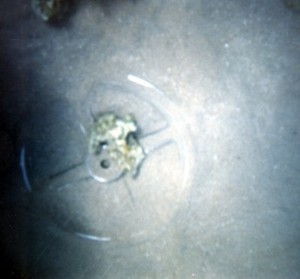
Ron Wyattʼs photo of a “gilded chariot wheel” allegedly from the Egyptian army that chased the Hebrews as they fled during the Exodus.

An email has begun proliferating this year titled, “The Red Sea Crossing,” or, “Parting of the Red Sea,” or, “Chariot Wheels Found in Red Sea,” and it is being passed around so much with so little investigation that snopes.com has begun a page on the email and its claims. I suspect that the email is part of an advertising campaign for a film due out in Fall 2008, starring a creationist named Dr. Lennart Moller (not an archeologist, but a biologist) and titled, “The Exodus Conspiracy

A previous film made for TV by the same company has already popularized the alleged “golden/gilded chariot wheel” that the late Ron Wyatt (another non-archeologist) “discovered in the Red Sea,” where “Pharaohʼs” chariots were allegedly swallowed up when two huge walls of water slammed together on either sides of them. (See the Bibleʼs Exodus tale.)

The made for TV film also featured Dr. Lennart Moller and was titled, “The Exodus Revealed” and one portion of it featured not the actual “gilded wheel” photographed by Wyatt but a digital “recreation” of it

Announcer: “While most of the possible artifacts found off the coast of Nuweiba are covered with coral, one significant discovery was not.”

Dr. Lennart Moller: “There is one find at the Nuweiba location that is of great interest, and that is the gilded wheel. [digital ‘recreation’ appears on screen, based on photo taken by Ron Wyatt] It is a wooden basic structure of the wheel and it is covered with gold or electrum, a mixture of silver and gold, and corals have not been able to grow on it. [really? why not? see questions below] Itʼs been very well preserved, although itʼs very fragile. It seems like the wooden content has been dissolved. So I mean you could break it if you tried to remove it.”

Announcer: “After its discovery the fragile wheel-shaped veneer was photographed, then left in place on the sea floor. Later analysis revealed that its dimensions and design resembled four-spoked chariot wheels painted on an 18th Dynasty tomb wall near the biblical date of the Exodus.”

Note that Moller does not say he discovered this “gilded wheel,” nor that he saw it, photographed it, nor touched it. There is no undersea footage of the “gilded wheel” in the film but merely a digital “reconstruction” of a photograph taken by Wyatt in the 1970s. But note that although almost no coral is shown touching this bright shiny wheel, based on Wyattʼs photo, still there are plenty of thick corals growing on one another and seen all over the actual seabed of the Red Sea as shown in the film. Neither does Wyattʼs original photo provide clear evidence as to whether the small piece of coral seen on the wheel simply was placed there or not, it doesnʼt seem particularly well attached, not compared with the vast conglomerations of corals in the general area. And contra a statement made by Dr. Moller in the film, there does not appear to be any reason why coral should not be able to grow on an object made of gold, silver or a mixture of both, as any archeologist can demonstrate who has dug up objects made of all sorts of ancient precious metals from the sea with coral growing on them.

Even a Christian on the web has pointed out:

“Can coral grow on gold? Yes. Coral is not a plant, it is an animal, and it does not get its nutrients from the soil or rock it grows on. Instead, it eats zooplankton and other small marine bugs, and it gets its calcium, amino acids, etc. from the surrounding sea water. To structurally support themselves, corals grow next to each other and harden together, forming reefs. Thus they could grow on anything!! It doesnʼt matter. Coral also uses photosynthesis to make sugars out of sunlight. The only way they wouldnʼt grow on gold is if it were toxic to coral. I do not think this is the case, since gold has little or no affinity for binding oxygen, carbon, or nitrogen. The only thing it really has an affinity for is sulfur. So if sulfur is necessary for coral to live, then perhaps…. The only thing that my pharmacology book says gold inhibits is mycobacterium tuberculosis, nothing else. Besides the point, however, Iʼm all for historical evidence of the Bible, but this guyʼs argument is so ridiculously flawed that itʼs an embarrassment to believers.”

Also, after 3,500 years of water flowing into the Red Sea and carrying sand and silt along with it, thatʼs the deepest that such a wheel has become buried? It looks like itʼs barely beneath the sand. Why is this “gilded wheel” not covered by several feet of silt and sand after 3,500 years?

Neither do Wyattʼs and Mollerʼs separate tales add up concerning such a gilded wheel. On the one hand Wyatt claimed in the 1970s to have photographed such a wheel and then “presented it” to Nassif Mohammed Hassan who worked at the Cairo museum whom Wyatt has on tape saying that it “resembled an ancient Egyptian chariot wheel.” (However what studies did Hassan made of the wheel if any? Did he actually handle it? What evidence is there that Hassan was “presented with” anything more than just a photograph of the wheel?) Then Hassan died a few years later. So heʼs no longer available for questioning. Now compare Mollerʼs story in his video which speaks about the “gilded chariot wheel” as if it were extremely fragile, made of 3,500 year old “wood covered with gold or electrum, a mixture of silver and gold. And itʼs very fragile. It seems like the wooden content has been dissolved. So you could break it if you tried to remove it,” and the announcer described it as nothing more than a “fragile wheel-shaped veneer.” So if Moller is right, how did Wyatt “remove” such a “fragile wheel-shaped veneer” and “present” it to the person at the museum without breaking it?*

*Maybe Moller interprets Wyattʼs story as merely the story of a photograph “presented” to Hassan, not “the wheel” itself?

Even the few photographs taken by Wyatt are not explicitly stated to be of just one wheel or of two different gilded chariot wheels. But even if there was one 3,500 year old gilded wheel solid enough to be lifted out of the sea and presented to Hassan, and a second gilded wheel in the Red Sea yet undiscovered and too fragile to excavate -- then in either case Godʼs providence or chance seems to have made it impossible to investigate either “wheel” story via direct investigation of the alleged “wheels,” nor via interviewing Wyatt or Hassan.

In fact there is no evidence other than Wyattʼs photograph of how large the alleged “gilded wheel” was, and so it could have been smaller than a chariot wheel because it is difficult to judge an objects size in a photograph unless you place something right next to the object like a yardstick, coin, or other object of known size. Also how do we know for sure that the object was made of gold? It might have been made merely of shiny brass and be a far younger object that recently was tossed into the water, so young that it lay near the surface, was still shiny enough to catch Wyattʼs eye, and also young enough such that coral had not had time to cement itself on it. (See the other modern day wheel shaped objects pictured further below.)

Below are links to another portion of the made-for-TV-film that features footage of coral formations and focuses only on those that one might imagine might have been formed around decaying chariot wheels:
Mt. Sinai, Moses & the Exodus - Part 8 of 10

Even in a conservative Christian news source like Worldnetdaily.com, Wyattʼs own wife is reported as urging "caution" before jumping to conclusions, and admits a lot of coral looks like “wheels” or other alleged chariot parts. The article, titled, “Pharaohʼs chariots found in Red Sea?” also admits that the one “golden chariot wheel” that Wyatt allegedly discovered cannot be found anywhere.

SEVEN Criticisms of Wyattʼs Claim that he discovered and photographed a 3,500 year old “Egyptian Chariot Wheel”

  1. While the image could be better, the above photo doesnʼt show any of the type of segmenting that the chariot in the earlier museum photo exhibits. Nor does it seem to have the types of joins shown in drawings of Egyptian chariot wheels. Someone else has already mentioned that the hub of the ocean “wheel” is greatly different then the one in the museum. The style seems more modern and looks as if the edges are milled to be beveled.

  2. As to the coral formations. I donʼt think anyone has brought up that coral often is spherical and or radial. I havenʼt seen any convincing arguments that the formations arenʼt natural. Keep in mind that different types of coral grow on top of each other. So given enough coral, time, and space all sorts of shapes are possible.

  3. Cnidarians are simple, radially symmetrical, animals. Radial symmetry means that the body is a hub, like a bicycle wheel, and tentacles are spokes coming out of it.

  4. Iʼm at a loss as to how a Saudi Law prevents anyone on the Egypt side of the sea from bringing up objects [am I missing something here?]. If they do not bring up items out of respect/fear for Saudi Law, then how did they bring up the bone?

  5. Even if it turns out that the formations arenʼt natural it doesnʼt mean theyʼre chariot wheels. There is certainly more than one ship that has been lost in the Red Sea. Google: shipwreck “red sea” 5,790 matches.

  6. The film features an examination of the “spokes” of various wheel-shaped coral formations and the discovery of positive metal detector readings and rust being associated with the coral. But 1446 BC is too early for extensive use of iron and Egyptian chariots didnʼt use much metal. The spokes were wooden. Small amounts of iron had been available to the Egyptians for a long time but we should not be seeing much, if any, at an 18th Dynasty site. We really do need better evidence for the Exodus than counting the number of spokes a coral formation appears to have. Iron Age I starts at 1200 BCE See also this and this about the history of metal usage. “Iron was first employed as a technology of war about 1300 B.C. by the Hittites. Within a hundred years the secret of iron making and cold forging had spread at least to Palestine and Egypt and, perhaps, to Mesopotamia as well.”

  7. Comparison of Wyattʼs golden chariot wheel…

…with some modern day objects found on ships and other machines.

Review Of Dr. Mollerʼs Book, The Exodus Case, which was published in 2002 and inspired the made-for-TV-film, and the move to be released Fall 2008:

Lennart Moller specializes in the earth hazards of air pollutants and the damage to DNA that they cause. Since 2001, he has been a professor of environmental medicine in the department of bioscience at Karolinska Institutet, one of Europeʼs largest medical universities and Swedenʼs main center for medical training and research. Beside his academic duties, Moller is an active member of Evangeliska Fosterlands-Stiftelsen, founded in 1856, a missionary organization within the Church of Sweden. He has edited and authored books on ethics and Gospel exegesis and recently a volume on biblical archaeology, The Exodus Case.

This book is the fruit of extensive travels in the Near East and Egypt. Its stated main purpose is to test a hypothesis: that the biblical texts of Genesis 11:27 through Exodus 40:38 are historically correct. A secondary purpose is to evaluate and expand upon the works of the late Ron Wyatt (1933-1999)… There are disturbing signs already in the hookʼs introduction. First, it is naive to judge these long texts, preserved through thousands of years of oral and written traditions, as either true or false in their entirety. Academic historians evaluate discrete factual statements, not entire books at one go. But Moller emphasizes that he is neither a theologian, a historian, nor an archaeologist. In fact, he underlines that he does not know what these disciplines believe regarding the questions he takes on. Moller feels that he can thereby offer a fresh perspective.

Then there are the references to Ron Wyatt. If ever there was a true native of Daniken Laird, it was Wyatt. His writings on biblical archaeology are such extreme flights of fancy that even many creationist debaters dismiss them as wild imaginings.

While ostensibly scientific, Mollerʼs perspective is at the same time explicitly anti rational (p. 15). We should not be too sure of ourselves and our powers of reasoning. Only God is perfect, says Moller, and humankind is frail and weak…

Moller sets out on his biblical trek through time and space from Abraham in Ur to Moses on Mount Sinai.. He searches intensively for anything that fits with it. The idea that the selected texts are historically true is not a hypothesis for Moller, it is the basic axiom of his investigation. To the extent that he takes his pseudo-Popperian philosophy of science seriously at all, Moller appears to feel that the task of disproving the hypothesis is the readerʼs job, not his.

Moller stomps in brandishing revealed truth… The book interfoliates a Bible summary with absolutely vertiginous speculations in archaeology, history, geology, and onomastics (the study of the origins and forms of words). Gomorrah was located on the plain between the hilltop stronghold of Masada and the Dead Sea. The reason that there is now only a gypsum formation to be seen there is that the wicked city was built of limestone and destroyed in a rain of burning sulphur: limestone + sulphur = gypsum! Joseph, son of Jacob, is identical with Imhotep, the architect of the Stepped Pyramid at Saqqara. This identification moves the Third Dynasty a thousand years forward in time from its accepted date. This does not appear to trouble Moller, as he feels that the dynastic chronology of Egypt contains serious uncertainties. Moses is identical with Pharaoh Tutmosis II, as indicated by, among other things, the fact that the Pharaoh is depicted with a hooked nose, suggesting a Hebrew heritage! And so on. Wherever Moller goes, what he sees turns out to be relevant to his search. He finally finds Mount Sinai…

Author Of The Above Review: Martin Rundkvist, review, is an archaeologist specializing in the pre- and protohistory of Scandinavia. He is a member of the board of the Swedish skeptic organization, Vetenskap och Folkbildning, and co-editor of the associationʼs quarterly, Folkvett. He lives in the suburbs of Stockholm, Sweden, 400 meters from a Viking-period cemetery.


Detailed Documentation Of Wyattʼs Questionable And Fraudulent Claims And Activities

A Review of The Exodus Revealed
Summary: The Exodus Revealed video, directed by Lad Allen and funded by Discovery (Institute?) Media Productions, is based on The Exodus Case book by Lennart Moller, which is based on the “discoveries” of Ron Wyatt. Both the video and the book include photos of a gold wheel supposedly found in the Gulf of Aqaba, presented as proof that the Bibleʼs Red Sea crossing story is true. But a TV producerʼs wife “was told by one of Ron Wyattʼs sons that the chariot wheels that Ron supposedly discovered in the Gulf of Aqaba were planted there by Ron.” Also, John Baumgardner, who is a Christian and initially believed Wyatt and inspected Wyattʼs Noahʼs ark “discovery”, later wrote that “I am almost 100% certain that Ron ‘planted’ them [rivets on the Ark].” Despite this and much more evidence that Ron Wyatt was a crazy liar, both Lennart Moller and Lad Allen were insidiously dishonest in promoting Wyattʼs “findings” without disclosing Wyattʼs history of fraud. [See the link below for more on Wyatt, much more.]

(I know the fellow who wrote the investigative review above, and even met some of relatives who live in Greenville, S.C. The family was home-schooled and taught young-earth creationist arguments. Two or three of the sisters attended Bob Jones University. Today half of the authorʼs siblings have left the fold.)

Wyatt Archaeological Research: Too “Good” To Be True? Yes!

Letter from Joe Zias on the “discoveries of Ron Wyatt,” including mention of the alleged chariot wheel (Zias is Curator of Anthropology/Archaeology, Israel Antiquities Authority, POB 586, Jerusalem, Tel. 972-2-292624)

Lastly, I exchanged a few emails with Pinkowski who runs the Wyatt museum, and who informed me that, “In the 22 years that Ron Wyatt performed this wonderful work for the Lord, he always maintained a very humble personality. It would have been very easy for him to become proud or boastful, but Ron did not do that. Both Moses and Ron Wyatt were extremely humble men. When asked “why” he was chosen to do this work, Ron replied: ‘If 10 different people found 10 different major archaeological finds, people could say, ‘Well, they were lucky, or smart, etc.,’ but for one person to find all of these things is not humanly possible. Not even the most brilliant and celebrated. But God uses ‘The simple things to confound the wise.’ In choosing a simple, average person, He leaves no room for doubt as to ‘who’ is actually doing these things. Perhaps He chose me because I was willing — I really donʼt know. But I can say that there is no one on earth who could be more grateful than I to be allowed to work with these things.’”

What faith Pinkowski has in the alleged authenticity of every one of Wyattʼs alleged “discoveries,” none of which have ever been verified by legitimate archaeologists. Wyatt always seemed to get a glimpse of something and then it promptly vanishes, like the gilded wheel, or the Phoenician style column found on the Saudi coastline and which contained in Phoenician letters (Archaic Hebrew) the words: Mizraim (Egypt ); Solomon; Edom; death; Pharaoh; Moses; and Yahweh; or “the Blood of Christ” on the “Judgment Seat” beneath the Temple site in Jerusalem which only Wyatt saw. Other evidence/claims of Wyatt likewise vanish after closer examination. Even those who at first supported his claims to have found Noahʼs ark no longer believed him after examining the evidence at the site further, including young-earth creationists belonging to major young-earth organizations.

The Above Quotations Arranged And Edited By Edward T. Babinski

Chimp's Awe Inspired by Waterfall & Some of the Best Things Ever Said in Favor of Human Evolution

Chimp Awe Waterfall

Elephants caring for a crippled herd member seem to show empathy. A funeral ritual performed by magpies suggests grief. Then thereʼs the excited dance chimps perform when faced with a waterfall – it looks distinctly awe-inspired.

In June 2006, Jane Goodall and I visited the Mona Chimpanzee Sanctuary near Girona in Spain. There we met Marco, a rescued chimp, who dances during thunderstorms with such abandon that he appears to be in a trance. Goodall and others have witnessed chimps, usually adult males, perform a similar ritual at waterfalls. She described a chimpanzee approaching one of these falls with slightly bristled hair, a sign of heightened arousal. “As he gets closer, and the roar of the falling water gets louder, his pace quickens, his hair becomes fully erect, and upon reaching the stream he may perform a magnificent display close to the foot of the falls,” she describes. “Standing upright, he sways rhythmically from foot to foot, stamping in the shallow, rushing water, picking up and hurling great rocks. Sometimes he climbs up the slender vines that hang down from the trees high above and swings out into the spray of the falling water. This ‘waterfall dance’ may last 10 or 15 minutes.”

Perhaps numerous animals engage in similar rituals but we havenʼt been lucky enough to see them. Is it possible that they are marveling at their surroundings - that they feel a sense of awe? “Do Animals Have Emotions?” New Scientist magazine, 23 May 2007

“A chimpanzee comes to a stunning sight in the midst of a tropical forest: A twenty-five foot waterfall sends water thundering into a pool below, which casts up mist some seventy feet. Apparently lost in contemplation, the chimpanzee cries out, runs excitedly back and forth, and drums on trees with its fists. Here we see the dawn of awe and wonder in animals.

“Famed heart surgeon, Dr. Christian Bernard, witnessed a chimpanzee weeping bitterly and becoming inconsolable for days after his companion was taken away for research. Bernard then vowed never again to experiment with such sensitive creatures.”
A. J. Mattill, Jr., The Seven Mighty Blows To Traditional Beliefs

“When Washoe [the chimpanzee] was about seven or eight years old, I witnessed an event that told about Washoe as a person, as well as causing me to reflect on human nature. [The account proceeds to describe the chimp island at the Institute for Primate Studies]…One day a young female by the name of Cindy could not resist the temptation of the mainland and jumped over the electric fence in an attempt to leap the moat. She hit the water with a great splash which caught my attention. I started running toward the moat intent on diving in to save her. [Chimps cannot swim.] As I approached I saw Washoe running toward the electric fence. Cindy had come to the surface, thrashing and submerging again. Then I witnessed Washoe jumping the electric fence and landing next to the fence on about a foot of bank. She then held on to the long grass at the waterʼs edge and stepped out onto the slippery mud underneath the waterʼs surface. With the reach of her long arm, she grasped one of Cindyʼs flailing arms as she resurfaced and pulled her to the safety of the bank…Washoeʼs act gave me a new perspective on chimpanzees. I was impressed with her heroism in risking her life on the slippery banks. She cared about someone in trouble; someone she didnʼt even know that well.”
Roger Fouts, “Friends Of Washoe” Newsletter

Gorilla Talk — “Koko the gorilla has learned the hand signs to over 600 words, and uses them regularly and spontaneously to communicate with others (including another gorilla she lives with, Michael). She also invents her own unique signs. A ring is called a ‘finger bracelet.’ A cigarette lighter is a ‘bottle match.’ Hand signs in Kokoʼs repertoire of abstractions include: bad, imagine, understand, curious, idea, gentle, stupid, boring, and damn. She also understands over a thousand spoken English words and short sentences. She recognizes words that end with similar sounds or start with the same letter, and can ‘talk’ via an auditory keyboard which produces spoken words when appropriate keys are pressed.

“When Koko was 3 1/2 to 4 years old she took several I.Q. tests designed for human children. In her case the tests were administered via sign language, and Kokoʼs scores on three separate tests over a one year period were 84, 95, 85 (which is not an uncommon fluctuation among human children). The scoring even took into account the cultural bias that favored the responses of human children, which was built into the tests, and without which Kokoʼs scores would have been higher. For instance, one question in the test was ‘Point to the two things that are good to eat.’ The depicted objects were a block, an apple, a shoe, a flower, and an ice-cream sundae. Koko, with her gorilla tastes, picked, ‘apple and flower.’ Another asked ‘Where you would run to shelter from the rain.’ The choices were a hat, a spoon, a tree, and a house. Koko picked ‘tree’ instead of ‘house.’ Rules for the scoring required that Kokoʼs responses be recorded as ‘wrong.’

“Koko ‘purrs’ and makes laughing and chuckling sounds to express happiness. Her laugh is a sort of voiceless human guffaw which she expresses at her own jokes and those made by others. She finds incongruity funny, the way a young child might. Asked ‘whatʼs funny,’ she put a toy key on her head and said it was a hat, pointed to a puppetʼs nose and said it was a mouth, and signed, ‘That red,’ showing me a green plastic frog.

“Barbara Hiller saw Koko signing, ‘That red,’ as she built a nest out of a white towel. Barbara said, ‘You know better, Koko. What color is it?’ Koko insisted that it was red — ‘red, Red, RED” and finally held up a minute speck of red lint that had been clinging to the towel. Koko was grinning.

“Another time, after persistent efforts on Barbaraʼs part to get Koko to sign, ‘Drink,’ Koko just leaned back and executed a perfect drink sign — in her ear. Again she was grinning.

“She even tells lies, once blaming a broken sink on a human volunteer. Another time, while I [Patterson] was busy writing, Koko snatched up a red crayon and began chewing on it. A moment later I noticed and said, ‘Youʼre not eating that crayon, are you?’ Koko signed, ‘Lip,’ and began moving the crayon first across her upper, then her lower lip as if applying lipstick.

“Koko also cries, a sort of heart- rending wooo-wooo, when sheʼs sad [like when her pet kitten, ‘All Ball’ died], or when sheʼs lonesome. And sheʼs thought about where gorillas go when they die: ‘Comfortable hole bye.’

“When one of Kokoʼs visitors asked her, ‘Are you an animal or a person?’ Koko answered, ‘Fine animal gorilla.’”

The Above Quotations Have Been Condensed And Edited From “Conversations With a Gorilla” by Francine Patterson (National Geographic, Oct. 1978); “‘Fear, Humor, Commitment, Sorrow’ — Apes Feel Them All” (U.S. News and World Report, July 22, 1985); “Talk to the Animals” by Don Kaplan (Instructor, Aug. 1985); “Sex and the Single Gorilla” by Judith Stone (Discover, Aug. 1988); One of the most careful and thoughtful reports on primate communication is “Language Comprehension in Ape and Child,” ed., E. Sue Savage-Rumbaugh, Monographs of the Society for Research in Child Development, Number 23 (1993). Savage-Rumbaughʼs work is based on rigorous tests and does not rely on anecdotal evidence, yet it supports some of the same claims made above.

“Apes and monkeys have drawn and painted pictures, displaying intense concentration, and appearing to gain satisfaction in the process. Artistically, a chimpanzee makes the same progress, by the same steps, as a human child does, though none have ever been known to get beyond the ‘simple circle dotted with marks resembling facial features,’ i.e., they do not add arms, legs, a body, etc. Still, ape and monkey art takes a lead ahead of children in placing its forms in the center of the page — they balance their compositions. Apes have also been seen tracing their shadows with their finger, and even using their breath to wet a window pane so they could draw upon it. One famous monkey artist, a Capuchin, began to draw with rough objects in her cage even before anyone showed her how. With most other monkeys and chimps all that human trainers had to do was put a pencil in their hand and paper in front of them. They discovered how to use it soon enough, and even how to hold the writing implement properly. The primates that were tested also knew when their pictures were finished, and enjoyed looking at them afterwards…

“Wild chimpanzees have been observed dancing round an object, employing unique modes of rhythm. They also make drinking cups out of folded leaves, and they pluck a stick clean of leaves to make a feeding-tool they use to extract ants and termites from holes in the ground or wood.”
Sally Carrighar, Wild Heritage [quotations have been condensed and edited]

“Forgiveness is not, as some people seem to believe, a mysterious and sublime idea that we owe to a few millennia of Judeo-Christianity. It did not originate in the minds of people and cannot therefore be appropriated by an ideology or a religion. The fact that monkeys, apes, and humans all engage in reconciliation behavior (stretching out a hand, smiling, kissing, embracing, and so on) means that it is probably over thirty million years old, preceding the evolutionary divergence of these primates…Reconciliation behavior [is thus] a shared heritage of the primate order.

“When social animals are involved… antagonists do more than estimate their chances of winning before they engage in a fight; they also take into account how much they need their opponent. The contested resource often is simply not worth putting a valuable relationship at risk. And if aggression does occur, both parties may hurry to repair the damage. Victory is rarely absolute among interdependent competitors, whether animal or human.”
Frans De Waal, Peacemaking Among Primates (see also, Morton Hunt, The Compassionate Beast: What Science is Discovering About the Humane Side of Humankind; and, Alfie Kohn, The Brighter Side of Human Nature: Altruism and Empathy in Everyday Life)

“Studies of food sharing by chimps at Atlantaʼs Yerkes Regional Primate Research Center [show that]…chimps most often get food from individuals whom they have groomed that day. Dominant males are among the most generous with their food. Fights occur rarely and usually stem from attempts either to take food without having performed grooming services or to withhold food after receiving grooming. Chimps usually kiss, hug, or otherwise make peace after a fight, especially if they need help and cooperation from one another in the future, according to Dr. Frans de Waal.”
“Chimps Reap What They Groom,” Science News, Vol. 146, Dec. 17, 1994

Sharing the Good Nudes, and Bad Neuters, of Christianity (& God's love for harp playing male virgins)

Adamites

Abstract

Everything You Wanted To Know About Nude, Virginal, Castrated Men in the Bible, and Men “Undefiled by Women.” And Mosesʼs command not to “come at your wives” before meeting God. (Though I donʼt know if that applies to Southern Baptists heading for their annual convention.) Includes mention of the Adamites and the Skoptzie, along with Augustineʼs answer to the question, “What if all men should abstain from all sexual intercourse, whence will the human race exist?” All that and more below.

Sixty residents of the Seminole Health Club nudist camp near Miami comprise a Christian mission that worships twice a week in the nude. According to leader Elijah Jackson, “Weʼre not trying to start a cult here, but I think nudity adds something to Christianity.” — News of the Weird, “Weird Clergy”

In the past another group of Christians worshiped in the nude called “Adamites.” They believed that Jesusʼs grace allowed them to draw closer to God in their nakedness, unlike Adam and Eve who were ashamed and withdrew from God in the garden because of their nakedness. They also cited the verse in which Job reminded his listeners that we all entered and exited life naked, and used that to argue that we will all face God naked. Besides which King David lost his robe in a religious dancing frenzy and danced naked for the Lord. The only trouble I can see with worshiping naked in church is having to set the temperature neither too hot nor too cold and keeping the seats from getting sticky.

Christians who worship naked, and the Bible verses they focus upon, are not to be confused with Russian Skoptzie Christians who focused on Jesusʼs words, “Some have made themselves eunuchs for the kingdom of heaven.” (Mat. 19:12) The Skoptzie avoided the “lust of the eyes” and “of the flesh,” via the use of a knife. All for the kingdom. (Another example of a Christian who made himself a eunuch for the kingdom of heaven was the early church father Origin. Incidentally, he believed in the restoration of all things, except perhaps for the thing he cut off.) Will we behold in heaven naked dancing genital-less men — made eunuchs either on earth by their own hand, or transformed into genital-less angel-like beings after death by God?

The author of Revelation mentions “144,000 men… not defiled with women; for they are virgins,” who are granted a prominent place in front of Godʼs throne to play their harps. Thatʼs what God likes most I guess, harp playing male virgins. (Revelation 14: 2-4)

Old Testament authors seem to concur with at least the necessity of celibacy in the presence of Yahweh, since Exodus 19:15,17 taught that Israelite men must “NOT to come at your wives” prior to “meeting the Lord.”

Paul likewise hailed celibacy as a holy virtue, but added, concerning those who could not rise to practice such a virtue, “it is better to marry than to burn” (a verse not often heard at Christian marriage ceremonies today, I wonder why, itʼs biblical):

“It is good for a man NOT TO TOUCH A WOMAN. For I would that all men were even as I myself. I say therefore to the unmarried and widows, it is good for them if they abide even as I. [i.e., celibate] But if they cannot contain, let them marry: for it is better to marry than to burn… I suppose therefore that this is good for the present distress, I say, that it is good for a man so to be. Are you loosed from a wife? seek not a wife. The time is short: it remains that they that have wives be as though they had none… He that is unmarried cares for the things that belong to the Lord, how he may please the Lord: But he that is married cares for the things that are of the world, how he may please his wife. There is difference also between a wife and a virgin. The unmarried woman cares for the things of the Lord, that she may be holy both in body and in spirit: but she that is married cares for the things of the world, how she may please her husband. And this I speak for your own profit, that you may attend upon the Lord WITHOUT DISTRACTION.” (1 Corinthians 7:1,7,8-9,26-27,29,32-35)

But Augustineʼs commentary on Paulʼs verses is especially ripe:

“In the first times, it was the duty to use marriage. chiefly for the propagation of the human race. But now, in order to enter upon holy and pure fellowship. they who wish to contract marriage for the sake of children, are to be admonished, that they use rather the larger good of continence. But I am aware of some that murmur, ‘What if all men should abstain from all sexual intercourse, whence will the human race exist?’ Would that all would. Much more speedily would the City of God be filled, and the end of the world hastened. For what else does the Apostle Paul exhort to, when he says, ‘I would that all were as myself;’ or in that passage, ‘But this I say, brethren, the time is short: it remains that both they who have wives, be as though not having: and they who weep, as though not weeping: and they who rejoice, as though not rejoicing: and they who buy, as though not buying: and they who use this world as though they use it not. For the form of this world is passing away.’” (Saint Augustine, On the Good of Marriage, Sections 9-10)


The Latest “Nudes” On the Christian Nudist Experience

Christian Nudist Convocation, Planning their Summer 2008 conference:

The periodic Christian Nudist Convocation took place in July at the Cherokee Lodge nudist camp in Tennessee, and according to a dispatch in Nashville Scene, the group evokes skepticism not only from most Christians (who dislike the flaunting of naked bodies, even if innocently done) but from most Cherokee Lodge members, who see them as too intense for naturismʼs laid-back attitude. One CNC attendee acknowledged that many Christians would not approve of Cherokee Lodge, but to him “Itʼs Jerusalem.” Another compared his work at nudist camps to missionary work: “Some people get sent to Africa, some people get sent to South America and the Lord was like, ‘I want you to go to nudist resorts.’ And Iʼm like, ‘Wow, what an assignment.’”
SOURCE: News of the Weird

“Christian nudists to build village in Florida”
by Phil Barnoti Wahba (Columbia News Service Dec. 6, 2005), www.azcentral.com

Jonathan Palmiter was enjoying a recent Sunday morning stroll through a lush yard full of trees and Spanish moss—naked as was Adam in the Garden of Eden. A 59-year-old born-again Christian, Palmiter was visiting Natura, a development 40 miles north of Tampa, Fla., that, when it opens up next summer, will become the first nudist community for devout Christians in North America.

Natura is being developed over five years and will house as many as 200 people in 50 family houses on 100 acres of land, with room for up to 100 recreational vehicles, according to Daniel Bellows, chief executive of the development. He even envisions a self-contained village with home-schooling and a strip mall.

Christian nudism might sound like an oxymoron, but for thousands of devout followers, living and worshipping naked is at the core of their faith. No one knows how many Christian nudists there are in North America, but the advent of Natura will increase their visibility.

Nathan Powers, a 50-year-old Texan, begins his day praying naked in his backyard. Nakedness intensifies his dialogue with God, he said. “I feel closer to God. Itʼs an act of humility. It is absolutely spiritual.” To reconcile being a good Christian with their need to be nude, many of the faithful turn to prayer and follow their own spiritual path. Some are led away from their particular denominations. Parker, who organizes the annual “Christian Nudist Convocation” in Virginia, a coming-out event for closeted nudists, was raised a Southern Baptist. He is now independent, turned off by Sunday sermons he said were “too hypocritical for one afternoon.”

The lifestyle of these Christians doesnʼt necessarily make them lefties of the 1960s free-love, live-and-let-live mold. They tend to be deeply conservative on issues like homosexuality and premarital sex, and Republican, differing only from other Christians in their need and desire to be naked whenever possible.

Naked Before God,” cover story in Nashville Scene. Christian nudists hit the church-and the hot tub-for three days of wet and wild worship in the backwoods of Tennessee by Elizabeth Ulrich

The compatibility of Christianity and nudism is detailed in “Nakedness and the Bible,” a self-published book by Canadian author Paul Bowman. The book cites key biblical events, including Godʼs order to the prophet Isaiah to go naked for three years, and states that, contrary to popular belief, Jesus was naked when he washed the feet of his disciples, when he was baptized and when he was crucified and resurrected. “Nakedness and the Bible” states that nothing forbids nonsexual nudity and that misinterpretations of the Bible stem from faulty translations of ancient Hebrew words for nudity. For example, Jim T., Naturaʼs spiritual adviser, and his wife, Shirley, believe the apostle Paulʼs call for modesty targeted ostentation, not nudity. Besides, said Shirley, 55, women in church wearing “designer clothes and $90 haircuts” are the immodest ones.

Christian nudists have long organized their own services and prayer groups. Carolyn Hawkins of the American Association for Nude Recreation, which was founded in 1931, said most of its 270-member clubs offer Sunday services, including one in North Carolina where they are led by a member who is a Baptist minister. Nathan Powers, a 50-year-old Texan, begins his day praying naked in his backyard. Nakedness intensifies his dialogue with God, he said. “I feel closer to God. Itʼs an act of humility. It is absolutely spiritual.”

Jonathan Palmiter was enjoying a recent Sunday morning stroll through a lush yard full of trees and Spanish moss—naked as was Adam in the Garden of Eden. A 59-year-old born-again Christian, Palmiter was visiting Natura, a development 40 miles north of Tampa, Fla., that, when it opens up next summer, will become the first nudist community for devout Christians in North America.


Transgender Televangelist: Sister Paula Nielsen the worldʼs first and only transgender televangelist. Unfortunately, Sister Paulaʼs show is only available on the cable system of — you guessed it — West Hollywood.

“No Stomach” for N.T. Wright (and the questions that raises concerning the life of the world to come)

N.T. Wright

N.T. Wright on page 290 of The Resurrection of Jesus Christ seems to be admitting the obviousness of a biblical contradiction that many conservative Christians seem loathe to admit. Before reading the passage from N.T. Wright one needs to know which verses he is referring to. They are from a Pauline letter and one of the earliest New Testament discussions concerning what “resurrection” meant, i.e., Paul wrote in 1st Corinthians 6:13 & 15:50, “Flesh and blood cannot inherit the kingdom of God,” and, “Food is for the stomach, and the stomach is for food; but God will do away with both of them.” About such teachings N.T. Wright wrote:

“There is that about the body which will be destroyed; in the non-corruptible future world, food and the stomach are presumably irrelevant. So, for that matter (since food and stomach point metaphorically here to sexual behaviour and sexual organs) will human reproduction be irrelevant. Paul is again treading a fine line here, since he wants to say simultaneously both that the creator will destroy the bits of the body which are being touted by some in Corinth as those to do what they like with and that there is bodily continuity between the present person, behaving this way and that, and the person who will be raised to new bodily life.”

To comment on Wrightʼs comment, one need only note that the two last Gospels (Luke and John) abandoned Paulʼs earlier teaching and depicted scenes in which the resurrected Jesus “ate fish” and declared himself “not a spirit,” but one “having flesh and bone.” Which makes one wonder whether Paul might not have found such late Gospel depictions of the resurrected Jesus “heretical” had Paul lived long enough to read them.

Speaking again of N.T. Wright, in his latest book he preaches that Christians will be resurrected in a new body to live on a new earth, which raises all sorts of questions. Will people be raised with or without sex organs? Will resurrection bodies have the anatomy of Barbie dolls? (In which case, how “PG-rated!” Finally, a “family friendly creation!”) Why have that stuff between your legs for eternity if itʼs to be of no use?

On the other hand, Christians like C. S. Lewis hoped there would be “sex” in the afterlife. Of course some might not like being stuck with the same physical organ they had on earth, either because of its size or shape, or they might like to imagine trying out a different sex organ entirely rather than only having had the experience of one genderʼs sexuality. And what about people born in the “old creation” with a bit of both sexual organs, the “inter-sexed?” Will God reassign them a gender specific organ after they are resurrected? (Again, a nice PG-rated cosmos, safe from any gray or blurry areas.)

And speaking of a “family friendly” cosmos, how “family friendly” will it be if you canʼt raise families in it? If “new creation” resurrected bodies have sexual organs can the gonads function and conceive children? Will there be “post-resurrection new creation babies?” Such babies wouldnʼt be born in a fallen cosmos but would have all the advantages of being born in a “new creation” — all the food, love, and daily miracles anyone might ever hope to see from birth onwards. A bit of an advantage Iʼd say over all the damned in hell born into the “old creation” after Adamʼs fall. Doesnʼt sound very fair.

Of course if giving birth is NOT an option in the “new creation,” then God has sterilized the chosen for eternity. (Which is a bit funny considering all the sermons some Christians keep preaching here on earth that sterilization is wrong.)

Conversation Of A Semi-Rebellious Questioning Christian With God After Being Resurrected In The New Creation:

“Hey God! Thanks for the resurrected body! Glory! Hey whereʼs my? (Hands rummaging deeply in pants pockets.) Thanks be to God itʼs still there! (whew). Does it still work? Yes? But Iʼm shooting blanks for eternity? I canʼt make babies? In the old creation You told us to procreate and fill the earth, which you probably didnʼt have to make a ‘command’ after all, our pleasure really, until environmental decline and water shortages started happening as a result. Maybe you ought to have added a word or two about the dangers of ‘overfilling’ the earth? You also told us children were a great blessing, though you wound up having to toss yours into a lake of fire whose smoke rises forever. Now in the ‘new creation’ you want us to have sex for pleasure with no baby-making even possible? Weird how you reversed the rules. Almost sounds like a resounding wet dream victory for Hugh Hefner and the sexual revolution. Can we have cosmic orgies too? No? I see. So we have to do it for eternity with one spouse, or ‘spouses’ if weʼd thought ahead like king Solomon and married a couple hundred while living in the old creation. What if we died without choosing a partner but were still looking for one? Can we date in the new creation? Is heavy petting an option in the new creation? Can we continue dating till eternity ends without settling on any one partner? But maybe I ought to thank you for resurrecting us all with sterile gonads here in the ‘new creation,’ since the only children that I was able to conceive never ‘came to Jesus,’ and the thought of them in their damned state only reminds me how risky it might be for any of us to risk conceiving any more souls to fill hell. We donʼt want to overfill it like we did the earth! Or overfill heaven too for that matter, I guess. So thanks for the blessing of knowing that the only kids I will ever be able to conceive throughout eternity are suffering forever.” Then Adam, who was listening to my conversation with God, walks up to my ear and whispers, “Tell me about it.”

Tertullian's Paradox; Why Protestants and Catholics, Calvinists and Armenians, will never see eye to eye

Tertullian's Paradox

CATHOLICISM critiques the sufficiency of Scripture alone, while PROTESTANTISM critiques Catholic claims that their traditions and miracle stories are true.

First, letʼs hear a bit of the Catholic argument…

Is Scripture Alone Sufficient?

Francis Beckwith, former president of the Evangelical [Protestant] Theological Society converted to Catholicism after recognizing that Scripture alone is insufficient. Judging by his conversion (as well as that of Newmanʼs during the Victorian era when the latter quit Anglicanism for Catholicism, which stunned England) critiques of the Reformation principle of sola scriptura can be quite successful. Introducing oneʼs Protestant friends to Catholic criticisms of sola scriptura may help them question their previous ideas of biblical authority without having to introduce them to books by agnostic or atheist scholars. See this piece for instance:

Ecclesiastical Authority in Scripture and Apostolic Tradition by James Roger Black (Ph.D. in “Ancient Religions of the Eastern Mediterranean”). Headings in Dr. Blackʼs paper include:

  • “Scripture alone is not a sufficient guide to faith and practice…
  • “Scripture is not self-defining…
  • “Scripture is not self-authenticating…
  • “Scripture is not self-interpreting…

“The Reformation principle of ‘sola scriptura’—i.e., reliance on ‘Scripture alone’—is not taught in Scripture itself, was not held by the early Church…

“The commonly cited biblical proofs of sola scriptura do not actually teach what they are alleged to teach…

“Both Jesus and the Apostles made use of—and even appealed to the authority of—the oral traditions, deuterocanonical and extracanonical writings, and varying textual recensions of their day.”

See Dr. Blackʼs article for the examples he cites beneath each heading.

There is also a former Protestant who converted to Catholicism, named Dave Armstrong who has written some concise pieces on the same topic, but one can find any number of Catholic scholars who likewise have written on the topic probably going back to Lutherʼs day:

Catholics imagine that after the Reformation principle of sola scriptura is undermined then Protestantʼs will be forced to recognize or at least look into Catholic claims of divinely-directed growth of dogma and traditions, not to mention centuries of miraculous and visionary experiences.

But hereʼs where it becomes PROTESTANTISMʼS turn to aid in leading more people toward deism, atheism, or at least agnosticism.

Are Miracle Tales True?

Protestants over the centuries have examined Catholic miracle tales and found them wanting. On the miracles reported to have taken place in the early church Rev. Dr. Conyers Middleton (18th century British Anglican clergyman, Cambridge graduate and author) says, regarding the early church fathers who reported them:

“I have shown by many indisputable facts, that the ancient fathers, by whose authority that delusion was originally imposed (that miracles existed in the early church), and has ever since been supported, were extremely credulous and superstitious; possessed with strong prejudices and enthusiastic zeal, in favour, not only of Christianity in general, but of every particular doctrine, which a wild imagination could ingraft upon it; and scrupling no art or means, by which they might propagate the same principles. In short; they they were of a character, from which nothing could be expected, that was candid and impartial; nothing but what a weak or crafty understanding could supply, towards confirming those prejudices, with which they happened to be possessed; especially where religion was the subject, which above all other motives, strengthens every bias, and inflames every passion of the human mind.” [Conyers Middleton (1749), A Free Inquiry Into The Miraculous Powers Which Are Supposed To Have Subsisted In The Christian Church From The Earliest Ages Through Several Successive Centuries. Reprinted (1967). New York: Garland Publishing. Preface, pp. 21-22.]

Then in the 19th century one can read the Protestant theologian (and father of modern inerrancy), B. B. Warfield, to see how he debunked Catholic miracles and resurrection stories in his famous work, COUNTERFEIT MIRACLES. Which just goes to show, as Dr. Robert M. Price (an ex-fundamentalist Protestant), wrote, “The zeal and ingenuity of conservative evangelical scholars in dismantling the miracles of rival Christian groups (and exploding rival interpretations of Scripture used to support such miracles), is worthy of the most skeptical gospel critic.”

In the 20th century after the worldwide rise of Pentecostalism, the conservative Protestant, George W. Peters, dismantled stories of “resurrections” that allegedly took place in the 1970s during the Pentecostal revival in the Phillipines. His book was titled, Indonesia Revival: Focus On Timor (Grand Rapids: Zondervan, 1973), Chapter 4, “The Miracle Phenomena of the Revival,” pp. 57-85. Other conservative Protestants have dismantled claims of miracles allegedly performed by Pentecostal televangelist Benny Hinn, including his claim, now withdrawn, that he had “raised someone to life.”

This brings us to a Catholic book by Father Albert J. Hebert S.M., Raised From The Dead: True Stories Of 400 Resurrection Miracles. Father Hebert claims many resurrection miracles have been performed by Roman Catholic saints. Naturally Protestants like Middleton, Warfield, and Peters are not going to simply allow Catholics to believe that their Church has a preponderance of resurrection miracles vouchsafed by God. They are going to question whether any such myriad of miracles ever took place, using every possible reason, rationalization or inkling of doubt in their minds.

But then one must ask how those same Protestants, so willing to employ every reason and rationalization at their disposal to deny Catholic miracles—chalking them up to gullibility, blindness, folk tales, myths, legends, or the result of living in ignorant and superstitious times—expect modern day people to believe every last miracle in the Bible instead?

On what historical grounds can the miracles of Protestantismʼs “enemy,” the Catholic Church, be rejected without also rejecting or at least questioning heartily those found in the New Testament? If Father Hebert is correct then the miracles he enumerates serve as evidence of Godʼs approval of the Roman Catholic Churchʼs status as true church of God. And the miracles Father Hebert documents happened much more recently than those reported in the Gospels, and they are reported by people about whom we know more than is known about the Gospel writers. So what do we really know of the anonymous writers of the Gospels that assures us that they would not make use of whatever stories or pious legends were being spread about by others living in such a superstitious era?

Hence, CATHOLICISM critiques the sufficiency of Scripture alone, while PROTESTANTISM critiques Catholic claims that their traditions and miracles stories are true.

So what must one believe?

Is God speaking especially clearly on either matter? See also this post on Miracles of All Religions. What a mixed bag they are. How can God or “Whatever is Out There” expect us all to make the same sense out of such a mixed bag of miracle stories?


Arminianism Versus Calvinism

The C.S. Lewis-ian/Arminian, Victor Reppert (of the blog Dangerous Idea) and the Calvinist, Paul Manata (of the blog Triablogue) went back and forth on one of the most heavily discussed and unresolved debates throughout centuries of Christian theology and philosophy, tossing at each other grandiose concepts and words that have a core of incomprehensibility not only in and of themselves, but also in the different ways different thinkers have conceived of them relating to one another — words such as “God,” “nature,” “omniscience,” “predestination,” “free will,” “divine goodness,” “human goodness” (or lack thereof w/ the exception of “common grace”).

Vic and Paul remain “certain” that whatever core of incomprehensibility may exist in such words, their use of them makes far greater sense, and adds up to a far more imposing and necessarily true system than that of their opponent.

All of which reminded me of something Bernard Williams, a Christian philosopher, wrote in his essay, “Tertullianʼs Paradox”:

“If the Christian faith is true, it must be partly incomprehensible. But if it is partly incomprehensible, it is difficult to see what it is for it to be true…”

He continued…

“It follows further… that it is difficult to characterize the difference between belief and unbelief”

Especially, I might add, in the sense of believing or not believing in explanatory systems propounded by other Christians.

In fact, one can see how incessant debates between Catholic and Protestant thinkers seem to have led almost naturally to a rise in deism and atheism, or at least agnosticism.

There have been (and still are) so many differences between Christians in matters of theology, philosophy, liturgy, spiritual regimes, buzz words, and other practices, that Christianity ought to be called “Christianities.” A spectrum of systems exist for interpreting the Bible and for determining its authority on various matters. How does one “find Godʼs will?”

No doubt the hunt for “Godʼs will” via interpreting holy books, dogmas, and traditions is endless and exhausting which explains why so many Christians feel relieved to leave such a hunt up to their pastor, or up to the Sunday School lessons their church receives in booklets sent from their parent institution, or up to the Magisterium of the Catholic Church, or up to the living patriarchs of the Eastern Orthodox church, or up to the guy with the weird haircut hawking “holy hankies” on TV.

I know itʼs exhausting because I tried and sought and prayed and read and continue to read up on the topic. So letʼs pour more oil on the fire of Vic and Paulʼs dialogue, and start by asking them both why they arenʼt Catholic? Itʼs the single biggest Christian Church in the world. Nearly as big as all Protestant denominations combined. And it has what it calls “apostolic authority” going back to an apostle whom Jesus himself picked as a rock of faith to whom things on heaven and earth would be loosed, and they say that apostle picked others, etc. And hereʼs the kicker, Catholics continue to use every reasonable, rational and historical argument in order to deny something near and dear to every Protestant, the sufficiency and perspicacity of Scripture.

The story of my journey
If It Wasnʼt For Agnosticism I Would Know WHAT to Believe,
and,
Agnosticism: Reasons to Leave Christianity