Yet More on The “Many Resurrected Saints”

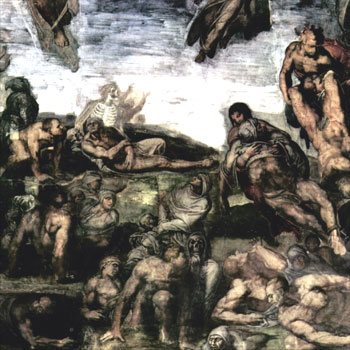
Resurrection of the Saints

The “many raised saints” story is an interesting one. I have a few pieces on the web concerning it and the questions it raises:

What happened to the resurrected saints?

More about the resurrected saints

What Happened To The Resurrected Saints? The “Christian Think Tank” Response

One interesting tidbit about the tale of the “many raised saints” found only in Matthew is the probable insertion of the phrase “after his resurrection” which appears to have been inserted so awkwardly into the Greek that it makes the sentences read as though the tombs were opened and the saints raised at Jesusʼs death, but then they lingered about until “after his resurrection” a day and a half later when they finally “entered the holy city.”

Some of course donʼt think that those two little verses about the anonymous “many raised saints” are historical at all but merely midrash added by Matthew, just as Matthew appears to have added incidents in Jesusʼs birth and childhood filling in gaps in knowledge with tales composed to add understanding in a similarly midrashic fashion. (One prominent inerrantist scholar was voted out of the Evangelical Theological Society in the 1980s for acknowledging that there was indeed a case to be made for Matthewʼs use of midrash in his telling of the Jesus story.)

As for inerrantist Christian apologists on the web who acknowledge the ancient use of midrash and even pesher to help try and explain the way some Gospel authors stretched the meanings of Old Testament verses to suit their prior view of “who Jesus was,” please read “The Fabulous Prophecies of the Messiah” which includes comments from Christian apologists at the end.

On this topic of the Gospel authorʼs use of midrash and pesher, even J. P. Holding has listed it among “leading Christian myths” that “OT prophecy fulfillment is a good apologetic. It actually isnʼt useful in the way it was at first. We need to understand (as do Skeptics) Jewish exegesis of the first century. It is not so much that the OT predicted the NT events as that the NT writers looked at history and sought OT passages that echoed what they had seen. This does not mean that there is not actual predictive prophecy at all (for even then God may have orchestrated the pattern) but rather that we cannot present an apologetic on this basis as we normally have; or else we are forced into a corner of explaining ie, why the NT allegedly uses OT passages “out of context.”

Personally, I suspect that the ancient world was generally more mysterious and wondrous than todayʼs and average people were more capable of believing stories or weird strange tales, and capable of repeating them and embellishing them as well. The story of many raised saints, the story of a bodily ascension, the story of a resurrection. I donʼt doubt that Christians were motivated in their beliefs, nor that Christians were motivated to compose not one, but three additional variant endings to Markʼs Gospel, none of them apparently original to that Gospel, and continued to compose additional Gospels and Acts. Truth telling does not seem to have been as important as convincing themselves and others of their beliefs. But certainties are more difficult to come by once Christianity began being examined by more rigorous standards. Historians are not easily cowed by partisan stories of miracles, or by miraculous partisan tales of how various religions allegedly began. Jerusalem itself was turned into rubble in 70 A.D. but the Romans, rubble such that Josephus pointed out if they hadnʼt left the towers of the city standing, one might even doubt that such an immense proud city such as Jerusalem ever had stood on that same spot. So thereʼs no evidence, and no non-partisan writings aside from Josephusʼs mention of Jesus, and even he would have gotten his brief paragraph of info from partisan believers not from actually having seen Jesus himself. The Gospels themselves are written without the authorʼs identifying themselves, and one could read all of the inerrantist and non-inerrantist historians one wants to try and guess who wrote them, and remain uncertain. (And I say that having read Holdingʼs collection of arguments for traditional authorship.)

Nuff said for now, I doubt any single argument can change another personʼs mind that has built up connections with other arguments in a web-like fashion over time, or relieve them of the doubts they may have.

Cheers,
Ed

The Brain-Mind Problem, C. S. Lewis's "Cardinal Difficulty of Naturalism," and its Modern Day Defender, Victor Reppert

Brain and mind

A list of resources and links in which Christian philosophers disagree whether a Christian should be a brain-mind monist or brain-mind dualist.

I have been discussing brain-mind matters with the Christian philosopher Vic Reppert for years, even before his book was published and before he began his blog. See Vicʼs blog, named after his book, “C. S. Lewisʼ Dangerous Idea”. I am a fan of Vicʼs expertise and composure, including his acknowledgment of arguments contrary to his philosophical and theological opinions. There is agnosticism mingled with his Christian faith—a healthy proportion—so far as I can tell. But that comes from his willingness to remain informed by all sides and to remain aware of unanswered questions and uncertain variables.

One might take note especially of some comments made by Vic concerning intellectual performances by freethinkers Drange (arguing against a proponent of Bahnsenʼs views) and Parsons in debates with Christian philosophers. Apparently Vic and even the younger Christian philosopher, Jason, have been impressed by some points freethinkers Drange and Parsons have raised.

Vic also admits that there are a variety of views held even by Christian philosophers regarding the brain-mind question, including pro-physicalist views. See also the Christian debate book published in May 2005, In Search Of The Soul: Four Views Of The Mind-body Problem, published by Inter-Varsity (the same Christian press that published Vicʼs book, C. S. Lewisʼs Dangerous Idea, two years previously) there are some “physicalistic” views represented. See also this book published Jan. 2006 Bodies and Souls, or Spirited Bodies? (Current Issues in Theology) And Whatever Happened to the Soul? Scientific and Theological Portraits of Human Nature And Body, Soul, and Life Everlasting: Biblical Anthropology and the Monism-Dualism Debate

My own comments can be found at Vicʼs blog and in a few articles at my website.

Iʼd sooner give science at least a couple more centuries of patient investigation of the brain-mind before coming out with premature proofs or disproofs. I also suspect that brain-minds do not come together all at once, but that just as the brain develops, a mind also takes time and a wealth of experiences to develop and incorporates more sensory input and data each second than any of us are consciously aware of, and that even at the moments of creation of memories of untold numbers of things we experience, we are probably unconscious of all the connections between each memory that happen at their creation. And all the thoughts we later take for granted and the connections they have with reality are likewise taken for granted as something automatic, but in fact it all took a lifetime to build up.

There is also the question of “commonsense” responses to the brain-mind question, and of “commsense” itself, as elucidated in an article in The Philosopherʼs Magazine by David Papineau, Professor of Philosophy of Science at Kingʼs College, London and author of The Roots of Reason and Thinking about Consciousness (Oxford University Press). Papineauʼs article is titled, “The Tyranny of Commonsense,” and in it he says, “Everyday thinking embodies a rich structure of assumptions about the mind, and it is by no means clear that all these assumptions are sound. In particular, there are many recent scientific findings that cast substantial doubt on our intuitive view of the mind. For a start, take Benjamin Libetʼs work on the genesis of actions. Libetʼs experiments indicate that, at least when it comes to basic bodily movements, our conscious choices occur a full third of a second after neural activity in the brain begins to prompt the behaviour. This certainly casts doubt on our intuitive conviction that our actions are instigated by our conscious choices. Again, the work of David Milner and Melvyn Goodale on the separation of the dorsal and ventral streams in visual processing (the “where” and “what” streams) suggests that our basic bodily movements arenʼt guided by our conscious visual awareness but by some more basic mechanism. And then there are the many experiments on “change blindness.” These show that we often fail to see large visible changes occurring right in front of us, and so question the intuitive compelling idea that we are aware of pretty much everything within our field of vision. However, when philosophers come across this kind of work, they donʼt view it as an exciting challenge to the everyday view of the mind. Rather, their first reaction is to distrust the interpretation of the scientific experiments. In their view, there is no way that our everyday view of the mind can be threatened by scientific findings. Our intuitive conception of the mind is sacrosanct, so there must be something wrong with scientific arguments that cast doubt on it.”

See also the book, The Illusion of Conscious Will.

I suspect that brain-minds “emerge” since surprising phenomena occur when a glowing stick is subjected to slightly higher and higher levels of oxygen because at some point it bursts into flame, just as surprising things occur when you add one more alphabet block to a pile because at some point you can suddenly form many more words from the letters on all the blocks in that pile. Both analogies were used by the Christian brain physiologist (also a founder of the journal, Experimental Brain Science) D. M. MacKay in his book The Clockwork Image (Intervarsity Press), in which he concluded that Christians need not be afraid of brain-mind monism, because God can preserve the data that is us in some other format after this body dies just as we can preserve songs in formats other than their original formats). “Emergence” has also been championed by a non-Christian philosopher of brain science, Roger Sperry.

Andrew M. Bailey, a young philosopher at the Christian college of BIOLA lists some reasons he too is attracted to physicalism (of an emergent yet non-reductive sort), adding in his blog that “substance dualism remains a (miniscule) minority position among philosophers of mind, despite the traction that more modest forms of dualism have recently found. Substance dualists like J.P. Moreland (and the rest of the Biola crew) [not to forget Platinga] do not yet have reason for triumphal celebrations.” See also Bailey on physicalism here and links to his other pieces here.

Christians who remain in the fold (but are “born again and again and again”)?

Born Again

Christians at ExploreFaith.org were asked, “What proof is there that Christianity is not a myth created to assuage our fears about death?” I donʼt want to spoil the surprise of their first reply (especially if youʼre only used to dealing with Christians who believe they hold all the proofs of God in their back pockets), so please click here to read it.

The existence of Christians like those at ExploreFaith.org is evidence that for some religious believers there can never be reason enough to leave the fold, no matter how many “questions of faith and doubt” one has. The website features a cadre of famous editors and/or contributors including Marcus Borg, Bart D. Ehrman, Barbara Brown Taylor, and Phyllis Tickle in addition to ministers of different denominations (Anglican, Catholic and Protestant) and at least one rabbi and Buddhist spokesperson as well.

Jon Sweeney is one of the editors of the site, and the author of Born Again And Again: Surprising Gifts Of A Fundamentalist Childhood (pub. Aug. 2005). Although Sweeney moved away from his fundamentalist upbringing, he refuses to give up the idea that we are all born again… and again. (One reviewer pointed out that “Sweeneyʼs practice of openness and hospitality make this autobiographical journey something special. His respect for his fellow Christians, even those with different beliefs, is something we should all emulate in our own spiritual journeys”—published in The Lutheran: The Magazine of the Evangelical Lutheran Church in America, November 2005)

Seeing how open, honest, compassionate (and in control of their tongues) as are the Christians at ExploreFaith.org makes me wonder why inerrantists canʼt be more like them?

Barbara Brown Taylor is on the editorial board of explorefaith.org, and even her short Vita is long! [Ten years ago Baylor University published a list of the worldʼs “most effective” English-speaking preachers and only one of the top twelve was a woman: Barbara Brown Taylor. After having had volumes of her sermons published, and spoken round the country and overseas, she surprised her growing number of admirers by resigning from her church and accepted a teaching “chair of religion” at a local liberal arts college. Taylor isnʼt the first to leave parish work in search of a second career as a professor. Religion departments are full of clerics and/or former clerics. But very few so honestly and so masterfully compose the memoirs walking the reader through the conscious and subconscious hopes and fears of all the years of “church life.” Not that Taylor betrays parishioner confidences. Her writing, rather, covers interior ground.—Evelyn Bence]

Taylorʼs new revealing book is titled, Leaving Church: A Memoir of Faith (Harper, May 2006).

Hereʼs an excerpt:

“By now I expected to be a seasoned parish minister, wearing black clergy shirts grown gray from frequent washing. I expected to love the children who hung on my legs after Sunday morning services until they grew up and had children of their own. I even expected to be buried wearing the same red vestments in which I was ordained.

“Today those vestments are hanging in the sacristy of an Anglican church in Kenya, my church pension is frozen, and I am as likely to spend Sunday mornings with friendly Quakers, Presbyterians, or Congregationalists as I am with the Episcopalians who remain my closest kin. Sometimes I even keep the Sabbath with a cup of steaming Assam tea on my front porch, watching towhees vie for the highest perch in the poplar tree while God watches me. These days I earn my living teaching school, not leading worship, and while I still dream of opening a small restaurant in Clarkesville or volunteering at an eye clinic in Nepal, there is no guarantee that I will not run off with the circus before I am through. This is not the life I planned, or the life I recommend to others. But it is the life that has turned out to be mine, and the central revelation in it for me—that the call to serve God is first and last the call to be fully human—seems important enough to witness to on paper. This book is my attempt to do that.”

Taylorʼs website also features an address she gave at the Washington National Cathedral in June, 2006, a few paragraphs of which appear below:

“If my other books have been whole milk books, this is my single malt scotch book, which is the main thing I want to speak with you about tonight. After twenty years of telling the public truth—the truth I believed was both true for all and good for all, or at least all within the sound of my voice—my first attempt at telling the private truth—the truth that may only be true or good for me—well, that was quite a stretch. Clergy spend a lot of time talking about what is right, in case you hadnʼt noticed. For once, I thought I would concentrate on what was true—just for me, from my limited point of view on planet Earth—in hopes that might be helpful to someone else trying to do the same thing.

“Making the move from sermon to memoir has been one of the more strenuous passages in my life, and it also makes the reviews a whole lot scarier to read. A couple of weeks ago I received one via e-mail with “Review of You” in the subject line. Just for the record, my mother confirms that everything in the book is true…

“A preacher who wants to keep his or her job would do well to avoid trying to say anything true about sex, money, politics, war, or existential despair in church. It is also not a good idea to question established readings of scripture or tradition…

“While I knew plenty of clergy willing to complain about the high expectations and long hours, few of us spoke openly about the toxic effects of being identified as the holiest person in a congregation. Whether this honor was conferred by those who recognized our gifts for ministry or was simply extended by them as a professional courtesy, it was equally hard on the honorees. Those of us who believed our own press developed larger-than-life swaggers and embarrassing patterns of speech, while those who did not suffered lower back pain and frequent bouts of sleeplessness. Either way, we were deformed.

“We were not God, but we spent so much tending the God-place in peopleʼs lives that it was easy to understand why someone might get us confused…

“In 1997, after fifteen years of full time parish ministry, I left my little church in the north Georgia foothills of the Appalachians to become a college teacher. My soul was sunburned, for one thing. I thought there was a chance I had lost my vocation, for another, although I continued to preach and to teach preaching in between my undergraduate classes on everything from the religions of the world to the life and letters of Paul.

“The teaching was and is wonderful. I get to work with nineteen and twenty year olds—an age group I saw very little of in church. I get to ask the questions instead of providing the answers, which is a great freedom and relief. I also get to give grades, which clergy only do in their secret fantasies. (I am sorry, Mr. Smith, but your efforts have been so minimal that I am afraid you have flunked Lent.) I am still a Master of Divinity—isnʼt that an interesting name for a theological degree?—but more importantly to me now, I am a member of the Department of Humanities, whose truth-telling has taken a decidedly private turn.

“My last book came out six years ago—a long time, for a wordy person. When people asked me what the hold up was, I told them I had lost my long time editor at Cowley Publications, which was true, but I had also lost my voice—or my voice was changing, anyway, and I did not yet trust it enough to put anything in print. I was no longer a parish priest. Many of my old certainties about life and faith had slipped from my hands.”

Add to the above a few more brief quotations from Taylorʼs book:

“I learned to prize holy ignorance more highly than religious certainty.”

“I empty the bag of my old convictions on the kitchen table to decide what I will keep.” [Ultimately what she keeps will not satisfy orthodox Christians, as it has more to do with faith (as a verb) than with beliefs.—Evelyn Bence]

Does the Bible Speak of the Brain?

Bible and Brain

by Ed Babinski
1993 / January-February
originally for The Skeptical Review

Does the Bible or the witless Scarecrow in The Wizard of Oz mention the brain more frequently? If your answer was the scarecrow, you are right. The Bible mentions a number of key human organs, such as the heart, blood, bowels, liver, and kidneys, but never mentions the most important organ of all, the brain. This is not unusual, of course, unless you happen to view the Bible as an inspired scientific textbook, in which case it would appear to be missing a bit of vital information.

Of course, it is easy to see how a merely human observer could overlook the brain. It lies hidden behind a hard bony shell and, even when exposed, maintains a noiseless, placid appearance. Compare the heart, which beats faster in reaction to anger, love, joy, physical exertion, etc. Add to this the fact that the heart lies near the center of the body and you arrive at the ancient conception that it was the primary seat of oneʼs emotions, moral direction (or misdirection), and according to some, our decision making ability. Indeed, how could early human observers have avoided being impressed by the pounding heart and racing blood?

In similar fashion, the ancients were also impressed with the “breath”—breathing being an easily observable external trait associated closely with life, its speed and depth coinciding with oneʼs emotional and physical state. In fact, both the Hebrew and Greek words for breath were also used (in their respective languages) to refer to oneʼs soul or spirit.

Historians agree that hundreds or even thousands of years passed before the brain, rather than the heart, was recognized as the most important organ in the body. An ancient Egyptian surgical treatise [circa 3,000 B.C.] mentioned how head and neck injuries affected a personʼs speech and the use of his limbs. This seemed to surprise the author of the treatise, who repeated several times that “the injury was in the head.” Regardless of the implications of such observations, the Egyptians, along with the Mesopotamians and the ancient Greek poet Homer, continued to regard the heart as the primary organ of the soul that harbored intelligence and feeling. To prepare a pharaoh for mummification, his heart (and other organs of his torso) had to be embalmed and buried with him, but his brain was removed from his skull and thrown away. 1

Around 460-370 B.C., the ancient Greek philosopher Democritus contested the heart-centered views found in Homerʼs Iliad . Democritus wrote: “The brain watches over the upper limbs like a guard, as citadel of the body, consecrated to its protection,” adding, “the brain, guardian of thoughts or intelligence,” contains the principal “bonds of the soul.” However, he also called the heart “the queen, the nurse of anger” and believed that “the center of desire is in the liver.”

The Greek physician Hippocrates (a contemporary of Democritus) enlarged the new brain-centered theory with clinical observations. He wrote in The Sacred Disease, “Men ought to know that from the human brain and from the brain only arise our pleasures, joys, laughter, and jests as well as our sorrows, pains, griefs and tears…. It is the same thing which makes us mad or delirious, inspires us with dread and fear, whether by night or by day, brings us sleeplessness, inopportune mistakes, aimless anxieties, absent-mindedness and acts that are contrary to habit….” That the Hebrews took for granted that the “heart, bowels, and kidneys” were the seats of manʼs emotional and moral impulses would no doubt have raised a wry smile on Hippocratesʼ face. But that is to get ahead of ourselves.

Plato [428-348 B.C.] in his dialogue entitled Timaeus argued that the intellectual part of the soul was contained in the head. Then Aristotle [384-322 B.C.], Platoʼs student and successor, reverted to the heart-centered view of the soul. Aristotle observed the way that blood vessels from all over the body converged toward the heart and how the heart reacted visibly to being touched while the brain did not. Furthermore, the lower animals, like worms, insects, and shellfish, all had pulsating heartlike organs but lacked anything resembling the vertebrate brain. Lastly, Aristotle pointed out that a chickenʼs body exhibited a life of its own after being separated from the head. It was thus obvious to Aristotle that “the seat of the soul and the control of voluntary movement—in fact of nervous functions in general-are to be sought in the heart. The brain is an organ of minor importance, perhaps necessary to cool the blood” (De Motu Animalum).

Three hundred years later, the Roman philosopher Lucretius wrote in a similar Aristotelian vein, “The dominant force in the whole body is that guiding principle which we term mind or intellect. This is firmly lodged in the midregion of the breast. Here is the place where fear and alarm pulsate. Here is felt the caressing touch of joy. Here, then, is the seat of the intellect and mind” (On the Nature of Things, Book III, circa 55 B.C.).

But even though philosophers like Aristotle and Lucretius were heart-centered, the tradition of Greek physicians, beginning with Hippocrates, remained brain-centered. In the 3rd century B.C, Herophilus and Erasistratus dissected thousands of bodies and demonstrated that nerves were different from blood vessels and that they originated not in the heart, as Aristotle thought, but in the brain or the spinal cord. Then almost five hundred years after Herophilusʼ day, the Greek physician and philosopher Galen [130-200 A.D.] experimented and established brain physiology as a science. He demonstrated that the brain played the central role in controlling bodily and mental activity.

However, because of the influence of Aristotle on medieval scholars and the added bonus that his view of the primacy of the heart agreed more with biblical descriptions than brain-centered views, heart-centeredness survived until the 16th century. As Martin Luther, the father of protestantism, put it, “Faith is under the left nipple.” (According to “folk anatomy,” the heart lies under the left nipple.) Or notice the feeling of uncertainty voiced in Shakespeareʼs Merchant of Venice: “Tell me, where is fancy bred, in the heart, or in the head?” And in Balzacʼs “Heartaches of an English Cat,” the “aches” have nothing to do with heart disease. After the 1700ʼs, new figures of speech arose, based on an appreciation of the brainʼs central importance. Today we are more likely to warn someone not to “lose his head” rather than to be “strong of heart,” and we admire people with “brains.” Now compare the Bible. It was written at a time when Hippocrates and other Greek physicians knew better, but throughout the length and breadth of it, emotional and moral behaviors are related foremost to the heart, the bowels, and the kidneys, rather than to the brain.

Of course, the Bible speaks of the “head.” It is a place to be anointed and crowned and where the priests wore their miters (turbans), but such practices were shared by heart-centered cultures, so they cannot be used to support any theory that the authors of the Bible recognized the primary importance of the brain.

There is one verse in the Bible that has been cited as some form of recognition of the brain. Daniel 2:28 speaks of “visions of thy head upon thy bed.” Of course, even if this were an instance of brain-centeredness, it should be remembered that historical scholarship assigns the book of Daniel a date of composition later than any other book in the Old Testament. Also, the verse merely refers to “head-visions,” and it could be referring obliquely to the fact that oneʼs eyes are in oneʼs head or, perhaps, to the fact that one sees images/visions in his head. However, in neither case does that imply that what is in oneʼs head is anything more than a screen for visions to play themselves out upon. That hardly gives full recognition to what lies inside oneʼs head.

Of course, the Bible refers to the “mind.” However, aside from implying that the mind is not identical with the heart (cf. Mt. 22:37; Mk. 12:30; Lk. 10:27), the Bible does not go on to state where the seat of the mind is located. Neither are “mind” and head used in conjunction with one another. Other ancient cultures also referred to the mind without specifying to which organ it was related. It appears to have been an entity like the soul-breath, whose location was never specified. Nevertheless, certain organs, to them, seemed especially capable of influencing and directing oneʼs emotions and morality, and those were specified.

The ancients (including the Hebrews) all agreed that one such organ, the primary one, in fact, was the heart. They used the word heart repeatedly, attaching enormous emotional and moral significance to its behavior. The Bible emphasizes how the heart “deviseth a manʼs way,” “inspires speech” “believes,” “is joyful,” “is deceitful,” “is good” (Prov. 16:9 ; Mt. 12: 34 ; Rom. 10:10 ; 1 Chron. 16:10 ; Jer. 17:9 ; Lk. 6:45). This resembles what the ancient Egyptians, Babylonians, and Greeks (those Greeks who were not physicians, Homer and Aristotle) believed and taught. Besides the heart, the Bible also focuses (to a lesser extent) on the emotional and moral significance of the bowels and kidneys. Here are some of the verses in the King James Bible in which the Greek and Hebrew terms for bowels and kidneys are literally translated:

My bowels are troubled for him; I will surely have mercy upon him, saith the Lord (Jer. 31:20).

Be ye straitened [restrained] in your own bowels (2 Cor. 6:12).

I long after you in the bowels [affection] of Christ (Philip. 1:8).

(T)he bowels of the saints are refreshed…. (R)efresh my bowels in the Lord (Philemon 7:20).

(S)hutteth up his bowels of compassion (1 John 3:17).

Thus my heart was grieved, and I was pricked in my reins [Latin, renes, which means kidneys, a literal translation of the Hebrew] (Ps. 73:21).

My reins [kidneys] also instruct me in the night seasons (Ps. 16:7).

Oh let the wickedness of the wicked come to an end; but establish the just: for the righteous God trieth the heart and reins [kidneys] (Ps. 7:9).

Yea, my reins [kidneys] shall rejoice when my lips speak right things (Prov. 23:16).

I am He [God] which searcheth the reins [kidneys] and hearts (Rev. 2:23).

The Talmud (Berakhoth 61a) says that one kidney prompts man to do good, the other to do evil. The kidneys (among other organs, yet excluding the brain) were especially reserved for Yahweh and sacrificed to Him as a burnt offering (Lev. 3:4-5). Even if the Hebrews regarded this insight into the kidneys as “pure poetry” (which is doubtful, based on historical comparisons, and since figures of speech have to originate from ideas), it is a poetry that no longer survives or interests mankind. In fact, in the above verses the Hebrew word for kidneys has been translated soul in modern English Bibles to avoid cumbersome explanations of why the ancient Hebrews attributed moral significance to a personʼs kidneys.

Or consider the twin biblical notions that “the life is in the blood” and “without the shedding of blood there is no remission of sins” (Lev. 17:11-14 ; Heb. 9:22). Because of such ideas, the ancient Hebrews sacrificed in a bloody fashion many thousands of animals, and Christians came to view Jesusʼ “blood” sacrifice as necessary for the forgiveness of sins and the drinking of Jesusʼ “blood” (in symbolic and/or mystical fashion) as partaking of his “life.” This is in obvious contrast to scientific consensus, which agrees that human “life” is not primarily “in the blood” but in the brain and nervous system.

Indeed, oneʼs primary “life” ends with the total and permanent cessation of brain activity, even if no blood is shed in the process, as in cases of poisoning, asphyxiation, or electrocution. In fact, as the comedian Lenny Bruce used to jibe, “If Jesus had been executed in the twentieth century instead of the first, Christians would be wearing little electric chairs around their necks.” Maybe so, but if you were a fundamentalist Christian, I suppose there would still have to be a spear in the side of an electrocuted Jesus. Thereʼs gotta be some “blood” shed for forgiveness. (I am not seeking to mock religion but merely posing questions to those who claim the Bible can be interpreted both literally and scientifically.)

”Science” in biblical times was based on apparent , not literal, truths. The earth appeared to be the flat, firm foundation of creation. The heavens appeared to be stretched out above the earth like a tent or canopy. The heart, bowels, and kidneys (and not the brain) appeared to be intimately linked with oneʼs emotions, morality, and decision-making processes. Even ancient creation accounts (Egyptian, Sumerian, Babylonian, Hebrew, etc.) reflected this attitude toward “science.” They thought that God (or the gods) had created all of the animals and plants as they then appeared and that their offspring would not appear any different no matter how many generations should pass. Thus, for the ancient Hebrews, crude “scientific” theories, based on superficial appearances, dictated the Hebrew view of reality and their subsequent figures of speech.

According to an article in Psychology: A Journal of Human behavior, Warren Gorman and Lawrence Edwin Abt questioned 110 females between the ages of eighteen and twenty to determine the concepts they had of the form and function of their bodies. Their article “Is the Brain the Most Important Organ?” (Aug. 1964, pp. 2-11) contained some interesting questionnaire results. For instance, when asked, “In Children, what is the most important organ? In adults?… In old people?…” the subjects rated the heart the “most important organ” in old people and the sex organs the most important in adults, whereas in children they rated the brain, heart, and digestive organs as “equally important.” (Only five subjects out of 110 responded “brain, brain, brain” to the three parts of this question!)

When asked, “What is the most important function of the body?” the subjects answered “breathing,” with “circulation or heart function” next. These first two questions of the survey along with their replies demonstrate how easy it must have been for the ancients to have overlooked the primary importance of the brain. Even 20th century questionnaire respondents continue to overlook the primary importance of “brain function”! However, the response of the subjects to the next question left no doubt that a side gap exists between ancient and modern views of the brain. When asked, “What part or function of the body is most intimately lined with your emotions?” the brain easily achieved first place. Such a result demonstrates how deeply modern scientific knowledge has penetrated our culture and superseded heart/bowel/kidney-linked descriptions of human emotions found in the Bible and other ancient works. 2

ENDNOTES

[1] For much of the historical data on how the brain eventually came to be viewed as more central to oneʼs life and “soul” than the heart, I am endebted to Neuronal Man (New York: Random House, 1985), an English translation of Jean-Pierre Changeuxʼs book LʼHomme Neuronal.

[2] If the results of my inquiry into the question “Does the Bible Speak of the Brain?” are deemed unsatisfactory by those who adhere to the literal words of the Bible and if those same adherents should blame my “blasphemous” conclusions on my “hard heartedness” toward God, then I should like to reply in all sincerity and politeness that my heart is as “hard” as their heads are soft.