
Also see:
Prominent Hominid Fossils
Creationist Arguments: Brain Sizes
According to The Big History Project concerning the history of the cosmos, life and humans, our distant ancestors in Africa


Also see:
Prominent Hominid Fossils
Creationist Arguments: Brain Sizes
According to The Big History Project concerning the history of the cosmos, life and humans, our distant ancestors in Africa

Do Christian apologists provide definitive answers to questions about the cosmos and humanityʼs place in it? The questions are obvious and based on known scientific data.
Leaving aside for a second the question of God, Jesus, heaven/hell, whom the vast majority do not claim to have seen or heard, letʼs look at the cosmos we can see. It may not only be weird but “weirder than we can imagine” (to quote J. B. S. Haldane). And it appears like we do not come into the cosmos so much as come out of it. In fact complexity appears to be how the cosmos flows, click here.
That being said, it appears like the cosmos might also be viewed as an immense experiment with all this matter and energy in constant flux, shaken endlessly—with incessant birth and death going on in teensy portions of the cosmos like on the quaking surface of our particular rock hurtling through space. Incessant life and death, evolution and extinction, even major extinction events, with the odds of another major asteroid strike or super volcano eruption increasing over time, along with the inevitable aging and inflation of our sunʼs diameter whose solar wind will destabilize our moonʼs orbit causing it to approach the earth too close and explode, raining death from above, an inevitable extinction event.
What I am saying is that the cosmos gives with one hand and takes with the other. At best it is in equilibrium with life and death, evolution and extinction. And it appears that if one wanted to reject the idea of a cosmos weirder than we can imagine but instead wished to posit some transcendent God or Demi urge for its origin, then it appears that about the best one could come up with on the basis of what we know is a Tinkerer of some sort. Judging by all the extinction events, both massive and continual and inevitable in the future, one might even wonder how many cosmoses of different types and sizes this Tinkerer might have tried out before setting up this experiment with this much matter and energy roiling about for billions of years.
As for the human species, it just arrived on the scene in the last cosmic second, and could conceivably be snuffed out the next, and the stars could go on burning for eons more. In fact I read two articles recently that said the cosmos has yet to reach its maximum number of either stars or planets!
Or, conversely, if humanity does survive longer than a cosmic blip and our species gets off the cradle planet and starts spreading throughout the cosmos what will humans look like a billion years in the future? Will those humans look back at us a bit like we look back at Australopithecus? How might genetic and cyber technologies alter our species, or the environmental pressures of having to survive on different planets? Will we use new technologies to uplift other species to human-like levels of sentience, or even find ways to join our sentience with theirs? What will AI be like in future? Maybe humanity is a stepping stone to some future silicon based life forms, or advanced sentient non human species? And so we might be here merely to pass along the torch.
Of course if something like the Carrington Event (massive solar storm from 1859) occurs and a solar flare explodes the worldʼs transformers (luckily the only danger was to telegraph lines back then), our present electronic-based civilization might crumble, since we couldnʼt possibly swap out all the exploded bits and get all the electronics back online even for water pumping or refrigeration in over a year. Same thing if the super volcano in Yellowstone erupts, or antibiotic-resistant microbes continue to evolve.
Does any Christian apologist really imagine he has definitive answers to all such questions, very real questions too, since new stars and planets are indeed continuing to form, and by all astronomical data they have enough fuel to continue to burn for billions of years should humanity take a tumble back toward barbarism or even extinction. Heck, humanity might even evolve into something less cerebral and more ape like. That appears to be yet another possibility.
Also, nature is basically one big buffet. Sometimes they eat you to death, or weaken you to death, sometimes they live off your juices just a little and are relatively benign, and sometimes they produce juices you can eat too (i.e., symbiosis — like the way we breathe the farts of algae and trees). But basically nature is constantly grinding up old organisms and spitting out new ones. How can one be sure what kind of weird ass Designer or Tinkerer came up with such a scheme?
Not Exactly Like the Image Below.
Hereʼs the Real Deal…

Scientists took brain cells from rats, cultured them on a 128-electrode array, and allowed the cells to control a simple robot consisting of two wheels with a sonar sensor. The little toy car has no microprocessor of its own--it depends entirely on a rat embryoʼs brain cells to direct its movements toward and away from objects in its path. Electrical impulses from the bot enter the batch of neurons, and responses from the rat brain cells are turned into commands for the device. The cells can form new connections, making the system a true learning machine. The ability of the car to avoid obstacles often shows clear improvement over time, demonstrating how networks of neurons can grant simple learning to the machines.
To start off a rat brain robot, embryonic neurons are separated out and allowed to grow on an electrode array. Within minutes the neurons start to push out tentacles and link up to each other, becoming interconnected dendrites and axons. A dense mesh of about 100,000 neurons can grow within several days. After about a week, Warwick and his collaborators can start to pulse the electrodes under the neural mesh in search of a pathway — that is, when neurons near an active electrode fire, another group of neurons on a different side of the array shows an inclination to fire as well.
Once they have a pathway — the groups fire in tandem at least a third of the time — the University of Reading researchers can use that connection to get the robot to roam around and learn to avoid crashing into walls. They connect the electrode array to the robot using Bluetooth. When the sonar senses itʼs nearing a wall, it stimulates the electrode at one end of the neural pathway, and at first the brain sends back a coherent response only every once in awhile. The robot interprets the response as an instruction to turn its wheels. With time and repetition, the neural pathways become stronger, and the robot runs into the walls less frequently. In effect, the robot works out for itself how to not bash into obstacles.
Amazing Robot Controlled By Rat Brain Continues Progress by Aaron Saenzon, Oct 06, 2010

Roger Sperry (1913–1994) was a neuropsychologist, neurobiologist and Nobel laureate who, together with two others , won the 1981 Nobel Prize in Physiology and Medicine for his work with split-brain research. A Review of General Psychology survey, published in 2002, ranked Sperry as the 44th most cited psychologist of the 20th century.
Sperryʼs writings on emergence in nature, as well as what he had to say on free will versus determinism are fascinating to read:
“Recall that a molecule in many respects is the master of its inner atoms and electrons. The latter are hauled and forced about in chemical interactions by the over-all configurational properties of the whole molecule. At the same time, if our given molecule is itself part of a single-celled organism such as a paramecium, it in turn is obliged, with all its parts and its partners, to follow along a trail of events in time and space determined largely by the extrinsic over-all dynamics of that paramecium. When it comes to brains, remember that the simpler electric,atomic, molecular, and cellular forces and laws, though still present and operating, have been superseded by the configurational forces of higher-level mechanisms. At the top, in the human brain, these include the powers of perception, cognition, reason, judgment, and the like, the operational, causal effects and forces of which are equally or more potent in brain dynamics than are the outclassed inner chemical forces…”
“We deal instead with a sequence of conscious or subconscious processes that have their own higher laws and dynamics…that move their neuronal details in much the way different program images on a TV receiver determine the pattern of electron flow on the screen…”
“And the molecules of higher living things are… flown… galloped… swung… propelled… mostly by specific holistic, and also mental properties—aims, wants, needs—possessed by the organisms in question. Once evolved, the higher laws and forces exert a downward control over the lower.”
“Evolution keeps complicating the universe by adding new phenomena that have new properties and new forces that are regulated by new scientific principles and new scientific laws—all for future scientists in their respective disciplines to discover and formulate. Note also that the old simple laws and primeval forces of the hydrogen age never get lost or canceled in the process of compounding the compounds. They do, however, get superseded, overwhelmed, and outclassed by the higher-level forces as these successively appear at the atomic, the molecular and the cellular and higher levels.”
“This does not mean these (higher forces) are supernatural. Those who conceived of vital forces in supernatural terms were just as wrong as those who denied the existence of such forces. In any living or nonliving thing, the spacing and timing of the material elements of which it is composed make all the difference in determining what a thing is.”
“As an example, take a population of copper molecules. You can shape them into a sphere, a pyramid, a long wire, a statue, whatever. All these very different things still reduce to the same material elements, the same identical population of copper molecules. Science has specific laws for the molecules by no such laws for all the differential spacing and timing factors, the nonmaterial pattern or form factors that are crucial in determining what things are and what laws they obey. These nonmaterial space-time components tend to be thrown out and lost in the reduction process as science aims toward ever more elementary levels of explanation.”
One might add that taking simple elements found in rocks and arranging them into just the right configurations can lead to the production of not just another rock, but a computer (perhaps even a ‘quantum computer’ one day).
“In determinism, humans are not free from the higher forces in his own decision-making machinery. In particular, our model does not free a person from the combined effects of his own thought, his own impulses, his own reasoning, feeling, beliefs, ideals, and hopes, nor does it free him from his inherited makeup or his lifetime memories. All these and more, including unconscious desires, exert their due causal influence upon any mental decision, and the combined resultant determines an inevitable but nevertheless self-determined, highly special, and highly personal outcome. Thus the question: Do we really want free will, in the indeterministic sense, if it means gaining freedom from our own minds? There may be worse fates, perhaps, than causal determinism. Maybe after all it is better to be an integral part of the causal flow of cosmic forces than to be out of contact with these—free-floating, as it were, with behavioral possibilities that have no antecedent cause, and hence no reason nor any reliability relative to future plans, predictions, or promises. If one were assigned the task of trying to design and build the perfect free-will model, consider the possibility that the aim might be not so much to free the machinery from causal contact as the opposite, that is, to try to incorporate into the model the potential value of universal causal contact. In other words, contact with all related information in proper proportion—past, present, and future.”
“At any rate it is clear that the human brain has come a long way in evolution in exactly this direction [from determinism to free will], when you consider the amount and the kind of causal factors that this multidimensional, intracranial vortex draws into itself, scans, and brings to bear in turning out one of its preordained decisions; potentially included, through memory, are the events and wisdom of most of a human lifetime. Potentially included, also, with a visit to the library, is the accumulated knowledge of all recorded history. And we can add, thanks to reason and logic, much of the forecast and predictive value extractable from all these data as well as creative insights newly conceived. Maybe the total falls a bit short of universal causal contact; maybe it is not even up to the kind of thing evolution has going for it over on galaxy nine; and maybe, in spite of all, any decision that comes out is still predetermined. Nevertheless it certainly represents a very long jump in the direction of freedom from the primeval slime mold, the Pleistocene sand dollar, or even the latest model orangutan.”
Hence, Sperryʼs naturalism does not appear to pose any ‘cardinal difficulties’ for itself, contra C. S. Lewisʼ ‘argument from reason.’
Marvin Minsky, one of the pioneers of computer science, notes in a similar vein to Sperry:
“Even if we understood how each of our billions of brain cells work separately, this would not tell us how the brain works as an agency. The ‘laws of thought’ depend not only upon the properties of those brain cells, but also on how they are connected. And these connections are established not by the basic, ‘general’ laws of physics, but by the particular arrangements of the millions of bits of information in our inherited genes. To be sure, ‘general’ laws apply to everything. But, for that very reason, they can rarely explain anything in particular…”
“It is not a matter of _different_ laws, but of _additional_ kinds of theories and principles that operate at higher levels of organization… Each higher level of description must _add_ to our knowledge about lower levels, rather than replace it.”
And contrary to C. S. Lewisʼ claim that “[Naturalism] leaves no room for the acts of knowing or insight on which the whole value of our thinking depends,” cognitive scientists have clearly demonstrated the validity of positing a level of mental representation. They study “perceptual apparatus, mechanisms of learning, problem solving, classification, memory, and rationality… The conjecture about the various vehicles of knowledge: what is a form, an image, a concept, a word; and how do these ‘modes of representation’ relate to one another… They reflect on language, noting the power and traps entailed in the use of words… Proceeding well beyond armchair speculation, cognitive scientists are fully wedded to the use of empirical methods for testing their theories and hypotheses… Their guiding questions are not just a rehash of the Greek philosophical agenda: new disciplines have arisen; and new questions, like the potential of man-made devices to think, stimulate research.”
“Given the most optimistic scenario for the future of cognitive science, we still cannot reasonably expect an explanation of mind which lays to rest all extant scientific and epistemological problems. Still, I believe that distinct progress has been made on the age-old issues that exercised… Plato, Descartes, Kant, and Darwin.” After all, “If the brain were so simple we could understand it, we would be so simple that we couldnʼt.” [Lyall Watson]
Look at the way a river becomes thousands of separate tributaries as it nears the sea, a neat visual analogy for complexity—a single river that breaks off into multiple branches without direct application of intelligence being involved because thatʼs what water and land do together. That is an increase in complexity that illustrates how basic and inherent in nature complexity is.

Lena River Delta, Russia
The island complex at the north end of Spring Lake, Pool 2, in the Mississippi National River and Recreation Area shows a variety of floodplain forests, wetlands, and aquatic vegetation
The Yukon River Delta, Alaska
Changes in the connectivity of the channel network structure on the Wax Lake Delta reflect its growth. The Wax Lake Delta is the only portion of the greater Mississippi River Delta complex that is growing over time.
Mathematical models have been produced to help explain the formation of such complex intricate formations on earth. There are models based on detailed computational fluid dynamics as well as competing models such as rule-based cellular morphodynamic models. As we will see, the formation of such complex intricate non-living formations does not lend distinction to the ideas of Intelligent Design advocates at the Discovery Institute.
To understand how complexity arises from relative simplicity, letʼs start at the beginning…
Our cosmos had to cool down for the first sub-atomic particles to congeal out of the unbelievably high energies and temperatures at our cosmosʼs birth. As it began to cool the first subatomic particles congealed into atoms, and then due to the force of gravity (the basic attraction of masses to other masses) those simple atoms congealed into stars. The pressure of gravity pushed those simple atoms together until atoms with more protons and electrons began to arise. Then many stars eventually exploded and heavier even more complex atoms were formed by the force of such explosions including carbon, nitrogen, oxygen up to uranium and beyond. Then as planets and asteroids cooled down, along with the insides of comets, the carbon and other atoms in space began to bond together forming longer chains of atoms.
Simply by virtue of the process of the cosmos Cooling Down, and also by virtue of Masses Attracting Other Masses, complexity arose.
The earliest most violent energies of the cosmos cooled down and congealed into subatomic particles that congealed into simple atoms that were attracted to one another by gravity that formed stars that formed the whole range of more complex atoms that began to congeal into molecules, some of which congealed into longer self replicating molecules.
So the second law of thermodynamics and the attraction of mass to other masses brought forth ever more complexity.
Consider this further analogy, you take a bottle of ink and throw it at a wall. Smash! The ink spreads forth. In the middle, itʼs dense. But out on the edge, little droplets of ink get finer and finer and make more complicated patterns. In the same way, there was a big bang at the beginning of things and it spread. You and I, sitting here in this room, are way, way out on the fringe of that bang. We are the little curlicues on the furthest edges of the ink. So we define ourselves as being only that… as one very complicated little curlicue, way out on the edge of that explosion. Way out in space, and way out in time. But billions of years ago is when everything including “you” began. You donʼt feel that youʼre still the big bang. But you are… Youʼre not just something thatʼs a result of the big bang. Youʼre not something that is a sort of puppet on the end of the process. You are a moving embodiment of a process that has remained in motion since the big bang.
But weʼve learned to define ourselves as separate from it. Some people even view the intelligibility of the cosmos and humanityʼs intellect as something separate from the cosmos. But we are the cosmos, embodied, which is why it is perfectly reasonable that it is intelligible to us.
But getting back to the river and all those tributaries that multiply and divide and subdivide in increasing complexity, the river of life appears to function in a similar fashion, and involves genes that get duplicated and mutated, which happens all the time. And whatever proteins these genes code for donʼt have to be 100 efficient. As more genes get duplicated they get added to ever growing cascades full of similar gene and hence similar protein complexes. Lifeʼs Ratchet and similar works listed here, here explain how the development of ever more complex processes proceeds by one process building on another, branches continuing to form, like all those tributaries of the river I mentioned. Each step in gene mutation and new protein formation leads to both new possibilities as well as new restrictions as to where future mutated branches as a whole may lead. This is not a sign of organisms being directed with a vast amount of forethought, but it is evidence that complexity is a natural ratcheting process inherent to the cosmos.
As for what nature and the cosmos is in essence, that remains a mystery about which all one can say is that the cosmos is constantly in motion and the evolution of life goes hand in hand with death and extinction. We live in a cosmos as fine-tuned for rainbows and sunny days as it is for floods, droughts—as fine-tuned for the evolution of replicating life forms as it is for their death and extinction—as fine-tuned for zygotes as it is for tumors—as fine-tuned for predators as it is for prey—and as fine-tuned for parasites as it is for parasites that live on those parasites that live on those parasites that live on those parasites, etc., up to five levels deep according to the latest examples known, right down to strands of genomic material parasitizing other strands of genomic material—see, “The Dexter of Parasites” here.
Speaking of the cosmos as a whole, nobody knows exactly what the cosmos is in essence, nor how it functions on every level. It functions in locally observable instances via feedback of one part to another—but feedback is inherent in nature, the simplest sort being the mutual attraction of two masses for one another, and later the way whole molecules attracted other molecules, and later, the way some larger molecules attracted smaller molecules and started replicating themselves (as even a single strand of RNA can do in a test tube with raw materials, or as a strand of viral RNA does inside a living cell, or as other strands of parasitical genomic material do inside living cells).
On some level physicists argue that the cosmos as a whole might even function via feedback from all parts to all parts, without centralized sovereignty, like the Internet, which is to say it is not necessary to imagine the cosmos as having to function in the style of a human despot, an American corporation, or Christian theology. It may function via decentralized intelligence, rich in circular-causal feedback, both local and universal feedback loops. That is also how the brain-mind system appears to function, via a constant feedback process.
How does the human ability to develop and use mathematical equations fit into the picture? Humans are pattern seekers, and when a mathematical equation can be used to model the curve of some observable measurable squiggly line in nature, we take note, just as we take note when a cloud looks like a human face.
As for purely theoretical mathematics, it is a vast enterprise with many different schools, and most of it does not resemble anything in nature, but it follows the axioms of whatever school of mathematics it is related to, and axiomatically speaking 1 = 1, which is no great mystery. Rats, pigeons, raccoons, and chimpanzees—can perform simple mathematical calculations, and human infants also have a rudimentary number sense.
But, do mathematical models equal reality? How can they, when it is plain that no word equals the thing in itself, no map equals the territory in itself, and no model of reality equals reality in itself, not even mathematical models.
Math is a model of reality, not reality itself. Newtonian equations define gravity at one level, via one perspective, but you need different, Einsteinian light-bending equations to model the effects of gravity on vaster levels. As soon as we discover new interactions that bend energies in new directions we need more equations to model those reactions. But reality itself is beyond math.
Some wonder if there is a mathematical basis to the cosmos that is nearer the essence of the cosmos than anything else we see, hear, or feel. But as I said, no word equals the thing in itself, no map equals the territory in itself, and even mathematical models are models of reality, not reality itself in its multi-faceted fullness.
Each field of mathematics is like the game Candyland. You accept certain axioms to begin with. You have a pre-set board and pieces, then you shuffle the cards and deal them out one by one following the directions on each card according to the rules of the game, but the game is determined by the axiomatic rules you agreed to start with, and it unfolds as you play it and move in different directions, whereby you discover your path through Candyland. In similar fashion each field of math unfolds based on the axiomatic rules one starts with, so new “discoveries” in math are not necessarily of things that exist in some Platonic realm of perfect math, nor “in the mind of God the mathematician.” Instead, mathematical discoveries unfold as you play each game by the axiomatic rules you agreed to start with in the first place.
Speaking of axioms, how do we know that 1 is not 2, or as in the case of symbolic logic, A is not B? Well, animals, even single-celled animals such as amoeba can tell the differences between things. They can detect and chase prey, they can tell when things are different and when they are similar, and they learn to react according. In similar fashion, mathematicians and poets with far more than just the single-celled capabilities of an amoeba, but instead with 100 billion cells in their brains connected via a trillion electro-chemical synapses, tend to notice far more astutely than your average amoeba when things are different or when they are similar or analogous to one another, such as when clouds look like faces or mathematical equations look like curves measured in nature, hence the faculty of noticing “differences” and “sameness” is rife in nature, and obviously comes in handy whenever equations from different fields of math or physics resemble one another or contain elements that overlap with one another.
So, on the topic of the discoverability of the cosmos, discoverability is inherent in us because we are children of the cosmos. We did not come into this cosmos, we came out of it. As for the essence of what a “cosmos” is, that remains a great question — we only have limited hypotheses concerning this cosmosʼs origin, as well as limitations concerning our knowledge of its size since telescopes can only see so far, and if the cosmos expanded faster than the speed-of-light early on then most of it still remains invisible to our telescopes since the light from those most distant parts has not yet even reached our telescopes. Even if our telescopes could see to the end of our cosmos this might not be the only cosmos there could be cosmoses outside our own. This cosmos might also begin anew or sprout other cosmoses. Our knowledge in all such cases consists of multiple possible hypotheses, along with our limited knowledge of the cosmoses smallest and largest dimensions, or even the number of dimensions in our cosmos. What IS a cosmos, what can it or canʼt it do?
As for the claim that the cosmos is “fine-tuned,” one can only ask, “fine-tuned” for what exactly? Fine-tuned such that life and evolution are merely in equilibrium with death and extinction?
We see a cosmos that is fine-tuned merely to the extent that there is
And our speciesʼ hard won knowledge and wisdom (that took ages to acquire) is merely in equilibrium with ignorance and easily acquired cultural prejudices picked up by each newborn.
Civilization seems to evolve like organisms do, via a lengthy ratchet process, acquiring knowledge slowly and painfully, generation after generation, and the ratcheting isnʼt guaranteed as one can see from historyʼs many pratfalls along the way, kind of like the way so many subspecies or cousin species become extinct for every species that flourishes.
One also cannot help but notice that there are hermit species and social species, herbivores and carnivores, animals that mate for life, others that live to mate… and some that eat their mates. In nature thereʼs also mothers who eat their sons and daughters, fathers who kill other fatherʼs children, daughters who eat their mothers, sons that mate with their mothers, and brothers and sisters who kill and/or devour each other in the womb. For examples see here.
Nature is basically one big buffet. Sometimes they eat you to death, or weaken you to death, sometimes they live off your juices just a little and are relatively benign, and sometimes they produce juices you can eat too (i.e., symbiosis — like the way we breathe the farts of algae and trees). But basically nature is constantly grinding up old organisms and spitting out new ones. Not sure what kind of weird ass Designer or Tinkerer came up with such a scheme.
ADDENDUM BY LANCE EMIL
Ed wrote, “Feedback is inherent in nature, the simplest sort being the mutual attraction of two masses for one another.”
In all factuality there are probably a great many more subtle things going on beneath that attraction than you or I or maybe any human will ever know (re. Higgs field which gives mass to things, search for gravitons, etc); when one studies matter and the universe at a quantum level weird things start to happen: the universe seems to be studying you (or at the very least, interacting strangely with you - like it “wants” what you expect it to do while youʼre watching, but when you look away, not so much; hand-in-the-cookie-jar style).
I think the problem with looking for “intelligent design” in anything is semantic: I know dolphins speak, but their language is beyond my comprehension; dolphins know something I DONʼT AND PERHAPS NEVER WILL. And for the present, they donʼt seem all that inclined to teach me how. If there is an “intelligence” reflected in the way the universe acts with respect to me, and I donʼt have the intellectual fortitude to understand the language of a species of mammal living on my own planet, how am I supposed to understand that intelligenceʼs language? As you so succinctly point out above, complexity becomes form seemingly all on its own. To me - trying hard to avoid purely mystical thinking along the way - this sure looks “intelligent.” But then, so do dolphins.
Snowflakes, sand dunes, tornadoes, stalactites, graded river beds, and lightning are just a few examples of order coming from disorder in nature; none require an intelligent program to achieve that order. In any nontrivial system with lots of energy flowing through it, you are almost certain to find order arising somewhere in the system. If order from disorder is supposed to violate the 2nd law of thermodynamics, why is it ubiquitous in nature?
From the standpoint of physics, there is one essential difference between living things and inanimate clumps of carbon atoms: The former tend to be much better at capturing energy from their environment and dissipating that energy as heat. Jeremy England, a 31-year-old assistant professor at the Massachusetts Institute of Technology, has derived a mathematical formula that he believes explains this capacity. The formula, based on established physics, indicates that when a group of atoms is driven by an external source of energy (like the sun or chemical fuel) and surrounded by a heat bath (like the ocean or atmosphere), it will often gradually restructure itself in order to dissipate increasingly more energy. This could mean that under certain conditions, matter inexorably acquires the key physical attribute associated with life.
Englandʼs theoretical results are generally considered valid. It is his interpretation — that his formula represents the driving force behind a class of phenomena in nature that includes life — that remains unproven. But already, there are ideas about how to test that interpretation in the lab.
“Heʼs trying something radically different,” said Mara Prentiss, a professor of physics at Harvard who is contemplating such an experiment after learning about Englandʼs work. “As an organizing lens, I think he has a fabulous idea. Right or wrong, itʼs going to be very much worth the investigation.” Click here for more info.
Decisions for a conscious being are based on a lot of variables, some random ones (circumstances of birth, language, culture, and questionable ideas one imbibes while young), but also include desires, wishes, goals, that arise naturally out of what we each find to be
most interesting, intellectually stimulating and attractive in the special sense/feeling called “mental fulfillment” (“Oh wow, I never connected the dots THAT way before!” “Wow, did you hear how those chords go together!” “That makes sense!”)
our most happy/sad, secure/insecure sensations/feelings, i.e., “emotional and physical fulfillment”
what our hindsight and foresight reveals about practical results and how we might best achieve them, including whatever memories we have about the state of our lives over time, and what we learn about the state of other people's lives, the results of decisions others have made concerning their lives, and the results of larger historical decisions, which is all part of analyzing each trajectory of our lives loves and interests, and the lives loves and interests of others as they have moved from “here” to “there” over time — a knowledge of the history of our interactions, and what we've learned about the history of everyone else's interactions.
repeating our own thoughts inside our heads, and repeating our own verbal and physical interactions with others plays a major role in reinforcing each of the previous 3 factors, making each desire, wish, goal more likely of being sought after again in future. Reinforcement and the subsequent development of “habits” play a powerful role in how our brains learn things even from birth when brain cells begin getting whittled down. To a neuron electrical stimulation is a “treat” as has been proven in laboratories. Unstimulated they die, stimulated they flourish. A recent experiment involved giving positive feedback to a couple hundred thousand rat neurons hooked to a machine that directed a small wheeled device. The device's direction and speed was determined by cultured rat brain cells, and according to one article they were given a positive jolt of electricity whenever they directed the device to avoid a barrier. Eventually the rat brain cells continued that behavior even after the positive electrical “treat” was no longer given them, simply by force of habit. According to another account the rat brain cells learned on their own to avoid hitting walls, there's several videos of such experiments on youtube:
So reinforcement over time forms habits that play a major role in how trajectories become increasingly more “set in mental stone.” Also, all of our decisions involve feedback loops of vast amounts of information, or as Hofstadter says, we are strange loops. That includes helping your mom, dreaming about leaving a good legacy, going to church, doing philosophy, etc.
the fact we are primates and our likes/dislikes, and social behaviors, both empathetic and aggressive, reflect that.

I find the argument from reason (hereafter known as the AFR) by C. S. Lewis & elaborated further by Victor Reppert to be unconvincing and inconclusive. Philosophic assertions and counter assertions consist of drawing lines where each philosopher thinks they ought to be drawn, based on a variety of factors, but neither philosopher focuses on the same factors, nor finds them equally relevant. Hence the disagreements.
For instance, naturalists concentrate on what they can discover experimentally about the nature of consciousness and cognitive processing. We are not always conscious. And most of our bodily movements, as well as our juggling of thoughts when arguing, resemble reflexes that do not require much effort once they have been repeated long enough and integrated into the brain-mind.
I have a previous piece that questions C. S. Lewisʼs AFR, and a piece that mentions Evangelical Christian philosophers who do not support brain-mind substance dualism but instead support brain-mind monism. But below I want to discuss differences of focus, prior prejudices or assertions that may explain why philosophers continue to disagree concerning the AFR.
Atoms cannot think.
Atoms cannot think logically nor rationally.
There can be no guarantee of correspondence between what a brain made of atoms “thinks,” and the world “out there.”
Concerning 1) Atoms cannot think.
Agreed, an individual atom does not appear to be able to think. Nor has the question been answered how consciousness exists inside the conglomeration of atoms known as the human brain. Naturalists admit it is a great question, a mystery. But they also know that the brain is unlike any other organ, it is especially active, electro-chemically speaking, even magnetically speaking. Naturalists also know that the same atoms found in a rock, if arranged in a different fashion, make up a computer. So naturalists are aware that differing arrangements of atoms can produce different things. And that inspires naturalists to continue to learn more about the brain and its electro-chemical system and 100 trillion connections in an attempt to solve such a mystery. After all, if the brain were so simple we could understand it, we would be so simple that we couldnʼt.
Naturalists point out that both the brain and the sense organs attached to it are made of atoms. And the senses take in data that is stored in the brain. We see, hear, smell, taste and touch the human-sized world around us. Atoms are at the bottom of everything we sense, but we live at the top of things and neither the bottom nor the top need be an illusion. The top is just as real, in fact itʼs more real for us than the bottom of things. The top is what we sense, what our brain-minds process, analyze, compare and interact with, and that information is stored in the brain, which remains active (waves of electrical activity passing through it) even while we are at rest or asleep. What is it doing both day and night? Presumably itʼs processing, arranging, filing things away, both cementing and loosening memories and learned behaviors, basically, recreating the world, or a facsimile of the world, inside itself, and running that facsimile in a perpetual loop subject to both external and internal feedback, a process that we are not aware of consciously.
A naturalist thinks there is enough input from the world and other people and even from inner dialogues to keep the process of “thinking” running, and leading naturally from each thought in our life to the next. So there is no separate “decision” made by us to “think,” we are continually doing it, we move from thoughts about breakfast to the meaning of life. Sometimes when weʼre in the middle of one thought, deeply concentrating up on it, another pops up or slowly intrudes that is entirely different. Itʼs a perpetual process.
When we “think,” our memories, and the discrete sights, sounds, smells that went with them, including othersʼ descriptions of their experiences in books weʼve read, all come into play. A naturalist imagines that the brainʼs electro-chemical impulses, revolving perpetually through the brainʼs different regions, pick up relevant bits from different portions, unconsciously. There are approximately 100 trillion neuronal connections with electro-chemical impulses passing through many parts of the brain at the same time. Scientists have recently detected specific points or nodes in the brain where data is more focused in its flow, like major communication hubs of the internet. Some circuits are presumably more well traveled than others — the circuits that presumably make greater sense out of the world.
Naturalists donʼt deny that the process of consciousness and thinking remains a mystery. Advances have been in the investigation of memory formation, along with advances in brain mapping that allow the study of unique fractures in consciousness that occur during seizures … showing that it may be possible to differentiate consciousness into functional components, rather than assuming it is an indivisible quality of mind. We are also learning more about the brain-mindʼs experience of emotions, and their importance (emotions have been discovered to play a crucial role in impelling concentration — people with damage to their brains that impairs their emotions no longer “want” do anything, let alone ponder long trains of thought). According to Richard Restak, neuroscience experiments have taught us more in the last decade than in the previous hundreds of years about topics like the brain and time, simultaneity, cause-effect, empathy, memory, and our mental representations of ourselves and others. Weʼre learning more about the specificity or lack thereof of the brainʼs perceptions, the manner in which it draws basic distinctions, as well as the ways a brain can be fooled, or fools itself, and what types of cognitive biases brains share.
To sum up the naturalistsʼ position (I hope fairly), it seems to them that “we” donʼt move thoughts around in our heads. The perpetual movement of thoughts inside the brain-mind system is what constitutes “us.” Another way of putting it is that we donʼt have thoughts, nor do thoughts have us, instead we are thinking and consciousness personified. We are the process, the process is us.
To help me envision thinking as a natural process I sometimes toy with a particular analogy, that of the brain-mind sorting out discrete bits of data into broader patterns in a manner akin to a Pachinko gaming machine, but I only use the analogy in the broadest sense and this is not meant to explain how thoughts are stored in matter but merely to illustrate the way a simple arrangement of balls, pins and gravity leads to different patterns. Below is an image of such a machine:
Metal balls descend from the top of the machine and the balls bounce left or right after striking each pin on the way down. Sometimes a ball will bounce left and then right alternately all the way down to the bottom, winding up directly beneath the place from which it first entered the Pachinko maze. At other times a ball can wind up far from where it first entered, by bouncing right, right, right, or, left, left, left. When many balls are released a pattern emerges at the bottom in which some balls can be piled in a tall vertical stack, with less tall stacks to the right or left and no balls in other places. But eventually all the balls exit the maze in different patterns each time one plays the game. The analogy Iʼm drawing is with a process of “settling over a complex terrain.” The brainʼs structure with its 100 trillion inter-neural connections, is a complex terrain, one that started to form with oneʼs earliest experiences. In fact the brain of a baby begins with far more neurons than it will require to function later in life, and it soon begins to loose them at a high rate as the baby starts to make sense of the world. Some neurons are used more than others, oneʼs that make sense of the world via continual feedback from the world. The neurons that are not used to make sense of the world begin to wither away. If this did not happen, then we wouldnʼt have trains of thought, weʼd have too many junctions for our electro-chemical impulses to keep crossing over in too many directions, and weʼd never make sense of anything. It seems that spaces need to develop, separate trackways form, so only with the death of vast numbers of neurons will the most well used tracks appear so the baby begins to make increasing sense out of the world. At least thatʼs one theory Iʼve heard that explains the large numbers of neurons lost by children after birth. After that process of “whittling down neurons” one is left with a complex terrain that more closely fits reality, the world. The brainʼs electro-chemical impulses might be considered “the balls” bouncing round that complex terrain at the speed of electricity, and settling out into different patterns based on the complexity of the terrain.
A pertinent quotation before I end comment 1):
I have a problem with the “C” word (i.e. consciousness), because no-one ever defines what it means. Those who do define it do so using other pieces of undefined terminology, and when you ask for definitions you find that they are circular. We all have a personal experience of something that we have agreed to call “consciousness”, but this gives us only the illusion that we know what we are talking about.
My own (unoriginal) view is that “consciousness” is an emergent property of a large network of interacting neurons. The network observes itself, because each part of the network interacts with other parts of the network, so the various parts of the network create a “virtual reality” for each other. It is not a big leap to then see how the experience that we call “consciousness” is one and the same as this “virtual reality.” Also, the network is coupled to its external sensors (e.g. eyes, ears, etc), so the networkʼs “virtual reality” is steered around by external inputs.
A corollary is that lots of different types of network can have “consciousness.” (Steve)
Concerning 2) Atoms cannot think logically nor rationally.
True, individually and on a purely atomic level, atoms show no evidence of doing so. A naturalist might add that the only atoms in the cosmos that we know for certain can employ abstract logic and reasoning are those found in the human brain. But those are atoms working in unison, arranged in an order that is indebted to an evolutionary progression of species over time, and which also depend on the cerebral development and sensory input a human baby processes on its way toward adulthood, a baby that must also be raised by other humans. (Without being around humans that speak a language and who themselves are embedded in a culture with a long history of acquiring knowledge that baby might not even learn how to speak, let alone be able to employ abstract logic and reasoning, i.e., if raised instead by dogs, it would probably bark.)
Second, what are logic and reason? Are they things or processes? I suspect that language fools us into thinking that all nouns are objects of some sort, because by naming something we make it appear more static. Writing down words in a book indeed makes them appear more solid and static, but such words mean nothing unless humans are actively processing them, thinking about what they are reading with their mind, making the information in the book come alive.
It takes a human to recognize what makes sense and what doesnʼt. Humans generalized and eventually summarized what they discovered and named it, “the laws of logic.” But humans didnʼt stop there, Aristotleʼs basic rules are no longer all there is to logic. Today thereʼs fascinating discussions concerning the nature of logic, non-classical logic, logical pluralism, paradoxes, vagueness, contradiction, questions concerning liars and heaps, new essays on the a priori, the origins of reason, the origins of objectivity, epistemological problems of knowing, empty names, shadows, holes, the law of noncontradiction, transconsistency, as well as discussions of learning, development and conceptual changes. Click on the words highlighted in this sentence for book lists concerning such topics as the philosophy of logic, philosophy of language, philosophy of mathematics, and philosophy of mind.
How mysterious is it for a brain-mind to come up with something that it calls “logical distinctions?” Is it a mystery that some things resemble (or donʼt resemble) other things? “A equals A,” “A does not equal B,” “A is greater or lesser than B,” and so forth. Such recognitions, illustrated symbolically, are so basic that even the simplest and earliest of electronic computers was capable of running symbolic logic equations. In contrast note that computer programmers have had a devil of a time trying to develop a computer that can sense, recognize and react to similarities and differences in their immediate environment. Animals do far better than computers in the latter respect. Even amoeba can detect, pursue and trap prey, all without a brain. Above the level of amoeba thereʼs the worm Caenorhabditis elegans with only 302 neurons in its brain by which is it able to sense its surroundings and react to them. Join together 100 billion neurons with 100 trillion connections between them and you have a human brain, capable of much, much more.
The human brain can think symbolically, but of course if it couldnʼt we wouldnʼt have language in the first place, let alone logic and math. But logic is self-referential and axiomatic, starting with “A=A” just as math begins with “1=1.” Reality is trickier. And one must experiment, question and juggle ideas to test how they match up, and continue to experiment to discover more. Itʼs an ongoing process, but so is all thought.
Also, apparently due to natural limitations of mind and language, no one system can categorize and catalog all of nature. Librarians recognize such a difficulty whenever someone writes a book that crosses genres or crosses scientific disciplines, or when geographical boarders and names of countries change, along with the many different languages with words unique to them, not to mention the subtle way words may change their common usages or meanings over time. Psychology is like that too, attempting to define peopleʼs behavior patterns using a limited number of terms, but peopleʼs dispositions and motivations lie along a spectrum, making strict categorizations of each personʼs “psychology,” difficult to say the least.
Anyone can form their own system of categorization, but all system require perpetual tweaking, from the Dewey Decimal System of organizing books in a library — to the Library of Congress System — to Googleʼs system of ranking links via algorithms that seek hub sites that link to other hub sites with a similar focus, and comparing number of “hits” at each hub for different words — which provides an analogy for how a neural network functions, and as google continues to refine its algorithms based on the worldʼs search patterns, until perhaps the worldʼs search patterns can provide a simulation of the brainʼs own patterns, I say perhaps.
Some categorization systems are more comprehensive and capable of absorbing new categorizes as they arise or change, while others grown more unwieldy over time as categories continue to multiply and change.
What about the vagueness inherent in words themselves, the fuzziness? Take the word “heap.” If you start with a tiny particle of something, and add another, then another, exactly at what point do all the particles become a heap? At what exact point does a chairʼs width make it no longer a chair but a couch? Or think of the many things upon which one might sit upright, called “chairs,” everything from the standard four legged chair to an amorphous bean bag. There is no divine “chair” in some world of Platonic absolutes. Speaking of fuzziness, if we had the technical ability to replace individual base pairs in the DNA of a chimpanzee, making each of its genes more closely resemble those in the DNA of a human being, after which replacement of which DNA base pair could you now declare the chimpanzee to be a human being? What if one reversed such an experiment, changing a human being into a chimpanzee one DNA based pair at a time?
Lastly, what about mathematical equations? Are they more mysterious than language or logic? Or can they also be understood as human made models of reality as in the previous cases? An analogy may help us decide. Letʼs picture nature as consisting of squiggly lines. We want to understand those lines better. A scientist can not concentrate on all of reality with all its squiggly lines at once. So he concentrates on one squiggly line at a time, tying to isolate that squiggle and then tries to devise a mathematical model that approximates the movement of that line, hoping that such an equation continues to prove useful when he widens the picture in both time and space and reintroduces more of natureʼs other squiggly lines back into the picture, some of which may influence the movement of the original line in ways he canʼt predict. In other words, mathematics is like building models that mimic things we see. But models are not reality in themselves, nor are words equal to things. Nor are maps equal to the territory. Models, words, maps are approximations, the best we have to work with. For a recent book the delves into such questions see, Why Beliefs Matter: Reflections on the Nature of Science by E. Brian Davies, and also this list of books on the history and philosophy of mathematics.
Philosophical world views are models as well, not reality. Thereʼs always some way for a philosopher to add qualifications and hypothetical explanations and maintain their world view in the face of questions. And we each have our own estimates of the worth of othersʼ ideas and experiences, based on our own, along with whatever world view weʼve relied most heavily on in the past that made the most sense to us and which our brain-mind stubbornly maintains rather than switching world views every week. The fact that philosophical world views are all models also reminds me of the words of E. M. Cioran:
The great philosophical systems are actually no more than brilliant tautologies. What advantage is it to know that the nature of being consists in the “will to live,” in the “idea,” or in the whim of God or of Chemistry? A mere proliferation of words, subtle displacements of meanings. “What is” loathes the verbal embrace, and our inmost experience reveals to us nothing beyond the privileged and inexpressible moment. (E. M. Cioran, “Farewell to Philosophy” in A Short History of Decay)
Further reading: “Theismʼs Pyrrhic Victory” in The Southern Journal of Philosophy 40 : 4 (2002) by Paul Jude Naquin, Louisiana State Univ. Naquinʼs paper addresses Plantingaʼs evolutionary argument against naturalism in Warrant and Proper Function. “The goal of this essay is to show that traditional theism suffers from a malady similar to the one that Plantinga claims to find in metaphysical naturalism.”
Comment on 3) There can be no guarantee of correspondence between what a brain made of atoms “thinks,” and the world “out there.”
Well, “guarantees” are difficult to come by in any field of purely philosophical investigation. Joseph Campbell expressed the natural relationship between the human mind and the cosmos in this manner:
We are children of this planet … we have come forth from it. We are its eyes and mind, its seeing and its thinking. And the earth, together with its sun … came forth from a nebula; and that nebula, in turn, from space. No wonder then, if its laws and ours are the same.
Another interesting fellow, Robert Anton Wilson, put things this way:
I donʼt believe anything, but I have many suspicions. I strongly suspect that a world “external to,” or at least independent of, my senses exists in some sense. I also suspect that this world shows signs of intelligent design, and I suspect that such intelligence acts via feedback from all parts to all parts and without centralized sovereignty, like Internet; and that it does not function hierarchically, in the style an Oriental despotism, an American corporation or Christian theology. I somewhat suspect that Theism and Atheism both fail to account for such decentralized intelligence, rich in circular-causal feedback. I more-than-half suspect that all “good” writing, or all prose and poetry that one wants to read more than once, proceeds from a kind of “alteration in consciousness,” i.e., a kind of controlled schizophrenia. [Donʼt become alarmed — I think good acting comes from the same place.] I sometimes suspect that what Blake called Poetic Imagination expresses this exact thought in the language of his age, and that visits by “angels” and “gods” states it an even more archaic argot. These suspicions have grown over 72 years, but as a rather slow and stupid fellow I do not have the chutzpah to proclaim any of them as certitudes. Give me another 72 years and maybe Iʼll arrive at firmer conclusions.
Consider this essay my own personal experiment in philosophy, subject to revision of course.
It is truly extravagant to define God, angels, and minds…when we do not know why we move our arms at will. Doubt is not a very agreeable state, but certainty is a ridiculous one. (Voltaire)
I wonder how will people react if it should be proven that the brain-mind is a sort of “machine?” Some will be crestfallen, exclaiming “Weʼre only machines! Woe is us!” But others may react differently, exclaiming, “Fascinating! I never knew machines could do that!”
— (E.T.B., paraphrasing Raymond Smullyan)
On the Mindʼs Imperfections and Other Tell Tale Signs that Thinking is a Function of the Natural World as Illustrated by Excerpts from the Works of Logan Pearsall Smith.
Self Analysis
Arenʼt they odd, the thoughts that float through oneʼs mind for no reason? But why not be frank? I suppose the best of us are shocked at times by the things we find ourselves thinking.
Microbes
But how is one to keep free from those mental microbes that worm-eat peopleʼs brains—those Theories and Diets and Enthusiasms and infectious Doctrines that we catch from what seem the most innocuous contacts? People go about laden with germs; they breath creeds and convictions on you as soon as they open their mouths. Books and newspapers are simply creeping with them—the monthly Reviews seem to have room for little else. Wherewithal then shall a young man cleanse his way; how shall he keep his mind immune to Theosophical speculations, and novel schemes of Salvation? Can he ever be sure that he wonʼt be suddenly struck down by the fever of Funeral or of Spelling Reform, or take to his bed with a new Sex Theory?
Edification
‘I must really improve my mind,’ I tell myself, and once more begin to patch and repair that crazy structure. So I toil and toil on at the vain task of edification, though the wind tears off the tiles, the floors give way, the ceilings fall, strange birds build untidy nests in the rafters, and owls hoot and laugh in the tumbling chimneys.
Smithʼs remarks on Edification remind me of this quotation from a young and up and coming philosopher:
“I will begin with two ordinary cases of weakness of will. First, a case of akrasia (the state of acting against oneʼs better judgment) at bedtime. I am watching television and I realize that it is 2 a.m. I am tired, and I know that I really should go to bed. Tomorrow morning the Formal Epistemology Workshop begins, and I would like to attend as much of it as possible so I can learn something about formal epistemology. But the witty dialogue of the Buffy rerun and the winsome smile of the redheaded supporting actress have their grip, and even as I tell myself that I really should go to sleep, I stay where I am and keep watching television for another hour.” — Neil Sinhababu, “The Humean Theory of Motivation Reformulated and Defended,” Philosophical Review 118.4 (2009), pp. 498-99)
The Goat
In the midst of my anecdote a sudden misgiving chilled me—had I told about this Goat before? And then as I talked there gaped upon me—abyss opening beneath abyss—a darker speculation: when goats are mentioned, do I automatically and always tell this story about the Goat at Portsmouth?
Desires
These exquisite and absurd fancies of mine—little curiosities, and greedinesses, and impulses to kiss and touch and snatch, and all the vanities and artless desires that nest and sing in my heart like birds in a bush—all these, we are now told, are an inheritance from our prehuman past, and were hatched long ago in very ancient swamps and forests. But what of that? I like to share in the dumb delights of birds and animals, to feel my life drawing its sap from roots deep in the soil of Nature. I am proud of those bright-eyed, furry, four-footed or scaly progenitors, and not at all ashamed of my cousins, the Apes and Peacocks and streaked Tigers.
Longevity
‘But when you are as old as I am!’ I said to the young lady.
‘But I donʼt know how old you are,’ the young lady answered almost archly. We were getting on quite nice.
‘Oh, Iʼm endlessly old; my memory goes back almost for ever. I come out of the Middle Ages. I am the primitive savage we are all descended from; I believe in Devil-worship and the power of the Stars; I dance under the new Moon, naked and tattooed and holy. I am a Cave-dweller, a contemporary of Mastodons and Mammoths; I am Pleistocene and Eolithic, and full of the lusts and terrors of the great pre-glacial forests. But thatʼs nothing; I am millions of years older; I am an arboreal Ape, and aged Baboon, with all its instincts; I am a pre-simian quadruped, I have great claws, eyes that see in the dark, and a long prehensile tail.’
‘Good gracious!’ said the terrified young lady. Then she turned away and talked in a hushed voice with her other neighbor.
Weltanschauung
When, now then then, on a calm night I look up at the Stars, I reflect on the wonders of Creation, the unimportance of this Plant, and the possible existence of other worlds like ours. Sometimes the self-poised and passionless shining of those serene orbs is what I think of; sometimes Kantʼs phrase comes into my mind about the majesty of the Starry Heavens and the Moral Law; or I remember Xenophanes gazing up at the broad firmament, and crying, ‘The All is One!’ and thus, in that sublime assertion, enunciating for the first time the great doctrine of the Unity of Being.
But these thoughts are not my thoughts; they eddy though my mind like scraps of old paper, or withered leaves in the wind. What I really feel is the survival of a much more primitive mood—a view of the world that dates from before the invention of language. It has never been put into literature; no poet has sung of it, no historian of human thought has so much as alluded to it; astronomers in their glazed observatories, with their eyes glued to the ends of telescopes, seem to have had no notion of it.
But sometimes, far off at night, I have heard a dog howling at the Moon.
Apotheosis
But oh, those heavenly moments when I feel this three-dimensional universe too narrow to contain my Attributes; when a sense of the divine Ipseity invades me; when I know that my voice is the voice of Truth, and my umbrella Godʼs umbrella!
Last Words
I got up with Stoic fortitude of mind in the cold this morning: but afterwards, in my hot bath, I joined the school of Epicurus. I was a Materialist at breakfast; after that an Idealist; and as I smoked my first cigarette I transcendentally turned the world to vapor. But when I began to read The Times I had no doubt of an externally existing world.
So all the morning and all the afternoon opinions kept flowing into and out of my mind; till by the time the enormous day was over, it had been filled by most of the widely-known Theories of Existence, and emptied of them.
This long speculation of life, this syllogizing that always goes on inside me, this running over and over of hypothesis and surmise and supposition—one day this infinite Argument will have ended, the debate will be for ever over, I shall have come to an indisputable conclusion, and my brain will be at rest.
This scene comes from a copy of the Egyptian Book of the Dead which was made for Ani, c.1250 B.C.(19th Dynasty). Ani was the Royal Scribe, Accounting Scribe for Divine Offerings of all the gods, Overseer of the Granaries of the Lords of Tawer. The original papyrus is now in the British Museum (BM 10470).
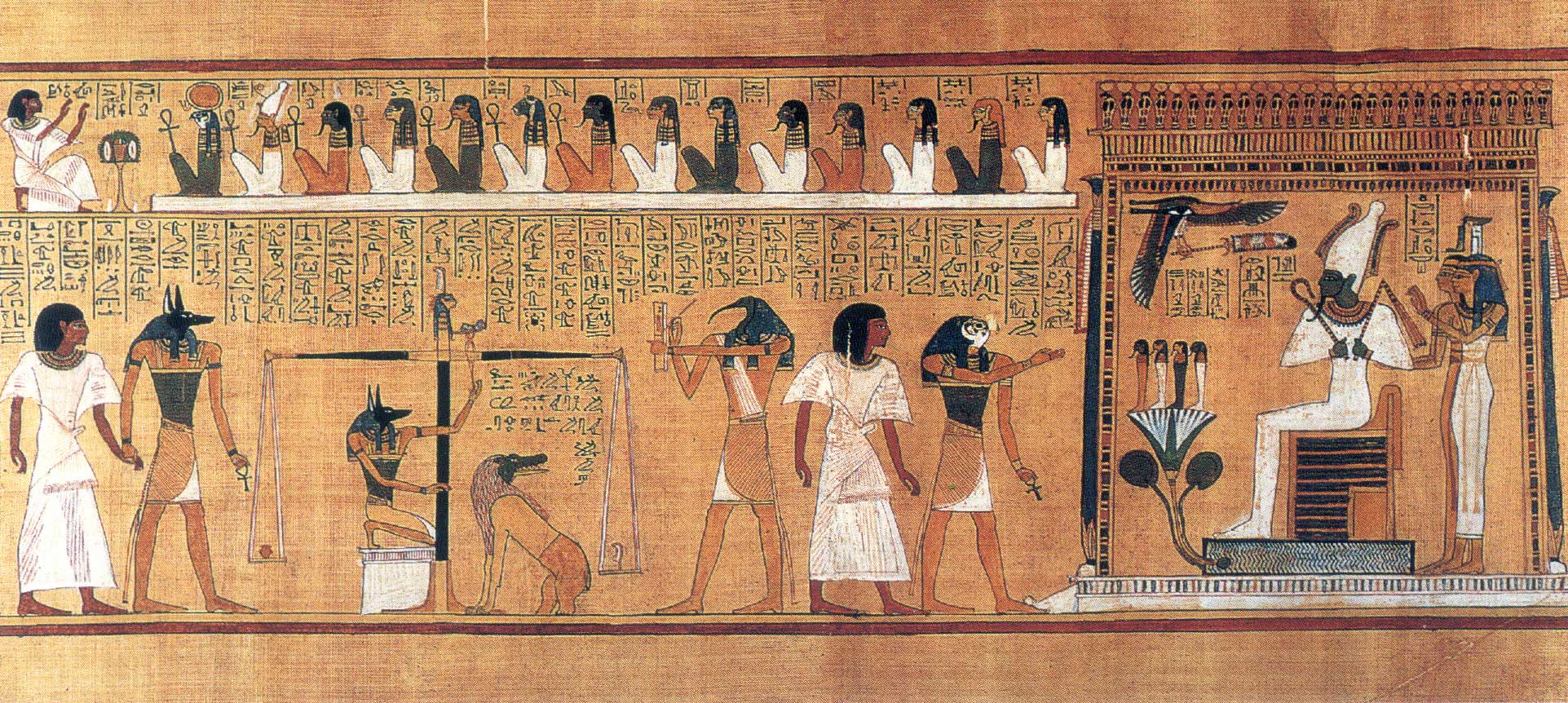
The judgment scene from the Book of the Dead of the royal scribe Hunefer (ca 1285 BCE). From left: Anubis brings Hunefer into the judgment hall; his heart is weighed and Thoth makes note of the favorable verdict; Horus conducts Hunefer into the presence of Osiris. (Source: National Geographic, Ancient Egypt)
Here you can see Ani on the far left watching while his heart is weighed against an ostrich feather representing Maʼat. Anubis is checking the scales while Thoth writes down the result. Ammit who is part lion, part hippopotamus and part crocodile waits in to see if a meal will be on offer (the heart would be eaten if the dead person was found wanting). At the top are gods and goddesses witnessing the judgment.
In the actual Book of the Dead text there is no mention of the weighing of the heart as such. Instead there is a long list of ‘negative confessions’ Extracts are given here.
Hail to you, great Lord of Justice!…I know the names of the forty-two gods of those who are with you in the Hall of Justice, who live on those who cherish evil and who gulp down their blood on that day of reckoning of characters in the presence of Wennefer. Behold the double son of the Songstress; Lord of Truth is your name. Behold I have come to you, I have brought you truth, I have repelled falsehood for you. I have not done falsehood against men, I have not impoverished my associates, I have done no wrong in the Place of Truth, I have not learnt that which is not, I have done no evil, I have not daily made labor in excess of what was due to be done for me, my name has not reached the offices of those who control slaves, I have not deprived the orphan of his property, I have not done what the gods detest….
Egypt Centre has a version of the weighing of the heart scene on a 21st Dynasty Coffin.
Weighing Of The Heart Scene from the 21st Dynasty coffinThis is a scene from the 21st Dynasty coffin of the lady musician which is on display in the downstairs gallery of the Egypt Centre. The representation is usually used to illustrate Spell 125 of the Book of the Dead which appears on coffins, papyri and tomb walls. In this the deceased is judged and their heart weighed against the ‘Maʼat’ feather, the Feather of Truth. If their heart was heavy and they were not judged ‘True of Voice’ the heart would be eaten by the Devourer. The theme of the weighing of the heart occurs as early as the 11th Dynasty (Seeber 1976: 67) but scenes are more common in the New Kingdom in tombs and on coffins. The actual spell does not mention the weighing of the heart as such.
Source: Weighing Of The Heart Scene
Does the Bible or the witless Scarecrow in The Wizard of Oz mention the brain more frequently? If your answer was the scarecrow, you are right. The Bible mentions a number of key human organs, such as the heart, blood, bowels, liver, and kidneys, but never mentions the most important organ of all, the brain. This is not unusual, of course, unless you happen to view the Bible as an inspired scientific textbook, in which case it would appear to be missing a bit of vital information.
Does the Bible Speak of a Brain?
Comparing the heart with the brain, which beats faster in reaction to anger, love, joy, physical exertion, etc. The heart lies near the center of the body and you arrive at the ancient conception that it was the primary seat of one's reasoning facilities.
Heart, Head and Mind - Prescientific Ignorance in the Bible
Addresses the Question about the use of the word ‘mind’ versus the ‘heart’ in the Bible. Biblical writers believed body organs such as the heart were center of reasoning.
“Brain and Mind Question” and Christian Theistic Philosophers
Christian Philosophers and their attempts at explaining the presently unexplainable.
The most important of the “core” spells that recur consistently in various versions of the Book of the Dead is found in Chapter 125, detailing the “weighing of the heart” of the deceased against the feather of Maʼat, the Egyptian goddess of truth. Before Osiris and a panel of judges, each of which represents an Egyptian Nome (province), the deceased denies a series of offenses which is called “the Negative Confession”. Followed by the heart, believed to be the center of thought, memory and personality, weighed in a balance by Anubis while Thoth (divine scribe) records the verdict. If the heart and feather measure equal weight, the deceased is thereby declared “true” or “justified of voice”, and accorded a portion in the domain of Osiris. He or she might also join the realm of the sun god or might dwell among the circumpolar stars. Miscreants faced annihilation by the “Swallowing Monster,” a hybrid of crocodile, lion and hippopotamus, that crouches at the base of the scales.
Does the Bible Speak of the Brain? - Heart vs. Mind in Bible
The Questions Below Are From The Article, “The Tyranny of Common Sense” by the British philosopher David Papineau, author of The Roots of Reason: Philosophical Essays on Rationality, Evolution, and Probability, and, Thinking about Consciousness (Oxford University Press).
To quote Papineau:
Philosophical conservatism is especially rife in one of my own specialties, the philosophy of mind. This is an area where there is plenty of scope to query common sense. Everyday thinking embodies a rich structure of assumptions about the mind, and it is by no means clear that all these assumptions are sound. In particular, there are many recent scientific findings that cast substantial doubt on our intuitive view of the mind. For a start, take Benjamin Libetʼs work on the genesis of actions. Libetʼs experiments indicate that, at least when it comes to basic bodily movements, our conscious choices occur a full third of a second after neural activity in the brain begins to prompt the behavior. This certainly casts doubt on our intuitive conviction that our actions are instigated by our conscious choices. Again, the work of David Milner and Melvyn Goodale on the separation of the dorsal and ventral streams in visual processing (the “where” and “what” streams) suggests that our basic bodily movements arenʼt guided by our conscious visual awareness but by some more basic mechanism. And then there are the many experiments on “change blindness”. These show that we often fail to see large visible changes occurring right in front of us, and so question the intuitive compelling idea that we are aware of pretty much everything within our field of vision.
However, when philosophers come across this kind of work, they donʼt view it as an exciting challenge to the everyday view of the mind. Rather, their first reaction is to distrust the interpretation of the scientific experiments. In their view, there is no way that our everyday view of the mind can be threatened by scientific findings. Our intuitive conception of the mind is sacrosanct, so there must be something wrong with scientific arguments that cast doubt on it.
Sometimes this resistance is rationalized by positing a principled distinction between “personal level” claims about the mind and “sub-personal” accounts of the mechanisms operating in the brain. The idea is that science can tell us about the sub-personal level, but the personal level is something that we need to find out about by commonsensical means. But this distinction seems a desperate device. Of course, there can be differences in the grain of different descriptions of any system, and we should not suppose that interesting claims about the parts will automatically translate into interesting claims about the whole. But we can agree about this without adopting the unmotivated and indefensible view that our intuitive large-scale picture of the mind is somehow insulated against any threat from scientific findings.
I myself have recently become interested in a rather different way in which recent scientific findings threaten to overturn our everyday view of the world. Here the evidence comes from quantum mechanics rather than psychological research…the full article appears in this monthʼs issue of The Philosophers Magazine
Professor Colin McGinn is a fascinating British philosopher whose work focuses on philosophy of mind, ethics, and philosophical logic. He was recently interviewed on Moyersʼs new program, Bill Moyersʼs on Faith and Reason, which can be seen here. As well as being interviewed by Jonathan Miller in the summer of 2003 for the series “Atheism - A Rough History Of Disbelief”, the transcript of which can be read here.
McGinn is the leading proponent of the “New Mysterianism”, namely, that a full understanding of the mind-brain identity might never be achieved. His classic paper on the topic is available online: McGinn, C. (1989), “Can We Solve the Mind-Body Problem?” One difficulty with solving the problem he mentions is that, “Consciousness does not seem made up out of smaller spatial processes; yet perception of the brain seems limited to revealing such processes.” McGinn also acknowledges a debt to Nagel who pointed out the ineffability of bat experience, which McGinn used as an analogy in his article. According to Nagel, we can never really grasp what itʼs like to be a bat; some aspects of bathood are, as McGinn might put it, perceptually closed to us. Now if all our ideas stemmed directly from our perceptions (as is the case for a ‘Humean’ mind), this would mean that we suffered cognitive closure [or blindness] in respect to some ideas (‘batty’ ones, we could say). Of course, weʼre not in fact limited to ideas that stem directly from perceptions; we can infer the existence of entities we canʼt directly perceive. But McGinn says this doesnʼt help. In explaining physical events, you never need to infer non-physical entities, and in analyzing phenomenal experience you never need anything except phenomenal entities. So weʼre stuck. (To quote someoneʼs analysis of McGinnʼs view.)
McGinn is also mentioned in the following online philosophy of mind articles:
Nicholson, Mr D.M. (2005) From a Flaw in the Knowledge Argument to a Physicalist Account of Qualia.
Lazarov, Georgi (2003) Materialism and the problem of consciousness: The aesthesionomic approach.
Nicholson, Dennis (2003) Solving the Mind-Body Problem - The Real Significance of the Knowledge Argument.
Carruthers, Peter (2002) Consciousness: explaining the phenomena. Naturalism, Evolution and Mind..
Harnad, Stevan (2001) Explaining the Mind: Problems, Problems. The Sciences.
Harnad, Stevan (2001) No Easy Way Out. The Sciences.
Carruthers, Peter (2000) The evolution of consciousness. Evolution and the human mind: modularity, language and meta-cognition.
Harnad, Stevan (2000) Correlation vs. Causality: How/Why the Mind/Body Problem Is Hard. Journal of Consciousness Studies.
Humphrey, Nicholas (2000) How to solve the mind-body problem. Journal of Consciousness Studies.
Also of note is McGinnʼs university homepage which features a link to his online book, “Principia Metaphysica” that contains some intriguing paragraphs. McGinn seems to be aiming for a poetic form of philosophical discourse that sums up his view of life the universe and everything, but also recognizes the limitations of both philosophical language and human understanding. Note especially his mention of “intentionality” and “consciousness” in the final paragraph below:
23. I want to say outright that laws necessarily come before everything, even God—but that is not quite right (though sometimes hyperbole serves sobriety). It is as if the laws of the world were the first item on Godʼs agenda, and once they were settled a lot else was too. The laws that govern God are an embarrassment to him, like wearing a low-ranking uniform; he wishes he could throw them off. But without them he is nothing, a pure untrammeled ego, a frictionless point, a featureless receptacle—a metaphysical vacuum. The laws of God would apply to other gods with his nature; he is subsumed by his laws. The idea of the supernatural is not scientifically dubious; it is metaphysically incoherent. Any object consists of law-governed stuff—so where is there room for the supernatural (in the sense of an object subject to no law—or to “quasi-laws”)? Try to conceive of a universe in which every object is supernatural. Supernatural compared to what? We think we have the idea of the absolutely free agent, a pure lawless will, a nomologically transcendent I—but without laws there is no nature, and hence no object. Of course, there is no contradiction in the idea of another kind of stuff “ectoplasm”) subject to other types of law; but this is really the idea of another order of nature. No object could participate only in miracles, if a miracle is defined as an exception to natural laws. (A law is actually the nearest thing to a miracle that we have.)
24. Laws are produced by nothing but produce everything. Laws do not impose order on the world, as if the world were a disorderly place till they came along. Can you rely on laws of nature? Not as you rely on the word of a trusted friend. Laws are formative, not merely reliable or predictively useful. The sun may not rise tomorrow—it may be blown out of the sky by powerful aliens. But this is no abrogation of the laws of nature. To abrogate the laws of nature would be to have no sun to begin with. Obviously, laws do not govern the universe in the way a political party governs a country, and yet this dual use of “govern” invites illusions of independence. It would probably be best to re-invent our entire vocabulary for talking about laws.
25. “Laws + stuff = objects”: not such a bad way to put it. “Laws are made manifest in objects and events”: yes, but that doesnʼt mean they acquire reality that way. “Objects instantiate laws”: true, but not as objects instantiate predicates (one wants to make a distinction here between internal and external instantiation.) “Objects have laws running through them”: better, metaphorically—and how metaphorical is “instantiate” anyway? Compare: “objects ‘respect’ laws”.) If there were no laws, there would only be raw stuff—and that is impossible. Raw stuff is like the unarticulated given—a kind of contradiction. Stuff must come in the form of objects, as thoughts must come in the form of intentionality (rough analogy). Lawless stuff is like Jamesʼs “blooming, buzzing confusion”—a trick of language. Stuff, objects and laws come in a seamless package—as consciousness and intentionality do. There is no shaping of a pre-existing reality. (Remember that all analogies have their limitations.) Physical atoms are anything but formless; they are the parts of objects—not their stuff. Godʼs three major acts of creation—stuff, objects and laws—are really just one. Conceptual distinctions are not ontological distinctions.
A list of resources and links in which Christian philosophers disagree whether a Christian should be a brain-mind monist or brain-mind dualist.
I have been discussing brain-mind matters with the Christian philosopher Vic Reppert for years, even before his book was published and before he began his blog. See Vicʼs blog, named after his book, “C. S. Lewisʼ Dangerous Idea”. I am a fan of Vicʼs expertise and composure, including his acknowledgment of arguments contrary to his philosophical and theological opinions. There is agnosticism mingled with his Christian faith—a healthy proportion—so far as I can tell. But that comes from his willingness to remain informed by all sides and to remain aware of unanswered questions and uncertain variables.
One might take note especially of some comments made by Vic concerning intellectual performances by freethinkers Drange (arguing against a proponent of Bahnsenʼs views) and Parsons in debates with Christian philosophers. Apparently Vic and even the younger Christian philosopher, Jason, have been impressed by some points freethinkers Drange and Parsons have raised.
Vic also admits that there are a variety of views held even by Christian philosophers regarding the brain-mind question, including pro-physicalist views. See also the Christian debate book published in May 2005, In Search Of The Soul: Four Views Of The Mind-body Problem, published by Inter-Varsity (the same Christian press that published Vicʼs book, C. S. Lewisʼs Dangerous Idea, two years previously) there are some “physicalistic” views represented. See also this book published Jan. 2006 Bodies and Souls, or Spirited Bodies? (Current Issues in Theology) And Whatever Happened to the Soul? Scientific and Theological Portraits of Human Nature And Body, Soul, and Life Everlasting: Biblical Anthropology and the Monism-Dualism Debate
My own comments can be found at Vicʼs blog and in a few articles at my website.
Iʼd sooner give science at least a couple more centuries of patient investigation of the brain-mind before coming out with premature proofs or disproofs. I also suspect that brain-minds do not come together all at once, but that just as the brain develops, a mind also takes time and a wealth of experiences to develop and incorporates more sensory input and data each second than any of us are consciously aware of, and that even at the moments of creation of memories of untold numbers of things we experience, we are probably unconscious of all the connections between each memory that happen at their creation. And all the thoughts we later take for granted and the connections they have with reality are likewise taken for granted as something automatic, but in fact it all took a lifetime to build up.
There is also the question of “commonsense” responses to the brain-mind question, and of “commsense” itself, as elucidated in an article in The Philosopherʼs Magazine by David Papineau, Professor of Philosophy of Science at Kingʼs College, London and author of The Roots of Reason and Thinking about Consciousness (Oxford University Press). Papineauʼs article is titled, “The Tyranny of Commonsense,” and in it he says, “Everyday thinking embodies a rich structure of assumptions about the mind, and it is by no means clear that all these assumptions are sound. In particular, there are many recent scientific findings that cast substantial doubt on our intuitive view of the mind. For a start, take Benjamin Libetʼs work on the genesis of actions. Libetʼs experiments indicate that, at least when it comes to basic bodily movements, our conscious choices occur a full third of a second after neural activity in the brain begins to prompt the behaviour. This certainly casts doubt on our intuitive conviction that our actions are instigated by our conscious choices. Again, the work of David Milner and Melvyn Goodale on the separation of the dorsal and ventral streams in visual processing (the “where” and “what” streams) suggests that our basic bodily movements arenʼt guided by our conscious visual awareness but by some more basic mechanism. And then there are the many experiments on “change blindness.” These show that we often fail to see large visible changes occurring right in front of us, and so question the intuitive compelling idea that we are aware of pretty much everything within our field of vision. However, when philosophers come across this kind of work, they donʼt view it as an exciting challenge to the everyday view of the mind. Rather, their first reaction is to distrust the interpretation of the scientific experiments. In their view, there is no way that our everyday view of the mind can be threatened by scientific findings. Our intuitive conception of the mind is sacrosanct, so there must be something wrong with scientific arguments that cast doubt on it.”
See also the book, The Illusion of Conscious Will.
I suspect that brain-minds “emerge” since surprising phenomena occur when a glowing stick is subjected to slightly higher and higher levels of oxygen because at some point it bursts into flame, just as surprising things occur when you add one more alphabet block to a pile because at some point you can suddenly form many more words from the letters on all the blocks in that pile. Both analogies were used by the Christian brain physiologist (also a founder of the journal, Experimental Brain Science) D. M. MacKay in his book The Clockwork Image (Intervarsity Press), in which he concluded that Christians need not be afraid of brain-mind monism, because God can preserve the data that is us in some other format after this body dies just as we can preserve songs in formats other than their original formats). “Emergence” has also been championed by a non-Christian philosopher of brain science, Roger Sperry.
Andrew M. Bailey, a young philosopher at the Christian college of BIOLA lists some reasons he too is attracted to physicalism (of an emergent yet non-reductive sort), adding in his blog that “substance dualism remains a (miniscule) minority position among philosophers of mind, despite the traction that more modest forms of dualism have recently found. Substance dualists like J.P. Moreland (and the rest of the Biola crew) [not to forget Platinga] do not yet have reason for triumphal celebrations.” See also Bailey on physicalism here and links to his other pieces here.
