The Flat Earth Myth? It's true that Columbus and most Church Fathers were not flat earthers, but don't start cheering just yet…

Christopher Columbus Map

The map (to the right) displays how Columbus and some other fifteenth century Italians imagined the earthʼs geography looked, click here for more info. Columbus died, still thinking he had reached islands near India. We will discuss Columbus (along with the influence theology had on Medieval map making, and myth-making) again at the end of this blog entry but for now itʼs enough to note that Columbus was no flat earther.

But long before Columbus (and even before the Church Fathers), writings and imagery from the ancient Near East demonstrated that ancient Egyptians, Mesopotamians and Hebrews agreed the earth was flat and stationary. Even the authors of inter-testamental works like Daniel and Enoch (written between the time of the “Old Testament” and the “New Testament”) assumed the earth was flat. Even the authors of the New Testament, in the first century, employed ideas and phrases appropriate to the flatness of the earth, and also appropriate to a three-tier cosmos with Godʼs heaven above, earth below and “sheol/hades/tartarus” lying “under” the earth—all such Greek terms being translated in the New Testament with the Germanic word, “hell” (see “The Cosmology of the Bible,” a chapter in The Christian Delusion, click here, and see “Is Flat Earth Biblical Cosmology merely an Infidelʼs Delusion?” click here).

Furthermore, the idea of the sun, moon, and stars, having waters set firmly above them was discussed by early rabbis as well as Church Fathers, and medieval Christians, in fact right up till Martin Lutherʼs day at the dawn of the Reformation in the fifteenth century. See this pic from Lutherʼs Bible:

Only after the invention of the telescope did enough data pour in such that ancient ideas and words of Scripture no longer determined how the cosmos was viewed (with some modern day Christians still in denial, from geocentrists to young-earth creationists, click here. While other Evangelicals are striving to get their brethren to understand the ancient Near Eastern background of Genesis 1, click here, here, and here.

Returning to the question of what the Church fathers believed, the majority were not flat earthers but sought a concordance between the Bible and the notion of a spherical earth as found in the Hellenstic world, the same world that the Church Fathers wished to evangelize. Though a few did reject the “pagan” notion of a spherical earth, click here for more info.

One Christian in particular, writing under the pseudonymn, “Cosmas Indicopleustes,” who lived toward the end of the reign of the Christian Emperor Justinian in the sixth century, attacked the pagan “spherical earth” view and defended instead the view that the earth was flat, based on the idea in the Letter to the Hebrews that the earth was like Godʼs tabernacle in the Old Testament in which God dwelt. His book was called Christian Topography, click here. Ironically, modern day Evangelical Christian scholars (including inerrantists like John Walton, and G. K. Beale, as well as apologists like N. T. Wright) agree that the setting up of the cosmos according to Genesis chapter 1 should be interpreted as the building and consecration of a “temple” for God to dwell in—which resembles the view of Cosmas, i.e., that the cosmos was shaped like the “tabernacle” used by Moses in the wilderness, a “tabernacle” being a sort of movable “temple.” [see ENDNOTE #1] So these modern day Evangelicals view Genesis 1 as a story about the creation of the cosmos based on the motif of “temple mythology.” Cosmas would probably be annoyed at the rejection of his literal interpretation, yet also pleased to at least hear that his tabernacle/temple idea has withstood the test of time and even been applied to the first chapter of the Bible.

Even as late as the eighth century at least one medieval Christian wrote a book that depicted the earth in flat terms, attributing his work not to himself in the eighth century but to an author before Cosmasʼ own day. The book was titled, The Cosmography of Aethicus Ister, click here for a description.

And even though most Church Fathers accommodated themselves to the prevalent Hellenistic idea of a spherical earth, note that a major Church Father like Augustine denied that human beings lived on the other side of that sphere.

Saint Augustine (354-430 CE):

But as to the fable that there are Antipodes, that is to say, men on the opposite side of the earth, where the sun rises when it sets to us, men who walk with their feet opposite ours that is on no ground credible. And, indeed, it is not affirmed that this has been learned by historical knowledge, but by scientific conjecture, on the ground that the earth is suspended within the concavity of the sky, and that it has as much room on the one side of it as on the other: hence they say that the part that is beneath must also be inhabited. But they do not remark that, although it be supposed or scientifically demonstrated that the world is of a round and spherical form, yet it does not follow that the other side of the earth is bare of water; nor even, though it be bare, does it immediately follow that it is peopled.

Since these people would have to be descended from Adam, they would have had to travel to the other side of the Earth at some point; Augustine continues:

It is too absurd to say, that some men might have taken ship and traversed the whole wide ocean, and crossed from this side of the world to the other, and that thus even the inhabitants of that distant region are descended from that one first man.

Flat earthism underwent a bit of a revival in the early 1900s when some Christians in both Britain and the U.S. cited Scripture in its support and defended it in the face of what they called the “evils of modern astronomy.” British supporters of a flat earth challenged spherical earth scientists to public debates, and the flat earthers were said to have won over their audiences. In the 1920s in the U.S. Wilbur Glenn Voliva built one of the most powerful radio transmitting stations in his day, and broadcast his flat earth views widely from the city of Zion, Illinois, a Christian religious community that upheld the flat earth view.

According to Robert J. Schadewald, who was researching a book on the history of Flat Earth movements before he died in 2000, there are still flat earthers today:

[The late] Charles Johnson, a twentieth century Flat Earther and editor of The Flat Earth News, was sort of a wacky character, but he was not really representative of flat earthers in general. The half dozen or so other flat earthers Iʼve spoken or corresponded with have included a successful Boston trial lawyer, a priest who belongs to a society devoted to the preservation and translation of ancient Coptic manuscripts, a retired financial officer from a major metropolitan school system (he thoughtfully corrected an error in Greek grammar I had copied from a flat earth source), and a young man who intended to translate an eighth century flat earth treatise by Aethicus of Istria from Latin into English. Not exactly a bunch of semiliterates!

Schadewald added:

The Antiochene Fathers of the early Christian Church more or less invented the historical-critical method of exegesis popular among modern fundamentalists within the Reformed tradition. (Not surprisingly, *every* Antiochene Father whose views on the subject I have been able to discern was a flat earther!) So I think it is a bit strong to suggest that this method doesnʼt have ‘anything to do with the history of Scriptural interpretation.’ It may have been moribund for a long time, but it has ancient roots. [Emails dated 8/10/99 and 8/5/99 respectively from the late Robert Schadewald, author of numerous articles on “flat earthism,” and author of the unpublished work, The Plane Truth: A History of Flat Earth Science.]

For some articles by Schadewald that touch upon the history of nineteenth and twentieth century flat earth groups click here.

Not only do the flat earthers whom Schadewald met attest to that beliefʼs presence in the year 2000, but some twenty first century flat earthers appear to have set up a serious web forum, click here.

T-shirt sold at TheFlatEarthSociety.Org

Geo-centrism is yet another view that has never died out among believers in the Bible who cite Scriptures in support of their belief. Early Church Fathers were geocentrists, as well as the Fathers of Protestantism, Luther and Calvin (click here). Today there are still geocentrists among some orthodox Jewish educational institutions (click here). Geocentrism is also promoted by some Catholics and Protestants, who held a joint conference recently, attempting to augment their Bible-based belief in geocentrism with “scientific arguments,” click here.

A T-O type map, from 1300 (Hereford Cathedral, England) with Jerusalem at center, east toward the top, Europe at bottom left and Africa on the right.

Columbus & Ptolemyʼs Geography

Columbusʼ fifteenth century view of the size of the earth was based on Ptolemyʼs second century Geography book. Ptolemy calculated that a degree was 50 miles (not 70 as we know today), which gave him an earth with a circumference of only 18,000 miles. Ptolemy also stretched Asia eastward for 180 degrees (not 130 degrees as we know today). Therefore, Columbus, taking the word of a book composed thirteen hundred years before he was born, thought India was far closer than it really was.

Why was Ptolemyʼs Geography still considered relatively accurate thirteen hundred years after its first publication? Europe had become Christian. Expanding knowledge of the physical world was deemed to be of relatively less importance than theological notions concerning the world, especially the “world to come.” In fact there was no English word for “geography” until the 16th Century.

A classical T-O Map, but this one is from a printing press, not hand drawn like the one above, and far from being the earliest. It dates to 1472.

At any rate, Columbus appears to have used a version of Ptolemyʼs smaller size of the earth along with a belief that less sea probably existed and more land (per II Esdras, see below). So when he did reach land he remained convinced he had discovered islands off the coast of India. Columbus also noted the existence of fresh waters from what we know today as the Orinoco river which implied a great river and a vast continent. Christian geographers said that such could not exist south of the equator. So, he decided that he had found the location of Paradise. Columbus grew increasingly religious in his later years and wrote, A Book of Prophecies (1505), in which passages from the Bible were used to place his achievements as an explorer in the context of Christian eschatology.

Other Peculiar Notions About Geography That Were Held During the Middles Ages

  1. The Insignificant Ocean—A passage found in the Catholic Bible (and in early Protestant Bibles that used to include the Apocrypha), implied that the earth was mostly land rather than sea. The “Ocean,” was believed to be a body of water that surrounded the earthʼs three major continents (Europe, Asia, Africa) in a circular fashion, but not as expansive as the continents themselves. The verse in question was this one:

    Upon the third day [of creation] thou didst command that the waters should be gathered in the seventh part of the earth: six pats hast thou dried up, and kept them, to the intent that of these some being planted of God and tilled might serve thee. [II Esdras 6:42, II Esdras is an ancient Apocryphal work included in Catholic Bibles, but also included in early Protestant Bibles, even the first edition of the King James Bible]

    The verse implied that six sevenths of the world must be land, so the ocean was believed to be far smaller than we know it to be today. The “Ocean” simply meant a circle of water that surrounded the three major continents of the world, with Jerusalem in the center. While beyond the “Ocean” lay Paradise.

  2. Early Medieval maps, driven by theological rather than geographical concerns, often pictured Asia at the top [east was at the top] and Europe and Africa beneath Asia, one on the right, the other on the left, all three continents being encircled by the “Ocean,” with a “T”-shaped body of water dividing the three continents. The upright trunk of the “T” was the Mediterranean Sea, the right cross bar of the “T” being the Nile river, and the left cross bar of the “T” being the Danube river (or some other major European river).

  3. It was also commonly believed that the three known continents, Europe, Asia, and Africa, constituted the entire world, and that each continent was occupied primarily by the descendants of one of the three sons of Noah after they left the ark, and/or after the dividing of the world after the tower of Babel incident, with Jerusalem lying at the “center of the world.”
  4. In short, Medieval map makers came up with ways to design maps that supported Christian theological beliefs. Different portions of the Bible provided added opportunities for creative cartography.

    At the top of the T maps, also called T-O maps, geographers placed the Garden of Eden. (Keep in mind the top was Asia, the east.) Typically surrounded by a mountain range or a high wall, outside of which was a wasteland filled with wild beasts. Popular tales told of monks who traveled to locate Eden.

    Saint Brendan (484-578), an Irish monk, apparently believed Eden was in the Atlantic. He reportedly sailed west and found a beautiful island paradise. “St. Brendanʼs Island” remained on maps until at least 1759, even though it was never found by anyone else.

    The books of Ezekial in the Old Testament and Revelation in the New Testament both warned of “Gog and Magog,” so they were added to maps. Usually located in the extreme north (per Ezekielʼs description). Roger Bacon urged the study of geography to prepare for an invasion from Gog and Magog.

    In the twelfth century during the Crusades, Europe sought allies in the Holy Land. Prester John was said to be a priest-king who had defeated the Muslims in his kingdom. Allegedly descended from the same race as “the Three Wise Men” (who traveled far to deliver gifts to the baby Jesus), Prester John was also allegedly a pious Christian, military genius, and an enormously wealthy ruler. About 1165, a letter appeared from Prester John to the Byzantine emperor of Rome and the King of France allegedly promising to help them to take back Jerusalem from the Muslims. “Prester Johnʼs Letter” was extremely popular and widely published. It included mention of such things as: “birds called griffins who can easily carry an ox or a horse into their nest to feed their young.” “Horned men who have but one eye in front and three or four in the back.” Bowmen “who from the waist up are men, but whose lower part is that of a horse.” For years, mapmakers continued to attempt to locate Prester Johnʼs kingdom.

    A Catalan Atlas from 1375, made for King of Aragon by Abraham Cresques, a Jew on Majorca, was created by combining empirical geographical knowledge gained from ships of trade with theologically based ideas. Jerusalem was still near the center of the earthʼs geography, Gog and Magog still present.

    The cartographerʼs greatest act of self-control was to leave parts of the earth blank. A difficult act of self-control indeed, as eons of cosmological speculation and mythmaking—from the time of the ancient Near East till today—demonstrates.


Endnotes

#1 Some Bible scholars argue that the story of a “tabernacle” in the “wilderness” might also be a myth retrojected back into the Moses story, based on the later building of the temple in Jerusalem.

Scent from heaven? Who nose? Do tales of Jesus' anointing, resurrection & bodily ascension, bear the aroma of truth?

Anointing

According to the Gospels Jesus was anointed with (or received) perfume numerous times in his life. Are all the tales true? Are any of them symbolic, legendary? At his birth Jesus allegedly received a visit from an unknown number of wealthy star gazers (was it two? three? more than three? Matthew does not say) who traveled far to deliver gifts of “frankincense and myrrh” (not to mention an unknown quantity of “gold”), at least thatʼs what the Gospel of Matthew states, none of the other Gospels happen to mention such a tale.

During his adulthood Jesus encountered expensive perfume again when women began anointing him with it. There is one story of the anointing of the adult Jesus in each Gospel. One was sufficient for the purposes of each Gospel author. To try and combine the anointing stories of all four Gospels into a single “life of Jesus” is to ignore the differences between each, and would add up to three separate tales: One found in Mark and Matthew which are in substantial agreement, another in Luke that disagrees with Mark/Matthew, and a third tale in John that features elements of the tales in Mark and Luke but also disagrees with them, giving us a total of three separate anointing stories. So was Jesus anointed three times? Or did the story change over time?

The failure of attempts to harmonize such stories reminds me of similar attempts made by conservative Christians to harmonize stories of “Peterʼs three denials of Jesus” that are found in all four Gospels (a total of twelve denials). The circumstances of each denial disagree as to where, when, and, in response to whom. Some of the individual denials are easier to harmonize with those in other Gospels, some less easy to harmonize. But disagreements between denials were so blatant in some cases that one conservative Christian insisted Peter must have denied Jesus as many times as there are unharmonizable incidents in all four Gospels. That Christian had convinced himself that Peter may have denied Jesus more than three times, maybe six or more times, so long as he could find a way to retain the historical truth of every divinely inspired detail in his Bible and read the Gospels like a single story—instead of four separate stories, including some that changed over time. He continued to argue that his solution of multiplying the total number of denials was the most reasonable, regardless of the fact that each Gospel by itself agrees with the others that Jesus only mentioned three denials by Peter.

Below are the tales of the anointings of Jesus. The tales in Mark and Matthew are probably the earliest and they parallel each other so closely as to suggest a common literary source. They also agree that perfume was poured on Jesusʼ head:

Mark 14:3,8 (NIV) While he was in Bethany, reclining at the table in the home of Simon the Leper, a woman came with an alabaster jar of very expensive perfume, made of pure nard. She broke the jar and poured the perfume on his head…to prepare for my burial.

Matthew 26:6-7,12 (NIV) While Jesus was in Bethany in the home of Simon the Leper, a woman came to him with an alabaster jar of very expensive perfume, which she poured on his head as he was reclining at the table…to prepare me for burial.

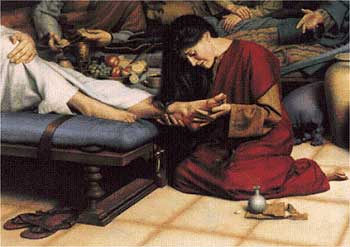
By the time Lukeʼs Gospel was composed the story seems to have changed. It is no longer Jesusʼ head that is anointed with expensive perfume but his feet, by a female sinner who first washes them with her tears and wipes them with her hair, and Luke places the anointing in an early chapter of Jesusʼ ministry, so early that Jesus is shown dining with a Pharisee:

Luke 7:36-38 (NIV) When one of the Pharisees invited Jesus to have dinner with him, he went to the Phariseeʼs house and reclined at the table. A woman in that town who lived a sinful life learned that Jesus was eating at the Phariseeʼs house, so she came there with an alabaster jar of perfume. As she stood behind him at his feet weeping, she began to wet his feet with her tears. Then she wiped them with her hair, kissed them and poured perfume on them.

In all three of the earliest Gospels the woman who anoints Jesusʼ head or feet is not named. But by the time the Gospel of John was composed a name had been allocated to the “anointress” (if I may coin a term), “Mary.” The author even says this was the same “Mary” whom Luke had mentioned in his separate tale of the “two sisters,” one of whom “sat” at Jesusʼ feet listening to him (Luke 10:38-42). But in the Gospel of John this Mary is no longer the one in Luke who merely “sat” at Jesusʼ feet and drew sighs from her sister who wished to scold her for sitting inertly on the floor and leaving her sister with all the kitchen work. Instead, the “Mary” in the Gospel of John is active, dramatically so, for she is depicted as anointing Jesusʼ feet and wiping them with her hair, resembling Lukeʼs anointing story about the unnamed female sinner in the home of the Pharisee. The Gospel of John adds that the whole house was filled with the aroma after about a “pint” of perfume was poured on Jesusʼ feet, so I guess there was no skimping on the perfume per John—nor does John skimp on the perfume in yet another anointing episode found only in that Gospel, but before proceeding to that episode here is the story of Johnʼs “Mary”:

John 12:1-3 (NIV) Six days before the Passover [Note: Jesus dies five days later in this Gospel, on the day before Passover], Jesus came to Bethany, where Lazarus lived, whom Jesus had raised from the dead. Here a dinner was given in Jesusʼ honor. Martha served, while Lazarus was among those reclining at the table with him. Then Mary took about a pint of pure nard [Note: “pure nard” is an unusual and precise phrase that appears in Markʼs earlier version and some commentators suggest that the author of the Gospel of John was acquainted with the tales in both Mark and Luke, combining elements of both to form a third tale], an expensive perfume; she poured it on Jesusʼ feet and wiped his feet with her hair. [Note how this resembles the tale in Luke, but the order in which the perfume is applied and the feet wiped is reversed. In Luke Jesusʼ feet are washed (with tears, something John does not mention) and wiped with hair, and only then is the perfume applied. But in John the perfume is applied and the feet are wiped with hair. So in John, Maryʼs hair is full of perfume, but in Luke the womanʼs hair smelled only of the dirt on Jesusʼ feet. The tale in John differs in this and other respects from earlier anointing tales but also demonstrates some knowledge of the story in Mark and Luke.] And the house was filled with the fragrance of the perfume.

Also, in the Gospel of John not only did the feet of Jesus receive about a pint of perfume, but five days later the same Gospel says Jesusʼ lifeless body was wrapped with “seventy-five pounds of myrrh and aloes.”

But wait, thereʼs another perfume story I have not mentioned, but we must return to the earliest Gospel, Mark, to find it. That Gospel says that after Jesus died some women “saw” where Jesus had been laid and they returned to the tomb a day and a half later carrying “spice” with which they planned to anoint the body. Probably not “seventy-five pounds of myrrh and aloes” as in John, and which was not said to have come from those ladies. But comparing Mark with John and attempting to combine the two stories one might wonder how the ladies who saw where Jesus had been laid also failed to note the odor of seventy-five pounds of myrrh and aloe, an odor that probably followed Jesusʼ body into the tomb or filled the air around it. I would have thought women had better senses of smell, or if they saw Jesusʼ body being hoisted into the tomb they might have at least seen how Jesusʼ body gained 75 pounds of bulky wrappings after he died and that men were straining to maneuver it into the tomb, even on a stretcher, or if the body was not anointed until after it was laid flat in the tomb then perhaps the woman might have seen large jars of spice and wrappings being carried into the tomb. Instead, the early tale in Mark of the hastily buried (and unanointed) body of Jesus, and the tale in John of the heavily anointed body of Jesus simply pass in the night, each going in their own direction without connecting at all.

Of course the differences between the story of Mark and John pose little difficulty once one accepts that the story in Mark is a completely different tale from Johnʼs. Mark imagined Jesus being buried hastily leaving no time for anointing. While John has Jesus laid out in style, seventy five pounds worth of style. The Gospel of Matthew introduces another take on the tale in Mark because in Matthew there is no mention of the women having “spice” and a desire to anoint Jesusʼ body, instead they come to “see” the tomb. Why does Matthew alter the reason why the woman arrive Sunday morning? Because in Matthew the tomb is sealed and guarded (a story found only in Matthew and no where else). So the women would have had no chance of getting near Jesusʼ body let alone “spice” it up, so Matthew says the woman only came to “see” the tomb. Itʼs obvious at this point that different Gospel writers told different stories and changed them to fit with whatever else they wrote.

Returning to the depiction in the Gospel of John, of Jesus having about a pint of perfume poured on his feet by Mary such that the whole house smelled of it, and five days later Jesusʼ body being wrapped with seventy-five pounds of myrrh and aloe, one might wonder if there is any mention in John of the resurrected Jesus smelling of perfume after having arisen a day and a half later and shown himself to a woman and to the apostles. But there is none.

Neither is there mention of the resurrected Jesus smelling of perfume in any of the earlier Gospels. Of course Mark and Matthew, presumably the earliest two Gospels, feature no “seventy-five pound” anointing of “myrrh and aloes” of Jesusʼ body as in John, and they agree that an announcement was made at the empty tomb that Jesus had gone before the apostles to Galilee (“There you will see him”), so, it would take a while to reach Galilee before the apostles would even be near Jesus. Itʼs only in later Gospels (Luke and John) that there is no long delay before the apostles get to see the resurrected Jesus, for neither of those Gospels mention Jesus going ahead to Galilee to be seen there, but instead they have Jesus appearing in Jerusalem on the same day heʼs allegedly resurrected. So Jesus gets to meet the apostles sooner in Luke and John than in the earlier Gospels, Mark and Matthew. But no mention of the resurrected Jesus smelling of perfume in either Luke or John.

Speaking of the resurrection, a story in Luke that has always caught my eye takes place on the day of Jesusʼ resurrection. No time of day is specified, could be late afternoon or evening, doesnʼt say, and the apostles are merely “assembled together” (not cowering behind a “locked door” as in Johnʼs later version), when “Jesus himself stood among them,” and proves he is “not a spirit” but has “flesh and bone,” by eating a piece of fish. The story in Luke continues by claiming that Jesus “led” the apostles out of the city of Jerusalem to the town of Bethany.

I mention this story in Luke because I understand the earlier stories in Mark and Matthew in which Jesus goes ahead of the apostles to Galilee to be seen there, and how it would take the apostles some time to get to Galilee and how some sort of vision could take place out in Galilee, something out of the public eye, away from the big city of Jerusalem. Mark supplies no details at all, just a promise of seeing Jesus in Galilee, while Matthew features a short tale about a sighting in Galilee—but nothing about Jesus trumpeting his physicality, nor boasting about being “flesh and bone” and eating fish—instead, Matthew features a few short words of the risen Jesus, ending with, “but some doubted.” In comparison with the earliest two Gospels (Mark and Matthew) the later Gospels (Luke and John) add more sighting episodes, more elaborate descriptions, more words of the risen Jesus (over a hundred more), and allude to speeches delivered by the risen Jesus, though neither Luke nor John provide them for us to read. After Luke and John there came further stories about Jesus,—the Gospel of John ends by alluding to great numbers of stories then circulating about what Jesus did, “which if all written down I suppose the world could not contain all the books.” Iʼve mentioned this legendary-like development in resurrection stories before, here.

But letʼs take another look at the story in Luke about a resurrected Jesus who was “not a spirit” but “flesh and bone,” and who “led” the apostles out of the city of Jerusalem to the town of Bethany. I assume Jesus was walking and not floating nor spiritually leading the apostles. A walk through Jerusalem, the same town where he was crucified. Was Jesus tempted to walk past the high priestʼs home, past Herodʼs palace, or Pilateʼs? Did the little group walk within sight of the tall Roman garrison building next to the Temple?

A conservative Christian might suggest that the story of such a quiet stroll is no argument against it taking place, and no reason for doubting the inerrant word of God, but the silence in this case is deafening compared with the shouts of Hosannas Jesus had previously received when he rode a donkey into Jerusalem. Compare the two scenes. How somber the triumph of the resurrected Jesus is, everyone in that part of Jerusalem and Bethany oblivious to a dead man walking. Comparing that scene with Jesusʼ public entrance into Jerusalem before his death provides quite a contrast.

I wonder whether any of the apostles in that procession were tempted to converse a bit louder than usual, shout, knock on doors, wave some palms, ask Jesus to show himself to the high priest, preach in public, or announce what a spectacular miracle, as well as a spectacular victory had just occurred. Wasnʼt Jesus more triumphant now than when he had first entered Jerusalem to Hosannas? But no mention in the story is made of joy, of the walkers revealing themselves, nor of anyone recognizing them, nor paying the slightest attention. No one notices the figure in the lead with the holes in his hands and feet (nor looks up after catching a whiff of his perfumed body)? No beggar looks up and sees anything out of the ordinary, perhaps a beggar who would have recognized Jesus having seen him preach in the Temple (with his apostles beside him) a few days earlier? No Roman guards on duty on a corner or at the city gates? No questions asked, no answers offered? As I said, the silence is deafening. But the story seems perfectly suited as a sort of unfalsifiable fantasy told by believers and for believers (equally true of another story in Luke about Jesus walking to Emmaus with two followers, and only revealing who he is for an instant before he “disappears”).

Of course an apologist might suggest that Lukeʼs story about a resurrected Jesus walking the streets of Jerusalem with no fanfare was simply Godʼs way of doing things. But that doesnʼt explain other allegedly God-inspired tales that do involve fanfare:

  1. Jesusʼ death was accompanied by “tombs opening” and “many saints” rising from the dead who “entered the holy city” and “showed themselves to many” on the same day as Jesusʼ own resurrection, a tale told with extreme brevity and only in the Gospel of Matthew (the names of the “saints” were not mentioned, nor the names of any alleged witnesses, not until a century or more after Matthew when some Christians named a few of the alleged “raised saints” and also explained what happened to them—they “vanished” of course, after delivering their testimony to the very same Jewish religious leaders who condemned Jesus at his trial—at least thatʼs what some Christians wrote in The Gospel of Nicodemus, talk about corroborating evidence, Christians have demonstrated that they can invent it as needed)

  2. “Jesus was seen by over five hundred brothers and sisters [believers]” per Paul (By whom? Where? When? Who knows? Neither God nor man preserved such info for us, nor any details about that “appearance,” nor why it took place prior to an appearance to James. Such a tale also seems to have run its course fairly early because it is never mentioned again in any Gospel, nor Acts.)

  3. “Appeared in Galilee” to an unknown number of disciples per Matthew (though “some doubted”)

  4. “Appeared to them [the apostles] over a period of forty days and spoke about the kingdom of God,” and ate food with them during this period, per Acts 1. (I guess they werenʼt public speaking engagements nor public eating engagements during those forty days. Just keepinʼ things private, nothing to see here folks, move along.)

Itʼs not like Jesus wasnʼt “around” per the above boasts, nor other resurrected folks—from the “many raised saints” (mentioned only in Matthew) to a resurrected Lazarus (mentioned only in John) if you believe such tales. Itʼs just that the resurrected Jesus seems shy of the public eye in comparison. Only his spiritual family gets to see him.

Why such shyness? Perhaps Jesus had had enough anointings with expensive perfume: “Enough with the perfume already! From my birth to several times before my death, both head and feet, and then my body before burial, seventy five pounds worth, and then women come to my tomb to try and spice me up some more! In fact Iʼm still sick of the noisy ‘Hosannas’ the time I entered Jerusalem, and the crowd nearly plucked every leaf off those poor palms to wave them in my face and toss them in front of me. And I definitely refuse to show myself to the Pharisees, Herod or Pilate, or any other occupant of Jersualem the majority of whom can remain non-Christian and damned to hell. They have the prophets, and the many raised saints, and Lazarus, why do they need to see the “resurrected me” as well? Next thing you know Iʼll have to appear before Caesar in Rome, and in North America (to found the Mormon church), and in Korea (to found the Unification Church), and soon doubting Thomases everywhere will be begging me to appear to them, but Iʼm not going to offer every Thomas, Dickus and Harryus a chance to stick their hand in my side and believe, including people two thousand years in the future. Damn all those future doubters.

“Instead, Iʼm walking out of town quietly, the same day I show myself to just the apostles, no public celebrations, just a quick nosh on some fish and a stroll out of the city to nearby Bethany and Iʼll ascend from there into heaven. (Luke)

“Maybe not that fast, instead maybe Iʼll hang round with just with my homies for about six weeks, teach them a little more about the kingdom, not that any of them will remember a word I tell them during those six weeks of speaking, nor write it down. (Acts)

“Well, and I might appear to over five hundred believers at once, but just once, and just to brothers and sisters in Christ. (Paul)

“Hmmm, hereʼs a question, where should I be when I appear to the apostles for the first time? In Galilee where I started preaching (Mark & Matthew) or in Jerusalem where I died (Luke & John)? I dunno. Maybe I can inspire them to write that the first time the apostles saw me it was in both places, and we can call that place “Galusalem” or “Jerusalee.” Why be specific? Let people say what they may about the mixed up memories and memoirs of the Gospel writers, and about my lame victory lap out of Jerusalem with no Hosannas (Luke), and no crowds to see me rise up into heaven. Let them say these are ‘just so’ stories or urban myths written by and for believers. It doesnʼt matter. Because if they can believe the story found only in Matthew about the raising of many saints, and the story found only in John of the raising of Lazarus, what wonʼt they believe? At least the believers will believe. As for the doubting Thomasʼs, I repeat, to hell with them. No one will ever get that chance again, not a fully physical post-resurrection meeting just for them. Instead Iʼll leave people some weird tales like that old pulp fiction magazine of the same title, and tell them to believe ʻem or be damned. I am outta here! Looking forward to ascending bodily into heaven and not returning again that way til judgment day (Acts 1).

“Wait a sec, maybe I should think about this a bit more. After all Iʼm not coming back for over 2,000 years, and come to think of it I didnʼt leave behind much in the way of first-person named testimonies to my resurrection. Only that of Paulʼs in fact. And he left behind no description concerning what he saw except to write, ‘he appeared to me,’ thatʼs it. There are stories in Acts about my appearance to Paul and they contain some details but thereʼs also some differences between those stories and none of them were written by Paul, so they arenʼt first-person testimonies, and the author of Acts isnʼt even named.

“Also, I hope people donʼt get confused as to what ‘appearance’ means based on what Paul is going to write in 1 Corinthians 15, because later writings (Luke & Acts) will tell people that my resurrected ‘flesh and bone’ body had already ascended into heaven before I ‘appeared’ to Paul, and that body wasnʼt going to be seen again until the day of final judgment (Acts 1), therefore whatever ‘appeared’ to Paul it wasnʼt my resurrected body, since that had already ascended into heaven. But darn it, Paul equated my ‘appearance’ to him as if it was the same as my ‘appearances’ to others, so the earliest mention of my ‘appearances’ makes no distinctions as to what ‘appeared’:

1 Corinthians 15 (NIV) He appeared to Cephas, and then to the Twelve. After that, he appeared to more than five hundred of the brothers and sisters at the same time, most of whom are still living, though some have fallen asleep. Then he appeared to James, then to all the apostles, and last of all he appeared to me also, as to one abnormally born.

“Yup, that letter of Paulʼs is going to make things sounds a bit vague and sketchy, that I ‘appeared’ to the apostles and to Paul, without distinguishing between them. All just ‘appearances.’ All equal. Oh well.

“And what about that line sandwiched in between the appearances to Cephas and James, the line that I ‘appeared to more than five hundred of the brothers and sisters at the same time.’ Decades after that statement, the book of Acts is going to imply that there were far less than ‘five hundred’ brethren around after my body had already ascended into heaven. Acts 1:15 says that Peter preached to only ‘one hundred and twenty’ brethren, much less than ‘over five hundred,’ and my resurrected body had already ascended into heaven. That means people will question whether I was still on earth in my resurrection body when I appeared to ‘over five hundred brothers and sisters.’ Neither could Paul have seen my resurrection body if Acts 1 is correct, yet he speaks of my appearance to him as though it was equal to that of my appearances to the apostles.

“It also irks me that there will never be any mention made of to whom, when, or where I appeared in 1 Cor. 15. But I guess thatʼs alright since the stories in 1 Cor. 15 of my appearance to Cephas alone, and James alone, and ‘over five hundred brethren,’ are going to die out pretty quickly and never be repeated in the Gospels or Acts.

“In fact in the Gospel that will be composed last of all and lay furthest from 1 Cor. 15 some of those stories about me appearing to a lone person and then to the apostles will be reversed, and the even the name changed of the lone person. In the last written Gospel (John) it will say that I appeared to all the apostles except one, Thomas, and then that I came back a little later to show myself specifically to that lone apostle after he had gathered together with them. Paul in 1 Cor. 15 features no knowledge of that later tale about me coming back to be seen by Thomas, and it will seem strange to readers how that tale in John is like the opposite of the ones in 1 Cor. 15, and even changes the name of the apostle.

“Sheesh, speaking of things Paul wonʼt mention but later writings like the Gospels will mention, thereʼs the story of my very first appearance, not to Cephas and the apostles, nor to over five hundred brethren, nor to James and the apostles, but to women. The story of my first appearance “to women” wonʼt even appear in the earliest Gospel, Mark, where all that the women see is a young man in white who tells them Jesus has gone ahead to Galilee. So the story about my first appearance to women will only start to be told in the next Gospel, Matthew. Paul wonʼt even mention the story of the “empty tomb” found in the earliest Gospel (Mark). So it will definitely look like the stories of my appearances to women and leaving a tomb empty arose later.

“Nor will Paul mention anything about me being born of a virgin, which is yet another story that didnʼt begin with the earliest Gospel (Mark), but with two later Gospels, Matthew and Luke. So some people might suspect these Gospel stories were legendary elaborations that arose over time.

“Yup, Paulʼs list of mere ‘appearances’ in 1 Cor. 15 is going to make it look like all that Paul had to work with were early mania-driven ill-defined ‘appearance’ stories, and that the Gospel tales including the empty tomb and appearances to women arose later. Even the author of the earliest Gospel will make it look like the empty tomb story arose later, because that Gospel will end with these words:

Mark 16:8 (NIV) Trembling and bewildered, the women went out and fled from the tomb. They said nothing to anyone, because they were afraid.

So the earliest story about the empty tomb implies the women were not running with joy to tell the apostles of what they had seen as in The Gospel of Matthewʼs later version of the story, but instead the earliest version of the empty tomb story will end with “They said nothing to anyone,” which will make readers think the story of the empty tomb itself could have arisen later, as a legend people began telling each other because the women themselves had originally been silent about what they had seen.

“Luckily I also know that people arenʼt going to think about these stories, their chronological order, and make such observations, not like I just did, at least not until eighteen centuries or so have passed after my death. Even then, most Christians wonʼt bother. They will continue reading the Gospels, jumbling stories together in their minds, like they teach their children to do at Christmas pageants that jumble together the stories of my birth and how and why I wound up born in Bethlehem yet raised in Nazareth. Or like they do—but on a far higher level of rationalization—whenever they attempt to write books about ‘systematic theology.’ They even jumble up Greek metaphysical ideals about an infinite God with the anthropomorphic images of God in the Bible, and imagine they have proved something, or thwarted all questions. Which is great, I mean who really has time to be deal with questions? Pick your systematic theologian and go for it, donʼt look back, donʼt be a doubting Thomas.

“In fact Iʼm gonna make things simple and just damn people for being doubting Thomases, for daring to question things in the past they can no longer see nor hear for themselves, for daring to question stories in a book. Iʼm going to damn those who publicly admit they have questions and that studies of history remain uncertain. And for doubting Creedal formulas concerning who I was and am and will be. And for not making perfect sense out of how shedding my blood fixes the past, present and future, and makes forgiveness possible, or for doubting the Trinity. Damn them for daring to doubt things no one can prove, things that do not make perfect rational sense but continue to be debated even by those that love me. And for daring to bring up the Messiah-mania and superstitious nature of beliefs during the first century.

“People donʼt need evidence, they donʼt need first-person named testimonies. The only one Iʼll give them is from Paul who wrote, ‘He appeared to me.’ (A lot of the other NT letters by ‘apostles’ are disputed or apocryphal and say no more than that, and most say even less than that.) Paul is the one who put Christianity on the map, along with his Gentile converts.

“Neither do people need testimonies from people who personally saw a few startling things but were not brethren themselves. Iʼll leave them stories written by brethren and for brethren, and I wonʼt stop brethren from continuing to add more stories and edit previous ones together so that weʼll have four Gospels with literary links between them, and five, six or more Gospels composed later, let them keep writing things like The Gospel of Peter, The Gospel of Nicodemus, The Apocalypses of Peter and Paul, Nativity Gospels, and a host of other Christian compositions, exactly as the Jews continued to write inter-testamental literature. They didnʼt stop after the OT was “complete.” Even the collection of holy books found among the Dead Sea Scrolls illustrate that that group of Jews had a broader canon than the one the Jews recognize today.

“Iʼll also leave my followers a few historical crumbs, a few disputed lines about me in the works of Josephus, a man who will never have met me but who will stitch together a few lines about me based on things he will hear second, third hand, etc. Neither am I going to go out of my way to try and preserve long scrolls or codices/books from the first century when I walked the earth, let all first century Christian writing rot. At most Iʼll only leaven my followers a few second century fragments, and a few quotations of Gospel passages or stories in some church fathers, but no whole Gospels till the fourth century. But I also think Iʼll mess with people and find a way to preserve a whole batch of scrolls near the Dead Sea that demonstrate the existence of Jewish apocalyptic-mania both before and right after my day.

“After all, people donʼt need evidence, just stories that move them. Novels and comic books, thatʼs what sells, characters, fiction, drama, and miracles as well. Who cares that the earliest writings that I will choose to inspire and preserve for future generations (those by Paul and the Gospel of Mark) will both lack descriptions of my post resurrection ‘appearances.’ Theyʼll just say ‘he appeared.’ Paul wonʼt even say where. Then Mark will add ‘Galilee,’ and Matthew will agree with Mark but add a quickie appearance of me to some women near the tomb, and then the appearance in Galilee to the apostles. Later, Luke and John will claim I appeared to the disciples in Jerusalem, on the same day as my resurrection.

“Also, who cares that the earliest Gospel Mark, will lack stories about my birth and even lack descriptions concerning my post-resurrection appearances? Mark will begin only with my baptism and end with an empty tomb a promise of seeing me in Galilee. Thatʼs it. The Gospels that come after Mark will differ most from each other in exactly those places where Mark didnʼt have any tales to tell, which makes it look like Matthew and Luke filled in Markʼs blanks with legends and divergent tales that Christians themselves began to tell each other after more converts arose and more of them grew curious about Markʼs blanks. Matthew and Luke tried filling in those blanks, and wound up differing most from each other in exactly those areas where Mark was blank, i.e., in their new tales and descriptions of my post-resurrection appearances (and in tales related to how and why I was born in Bethlehem yet raised in Nazareth).

“Gotta run. Canʼt say when Iʼll be back. Of course things will be hellish on earth in the future, plagues, famines, maybe even an asteroid or solar flare damaging the earth and dragging down civilization, which is why I hope youʼll keep the Bible in print, because if you only try to preserve it in e-book format in the future, good luck. Oh, sure, the Bible wonʼt tell you how to survive the coming difficulties. Itʼs just a book about fearing him who can kill both body and soul and cast you into hell. Oh yeah, and loving your neighbor. So read and tremble! And marvel at the strange mixed up tales of my resurrection! Everybodyʼs gotta believe something.”


Prior Prejudices and the Argument from Reason, or,why some don’t think consciousness is supernatural

Dangerous Idea

I find the argument from reason (hereafter known as the AFR) by C. S. Lewis & elaborated further by Victor Reppert to be unconvincing and inconclusive. Philosophic assertions and counter assertions consist of drawing lines where each philosopher thinks they ought to be drawn, based on a variety of factors, but neither philosopher focuses on the same factors, nor finds them equally relevant. Hence the disagreements.

For instance, naturalists concentrate on what they can discover experimentally about the nature of consciousness and cognitive processing. We are not always conscious. And most of our bodily movements, as well as our juggling of thoughts when arguing, resemble reflexes that do not require much effort once they have been repeated long enough and integrated into the brain-mind.

I have a previous piece that questions C. S. Lewisʼs AFR, and a piece that mentions Evangelical Christian philosophers who do not support brain-mind substance dualism but instead support brain-mind monism. But below I want to discuss differences of focus, prior prejudices or assertions that may explain why philosophers continue to disagree concerning the AFR.

  1. Atoms cannot think.

  2. Atoms cannot think logically nor rationally.

  3. There can be no guarantee of correspondence between what a brain made of atoms “thinks,” and the world “out there.”

Concerning 1) Atoms cannot think.

Agreed, an individual atom does not appear to be able to think. Nor has the question been answered how consciousness exists inside the conglomeration of atoms known as the human brain. Naturalists admit it is a great question, a mystery. But they also know that the brain is unlike any other organ, it is especially active, electro-chemically speaking, even magnetically speaking. Naturalists also know that the same atoms found in a rock, if arranged in a different fashion, make up a computer. So naturalists are aware that differing arrangements of atoms can produce different things. And that inspires naturalists to continue to learn more about the brain and its electro-chemical system and 100 trillion connections in an attempt to solve such a mystery. After all, if the brain were so simple we could understand it, we would be so simple that we couldnʼt.

Naturalists point out that both the brain and the sense organs attached to it are made of atoms. And the senses take in data that is stored in the brain. We see, hear, smell, taste and touch the human-sized world around us. Atoms are at the bottom of everything we sense, but we live at the top of things and neither the bottom nor the top need be an illusion. The top is just as real, in fact itʼs more real for us than the bottom of things. The top is what we sense, what our brain-minds process, analyze, compare and interact with, and that information is stored in the brain, which remains active (waves of electrical activity passing through it) even while we are at rest or asleep. What is it doing both day and night? Presumably itʼs processing, arranging, filing things away, both cementing and loosening memories and learned behaviors, basically, recreating the world, or a facsimile of the world, inside itself, and running that facsimile in a perpetual loop subject to both external and internal feedback, a process that we are not aware of consciously.

A naturalist thinks there is enough input from the world and other people and even from inner dialogues to keep the process of “thinking” running, and leading naturally from each thought in our life to the next. So there is no separate “decision” made by us to “think,” we are continually doing it, we move from thoughts about breakfast to the meaning of life. Sometimes when weʼre in the middle of one thought, deeply concentrating up on it, another pops up or slowly intrudes that is entirely different. Itʼs a perpetual process.

When we “think,” our memories, and the discrete sights, sounds, smells that went with them, including othersʼ descriptions of their experiences in books weʼve read, all come into play. A naturalist imagines that the brainʼs electro-chemical impulses, revolving perpetually through the brainʼs different regions, pick up relevant bits from different portions, unconsciously. There are approximately 100 trillion neuronal connections with electro-chemical impulses passing through many parts of the brain at the same time. Scientists have recently detected specific points or nodes in the brain where data is more focused in its flow, like major communication hubs of the internet. Some circuits are presumably more well traveled than others — the circuits that presumably make greater sense out of the world.

Naturalists donʼt deny that the process of consciousness and thinking remains a mystery. Advances have been in the investigation of memory formation, along with advances in brain mapping that allow the study of unique fractures in consciousness that occur during seizures … showing that it may be possible to differentiate consciousness into functional components, rather than assuming it is an indivisible quality of mind. We are also learning more about the brain-mindʼs experience of emotions, and their importance (emotions have been discovered to play a crucial role in impelling concentration — people with damage to their brains that impairs their emotions no longer “want” do anything, let alone ponder long trains of thought). According to Richard Restak, neuroscience experiments have taught us more in the last decade than in the previous hundreds of years about topics like the brain and time, simultaneity, cause-effect, empathy, memory, and our mental representations of ourselves and others. Weʼre learning more about the specificity or lack thereof of the brainʼs perceptions, the manner in which it draws basic distinctions, as well as the ways a brain can be fooled, or fools itself, and what types of cognitive biases brains share.

To sum up the naturalistsʼ position (I hope fairly), it seems to them that “we” donʼt move thoughts around in our heads. The perpetual movement of thoughts inside the brain-mind system is what constitutes “us.” Another way of putting it is that we donʼt have thoughts, nor do thoughts have us, instead we are thinking and consciousness personified. We are the process, the process is us.

To help me envision thinking as a natural process I sometimes toy with a particular analogy, that of the brain-mind sorting out discrete bits of data into broader patterns in a manner akin to a Pachinko gaming machine, but I only use the analogy in the broadest sense and this is not meant to explain how thoughts are stored in matter but merely to illustrate the way a simple arrangement of balls, pins and gravity leads to different patterns. Below is an image of such a machine:

Metal balls descend from the top of the machine and the balls bounce left or right after striking each pin on the way down. Sometimes a ball will bounce left and then right alternately all the way down to the bottom, winding up directly beneath the place from which it first entered the Pachinko maze. At other times a ball can wind up far from where it first entered, by bouncing right, right, right, or, left, left, left. When many balls are released a pattern emerges at the bottom in which some balls can be piled in a tall vertical stack, with less tall stacks to the right or left and no balls in other places. But eventually all the balls exit the maze in different patterns each time one plays the game. The analogy Iʼm drawing is with a process of “settling over a complex terrain.” The brainʼs structure with its 100 trillion inter-neural connections, is a complex terrain, one that started to form with oneʼs earliest experiences. In fact the brain of a baby begins with far more neurons than it will require to function later in life, and it soon begins to loose them at a high rate as the baby starts to make sense of the world. Some neurons are used more than others, oneʼs that make sense of the world via continual feedback from the world. The neurons that are not used to make sense of the world begin to wither away. If this did not happen, then we wouldnʼt have trains of thought, weʼd have too many junctions for our electro-chemical impulses to keep crossing over in too many directions, and weʼd never make sense of anything. It seems that spaces need to develop, separate trackways form, so only with the death of vast numbers of neurons will the most well used tracks appear so the baby begins to make increasing sense out of the world. At least thatʼs one theory Iʼve heard that explains the large numbers of neurons lost by children after birth. After that process of “whittling down neurons” one is left with a complex terrain that more closely fits reality, the world. The brainʼs electro-chemical impulses might be considered “the balls” bouncing round that complex terrain at the speed of electricity, and settling out into different patterns based on the complexity of the terrain.

A pertinent quotation before I end comment 1):

I have a problem with the “C” word (i.e. consciousness), because no-one ever defines what it means. Those who do define it do so using other pieces of undefined terminology, and when you ask for definitions you find that they are circular. We all have a personal experience of something that we have agreed to call “consciousness”, but this gives us only the illusion that we know what we are talking about.

My own (unoriginal) view is that “consciousness” is an emergent property of a large network of interacting neurons. The network observes itself, because each part of the network interacts with other parts of the network, so the various parts of the network create a “virtual reality” for each other. It is not a big leap to then see how the experience that we call “consciousness” is one and the same as this “virtual reality.” Also, the network is coupled to its external sensors (e.g. eyes, ears, etc), so the networkʼs “virtual reality” is steered around by external inputs.

A corollary is that lots of different types of network can have “consciousness.” (Steve)


Concerning 2) Atoms cannot think logically nor rationally.

True, individually and on a purely atomic level, atoms show no evidence of doing so. A naturalist might add that the only atoms in the cosmos that we know for certain can employ abstract logic and reasoning are those found in the human brain. But those are atoms working in unison, arranged in an order that is indebted to an evolutionary progression of species over time, and which also depend on the cerebral development and sensory input a human baby processes on its way toward adulthood, a baby that must also be raised by other humans. (Without being around humans that speak a language and who themselves are embedded in a culture with a long history of acquiring knowledge that baby might not even learn how to speak, let alone be able to employ abstract logic and reasoning, i.e., if raised instead by dogs, it would probably bark.)

Second, what are logic and reason? Are they things or processes? I suspect that language fools us into thinking that all nouns are objects of some sort, because by naming something we make it appear more static. Writing down words in a book indeed makes them appear more solid and static, but such words mean nothing unless humans are actively processing them, thinking about what they are reading with their mind, making the information in the book come alive.

It takes a human to recognize what makes sense and what doesnʼt. Humans generalized and eventually summarized what they discovered and named it, “the laws of logic.” But humans didnʼt stop there, Aristotleʼs basic rules are no longer all there is to logic. Today thereʼs fascinating discussions concerning the nature of logic, non-classical logic, logical pluralism, paradoxes, vagueness, contradiction, questions concerning liars and heaps, new essays on the a priori, the origins of reason, the origins of objectivity, epistemological problems of knowing, empty names, shadows, holes, the law of noncontradiction, transconsistency, as well as discussions of learning, development and conceptual changes. Click on the words highlighted in this sentence for book lists concerning such topics as the philosophy of logic, philosophy of language, philosophy of mathematics, and philosophy of mind.

How mysterious is it for a brain-mind to come up with something that it calls “logical distinctions?” Is it a mystery that some things resemble (or donʼt resemble) other things? “A equals A,” “A does not equal B,” “A is greater or lesser than B,” and so forth. Such recognitions, illustrated symbolically, are so basic that even the simplest and earliest of electronic computers was capable of running symbolic logic equations. In contrast note that computer programmers have had a devil of a time trying to develop a computer that can sense, recognize and react to similarities and differences in their immediate environment. Animals do far better than computers in the latter respect. Even amoeba can detect, pursue and trap prey, all without a brain. Above the level of amoeba thereʼs the worm Caenorhabditis elegans with only 302 neurons in its brain by which is it able to sense its surroundings and react to them. Join together 100 billion neurons with 100 trillion connections between them and you have a human brain, capable of much, much more.

The human brain can think symbolically, but of course if it couldnʼt we wouldnʼt have language in the first place, let alone logic and math. But logic is self-referential and axiomatic, starting with “A=A” just as math begins with “1=1.” Reality is trickier. And one must experiment, question and juggle ideas to test how they match up, and continue to experiment to discover more. Itʼs an ongoing process, but so is all thought.

Also, apparently due to natural limitations of mind and language, no one system can categorize and catalog all of nature. Librarians recognize such a difficulty whenever someone writes a book that crosses genres or crosses scientific disciplines, or when geographical boarders and names of countries change, along with the many different languages with words unique to them, not to mention the subtle way words may change their common usages or meanings over time. Psychology is like that too, attempting to define peopleʼs behavior patterns using a limited number of terms, but peopleʼs dispositions and motivations lie along a spectrum, making strict categorizations of each personʼs “psychology,” difficult to say the least.

Anyone can form their own system of categorization, but all system require perpetual tweaking, from the Dewey Decimal System of organizing books in a library — to the Library of Congress System — to Googleʼs system of ranking links via algorithms that seek hub sites that link to other hub sites with a similar focus, and comparing number of “hits” at each hub for different words — which provides an analogy for how a neural network functions, and as google continues to refine its algorithms based on the worldʼs search patterns, until perhaps the worldʼs search patterns can provide a simulation of the brainʼs own patterns, I say perhaps.

Some categorization systems are more comprehensive and capable of absorbing new categorizes as they arise or change, while others grown more unwieldy over time as categories continue to multiply and change.

What about the vagueness inherent in words themselves, the fuzziness? Take the word “heap.” If you start with a tiny particle of something, and add another, then another, exactly at what point do all the particles become a heap? At what exact point does a chairʼs width make it no longer a chair but a couch? Or think of the many things upon which one might sit upright, called “chairs,” everything from the standard four legged chair to an amorphous bean bag. There is no divine “chair” in some world of Platonic absolutes. Speaking of fuzziness, if we had the technical ability to replace individual base pairs in the DNA of a chimpanzee, making each of its genes more closely resemble those in the DNA of a human being, after which replacement of which DNA base pair could you now declare the chimpanzee to be a human being? What if one reversed such an experiment, changing a human being into a chimpanzee one DNA based pair at a time?

Lastly, what about mathematical equations? Are they more mysterious than language or logic? Or can they also be understood as human made models of reality as in the previous cases? An analogy may help us decide. Letʼs picture nature as consisting of squiggly lines. We want to understand those lines better. A scientist can not concentrate on all of reality with all its squiggly lines at once. So he concentrates on one squiggly line at a time, tying to isolate that squiggle and then tries to devise a mathematical model that approximates the movement of that line, hoping that such an equation continues to prove useful when he widens the picture in both time and space and reintroduces more of natureʼs other squiggly lines back into the picture, some of which may influence the movement of the original line in ways he canʼt predict. In other words, mathematics is like building models that mimic things we see. But models are not reality in themselves, nor are words equal to things. Nor are maps equal to the territory. Models, words, maps are approximations, the best we have to work with. For a recent book the delves into such questions see, Why Beliefs Matter: Reflections on the Nature of Science by E. Brian Davies, and also this list of books on the history and philosophy of mathematics.

Philosophical world views are models as well, not reality. Thereʼs always some way for a philosopher to add qualifications and hypothetical explanations and maintain their world view in the face of questions. And we each have our own estimates of the worth of othersʼ ideas and experiences, based on our own, along with whatever world view weʼve relied most heavily on in the past that made the most sense to us and which our brain-mind stubbornly maintains rather than switching world views every week. The fact that philosophical world views are all models also reminds me of the words of E. M. Cioran:

The great philosophical systems are actually no more than brilliant tautologies. What advantage is it to know that the nature of being consists in the “will to live,” in the “idea,” or in the whim of God or of Chemistry? A mere proliferation of words, subtle displacements of meanings. “What is” loathes the verbal embrace, and our inmost experience reveals to us nothing beyond the privileged and inexpressible moment. (E. M. Cioran, “Farewell to Philosophy” in A Short History of Decay)

Further reading: “Theismʼs Pyrrhic Victory” in The Southern Journal of Philosophy 40 : 4 (2002) by Paul Jude Naquin, Louisiana State Univ. Naquinʼs paper addresses Plantingaʼs evolutionary argument against naturalism in Warrant and Proper Function. “The goal of this essay is to show that traditional theism suffers from a malady similar to the one that Plantinga claims to find in metaphysical naturalism.”


Comment on 3) There can be no guarantee of correspondence between what a brain made of atoms “thinks,” and the world “out there.”

Well, “guarantees” are difficult to come by in any field of purely philosophical investigation. Joseph Campbell expressed the natural relationship between the human mind and the cosmos in this manner:

We are children of this planet … we have come forth from it. We are its eyes and mind, its seeing and its thinking. And the earth, together with its sun … came forth from a nebula; and that nebula, in turn, from space. No wonder then, if its laws and ours are the same.

Another interesting fellow, Robert Anton Wilson, put things this way:

I donʼt believe anything, but I have many suspicions. I strongly suspect that a world “external to,” or at least independent of, my senses exists in some sense. I also suspect that this world shows signs of intelligent design, and I suspect that such intelligence acts via feedback from all parts to all parts and without centralized sovereignty, like Internet; and that it does not function hierarchically, in the style an Oriental despotism, an American corporation or Christian theology. I somewhat suspect that Theism and Atheism both fail to account for such decentralized intelligence, rich in circular-causal feedback. I more-than-half suspect that all “good” writing, or all prose and poetry that one wants to read more than once, proceeds from a kind of “alteration in consciousness,” i.e., a kind of controlled schizophrenia. [Donʼt become alarmed — I think good acting comes from the same place.] I sometimes suspect that what Blake called Poetic Imagination expresses this exact thought in the language of his age, and that visits by “angels” and “gods” states it an even more archaic argot. These suspicions have grown over 72 years, but as a rather slow and stupid fellow I do not have the chutzpah to proclaim any of them as certitudes. Give me another 72 years and maybe Iʼll arrive at firmer conclusions.

Consider this essay my own personal experiment in philosophy, subject to revision of course.

It is truly extravagant to define God, angels, and minds…when we do not know why we move our arms at will. Doubt is not a very agreeable state, but certainty is a ridiculous one. (Voltaire)

I wonder how will people react if it should be proven that the brain-mind is a sort of “machine?” Some will be crestfallen, exclaiming “Weʼre only machines! Woe is us!” But others may react differently, exclaiming, “Fascinating! I never knew machines could do that!”

— (E.T.B., paraphrasing Raymond Smullyan)


On the Mindʼs Imperfections and Other Tell Tale Signs that Thinking is a Function of the Natural World as Illustrated by Excerpts from the Works of Logan Pearsall Smith.


Self Analysis

Arenʼt they odd, the thoughts that float through oneʼs mind for no reason? But why not be frank? I suppose the best of us are shocked at times by the things we find ourselves thinking.

Microbes

But how is one to keep free from those mental microbes that worm-eat peopleʼs brains—those Theories and Diets and Enthusiasms and infectious Doctrines that we catch from what seem the most innocuous contacts? People go about laden with germs; they breath creeds and convictions on you as soon as they open their mouths. Books and newspapers are simply creeping with them—the monthly Reviews seem to have room for little else. Wherewithal then shall a young man cleanse his way; how shall he keep his mind immune to Theosophical speculations, and novel schemes of Salvation? Can he ever be sure that he wonʼt be suddenly struck down by the fever of Funeral or of Spelling Reform, or take to his bed with a new Sex Theory?

Edification

‘I must really improve my mind,’ I tell myself, and once more begin to patch and repair that crazy structure. So I toil and toil on at the vain task of edification, though the wind tears off the tiles, the floors give way, the ceilings fall, strange birds build untidy nests in the rafters, and owls hoot and laugh in the tumbling chimneys.

Smithʼs remarks on Edification remind me of this quotation from a young and up and coming philosopher:

“I will begin with two ordinary cases of weakness of will. First, a case of akrasia (the state of acting against oneʼs better judgment) at bedtime. I am watching television and I realize that it is 2 a.m. I am tired, and I know that I really should go to bed. Tomorrow morning the Formal Epistemology Workshop begins, and I would like to attend as much of it as possible so I can learn something about formal epistemology. But the witty dialogue of the Buffy rerun and the winsome smile of the redheaded supporting actress have their grip, and even as I tell myself that I really should go to sleep, I stay where I am and keep watching television for another hour.” — Neil Sinhababu, “The Humean Theory of Motivation Reformulated and Defended,” Philosophical Review 118.4 (2009), pp. 498-99)

The Goat

In the midst of my anecdote a sudden misgiving chilled me—had I told about this Goat before? And then as I talked there gaped upon me—abyss opening beneath abyss—a darker speculation: when goats are mentioned, do I automatically and always tell this story about the Goat at Portsmouth?

Desires

These exquisite and absurd fancies of mine—little curiosities, and greedinesses, and impulses to kiss and touch and snatch, and all the vanities and artless desires that nest and sing in my heart like birds in a bush—all these, we are now told, are an inheritance from our prehuman past, and were hatched long ago in very ancient swamps and forests. But what of that? I like to share in the dumb delights of birds and animals, to feel my life drawing its sap from roots deep in the soil of Nature. I am proud of those bright-eyed, furry, four-footed or scaly progenitors, and not at all ashamed of my cousins, the Apes and Peacocks and streaked Tigers.

Longevity

‘But when you are as old as I am!’ I said to the young lady.

‘But I donʼt know how old you are,’ the young lady answered almost archly. We were getting on quite nice.

‘Oh, Iʼm endlessly old; my memory goes back almost for ever. I come out of the Middle Ages. I am the primitive savage we are all descended from; I believe in Devil-worship and the power of the Stars; I dance under the new Moon, naked and tattooed and holy. I am a Cave-dweller, a contemporary of Mastodons and Mammoths; I am Pleistocene and Eolithic, and full of the lusts and terrors of the great pre-glacial forests. But thatʼs nothing; I am millions of years older; I am an arboreal Ape, and aged Baboon, with all its instincts; I am a pre-simian quadruped, I have great claws, eyes that see in the dark, and a long prehensile tail.’

‘Good gracious!’ said the terrified young lady. Then she turned away and talked in a hushed voice with her other neighbor.

Weltanschauung

When, now then then, on a calm night I look up at the Stars, I reflect on the wonders of Creation, the unimportance of this Plant, and the possible existence of other worlds like ours. Sometimes the self-poised and passionless shining of those serene orbs is what I think of; sometimes Kantʼs phrase comes into my mind about the majesty of the Starry Heavens and the Moral Law; or I remember Xenophanes gazing up at the broad firmament, and crying, ‘The All is One!’ and thus, in that sublime assertion, enunciating for the first time the great doctrine of the Unity of Being.

But these thoughts are not my thoughts; they eddy though my mind like scraps of old paper, or withered leaves in the wind. What I really feel is the survival of a much more primitive mood—a view of the world that dates from before the invention of language. It has never been put into literature; no poet has sung of it, no historian of human thought has so much as alluded to it; astronomers in their glazed observatories, with their eyes glued to the ends of telescopes, seem to have had no notion of it.

But sometimes, far off at night, I have heard a dog howling at the Moon.

Apotheosis

But oh, those heavenly moments when I feel this three-dimensional universe too narrow to contain my Attributes; when a sense of the divine Ipseity invades me; when I know that my voice is the voice of Truth, and my umbrella Godʼs umbrella!

Last Words

I got up with Stoic fortitude of mind in the cold this morning: but afterwards, in my hot bath, I joined the school of Epicurus. I was a Materialist at breakfast; after that an Idealist; and as I smoked my first cigarette I transcendentally turned the world to vapor. But when I began to read The Times I had no doubt of an externally existing world.

So all the morning and all the afternoon opinions kept flowing into and out of my mind; till by the time the enormous day was over, it had been filled by most of the widely-known Theories of Existence, and emptied of them.

This long speculation of life, this syllogizing that always goes on inside me, this running over and over of hypothesis and surmise and supposition—one day this infinite Argument will have ended, the debate will be for ever over, I shall have come to an indisputable conclusion, and my brain will be at rest.

Tim McGrew and the Ring of Truth — The Undesigned Coincidences in Scripture? Or Redactions with Marcan Priority?

Dr. Timothy McGrew

On Jan. 9 2011 Dr. Tim McGrew delivered a sermon titled, “The Ring of Truth” at First Baptist, Keener, Lousiana. You may listen to it here. It was delivered in a heartfelt fashion and meant to confound those who do not know Christ by presenting evidence of “the undesigned coincidences in Scripture,” based on an “old book” that McGrew had been reading recently.

I listened to the sermon because it was noted on the facebook group, Dissecting Apology.

Below are my comments.

Tim McGrewʼs failure to enlighten his audience concerning the most widely accepted answer to the “synoptic problem” (Marcan Priority) was in evidence throughout his sermon.

  1. The first point Tim raised concerning what he called the “undesigned coincidences” in the Gospels is that the Gospel of Matthew mentions Jesus being struck and the guards saying “prophesy, who struck you?” Tim says this makes no sense, striking a person and asking “who struck you,” without adding that Jesus was blindfolded. And then we read in Luke that indeed, Jesus was “blindfolded.” McGrew thinks this constitutes an undesigned coincidence between those two Gospels, possibly even evidence of separate eye witness testimony to the same event. But McGrew neglects to mention the mainstream explanation that both Matthew and Luke reproduce over 90% of Mark, the earliest Gospel. And Mark mentions, “they blindfolded him, struck him with their fists, and said, ‘Prophesy’!” Therefore all that McGrew has demonstrated via his first example is that Matthew and Luke both reproduced a great amount of Markʼs story but in this one case Matthew sloppily forgot to add mention of the “blindfold,” while Luke did include that bit from Mark and added the phrase “…who struck you?” So Tim has demonstrated yet another reason to accept that Mark was the earliest Gospel written, followed by Matthew and Luke that built their stories on Mark.

  2. Timʼs second example likewise points to Marcan priority over that of Matthew. Tim mentioned the story of sick people whom Matthew says came to Jesus “when it was evening,” without explaining why they waiting till eventing to come to Jesus for healing. But the earlier Gospel, Mark, contains the same story and explains “it was the Sabbath,” and thatʼs why the sick waited “till evening” to come to Jesus in Matthewʼs version. Therefore, Matthew assumed Markan priority and the first two examples that McGrew discussed both demonstrate Marcan priority. They demonstrate nothing miraculous.

    At this point, based on Timʼs first two examples, I began to suspect that Tim got hold of a book so old that its author still assumed MATTHEAN PRIORITY, namely that Matthew was the first Gospel composed, not Mark. But most scholars agree today that Mark was the first Gospel composed, NOT MATTHEW. See this short video on Marcan priority, click here to watch.

  3. 3) Timʼs third example involved the Gospel story about three apostles going up a mountain and seeing Jesus transformed, glowing, along with great Hebrew prophets. The story has been named the transfiguration, and itʼs hard to imagine anyone remaining silent about seeing such a miracle. Thatʼs why Tim said Lukeʼs ending of the story (“they told no one”) made little sense, and why he claimed that by an “undesigned coincidence,” Mark explained Luke, since Markʼs version of the story ends with, “Jesus charged them that they tell no one [until later].” But this is not an undesigned coincidence itʼs a third example of Marcan priority in action, since Mark was the earlier Gospel and the others followed Mark, sometimes with little explanation. In fact this old book that Tim is citing provides many of the basic reasons why scholars eventually came to reject the traditional view that Matthew was the first Gospel composed, and instead began arguing in favor of Marcan priority.

    I could even add a note concerning the idea that the apostles came down from the mountain on which Jesus had been transfigured and “told no one,” since that applies not only to Markʼs tale of the transfiguration but also to his tale of the empty tomb, i.e., Markʼs Gospel ends with this sentence, “Trembling and bewildered, the women went out and fled from the tomb. They said nothing to anyone, because they were afraid.” Some scholars a bit less devout than Dr. McGrew suggest that the use of the idea that “no one was told” might signify that both the miraculous story of the “empty tomb” and the miraculous “transfiguration” only began circulating later among early Christians and were not part of the earliest Christian stories about Jesus. If the writer admits that “no one was told” about such things till later, then people only heard about such stories later. So such amazing miracles might be later legendary accretions, not part of the earliest stories about Jesus. Also in both the case of the transfiguration and the empty tomb tale, only three people are mentioned as having seen either: “Three male apostles” in the case of the transfiguration, and “three women” in the case of the empty tomb. In both cases according to Mark, “no one was told” about such miraculous tales until some time later.

  4. Timʼs fourth example involves the fourth Gospel,the Gospel of John, but it raises no questions since most scholars agree the fourth Gospel was the last one composed and drew upon previous stories found in earlier Gospels. Tim points to the story about “the feeding of the five thousand,” which appears in both Luke and John, and which both agree took place around “Bethsaida.” John, a later Gospel than Luke, added that the apostle “Philip” was from “Bethsaida,” thus adding an apostleʼs name and some words from “Philip” to the story in Luke. There is no mystery in that case, just later legendary accretion. The story of the feeding of the five thousand has been embellished. Speaking of which, the Gospel of John also added a new line from “Philip” in chapter 6, “We have found the one Moses wrote about in the Law, and about whom the prophets also wrote—Jesus of Nazareth, the son of Joseph.” The author put that new line right at the beginning of Jesusʼ ministry, then Philip immediately goes to Nathaniel, who meets Jesus and declares, “You are the Son of God; you are the king of Israel.” This is unlike the earlier Gospels in which declarations of Jesusʼ “son of God” status and messiahship only appear later in Jesusʼ ministry, and Peter is the only one brave enough to speak them, and Jesus applauds Peterʼs perception. Therefore one must at least question the Gospel of Johnʼs stories about Philip, Nathaniel, et al, in comparison to whatʼs in the earlier Gospels. And not only in this case but also in others the Gospel of John goes overboard in announcing who Jesus is. While the earlier Gospels typically have Jesus keeping even his Messiahship a secret.

    The Gospel of John is very heavy on everyone knowing who Jesus is right from the start of Jesusʼ ministry. The prologue of the Gospel of John leaves little doubt as to who the author wished to picture Jesus as being, and this last written Gospel also has John the Baptist speak about Jesus as if the Baptist knew Jesus was “the lamb of God,” right from the start.

    In fact the Gospel of John admits it was written “that ye may believe,” and ends with “it is more blessed to believe without seeing,” and that “if all the things Jesus did were written down the world probably couldnʼt contain all the books,” which strike me as special pleading and less than convincing hyperbole.

    The Gospel of John also consists of seven miraculous signs followed by “I am” statements, “I am the way the truth and the light, I am the good shepherd, I am the resurrection and the life, I am the light of the world, etc.” This is not the Jesus from the earlier three Gospels about whose Messiahship he told his own apostles to remain silent. Furthermore, Jesus in the Gospel of John never speaks a single parable (compare the earlier Gospels in which Jesus speaks to the people “in nothing but parables”).

    So how reliable is the Gospel of John historically speaking? Scholars doubt that it contains many actual words of the historical Jesus, especially when compared with the parables of Jesus in the earlier three Gospels.

    Even the story about Nicodemus meeting Jesus at night in John seems suspect since the conversation includes Nicodemus being confused about a word that has a double meaning in Greek, but only a single meaning in Aramaic, and Aramaic is the language that would have been spoken at that time and place. So the story of Jesus meeting Nicodemus “at night” and revealing the secret of being “born again,” may also be an invention. Click here to read more on that question.

    There is much to be said about differences between John and the earlier Gospels and theologians like James D. G. Dunn have already said them as well as other prominent theologians. But Iʼve included a summary of some of the points raised if you click here and here.

    McGrew contends that the story in the Gospel of John has the “ring of truth, fiction isnʼt like this.” I would say the opposite, based on the examples of Marcan priority above, and based on comparisons of the first three Gospels (Mark, Matthew, Luke) with the last written Gospel (John).

    The most prominent view among biblical scholars, for obvious reasons, is that the Gospels are literary works, with Matthew and Luke reproducing over 90% of Mark right down to incidental connecting phrases in Greek. (Greek wasnʼt even the language Jesus and other first century Jews spoke, which was Aramaic.) The literary roots of the Gospel tree lie in Mark which was edited and added to by Matthew and Luke. The Gospel of John came last. Based on the sophistication of its theological ideas one would expect it to be the result of later contemplation and speculation concerning Jesus, it also begins not with Jesusʼ baptism as in Mark, nor with Jesusʼ birth as in Matthew and Luke, but even earlier than Jesusʼ birth, i.e, “in the beginning,” mimicking Genesis.

    And speaking of Timʼs mention of the Gospel of John adding “Philip” the apostle to the story of the “feeding of the five thousand,” and adding the city that was mentioned in Lukeʼs earlier Gospel as Philipʼs “home town,” that is not the only example of the Gospel of John amalgamating names and details from earlier Gospels in order to create new stories peculiar only to the Gospel of John.

    Another case even more obvious is that of the story found only in The Gospel of John, of “Lazarus” and his sisters, “Mary and Martha,” and how “Mary sat at Jesusʼ feet,” “anointed them” with perfume, and “wiped them with her hair” in the town of “Bethany.” (John 12) Stories that contain all the details employed later to form the story in John are found in the earlier three Gospels:

    Mark 14:3—An unnamed woman anointed Jesusʼ head in Bethany at the house of Simon the Leper.

    Luke 7:37-38—An unnamed sinner anointed Jesusʼ feet and wiped them with her hair in Nain at the house of a Pharisee.

    Luke 10:38-39—Mary, the sister of Martha, listened at Jesusʼ feet in an unnamed town at her house.

    Matthew and Lukeʼs tales could be later variations of the original story in Mark, i.e., edits, redactions, as Strauss suggested, with the story in the Gospel of John being the final and most elaborate variant, amalgamating information from the previous stories.

    Did you ever get confused about similar events like those listed above? Say, in a Sunday School discussion, you mixed up the name of the town where the woman anointed Jesusʼ “head” with the name of the town where the woman anointed Jesusʼ “feet.” Was it Nain or Bethany? Or you confused the woman who “anointed” Jesusʼ feet with the woman who “listened at” Jesusʼ feet? The unnamed sinner lady in Nain, became, until you looked it up, Mary, sister of Martha? Well, something like that appears to have happened in the minds of Christians before the Gospel of John was composed, the last written of the four Gospels. By that time, similar persons and events from the earlier Gospels may have become amalgamated in peopleʼs minds. In John 12:3, Mary, the woman who simply “listened” at Jesusʼ feet per an earlier Gospel (Luke) is now also anointing them and wiping them with her hair in the last written Gospel (John)! And the unnamed woman of the town of Nain who wiped Jesusʼ feet with her hair in the home of a Pharisee (Luke) became “Mary, Marthaʼs sister who wiped Jesusʼ feet with her hair” (John). And Mary whose hometown was not named in Luke is now given a hometown named “Bethany,” based on the earlier story in Mark about a woman who anointed Jesusʼ “head” and lived in “Bethany.” And the Mary in Luke who is not said to have spread any ointment on Jesus is now depicted as have spread expensive “spikenard ointment” on Jesusʼ feet, just as the lady in the earlier Gospel, Mark (and possibly Luke) did. Only this time it is not at “Simon the Leperʼs house,” nor at the house of “a Pharisee,” but at “Maryʼs house.”

    If the Gospel of John was composed last, after such stories were known from the earlier Gospels itʼs easy to see how people could have combined each name and place cited in the earlier Gospels to create the new story that appears for the first time in the Gospel of John.

    Furthermore, only the Gospel of John depicts “Lazarus” as a real person. Luke mentions a real Mary and Martha, but says nothing about them having a brother, nor in which town they lived, nor anything about Mary sitting at Jesusʼ feet nor anointing them. So the Gospel of John appears to combine a town name, sisterʼs names, anointing stories, and a figure in a parable that are all found in earlier Gospels (the “Lazarus” figure from a parable in Luke), and formed a new story to demonstrate that Jesus is “the resurrection and the life.”

    In the parable in Luke a poor beggar named “Lazarus” dies and goes to “Abrahamʼs bosom,” while a rich man suffering in nearby “Hades” sees “Lazarus” and pleads with Abraham to “send Lazarus to my Fatherʼs house, to warn my brothers…so they may repent [and avoid going to Hades],” to which the answer was, “… neither will they be persuaded if someone rises from the dead.”

    Think about it… a “Lazarus” who dies and someone who hopes Lazarus will be “raised from the dead” to “persuade others” “to repent.” But such persuasion is predicted not to work. Thatʼs in Luke.

    Now compare the last written Gospel, John. “Lazarus” is now a concrete person, the “brother” of Mary and Martha mentioned in Luke. (Neither is this Lazarus a poor “beggar,” since heʼs rich enough to have his own tomb.) He is “raised from the dead”—a parable come true.

    And, as in the parable, such a miracle fails to persuade those who refuse to listen to Moses and the prophets, namely the Pharisees: “Many therefore of the Jews, who had come to Mary and beheld what He had done, believed in Him. But some of them went away to the Pharisees, and told them the things which Jesus had done.” The Pharisees refuse to repent, and even decide, after hearing of this great miracle, to seize Jesus and have him executed. What a coincidence. Two “Lazaruses,” one in Luke and one in John, both die, both illustrate that “even though he be raised from the dead, they will not be persuaded,” in fact, “Lazarusʼs resurrection” in the Gospel of John elicits even a stronger negative response.

    Not surprisingly, when you add a whole new miracle found in none of the other Gospels, and make it the focal point for the Phariseesʼ decision to have Jesus seized and executed, you have to do something with the fact that all three of the earlier Gospels agreed that it was Jesusʼ overturning of the tables in the Temple that made the Pharisees decide to have Jesus crucified. So the author(s) of John decided to move the table-turning episode from the end of Jesusʼ ministry to the beginning of Jesusʼ ministry. All so that the Pharisees would decide to have Jesus seized and killed due to the unsettling nature of the stunning new resurrection miracle that only appears in the last Gospel.

    The moving of Jesusʼ “table-turning” episode from the end of all of the earlier Gospels to the beginning of the last written Gospel makes it appear quite obvious that it was now necessary to make room at the end of their Gospel to display the totally new miracle and make it the new reason why the Pharisees decided to seize and crucify Jesus.

    This new resurrection story is also featured in the same late Gospel that concentrates on seven miraculous signs in Jesusʼ ministry, the Lazarus miracle being used to illustrate that Jesus was “the resurrection and the life.” The author has Jesus speak those very words, along with a lot of “I ams,” one after each miraculous sign. How unlike the Jesus who is portrayed in the earlier three Gospels, who asked his disciples not to tell anyone he was the Messiah, and who did not speak in such an “I am” manner even after healing people, performing exorcisms, or raising the synagogue rulerʼs daughter who was “at the point of death” (in Markʼs version) or who had “just died” (per Matthewʼs version).

    The Gospel of John is primarily a theological creation. It does not begin with the words of Jesus, but with the authorʼs own theological claim about Jesusʼ identity (“In the beginning was the Word…”) Also in the first chapter the author has John the Baptist state twice (“Behold the Lamb of God, who takes away the sins of the world,” and, “Behold the Lamb of God” John 1:29,36), and has Jesus die at the same moment as the Passover lambs are being slaughtered. But no such words are spoken by John the Baptist in any of the earlier Gospels, nor is Jesus sacrificed on the same day as the lambs in the earlier Gospels. In fact in the Gospel of John the last meal of Jesus was simply an “evening meal” while Passover was approaching.

    The Gospel of John is also the only one that includes Jesusʼ long-winded prayer in the garden, allegedly spoken on the eve of his death. Keeping in mind that the latter prayer was uttered only once in Jesusʼ life, and while the apostles were all asleep, or at least falling in and out of sleep, it seems quite a feat to be able to recall and later write down all twenty-six verses of it (chapter 17). The Gospel of John also contains a long sermon by John the Baptist, but it sounds more like the authorʼs introduction to the Gospel than any of the Baptistʼs spoken words in the three earlier Gospels. Scholars also point out that for a work traditionally assigned to “John the apostle” itʼs odd that it fails to include any mention of “the transfiguration,” an event that only John and two other apostles allegedly witnessed according to the earlier three Gospels. Lastly, the Gospel of John ends by stating that it was written “that ye may believe.” How objective could such a work be?

  5. Timʼs fifth example involves the ending of the Gospel of John wherein is found a scene thatʼs indebted to something in an earlier Gospel, Matthew. No mystery there, not when you consider the chronological order.

  6. Timʼs sixth example involves Jesusʼ response to Pilateʼs question, “Are you the king of the Jews?” and Jesusʼ reply, “You have said it.” After which the Gospel of Luke says that Pilate “released him.” Tim says that “You said it,” is like the English idiom, “You said it yourself.” Though the latest Anchor Bible commentary on Mark translates Jesusʼ response as “You are saying it,” and the commentator adds that such a phrase “merely shifts the responsibility for a positive evaluation of Jesusʼ kingship onto Pilate” (as pointed out in the New Anchor Bible Yale Commentary on Mark by Joel Marcus). Tim wonders why Pilate would release anyone who admitted he was “a king.” Though it would actually have to be Pilate admitting Jesus was a king. At any rate, Tim then reads some passages from the last written Gospel, John, to compare them with Lukeʼs, and Tim says the passages in John “explain” the Luke, because John has Jesus explain to Pilate, “my kingdom is not of this world.” So Tim thinks John explains Luke as an “undesigned coincidence” demonstrating separate eyewitness testimony.

    But, aside from the fact that no apostles are recorded as being there to hear any of these alleged conversations. And aside from the fact that the stories we have about Jesusʼ trial before Pilate were all composed by Christians who DID believe Jesus to be the king of the Jews, itʼs not surprising that such a scene exists in the Gospels.

    And Tim leaves out the fact that the Jews are the ones bringing Jesus to Pilate, probably already bruised and bound, in a position of impotence, the exact opposite of the unfettered power associated with kingship, and the Jews are the ones accusing Jesus of claiming to be “a king.” So the irony is in the Jews turning in one of their own bound and bruised and making all manner of accusations against him. In other words, Pilate is depicted as being baited by the Jews to kill one of their own, probably an amusing situation when you consider the essence of the scene. Matthew follows the Markan version closely and fills in the essence of the scene a bit more, adding, “For he [Pilate] knew it was out of self-interest that they had handed Jesus over to him.”

    The question is, do we have to look forward in time to the Gospel of John (per McGrew) to explain why the earlier Gospel of Luke said Pilate found Jesus “innocent?” Or should we perhaps look backward in time to the earlier Gospel, Mark, for a reason why Luke summarized the scene as one in which Pilate found Jesus “innocent?” I think Marcan priority explains Lukeʼs mention of “innocence” better than later Johnnine literary additions to the story.

    In Mark, “The chief priests accused him [Jesus] of many things. So again Pilate asked him, ‘Arenʼt you going to answer? See how many things they are accusing you of.’ But Jesus still made no reply, and Pilate was amazed.” There is nothing in Mark, the earliest Gospel, about Pilate finding Jesus “innocent.” Mark only stresses that “Jesus still made no reply.” And Pilate was “amazed” enough to give the people a chance to set Jesus free since it was supposedly part of the Passover festivalʼs regular practice that Pilate would agree to free one prisoner to the people. [Was there ever such a practice? How much of that tale is historical and how much legendary?]

    So we have in the earliest Gospel no mention of Pilate finding Jesus “innocent,” we have only “amazement” at Jesusʼ “not replying” to all the accusations being made against him.

    Later, in Matthew we have what Mark wrote plus this, “For he [Pilate] knew it was out of self-interest that they had handed Jesus over to him.”

    Only in Luke do we finally have the claim that Pilate found Jesus “innocent.”

    And then by the time the Gospel of John was written the story grew to a conversation between Pilate and Jesus:

    “Pilate then went back inside the palace, summoned Jesus and asked him, ‘Are you the king of the Jews?’ ‘Is that your own idea,’ Jesus asked, ‘or did others talk to you about me?’ ‘Am I a Jew?’ Pilate replied, ‘Your own people and chief priests handed you over to me. What is it you have done?’ Jesus said, ‘My kingdom is not of this world. If it were, my servants would fight to prevent my arrest by the Jewish leaders. But now my kingdom is from another place.’ ‘You are a king, then!’ said Pilate. Jesus answered, ‘You say that I am a king. In fact, the reason I was born and came into the world is to testify to the truth. Everyone on the side of truth listens to me.’”

    The chronological development of the story of Jesusʼ trial before Pilate from Mark, Matthew, Luke, John, as I have pointed out above, has all the marks of the ring of fiction, not truth.

For more info see Scripting Jesus: The Gospels in Rewrite by L. Michael White (Chair in Classics and Christian Origins and director of the Institute for the Study of Antiquity and Christian Origins at the University of Texas at Austin). It covers a host of essential topics. And click here for additional works that intelligent Christians ought to read.