The Joy Of Secularism

Joy of Secularism

The Joy of Secularism includes an essay by one of my favorite writers, Frans de Waal, author of Our Inner Ape: A Leading Primatologist Explains Why We Are Who We Are; and, Primates and Philosophers: How Morality Evolved (Princeton Science Library). The story in the former of de Waal taking his baby with him to the zoo to see the bonobo chimpanzees, one of whom also was raising a baby of her own, was touching. She made eye contact with de Waal whom sheʼd come to know, and so she came up to the glass where de Waal was holding his baby who was looking into the ape enclosure, and she held up her own baby to the glass so that both babies could look into each othersʼ eyes. Then the bonobo mother looked into the eyes of de Waal.

Choice quotations from de Waalʼs chapter:

“I am wary of anyone whose belief system is the only thing that stands between them and repulsive behavior.” [In response to claims by theistic moralists that there would be nothing to keep THEM from killing or raping whomever they pleased but for their belief in God, Jesus, the Bible, etc.]

de Waal summarizes the evidence for emotional linkages between primates, including empathy and consolation, other prosocial tendencies, abundance of examples of spontaneous helping, as well as cases of reciprocity and recognition of fairness/unfairness between primates.

He ends his essay with these words:

“Humans moved from a purely socially reinforced system to one with religious backing. A big step perhaps, but not big enough to claim morality as a religious invention. Without claiming other primates as moral beings, we may assert that the seeds for a moral order seem far older than our species. Empathy, sympathy, reciprocity, fairness, and other basic tendencies were built into humanityʼs moral order based on our primate psychology.”

I first encountered de Waal years ago, after heʼd authored the following lines:

“Forgiveness is not, as some people seem to believe, a mysterious and sublime idea that we owe to a few millennia of Judeo-Christianity. It did not originate in the minds of people and cannot therefore be appropriated by an ideology or a religion. The fact that monkeys, apes, and humans all engage in reconciliation behavior (stretching out a hand, smiling, kissing, embracing, and so on) means that it is probably over thirty million years old, preceding the evolutionary divergence of these primates… Reconciliation behavior [is] a shared heritage of the primate order…

“When social animals are involved… antagonists do more than estimate their chances of winning before they engage in a fight; they also take into account how much they need their opponent. The contested resource often is simply not worth putting a valuable relationship at risk. And if aggression does occur, both parties may hurry to repair the damage. Victory is rarely absolute among interdependent competitors, whether animal or human.”

— Frans de Waal, Peacemaking Among Primates


Echoing de Waal, the wise words of philosopher, Mary Midgley, have also stuck with me over the years:

“Darwin proposed that creatures like us who, by their nature, are riven by strong emotional conflicts, and who have also the intelligence to be aware of those conflicts, absolutely need to develop a morality because they need a priority system by which to resolve them. The need for morality is a corollary of conflicts plus intellect:

‘Man, from the activity of his mental faculties, cannot avoid reflection… Any animal whatever, endowed with well-marked social instincts, would inevitably acquire a moral sense or conscience as soon as its intellectual powers had become as well-developed, or anything like as well-developed as in man.’
— (Charles Darwin, The Descent of Man)

“That, Darwin said, is why we have within us the rudiments of such a priority system and why we have also an intense need to develop those rudiments. We try to shape our moralities in accordance with our deepest wishes so that we can in some degree harmonize our muddled and conflict-ridden emotional constitution, thus finding ourselves a way of life that suits it so far as is possible.

“These systems are, therefore, something far deeper than mere social contracts made for convenience. They are not optional. They are a profound attempt—though of course usually an unsuccessful one—to shape our conflict-ridden life in a way that gives priority to the things that we care about most.

“If this is right, then we are creatures whose evolved nature absolutely requires that we develop a morality. We need it in order to find our way in the world. The idea that we could live without any distinction between right and wrong is as strange as the idea that we—being creatures subject to gravitation—could live without any idea of up and down. That at least is Darwinʼs idea and it seems to me to be one that deserves attention.”

Mary Midgley, “Wickedness: An Open Debate,” The Philosopherʼs Magazine, No. 14, Spring 2001


My definition of morality (not de Waalʼs nor Midgleyʼs but owing something to both of their views)

Morality is an agreement that takes place between two or more people concerning where to draw the line in each othersʼ behavior(s).

It is also something we may argue about with ourselves, i.e., concerning where we ought best to draw those lines. We have great intelligence, including foresight that allows us to contemplate results of our actions.

But most importantly, being a member of a social species, we interact constantly via a wealth of signals from our faces, our bodies, our speech. So we have lots of data that goes into assessing our interactions with others. And we share similar pains when physically or mentally abused. We share similar pleasures, not just physical pleasures, but intellectual/mental ones too. Unless we are absolute hermits or serial killers, we much prefer interacting with fellow members of society, enjoying living among them, communicating with them, sharing stories, goods and services, rather than ostracizing ourselves (choosing to live as an absolute hermit) or risking being ostracized by others (choosing to live as a serial killer, or other type of person who attempts to impose what we all agree is quite a lot of harm on others merely at one personʼs whim).


David Sloan Wilsonʼ chapter in The Joy of Secularism was also interesting.

He pointed out that “religion is a fuzzy set—everything that defines it also exists outside religion.”

He also points out that religious beliefs are not intrinsically “enchanting,” nor intrinsically “unenchanting.” There has been and probably will always be a “dull, bureaucratic, ham-fisted conformity-inducing side of religion, not to speak of the deception, backbiting, social climbing, and exploitation that can take place under its cloak,” his point being “that both religious and nonreligious cultural systems overlap to a large degree” when it comes to reasons to feel unenchanted. While secularism, like religion, also has its own peculiar enchantments. For instance whenever people get involved in a cause (whether religious or nonreligious), and there is much to do to advance that cause, enchantment arises.

He also cites the case of Myles Horton, a great social activist of the early twentieth century who was beaten up by racists and toughs and locked up by governors, and how he was raised a member of devout Calvinist community, but when he was young he had plenty of doubts about predestination and wondered if he believed “any of this.” His mother told him, “Donʼt bother about all that, thatʼs not important, thatʼs just preacherʼs talk. The only thing thatʼs important is that youʼve got to love your neighbor.” As Horton recalls, “She didnʼt say, ‘Love God,’ she said, ‘Love your neighbor, thatʼs all itʼs all about.’ … It was a good nondoctrinaire background [to my thoughts today], and it gave me a sense of what was right and what was wrong.”

Lastly, Wilson notes how science, like religion before it, continues to attract more rousing speakers and artists who are adorning science-based messages with the arts. Heʼs all in favor of seeing such a trend continue.

Wilson mentioned the case of Michael Dowd, an American Protestant minister who married Connie Barlow, a science writer and atheist, and together they tour the country in a van adorned with the bumper sticker image of a “Darwin fish” kissing a “Christian fish,” and Michael gives rousing Evangelical-style talks on Evolutionary Christianity, and why we should “Thank God for Evolution!” Michael communicates scientific information in a way that adds the enchantment associated with religion.

A more secular case of the same thing involves Baba Brinkmanʼs Rap Guide to Evolution, “a hip hop exploration of modern evolutionary biology.” [See poster below]

Wilson ended his essay with a personal tale about how he was invited to participate in an annual midwinter festival celebrating science and the arts in Ithica, New York, called, Light in Winter. He was paired with a musical group called Water Bear, consisting of a pianist, a violinist, a cellist, and an electric bassist. The lead member of the group, Mer Boel, had read Wilsonʼs book, Evolution for Everyone and composed music inspired by three themes: individual differences, social control, and expanding the circle of cooperation. The performance consisted of Wilsonʼs short explanation of each theme, followed by their performance while he stood on stage. For the individual difference piece, the musicians adopted shy and bold personalities in their playing style. For the social control piece, the cellist started to dominate the group by playing in Jimi Hendrix style until the electric bassist brought him back into line. For the cooperation piece, the audience was invited to join in a rhythmic chant along with the instruments. The combination of science lecture and artistic performance was followed by the audience snapping up all of Wilsonʼs books, which Wilson admitted seldom happens after his lectures.

Speaking of a scientific and secular understanding of humanity being mixed with the arts…

Thereʼs a series of popular videos titled, The Symphony of Science that mix music and auto-tuned lines from famous scientists!

Speaking of atheism and music, the most famous atheist composers in the past were Schubert, Brahms, Shostakovich, Nikolai Rimsky-Korsakov, Richard Strauss, Hector Berlioz, Béla Bartók, Frederick Delius, Michael Tippett. Also, atheist composer, Richard Rodgers, composed the music to “The Sound of Music.”

Someone on youtube dubbed this video of the burning of the enormous “Touchdown Jesus” statue (by lightning strike) with the music of atheist composer Berlioz (his “Pandemonium” from “The Damnation of Faust“).

Today thereʼs also Secular Chorale Music, composed by Francis Poulenc.

Not to mention the works of Ned Rorem, half of whose considerable output is for chorus and the church (I work with someone whose church choir sang some of his pieces), yet Rorem happens not to believe in God (and is gay). He has produced some of his richest and most deeply affecting music for massed voices, the best of it possessing an expressive urgency that transcends the categorization of being either sacred or profane. Click here to listen.

Peter Maxwell Davies is a British atheist (and openly gay) composer of avant-garde choral, vocal and instrumental works, not to mention also being Master of the Queenʼs Music.

Most recently a new chorale composer of rare talents has appeared—one of the most popular and performed composers of his generation, Eric Whitacre. The majority of his work makes no reference to religion or God, and he professes no particular religious affiliation. It appears that beautiful choral music for its own sake is what heʼs most interested in. His music is also so enchanting that it has inspired thousands from around the world to contribute their talents to performing his pieces, their voices strung together to produce videos in which two thousand people from numerous countries sing together as a virtual super choir! Click here. (One of Whitacreʼs works, “When David Heard,” while taken from the Bible, is far less about a deity or worship than it is about the emotions of a man who has lost his son, a work of devastating power.)

Also, in Britain a godless fellow named Robin Ince has created an annual Christmas show featuring a 20-piece orchestra, a choir, assorted atheist and agnostic comedians like Ricky Gervais and Phill Jupitus, and some scientists like Ben Goldacre, Simon Singh and Richard Dawkins. Itʼs called Nine Lessons and Carols for Godless People, and is now in its third or fourth year. Says Ince, “I think Christmas is good, itʼs nice to have some time for reflection.” Some people were annoyed when they heard heʼd produced a godless show at Christmas, thinking he just wanted to rant against the holiday but thatʼs not what Ince had in mind. “When we say weʼre having a Godless celebration, that means no god at all. Itʼs not about having a go at religion – itʼs going to be a proper celebration; of the Big Bang, of evolution theory and of comedy.” Click here for the 2010 show!

SEE ALSO The Damned Sing the Damnedest Songs, a youtube list of some contemporary agnostic/atheistic pop/rock/reggae/rap tunes.

Pagans 0, Christians 1

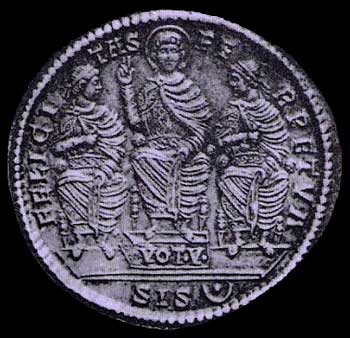
Coin of Constantine I, making a benediction gesture, with his sons, enthroned.

Coin of Constantine I, making a benediction gesture, with his sons, enthroned.

There is little room for the myth that Christians [in the Roman Empire] were a perpetually hounded minority, literally driven underground by unremitting persecution… Even at the height of the Great Persecution, martyrdom was not an everyday occurrence for Christians. But martyrdom did not have to be frequent for its message to inspire horror and awe…

Nor is there any truth in the more modern myth that presents the advance of Christianity as due to the spread of a religion of mercy and equality among the underprivileged. Christianity was by no means the religion only of slaves and of simple folk… It could not be said that Christians were totally innocent of wealth, of slave-owning or, even, of power… Rather, the third century was an age of surprising Christians, of whom the Roman emperor Constantine was only the last…

In the Christian churches of the third century…salvation meant, first and foremost, salvation from idolatry and from the power of the demons…Seen with Christian eyes in the age of Constantine, the immemorial worship of the gods throughout the Roman world was a grand illusion: the ancient rites to which the emperor Diocletian paid such heavy reverence were no more than a tawdry stage-set, set up by the demons so as to stand between mankind and its rightful God…

We should not underestimate the fierce mood of Christians in the fourth century A.D. For centuries, the churches had consisted of small, compact groups, tensed against the outside world. These groups had recently emerged from widespread persecution [the Great Persecution instituted in 303 A.D. under the Emperor Diocletian]. It was not a situation likely to breed tolerance of others. Furthermore, as we have seen in the case of the martyrs, Christians made sense of the world in terms of a clash of gods. The power of Christ was pitted remorselessly against the malevolent power of the demons who lurked behind the façade of traditional polytheist worship. The unexpected conversion of Constantine in 312, and his subsequent support of the Church, seemed to be a triumphant vindication of this militant view of the world. By patronizing the Church, Constantine had wished to gain the support of the God of the Christians. Whether he wanted to foster renewed religious violence (this time, by Christians against pagans) is another matter. But the Christian bishops thought otherwise. For them it was now or never. They considered that they had won the right to finish off the struggle with the gods.

— Peter Brown, The Rise of Western Christendom, 2nd Ed., (Malden, MA: Blackwell Publishing, 2003), p.63, 64, 66, 73


Constantine [the first Roman Emperor to embrace Christianity] united the whole Roman Empire under his rule and reigned for twenty-five years. He brought up his sons to be pious Christians, and the last of them reigned for another twenty-five years, having ultimately reunited the empire under his rule. During that half-century the Church had enjoyed imperial protection and paganism had been viewed with disfavor. Christians had been promoted and pagans frowned upon. With only two short-lived exceptions no pagan was to reign as Emperor after Constantine.

A. H. M. Jones, Constantine and the Conversion of Europe

Constantineʼs Mother

Helena, Constantineʼs mother, lived about three hundred years after Jesusʼs day. Once her son became Emperor, “Helena traveled all over Palestine and whenever she found a thing mentioned in her Bible, Old or New Testament, she would search for it in reality, and never stop until she had found it. If it was Adam, she would find Adamʼs grave; if it was Goliath, Joshua or Melchizadek, she would find their graves; if it was Noahʼs ark, she would find the ark. She was always fortunate,” as Mark Twain put it in The Innocents Abroad, a book he wrote concerning his visit to the Holy Land and what he learned while there.

Helena also claimed to have found the exact spot of the crucifixion; the spot where the soldiers divided Jesusʼs clothing; and the three crosses upon which Jesus and the two thieves were crucified [see picture below, drawn to illustrate Helenaʼs discovery of “the three crosses” by an artist in Italy in the 800s].


St. Helena Finding the True Cross

Helena also claimed to have found a metal plate that was nailed to the top of the cross and upon which Pilate had written, “This is the King of the Jews;” and the rift in the rock made by the alleged earthquake (mentioned only in Matthew) at the time of Jesusʼs crucifixion. Many of the things Helena found are still being hawked to tourists in the Holy Land today, but archaeologists doubt they are genuine. Helenaʼs story proves how relatively easy it is to “find” everything youʼre looking for if you just use “eyes of faith” (and carry round enough gold to tempt folks to bring you everything you ask, whether genuine or not). For faith is a wondrous thing, it can move mountains and also convince you that a herring is a racehorse.

Her son, the Emperor Constantine, built luxurious churches in the Holy Land to house items she had found. One church allegedly features some of the same earth out of which Adamʼs body had been formed. Another features the very spot where Christʼs cross pierced the ground, which has been memorialized with gold inlay encircling it—though it lay on the second floor of the church. (Does that mean Christʼs cross was suspended in thin air?)

Another interesting thing Constantine did was to give Jesusʼ hometown of Nazareth an upgrade. Prior to Constantineʼs day, Nazareth had only been a small village. But Luke in his Gospel called Nazareth a “city” not a mere town or village. With Constantineʼs help it became one, even if after the fact.

— E.T.B.


The Word“Pagan” Was a Term of Derision Coined by Christians

In the late fourth century, polytheism received its modern name. The word “pagan,” paganus, began to circulate among Christians. This word emphasized the marginal status of polytheism. Usually, paganus had meant “second-class participant” —civilian as opposed to regular solider, lower as opposed to high officials… Cultivated polytheists, urban notables, and even members of the Roman Senate, were told by the Spanish priest, Orosius (in his History Against the Pagans, written at the behest of Augustine in 416), that… theirs was a religion of country folk, of pagani, or men of the pagus, of paysans, paesanos—that is, a religion worthy only of illiterate peasants. Nor was this simply a matter of clerical preaching. The most effective sermonizer of all, in the fourth and fifth centuries, was the newly organized Roman state… In the sharp words of an early edict of Constantine, polytheists might, if they wished, “celebrate the rites of an outmoded illusion,” provided that they did not force Christians to join in them.

Peter Brown, The Rise of Western Christendom, 2nd Ed., (Malden, MA: Blackwell Publishing, 2003), p.74


A spirit of scornful tolerance breathes through not a few of his [Constantineʼs] edicts. As the years passed, toleration of paganism gave place to active repression; the emperor felt that he was strong enough to advance to a frontal attack upon paganism. The important fact to realize, however, is that this alteration in policy entailed no change of spirit, only a change of method. What Constantine would have recommended in 323 he later felt free to proclaim as the imperial will.

— Norman H. Baynes, Constantine the Great and the Christian Church


For all their propaganda, Constantine and his successors did not bring about the end of paganism. But what they did bring to the Christian churches was peace [but not peace between Christians, click here.—E.T.B.], wealth, and, above all, the ability to build up, at a surprising rate, a strong local position.

Constantine set up great basilica churches (true “royal halls,” as the name basilica, from basileus, “king,” implies) in Rome—Saint Peterʼs and San Giovanni in Laterano. At Antioch he built a large, golden-domed octagon opposite the newly-built imperial palace. Above all, he built the Church of the Holy Sepulcher at Jerusalem. These churches were sermons in stone. They spoke far more loudly and more continuously of the providential alliance of Church and empire than did any imperial edict or the theorizing of any bishop. They left visitors amazed:

“The decorations really are too marvelous for words [wrote Egeria, a Spanish pilgrim, on Constantineʼs church of the Holy Sepulcher.] All you can see is gold and jewels and silk… You simply cannot imagine the number and the sheer weight of the candles, tapers, lamps and everything else they use for the services… They are beyond description, and so is the magnificent building itself. It was built by Constantine and … was decorated with gold, mosaic and precious marble, as much as his empire could provide.”

— Peter Brown, The Rise of Western Christendom, 2nd Ed., (Malden, MA: Blackwell Publishing, 2003), p.77


Constantineʼs allegiance to his God was backed by massive patronage. Emperors had always honored their favored gods with benefactions and buildings. Constantineʼs patronage was so lavish that he had to strip resources from pagan temples to fund it. One of his early foundations in Rome was the church of St. John Lateran, whose apse was to be coated in gold. Around 500 pounds of it was needed… Another 3,700 lbs was required for light fittings and another 400 pounds of gold for fifty gold vessels.

— Charles Freeman, “The Emperorʼs State of Grace,” History Today, January 2001


Constantine … banned the construction of new pagan temples, the consulting of oracles, and animal sacrifices. That these decrees were enforced sporadically did not detract from their symbolic value…

[During the reign of Christian Emperor Theodosius] bands of wandering monks attacked synagogues, pagan temples, hereticsʼ meeting places, and the homes of wealthy non-believers in Mesopotamia, Syria, Egypt, Palestine, and North Africa. The bishop of Alexandria incited local vigilantes to destroy the Temple of Serapis [also known as the Serapeum], one of the largest and most beautiful buildings in the ancient world... Alexandrian Christians whipped up by Bishop Cyril rioted against the Jews in 415, and then murdered Hypatia, a wise and beloved Platonic philosopher.

Richard E. Rubenstein, When Jesus Became God: The Epic Fight over Christʼs Divinity in the Last Days of Rome, p.226-227


Examples of destroyed Temples: the Sanctuary of Aesculap in Aegaea, the Temple of Aphrodite in Golgatha, Aphaka in Lebanon, the Heliopolis. Christian priests such as Mark of Arethusa or Cyrill of Heliopolis were famous as “temple destroyers.”

Between 315 AD and the sixth century thousands of pagan believers were slain. Pagan services became punishable by death in 356 AD.

The Christian Emperor, Theodosius, even had children executed, because they had been playing with remains of pagan statues.

In the early fourth century the philosopher Sopatros was executed on demand of Christian authorities.

In the sixth century pagans were declared void of all rights.

— K. Deschner, Abermals krähte der Hahn, (Stuttgart 1962), p.466, 468-469

For more info concerning the works of K. Deschner click here.


The Christian zealots for conversion took to the streets or crisscrossed the countryside, destroying no doubt more of the architectural and artistic treasure of their world than any passing barbarians thereafter.

— Ramsay MacMullen, Christianizing the Roman Empire


[Pagan] oracles had remained popular: many were shut down. Great [pagan] temples were deliberately violated: their doors were broken and their sanctuaries defiled, if only to prove that the gods associated with them were unable to protect their shrines against such sacrilege. Statues of the gods were broken up with deliberate care: their heads, arms, and legs were broken off, so as to deprive them of the divine “life” which their worshippers (and many half-hearted Christians also) had seen in them. These pre-emptive, “first strike” measures were not necessarily expected to convert pagans. They took place, rather, so as to hold in newly converted Christians by removing from them the temptation offered by old places of pagan worship.

The Christian empire was fully implicated in these actions…Constantine and his successors did the same [things that pagan emperors had done to Christians, forbidding their meetings, destroying their property and sacred books, only] in reverse…After 312, first Constantine, then his devout son, Constantius II (337-361), and finally, Theodosius I (379-395) progressively forbade public [pagan] sacrifices, closed temples, and colluded in frequent acts of local violence by Christians against major cult sites—of which the destruction of the gigantic Serapeum of Alexandria, in around 392, was only the most spectacular.

— Peter Brown, The Rise of Western Christendom, 2nd Ed., (Malden, MA: Blackwell Publishing, 2003), p.73-74


The Theodosian Code & Paganism

In 436, the lawyers of Theodosius II (408-450), the grandson of Theodosius I, met in Constantinople to bring together the edicts of his Christian predecessors in a single book. The subsequent Theodosian Code appears in 438…

When early medieval Christians looked back to Rome, what they saw, first and foremost, was not the “Golden Age” of classical Rome (as we would tend to do). The pagan empire did not impress them. It was the Theodosian Code that held their attention and esteem. It was the official voice of the Roman empire at its greatest, that is, when it was the Roman empire as God always intended it to be—a Christian empire. The Code ended with a book On Religion. This book, in itself, signaled the arrival of a new attitude to religion. Religious belief as such was not treated as a subject for legislation. As we have seen, Roman had always been concerned with the correct performance of religions, with the maintenance of traditional rites. But this attitude had been replaced by the new definition of “religion” which, as we saw, had emerged in the course of the third century A.D. Now it was “thought-crime” itself—wrong view on religion in general, and not simply failure to practice traditional rites in the traditional manner—which was disciplined. In the Theodosian Code, extracts from the laws issued from the reign of Constantine to that of Theodosius II were arranged in chronological order. They communicated a rising sense of governmental certainty. There was to be little place, in the new Roman order, for heresy, schism, or Judaism, and no place at all for “the error of stupid paganism.”

Peter Brown, The Rise of Western Christendom, 2nd Ed., (Malden, MA: Blackwell Publishing, 2003), p.75


Pagans had not been clear or unanimous in their belief in an afterlife, but those who credited it looked to mystery cults for insurance in their future. Christians were much more positive…The Christians united ritual and philosophy and brought the certainty of God and history to questions whose answers eluded the pagan schools… Whereas pagan cults won adherents, Christianity aimed, and contrived, to win converts…

Paganism was reclassified as a demonic system… If Satan was the source of error and evil, false teaching and wrongdoing were not merely mistaken: they were diabolic. The division between a Christian “community of goodness” and an “outer world of evil” could easily become too pronounced. The idea of Satan magnified the difference between “true” and “false” Christians and between Christian sinners and saints…

Like Satan, the Last Judgment was a force that Christians exaggerated and then claimed to be able to defeat…This teaching was reinforced by an equally powerful ally, the Christian idea of sin. Sin was not just the sin of an action, or even an intention, but also the sin of a thought, even a passing interest in an appealing man or woman. This combination of rarefied sin and eternal punishment was supported, as we shall see, by books of vision and revelation that were probably more widely read than modern contempt for “pseudepigraphic” forgeries allows: acquaintance with the Apocalypse of “Peter” would make anyone think twice before leaving the Church (we happen to know that “Peterʼs vision of hell” was still read as a holy text in the churches in Palestine on Good Friday during the fifth century). If fears for Eternity brought converts to the faith, one suspects that they did even more to keep existing converts in it.

— Robin Lane Fox, Pagans and Christians (Alfred A. Knopf, Inc., New York, 1987), p.326-327, 330-331, 412


Institutions of higher learning had been largely destroyed. The [Christian] emperorsʼ attacks had centered on the chief of them, Athens and Alexandria, in the late fourth century and were turned against them again toward the end of the fifth and in 529. [“529 A.D.” was the year that the School of Athens was closed by the decree of the Christian Roman Emperor Justinian, the same Justinian who also outlawed sodomy, because, “It is well known that buggery is a principal cause of earthquakes, and so must be prohibited.”—E.T.B.]. As to the initiators of the persecution, the [Christian] emperors themselves, a steady decline in their level of cultivation has been noticed. Thus books and philosophy were bound to fade from sight.

After Constantine there existed an empire-wide instrument of education: the church. What bishops, even emperors, made plain, and what could be heard in broader terms from every pulpit, was an agreed upon teaching. Every witness, every listener should know the great danger to his soul in Platoʼs books, in Aristotleʼs, in any of the philosophical corpus handed down from the past. The same danger threatened anyone using his mind according to their manner, with analytical intent, ranging widely for the materials of understanding, and independent of divine imparted teachings.

Another factor that arose specifically out of the ongoing conversion of the empire was the doctrine of demonic causation. The belief in the operation of maleficent forces on a large scale had to await Christianity; and it was of course Christianity that was to form the medieval and Byzantine world.

Satanic agents were to be seen as the cause not only of wars and rebellions, persecution and heresy, storms at sea and earthquakes on land, but of a host of minor or major personal afflictions. So, in consequence, Christians were forever crossing themselves, whatever new action they set about, and painted crosses on their foreheads too, responding to their leadersʼ urging them to do so. It would protect them against all evil.

— Ramsay MacMullen, Christianity and Paganism in the Fourth to Eighth Centuries


Art, philosophy, literature, the very psychology of Western man, all suffered by the victory of the bishops.

John Holland Smith, The Death of Classical Paganism

The Closing of the Western Mind: The Rise of Faith & the Fall of Reason

The argument of this book is that the Greek intellectual tradition did not simply lose vigour and disappear. (Its survival and continued progress in the Arab world is testimony to that.) Rather, in the fourth and fifth century A.D. it was destroyed by the political and religious forces which made up the highly authoritarian government of the late Roman empire. There had been premonitions of this destruction in earlier Christian theology. It had been the Apostle Paul who declared war on the Greek rational tradition through his attacks on “the wisdom of the wise” and “the empty logic of the philosophers,” words which were to be quoted and requoted in the centuries to come. Then came the absorption of Platonism by the early Christian theologians. It was assumed that Christian dogma could be found through the same process as Plato had advocated, in other words, through reason, and would have the same certainty as the Forms. However, as with other aspects of Platonism, it proved impossible to find secure axioms from which to start the rational argument. Scriptural texts conflicted with each other, different theological traditions had taken root in different parts of the empire, theologians disagreed whether they should discard pagan Greek philosophy or exploit it. The result, inevitably, was doctrinal confusion. Augustine was to note the existence of over eighty heresies (for which read “alternative ways of dealing with the fundamental issues of Christian doctrine”). When Constantine gave toleration to the churches in the early fourth century, he found to his dismay that Christian communities were torn by dispute. He himself did not help matters by declaring tax exemptions for Christian clergy and offering the churches immense patronage, which meant that getting the “right” version of Christian doctrine gave access not only to heaven but to vast resources on earth. By the middle of the fourth century, disputes over doctrine had degenerated into bitterness and even violence as rival bishops struggled to earn the emperorʼs favour and the most lucrative bishoprics. At a time of major barbarian attacks, the threat to order was so marked that it was the emperors who increasingly defined and enforced an orthodoxy, using hand-picked church councils to give themselves some theological legitimacy.

So one finds a combination of factors behind “the closing of the Western mind”: the attack on Greek philosophy by Paul, the adoption of Platonism by Christian theologians and the enforcement of orthodoxy by emperors desperate to keep good order. The imposition of orthodoxy went hand in hand with a stifling of any form of independent reasoning. By the fifth century, not only has rational thought been suppressed, but there has been a substitution for it of “mystery, magic and authority,” a substitution which drew heavily on irrational elements of pagan society that had never been extinguished. Pope Gregory the Great warned those with a rational turn of mind that, by looking for cause and effect in the natural world, they were ignoring the cause of all things, the will of God. This was a vital shift of perspective, and in effect a denial of the impressive intellectual advances made by the Greek philosophers.

Some who have found this argument too damning have stressed how it was Christians who preserved the great works of the Greek philosophers by copying them from decaying papyri, or parchment. The historian is indeed deeply indebted to the monks, the Byzantine civil servants and the Arab philosophers who preserved ancient texts, but the recording of earlier authorities is not the same as maintaining a tradition of rational thought. This can be done only if these authorities are then used as inspiration for further intellectual progress or as a bulwark against which to react. This happened in the Arab world (where, for instance, even the findings of a giant such as Galen were challenged and improved on) but not in the Byzantine empire or the Christian west. The Athenian philosopher Proclus made the last recorded astronomical observation in the ancient Greek world in A.D. 475. It was not until the sixteenth century that Copernicus—inspired by the surviving works of Ptolemy but aware that they would make more sense, and in fact would be simpler, if the sun was placed at the centre of the universe—set in hand the renewal of the scientific tradition. The struggle between religion and science had now entered a new phase, one which is beyond the scope of this book. What cannot be doubted is how effectively the rational tradition had been eradicated in the fourth and fifth centuries. The “closing of the Western mind” has been ignored for all too long. I hope this book reinvigorates debate on this turning point in European history.

— Charles Freeman


Christianity & Paganism in the Fourth to Eighth Centuries

The slaughter of animals for religious feasts, the tinkling of bells to ward off evil during holy rites, the custom of dancing in religious services-these and many other pagan practices persisted in the Christian church for hundreds of years after Constantine proclaimed Christianity the one official religion of Rome. In this book, Ramsay MacMullen investigates the transition from paganism to Christianity between the fourth and eighth centuries. He reassesses the triumph of Christianity, contending that it was neither tidy nor quick, and he shows that the two religious systems were both vital during an interactive period that lasted far longer than historians have previously believed. MacMullen explores the influences of paganism and Christianity upon each other. In a rich discussion of the different strengths of the two systems, he demonstrates that pagan beliefs were not eclipsed or displaced by Christianity but persisted or were transformed. The victory of the Christian church, he explains, was one not of obliteration but of widening embrace and assimilation. This fascinating book also includes new material on the Christian persecution of pagans over the centuries through methods that ranged from fines to crucifixion; the mixture of motives in conversion; the stubbornness of pagan resistance; the difficulty of satisfying the demands and expectations of new converts; and the degree of assimilation of Christianity to paganism.

Publisherʼs synopsis for Christianity and Paganism in the Fourth to Eighth Centuries by Ramsay MacMullen

The traditional view has been that, during the century after Constantineʼs conversion, most of the Roman Empire (and lands beyond) converted to Christianity with wholehearted gusto, and pagan beliefs survived only in remote pockets. Not so, according to the authorʼs overwhelming evidence: paganism had an extremely long half-life. MacMullen also dispenses with the long-held traditional argument that women and slaves converted to Christianity because paganism did not offer them much. (If anything, as he clearly and succinctly shows, the reverse is true.) Furthermore, MacMullen discusses how, beginning in the fourth century, upon subsuming power, Christians dealt with pagans in the traditional (non-Christian) way: they persecuted them with intimidation, torture, forced conversions, and death. Persecutions continued for many centuries, indicating that the underlying pagan culture was indeed very hearty.

The problem with the early Churchʼs aggressive approach is obvious: many converts were not true believers, or they didnʼt quite understand what they were accepting. In addition, the relatively new Christianity, “a religion of the book” that was strong on doctrine, lacked a distinctive culture or the ability to satisfy everyday needs and desires (whether worldly or supernatural). Still, the Christian elites—the educated or the anointed—placed far more faith in the supernatural (God) than did their pagan predecessors, who viewed the reliance on superstition (gods) as a crutch for the lower, especially rural, classes. This difference ironically gave Christianity an advantage: believers at both ends of the social spectrum, from bishops to peasants, looked to the supernatural for explanations of everyday occurrences, from the weather to illness to death. Thus, many pagan rituals provided the basis for Christian traditions: offerings to the gods became cults of the saints, pagan feasts became Christian festivals, etc. As Jerome acknowledged, in MacMullenʼs paraphrase: “better, worship of the saints in the pagan manner than none at all.”
— D. C. Smith (Amazon Review of MacMullenʼs book)

I think Stalin would find it grimly amusing reading, since it suggests that whatever success Christianity achieved was by fanaticism and violence. We start off with an account of how Christians systematically suppressed non-Christian works, as well as the “heretics” amongst themselves. We hear Eusebius, the first great Church historian, announce that it is not the duty to tell the whole truth but only what is of profit. Students of the Russian Revolution will remember the gruesome story of the child who informed on his “kulak” parents, was murdered by his relatives, and became the hero of a gruesome cult. In this book we hear how the emperor Justinian was moved to raptures on hearing of how a Jewish boy convert survived being thrown into a furnace by his father. Justinian learned how angels prevented the boy from being burned, and then he had the father crucified.

Persecution: MacMullen challenges those who argue that Christianity was an improvement for women and slaves. Women did play some role in leading Pagan cults, none at all in Christianity, and he tells how while a pagan governor demanded the compensation for the family of a murdered prostitute, Saint Jerome supported beheading for extramarital fornication. He discusses how exorcisms, resurrections, and healings played a greater role in conversions than sermons or reasoned argument. He discusses the increasingly bloodthirsty demands of bishops, monks and imperial decrees as well as pointing out the weaknesses of the bureaucratic machinery.

Cost to the Persecuted: MacMullen notes how Constantine still claimed a sort of divine status for himself and his father. He discusses the joyous pagan festivals, including feasts, dancing, poetry orations and their long persistence despite the opposition of the bishops (Augustine tried to argue that giving friends presents was wicked). MacMullen also gives accounts of pagans who thought idols had actual magical powers. He discusses the destruction of pagan temples and shrines, as well as the cutting down of sacred trees.

Superstition: MacMullen discusses the shifting attitude from the rational world view of Pliny, Seneca and Plotinus and the increase in credulity throughout the third and fourth centuries. MacMullen argues that this was a result of changes in the elite as more vulgar and less literate people increased their predominance. Whatever the merits of this thesis, MacMullen points out the contempt prominent Christians such as Tertullian, Augustine, Lactantius, Ambrose and John Chrysostom had for ancient philosophy. They denounced Plato and Aristotle by name, and mocked the idea of skeptical study and the scientific attitude. Nor did they stop there. They told stories about apparitions over the battlefield, miraculous cures, the ever present existence of demons, people raised to life by Christians, and dragons turned to dust by the sign of the cross.

Assimilation: MacMullen provides much information about the assimilation of dancing, festival meals for the dead, and the growth about the cult of martyrs. He tells how angels and martyrs took the place of minor deities who heard the wishes that would have been apparently too petty to relate to God. Christianity also assimilated practices like valorizing the dust around certain shrines and the plants that grew there, as well as amulets and ankhs used to ward off disasters, while images of Jesus and other Christian figures spread throughout the world. “The triumph of the church was not one of obliteration but of widening embrace and assimilation,” concludes MacMullen, and it is the weakness of Christian efforts which mitigates an otherwise brutal history.
— pnotley, Amazon Review of MacMullinʼs book

Also See

Constantine: 4. 2. Suppression of other religions

The Flat Earth Myth? It's true that Columbus and most Church Fathers were not flat earthers, but don't start cheering just yet…

Christopher Columbus Map

The map (to the right) displays how Columbus and some other fifteenth century Italians imagined the earthʼs geography looked, click here for more info. Columbus died, still thinking he had reached islands near India. We will discuss Columbus (along with the influence theology had on Medieval map making, and myth-making) again at the end of this blog entry but for now itʼs enough to note that Columbus was no flat earther.

But long before Columbus (and even before the Church Fathers), writings and imagery from the ancient Near East demonstrated that ancient Egyptians, Mesopotamians and Hebrews agreed the earth was flat and stationary. Even the authors of inter-testamental works like Daniel and Enoch (written between the time of the “Old Testament” and the “New Testament”) assumed the earth was flat. Even the authors of the New Testament, in the first century, employed ideas and phrases appropriate to the flatness of the earth, and also appropriate to a three-tier cosmos with Godʼs heaven above, earth below and “sheol/hades/tartarus” lying “under” the earth—all such Greek terms being translated in the New Testament with the Germanic word, “hell” (see “The Cosmology of the Bible,” a chapter in The Christian Delusion, click here, and see “Is Flat Earth Biblical Cosmology merely an Infidelʼs Delusion?” click here).

Furthermore, the idea of the sun, moon, and stars, having waters set firmly above them was discussed by early rabbis as well as Church Fathers, and medieval Christians, in fact right up till Martin Lutherʼs day at the dawn of the Reformation in the fifteenth century. See this pic from Lutherʼs Bible:

Only after the invention of the telescope did enough data pour in such that ancient ideas and words of Scripture no longer determined how the cosmos was viewed (with some modern day Christians still in denial, from geocentrists to young-earth creationists, click here. While other Evangelicals are striving to get their brethren to understand the ancient Near Eastern background of Genesis 1, click here, here, and here.

Returning to the question of what the Church fathers believed, the majority were not flat earthers but sought a concordance between the Bible and the notion of a spherical earth as found in the Hellenstic world, the same world that the Church Fathers wished to evangelize. Though a few did reject the “pagan” notion of a spherical earth, click here for more info.

One Christian in particular, writing under the pseudonymn, “Cosmas Indicopleustes,” who lived toward the end of the reign of the Christian Emperor Justinian in the sixth century, attacked the pagan “spherical earth” view and defended instead the view that the earth was flat, based on the idea in the Letter to the Hebrews that the earth was like Godʼs tabernacle in the Old Testament in which God dwelt. His book was called Christian Topography, click here. Ironically, modern day Evangelical Christian scholars (including inerrantists like John Walton, and G. K. Beale, as well as apologists like N. T. Wright) agree that the setting up of the cosmos according to Genesis chapter 1 should be interpreted as the building and consecration of a “temple” for God to dwell in—which resembles the view of Cosmas, i.e., that the cosmos was shaped like the “tabernacle” used by Moses in the wilderness, a “tabernacle” being a sort of movable “temple.” [see ENDNOTE #1] So these modern day Evangelicals view Genesis 1 as a story about the creation of the cosmos based on the motif of “temple mythology.” Cosmas would probably be annoyed at the rejection of his literal interpretation, yet also pleased to at least hear that his tabernacle/temple idea has withstood the test of time and even been applied to the first chapter of the Bible.

Even as late as the eighth century at least one medieval Christian wrote a book that depicted the earth in flat terms, attributing his work not to himself in the eighth century but to an author before Cosmasʼ own day. The book was titled, The Cosmography of Aethicus Ister, click here for a description.

And even though most Church Fathers accommodated themselves to the prevalent Hellenistic idea of a spherical earth, note that a major Church Father like Augustine denied that human beings lived on the other side of that sphere.

Saint Augustine (354-430 CE):

But as to the fable that there are Antipodes, that is to say, men on the opposite side of the earth, where the sun rises when it sets to us, men who walk with their feet opposite ours that is on no ground credible. And, indeed, it is not affirmed that this has been learned by historical knowledge, but by scientific conjecture, on the ground that the earth is suspended within the concavity of the sky, and that it has as much room on the one side of it as on the other: hence they say that the part that is beneath must also be inhabited. But they do not remark that, although it be supposed or scientifically demonstrated that the world is of a round and spherical form, yet it does not follow that the other side of the earth is bare of water; nor even, though it be bare, does it immediately follow that it is peopled.

Since these people would have to be descended from Adam, they would have had to travel to the other side of the Earth at some point; Augustine continues:

It is too absurd to say, that some men might have taken ship and traversed the whole wide ocean, and crossed from this side of the world to the other, and that thus even the inhabitants of that distant region are descended from that one first man.

Flat earthism underwent a bit of a revival in the early 1900s when some Christians in both Britain and the U.S. cited Scripture in its support and defended it in the face of what they called the “evils of modern astronomy.” British supporters of a flat earth challenged spherical earth scientists to public debates, and the flat earthers were said to have won over their audiences. In the 1920s in the U.S. Wilbur Glenn Voliva built one of the most powerful radio transmitting stations in his day, and broadcast his flat earth views widely from the city of Zion, Illinois, a Christian religious community that upheld the flat earth view.

According to Robert J. Schadewald, who was researching a book on the history of Flat Earth movements before he died in 2000, there are still flat earthers today:

[The late] Charles Johnson, a twentieth century Flat Earther and editor of The Flat Earth News, was sort of a wacky character, but he was not really representative of flat earthers in general. The half dozen or so other flat earthers Iʼve spoken or corresponded with have included a successful Boston trial lawyer, a priest who belongs to a society devoted to the preservation and translation of ancient Coptic manuscripts, a retired financial officer from a major metropolitan school system (he thoughtfully corrected an error in Greek grammar I had copied from a flat earth source), and a young man who intended to translate an eighth century flat earth treatise by Aethicus of Istria from Latin into English. Not exactly a bunch of semiliterates!

Schadewald added:

The Antiochene Fathers of the early Christian Church more or less invented the historical-critical method of exegesis popular among modern fundamentalists within the Reformed tradition. (Not surprisingly, *every* Antiochene Father whose views on the subject I have been able to discern was a flat earther!) So I think it is a bit strong to suggest that this method doesnʼt have ‘anything to do with the history of Scriptural interpretation.’ It may have been moribund for a long time, but it has ancient roots. [Emails dated 8/10/99 and 8/5/99 respectively from the late Robert Schadewald, author of numerous articles on “flat earthism,” and author of the unpublished work, The Plane Truth: A History of Flat Earth Science.]

For some articles by Schadewald that touch upon the history of nineteenth and twentieth century flat earth groups click here.

Not only do the flat earthers whom Schadewald met attest to that beliefʼs presence in the year 2000, but some twenty first century flat earthers appear to have set up a serious web forum, click here.

T-shirt sold at TheFlatEarthSociety.Org

Geo-centrism is yet another view that has never died out among believers in the Bible who cite Scriptures in support of their belief. Early Church Fathers were geocentrists, as well as the Fathers of Protestantism, Luther and Calvin (click here). Today there are still geocentrists among some orthodox Jewish educational institutions (click here). Geocentrism is also promoted by some Catholics and Protestants, who held a joint conference recently, attempting to augment their Bible-based belief in geocentrism with “scientific arguments,” click here.

A T-O type map, from 1300 (Hereford Cathedral, England) with Jerusalem at center, east toward the top, Europe at bottom left and Africa on the right.

Columbus & Ptolemyʼs Geography

Columbusʼ fifteenth century view of the size of the earth was based on Ptolemyʼs second century Geography book. Ptolemy calculated that a degree was 50 miles (not 70 as we know today), which gave him an earth with a circumference of only 18,000 miles. Ptolemy also stretched Asia eastward for 180 degrees (not 130 degrees as we know today). Therefore, Columbus, taking the word of a book composed thirteen hundred years before he was born, thought India was far closer than it really was.

Why was Ptolemyʼs Geography still considered relatively accurate thirteen hundred years after its first publication? Europe had become Christian. Expanding knowledge of the physical world was deemed to be of relatively less importance than theological notions concerning the world, especially the “world to come.” In fact there was no English word for “geography” until the 16th Century.

A classical T-O Map, but this one is from a printing press, not hand drawn like the one above, and far from being the earliest. It dates to 1472.

At any rate, Columbus appears to have used a version of Ptolemyʼs smaller size of the earth along with a belief that less sea probably existed and more land (per II Esdras, see below). So when he did reach land he remained convinced he had discovered islands off the coast of India. Columbus also noted the existence of fresh waters from what we know today as the Orinoco river which implied a great river and a vast continent. Christian geographers said that such could not exist south of the equator. So, he decided that he had found the location of Paradise. Columbus grew increasingly religious in his later years and wrote, A Book of Prophecies (1505), in which passages from the Bible were used to place his achievements as an explorer in the context of Christian eschatology.

Other Peculiar Notions About Geography That Were Held During the Middles Ages

  1. The Insignificant Ocean—A passage found in the Catholic Bible (and in early Protestant Bibles that used to include the Apocrypha), implied that the earth was mostly land rather than sea. The “Ocean,” was believed to be a body of water that surrounded the earthʼs three major continents (Europe, Asia, Africa) in a circular fashion, but not as expansive as the continents themselves. The verse in question was this one:

    Upon the third day [of creation] thou didst command that the waters should be gathered in the seventh part of the earth: six pats hast thou dried up, and kept them, to the intent that of these some being planted of God and tilled might serve thee. [II Esdras 6:42, II Esdras is an ancient Apocryphal work included in Catholic Bibles, but also included in early Protestant Bibles, even the first edition of the King James Bible]

    The verse implied that six sevenths of the world must be land, so the ocean was believed to be far smaller than we know it to be today. The “Ocean” simply meant a circle of water that surrounded the three major continents of the world, with Jerusalem in the center. While beyond the “Ocean” lay Paradise.

  2. Early Medieval maps, driven by theological rather than geographical concerns, often pictured Asia at the top [east was at the top] and Europe and Africa beneath Asia, one on the right, the other on the left, all three continents being encircled by the “Ocean,” with a “T”-shaped body of water dividing the three continents. The upright trunk of the “T” was the Mediterranean Sea, the right cross bar of the “T” being the Nile river, and the left cross bar of the “T” being the Danube river (or some other major European river).

  3. It was also commonly believed that the three known continents, Europe, Asia, and Africa, constituted the entire world, and that each continent was occupied primarily by the descendants of one of the three sons of Noah after they left the ark, and/or after the dividing of the world after the tower of Babel incident, with Jerusalem lying at the “center of the world.”
  4. In short, Medieval map makers came up with ways to design maps that supported Christian theological beliefs. Different portions of the Bible provided added opportunities for creative cartography.

    At the top of the T maps, also called T-O maps, geographers placed the Garden of Eden. (Keep in mind the top was Asia, the east.) Typically surrounded by a mountain range or a high wall, outside of which was a wasteland filled with wild beasts. Popular tales told of monks who traveled to locate Eden.

    Saint Brendan (484-578), an Irish monk, apparently believed Eden was in the Atlantic. He reportedly sailed west and found a beautiful island paradise. “St. Brendanʼs Island” remained on maps until at least 1759, even though it was never found by anyone else.

    The books of Ezekial in the Old Testament and Revelation in the New Testament both warned of “Gog and Magog,” so they were added to maps. Usually located in the extreme north (per Ezekielʼs description). Roger Bacon urged the study of geography to prepare for an invasion from Gog and Magog.

    In the twelfth century during the Crusades, Europe sought allies in the Holy Land. Prester John was said to be a priest-king who had defeated the Muslims in his kingdom. Allegedly descended from the same race as “the Three Wise Men” (who traveled far to deliver gifts to the baby Jesus), Prester John was also allegedly a pious Christian, military genius, and an enormously wealthy ruler. About 1165, a letter appeared from Prester John to the Byzantine emperor of Rome and the King of France allegedly promising to help them to take back Jerusalem from the Muslims. “Prester Johnʼs Letter” was extremely popular and widely published. It included mention of such things as: “birds called griffins who can easily carry an ox or a horse into their nest to feed their young.” “Horned men who have but one eye in front and three or four in the back.” Bowmen “who from the waist up are men, but whose lower part is that of a horse.” For years, mapmakers continued to attempt to locate Prester Johnʼs kingdom.

    A Catalan Atlas from 1375, made for King of Aragon by Abraham Cresques, a Jew on Majorca, was created by combining empirical geographical knowledge gained from ships of trade with theologically based ideas. Jerusalem was still near the center of the earthʼs geography, Gog and Magog still present.

    The cartographerʼs greatest act of self-control was to leave parts of the earth blank. A difficult act of self-control indeed, as eons of cosmological speculation and mythmaking—from the time of the ancient Near East till today—demonstrates.


Endnotes

#1 Some Bible scholars argue that the story of a “tabernacle” in the “wilderness” might also be a myth retrojected back into the Moses story, based on the later building of the temple in Jerusalem.

Scent from heaven? Who nose? Do tales of Jesus' anointing, resurrection & bodily ascension, bear the aroma of truth?

Anointing

According to the Gospels Jesus was anointed with (or received) perfume numerous times in his life. Are all the tales true? Are any of them symbolic, legendary? At his birth Jesus allegedly received a visit from an unknown number of wealthy star gazers (was it two? three? more than three? Matthew does not say) who traveled far to deliver gifts of “frankincense and myrrh” (not to mention an unknown quantity of “gold”), at least thatʼs what the Gospel of Matthew states, none of the other Gospels happen to mention such a tale.

During his adulthood Jesus encountered expensive perfume again when women began anointing him with it. There is one story of the anointing of the adult Jesus in each Gospel. One was sufficient for the purposes of each Gospel author. To try and combine the anointing stories of all four Gospels into a single “life of Jesus” is to ignore the differences between each, and would add up to three separate tales: One found in Mark and Matthew which are in substantial agreement, another in Luke that disagrees with Mark/Matthew, and a third tale in John that features elements of the tales in Mark and Luke but also disagrees with them, giving us a total of three separate anointing stories. So was Jesus anointed three times? Or did the story change over time?

The failure of attempts to harmonize such stories reminds me of similar attempts made by conservative Christians to harmonize stories of “Peterʼs three denials of Jesus” that are found in all four Gospels (a total of twelve denials). The circumstances of each denial disagree as to where, when, and, in response to whom. Some of the individual denials are easier to harmonize with those in other Gospels, some less easy to harmonize. But disagreements between denials were so blatant in some cases that one conservative Christian insisted Peter must have denied Jesus as many times as there are unharmonizable incidents in all four Gospels. That Christian had convinced himself that Peter may have denied Jesus more than three times, maybe six or more times, so long as he could find a way to retain the historical truth of every divinely inspired detail in his Bible and read the Gospels like a single story—instead of four separate stories, including some that changed over time. He continued to argue that his solution of multiplying the total number of denials was the most reasonable, regardless of the fact that each Gospel by itself agrees with the others that Jesus only mentioned three denials by Peter.

Below are the tales of the anointings of Jesus. The tales in Mark and Matthew are probably the earliest and they parallel each other so closely as to suggest a common literary source. They also agree that perfume was poured on Jesusʼ head:

Mark 14:3,8 (NIV) While he was in Bethany, reclining at the table in the home of Simon the Leper, a woman came with an alabaster jar of very expensive perfume, made of pure nard. She broke the jar and poured the perfume on his head…to prepare for my burial.

Matthew 26:6-7,12 (NIV) While Jesus was in Bethany in the home of Simon the Leper, a woman came to him with an alabaster jar of very expensive perfume, which she poured on his head as he was reclining at the table…to prepare me for burial.

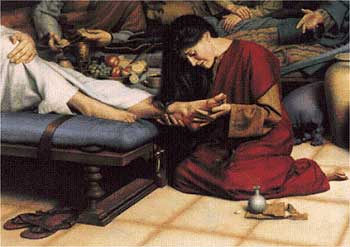
By the time Lukeʼs Gospel was composed the story seems to have changed. It is no longer Jesusʼ head that is anointed with expensive perfume but his feet, by a female sinner who first washes them with her tears and wipes them with her hair, and Luke places the anointing in an early chapter of Jesusʼ ministry, so early that Jesus is shown dining with a Pharisee:

Luke 7:36-38 (NIV) When one of the Pharisees invited Jesus to have dinner with him, he went to the Phariseeʼs house and reclined at the table. A woman in that town who lived a sinful life learned that Jesus was eating at the Phariseeʼs house, so she came there with an alabaster jar of perfume. As she stood behind him at his feet weeping, she began to wet his feet with her tears. Then she wiped them with her hair, kissed them and poured perfume on them.

In all three of the earliest Gospels the woman who anoints Jesusʼ head or feet is not named. But by the time the Gospel of John was composed a name had been allocated to the “anointress” (if I may coin a term), “Mary.” The author even says this was the same “Mary” whom Luke had mentioned in his separate tale of the “two sisters,” one of whom “sat” at Jesusʼ feet listening to him (Luke 10:38-42). But in the Gospel of John this Mary is no longer the one in Luke who merely “sat” at Jesusʼ feet and drew sighs from her sister who wished to scold her for sitting inertly on the floor and leaving her sister with all the kitchen work. Instead, the “Mary” in the Gospel of John is active, dramatically so, for she is depicted as anointing Jesusʼ feet and wiping them with her hair, resembling Lukeʼs anointing story about the unnamed female sinner in the home of the Pharisee. The Gospel of John adds that the whole house was filled with the aroma after about a “pint” of perfume was poured on Jesusʼ feet, so I guess there was no skimping on the perfume per John—nor does John skimp on the perfume in yet another anointing episode found only in that Gospel, but before proceeding to that episode here is the story of Johnʼs “Mary”:

John 12:1-3 (NIV) Six days before the Passover [Note: Jesus dies five days later in this Gospel, on the day before Passover], Jesus came to Bethany, where Lazarus lived, whom Jesus had raised from the dead. Here a dinner was given in Jesusʼ honor. Martha served, while Lazarus was among those reclining at the table with him. Then Mary took about a pint of pure nard [Note: “pure nard” is an unusual and precise phrase that appears in Markʼs earlier version and some commentators suggest that the author of the Gospel of John was acquainted with the tales in both Mark and Luke, combining elements of both to form a third tale], an expensive perfume; she poured it on Jesusʼ feet and wiped his feet with her hair. [Note how this resembles the tale in Luke, but the order in which the perfume is applied and the feet wiped is reversed. In Luke Jesusʼ feet are washed (with tears, something John does not mention) and wiped with hair, and only then is the perfume applied. But in John the perfume is applied and the feet are wiped with hair. So in John, Maryʼs hair is full of perfume, but in Luke the womanʼs hair smelled only of the dirt on Jesusʼ feet. The tale in John differs in this and other respects from earlier anointing tales but also demonstrates some knowledge of the story in Mark and Luke.] And the house was filled with the fragrance of the perfume.

Also, in the Gospel of John not only did the feet of Jesus receive about a pint of perfume, but five days later the same Gospel says Jesusʼ lifeless body was wrapped with “seventy-five pounds of myrrh and aloes.”

But wait, thereʼs another perfume story I have not mentioned, but we must return to the earliest Gospel, Mark, to find it. That Gospel says that after Jesus died some women “saw” where Jesus had been laid and they returned to the tomb a day and a half later carrying “spice” with which they planned to anoint the body. Probably not “seventy-five pounds of myrrh and aloes” as in John, and which was not said to have come from those ladies. But comparing Mark with John and attempting to combine the two stories one might wonder how the ladies who saw where Jesus had been laid also failed to note the odor of seventy-five pounds of myrrh and aloe, an odor that probably followed Jesusʼ body into the tomb or filled the air around it. I would have thought women had better senses of smell, or if they saw Jesusʼ body being hoisted into the tomb they might have at least seen how Jesusʼ body gained 75 pounds of bulky wrappings after he died and that men were straining to maneuver it into the tomb, even on a stretcher, or if the body was not anointed until after it was laid flat in the tomb then perhaps the woman might have seen large jars of spice and wrappings being carried into the tomb. Instead, the early tale in Mark of the hastily buried (and unanointed) body of Jesus, and the tale in John of the heavily anointed body of Jesus simply pass in the night, each going in their own direction without connecting at all.

Of course the differences between the story of Mark and John pose little difficulty once one accepts that the story in Mark is a completely different tale from Johnʼs. Mark imagined Jesus being buried hastily leaving no time for anointing. While John has Jesus laid out in style, seventy five pounds worth of style. The Gospel of Matthew introduces another take on the tale in Mark because in Matthew there is no mention of the women having “spice” and a desire to anoint Jesusʼ body, instead they come to “see” the tomb. Why does Matthew alter the reason why the woman arrive Sunday morning? Because in Matthew the tomb is sealed and guarded (a story found only in Matthew and no where else). So the women would have had no chance of getting near Jesusʼ body let alone “spice” it up, so Matthew says the woman only came to “see” the tomb. Itʼs obvious at this point that different Gospel writers told different stories and changed them to fit with whatever else they wrote.

Returning to the depiction in the Gospel of John, of Jesus having about a pint of perfume poured on his feet by Mary such that the whole house smelled of it, and five days later Jesusʼ body being wrapped with seventy-five pounds of myrrh and aloe, one might wonder if there is any mention in John of the resurrected Jesus smelling of perfume after having arisen a day and a half later and shown himself to a woman and to the apostles. But there is none.

Neither is there mention of the resurrected Jesus smelling of perfume in any of the earlier Gospels. Of course Mark and Matthew, presumably the earliest two Gospels, feature no “seventy-five pound” anointing of “myrrh and aloes” of Jesusʼ body as in John, and they agree that an announcement was made at the empty tomb that Jesus had gone before the apostles to Galilee (“There you will see him”), so, it would take a while to reach Galilee before the apostles would even be near Jesus. Itʼs only in later Gospels (Luke and John) that there is no long delay before the apostles get to see the resurrected Jesus, for neither of those Gospels mention Jesus going ahead to Galilee to be seen there, but instead they have Jesus appearing in Jerusalem on the same day heʼs allegedly resurrected. So Jesus gets to meet the apostles sooner in Luke and John than in the earlier Gospels, Mark and Matthew. But no mention of the resurrected Jesus smelling of perfume in either Luke or John.

Speaking of the resurrection, a story in Luke that has always caught my eye takes place on the day of Jesusʼ resurrection. No time of day is specified, could be late afternoon or evening, doesnʼt say, and the apostles are merely “assembled together” (not cowering behind a “locked door” as in Johnʼs later version), when “Jesus himself stood among them,” and proves he is “not a spirit” but has “flesh and bone,” by eating a piece of fish. The story in Luke continues by claiming that Jesus “led” the apostles out of the city of Jerusalem to the town of Bethany.

I mention this story in Luke because I understand the earlier stories in Mark and Matthew in which Jesus goes ahead of the apostles to Galilee to be seen there, and how it would take the apostles some time to get to Galilee and how some sort of vision could take place out in Galilee, something out of the public eye, away from the big city of Jerusalem. Mark supplies no details at all, just a promise of seeing Jesus in Galilee, while Matthew features a short tale about a sighting in Galilee—but nothing about Jesus trumpeting his physicality, nor boasting about being “flesh and bone” and eating fish—instead, Matthew features a few short words of the risen Jesus, ending with, “but some doubted.” In comparison with the earliest two Gospels (Mark and Matthew) the later Gospels (Luke and John) add more sighting episodes, more elaborate descriptions, more words of the risen Jesus (over a hundred more), and allude to speeches delivered by the risen Jesus, though neither Luke nor John provide them for us to read. After Luke and John there came further stories about Jesus,—the Gospel of John ends by alluding to great numbers of stories then circulating about what Jesus did, “which if all written down I suppose the world could not contain all the books.” Iʼve mentioned this legendary-like development in resurrection stories before, here.

But letʼs take another look at the story in Luke about a resurrected Jesus who was “not a spirit” but “flesh and bone,” and who “led” the apostles out of the city of Jerusalem to the town of Bethany. I assume Jesus was walking and not floating nor spiritually leading the apostles. A walk through Jerusalem, the same town where he was crucified. Was Jesus tempted to walk past the high priestʼs home, past Herodʼs palace, or Pilateʼs? Did the little group walk within sight of the tall Roman garrison building next to the Temple?

A conservative Christian might suggest that the story of such a quiet stroll is no argument against it taking place, and no reason for doubting the inerrant word of God, but the silence in this case is deafening compared with the shouts of Hosannas Jesus had previously received when he rode a donkey into Jerusalem. Compare the two scenes. How somber the triumph of the resurrected Jesus is, everyone in that part of Jerusalem and Bethany oblivious to a dead man walking. Comparing that scene with Jesusʼ public entrance into Jerusalem before his death provides quite a contrast.

I wonder whether any of the apostles in that procession were tempted to converse a bit louder than usual, shout, knock on doors, wave some palms, ask Jesus to show himself to the high priest, preach in public, or announce what a spectacular miracle, as well as a spectacular victory had just occurred. Wasnʼt Jesus more triumphant now than when he had first entered Jerusalem to Hosannas? But no mention in the story is made of joy, of the walkers revealing themselves, nor of anyone recognizing them, nor paying the slightest attention. No one notices the figure in the lead with the holes in his hands and feet (nor looks up after catching a whiff of his perfumed body)? No beggar looks up and sees anything out of the ordinary, perhaps a beggar who would have recognized Jesus having seen him preach in the Temple (with his apostles beside him) a few days earlier? No Roman guards on duty on a corner or at the city gates? No questions asked, no answers offered? As I said, the silence is deafening. But the story seems perfectly suited as a sort of unfalsifiable fantasy told by believers and for believers (equally true of another story in Luke about Jesus walking to Emmaus with two followers, and only revealing who he is for an instant before he “disappears”).

Of course an apologist might suggest that Lukeʼs story about a resurrected Jesus walking the streets of Jerusalem with no fanfare was simply Godʼs way of doing things. But that doesnʼt explain other allegedly God-inspired tales that do involve fanfare:

  1. Jesusʼ death was accompanied by “tombs opening” and “many saints” rising from the dead who “entered the holy city” and “showed themselves to many” on the same day as Jesusʼ own resurrection, a tale told with extreme brevity and only in the Gospel of Matthew (the names of the “saints” were not mentioned, nor the names of any alleged witnesses, not until a century or more after Matthew when some Christians named a few of the alleged “raised saints” and also explained what happened to them—they “vanished” of course, after delivering their testimony to the very same Jewish religious leaders who condemned Jesus at his trial—at least thatʼs what some Christians wrote in The Gospel of Nicodemus, talk about corroborating evidence, Christians have demonstrated that they can invent it as needed)

  2. “Jesus was seen by over five hundred brothers and sisters [believers]” per Paul (By whom? Where? When? Who knows? Neither God nor man preserved such info for us, nor any details about that “appearance,” nor why it took place prior to an appearance to James. Such a tale also seems to have run its course fairly early because it is never mentioned again in any Gospel, nor Acts.)

  3. “Appeared in Galilee” to an unknown number of disciples per Matthew (though “some doubted”)

  4. “Appeared to them [the apostles] over a period of forty days and spoke about the kingdom of God,” and ate food with them during this period, per Acts 1. (I guess they werenʼt public speaking engagements nor public eating engagements during those forty days. Just keepinʼ things private, nothing to see here folks, move along.)

Itʼs not like Jesus wasnʼt “around” per the above boasts, nor other resurrected folks—from the “many raised saints” (mentioned only in Matthew) to a resurrected Lazarus (mentioned only in John) if you believe such tales. Itʼs just that the resurrected Jesus seems shy of the public eye in comparison. Only his spiritual family gets to see him.

Why such shyness? Perhaps Jesus had had enough anointings with expensive perfume: “Enough with the perfume already! From my birth to several times before my death, both head and feet, and then my body before burial, seventy five pounds worth, and then women come to my tomb to try and spice me up some more! In fact Iʼm still sick of the noisy ‘Hosannas’ the time I entered Jerusalem, and the crowd nearly plucked every leaf off those poor palms to wave them in my face and toss them in front of me. And I definitely refuse to show myself to the Pharisees, Herod or Pilate, or any other occupant of Jersualem the majority of whom can remain non-Christian and damned to hell. They have the prophets, and the many raised saints, and Lazarus, why do they need to see the “resurrected me” as well? Next thing you know Iʼll have to appear before Caesar in Rome, and in North America (to found the Mormon church), and in Korea (to found the Unification Church), and soon doubting Thomases everywhere will be begging me to appear to them, but Iʼm not going to offer every Thomas, Dickus and Harryus a chance to stick their hand in my side and believe, including people two thousand years in the future. Damn all those future doubters.

“Instead, Iʼm walking out of town quietly, the same day I show myself to just the apostles, no public celebrations, just a quick nosh on some fish and a stroll out of the city to nearby Bethany and Iʼll ascend from there into heaven. (Luke)

“Maybe not that fast, instead maybe Iʼll hang round with just with my homies for about six weeks, teach them a little more about the kingdom, not that any of them will remember a word I tell them during those six weeks of speaking, nor write it down. (Acts)

“Well, and I might appear to over five hundred believers at once, but just once, and just to brothers and sisters in Christ. (Paul)

“Hmmm, hereʼs a question, where should I be when I appear to the apostles for the first time? In Galilee where I started preaching (Mark & Matthew) or in Jerusalem where I died (Luke & John)? I dunno. Maybe I can inspire them to write that the first time the apostles saw me it was in both places, and we can call that place “Galusalem” or “Jerusalee.” Why be specific? Let people say what they may about the mixed up memories and memoirs of the Gospel writers, and about my lame victory lap out of Jerusalem with no Hosannas (Luke), and no crowds to see me rise up into heaven. Let them say these are ‘just so’ stories or urban myths written by and for believers. It doesnʼt matter. Because if they can believe the story found only in Matthew about the raising of many saints, and the story found only in John of the raising of Lazarus, what wonʼt they believe? At least the believers will believe. As for the doubting Thomasʼs, I repeat, to hell with them. No one will ever get that chance again, not a fully physical post-resurrection meeting just for them. Instead Iʼll leave people some weird tales like that old pulp fiction magazine of the same title, and tell them to believe ʻem or be damned. I am outta here! Looking forward to ascending bodily into heaven and not returning again that way til judgment day (Acts 1).

“Wait a sec, maybe I should think about this a bit more. After all Iʼm not coming back for over 2,000 years, and come to think of it I didnʼt leave behind much in the way of first-person named testimonies to my resurrection. Only that of Paulʼs in fact. And he left behind no description concerning what he saw except to write, ‘he appeared to me,’ thatʼs it. There are stories in Acts about my appearance to Paul and they contain some details but thereʼs also some differences between those stories and none of them were written by Paul, so they arenʼt first-person testimonies, and the author of Acts isnʼt even named.

“Also, I hope people donʼt get confused as to what ‘appearance’ means based on what Paul is going to write in 1 Corinthians 15, because later writings (Luke & Acts) will tell people that my resurrected ‘flesh and bone’ body had already ascended into heaven before I ‘appeared’ to Paul, and that body wasnʼt going to be seen again until the day of final judgment (Acts 1), therefore whatever ‘appeared’ to Paul it wasnʼt my resurrected body, since that had already ascended into heaven. But darn it, Paul equated my ‘appearance’ to him as if it was the same as my ‘appearances’ to others, so the earliest mention of my ‘appearances’ makes no distinctions as to what ‘appeared’:

1 Corinthians 15 (NIV) He appeared to Cephas, and then to the Twelve. After that, he appeared to more than five hundred of the brothers and sisters at the same time, most of whom are still living, though some have fallen asleep. Then he appeared to James, then to all the apostles, and last of all he appeared to me also, as to one abnormally born.

“Yup, that letter of Paulʼs is going to make things sounds a bit vague and sketchy, that I ‘appeared’ to the apostles and to Paul, without distinguishing between them. All just ‘appearances.’ All equal. Oh well.

“And what about that line sandwiched in between the appearances to Cephas and James, the line that I ‘appeared to more than five hundred of the brothers and sisters at the same time.’ Decades after that statement, the book of Acts is going to imply that there were far less than ‘five hundred’ brethren around after my body had already ascended into heaven. Acts 1:15 says that Peter preached to only ‘one hundred and twenty’ brethren, much less than ‘over five hundred,’ and my resurrected body had already ascended into heaven. That means people will question whether I was still on earth in my resurrection body when I appeared to ‘over five hundred brothers and sisters.’ Neither could Paul have seen my resurrection body if Acts 1 is correct, yet he speaks of my appearance to him as though it was equal to that of my appearances to the apostles.

“It also irks me that there will never be any mention made of to whom, when, or where I appeared in 1 Cor. 15. But I guess thatʼs alright since the stories in 1 Cor. 15 of my appearance to Cephas alone, and James alone, and ‘over five hundred brethren,’ are going to die out pretty quickly and never be repeated in the Gospels or Acts.

“In fact in the Gospel that will be composed last of all and lay furthest from 1 Cor. 15 some of those stories about me appearing to a lone person and then to the apostles will be reversed, and the even the name changed of the lone person. In the last written Gospel (John) it will say that I appeared to all the apostles except one, Thomas, and then that I came back a little later to show myself specifically to that lone apostle after he had gathered together with them. Paul in 1 Cor. 15 features no knowledge of that later tale about me coming back to be seen by Thomas, and it will seem strange to readers how that tale in John is like the opposite of the ones in 1 Cor. 15, and even changes the name of the apostle.

“Sheesh, speaking of things Paul wonʼt mention but later writings like the Gospels will mention, thereʼs the story of my very first appearance, not to Cephas and the apostles, nor to over five hundred brethren, nor to James and the apostles, but to women. The story of my first appearance “to women” wonʼt even appear in the earliest Gospel, Mark, where all that the women see is a young man in white who tells them Jesus has gone ahead to Galilee. So the story about my first appearance to women will only start to be told in the next Gospel, Matthew. Paul wonʼt even mention the story of the “empty tomb” found in the earliest Gospel (Mark). So it will definitely look like the stories of my appearances to women and leaving a tomb empty arose later.

“Nor will Paul mention anything about me being born of a virgin, which is yet another story that didnʼt begin with the earliest Gospel (Mark), but with two later Gospels, Matthew and Luke. So some people might suspect these Gospel stories were legendary elaborations that arose over time.

“Yup, Paulʼs list of mere ‘appearances’ in 1 Cor. 15 is going to make it look like all that Paul had to work with were early mania-driven ill-defined ‘appearance’ stories, and that the Gospel tales including the empty tomb and appearances to women arose later. Even the author of the earliest Gospel will make it look like the empty tomb story arose later, because that Gospel will end with these words:

Mark 16:8 (NIV) Trembling and bewildered, the women went out and fled from the tomb. They said nothing to anyone, because they were afraid.

So the earliest story about the empty tomb implies the women were not running with joy to tell the apostles of what they had seen as in The Gospel of Matthewʼs later version of the story, but instead the earliest version of the empty tomb story will end with “They said nothing to anyone,” which will make readers think the story of the empty tomb itself could have arisen later, as a legend people began telling each other because the women themselves had originally been silent about what they had seen.

“Luckily I also know that people arenʼt going to think about these stories, their chronological order, and make such observations, not like I just did, at least not until eighteen centuries or so have passed after my death. Even then, most Christians wonʼt bother. They will continue reading the Gospels, jumbling stories together in their minds, like they teach their children to do at Christmas pageants that jumble together the stories of my birth and how and why I wound up born in Bethlehem yet raised in Nazareth. Or like they do—but on a far higher level of rationalization—whenever they attempt to write books about ‘systematic theology.’ They even jumble up Greek metaphysical ideals about an infinite God with the anthropomorphic images of God in the Bible, and imagine they have proved something, or thwarted all questions. Which is great, I mean who really has time to be deal with questions? Pick your systematic theologian and go for it, donʼt look back, donʼt be a doubting Thomas.

“In fact Iʼm gonna make things simple and just damn people for being doubting Thomases, for daring to question things in the past they can no longer see nor hear for themselves, for daring to question stories in a book. Iʼm going to damn those who publicly admit they have questions and that studies of history remain uncertain. And for doubting Creedal formulas concerning who I was and am and will be. And for not making perfect sense out of how shedding my blood fixes the past, present and future, and makes forgiveness possible, or for doubting the Trinity. Damn them for daring to doubt things no one can prove, things that do not make perfect rational sense but continue to be debated even by those that love me. And for daring to bring up the Messiah-mania and superstitious nature of beliefs during the first century.

“People donʼt need evidence, they donʼt need first-person named testimonies. The only one Iʼll give them is from Paul who wrote, ‘He appeared to me.’ (A lot of the other NT letters by ‘apostles’ are disputed or apocryphal and say no more than that, and most say even less than that.) Paul is the one who put Christianity on the map, along with his Gentile converts.

“Neither do people need testimonies from people who personally saw a few startling things but were not brethren themselves. Iʼll leave them stories written by brethren and for brethren, and I wonʼt stop brethren from continuing to add more stories and edit previous ones together so that weʼll have four Gospels with literary links between them, and five, six or more Gospels composed later, let them keep writing things like The Gospel of Peter, The Gospel of Nicodemus, The Apocalypses of Peter and Paul, Nativity Gospels, and a host of other Christian compositions, exactly as the Jews continued to write inter-testamental literature. They didnʼt stop after the OT was “complete.” Even the collection of holy books found among the Dead Sea Scrolls illustrate that that group of Jews had a broader canon than the one the Jews recognize today.

“Iʼll also leave my followers a few historical crumbs, a few disputed lines about me in the works of Josephus, a man who will never have met me but who will stitch together a few lines about me based on things he will hear second, third hand, etc. Neither am I going to go out of my way to try and preserve long scrolls or codices/books from the first century when I walked the earth, let all first century Christian writing rot. At most Iʼll only leaven my followers a few second century fragments, and a few quotations of Gospel passages or stories in some church fathers, but no whole Gospels till the fourth century. But I also think Iʼll mess with people and find a way to preserve a whole batch of scrolls near the Dead Sea that demonstrate the existence of Jewish apocalyptic-mania both before and right after my day.

“After all, people donʼt need evidence, just stories that move them. Novels and comic books, thatʼs what sells, characters, fiction, drama, and miracles as well. Who cares that the earliest writings that I will choose to inspire and preserve for future generations (those by Paul and the Gospel of Mark) will both lack descriptions of my post resurrection ‘appearances.’ Theyʼll just say ‘he appeared.’ Paul wonʼt even say where. Then Mark will add ‘Galilee,’ and Matthew will agree with Mark but add a quickie appearance of me to some women near the tomb, and then the appearance in Galilee to the apostles. Later, Luke and John will claim I appeared to the disciples in Jerusalem, on the same day as my resurrection.

“Also, who cares that the earliest Gospel Mark, will lack stories about my birth and even lack descriptions concerning my post-resurrection appearances? Mark will begin only with my baptism and end with an empty tomb a promise of seeing me in Galilee. Thatʼs it. The Gospels that come after Mark will differ most from each other in exactly those places where Mark didnʼt have any tales to tell, which makes it look like Matthew and Luke filled in Markʼs blanks with legends and divergent tales that Christians themselves began to tell each other after more converts arose and more of them grew curious about Markʼs blanks. Matthew and Luke tried filling in those blanks, and wound up differing most from each other in exactly those areas where Mark was blank, i.e., in their new tales and descriptions of my post-resurrection appearances (and in tales related to how and why I was born in Bethlehem yet raised in Nazareth).

“Gotta run. Canʼt say when Iʼll be back. Of course things will be hellish on earth in the future, plagues, famines, maybe even an asteroid or solar flare damaging the earth and dragging down civilization, which is why I hope youʼll keep the Bible in print, because if you only try to preserve it in e-book format in the future, good luck. Oh, sure, the Bible wonʼt tell you how to survive the coming difficulties. Itʼs just a book about fearing him who can kill both body and soul and cast you into hell. Oh yeah, and loving your neighbor. So read and tremble! And marvel at the strange mixed up tales of my resurrection! Everybodyʼs gotta believe something.”