Cartoons & Info-tainment. This Week's Topic, Marijuana Legalized, Hippie Days Are Here Again

Satire of Marijuana Prohibition

Disclaimer: I am NOT in favor of anyone getting hooked on drugs, or becoming obsessed with, nor addicted to, anything that inhibits or destroys their rational faculties, or makes them a danger to themselves and/or others. I would like to see more people get “high” on exercise, B-12 shots, filling their lungs with air, laughing and loving, as well as seeking to fill their brains with interesting, captivating, exhilarating books, music and art (not that being a collector of books, music, art, or knick knacks cannot also become an addiction that ruins a personʼs life *sigh* anything can become addictive, like the internet for instance).

That being said, read on at your own risk… of being info-tained.


Only a Designer would have had the infinite wisdom to create euphoric and hallucinogenic plants, like the coca (from whose dried leaves we get cocaine), the poppy (from which we get heroin), the hemp plant (from which we get marijuana and hashish), magic mushrooms, and even catnip for cats. (A cat that has rolled around in a field of catnip will stagger into the house and miss the litter box.) I guess that makes God the undisputed KING of illegal drug manufacturing.


Iʼve never heard a reason that rang true why marijuana is against the law. Have you ever heard one reason that rang true? It grows everywhere, serves a thousand different functions, all of them positive. To make marijuana against the law is like saying God made a mistake. Like He looked down on the seventh day and said, “There is my creation, perfect and holy in all ways. Now I can rest…Oh Me…I left pot everywhere. Man, I should never have smoked that joint on the third day. If I leave pot everywhere itʼll give people the impression theyʼre supposed to use it. Shit. Now I have to create Republicans.” So you see, itʼs a vicious cycle.

Bill Hicks (comedian)


Man made beer. But God made marijuana. Who you gonna trust?

Bumper Sticker


A Government-commissioned panel of experts reported last week that there had been “an explosion of new scientific knowledge” on the medical uses of marijuana. The chemicals in marijuana, they concluded, can fight the nausea induced by chemotherapy, boost the appetites of AIDS patients and ameliorate some symptoms of multiple sclerosis. The report was no news to me. I had reached the same conclusions as a cancer patient, seven years ago.

Richard Brookhiser, “Opinion: A Drug War Against the Sick,” The National Review (a pro-Republican conservative magazine)


Many of us suffering from MS spasticity (painful permanent muscle cramps or else shaking) are in great need of marijuana inhalers like the inhalers for asthma. There is no prescription medicine for spasticity that is anywhere near as harmless and effective as marijuana. My neurologist would prescribe marijuana for me if it were legal to do so.

Kathryn Lindskoog (author of C. S. Lewis: Mere Christian)


Dear Congressperson,
I am writing you today to urge your support for the revival of the American Hemp Industry in our state. Hemp, otherwise known as Cannabis Sativa L. has been cultivated by humans for over 10,000 years and continues to be grown in many industrial nations including Canada, England, France, Germany, Thailand, China and Hungary. Hemp was grown by our founding fathers and used for textiles (the first American flag was made from hemp), paper (the first draft of the Constitution was written on hemp paper) and the hemp seed was the mainstay of the colonial diet and provided lamp oil. The original diesel engine as well as todayʼs models can run on pure hemp oil, and hemp oil could be used to produce plastics and synthetic fibers, reducing our reliance on fossil fuels for their production. Hemp oil can be used as a base for paints and inks as well as an industrial lubricant. Hemp is the strongest natural fiber (three times as strong as cotton) and can be grown without harmful pesticides and herbicides. Breeding techniques have yielded industrial hemp strains that contain virtually no THC (the psychoactive chemical in marijuana), eliminating any potential drug value. Farmers stand to gain access to a crop with excellent profit potential (current paper pulp prices would net $200 profit per acre) that will not degrade their valuable topsoil. We as a nation stand to gain an abundant fiber and oil source while protecting what is left of our forests. Our forests provide much more of a service than simple beauty and recreation. They are a habitat to millions of creatures and also serve as the lungs for our planet. There is no doubt that deforestation must end very soon and we think hemp is the answer.

Sincerely,
Citizen (Sign Your Name Here)
Rasa, The Pelorian Press


An Israeli/American drug company called Pharmos, has developed a marijuana-derived nerve-preserving medication which is well on its way to market. This new synthetic cannabinoid, dexanabinol, has been shown to reliably forestall permanent nerve damage in lab animals subjected to cerebral stroke and surgical shock, and is undergoing human trials now in Israeli hospitals.

“We have found that cannabinoids are very powerful anti-oxidants,” emphasized Dr. Aidan Hampson, a biologist on the project, for reporters. “In fact they appear to be more powerful than vitamin C or vitamin E.” Health-food fanciers, who incessantly glorify the “life-extending” and “tissue-preserving” properties of dietary anti-oxidants like vitamins and melatonin, may be startled to learn that cannabis can do the same sort of thing, only better. And since, unlike vitamins, THC and CBD readily enter the brain after ingestion, they can be of unique importance in preventing damage to the central nervous system. “We have something that passes the blood-brain barrier,” noted Dr. Hampson, “has low toxicity and appears to be working in animal trials—so I think we have a chance.”

In cases of cerebral stroke or concussion, when the brainʼs oxygen supply is cut off by an obstruction of blood circulation, nerve-cell death is caused by the release of toxic glutamate in the brain; but cannabinoids, if theyʼre administered within about an hour of the trauma, can prevent this cell “necrosis” by arresting the action of glutamate in critical nerve-cell receptor sites. In the same way, conclude the NIMH researchers, cannabinoids are likely to be useful in preventively forestalling progressive, oxidation-mediated brain diseases like Parkinsonʼs and Alzheimerʼs syndromes. Dr. Axelrod also considers cannabinoids promising for the treatment of meningitis; and both arthritis and AIDS dementia are oxidative neurological conditions, involving an inflammatory body chemical called TNF-a, “tumor necrosis factor alpha,” which is known to be suppressed by cannabinoids.

Dean Latimer, High Times Web News Crew, filed 6/8/98


Who knows? Maybe the powerful antioxidants in marijuana will one day be added to vitamin pills?

Johnnyʼs Mom (speaking to her son at the breakfast table): “Donʼt forget to take your marijuana pill, son, so you can grow up to be big and strong like your brother Billy.”

Johnny(half an hour after swallowing the pill): “Got another box of Wheaties, Mom? I just finished the first two.”

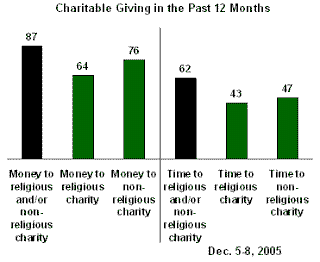
Charity, Religious and Nonreligious

Gallup Chart Charity

“Nearly all the money the religious givers—which in the United States comprises mostly Christians—give to their congregations appears to end up getting spent directly or indirectly on themselves.” [from Part 2, below]

“To completely replace public [governmental] aid with private charity would require an enormous increase in charity. For example, if all the annual religious contributions in the U.S. were used to offset public expenditure for the poor, the amount would fund less than 15 percent of current aid to poor people.”
—An Evangelical Christian economist at Wheaton College

A little history lesson on charity…

One sometimes hears the claim that Aristotle, the famed philosopher from ancient Greece, never included charity among his virtues. Which is astonishing because it is in fact one of his fundamental virtues, extensively discussed in an entire chapter of his book on moral theory. Or one hears the claim that no one cared for or about the poor before Christians came along, that philanthropy didnʼt exist, that social welfare wasnʼt a concern. Which is astonishing because in fact the Greeks and Romans were famous for inventing these things, and implementing them quite extensively compared to previous empires. In fact the word, “philanthropy,”from them! Many Roman and Greek philosophers wrote extensively on generosity and charity and concern for the poor as being fundamental to the good person, definitive of the moral life. The idea of charity, welfare, the common good, sharing wealth, helping the poor was heavily ingrained throughout all ancient societies before Christianity. Itʼs evident in Aristotelian generosity and magnanimity, Stoic and even Epicurean moral theory, Cynic discourses, and the Greco-Roman institutions of philanthropia and euergetism, and of course pre-Christian Jewish wisdom literature. (Notions of charity were also developed in the East, independently of Western thought altogether.) Social welfare in antiquity was extensive, often including subsidized and sometimes free medical care, food supplies, educational scholarships, income subsidies for the poor, and disaster relief; as well as access to fresh water (which required massive outlays for aqueducts and associated delivery and storage systems), and other urban infrastructure, like roads and libraries, which were free to the public. Public baths and toilets were not free, but heavily subsidized for the benefit of the poor, and sometimes indeed free (on holy days). Private charities were likewise everywhere, from burial and dinner clubs, to guilds and religious fraternities, to secular and sacred hospices. Advanced hospitals with hygienic arrangements, scientific medical staff, medicinal gardens, baths, latrines, and libraries were free to slaves and soldiers—and may have been available to the public for a fee, just as today; otherwise, healing temples provided scaled-fee services with all the same features, with a big dose of fake “miracle medicine” of course; but thatʼs also what the Christians sold. Nor were Christians different from the pagans in that after a few centuries Christians became defenders of material and social stratification rather than champions for ending poverty. In other words, they became pretty much just like the pagans they claimed to be superior to. Christians taught that the poor should accept their lot; the rich and the ruling classes were blessed by God. At the level of nation-states, no Christian society has been organized otherwise. Until Deists of the Enlightenment started chiding Christians they never even proposed a solution to poverty much less attempted one. SOURCE

During the Victorian era universalistic charities and government charity assistance programs arose, i.e., when people realized that the churches could not be societyʼs safety net. More had to be done, much more, charity wise and politics wise (to raise pay, lower work hours, and improve work safety conditions). It was at this time that universalist Christianity also grew. Florence Nightingale made nursing a legitimate modern profession, and revolutionized hospital care. She was a universalist Christian who taught that hospitals must serve sick people no matter what their religion or sect, and allow people to see whatever clergy they wished. Hospitals up to her day had been sectarian in nature, built mainly to aid those of the same religious sect, and/or evangelize those in their care. Florence put care above evangelization, and taught that hospitals must allow people to see whomever they wished when it came to their soulʼs needs. The founder of the Red Cross, Andre Dunant, was gay it turns out. His family burned his love letters after he died. And Clara Barton, the founder of the American Red Cross was another universalist Christian. Since then, charity for its own sake has been increasingly recognized. Ever heard of Jane Addams and “Hull House” in Chicago? Some claim that the work of the Hull House marked the beginning of what we know today as “Social Welfare.” Interestingly, Nightingale, Dunant, and Addams, all appear to have helped revolutionize charity, and all three held an open view of religion, were not into the Jonathan Edwardsʼ hell-fire stuff at all, but into universalistic acceptance of others. And Dunant, being gay, with Addams living with a woman and mentioning how much she loved her is certainly suspected of being gay, and Nightingale also mentioned her love of another woman in some strongly worded prose, and is at least suspected of having homosexual urges. Today people of all religions or none work in hospitals, and work for the betterment of mankind via agricultural science and medical science.

Today the majority of charities are non-denominational and/or secular in the sense that doing good and not preaching is what they are about. Doctors Without Borders is not a religious group. It was created on the belief that all people have the right to medical care regardless of gender, race, religion, creed, or political affiliation, and that the needs of these people outweigh respect for national boundaries. Also, a major cross-sectional survey of U.S. physicians found that doctors who are more religious are slightly less likely to work with the underserved than physicians with no religious affiliation. Researchers from the University of Chicago and Yale New Haven Foundation published a report (Annals of Family Medicine, July/August) showing that 31% of more religious doctors practiced among the underserved, compared to 35% of physicians described as atheist, agnostic or none. Source: University of Chicago News Office, July 30, 2007

Some of the hardest work that has been done (which has saved the most lives) has often been done by people who either arenʼt very religious or who choose not to mention religion, nor connect their work with it. Take Maurice Hilleman and Norman Bourlag, two who never seem to have taken time to be widely recognized for their work except by fellow specialists in their fields.

Vaccines developed by Maurice Ralph Hilleman probably saved more lives than the work of any other single scientist in the past century, and his research helps the medical establishment predict and prepare for upcoming flu seasons. His peers said that he had done more for preventive medicine than anyone since Louis Pasteur. Dr. Hilleman developed 8 of the 14 vaccines routinely recommended: measles, mumps, hepatitis A, hepatitis B, chickenpox, meningitis, pneumonia and Haemophilus influenzae bacteria (which brings on a variety of symptoms, including inflammation of the lining of the brain and deafness). He also developed the first generation of a vaccine against rubella or German measles. The vaccines have virtually vanquished many of the once common childhood diseases in developed countries. SOURCE

Norman Borlaug is credited with saving a billion lives or more from starvation. Though Borlaug held to his familyʼs traditional Lutheran beliefs he did not use his notoriety to try and lead others to Christ as so many Christian congressmen, actors and athletes have attempted to do. He did not trumpet the importance of his personal religious beliefs, he barely tooted them in so far as his lifeʼs work was concerned. What he did use his notoriety for was to promote further scientific research and to speak on the importance of education, the necessity of population control, and the importance of producing food for all. SOURCE

As for saving the most lives, the grand prize probably goes to the plumbers of the world, and water and waste engineers. Without the development of plumbing the spread of diseases from unsafe water supplies and the mosquitoes and flies that carry disease back and forth from them, would have been epidemic. Iʼve read other essays that agree, voting for the plumbers and the engineers who developed plumbing, makes the most sense.

Billionaire Bill Gates founded the Bill and Melinda Gates Foundation by donating tens of billions of his own wealth along with tens of billions of additional dollars added by agnostic billionaire, Warren Buffet. Gates and Buffet were ranked as the top two wealthiest men on earth (at least that was their ranking before the recent stock market meltdown). Gatesʼ website promotes the Big History Project, a pro-evolution project, and even books by some atheist scientists. Gates does not appear very interested in propagating any particular religious beliefs, though he did convert to Catholicism, his wife Melinda's religion, and she says she is "living out" her faith via her charitable activities. Meanwhile, many Catholics on the internet wonder how serious either of the Gates' are when it comes to promoting some of the Catholic Church's specific moral and/or doctrinal teachings. Andrew Carnegie from two or three generations ago was an atheist philanthropist. SOURCE

Charity & the nonreligious Part 2

BOOK: Passing the Plate: Why American Christians Donʼt Give Away More Money by eminent sociologists of religion Michael Emerson, Christian Smith and Patricia Snell, published by Oxford University Press 2008

Chapter Two, “Failed Generosity” lists in bold print the most crucial Facts derived findings from the data. And adds on pg. 53, “Thus, nearly all the money the religious givers—which in the United States comprises mostly Christians—give to their congregations appears to end up getting spent directly or indirectly on themselves.”

  • Fact #1 At least one out of five American Christians—20 percent of all U.S. Christians—gives literally nothing to church, para-church, or nonreligious charities.

  • Fact #2 The vast majority of American Christians give very little to church, para-church, or nonreligious charities.

  • Fact #3 American Christians do not give their dollars evenly among themselves, but, rather, a small minority of generous givers among them contributes most of the total Christian dollars given.

  • Fact #4 Higher income earning American Christians—like Americans generally—give little to no money as a percentage of household income than lower income earning Christians.

  • Fact #5 Despite a massive growth of real per capita income over the twentieth century, the average percentage of income given by American Christians not only did not grow in proportion but actually declined slightly during this time period.

  • Fact #6 The vast majority of the money that American Christians do give to religion is spent in and for their own local communities of faith—little is spent on missions, development, and poverty relief outside of local congregations, particularly outside the United States, in way that benefit people other than the givers themselves.

Reviews of the above work:

A Lot of Lattés: Stingy Christians in an Age of Opulence by Ron Sider posted 10/30/2008 Christianity Today, click here.

American Christian groups typically give away only 1.5% to 2% percent of their income. Considering that this figure is based on self-reporting, the reality is probably even less. Catholics are the worst, with many Protestant groups in the middle and Mormons (whom this study regards as “non-Christian religious believers”) at the top. Click here.

Mormons, who appear to give seven times more as a percentage of their income than Catholics, are the exception. Smith said the book does not include them in its overall calculations of giving because “they are so sociologically distinctive in terms of giving” that they deserve a separate mention. “Mormons have a much higher expectation. They teach tithing much more conscientiously. Every year you meet with a local bishop who asks you if you tithed, and if you havenʼt there are consequences,” Smith said here.

Charity and the nonreligious Part 3

Further Considerations

  1. Is there nothing to be learned from the way less religious modern industrialized countries have lower crime rates than the U.S., higher general education levels than the U.S., lower teen pregnancy rates than the U.S., lower child mortality rates than the U.S., higher life expectancies than the U.S., and devote a higher percentage of their taxes to foreign aid than the U.S.?

  2. When attempting to measure the “charitableness of Christianity” one must subtract the costliness of churches in general, including preacher(entertainerʼs) incomes. I certainly donʼt begrudge people spending money on whatever religion they wish, but calling all the money they spend on their pastorʼs and churches “charity,” is about as close to the truth as me calling the money I spent last year attending various events that either entertained or were social functions of one sort another, “charity.”

  3. One could even subtract the way that “religious affinity fraud” robs devout churchgoers of billions each year, who are dragged into money losing operations VIA conservative religious faith, either of the Prosperity Gospel kind, or, of wild eyed claims of “blessed” money-making investments that are heralded as the Gospels truth by pastors or by fellow devout church going friends that you canʼt help but trust, i.e., schemes that spread like wildfire among conservative congregants. SOURCE

  4. Lastly what about the cost and function served by most “mission trips?” Seems like another cost one could subtract. SOURCE 1 SOURCE 2.

On Missionary Trips

Itʼs that time of year again! Pack your bags, round up your dusty ole passport, dig up that Hawaiian shirt you love so much (you know, the one that makes you look like Rick Warren), and get your flippy-floppies out—itʼs mission trip time again! Time to go tell some third-world peasants about Jesus, hammer a few nails in a decrepit schoolhouse, and catch some rays! Click here.

Dirty Secrets of Christian Evangelism—Saturday June 27, 2009
Both Catholics and Protestants spend a lot of money on missionary programs in the “Unreached Bloc,” a largely non-Christian region stretching from Africa to East Asia, with India being a primary target. The tactics can be very unethical and the results very poor. So why do people go through with it? For Christ, they say. I suppose anything can be justified in the name of Jesus, no matter how unethical and harmful.

S. R. Welch writes for the Secular Web:

Missionaries exploit the sick:

Catholic priests had been instructed to learn something of medicine in order to gain access to the bedsides of sick Hindu (and Muslim) children. There, on the pretext of administering medicine, the priests secretly baptized the children before they died. What is troubling are the reports that this practice continues today, with formulas of baptism whispered and holy water sprinkled surreptitiously over non-Christian patients even in the hospices of such well-known orders as the Missionaries of Charity.

Both Westerners and Indians are exploited via fake “orphans”:

Exploiting customs that make female children economic burdens on their families, missionaries reportedly induce tribal mothers to relinquish baby girls shortly after birth. Often the mothers are promised that rich Westerners will adopt their daughters and they will live a “much better life.” The mother is typically paid about $70 for her child, which is then adopted by Western parents for a “donation” of $2,500.

There is an irony to the notion of tribal “orphans,” according to Arvind Neelakandan, a volunteer with the Vivekananda Kendra (VK), a Hindu nonprofit that works among the tribals. In most tribal communities, Neelakandan explains, “Orphans as we know them are nonexistent”; parentless children are typically cared for by their extended family. But, he explains, missionaries will “fleece money from their foreign donors by projecting these very same children as ‘orphans’” in fundraising campaigns.

Is it immoral to solicit “conversions” by offering food or medicine? Missionaries donʼt think so:

Whatever one calls the offer of material allurements in exchange for religious conversion, it does not deserve the appellation of “charity.” But this is lost on missionaries like Paul, who offers no apologies when confronted with Hindu objections. “If Hindus believe that certain tactics like offering money, food or clothes to their naked children in return for embracing Christ is immoral, then what can I say?” he protests. “All congregations and missionaries have been advised to follow these techniques, as others will only fail. Sounds immoral but that is the only way.”

And just how successful is this, anyway? Not very:

According to the World Evangelization Research Center (WERC), there are more than four thousand mission agencies. Collectively they operate a huge apparatus, manned by some 434,000 foreign missionaries wielding an annual global income of eighteen billion dollars. And yet, for all the money that is spent—an astonishing average of $359,000 for every person baptized—the benefits of evangelism are meager. … Meanwhile, the quality of life for Indiaʼs Christian population remains dismal. Despite “crocodile-tears for the oppressed,” says Edamaruku, and contrary to apologistsʼ frequent boast that Christianization brings justice and equality to the “untouchables,” dalits who convert find that as Christians, they remain “as ‘untouchable’ as they had been as Hindus.” While more than 75 percent of the Catholics in India are dalits, dalits make up less than 5 percent of Indian priests. Most priests come from upper castes.

This is supposed to be the “charitable” face of Christianity. As Welch explains, the helps to breed ethnic and religious strife as new converts are often induced to adopt fanatical attitudes towards their former faith. Missionaries feed and clothe people, but at what price? They are paying a serious ethical price themselves and extracting a large price from local society through increased tensions — not to mention the funds and time that could be better spent on more productive programs.

For much more info: Christian Missionaries, Vacationaries, VolunTOURism (Humor, Data, Questions Galore)

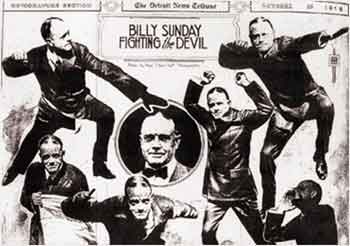
America's First Millionaire Evangelist Made The Tea Party Seem Tame, Made Intolerance a Virtue, Was a Bob Jones College Trustee, And Stole Lines from America's Great Agnostic. His name was Rev. Billy Sunday OMG What a Tale

Billy Sunday

Billy Sunday, an orphaned bricklayerʼs son, rose to fame and wealth as an American revivalist preacher in the early 1900ʼs. Sunday preached: “I donʼt know any more about theology than a jack-rabbit knows about ping-pong, but Iʼm on my way to glory!” And, “When the word of God says one thing and scholarship says another, scholarship can go to hell!” During his career he spoke to over 100,000,000 people in the days before radios and loud-speakers; led 1,000,000 “down the sawdust trail” [i.e., converts], and he received, so it was said, millions of dollars in free-will offerings.

Sunday gradually developed a style of preaching that was as popular as it was sensational. He began by imitating those idols of Midwestern oratory, William Jennings Bryan [Christian defender of the Tennessee state law that banned the teaching of evolution in the 1920ʼs], and Robert G. Ingersoll [Americaʼs “Great Agnostic” whose speeches around the U.S. were heavily attended and reported in his day], both of whom he had heard in Chicago. He even went so far as to paraphrase the agnostic Ingersoll in a sermon titled, “The Inspiration of the Bible, or Nuts for Skeptics to Crack,” in order to prove to his audiences that a man who believed in the orthodox Protestant faith could be just as eloquent as one who flouted it. He also took some humorous anecdotes from the sermons of fellow-evangelists. And for doctrinal exegesis he borrowed freely from the sermons of D. L. Moody and T. DeWitt Talmage. The results enraptured his audiences. Some of Sundayʼs “prose poems and rhetorical gems” were compared to “the finest passages of Robert G. Ingersoll.”

Another aspect of Sundayʼs style that attracted enthusiastic response was his “power of ridicule and denunciation.” Typical was his opening-night expression: “Exercise good country cow sense and weʼll get along all right. Thereʼll be in my sermons good fodder and rock salt, barbed wire and dynamite.” With considerable relish Sunday populated hell with all the great freethinkers and “sinners” of history. The list included persons as dissimilar as Nero and Darwin, Henry VIII and Robert Ingersoll, Mme de Pompadour and John Stuart Mill, Catherine of Russia and Mary Baker Eddy. Later he even counted famed Christian preachers such as Harry Emerson Fosdick among the atheists, because they preached “Modernism” rather than Sundayʼs “Fundamentalism.”

Sunday preached that ministers who say “there isnʼt any devil—that he is a poetic personification of the sin in our natures, are calling the Holy Bible a lie!” A hundred years earlier than Sunday, in the 1830ʼs, the evangelist Charles G. Finney had written in his Memoirs about having personal encounters with the devil, who on several occasions tried to kill him, but Sunday had no such encounters.

To the evil effects of dancing Sunday devoted much of his sermon on “Amusements.” “Dancing seems to be a hugging match set to music…three-fourths of all the fallen women fell as a result of the dance.” The young ladies of 1917 were warned that “the movies are too suggestive,” that they must not “kiss or hold hands,” and that only at “the cheapskate dance halls” would you “find young girls with their dresses [up] to their shoetops!” He even opposed traditional country square dancing. “The swinging of corners in the square dance brings the position of the bodies in such attitude that it isnʼt tolerated in decent society.” Little girls were told to play dolls instead of jackstones. “We donʼt like to see girls playing leap frog,” Sunday said, “it donʼt look right.” Billiard-playing also caused him some difficulty when the YMCAʼs began to install tables: “I love the YMCA, but Iʼve never yet become reconciled to its adoption of billiard rooms.” Adolescent boys were told of the terrible consequences of masturbation.

Sunday also viewed conversion as a guarantee of inevitable success: “Following Christ you may discover a gold mine of ability that you never dreamed of possessing.” He himself had done so as a preacher, he said. If a man complained that he did his best but still did not succeed, Sunday merely answered, “You have a flaw in your character. They canʼt trust you. That is the reason you did not succeed.” Probably men who failed to become a success were not truly converted: “I never saw a Christian that was a hobo…They that trust in the Lord do not want for anything.” Of course Sunday admitted with a touch of irony, “You may not be able to be a search light or a whistle, but you can be a cog in the machine.” For the unemployed Sunday had no more sympathy than had evangelist D. L. Moody, who, during the terrible depression of the mid-1870ʼs, told an audience made up of the unemployed of Boston: “Get something to do. If it is for fifteen hours a day all the better, for while you are at work Satan does not have so much chance to tempt you…work faithfully for three dollars a week, it wonʼt be long before you have six dollars. You want to get these employers under an obligation to you…If a man works in the interest of his employer, he will be sure to keep him and treat him well.” If it was pointed out to Sunday that the unemployed were willing to work but could not get jobs [i.e., during the depression of 1914-15], Sunday resorted to the same ludicrous proposition that Moody offered in 1877, when he told the unemployed that they should return to the farm. But Sunday gave it a modern twist, “Go back to the farm and study expert dairying and help save the lives of 200,000 babies that die every year from impure milk that is sold…Go out west and study and be a horticulturist.”

Newspapers all over the nation followed the rise in Sundayʼs fame and earnings. His cumulative earnings during the years 1907 to 1918 added up to $1,140,000 [=$15,670,000 in 2003, according to an online “inflation calculator”]. . . Critics were not impressed by the fact that Sunday paid part of the salaries of his staff out of this or by the fact that he gave one-tenth of his earnings to charity. According to Rodeheaver, Sunday was a millionaire by 1920, when Dun and Bradstreet rated him as worth $1,500,000. Sundayʼs only comment was that it was nobodyʼs business how much money he had or what he did with it. Like another contemporary millionaire, John D. Rockefeller, Sr., Sunday believed that the Lord gave him his money. [Rockefellerʼs son, John D. Rockefeller Jr., at first a fan of Sundayʼs, later deserted him to take the side of Harry Emerson Fosdick, a “Modernist” rather than “Fundamentalist” Christian.]

Sunday defended the high cost of his revivals by stating that they produced more converts more cheaply than any other revivalist and even than the churches themselves. “What Iʼm paid makes it only about $2 a soul.” True enough if the expenses of the revival alone are counted. But if the free-will offering was considered part of the revival expenses, the cost of a convert would have averaged nearly $4 for the 1906-18 period. Some critics added not only the expenses and the free-will offering but money gained from sales of hymnbooks, religious pamphlets, Bibles, biographies, postcards, and other literature—plus gifts of clothes, jewelry, and bric-a-brac—all taken out of the city by the revivalist. Others noted that those who walked down front to shake Sundayʼs hand [as a sign of conversion] did not all join churches. So all in all, Sundayʼs “cost per converted soul” criterion was purely academic.

Charting membership figures of ten or twenty churches for a period of five years preceding the revivals of Billy Sunday, and five years after it (including the revival year itself)…[p.207] reveals a significant similarity of pattern…an even rate of growth in membership for the years preceding the revival, then a rapid increase in the rate of growth for the year of the revival, then a serious slump in the rate of growth (often an actual numerical decrease); and then, slowly, the growth picks up again, until, at the end of the fifth year following the revival, the rate is once more about the same as it was in the years preceding the revival. The net result in some cases is that over the ten-year period the total growth has been about the same as it would have been had there been no revival at all. . . . There is little evidence that Sunday converted many social derelicts or “booze-hoisting” bums, who were the stereotype revival converts pictured in cartoons.

Rodeheaver was Sundayʼs song leader for 20 years, who “warmed up” the revivalist crowd with “inspirational” songs before Sunday preached. Rodeheaverʼs salary reached as high as $200/week [=$2,750 in 2003], while Ackley [Sundayʼs private secretary], the next most important member of Sundayʼs revival crew, never received over $40/week [=$550 in 2003]. But in addition to their salaries they were all frequently given gifts of considerable value by grateful converts or members of the local committees with whom they worked. In addition, Rodeheaver and Ackley made money writing hymns and publishing the Billy Sunday hymnbook, Songs for Service.

The mail that Sundayʼs song leader, Rodeheaver, received during each revival campaign consisted largely of letters from lovesick women whom he had never met, and he was sued for “alleged breach of promise [to wed]” in 1914, the jury awarding the plaintiff $20,000 (=$355,000 in 2003) [p.83,269] In June, 1915, Sundayʼs private secretary, B. D. Ackley, in a fit of depression resulting from chronic alcoholism [something Sunday preached against in one of his most popular sermons, “Booze, or Get on the Water Wagon”], denounced the commercialism of the song leader, Rodeheaver, and threatened to write a series of articles exposing the whole profession of evangelism. Fred Seibert [who handled the selling of photo postcards of Sunday and various religious pamphlets at each revival] was sued for divorce in 1915. Also in 1915, suit was brought against Sundayʼs revival campaign for $1,754 [=$30,800 in 2003] worth of damage to a home they rented during a Philadelphia revival campaign, and for the destruction of wine and champagne glasses during the partyʼs occupancy.

Charges of plagiarism also hounded Sunday throughout his career. Sunday never claimed complete originality for all his sermons. “I am indebted to various friends of mine for some of my thoughts,” he would often say, “though I do not always give credit.” It became apparent, however, that, had he given credit for all the material he borrowed, there would have been little left of his own. To those who took the trouble to unearth the sermons from which he borrowed, it was evident that, while he often altered the form, the substance was the same. [p.165] Sunday claimed that he could not know the source of clippings [that he stored in envelopes according to subject category, and that he used to compose his sermons], many of which were sent to him in the mail, and he made this excuse when some freethinkers discovered he had plagiarized one of Ingersollʼs speeches. The Ingersoll borrowing was particularly damaging to Sunday for two reasons: first, because he had so consistently condemned Ingersoll to hell for his agnosticism and second, because the borrowing was absolutely verbatim.

A large part of a book that Sunday permitted to be issued under his name in 1917, called Great Love Stories of the Bible, had been ghost-written by a man named Hugh A Weir, and in 1918 Weir sued Sunday for alleged failure to live up to an agreement regarding the royalties. In 1918 another suit for plagiarism was brought against Sunday by Sidney C. Tapp.

The accumulated weight of these incidents and of reiterated charges of “polite black-mail” in regard to the free-will offerings could not be shrugged off. Even the conspiratorial silence of most of the religious press regarding derogatory information could not offset the obvious failures of the revival campaigns to live up to their advance claims. A cartoon in Washington, D.C. in 1918 was indicative of the change in the publicʼs attitude. Instead of the usual picture of Sunday hurling hot shot at a cringing devil, the cartoonist portrayed a small boy clinging to his mother in the crowded tabernacle and saying, as he pointed to the men selling hymnbooks, Bibles, and authorized biographies. “Itʼs just like a circus, ainʼt it Ma?”

Sundayʼs revivalism suffered additional shocks from the bitter fight between the Fundamentalist and Modernist wings of the Protestant churches that broke out in full fury in the early 1920s. Almost every denomination was rent from top to bottom over questions of correct interpretation and proper emphasis of certain aspects of the Scriptures. Sunday, like every other evangelist, sided with the Fundamentalists, particularly on the issues of the imminent Second Coming of Christ and the literal inerrancy of the Bible. In some cities his revivals came to be looked upon as propagandistic moves by the conservatives in the battle for control of the denominations. But regardless of which side Sunday had been on, the very fact that the churches were split so deeply and so fanatically in this struggle made it virtually impossible to produce the united harmony necessary for mass revivalism.

Sunday came to consider the Southern U.S. the bastion of Christianity because, compared with other sections of the U.S., it had a higher percentage of church members, a smaller number of Catholics and foreigners, and a more rural and conservative social system. The South, he observed in one sermon, was the home of “more true-blue Americanism than any other part of the country.” But the problem of segregation he never solved; he faced it only when forced to do so by his general ostracization from the North.

Sunday claimed that Negroes and white were both equal before God, but he was unwilling to accept their equality among men. He stated his views on the Negroʼs inequality most clearly in Springfield, Illinois, in 1909, the year after the race riots there. He denounced the riots in one of his sermons and was cheered when he said that, if he had been in charge of the police during the riot, the streets would have been “crimson with the blood of the members of the gang” that had lynched the Negroes. But then he went on to state: “I am not going to plead for the social equality of the white man and the black man. I donʼt believe there is an intelligent white man who believes in social equality or an intelligent and reasonable colored man who believes in social equality. But before God and men every man stands equal whether he is white or whether he is black.” Sunday brushed aside this typical inconsistency in his next remark that he would not want his daughter to marry a Negro, and “I do not think any sensible Negro would want to marry my daughter.” He finally passed the whole question off with a bit of sophistry: “We havenʼt equality even among the white folks. Mrs. Potter Palmer gave a magnificent reception in her palatial home on Lake Shore Drive in Chicago. She didnʼt invite me.”

Firm in his belief that “only Christians should be allowed to teach in the schools,” Sunday became in the 1930ʼs a trustee of Bob Jones College, an arch-conservative Bible school that started in Cleveland, Tennessee, and later moved to Greenville, South Carolina to become Bob Jones University. [Founded by Bob Jones Sr., a Southern revivalist who accepted monetary contributions from the Ku Klux Klan (and looked the other way when they handed out leaflets of their own at his rallies), and who preached on his own college radio station, “If you are against segregation, you are against God!” It was only after the 2000 U.S. presidential election race that Bob Jones University lifted its ban on interracial dating (though students require a note from their parents to do so).] Bob Jones College was one of many such schools founded in the 1920ʼs, and 1930ʼs to take the place of those where unconverted (hence non-Christian) teachers taught evolution. “Schools,” said Sunday in 1931, “are worse than useless if they bring students under the influence of those who do not believe in Jesus Christ upon which the church and schools were built.” At Bob Jones College, Americanism of Sundayʼs variety—the variety that said, “There can be no religion that does not express itself in patriotism”— could be promoted, and the youth of America could remain free from any ideas of dissent. [Bob Jones students cheered at the news of Rev. Martin Luther King Jr.ʼs assassination in the 1960ʼs, since Rev. King preached a “compromised Gospel.” And though worldwide evangelist Billy Graham had attended Bob Jones College in Tennessee for a little while before transferring to Wheaton College up north, the folks at Bob Jones College found Grahamʼs own Gospel too socially compromised since Graham worked with the World Council of Churches.]

The election of Franklin Roosevelt as president of the U.S., the repeal of Prohibition [that made it legal once again to sell alcoholic beverages], the diplomatic recognition of communist Russia, and the rise of Hitler, came as a series of shattering blows that made Sunday begin to doubt whether America could ever be saved. In one of his last sermon revisions, some time in 1934, Sunday rewrote his interpretation of the Second Coming, and entitled it “The Coming Dictator.” In this sermon he reached the ultimate stage of pessimism, and, rejecting all faith in the American heritage and destiny, he expressed his agreement with the evangelist Dwight L. Moody (founder of the Moody Bible Institute, and Moody Press) that the world was doomed. He even went beyond Moody by setting the date for the end of the world in the year 1935. “Russia has her Stalin, Italy has her Mussolini, Germany has her Hitler…and Colonel House thinks ‘even America seems ripe for one—if we havenʼt already got him [referring to the U.S. president, Roosevelt].’” He described the antichrist as “a Mussolini—a Stalin and a Hitler all rolled into one. He will give the world a ‘New Deal.’ A wizard in finance, he will stabilize the currency of the world and all industry will be brought under his control. He will issue a compulsory code for every commercial enterprise.” The similarity to U.S. president, Franklin Roosevelt, became almost too pointed, but Sunday avoided it. Sunday presented evidence to show that the era of the gentiles would end in 1935 and that the last dispensation of God “is about to close.”

In the years between 1862 and 1935, while gains from revivals and losses from declining church memberships roughly canceled each other out, the steady over-all growth in membership (although at a diminishing rate) continued. In 1936 the United States Religious Census revealed that, for the first time in history, more Americans were church members than were not. But the principal reasons for the growth of the Protestant churches in America were social rather than religious. Joining a church had become the socially respectable “thing to do;” a crisis conversion was neither necessary not expected. A watered-down version of Horace Bushnellʼs doctrine of Christian nurture had successfully replaced the ecstatic regeneration of the frontier camp meeting, and Billy Sundayʼs revivalism had played an unwitting part in the transformation. Despite his emphasis on conversion through the agency of the Holy Spirit, Sundayʼs revivalist converts were primarily expressing the acceptance of the prevailing morality. Sundayʼs revivalism made church membership a test of Americanism and salvation a ritual of acceptance of the myth. It limited membership to those whose native birth, education, occupation, and social status conformed to a strictly defined stereotype. In his fanatical self-righteousness he asserted that those who did not conform were not only damned to hell but were ineligible for citizenship or acceptance in respectable society, and his audience applauded.

The increasing discrepancy between the traditional American ideals and Sundayʼs ideals became abundantly clear in his sermons. Freedom of speech should apply to all—except to pacifists, Socialists, anarchists, communists, labor agitators, and “pinko” liberals. Freedom of religion should apply to all—except to Unitarians, Universalists, atheists, Mohammedans, Hindus, Confucianists, Mormons, Christian Scientists, theosophists, and Christian theological Modernists. All men were born equal—except Negroes and foreigners. Church and state must be separated—except that Christianity should be written into the Constitution, no Roman Catholic should be eligible for the Presidency, there should be a Bible in every schoolroom, all teachers should be converted Christians, and anything contrary to the most literal interpretation of the Bible should be prohibited by law from the curriculum of the public schools. The fact that Sunday continued to find widespread support throughout the 1920ʼs despite the reactionary extremism of his message indicates the extent to which the nation had turned aside from its principles.

Then, in 1929, a new phase began in American history. The great depression shattered the make-believe world of perpetual prosperity in the 100 percent American way. As the nation faced up to the necessity of making its business enterprise more adequately serve the general welfare, Sunday lost touch completely with the public temper. He had excluded so many from his definition of “true-blue Americans” that he found himself in a dwindling minority. He decided not only that the twentieth century had broken the speed limit but that it could never put on the brakes short of hell. At the time of his death he was ready to abandon America for heaven unless the quick advent of Christ by inaugurating the millennium, should put an end to the nation that had changed beyond recall.

His message aside, it is easy to see why those who knew Sunday liked him. As an individual he had many laudable traits. He was generous to a fault; he was courageous and honest. He was trusting to the point of naiveté yet extremely sensitive to any ridicule or rebuke. Quick to anger but equally quick to apologize, he had a keen sense of humor, a vivid imagination, a gift for words, and a positive genius for catching the eye and ear of his generation. The religious movement he led from 1908 to 1918 was not a revival in the usual sense of the word, for, on the whole, it failed to win the large numbers of new converts to Christianity which the term generally implies. If Billy Sundayʼs career was, in the long run, a failure, it was a failure shared by a generation of Americans.

Two of Sundayʼs sons took the proverbially wicked path of a ministerʼs children. His eldest son, George, attempted suicide in 1923, was arrested for auto theft and bail-jumping in 1929, was divorced by his first wife in 1930, married a Los Angeles model in 1931, and jumped from a window to his death in September, 1933. The youngest son, William A. Sunday, Jr., was divorced in 1927, remarried in 1928, and was divorced a second time on grounds of extreme cruelty in 1929. The death of Sundayʼs only daughter, Helen, in 1933, further saddened his life. He was sixty-eight in 1930, and his health failed fast in the five remaining years of his life. A heart attack in 1933 and another in May, 1935, left him seriously weakened, but he would not give up preaching. [He died of a third heart attack on Nov. 6, 1935]

Source [with edits by ETB]: William G. McLoughlin, Jr., Billy Sunday Was His Real Name (Chicago, Ill.: Univ. of Chicago Press, 1955)


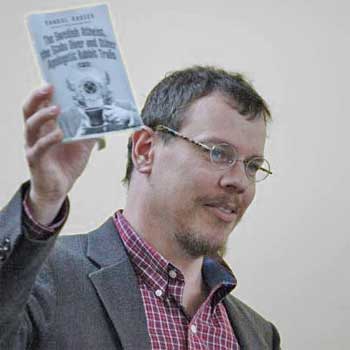
Randal Rauser and Ed Babinski: On Storytelling, Atheism, Christianity, God, the Cosmos, Miracles, Near Death Experiences, Scientific Hypotheses and Religious Beliefs

Randal Rauser
Randal Rauser

Randal, Thanks for your kind words here concerning something I wrote. You think I am a “great storyteller?” I think ancient Hebrews were “great storytellers” and I suspect you agree with me there, especially concerning the primeval history section of Genesis from the six-day creation to the Garden of Eden, Flood, and Tower of Babel stories.

Two items to clear up before proceeding further:

  1. Please call me “Ed,” rather than “Dr. Babinski.” I do not hold a doctorate only a bachelorʼs in biology.

  2. I am not an “atheist.” I am a former born again Christian who experienced what some call “charismatic/Pentecostal” phenomena, such as the “baptism in the Holy Spirit” and “speaking in tongues,” see here. As a Christian I was very interested in apologetics and a big fan of the Inklings (C. S. Lewis, Charles Williams, Tolkien), George MacDonald, G. K. Chesterton, Francis Schaeffer, InterVarsity Press authors who wrote works on apologetics, and, Josh McDowell. After leaving the fold I was invited to reply to McDowellʼs claim that the Christian experience was “unique,” and did so here. Today, I am an agnostic who hopes for an afterlife (that is, if a God or some sort of cosmic consciousness exists).

    I edited a book, Leaving the Fold: Testimonies of Former Fundamentalists, click here, that includes testimonies of people who left conservative Christianity for more moderate pastures, or liberal pastures, or who became adherents of other religions, or agnostics, or atheists. I also wrote a chapter on “The Cosmology of the Bible,” click here, and click here to read some of the replies the chapter received, as well as counter-replies by my atheist friend Ben.


Ed Babinski (circa 1995)

Randal, Your Comments to Me From Your Blog Appear Below, Followed by My Responses Which Are Indented

Ed, youʼre a great story teller. Your Achillesʼ heal is in moving from story telling to formal argument. How do you move from “This is the ‘natural history’ of human origins and the human place in the universe” to “Therefore, there is no God”?

Randal, Itʼs “heel,” not “heal.” And your own Achilleʼs heel consists in missing my point that stories raise questions, and questions precede formal arguments. Nor do formal arguments have any advantage over informal ones as told in stories, not when it comes to the crucial matter of basic intuitions--the same basic intuitions that constitute the demarcation lines where even formal arguments either convince or fail to do so.

I did not declare, “There is no God.” Nor is there any need to do so. My point was that before any debate begins there are points about the cosmos we may agree on, points based on scientific investigation, points that are unsettling and that even make a Divine Tinkerer Hypotheses appear as likely as a Divine Designer Hypothesis.

In fact, knowing the cosmic story and humanityʼs place in it is a necessary precursor to arguing formally about it. I would like us to begin by agreeing that the cosmos has a story, see The Great Story site here, or see The Big History Project here.

Daily life for most involves long stretches of repetitive events that have minimal emotional, philosophical, or religious impact. It is in between such long stretches that the high drama takes place like being born/dying, getting wed/divorced, graduating/dropping out, getting hired/fired, holiday cheers/jeers, sporting event cheers/jeers, days of grand beauty/days of natural disasters, wonderful health/catastrophic illness, or, changes in oneʼs world view. A story can compress into a few hours the peak events in a personʼs life, the lives of a generation, a country, empire, planet or galaxy.

Stories let us see through other peopleʼs eyes the ways humans affect one another and the ways nature affects us. Stories are how we learn about the world and others.

The story I shared with you is that we live in a cosmos where life is in equilibrium with death, in which living organisms arise on infinitesimally small quaking planets that orbit stars that emit dangerous solar flares, all of which lay in the asteroid-strewn and radiation-filled vacuum of space. And life arises at the expense of high mortality rates of the young per each generation, such as the enormous percentages of dying zygotes and dying young of all species, not to mention mass extinction events. See my comments here on mortality rates, extinction events, and the questions they raise for the Intelligent Design hypothesis. Nor are those the only questions that a study of science raises, there are questions concerning how efficiently and/or beneficently the cosmos was “designed,” click here for examples. Astronomers have mapped out the lifetimes of stars depending on their mass and numerous corroborating stellar observations, and determined that stars are born and die (our own sun is a second-generation star, made partly from the exploded remains of a supernova whose explosion forged the heavier elements found on our planet). And our star, following the lifetime of others of similar size and mass, will one day expand in size to a red giant and burn up the earth long before the cosmos as a whole comes to an end. Though before our sun expands to become a red giant the Andromeda galaxy is due to collide with our own Milky Way galaxy since they are on a collision course -- but Iʼm speaking about a billion years from now. (Speaking of which “heat death” is no longer the only option as to how the cosmos will end, see here -- the leading hypothesis is the Big Rip in which time and space continue to expand at the current rate of measured acceleration till they rip apart at the edges like a balloon pumped with too much air or a Hippo leaping into a pair of size 12 khakis.

Scientific knowledge in areas as diverse as physics, astronomy, chemistry, geology and biology continues to expand like the surface area of a balloon being pumped each year with greater knowledge and inter-disciplinary research is common. But is that what we see in the religious world where adherents of rival religions, denominations, sects, and offshoots abound? Even focusing on Christianity alone, do Christians exhibit as much unity throughout their history as one might expect given the list of divine advantages that they claim they alone possess? Christians claim they possess

  1. the worldʼs only truly divinely inspired writings,
  2. the Holy Spirit guiding them into truth, and,
  3. the personal gift of special divine grace.

Scientists make no claim to such supernatural advantages. But Christians do claim such advantages, yet Christianity consists of divisions too numerous to mention and Christians remain the greatest debunkers of the views of other Christians, including todayʼs rival interpretations of the authority of the Bible, rival views concerning a wide range of theological questions and divisions still unsettled, rival views of spiritual or sacramental authority, sanctification, purity, divine commands and laws. To see some recent examples in print click here. As someone told me, “The ‘no-true-Christian-would-do-or-believe-XYZ” game is one of the more popular among, well, Christians.”

Put another way, religious believers remain convinced on the basis of

  1. personal or internal experiences that are not shared by (or remain invisible to) those of other religions, and,

  2. holy doctrines, dogmas and sacraments that appear unfalsifiably true to the religious believer but not shared by those of other religions. Hence, in religion, “Blessed are those who did not see, yet believe”. But that doesnʼt do much for people of other religions who believe in theirʼs without seeing, and it does even less for people with questions. The cosmic questions are obvious, while questions pertaining to the diversity and rivalries of religions raise yet more questions and add more confusion. Nor do I have to claim that everyoneʼs personal or internal religious experiences are false in order to ask, How can God expect me/us/everyone to know what to make of the diversity of religious beliefs and stories? We are presented with a mixed bag of evidence here as well as in the case of what we see in the cosmos. But letʼs look at some personal experiences below to illustrate what I mean.

  1. Amazing healings. (Craig S. Keenerʼs book on Miracles is top heavy with tales of Protestants and Pentecostals who say they have been miraculously healed, though it appears light on stories from Catholics [Marian and saintsʼ miracles], Muslims, Hindus, Buddhists, Native Americans, New Agers, Wiccans, Scientologists, Tribalists or Aborigines. It also does not discuss cases of spontaneous remission from terminal cancers that happen on a statistical basis, see here. Or, herbal and nutritional supplements claimed by some to be involved in their remissions. Yes people tell stories that involve amazing healings. One such tale comes out of Cambodia concerning a three-year-old healer whom multitudes are flocking to see. But what does this demonstrate concerning the truth of any one religion? And why are there no cases of a limb being regrown in Keenerʼs book though he has scoured the literature worldwide? So what does God expect us to believe?

  2. Amazing, astonishing coincidences. Do they point in the direction of one religion being true? See here, here, here, here, here, here, and lastly see, This Is My Lucky Day, a video featuring jaw-dropping scenes in the lives of people walking or driving who are very nearly killed, and in the final scene some bank robbers in their escape vehicle are literally surrounded when several police vehicles arrive, but the police donʼt realize they have surrounded the robbers, so the police all leave their cars simultaneously and rush into the bank together, leaving the police cars empty, so the robbers simply drive off!) Yes, there are amazing coincidences. Certainly Iʼd expect Christians to have them too, not just bank robbers. And see the other cases above! The trouble is interpreting the full width and breath of such data. Or as someone once said, the basis of all superstition is recalling all the hits that affected you (or your beliefs) the most, and forgetting all the misses and near hits everyone is subject to in real life each day.

  3. And what to make of UFO sightings, including first person tales of abductions or contacts with aliens? A college professor and his son had a long experience they wrote about in detailed form. Thereʼs annual conferences concerning the latest UFO evidence and contact stories. Thereʼs generals who have made pro-UFO statements. Thereʼs video footage and first-person testimonies of sightings from around the world. What about tales of ghostly apparitions that range from minor to major sightings, and benign to frightening stories? What about stories people recount of seeing beings of light, angels, demons, deities other than the Christian variety, or even those who say they saw the sun come down out of the sky and dance beside them (I know a Catholic couple who told me first hand that they experienced this along with other Catholic travelers on a Marian pilgrimage). What does “God” expect us to make of such stories?

  4. Near Death Experiences (NDEs) and/or Out of Body Experiences (OBEs), see here. NDEs have been experienced by people of all religions or none. Atheists experience NDEs as often as other groups, percentage-wise, see here. (Though people of all groups whose heart are restarted usually say that they recall nothing, just as in dreamless sleep. What is one to make of that? Is God squandering a possible opportunity to reach more people?)

The majority of NDEs (and of course, OBEs) involve leaving oneʼs body, hovering for a while then returning again. NDEs in which people go to another realm and actually meet a Being of light, are rarer, and the Being of light is most often interpreted as another human who had gone on before, or a deceased loving relative, rather than a specific religious figure. Also, NDEs most often lessen a personʼs fear of death.

The rarest NDEs involve long memorable excursions in other realms. Sometimes Evangelical Christians claim to have experienced such an NDE, and they write a Scripture-packed bestseller about their visits to heaven and/or hell and believe their conservative religious interpretations have been vindicated.

Other Evangelical Christians after their NDE have grown convinced that God will include more people in heaven rather than fewer. For instance, see in the case of Mary C. Neal, here. She became convinced that everyone is given a “choice” what to believe not only in this life but also after they have died and seen for themselves the next life.

Sadhu Sundar Singh was raised a member of the Sikh religion in India but converted to Christianity in his teens after hating it at first, but then had a vision of Jesus and became a missionary to Tibet where he suffered persecution and imprisonment, but continued to return there to preach. Reading about him reminds one of the conversion story of Paul in the New Testament. Sundarʼs fame grew in India and he toured Europe as well, but on the way to Tibet for one last missionary trip he was never seen again. He wrote a few small books featuring simple lessons and stories of his journeys. He claimed to have visited a Maharishi who was over 300 years old, and he used to fast for tens of days at a time, during which he experienced OBEs and says he visited heaven and hell, and he wrote about such visits in Visions of the Spiritual World (London: Macmillan, 1926). But he was also a universalist who believed even those in hell would one day be saved, see here.

Howard Storm thought little of religion prior to his experience (which was perhaps an OBE--since no one can verify that his heart stopped that night he was in hospital for a severely bleeding ulcer), but it was such an overpowering experience that he afterwards quit his well paid job as Chair of an Art Dept., attended a seminary and became a Christian minister. His experience began when a trip to a hellish place, then he prayed the only prayer he could remember, “Jesus loves me,” and a Being of light appeared overhead and lifted Howard out of that place. Then he met with other Beings of Light and asked them questions, including “Is there life elsewhere in the cosmos?” (He was shown both humanoid and non-humanoid forms of intelligent life.) And, “Whatʼs the best religion?” (They replied, “Whichever one brings you closest to God.”) I heard two different testimonies he taped concerning his experience, that were recorded over a decade earlier that his book, and perhaps before all of his seminary education had been completed. At that time he made it sound like people raised in other religions might also draw near to God via which ever religion they were most familiar with and that brought them closest, like the view of C.S. Lewisʼ lifelong friend, Don Bede Griffiths, who ran a Christian-Hindu ashram in India for decades. Howard even said at that time that he believed God would make the transition comfortable for each person, altering what they first saw depending on their previous lives and religious beliefs. But after years of preaching, Rev. Howard Storm now seem more enamored with conservative Evangelicalism.

Betty Eadie, whose story happened to become a bestseller, is one of many who felt great love during their journey to the other side, and she does not fear death, her religious beliefs were also transformed in the process.

Dannion Brinkley, another whose story happened to become a bestseller, experienced a lengthy afterlife excursion that convinced him to become spiritual but not religious. Afterwards he spent time comforting people who were dying from terminal illnesses, and heʼs worked with Dr. Raymond Moody (the bestselling author of, Life after Life) at Moodyʼs institute.

As already mentioned, NDEs are experienced by people of other religions. Mormons experience as high a number as others, but there is no rush by such people to leave Mormonism and convert to Evangelical Protestantism. One Buddhist in Thailand says he met a talking turtle that was divine. Another fellow was revived from a major heart attack by an Evangelical Christian cardiologist who gave the paddles once last time after praying, but while on the other side he didnʼt meet angels or Jesus or God, but met “Bob” who comforted him. One famous atheist philosopher, A. J. Ayers, had an NDE in which he says, here, that he met “two creatures who had been put in charge of space. These ministers periodically inspected space and had recently carried out such an inspection. They had, however, failed to do their work properly, with the result that space, like a badly fitting jigsaw puzzle, was slightly out of joint. A further consequence was that the laws of nature had ceased to function as they should.” Pretty odd! Dannion Brinkley, previously mentioned, says he spoke with some Beings of light who admitted they had failed in their mission. Apparently World War 1 was a plan concocted by heaven to end all wars, but, they admitted sorrowfully, the plan failed (Iʼm recalling that last bit from memory.)

During an NDE some have seen and heard crazy looking beings and other things that do not harmonize well with any particular religion, see here. See also this paper that raises questions concerning NDEs from a non-supernatural perspective. And this paper as well, by Neuroscientist, Sam Harris.

My point is that religions, denominations, holy books and their rival interpretations are just as diverse and confusing as the array of weird and amazing tales people tell about their first hand experiences. So if one were to take into account the sum total of evidence one might have to conclude that God mumbles, or that God chooses to mumble for some “reason” that is just as incoherent to us as a genuine mumble might be.


To Continue with What Randal Said & My Further Response, Indented Beneath It.

Take Carl Saganʼs famous statement that the cosmos is all there is or was or ever will be. That goes beyond what is “universally apparent” too. Now some cosmologists speak of multiple universes as a way of explaining apparent cosmic fine-tuning. And by doing so they (1) falsify Saganʼs claim even as they (2) embrace premises about things not universally apparent.

So hereʼs what Iʼd like you to do Ed. Donʼt just tell a story for me. Take the next step to articulate your worldview based on your story. Go out on a limb. Explain to us how you think this natural history of human origins and the human place in the universe that youʼve described entails a set of claims like “Therefore, there is no God” and “Therefore, human beings cease to exist when they die” and “Therefore, Christianity is false” and whatever else.

I did not say “the cosmos is all that ever was or will be.” Nor must I get you to say it. The questions Iʼve raised above are ones that raise themselves.

Nor did I claim “Christianity is false.” I said letʼs begin with knowledge we both have access to, such as knowledge about the cosmos, and that life and death are at best in equilibrium in it, as well as the evidence of inefficient designs, and evidence that the vast majority of the cosmos is deadly to life, which only arises on infinitesimally small quaking planetoids near flame-stars, as well as noting the lack of clear evidence of beneficence. See examples by clicking here. Instead we observe a cosmos that is a mixed bag in which life may arise, but dies in large numbers each generation, even in mass extinction events. Thatʼs the kind of evidence thatʼs visible to both of us. And I added that this evidence could be explained just as well by the existence of a Divine Tinkerer rather than a Divine Designer.

I suggested we also look at first hand stories from around the world by people who claim to have experienced amazing healings, coincidences, visions, NDEs. But again we see a mixed bag. I added that Christians were the greatest debunkers of each otherʼs views, and wondered about that in light of the fact that Christians claim they have the worldʼs most inspired book, and the Holy Spirit to lead them into truth, and Godʼs grace at work in their lives, advantages that they claim believers of no other religions have. So the question remains, what does God expect us to believe in lieu of such a mixed bag of testimonies from the cosmos and other people, and religious disagreements?


Randalʼs Last Paragraph & My Response in the Indented Paragraph Beneath It

Once youʼve done that we will no longer have my apple compared to your orange. Instead we will have two apples that can be compared for their respective strengths and weaknesses. And in particular we will be able to see where you follow me, and Sagan, and cosmologists who endorse multiple universes, in going beyond “things not universally apparent” in the articulation of your worldview.

I do not need to have an orange to compare to your apple. I was pointing out that evidence from the cosmos, as well as from the variety and diversity of personal stories, as well as the fact that Christians claim to have the greatest supernatural advantages but have been constantly debunking each otherʼs views since Christianity began (and it doesnʼt look like itʼs going to get any better since the arrival of freedom of belief and inquiry), presents us with a mixed bag. And, How can God expect me/us/everyone to know what to make of such a mixed bag?

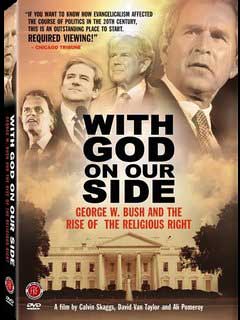
The Religious Right

The Religious Right

Religion is a queer thing. By itself, itʼs all right. But sprinkle a little politics into it and dynamite is bran flour compared with it.

Finley Peter Dunneʼs “Mr. Dooley”


Notice any difference between the ancient Hebrewʼs “First Commandment” and our First Amendment? According to the “First Commandment” in the Bible “ye shall have no other gods before me” under penalty of death. While our First Amendment guarantees freedom of religion.

E.T.B.


The Christian Right do not call upon their faith to certify their politics as much as they call for a country that certifies their faith. Fundamentalism really cannot help itself—it is absolutist and can compromise with nothing, not even democracy. It is not surprising that immediately after the Islamic fundamentalist attack on the World Trade Centerʼs twin towers and the Pentagon, two prominent Christian fundamentalists (Jerry Falwell and Pat Robertson) were reported to have accounted it a justifiable punishment by God for our secularism. In thus honoring the foreign killers of almost 3,000 Americans as agents of Godʼs justice, they established their blood brotherhood with the principle of righteous warfare in the name of all that is holy, and gave their pledge of allegiance to the theocratic ideal of government of whatever sacred text.

E. L. Doctorow, Reporting the Universe (Harvard)


Iʼm not convinced that faith can move mountains, but Iʼve seen what it can do to skyscrapers.

William H. Gascoyne, “One-liners,” Op/Ed section, San Jose Mercury, Jan. 20, 2004


The Religious Right in Iraq

In post-Saddam Iraq many children are being educated in private Islamic fundamentalist schools where they learn to memorize the Koran, rather than being prepared for a world of complex diverse knowledge and higher paying jobs. Therefore, such schools breed further misunderstandings between world cultures, as well as perpetuate poverty, which in turn perpetuates anger. Moreover, as pointed out by professor W. Andrew Terrill (professor at the Army War Collegeʼs Strategic Studies Institute, and the top expert on Iraq there), “I donʼt think that you can kill the insurgency in Iraq. If you are a Muslim and the community is under occupation by a non-Islamic power it becomes a religious requirement to resist that occupation. Most Iraqis consider us occupiers, not liberators. Thereʼs talk of angels and the Prophet Mohammed coming down from heaven to lead the fighting, talk of martyrs whose bodies are glowing and emanating wonderful scents.”

W. Andrew Terrill, [Cited by Sidney Blumenthal, sidney_blumenthal@yahoo.com, “Far graver than Vietnam,” The Guardian, Thursday September 16, 2004]


Fundamentalist Christian Leader, Pat Robertson, Flip Flops on the Necessity of “Separation of Church & State” Depending on the The Country

If the United States tries nation building [in Iraq], itʼs got to [have] at the very top of its agenda a separation of church and state…Itʼs… imperative to set up a constitution and safeguards that say we will maintain a secular state.

— Pat Robertson, 700 Club broadcast, March 17, 2003 (cited in a March 18th press release from Americans United for the Separation of Church and State)

We have had a lie foisted on us that there is something in the Constitution [of the U.S.] called separation of church and state.

— Pat Robertson, speech at the Christian Coalition “Road to Victory” Conference Oct. 12, 2002 (cited in a March 18th press release from Americans United for the Separation of Church and State)


President Bush is worried that Iraq is going to be overrun by religious fundamentalists. Hey, if itʼs O.K. for the Republican party, itʼs good enough for Iraq.

Jay Leno, The Tonight Show


We donʼt want the establishment of a state religion here, as in Saudi Arabia, where the religious police are permitted to whip with sticks any woman not modestly attired. There arenʼt enough trees in North America for the necessary sticks. Youʼd have to level Yellowstone just to deal with [insert name of hot female rock star].

James Lileks, “Bow Wow,” Fresh Lies


Guess Which Nationʼs Constitution Explicitly Excludes Mention of “God”

America is the first and only country to adopt a Constitution that specifically excludes all reference to a higher power. I say “specifically” because those meeting at the Constitutional Convention in Philadelphia considered and rejected any such reference. [They also considered and rejected whether or not to open their meetings with public prayer.—E.T.B.] Many bishops and preachers of the time warned that God would punish such decisions, but many were the preachers who said the same about the Virginia Statute on Religious Freedom, which did no more than state that no citizen could be obliged to pay for the upkeep of a church in which he did not believe.

Christopher Hitchens, “Believe It or Not: Making a Patriotic Case for those of Little Faith,” a review of Freethinkers: A History of American Secularism by Susan Jacoby, in the Book World section of the Washington Post, April 25, 2004 [slight editing and one added sentence by E.T.B.]


Did Jesus Pursue the Same Goals as Todayʼs Religious Right Leaders?

Was Jesus For Or Against the Separation of Church and State?

Jesus said, “Render therefore unto Caesar the things that are Caesarʼs, and unto God the things that are Godʼs.”

- Matthew 22:21

Was Jesus For Or Against Public Prayer?
Jesus said, “And when thou pray, thou shalt not be as the hypocrites are: for they love to pray standing in the synagogues and in the corners of the streets, that they may be seen of men. Verily I say unto you, they have their reward. But thou, when thou pray, enter into thy closet, and when thou hast shut thy door, pray to thy Father which is in secret; and thy Father who sees in secret shall reward thee openly.”
- Matthew 6:5-6

Did Jesus Rail Against Abortion or Infanticide?
Jesus didnʼt mention either topic, though the Hellenistic world not only employed abortifacents, but also abandoned unwanted newborns, usually females, to die (or be picked up by anyone who wished to raise the newborn as their slave).

So What Did Jesus Rail Against?
Jesus railed primarily against two things: 1) “the rich,” and, 2) overly pious, legalistic, self-righteous religious “hypocrites.” Those were his two priorities when it came to a good railing.

Jesus does not sound like the kind of person todayʼs Religious Right would let lead them.

E.T.B.


What If Jesus Ran For President?

Washington, D.C.—Jesus Christ formally declared himself a contender for the Republican presidential nomination today, amid growing controversy over his purported “anti-family” views.

Mr. Christʼs principal rivals for the GOP nomination were quick to cite an occasion reported in Luke 9:60, where Mr. Christ refused to allow one of his campaign volunteers time off to bury his father. One senator added that the next two verses of that same chapter show that Mr. Christ does not even permit his volunteers to so much as say goodbye to their families when they join his campaign. “Thatʼs just plumb shameful,” deplored the senator.

Leaders of the religious right were even more critical of Mr. Christʼs stand on family issues. The head of the Christian Coalition quoted Matthew 10:35-36—verses, he insisted, that revealed Mr. Christʼs “secret plan” to destroy the traditional family: “For I am come to set a man at variance with his father, and the daughter against her mother, and the daughter-in-law against her mother-in-law. And a manʼs foes shall be they of his own household.” The head of the Christian Coalition added, “What further proof do we need that Mr. Christ is the enemy of all that is good and wholesome in American family life? Even the most extreme elements of the homosexual lobby havenʼt proposed anything as subversive as this!”

Responding to rumors that Mr. Christ had sought to address a mass meeting of the male Christian organization known as “The Promise Keepers,” and had been turned away, the organizationʼs founder said that Mr. Christʼs appearance at the Promise Keeperʼs rally would be “inappropriate,” given the organizationʼs avowed purpose of helping men become better husbands and fathers. Mr. McCartney said it is common knowledge that Mr. Christ is over thirty years of age, still unmarried, hints at the ideal of becoming “a eunuch for the kingdom of heaven” (Mat. 19:12), and leads a rootless, itinerant lifestyle. Furthermore, he noted, Mr. Christ encourages his married followers to leave their families behind when they come to work for him.

Hal Gordon, article in The Texas Triangle, Dec. 1, 1996


If Jesus Ran For President, How Would His Political Opponents Counter His Statements?

Jesus: “Give to him who begs from you, and do not refuse him who would borrow from you.”
COUNTER: Jesus favors more government handouts for welfare cheats.

Jesus: “Judge not, that you be not judged.”
COUNTER: Jesus is soft on crime.

Jesus: “Render unto Caesar the things which are Caesarʼs.”
COUNTER: Jesus will raise your taxes.

Jesus: “Do not resist one who is evil. But if anyone strikes you on the right cheek, turn to him the other.”
COUNTER: Can we trust Jesus to fight the War on Terror?

Jesus—Wrong on social services. Wrong on crime. Wrong on defense. Wrong for America.

Mad magazine


A Lesson From the Christianized Rome Empire

After Christian Emperors assumed the leadership of Rome and began throwing enormous quantities of state money and support at Christianity, many concrete “worldly” problems were no longer treated as such, but began being blamed on “Satan,” while the finest minds of the Empire were reduced to brooding over Biblical minutia and spiritual problems, from “sniffing out heresies” to “preserving oneʼs virginity.”

E.T.B.


Biblical Ethical Relativism

In the Bible you cannot find any verses that say polygamy, concubinage, slavery(*) or mass murder are always and everywhere “sins.” In fact, according to the Bible such practices are perfectly acceptable to “God,” even praiseworthy—depending on the circumstances.

(*)Male and female non-Israelite slaves, and also female Israelite slaves, were not offered release during “Jubilee.” And any children that resulted from a master setting up two slaves as a couple, remained the masterʼs.

E.T.B.


Is More Christianity “The Answer” To A Nationʼs Woes?

The percentage of the U.S. population that is in prison is the highest percentage for any nation on earth. One child in five grows up in poverty in the U.S. (a conservative estimate). So we do not appear overly “blessed” when compared with nations that have lower crime rates, less poverty, and far fewer “Christians” than we do. Yet the U.S. spends more money on weapons of mass destruction than all other nations combined. Which makes you wonder, how exactly do those other nations, with fewer Christians, less Bible reading and less churchgoing, achieve lower crime rates, less poverty, lower rates of unplanned pregnancies, and higher educational test results?

Maybe “more Christianity” isnʼt necessarily “the answer” to a nationʼs woes?

E.T.B.


Do We Want A Nation “Blessed” By God?

Numerous Christian organizations are eager for America to seek the “blessings of God.” But have they studied what happened to that other nation “blessed by God,” the nation of Israel? Hmmm, letʼs see…According to the Bible, the God of Israel tried to kill Moses (and failed); struck dead two sons of Aaron; commanded “brother to kill brother” leading to the deaths of 3,000 Israelites (right after He gave them the commandment, “Do not kill”); opened up the earth and buried alive “wives, sons and little children;” sent a fire that consumed 148 Levite princes; cursed his people to wander in the desert for forty years and eat 40,000 meals of quail and “manna” (talk about a monotonously torturous diet—and when they complained about it, God killed 3,000 Israelites with a plague); had a man put to death for picking up sticks on the Sabbath; denied Moses and Aaron entrance into the “promised land” because Moses struck a rock twice with his staff instead of talking to the rock; delivered to his people a “promised land” that was parched, bordered by desert, and a corridor for passing conquering armies; sent fiery serpents among Israel, killing many; wanted to kill every Israelite and start over with Moses and his family (but Moses talked God out of that plan); drove the first king of Israel to suicide; killed someone who tried to steady a teetering ark of the covenant; murdered king Davidʼs innocent child; sent plagues and famines upon his people that killed men, women and children; ordered the execution of 42 children of the king of Judah; “smote all Israel” killing half a million men of Israel in a civil war between Israel and Judah; “delivered into the hand of the king of Israel” 120,000 Judeans massacred in one day along with 200,000 Jewish women and children; gave Satan the power to kill Jobʼs children and servants (in order to win a bet); let the Babylonians conquer the holy city of Jerusalem, and then the Greek forces of Alexander the Great, followed by the Romans; and finally left the Jews homeless and persecuted by Christians and Moslems for nearly 2000 years. Furthermore, the large number of laws in the Hebrew Bible concerning the treatment of lepers and those with sores demonstrates that the Israelites were far from being blessed with unparalleled good health. And archeological evidence indicates that in ancient Israel the infant mortality rate was as high as fifty percent.

So, knowing everything that happened to that nation “blessed by God,” Iʼve got to ask the Religious Right WHAT THE #%$?! ARE THEY THINKING?

E.T.B. [See the Bible for all of the cases mentioned above, except for the archeological evidence concerning ancient Israelʼs infant mortality rate. For the latter see, Drorah OʼDonnell Setel, “Abortion,” The Oxford Guide to Ideas & Issues of the Bible, ed. by Bruce Metzger and Michael D. Coogan (Oxford University Press, 2001)]


Another Nation That Invoked “Godʼs Blessing”: The South

After the states of the South seceded from the Northern states in the U.S., the Confederacy drew up its own separate Constitution and made sure it contained an invocation to God: “We, the people…invoking the favor and guidance of Almighty God…”

Learning what the South had done, a few legislators in the North drafted bills to have a Divine invocation added to the Constitution in the North, but all such bills were voted down. To this day (2004), the U.S. Constitution does not mention “God” nor invoke “Godʼs favor and guidance.”

E.T.B. (See The Confederate Constitutions, compiled by Charles Robert Lee, Jr.)


Yet Another Nation That Invoked “Godʼs Blessing”: Nazi Germany

Each belt buckle that German soldiers wore had embossed upon it “Gott Mit Uns” (“God Is with Us”). Over the door of the courthouse in the Palace of Justice complex in Nuremberg were engraved the Ten Commandments.

Fredrick R. Abrams, M.D., in the foreword to Vivien Spitzʼs Doctors from Hell: The Horrific Account of Nazi Experiments on Humans


“Forced Religion Stinks in Godʼs Nostrils”

The “godly and zealous” Roger Williams was a prime example of an extreme separatist. He arrived in Massachusetts in 1631 and was elected minister of the church in Salem in 1635. But his opposition to the alliance of church and civil government turned both ministers and magistrates of the colony against him. He insisted that government magistrates should have no voice in spiritual matters and that “forced religion stinks in Godʼs nostrils.” He also advanced the radical idea that it was “a national sin” for anyone, including the king, to take possession of any American land without buying it from the Indians. For these teachings he was banished by the General Court. Williams departed Massachusetts in January 1636, traveling south to the head of Narragansett Bay. There he worked out mutually acceptable arrangements with the local Indians and founded the town of Providence. In 1644, after obtaining a charter from Parliament, he established the colony of Rhode Island and Providence Plantations. The government was relatively democratic, all religions were tolerated, and church and state were rigidly separated. Whatever Williamsʼs temperamental excesses, he was more than ready to practice what he preached when given the opportunity.

Dr. Priestʼs Magical History Tour, AP U.S. History, On-line History Textbook, Chapter One, Europe Discovers America


I am in favor of the separation of church and state. I figure, either of those institutions screws you up so much on its own, put them together, you got certain death.

George Carlin, Saturday Night Live, 1984