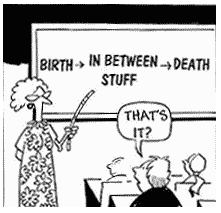
What do Christians want? What do atheists want? What is the meaning of life for Christians and atheists?

Meaning of Life

First, what do Christians want? Christians (and other believers in a personal higher power) want clarity, fewer grey areas, more black and white regions, a roadmap to life, a roadmap to eternity, certainty. Feeling one is certain about something is an addictive feeling that tends to reinforce itself, and people argue the most over topics where certainty does not exist such as religious and political views—perhaps because people are capable of living in many different types of societies and holding a wide varieties of beliefs including a firm belief in how things must turn out in the future provided we do such and such.

Christians donʼt want to be alone, they want a person who is guaranteed to be with them always, who hears their cries, even If those cries are not always answered, even if the Xn has to interpret what the answer to their prayers are (such as answered quickly, slowly, fully, partially, or, keep praying and maybe they will be answered, or, forget about that prayer and start praying for something else), but regardless of having to interpret such answer to prayer for themselves, the Christian is sure someone is there, so they are never alone.

Christians want all human suffering and pain to make sense, to eventually be accounted for, either in the form of punishment for the person who has made others suffer, or as blessings granted sooner or later to the one who has suffered, or if not added blessings, then they want such suffering to have been a soul building experience rather than a soul weakening or deconstructing experience like post traumatic stress disorder (or to coin a more Christian sounding term, “post traumatic spiritual stress disorder”). And they want not just a balanced account book for human suffering, an eye for an eye, but something more—forgiveness and healing for all of their own sins, feelings of guilt and pain.

Lastly, the Christian wants human death to be an illusion (some also want the death of believed pets to be an illusion). They want to be immortal like the personal higher power they worship.

What do atheists want?

Do atheists want the reverse of what Christians want? No. Atheists like feeling certain about many things, they prize knowledge, they donʼt want to be alone, and as humanists they are in favor of justice, equality, reducing suffering, aiding healing, and human life extension. Atheists however hold more modest views in those areas than those who are certain that a higher power exists.

Atheists and Christians also agree to some extent that there are plenty of people with their own individual concerns who fail to live up to humanist or Christian ideals, who fail to think big, embrace larger visions, wider feelings of empathy. Those people might be caught up in a daily struggle to make ends meet, wage slaves who earn only a few dollars a day in third world countries, migrant workers in the U.S., or even people with well paying jobs but whose debts or hospital bills have risen and they are struggling to keep their heads above financial water. While other people are locked into repetitious jobs for decades that no longer feed their mental reservoir of wider interests, curiosities and knowledge they possessed when they were young and which continue to atrophy away, so there are plenty of people who might never develop much of a thirst for knowledge, certainty or global justice. While still other people grow addicted to a wide variety of beliefs, thoughts, substances and behaviors, overlooking broader concerns or the needs of others, since the brain can reward itself with little blasts of pleasurable chemicals for all kinds of thoughts and behaviors, including many that do not benefit either the individualʼs health or well being, or society as a whole.

In fact, religions and philosophies (notably political philosophies) of various types can be so addictive that attempting to win an argument is more important than maintaining a friendship, a family, or peace on earth.

Religious people like everyone else can also fall into repetitious patterns that slowly rob them of flexibility of mind, or they can fall into addictive behaviors of all sorts. They can become beer and football Christians, nominal churchgoers. There are also plenty of discouraged Christians, some suffering post traumatic faith disorders. Not to mention the existence of many restless, semi-disenchanted, questioning, progressive, humanistic, very moderate to liberal or even universalist and mystical Christians,

On what I would call the brighter side, many Christians are mingling with atheists than ever before, not just on the internet, but you sometimes find churches opening their doors to a discussion of uncertainties of belief, even inviting debates with atheists. People are getting to know one another, atheists and Christians, sharing fears, failures, wishes, hopes and dreams.

What I find ironically hopeful is that no matter what side one is on in a religious or political debate, both sides are often full of energy and happy, knowing the challenge ahead, of trying to fully communicate their point of view, all they know and believe about a topic, in summary of course, to people who are less than eager to agree with it. Humans enjoy not simply holding ideas in their heads, but sharing them with others, and it is a joy when given the chance to do so. Also, for those who love a challenge, “preaching to the choir” appears to be less of a joy than engaging in a debate.

What is the meaning of life for Christians and atheists?

Christians think of meaning as coming from an eternal God. Things that do not last, called temporal things, have little meaning. However, many ancient Jewish writings depict human life as temporary, all die and go to the same place, a land of shadows called “Sheol” (with only a few exceptions like Enoch or Elijah who get to live with Yahweh in heaven, but even the Greeks had a few exceptions, with everyone else winding up in Hades after they die). The immortality of humans is not assumed throughout ancient Jewish writings, many writers of whom found meaning in temporal existence, looking forward to blessings from Yahweh in this life and then blessings on oneʼs descendants, nation, people, race that live on after one has died.

Also, many Christians believe that worshiping God is not enough to give oneʼs life meaning, because it has to be the right God, the Trinitarian creedal Christian God, otherwise one risks being damned eternally (universalist Christians would not agree with that statement, but most Christians are not universalists). So the meaning of life consists largely in avoiding hell and being assured of heaven by worshiping the one true God, and nothing in life matters more or holds more meaning than making a “decision” to follow and believe in the Trinitarian creedal Christian God, the author of such assurances.

Atheists do not find meaning in becoming an adherent of a belief system that must continue being “sold” in all of its original exclusivity because if no further “sales” are made then many wonderful and interesting people one has grown to love and respect will be damned for eternity. That sounds too much like a pyramid scheme erected on fear.

The atheist idea of meaning is more modest, along the lines of using reason and foresight to obtain the necessities and joys of life for themselves and others. Many atheists are also happy simply to see more moderate points of view in religion flourishing.

Atheists also recognize that most experiences in life are temporary, like enjoying ice cream. Memories tend to fade over time. And we see living things dying all around us. But that does not make such experiences, memories and life, meaningless, but precious.

Gospel Trajectories & The Resurrection (questions as well as sources to read or listen to)

Gospel Trajectories
  1. Cross-Examining the Four Witnesses, Parts 1 and 2
    Episodes 130-131 of this free podcast.

  2. Concerning just the resurrection, if you are debating the subject with others or yourself, I would start by asking how many FIRST-person statements we have of people who say Jesus after his execution, “appeared” to “me.”

    In the NT I only know of Paul stating briefly that “Jesus appeared to me,” in 1 Cor. and Galatians with no details at all. 1 Peter also has a first person statement but many scholars rank that letter as late and apocryphal.

So the only FIRST-person statement we have is from Paul with no details. Does God expect everyone to believe less than first person tales? And what exactly are we to believe concerning Paulʼs statement since all it consists of are the words, “he appeared to me.”

Note that in 1 Cor. Paul uses the word “appeared” with no distinctions. But according to Luke-Acts the raised Jesus had ascended bodily into heaven never to return in the body until the day of judgment, before Paul became an apostle, so whatever appeared to Paul was not the bodily raised Jesus, yet Paul implies in 1 Cor. that he was blessed with the same sort of appearance as everyone else. And since none of the appearances in 1 Cor. are told first hand, but being told second hand or more, and since 1 Cor. includes no descriptions of each appearance to compare one with the other, we know very little about any of them. Who was among the “over 500 brethren?” Where did each appearance take place? When? What time of day? How light or bright was it? How near or far away from Jesus were each of these people? How certain were they concerning what they were seeing? Did Jesus say or do anything, or nothing, during each appearance? We donʼt know. There are also discrepancies between the 1 Cor. list and later tales in the Gospels.

See also the award winning book, “Scripting Jesus,” for a discussion of the changes one can see in the retelling's of the resurrection story over time, from Mk to Mt, Lk, etc.

Also note how the alleged words spoken by the resurrected Jesus grew more numerous over time from Mk to Mt to Lk Acts and John. The story grew over time.

Additional Gospel Trajectories

See Four Gospel Trajectories by clicking here.

There is also a gospel trajectory related to how Judas is presented in the Gospels, starting with Mark and ending with John. See Judas Armed and Dangerous by clicking here.

One can see Gospel stories growing bolder with various retellings from Mark —>John, attempting to enhance belief, also some deletions of negative sounding tales/passages in the earliest Gospel, Mark. Not all trajectories follow through all four Gospels, some just branch off from Mark to Matthew, or from Mark to Luke respectively. Matthew and Luke differ most from each other where they could not follow Mark, i.e., in their beginnings and endings, their nativity and post-resurrection tales, that start at an earlier point than Mark and end at a later point than Mark. And like Matthew and Lukeʼs extended endings, at some point believers also extended Markʼs ending (of which more than one extended ending exists).

And one can see where parts of the fourth Gospel appear to have been constructed based on information and tales found in earlier Gospels—for instance in the tale about the raising of Lazarus which is preceded by Jesus being anointed with oil in the fourth Gospel, John, the story combines elements from earlier anointing stories in earlier Gospels, and an earlier tale of a beggar named Lazarus in Luke. The tale of feeding the multitude in John also owes much to earlier Gospel renditions and appears to build on them. Were the newly constructed stories in John due to the fluid memory/theological artistry of John, or of preachers in his community who knew tales in the earlier Gospels? See this post that explains which elements from earlier Gospels made their way into the tale of the raising of Lazarus and the anointing of Jesus in the fourth Gospel.

You can also see how the tale of Jesusʼ burial became more aggrandized over time from Mark to Matt, Lk, John:

“Hereʼs the problem. When you look at Mark, Matthew, Luke and John, the story of the burial of Jesus, knowing that Mark is the basis for Matthew and Luke and that possibly (this is debated in scholarship) they may be the source for John, you watch the bodyʼs burial get steadily better. Itʼs a hasty hurried burial in Mark. By the time Matthew and Luke read Mark and develop the story itʼs a burial in a tomb in which nobody else has been laid and theyʼre explaining to you why Joseph of Arimathea was able to be a counselor for Jesus but not against him on Thursday night as it were. The story is developing, and by the time you get to Johnʼs account the burial of Jesus is – I wouldnʼt even say royal – itʼs transcendental, thereʼs so many spices used they would have filled almost the entire tomb, itʼs a magnificent burial, itʼs the burial of the son of God when you get to John. What happens is that as a historian when I retroject that trajectory of a burial that keeps getting better and better, and ask what was there in the beginning, it doesnʼt look very good. It looks like all they might have had in the beginning was a hope that maybe some pious non-Christian, a Jew, out of respect for the Jewish law of Deuteronomy, would have buried Jesusʼ body (instead of letting the Romans do what they usually did with the people they crucified, which was to toss the bodies in a common grave). But if a Jew asked Pilate for the body and gave it a burial that immediately raises the issue that the writers of the Gospels also must have seen, namely wouldnʼt Joseph also have buried the two robbers, presumably fellow Jews, who were with Jesus? And wouldnʼt there at least be three in the tomb? Would it be a public tomb for criminals? Then how would we know which was Jesusʼ body? And so you can see the Gospel writers, I think, grappling with the difficulties of trying to have Jesus rescued from a common grave – a story whose original I donʼt think is historical and which grew in the telling over time. I think it is their fervent hope, their best hope, that somebody took care of the body of Jesus.”
— John Dominic Crossan as heard on “Jesus and Crucifixion, a Historical View,” Fresh Air from WHYY, Mar. 20, 2008 (with some edits by ETB)

The first three Gospels grow in length in the order Mk, Mt, Lk (while the fourth Gospel, John, only grows shorter because it lacks a birth narrative, all parables, all exorcism tales, though it does have a very talky narrator, explaining so much more than any of the narrators did in any of the previous Gospels, and of course interpreting everything in his own theological terms, and a very talky Jesus as well whose theological terms simply mirror those used by the author, and whose dialogues with others (not to mention Jesusʼ alleged final prayer) go on and on, like the author as well. Most scholars do not take seriously that the words of Jesus in the fourth Gospel are authentic, but more the result of following the theological outline of the fourth Gospel author.

Speaking of the Gospel order, Mk first, Mt second, one can see that Matthew reproduces more of Mark than Luke does. And Matthew usually just inserts passages or parables right into the Markan narrative. So Matthew is plainly the closest to Mark. And though it is debated whether the author of Luke lacked access to Matthew, or had indirect verbal access via others, or direct access to a copy of Matthewʼs Gospel, still, Lukeʼs general outline seems to echo Matthewʼs, i.e., starting with having Jesusʼ born in Bethlehem (via different tales than Matthew employs), and adding a longer genealogy than Matthewsʼ since Lukeʼs goes back not just to Abraham as Matthewʼs did, but all the way back to Adam. Luke also features not just one miraculous birth tale, as in Matthew, but adds a second miraculous birth tale, that of the miraculous birth of John the Baptist, even having people sing holy songs, itʼs a liturgical musical! Obviously a later creation, a more involved work of literature than what we find in Matthew, including an added brief tale to fill in the time from between Jesusʼ birth and baptism, i.e., a tale from Jesusʼ boyhood.

Lukeʼs post-resurrection tales are also more involved than Matthewʼs, with added sightings, and a bodily ascension tale, and no line as in Matthew that “some doubted.” Lukeʼs post-resurrection tales also take place in and around Jerusalem, a more impressive cosmopolitan setting, while the two earlier Gospels, Mark and Matthew had the disciples being commanded to venture to Galilee to see the risen Jesus, “He has gone before you to Galilee, there you will see him.” Luke does not say that Jesus had gone before them to Galilee to be seen there, not at all. Luke adds far more alleged post-resurrection words of Jesus than Matthew, and new parables that are longer and more artistic than any seen before, like the Prodigal Son, the Good Samaritan, etc. Neither does Luke simply insert lines and new material into Mark like Matthew did, but Luke has taken the time and effort to blend information into Markan story segments unlike Matthew who more often simply inserts stuff here and there in a cruder fashion.

I would add another trajectory as well, involving tales of Jesus raising other people. For instance In Mk Jesus is asked to HEAL someoneʼs daughter who is “at the point of dying,” he gets there and people are mourning, saying she has died and Jesus clears the room and raises her in the company of her immediate family and some disciples. Matthew repeats the tale, though when Jesus is first asked to come he is told that the child has ALREADY “died,” not being merely “at the point of dying” as in Mark. Luke repeats the same tale, but Luke adds a second resurrection miracle tale in his Gospel, that of a child who was not merely “raised” inside a private home, such a miracle being seen by only a few, but in this new tale, Jesus raises a child who is ON THE WAY TO THE CEMETERY, and this child is raised publicly. So this new resurrection miracle is grander than any that appeared in Mk and Mt. But in the fourth Gospel, John, the grandest resurrection miracle is found, someone raised not privately in a house, and not on the way to being buried, but someone already buried, for a few days, and that resurrection is the most public of all, and becomes the reason the Pharisees seek Jesusʼ own death due to how people were reacting to this very public resurrection, which also was apparently near Jerusalem, nearer Jerusalem than the others in the earlier Gospels if I recall.

Of course, Jesusʼ miracles in the Gospels also resemble reworked versions of miracles of Moses, Elijah and Elisha, including the raising of children, sometimes even copying the exact Greek phrases and settings as one can read when one compares the miracle tales in the Greek O.T. (the Septuagint) with the Gospel miracle tales involving Jesus.

Additional red flags emerge as we note that Jesusʼ most public miracle was the feeding of the multitude, but there is no mention of where it took place according to the earliest Gospel, Mark which mentions two such feedings, both of which took place “in the wilderness,” much as the OT tale of people being fed by God in the “wilderness.” Both such tales are equally vague as to the whereabouts where such miracles took place. The feeding miracle in the Gospels also resembles that of the feeding of many men with just a little bread, as in another OT tale involving a miracle-working prophet. It is only later Gospels that try to pin down the location of the feeding miracle. Luke says it took place in Bethsaida, But Mark, the earliest Gospel, does not say that, in fact Mark says that after the feeding miracle the apostles got into a boat to go to Bethsaida, but they donʼt even make it to Bethsaida because they get sidetracked. So we know from Mark that neither healing miracle that he mentions took place place in Bethsaida, only in “the wilderness.” And we also know that Luke could have derived his name of the town, Bethsaida, from Mark since that Gospel says the apostles got into a boat and tried to reach Bethsaida AFTER the miracle. But that is of course to simply use a name mentioned in Mark that is NOT directly connected with the feeding story, and, Interestingly, you can see that Luke is merely stitching matters together loosely in his retelling of the Markan tale because as soon as Luke mentions Bethsaida he copies the rest of Mark that says it was in “the wilderness,” so Luke simply reverts back to what Mark originally wrote (editorial fatigue), so Lukeʼs story remains derivative to Markʼs, and Luke probably added a place name to make it sound a bit more convincing. But as we have seen, thatʼs not what the earliest version says, it says wilderness.

Other miracles of Jesus are only seen by few apostles like the walking on water, the calming of the storm, the transfiguration. And according to the earliest version of the transfiguration tale, in Mark, the disciples are even told not to tell anyone about the transfiguration miracle until later.

In fact according to the Gospels there is no tale about Jesus entering a major city in Galilee and doing a miracle there. There were several big cities in Galilee we know from writings and archaeology, but all the places Jesus visited and allegedly performed miracles were far smaller. Small towns. In fact when Jesus does visit a city, it is Jerusalem and he gets crucified there. According to the two earliest Gospels, Mark and Matthew, Jesus is not depicted healing or exorcising anyone in the one big town he visits, Jerusalem. (Only in the last written Gospels, Luke and John, does Jesus allegedly perform healing miracles in Jerusalem, and they only mention two, the healing of the servantʼs ear which was cut off at Jesusʼ arrest, per a very short line in Luke, and the healing of the lame man by the pool per John).

Of course Jerusalem is supposedly where Jesusʼ biggest miracle took place, but according to the Gospels themselves, no one in Jerusalem actually sees Jesus exit his tomb, if there was a tomb (see Crossan above). And according to the earliest two Gospels, Mark and Matthew, Jesus appeared to his male disciples in Galilee first, not Jerusalem, the message at the tomb being, “He has gone before you to Galilee, THERE ye shall see him.” Even Luke, who has the disciples remain in Jerusalem to see the risen Jesus there, does not have anyone but the apostles accompany Jesus out of that room and out of Jerusalem (“he led them”) to a nearby mount where they alone got to see Jesus rise up to heaven, per Luke-Acts.

The Moral Question (Ethical Decision-Making As a Sub-Set of Decision Making In General)

The Moral Question

Philosophical theories of morality (see here) are inconclusive. They all raise questions. Moral values and behaviors do not appear to be driven totally by oneʼs conscious mind, nor do they appear to be due totally due to genetic predispositions (including to some degree the behaviors the human species shares with its primate ancestors), nor totally due to repeated lessons from birth that eventually become ingrained behavior patterns requiring little to no thought. Moral values are based on all of the above, which is why they feel so much a part of us.

Furthermore, moral values appear to be a sub-division of the relative values humans place on things. For instance, I donʼt think many people have great difficulty agreeing on what values they hold dearest relative to the alternatives:

  1. being healthy rather than chronically ill or in pain
  2. being mentally healthy, rather than losing oneʼs memories and ability to concentrate
  3. eating rather than starving
  4. having at least a little money rather than living in abject poverty
  5. being sociable and having some friends rather than being shunned or living in total isolation from other humans and their society or their creations
  6. living in peace and safety rather than living in fear of having oneʼs life, belongings, family, friends, job, etc., taken from one at someone elseʼs whim
  7. living in peace and safety rather than living in fear of having oneʼs life, belongings, family, friends, job, etc.,taken from one via natureʼs whimsical disasters, pandemics, genetic mutations, or day to day accidents

Such “choices” seem undeniably obvious to us, being a species with a long shared biological background, large brains, similar sensory organs, similar nerves that record similar feelings of pain and pleasure, and a similar psychological need to feel wanted and belong, rather than mocked and shunned, and a hunger to be in the presence of other members of our species like our family and others who stimulate us physically, verbally, and mentally. Hence, joys shared are increased, while sorrows shared are reduced. (Two notable exceptions would be psychopaths—who usually show signs while very young that they have a much diminished sense of empathy; or, complete hermits who attempts to isolate themselves from the family or society in which they were raised.)

Second, we all know life is a risky business. Painful, joyless experiences occur no matter what oneʼs belief system. For instance, it has been said that “in a cosmos without God anything is possible,” but even in a cosmos WITH God, anything is possible. So we seek ways to avoid the worst and accentuate the best. We make laws, hire police, as well as develop ways to increase our happiness, i.e., music, drama, parks, arts. And courts to argue continually over how far most people in a society ought to be allowed to go in pursuing their anger, vengeance, as well as their pleasures, based on how such pursuits affect the lives of others in that society. In a similar vein, senators, governors, city councils and courts pass regulations regarding city planning, safety and health in order to help us avoid other things we dislike, such as debilitating accidents, illnesses, foul water, and natural disasters.

No doubt thereʼs both an attraction toward being sociable and the opposite, i.e., self-centered impulses as well as the possibility of being irritated by others or acting aggressively toward others. That is the old evolutionary trade off seen in all large-brained mammalian species, even the most sociable ones. There is also the fact that a species with large brains can grow addicted to nearly anything, which can lead to some very anti-social behaviors. The brain does not discriminate concerning what kinds of behaviors feed it the chemicals that give it internal pleasure. Not to mention other jury-rigged features of the mammalian-brain-mind, like the numerous cognitive biases we are all born with and subject to. Luckily, studies in behavioral and cognitive psychology have allowed us to grow more cognizant of such limits to sociability, and also, most intelligent brain-minds throughout history have pointed out the obvious benefits of mass civilization over mass barbarism. With civilization we can extend our curiosity and imagination beyond the stars, while with barbarism we can merely stick spears in each other and tremble in fear of what lies over the nearest darkened hillside.

Also see How Atheists Ground Morality

RECOGNITION OF UNFAIRNESS probably arrived with the evolution of new types of brains that could compare situations in increasingly more generalized ways. Such recognitions preceded the arrival of humans on earth. For instance, monkeys sense when someone else is getting a “better deal” for the same token, and they complain about that by THROWING BACK the cucumber they were paid for handing over their token, once they see the monkey in the cage next door getting a more sought after food like a grape for the same token. This resembles in some ways the Wall Street Protests.

SPEAKING OF MORALITY IN AN EVOLUTIONARY SENSE, Darwin proposed that creatures like us who, by their nature, are riven by strong emotional conflicts, and who have also the intelligence to be aware of those conflicts, absolutely need to develop a morality because they need a priority system by which to resolve them. The need for morality is a corollary of conflicts plus intellect:

Man, from the activity of his mental faculties, cannot avoid reflection… Any animal whatever, endowed with well-marked social instincts, would inevitably acquire a moral sense or conscience as soon as its intellectual powers had become as well-developed, or anything like as well-developed as in man.
(Charles Darwin, The Descent of Man)

That, Darwin said, is why we have within us the rudiments of such a priority system and why we have also an intense need to develop those rudiments. We try to shape our moralities in accordance with our deepest wishes so that we can in some degree harmonize our muddled and conflict-ridden emotional constitution, thus finding ourselves a way of life that suits it so far as is possible.

These [priority] systems are, therefore, something far deeper than mere social contracts made for convenience. They are not optional. They are a profound attempt—though of course usually an unsuccessful one—to shape our conflict-ridden life in a way that gives priority to the things that we care about most.

If this is right, then we are creatures whose evolved nature absolutely requires that we develop a morality. We need it in order to find our way in the world. The idea that we could live without any distinction between right and wrong is as strange as the idea that we—being creatures subject to gravitation—could live without any idea of up and down. That at least is Darwinʼs idea and it seems to me to be one that deserves attention.
[Mary Midgley, “Wickedness: An Open Debate,” The Philosopherʼs Magazine, No. 14, Spring 2001]

Monkeys, apes, and humans all engage in reconciliation/forgiving behaviors (stretching out a hand, smiling, kissing, embracing, and so on) which means that it is probably over thirty million years old, preceding the evolutionary divergence of these primates… Reconciliation behavior [is] a shared heritage of the primate order… When social animals are involved… antagonists do more than estimate their chances of winning before they engage in a fight; they also take into account how much they need their opponent. The contested resource often is simply not worth putting a valuable relationship at risk. And if aggression does occur, both parties may hurry to repair the damage. Victory is rarely absolute among interdependent competitors, whether animal or human.
[Frans De Waal, “Peacemaking Among Primates”]

The bottom line is that it appears that humans have been teaching EACH OTHER how to behave for a very long time. And not just adults teaching adults, but also adults teaching their children. So, the process begins early in life and continues throughout life. Children naturally tend to act in ways that annoy or harm others or harm themselves, therefore humans begin teaching or training other humans how to behave at a very young age. Itʼs natural for large-brained mammalian parents to deliver lessons in behavior to their children. So morality evolved not only among and between adults but also as part of the human developmental process as directed by parents. Humans have been teaching other humans how to behave, generation after generation, ages before even a written language was developed. Large-brained mammalian species from apes and dolphins to elephants form tribal societies that involve teaching the young how to behave. In one case I read about, juvenile elephants moved to another territory by themselves started acting like “Lord of the Flies” children, rampaging and even trampling animals of other species, until some older elephants were added to the mix, who disciplined the adolescents and taught them lessons in how to act.

Lastly, among large-brained primates, thereʼs the fascinating species of chimpanzee known as the bonobo. Last I read there was no record of a bonobo killing another bonobo in nature compared with the pan species of chimpanzee that is known to kill each other and hunt monkeys for food. It is hypothesized, based on what evidence we have, that the bonobos branched off from other chimp species after some ancestors crossed a river in Africa and began living on the side with far fewer predators and more abundant food sources, but there is a further curiosity…

“Without a doubt the most peaceful species of chimpanzee is the ‘bonobo.’ Among bonobos the females—not the physically larger males—dominate the hierarchy, and casual sex soothes all conflicts. Bonobos even engage in such human-like practices as French kissing, face-to-face sex in the ‘missionary’ position, promiscuity, and homosexuality.”

“The discovery of such a species of ape with such behaviors disturbed the creationist Christian reviewer of the book, “Bonobo: The Forgotten Ape”, who wrote, ‘In an evolutionary framework the integration of such sexual features [as promiscuity and homosexuality, both of them favorite pastimes among bonobos] into human society is out of the question, but the Judeo-Christian tradition indicates that promiscuity and homosexuality are secondary events, coming into the world after manʼs ‘fall’ and dragging the whole of creation into a new pattern of life.”

“Aside from the fact that this ‘Christian’ explanation for the ‘sexual features’ of bonobo behavior doesnʼt explain why the other well known chimp species (pan), does not engage in such behavior [Is the other species less ‘fallen?’ By how many degrees of ‘fallenness?’], it also seems to me most unfair that these attractive, harmless chimps should have been affected in any way by Adam eating a piece of fruit. But I will admit that they seem to enjoy the results.”
[Dr. Colin Groves, commenting on a book review in Current Anthropology, Vol. 40, No. 1, 1999 that was written by creationist, Sigrid Hartwig-Scherer]

When early tribes of humans became city dwellers they could no longer know everyone in their tribe at a glance since their tribe was now a whole city, so they could not know what kinds of behaviors they might expect or enjoy or fear from others, and neither could the whole tribe still be involved in ostracizing or ousting or reacting to unwelcome behaviors, so the creation of laws and their enforcement by the ruler seemed like a more impersonal and natural next step beyond tribalistic morality.

But to continue to add a personal tinge to such laws, plenty of ancient civilizations claimed such laws were handed down or inspired by a personal divinity, such as the story set in stone of the Babylonian sun god Shamash handing down or inspiring the laws of King Hammurabi even before the earliest possible dates for the time of Moses and his reception of laws from the Hebrew high god, Yahweh. Neither is that the only case earlier than Moses of Egyptian and Mesopotamian laws being handed down or inspired by gods. (Even the story about a Hebrew king receiving directions for how Yahweh wanted His temple built was preceded in time by a rock-carved tale of an Egyptian king having recʼd directions direct from his god on how that god wanted his temple built.)

The OT contains divinely inspired “moral” laws nobody but the most hard-nosed Calvinist adores, and even then they adore them from afar, knowing that theyʼd get arrested if they starting stoning homosexuals, witches, women-not-found-to-be-virgins on their wedding nights, and disobedient children in their mid-teens.

In the NT, Jesus left a long list of commands to his followers, including, “take no thought for the morrow, or what ye shall eat or drink” “sell all you have and give it to the poor,” “give to all who ask, asking nothing in return,” “love your enemies,” but again, those are adored from afar, not to be confused with a “morally objective” list of laws to be enforced by government.

In fact nowhere in the Bible is mass murder, slavery (which is never called a “sin,” but slaves are to be duly disciplined even with physical punishment as even Jesus taught in a parable), polygamy, concubinage, the persecution of witches, homosexuals, heretics and blasphemers, and the stoning of adulterers and disobedient children, and the beating of children till they are black and blue, condemned, but each is divinely instituted and/or acceptable based on the era and circumstances.

What appears to have happened in the history of human morality and lawmaking is that humans have been learning (not without effort, and only after centuries of conflict, exploration, discovery, and increases in worldwide communications) to recognize the value of “the other” in ever widening circles, from tribal laws to city-state and national laws to international laws, including a greater recognition of equality and/or tolerance for racial minorities, females, gays, and people of other religions. Some seek to grant greater equality and protection to chimpanzees (especially those being used in laboratory experiments), or to a variety of species being slaughtered, in danger of extinction, or eaten.

Golden Age of Christian Apologetics? Renaissance?

Golden Age of Apologetics

What if itʼs not a new golden age or renaissance but that the arising of so many apologetic ministries as well as the attempts by more Christians to seek degrees in “philosophy of religion” (and flood the college market in that particular arena) only proves that when a dam starts to leak in places it takes more and more fingers to stick into each fresh hole, i.e., to keep at bay increasing waves of potential “doubters” and “leavers” from becoming a full blown flood?

Baptizing infants into a Christian church and expecting Christianity to take over the world that way, and also holding periodic revivals has proven insufficient, because churches keep splintering, and world religions continue blaming each other for going down the wrong trail or even damning each other to hell. *SEE NOTE The “power of Christ” alone no longer appears sufficient to compel crowds of people in the U.S. to convert (though Pentecostal revivals seem to be working fairly well in some third world nations, i.e., without the necessity of courses in apologetics).

*NOTE Of course some members of each world religion react in the opposite fashion, by growing more tolerant and cooperative, i.e., the moderates and liberals in each different religion tend to get along better than the conservatives do in the same religion.

Apologetic argumentation is also an invitation to get Christians to read atheist books, or if they dare, to read classics in biblical criticism like Straussʼ Life of Jesus Critically Examined (now in free audio online); or, Schweitzerʼs The Search of the Historical Jesus, and, The Mystery of the Kingdom of God, The questions will always be there, because written words do not prove their own authority, historicity or inspiration.

Speaking of questions, look at the history of the oldest most prestigious institutions of higher learning in the U.S., Harvard, Yale, Princeton. Harvard was founded as a seminary for conservative Christian ministers. Then some conservative ministers became alarmed at the growing “theological excesses” of Harvard and founded Yale in reaction. Now look at Yale. It is now far less conservative than its founderʼs views, just as Harvard has become. Apparently any institution that continues to attract the brightest professors and students who also attempt to interact with all the questions of their field raised by other scholars worldwide, cannot miss that fact that questions of history involve probabilities galore, making the retention of highly conservative Christian beliefs problematical. Or take Princeton, once the home of verbal plenary inerrantist, B. B. Warfield. Conservative Christian professors left Princeton to found a more conservative seminary, Westminster. In fact all of the most highly conservative seminaries and institutions of higher Christian learning in the U.S. are relatively youthful compared with Harvard, Yale, and Princeton, and demand signed statements of faith, so that they donʼt hire professors who dare to leave the door open to questions and/or interpretations of the Bible that are not “approved.”

Speaking of a renaissance, if there is one going on, one that is truly new, like never before, it appears to be a renaissance of atheist, humanist podcasters, screen writers, song writers, novelists, artists, and comedians whose beliefs range from “not very devout” to “blasphemous,” including scientists whose belief in “God” is less doctrinal or non-existent, compared with the average beliefs of the rest of U.S. society. There are also increasing numbers of “emergent” Christians, or “very moderate” Evangelicals a growing number of whom believe the Bible is a “thoroughly human” book, and neither infallible nor inerrant according to older definitions of inerrancy.

And for the first time in history there have been atheist bestselling books that did not merely consist of a character in a novel or play who was atheistic, but books advocating in non-fiction fashion for a belief in atheism. Previously there had been agnostic bestsellers, such as Bertrand Russellʼs works. Shellyʼs The Necessity of Atheism was a mere tract printed in 1811, and never a bestseller. But at the start of the 21st century we saw not just the first bestselling book advocating for atheism, but three of them.

I would add that whenever a book came out that posed some sort of challenge to “what the Bible says,” or even just to “what some Christians believe the Bible says, as opposed to what other Christians believe,” such books generally produce tsunamiʼs of replies. In the days of Christian emperors, and through the Middle Ages and Reformation such books were confiscated and burned. But with the advent of the printing press that became more difficult. Perhaps Christian apologists hope they can flood the market rather than burn books, i.e., simply produce far more books than “atheists” do? Differential reproduction? How Darwinian a notion!

Personally, I donʼt expect to see any particular religious belief, denominational belief, unorthodoxies galore, superstitious beliefs, or non-religious philosophical points of view die out soon. And everyone may imagine what they wish when it comes to how “the other folks” will “wind up in eternity.”

All I have are questions that I think are justifiable, and which remain, regardless of all the hypothetical replies each person constructs to try and justify what they “believe.”

We Are All Greater Artists Than We Realize when it comes to maintaining our “views” of the world

Most people either avoid reading material based on views they oppose, or they read them and STILL manage to slough off the questions raised. The mind is a marvelously creative artist when it comes to finding ways to maintain whatever worldview it acquires rather than juggling and shifting between different worldviews which takes too much mental energy. After all, why move into a new house when you can just rearrange some of the furniture in the old one (and also keep any mad relatives locked away in an attic out of sight? All those unplumbed depths of questions that continue to remain unanswered in anything but a strictly hypothetical fashion and which will always bother us.) We all do that mentally creative furniture arranging to varying degrees, but of course we also each think WE are the ones who do it to a lesser degree than the “other guy.” Which makes me wonder why any Infinite Being would consider it perfect justice to punish people based on their “worldviews/beliefs.”

Questions I Ask Myself (As Oscar Wilde once put it, “Converting others is easy, converting oneself is difficult.”)

Was the universe created so that humans could arise and build churches, write holy books and pass collection plates so that more churches could be built, more holy books printed, and clergy paid to explain the true meaning of these books, though the “true” meaning of sections of Genesis to Revelation remain debatable, and Christians remain the greatest debunkers of each otherʼs views?

Was the universe created so that a particular species of Homo sapiens could arise – with unknown numbers of cousin species like ancient great apes (and hominids) arising in the process, but nearly all of them going extinct? (Keep in mind that the number of species of great apes now living on our planet is far smaller than the number of species of great apes that lived in the past, and the same goes for hominid species. In fact, earth was once truly a planet of the apes. In the Miocene Epoch, 24 to 5 million years ago, some 30 known species lived in Africa, Asia, and Europe, before hominids arrived on the scene, and there must have been many more species of ancient apes and hominids that did not leave behind much of a fossil trail, because great apes live in the savannas or forests where decomposition is almost assured rather than fossilization. Genetic analysis even suggest that only a single species out of all those extinct species of great apes gave rise to all living apes and hominids, including humans (click HERE). This suggests that “natural selection” or perhaps a “tinkering” was going on. It is difficult to see a straightforward plan taking place in natureʼs lengthy tale of endless branching forth and endless pruning. And if you stopped and looked at any particular species in a past epoch, one might be tempted to think, “Ah, this is where all the former development has lead,” but that would be a mistake because there would be more changes ahead.

Was the universe created so that a particular species of Homo sapiens could finally arise, a very late comer on the scene, arising at the last microsecond of cosmic time and in danger of falling back into either barbarism or extinction in the next microsecond? Keep in mind that the stars can continue to burn for billions of years should Homo sapiens turn belly up tomorrow, because the stars burn via fusion and have tons of hydrogen and helium to burn (even young-earth creationists find it hard to debate the evidence that stars can burn for billions of years). As our sun ages, it will expand, burn up planet earth, and then slowly grow cold, of course our planet could undergo mass extinction events via a host of cosmic means, including earth-produced volcanic eruptions if one of several supervolcanoes should erupt (Yellowstone is due). Furthermore, massive stellar nurseries have been found in parts of the cosmos where new stars continue to form at a fantastic rate (google “star formation”). Were the stars “designed” to have enough fuel to burn for billions of years before the arrival of our species, and burn for billions more after our arrival? Why? I am not asking for a hypothetical reply, Iʼm sure anyone with enough ingenuity could come up with one. As I said, we are all greater artists than we realize when it comes to keeping our beliefs afloat. And if our species avoids extinction for a long enough period of time, will we still be the same species? Or will we be looking back and chuckling at todayʼs “humans” like we chuckle at our ancient ancestors who thought that learning to control “fire” was the most awesome thing humans could dream of discovering?

Do genuine “accidents” happen, including deadly ones? A lot of religious people feel more comfortable believing thereʼs a reason behind everything that happens, but so do “conspiracy” minded folks who want to believe that history is not a record of human stupidity and accidental outcomes, but that a hidden hand of some vast conspiracy directs world affairs. In both cases, such beliefs add more “meaning” to peopleʼs lives, rather than the idea that sometimes things just “happen” that way. As the saying goes, the basis of all superstition is that people are prone to remember all the “hits” and forget about all the misses and near hits that are possible.

I used to be a huge fan of C. S. Lewis' apologetic arguments, but today I have my doubts (ht: Tyler Vela)

C. S. Lewis

I was a huge C. S. Lewis fan, read all of his Christian writings, but also read Beversliusʼ book on C. S. Lewis and the Search for Rational Religion and wrote my own criticisms of Lewisʼ arguments:

  1. C. S. Lewis: Provocative, Poignant & Profound Words

  2. C. S. Lewis Resources: Pro and Con

  3. My journey and the role C. S. Lewis played in it

  4. C.S. Lewis & Josh McDowell

  5. Prior Prejudices and the Argument from Reason

  6. C. S. Lewis and the Cardinal Difficulty of Naturalism

  7. Edited Collection of C. S. Lewisʼ final letters (with a bit of Hitchen on Lewis at the end)

  8. C. S. Lewisʼs “Man or Rabbit?” and Eric Hofferʼs “The True Believer”

  9. Moral Objectivity, C. S. Lewis, Victor Reppert, Edward T. Babinski

  10. The Gospel of John and C. S. Lewis

    C. S. Lewisʼ “Modern Theology and Biblical Criticism”

    Some Reflections on C. S. Lewisʼ “Modern Theology and Biblical Criticism”

  11. Literary Criticism and Historical Accuracy of the Gospels — C. S. Lewis, Jesus, Boswellʼs Johnson, and the Usefulness/Uselessness of Literary Criticism to Nail Down Historical Truth

  12. Did the historical Jesus speak about the necessity of being “born again?” Questions raised by Bart Ehrman and David Friedrich Strauss

  13. Scent from heaven? Who nose? Do tales of Jesusʼ anointing, resurrection & bodily ascension, bear the aroma of truth?

The Christian “Insider/Outsider” Way of Looking at the World Questioned

Christian "Insider/Outsider" Way of Looking at the World Questioned
  • One day as Manjusri stood outside the gate, the Buddha called to him, “Manjusri, Manjusri, why do you not enter?”

    Manjusri replied, “I do not see myself as outside. Why enter?”

    — Zen Koan

  • He drew a circle that shut me out-
    Heretic , rebel, a thing to flout.
    But love and I had the wit to win:
    We drew a circle and took him In!

    — Edwin Markham, from the poem “Outwitted

  • I suddenly thought, “Is there really that much difference between ‘them’ and ‘us’?”
    I had always accepted the qualitative difference between the “saved” and the “unsaved.” Until that moment, it was as if I and my fellow-seminarians had been sitting in a “no-damnation” section of an otherwise “unsaved” restaurant. Then, in a flash, we were all just people.

    — Robert M. Price, “Testimony Time,” Beyond Born Again

  • Were it true that a converted man as such is of an entirely different kind from a natural man, there surely ought to be some distinctive radiance. But notoriously there is no such radiance. Converted men as a class are indistinguishable from normal men.

    By the very intensity of his fidelity to the paltry ideals with which an inferior intellect may inspire him, a saint can be even more objectionable and damnable than a superficial “carnal” man would be in the same situation.

    — William James, “The Varieties of Religious Experience”

  • In the days of my youth, ministers depended on revivals to save souls and reform the world. The emotional sermons, the sad singing, the hysterical “Amens,” the hope of heaven, the fear of hell, caused many to lose what little sense they had. In this condition they flocked to the “mournerʼs bench”—asked for prayers of the faithful—had strange feelings, prayed, and wept and thought they had been “born again.” Then they would tell their experiences—how wicked they had been, how evil had been their thoughts, their desires, and how good they had suddenly become.

    They used to tell the story of an old woman who, in telling her experience, said, “Before I was converted, before I gave my heart to God, I used to lie and steal, but now, thanks to the grace and blood of Jesus Christ, I have quit ʽem both, in a great measure.”

    Well, while the cold winter lasted, while the snows fell, the revival went on, but when the winter was over, the boats moved in the harbor again, the wagons rolled, and business started again, most of the converts “backslid” and fell again into their old ways. But the next winter they were on hand again, read to be “born again.” They formed a kind of stock company, playing the same parts every winter and backsliding every spring.

    I regard revivals as essentially barbaric. The fire that has to be blown all the time is a poor thing to get warm by. I think they do no good but much harm; they make innocent people think they are guilty, and very mean people think they are good.

    — Robert Ingersoll, “Why I am An Agnostic”

  • I had what I consider a “spiritual epiphany” regarding “evangelicalism” in high school when a group of friends and I drove to an evangelistic rally and heard the preacher rail on and on against the evils of drinking, smoking, and other things. The evangelist was a spectacular showman and implored the audience to take heed, come forward, let go of any liquor bottles or packs of cigarettes in their possession, repent, and sin no more with Godʼs power. Each word of the evangelist blazed with the certainty that God would heal His peopleʼs sinful ways and a choir was singing with trumpets blaring and the audience grew very excited. My friends all deposited their packs of cigarettes on the growing pile in the center of the rally and prayed with the ushers and pleaded with me to do so as well for the good of my soul.

    I refused.

    No sooner had the emotion-filled rally ended, no sooner had we traveled a few blocks in our car, than my friends bummed cigarettes off me.

    — Dr. Charles Brewer, Professor of Psychology (as told to ETB 7/18/06)

  • An evangelical Christian once told me, “Only Jesus Christ can save man and restore him to his lost state of peace with God, himself and others.” Yeah, sure, and only new Pepsi can make you feel really happy, and only our brand is better than the competition, and only our country is the best country. It is truly amazing to me that people can utter such arrogant nonsense with no humor, no sense of how offensive they are to others, no doubt or trepidation, and no suspicion that they sound exactly like advertisers, con-men and other swindlers. It is really hard to understand such child-like prattling. If I were especially conceited about something (a state I try to avoid, but if I fell into it…), if for instance I decided I had the best garden or the handsomest face in Ireland, I would still retain enough common sense to suspect that I would sound like a conceited fool if I went around telling everybody those opinions. I would have enough tact left, I hope, to satisfy my conceit by dreaming that other people would notice on their own that my garden and/or my face were especially lovely. People who go around innocently and blithely announcing that they belong to the Master Race or the Best Country Club or have the One True Religion seem to have never gotten beyond the kindergarten level of ego-display. Do they have no modesty, no tact, no shame, no adult common sense at all? Do they have any suspicion how silly their conceit sounds to the majority of the nonwhite non-Christian men and women of the world? To me, they seem like little children wearing daddyʼs clothes and going around shouting, “Look how grown-up I am! Look at me, me, me!”

    There are more amusing things than ego-games, conceit and one-upmanship. Really, there are. I suspect that people stay on that childish level because they have never discovered how interesting and exciting the adult world is.

    If one must play ego-games, I still think it would be more polite, and more adult, to play them in the privacy of oneʼs head. In fact, despite my efforts to be a kind of Buddhist, I do relapse into such ego-games on occasion; but I have enough respect for human intelligence to keep such thoughts to myself. I donʼt go around announcing that I have painted the greatest painting of our time; I hope that people will notice that by themselves. Why do the people whose ego-games consist of day-dreaming about being part of the Master Race or the One True Religion not keep that precious secret to themselves, also, and wait for the rest of the human race to notice their blinding superiority?

    — Robert Anton Wilson

  • There is an old story of a missionary trying to convert an Indian. The Indian made a little circle in the sand and said, “That is what the Indian knows.” Then he made another circle a little larger and said, “That is what missionary knows, but outside there the Indian knows just as much as missionary.”

    — as told by Robert Ingersoll

  • There are only two kinds of people in the world, those who think thereʼs only two kinds of people in the world, and, all the rest.

    Toleration was born of lengthy experience and reasoning, not divine revelation. Divine revelation taught men to both hate and love “with a vengeance.” So naturally, many Bible believers for centuries abundantly loved all “insiders” (or those whom they were hoping to lead “inside”), and viewed all “outsiders” with suspicion or derision.

    One consequence of literally believing the Bible involves psychologically projecting what one knows is worst about oneself onto “outsiders,” (and blinding oneself to the existence of genuine goodness in “outsiders”). It also involves projecting what one knows is best about oneself onto “insiders” (and blinding oneself to the existence of evil in fellow “insiders”).

    One biblical belief in particular creates and magnifies the force of such “projections.” Namely that, “Insiders are all going to heaven, while outsiders are all going to hell.” So there canʼt be anything essentially wrong with “us” (we are “born again,” we are “sanctified,” we are “baptized in the Holy Ghost,” we have the “correct faith,” we are the “elect” and so on), while there must be something essentially wrong with “them” (otherwise they would not be “eternally damned,” which they “obviously” are-just look at what they believe).

    But, as Joseph Campbell pointed out concerning the growing human population and our increasingly fragile natural and political environments:

    “We can no longer hold our loves at home and project our aggressions elsewhere; for on this spaceship Earth there is no ‘elsewhere’ any more. And no mythology that continues to speak or to teach of ‘elsewheres’ and ‘outsiders’ meets the requirements of this hour.”

R. Joseph Hoffmann does not like lowbrow humor, mere insults, or The Blasphemy Challenge. We agree in many ways, but I have still responded to his piece, The Moral Apathy of Atheism: Leaving it to the Snake, rjosephhoffmann

Moral Apathy

I disagree with Hoffman without being diametrically opposed to everything he wrote in his piece here. For instance, the famous “blasphemers” he mentioned in his piece indulged in anti-clerical humor, not necessarily “atheist humor.” Anti-clerics (people who poke fun at the behavior of priests or practices of a religion) have been around since the days of the pre-Socratics.

But until the late 1800s there remained anti-blasphemy and anti-heresy laws on the books of Christian nations, though decreasingly enforced. Christian Roman Emperors Theodosius and Justinian, condemned “heretics” such as “anti-Trinitarians,” and in their law books called them “demented, insane,” and worthy of being judged by the full force of the state. And so the argument went for centuries, with popes, Luther, Melanchthon, Calvin, all arguing and agreeing that rulers must persecute heretics and blasphemers.

See…

So Iʼm in favor of a day to commemorate the movement away from anti-blasphemy/anti-heresy laws. People ought to be reminded of just how strongly both Catholics and Protestants argued in favor of such laws. And how strongly some Islamic groups still do.

I also agree with Voltaire and Twain that religion could stand to be satirized. Though I would agree with Hoffman if heʼs merely saying that atheists should do more than just call religionists “stupid.” Thereʼs certainly no wit in doing merely that.

I also understand where Hoffman is coming from. Like Kurtz before him, Hoffman craves serious discussions between atheists and theists, and also wishes to forge alliances between humanistic atheists and theists of all religions. Neither imagine religious belief and practices will end soon. They are interested in Christians, Muslims, atheists, all being the best and brightest they can be—to help maintain the bonds of civil society and civilization.

On the other hand… People, especially younger folks, tend to be less well controlled, more highly excitable, less predictable than Hoffman at his age. Neither are atheism and atheists all alike, neither does Hoffman explain why they should be. One even doubts whether there ever was a completely “new atheism” as some journalist claimed by inventing the phrase.

Neither are all atheists interested in nothing but serious dialogue any more than all Christians are. At heart weʼre all still primates who want alpha males to do the work of leading us, shepherding us, heroes we can point to, whom we can claim “win debates,” or authorities we can cite. So we can feel like “winners,” like we “know things beyond a doubt.” So we can feel empowered. Thatʼs often why people join mass movements, to attach their fragile individual egos to something greater or more enduring than their own individual lives. Read Hoffer.

As for Kurtz himself, Iʼve read some of his works, and met him. He was a serious individual, hard working, and also liked to drink. (I prefer total sobriety.) He invited me to a conference after Prometheus Books published my book, Leaving the Fold: Testimonies of Former Fundamentalists. But I found the jokes and chatting in the bar more entertaining and interesting than the lectures at the conference. But then, I was never much of a fan of mass movements, pep rallies, spectator sporting events, etc. I liked to be left alone to read books, especially about peopleʼs unique individual intellectual and spiritual journeys, and share written dialogues with others, and pluck on my guitar.

On the Christian apologetic “Argument for God's Existence Based on Morality / Moral Duties” (hat tip: Matthew Flannagan at MandM )

God's Existence Based on Morality

The Christian apologistʼs “argument from moral duties” as seen here is merely a twist on the “argument for God based on morality.” But there is no validity to either argument once you consider that even in a cosmos “with God” all pain-inducing acts of nature on humans (as well as humans on humans) remain possible just as in a cosmos “without God.” So the “argument” reflects the Christian apologistʼs fear that we live in a wild and wooly cosmos and their hope that peopleʼs behaviors can be controlled if we all agreed to their particular philosophical/religious views including their unproven assertion that a list of human behavioral likes and dislikes comes “from God.”

But does such a list of likes/dislikes come from God? Humans are prone to constructing top ten lists of what they like or dislike on any subject under the sun, we spend loads of time rating and comparing things inside our heads, and many items on such lists no doubt overlap, especially in the sense of “I donʼt like even the thought of some other person in reality taking away my life or belongings based on that other personʼs whims. Neither do I like the psychological displeasure of being called insulting names, etc.” Those particular dislikes are found on a vast number of peopleʼs inner lists and incorporated into a vast number of holy books, dramas, novels and books of practical moral philosophy spanning ages, not just “in the Bible.” Apologists who want to play at proving God via the “moral argument” should also consider how many large-brained mammals like being part of a society of other large-brained mammals, and engage in peacemaking behaviors so as to remain a part of that society. They should also consider that many animals, especially those with large mammalian brains share not only loads of pain receptors but mirror neurons. And lastly they should consider the brain-mindʼs ability to foresee how pain can come round again to the person who inflicts it if pain or social disorder is allowed to continue and expand. Those make at least as much explanatory sense as the assertion that “God did it,” but without necessarily disproving God, nor affirming the existence of God.

Also, apologists should consider that when human societies were tribal and smaller in number everyone could learn each otherʼs behavior patterns and could together shun a person that had high pain-inducing behaviors, or employ feuds and vendettas on rival tribes. Neither was there much to lose in the way of all the benefits of modern civilization if one lived back in tribal times and oneʼs reed or mud hut was burned to the ground, compared with say, blowing up a modern day metropolis and destroying an enormously complicated infra-structure of food production, storage, and a thousand different inter-connected business establishments. In the case of the tribesmen, they just need to build another reed hut, which they might be able to do with natural materials growing not far from them.

But as human societies grew, everyone could no longer know each other personally and act together to shun those whom they all knew to practice the most pain-inducing behaviors, therefore abstract generalizations and laws and peace-keeping tactics grew in importance.

Today we are connected more globally than ever before, with videos of people from different places showing their aggressive as well as day-to-day, and peace-making practices in their societies, and we see more of ourselves in outsiders than ever before. While computers continue to break down language barriers, and, movies, novels, and other materials are shared and distributed worldwide, which means we are all learning to recognize how much we share rather than lacking direct vision of outsiders and their lives in all their fullness and diversity.

Today we also live relatively peacefully in enormous cities packed with millions of us (something other primates probably could never do), and amuse ourselves in a wider variety of non-murderous ways than ever before. So today the problems we face together on this planet appear to be the enormous amounts of energy and other products made from nature to support such a huge interconnected worldwide population, and if our infrastructure grows too polluted or our energy supply is cut off, civilization could revert to barbarism and a billion or more people could suffer. That appears to be the danger today, not the problem of how many people are going to hell because they donʼt believe like certain Christian apologists assure us we all must believe.

Speaking of which, I wonder if Christian apologists have considered how many people will die and wake up in heaven who knew little to nothing about Christianity while on earth? What kind of a Divine Plan is it that includes such facts as these:

  • Half of all human zygotes naturally perish before the develop to the point of being born, as even admitted by a pro-life doctor.

  • About 20-30 percent of zygotes undergo a twinning after which one of the twins is reabsorbed into the womb or the remaining zygote.

  • Until the 18th century half of all children born died before reaching the age of eight years old due to many natural diseases and infections they are prone to.

  • Natural disasters have killed large populations indiscriminately for tens of thousands of years. Not to mention that according to estimates by a renowned population bureau, seven billion human beings had lived and died on earth before Jesus was born.

  • Christianity is spread via human beings, which leaves much of the world unevangelized and/or told confusing information or wrong information, and even many who heed the call to become Christians wind up nominal ones, leading to many people who know little to nothing about "true" Christianity as "evangelicals" define it.

My Point Is That

IF “God forgives and saves” all those dead zygotes, and all those children who died from 1-8 years old, and the 7 billion people who died before Jesus was born, as well as those who have not heard the Gospel or heard a confused message or the wrong message,

THEN heaven will be filled to overflowing with people who arrived there knowing little to nothing about Christianity. Great Divine plan. (While those of us, who do know something about Christianity, are damned?)

Makes sense I guess (if you happen to be someone like yourself).

Reminds me of the old joke involving the missionary and the Eskimo. An Eskimo hunter asked the local missionary priest, “If I did not know about God and sin, would I go to hell?”

“No,” said the priest, “not if you did not know.”

“Then why,” asked the Eskimo earnestly, “did you tell me?”


Of all the failures of which we have any history or knowledge, the missionary effort is the most conspicuous. The whole question has been decided here, in our own country, and conclusively settled. We have nearly exterminated the Indians, but we have converted few.

There is an old story of a missionary trying to convert an Indian. The Indian made a little circle in the sand and said, “That is what the Indian knows.” Then he made another circle a little larger and said, “That is what missionary knows, but outside there the Indian knows just as much as missionary.”

Great minds in evangelical seminaries across the country continue to dispute among themselves as to what is to become of the heathen who fortunately died before meeting any missionary from their institutions.

Robert Ingersoll

Did the historical Jesus speak about the necessity of being "born again?" Questions raised by David A. Croteau, Bart Ehrman & David Friedrich Strauss

Born Again

Major historical Jesus scholar, James D. G. Dunn (who is very moderate but not liberal) doubts that Jesus spoke a word attributed to him in Johnʼs Gospel. Even conservative Christian scholars of New Testament and Greek like David A. Croteau of Columbia International University (Columbia, South Carolina) claim that the words attributed to Jesus in the fourth Gospel are unlikely to be the literal words Jesus used, but more like the author relaying the spirit of Jesusʼs teachings. Reasons for doubt in the case of John 3:16 seem obvious enough…

Letʼt start with what Dr. Croteau says in Urban Legends of the New Testament: 40 Common Misconceptions (pub. 2015), and then add Ehrmanʼs and Straussʼs comments.

According to Croteau, it is a Christian “urban myth” that “Jesus spoke the most famous Bible verse in John 3:16. This myth holds that the red letters in modern Bibles indicate that Jesus spoke John 3:16. But it is unlikely Jesus spoke these words that editors of different Bibles chose to highlight with red letters, because the language is more typical of the author of the Gospel of John, and 3:16 would be redundant for Jesus to speak just after he spoke 3:15. Also, 3:16 speaks of Jesus dying in the past which makes it more likely for the author of that Gospel to have spoken it rather than Jesus himself.” But in the end, itʼs still a thumbs up verse for Croteau, “it doesnʼt matter who spoke the words, they are equally inspired.”

The above is an Evangelicalʼs admission. But letʼs delve deeper, because when you read Ehrman and Strauss you soon find commonsense reasons to question whether the entire conversation in John chapter 3 between Jesus and Nicodemus ever took place.

Here is the conversation:

John 3 New American Standard Bible (NASB)

  1. Now there was a man of the Pharisees, named Nicodemus, a ruler of the Jews;

  2. this man came to Jesus by night and said to Him, “Rabbi, we know that You have come from God as a teacher; for no one can do these signs that You do unless God is with him.”

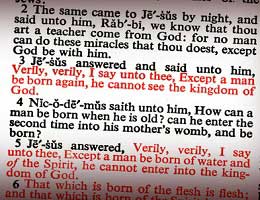
  3. Jesus answered and said to him, “Truly, truly, I say to you, unless one is born again [Greek, “anathon”] he cannot see the kingdom of God.”

  4. Nicodemus said to Him, “How can a man be born when he is old? He cannot enter a second time into his motherʼs womb and be born, can he?”

  5. Jesus answered, “Truly, truly, I say to you, unless one is born of water and the Spirit he cannot enter into the kingdom of God.

  6. That which is born of the flesh is flesh, and that which is born of the Spirit is spirit.

  7. Do not be amazed that I said to you, “You must be born again [Greek, ‘anathon’].”

  8. The wind blows where it wishes and you hear the sound of it, but do not know where it comes from and where it is going; so is everyone who is born of the Spirit.”

  9. Nicodemus said to Him, “How can these things be?”

  10. Jesus answered and said to him, “Are you the teacher of Israel and do not understand these things?

  11. Truly, truly, I say to you, we speak of what we know and testify of what we have seen, and you do not accept our testimony.

  12. If I told you earthly things and you do not believe, how will you believe if I tell you heavenly things?

  13. No one has ascended into heaven, but He who descended from heaven: the Son of Man.

  14. As Moses lifted up the serpent in the wilderness, even so must the Son of Man be lifted up;

  15. so that whoever believes will in Him have eternal life.

  16. For God so loved the world, that He gave His only begotten Son, that whoever believes in Him shall not perish, but have eternal life.

  17. For God did not send the Son into the world to judge the world, but that the world might be saved through Him.

  18. He who believes in Him is not judged; he who does not believe has been judged already, because he has not believed in the name of the only begotten Son of God.

  19. This is the judgment, that the Light has come into the world, and men loved the darkness rather than the Light, for their deeds were evil.

  20. For everyone who does evil hates the Light, and does not come to the Light for fear that his deeds will be exposed.

  21. But he who practices the truth comes to the Light, so that his deeds may be manifested as having been wrought in God.”

After reading the above note that the Gospel of John was composed in Greek, yet Jews in Jesusʼ day spoke Aramaic, so two Jews holding a conversation, such as Nicodemus and Jesus in the Jewish city of Jerusalem, would most likely have been speaking Aramaic rather than Greek to one another. And that means Nicodemus would not have been confused as to the double-meaning of the Greek word “anathon,” which could mean either “again” or “from above,” and which Nicodemus heard as “Ye must be born AGAIN” but which Jesus used in the sense of “Ye must be born FROM ABOVE.” Neither is there any word in Aramaic with such a double meaning according to Bart Ehrman, who told me that the Aramaic word for “again” does not also mean “from above,” nor does the Aramaic word for “from above” mean “again.” So why was Nicodemus confused? Probably because the conversation was invented by a Greek speaking storyteller or perhaps by the author of the Gospel of John himself.

In an email recʼd 9/4/11, Ehrman added:

The conversation makes much better sense as hinging on a mistaken double entendre, as happens, in fact, in the very next chapter where the woman thinks that Jesusʼ reference to “living water” means “running water” (since that is how it is normally described in Greek), when in fact he means “water that gives life.” Both conversations proceed by a double entendre, misunderstood, leading to a re-explanation. That works only if there is in fact a double entendre, possible in Greek but not Aramaic.

Furthermore, the author of the Gospel of John utilizes certain dualistic ideas and characteristic phrases which first appear in the authorʼs lengthy prologue as well as in the mouth of John the Baptist, as well as in the mouth of Jesus such dualisms include:

“earthly and heavenly things”

“flesh and spirit”

“darkness and light”

“truth and lies”

“eternal life and death”

and the conversation in John 3 is no exception. It appears like the author of the fourth Gospel invented this conversation as one more of his dualistic sermons about things earthly and heavenly, and so he employed the Greek word, anothen, with its dual meaning, as well as the Greek word pneuma with its dual meaning since pneuma could refer to either “wind” or “spirit,” and a third dualistic phrase as well, all in the same “dialogue with Nicodemus.”

Now read John, chapter 3, below with the above in mind:

Jesus replied, “Very truly I tell you, no one can see the kingdom of God unless they are born again/from above.” “How can someone be born when they are old?” Nicodemus asked [picking up on the “again” meaning of anothen, but ignoring the “from above” meaning]. “Surely they cannot enter a second time into their motherʼs womb to be born!” Jesus answered, “Very truly I tell you, no one can enter the kingdom of God unless they are born of water and the Spirit. Flesh gives birth to flesh, but the Spirit gives birth to spirit. You should not be surprised at my saying, ‘You must be born again/from above.’

Jesus continues by applying another double meaning:

The wind [=pneuma, the same Greek word for spirit] blows wherever it pleases. You hear its sound, but you cannot tell where it comes from or where it is going. So it is with everyone born of the Spirit [=pneuma, spirit/wind in Greek]. “How can this be?” Nicodemus asked.

Nicodemus is confused a second time by the authorʼs use of a Greek word with a dual meaning that applies both to earthly and heavenly things, “wind,” and “spirit,” but unlike the previous case the word pneuma had the same dual meaning in Greek as well as Aramaic and Hebrew, meaning both “wind” and “spirit” in all three languages, since the wind appeared invisible and mysterious/spiritual to all ancient cultures (viz., the “spirit/wind, or even breath” [of life]).

Jesus continues by applying a third double meaning:

“You are Israelʼs teacher,” said Jesus, “and do you not understand these things? Very truly I tell you, we speak of what we know, and we testify to what we have seen, but still you people do not accept our testimony. I have spoken to you of earthly things and you do not believe; how then will you believe if I speak of heavenly things? [my emphasis] No one has ever gone into heaven except the one who came from heaven—the Son of Man. Just as Moses lifted up [the same Greek word for lifted up also means exalted] the snake in the wilderness, so the Son of Man must be lifted up [the same Greek word for “lifted up” also means “exalted,” a third play on words], that everyone who believes may have eternal life in him.” [end of John 3:3-15]

The author continues in that same chapter in dualistic fashion by teaching that you either,

“believe in the name of Godʼs one and only Son,” or,

you are “condemned already,”

and

you either “love the light” or,

you “love the darkness.”

This is not the Jesus of the synoptics who taught that oneʼs deeds mattered more than what one believed about Jesus, and who said people could be forgiven even if they blasphemed the son of man.

John 3:16-21, the tagline one might say to the conversation with Nicodemus, but note that in the NIV there are no quotation marks around this paragraph, so not even the editors of the NIV assume that Jesus spoke these words, rather these words appear to be the authorʼs—his tagline to the story of Jesusʼ conversation with Nicodemus, just like the lengthy prologue to his Gospel which also were the authorʼs words, not Jesusʼ:

For God so loved the world that he gave his one and only Son, that whoever believes in him shall not perish but have eternal life. For God did not send his Son into the world to condemn the world, but to save the world through him. Whoever believes in him is not condemned, but whoever does not believe stands condemned already because they have not believed in the name of Godʼs one and only Son. This is the verdict: Light has come into the world, but people loved darkness instead of light because their deeds were evil. Everyone who does evil hates the light, and will not come into the light for fear that their deeds will be exposed. But whoever lives by the truth comes into the light, so that it may be seen plainly that what they have done has been done in the sight of God.


Further Questions Related to the Fictional Nature of the Dialogue Between Jesus & Nicodemus in the Fourth Gospel

The biblical scholar David Friedrich Strauss examined the dialogue between Nicodemus and Jesus and like Ehrman found the historicity of such a dialogue questionable for a variety of reasons.

Conversation of Jesus with Nicodemus by David Friedrich Strauss

The first considerable specimen which the fourth gospel gives of the teaching of Jesus, is his conversation with Nicodemus (3.1-21). In the previous chapter (23-25) it is narrated, that during the first Passover attended by Jesus after his entrance on his public ministry, he had won many to faith in him by the miracles which he performed, but that he did not commit himself to them because he saw through them: he was aware, that is, of the uncertainty and impurity of their faith. Then follows in our present chapter, as an example, not only of the adherents whom Jesus had found even thus early, but also of the wariness with which he tested and received them, a more detailed account how Nicodemus, a ruler of the Jews and a Pharisee, applied to him, and how he was treated by Jesus.

It is through the Gospel of John alone that we learn anything of this Nicodemus, who in 7.50f. appears as the advocate of Jesus, so far as to protest against his being condemned without a hearing, and in 19.39 as the partaker with Joseph of Arimathea of the care of interring Jesus. Modern criticism, with reason, considers it surprising that in all three synoptic Gospels, Mark, Matthew and Luke, there is no mention of the name of this remarkable adherent of Jesus, and that we have to gather all our knowledge of him from the fourth gospel (John); since the peculiar relation in which Nicodemus stood to Jesus, and his participation in the care of his interment, must have been as well known to Matthew a.s to John. This difficulty has been numbered among the arguments which are thought to prove that the first gospel was not written by the Apostle Matthew, but was the product of a tradition considerably more remote from the time and locality of Jesus. But the fact is that the common fund of tradition on which all three synoptic Gospels (Mark, Matthew, Luke) drew had preserved no notice of this Nicodemus. With touching piety the Christian legend has recorded in the tablets of her memory, the names of all the others who helped to render the last honors to their murdered master of Joseph of Arimathea and the two Marys (Matt 27.57-61 with parallels in other Gospels); why then was Nicodemus the only neglected one he who was especially distinguished among those who tended the remains of Jesus, by his nocturnal interview with the teacher sent from God, and by his advocacy of him among the chief priests and Pharisees? It is so difficult to conceive that the name of this man, if he had really assumed such a position, would have vanished from the popular evangelical tradition without leaving a single trace, that one is induced to inquire whether the contrary supposition be not more capable of explanation: namely, that such a relation between Nicodemus and Jesus might have been fabricated by tradition, and adopted by the author of the fourth gospel without having really subsisted.

John 12.42, it is expressly said that many among the chief rulers believed on Jesus, but concealed their faith from dread of excommunication by the Pharisees, because they loved the praise of men more than the praise of God. That towards the end of his career many people of rank believed in Jesus, even in secret only, is not very probable, since no indication of it appears in the Acts of the Apostles ; for that the advice of Gamaliel (Acts 5.34 ff.) did not originate in a positively favorable disposition towards the cause of Jesus, seems to be sufficiently demonstrated by the spirit of his disciple Saul. Moreover the synoptists make Jesus declare in plain terms that the secret of his Messiahship had been revealed only to babes, and hidden from the wise and prudent (Matt. 11.25; Luke 10.21), and Joseph of Arimathea is the only individual of the ruling class whom they mention as an adherent of Jesus.

How, then, if Jesus did not really attach to himself any from the upper ranks, came the case to be represented differently at a later period? In John 7.48f we read that the Pharisees sought to disparage Jesus by the remark that none of the rulers or of the Pharisees, but only the ignorant populace, believed on him; and even later adversaries of Christianity, for example, Celsus, laid great stress on the circumstance that Jesus had had as his disciples. This reproach was a thorn in the side of the early church, and though as long as her members were drawn only from the people, she might reflect with satisfaction on the declarations of Jesus, in which he had pronounced the poor, and simple, blessed : yet so soon as she was joined by men of rank and education, these would lean to the idea that converts like themselves had not been wanting to Jesus during his life. But, it would be objected, nothing had been hitherto known of such converts. Naturally enough, it might be answered ; since fear of their equals would induce them to conceal their relations with Jesus. Thus a door was opened for the admission of any number of secret adherents among the higher class (John 12.42f). But, it would be further urged, how could they have intercourse with Jesus unobserved ? Under the veil of the night, would be the answer ; and thus the scene was laid for the interviews of such men with Jesus (19.39). This, however, would not suffice ; a representative of this class must actually appear on the scene : Joseph of Arimathea might have been chosen, his name being still extant in the synoptical tradition ; but the idea of him was too definite, and it was the interest of the legend to name more than one eminent friend of Jesus. Hence a new personage was devised, whose Greek name (Nicodemus) seems to point him out significantly as the representative of the dominant class. That this development of the legend is confined to the fourth gospel, is to be explained, partly by the generally admitted lateness of its origin, and partly on the ground that in the evidently more cultivated circle in which it arose, the limitation of the adherents of Jesus to the Common people would be more offensive, than in the circle in which the synoptical tradition was formed. Thus the reproach which modern criticism has cast on the first gospel, on the score of its silence respecting Nicodemus, is turned upon the fourth, on the score of its information on the same subject.

These considerations, however, should not create any prejudice against the ensuing conversation, which is the proper object of our investigations. This may still be in the main genuine; Jesus may have held such a conversation with one of [his adherents, and our Evangelist may have embellished it no further than by making this interlocutor a man of rank. Neither will we, with the author of the Probabilia, take umbrage at the opening address of Nicodemus, nor complain, with him, that there is a want of connexion between that address and the answer of Jesus. The requisition of a new birth, as a condition of entrance into the kingdom of heaven, does not differ essentially from the summons with which Jesus opens his ministry in the synoptical gospels, Repent ye, for the kingdom of heaven is at hand. New birth, or new creation, was a current image among the Jews, especially as denoting the conversion of an idolater into a worshiper of Jehovah. It was customary to say of Abraham, that when, according to the Jewish supposition, he renounced idolatry for the worship of the true God, he became a new creature. The proselyte, too, in allusion to his relinquishing all his previous associations, was compared to a new-born child. That such phraseology was common among the Jews at that period, is shown by the confidence with which Paul applies, as if it required no explanation, the term new creation, to those truly converted to Christ. Now, if Jesus required, even from the Jews, as a condition of entrance into the messianic kingdom, the new birth which they ascribed to their heathen proselytes, Nicodemus might naturally wonder at the requisition, since the Israelite thought himself, as such, unconditionally entitled to that kingdom : and this is the construction which has been put upon his question 5.4. But Nicodemus does not ask, How canst thou say that a Jew, or a child of Abraham, must be born again? His ground of wonder is that Jesus appears to suppose it possible for a man to be born again, and that when he is old. It does not, therefore, astonish him that spiritual new birth should be expected in a Jew, but corporeal new birth in a man. How an oriental, to whom figurative speech in general how a Jew, to whom the image of the new birth in particular must have been familiar how especially a master of Israel, in whom the misconstruction of figurative phrases cannot, as in the apostles (e.g. Matt. 15.15f; 16.7), be ascribed to want of education could understand this expression literally, has been matter of extreme surprise to expositors of all parties, as well as to Jesus (5.10). Hence some have supposed that the Pharisee really understood Jesus, and only intended by his question to test the ability of Jesus to interpret his figurative expression into a simple proposition: but Jesus does not treat him as a hypocrite, as in that case he must have done he continues to instruct him, as one really ignorant(5.10). Others give the question the following turn : This cannot be meant in a physical sense, how then otherwise? But the true drift of the question is rather the contrary : By these words I can only understand physical new birth, but how is this possible? Our wonder at the ignorance of the Jewish doctor, therefore, returns upon us; and it is heightened when, after the copious explanation of Jesus (5.5-8), that the new birth which he required was a spiritual birth, Nicodemus has made no advance in comprehension, but asks with the same obtuseness as before (5.9), How can these things be? By this last difficulty one apologist who tries to argue for the historicity of the tale is so destitute of excuses, that, contrary to his ordinary exegetical tact, he refers the continued amazement of Nicodemus—as other expositors had referred his original question—to the circumstance that Jesus maintained the necessity of new birth even for Israelites. But, in that case, Nicodemus would have inquired concerning the necessity, not the possibility, of that birth; instead of asking, How can these things be? he would have asked, Why must these things be? This inconceivable mistake in a Jewish doctor is not then to be explained away, and our surprise must become strong suspicion so soon as it can be shown, that legend or the Evangelist had inducements to represent this individual as more simple than he really was. First, then, it must occur to us, that in all descriptions and recitals, contrasts are eagerly exhibited; hence in the representation of a colloquy in which one party is the teacher, the other the taught, there is a strong temptation to create a contrast to the wisdom of the former by exaggerating the simplicity of the latter. Further, we must remember the satisfaction it must give to a Christian mind of that age, to place a master of Israel in the position of an unintelligent person, by the side of the Master of the Christians. Lastly, it is, as we shall presently see more clearly, the constant method of the fourth Evangelist in detailing the conversations of Jesus, to form the knot and the progress of the discussion, by making the interlocutors understand literally what Jesus intended figuratively.

In reply to the second query of Nicodemus, Jesus takes entirely the tone of the fourth Evangelistʼs prologue (5.11-13). The question hence arises, whether the Evangelist borrowed from Jesus, or lent to him his own style. A previous investigation has decided in favor of the latter alternative. But this inquiry referred merely to the form of the discourses; in relation to their matter, its analogy with the ideas of Philo, does not authorize us at once to conclude that the writer here puts his Alexandrian doctrine of the Logos into the mouth of Jesus; because the expressions, “We speak that we do know,” etc., and, “No man hath ascended up to heaven,” etc., have an analogy with Matt. 11.27; and the idea of the pre-existence of the Messiah which is here propounded, is, as we have seen, not foreign to the Apostle Paul.

In chapter 5.14 & 15 Jesus proceeds from the more simple things of the earth, the communications concerning the new birth, to the more difficult things of heaven, the announcement of the destination of the Messiah to a vicarious death. The Son of Man, he says, must be lifted up (which, in Johnʼs phraseology, signifies crucifixion, with an allusion to a glorifying exaltation), in the same way, and with the same effect, as the brazen serpent in Num. 21.8,9. Here many questions press upon us. Is it credible, that Jesus already, at the very commencement of his public ministry, foresaw his death, and in the specific form of crucifixion? and that long before he instructed his disciples on this point, he made a communication on the subject to a Pharisee? Can it be held consistent with the wisdom of Jesus as a teacher, that he should impart such knowledge to Nicodemus? Even a conservative theologian like Lucke puts the question why, when Nicodemus had not understood the more obvious doctrine, Jesus tormented him with the more recondite, and especially with the secret of the Messiahʼs death, which was then so remote? Luckeʼs ingenious proposal to try and explain such away such a question is to propose that ‘it accords perfectly with the wisdom of Jesus as a teacher, that he should reveal the sufferings appointed for him by God as early as possible, because no instruction was better adapted to cast down false worldly hopes;’ or to say it another way, the more remote the idea of the Messiahʼs death from the conceptions of his contemporaries, owing to the worldliness of their expectations, the more impressively and unequivocally must Jesus express that idea, if he wished to promulgate it; not in an enigmatical form which he could not be sure that Nicodemus would understand. Lucke continues: “Nicodemus was a man open to instruction; one of whom good might be expected. But in this very conversation, his dullness of comprehension in earthly things, had evinced that he must have still less capacity for heavenly things; and, according to 5.12, Jesus himself despaired of enlightening him with respect to them. Lucke, however, observes, that it was a practice with Jesus to follow up easy doctrine which had not been comprehended, by difficult doctrine which was of course less comprehensible; that he purposed thus to give a spur to the minds of his hearers, and by straining their attention, engage them to reflect. But the examples that Lucke adduces of such proceeding on the part of Jesus, are all drawn from the fourth gospel. Now the very point in question is, whether that gospel correctly represents the teaching of Jesus; consequently Lucke argues in a circle. We have seen a similar procedure ascribed to Jesus in his conversation with the woman of Samaria, and we have already declared our opinion that such an overburdening of weak faculties with enigma on enigma, does not accord with the wise rule as to the communication of doctrine, which the same gospel puts into the mouth of Jesus, 16.12. It would not stimulate, but confuse, the mind of the hearer, who persisted in a misapprehension of the well-known figure of the new birth, to present to him the novel comparison of the Messiah and his death, to the brazen serpent and its effects; a comparison quite incongruous with his Jewish ideas. In the first three Gospels Jesus pursues an entirely different course. In these, where a misconstruction betrays itself on the part of the disciples, Jesus (except where he breaks off altogether, or where it is evident that the Evangelist unhistorically associates a number of metaphorical discourses) applies himself with the assiduity of an earnest teacher to the thorough explanation of the difficulty, and not until he has effected this does he proceed, step by step, to convey further instruction (e.g. Matt. 13.10 ff, 36 ff, 15.16, 16.8 ff.). This is the method of a wise teacher; on the contrary, to leap from one subject to another, to overburden and strain the mind of the hearer, a mode of instruction which the fourth Evangelist attributes to Jesus, is wholly inconsistent with that character. To explain this inconsistency, we must suppose that the writer of the fourth gospel thought to heighten in the most effective manner the contrast which appears from the first, between the wisdom of the one party and the incapacity of the other, by representing the teacher as overwhelming the pupil, who put unintelligent questions on the most elementary doctrine, with lofty and difficult themes, beneath which his faculties are laid prostrate.

From 5.16, even those commentators who pretend to some ability in this department, lose all hope of showing that the remainder of the discourse may have been spoken by Jesus. Not only does Paulus make this confession, but even Olshausen, with a concise statement of his reasons. At the above verse, any special reference to Nicodemus vanishes, and there is commenced an entirely general discourse on the destination of the Son of God, to confer a blessing on the world, and on the manner in which unbelief forfeits this blessing. Moreover, these ideas are expressed in a form, which at one moment appears to be a reminiscence of the Evangelistʼs introduction, and at another has a striking similarity with passages in the first Epistle of John. In particular, the expression, the only begotten Son, which is repeatedly (5.16 & 18) attributed to Jesus as a designation of his own person, is nowhere else found in his mouth, even in the fourth gospel; this circumstance, however, marks it still more positively as a favorite phrase of the Evangelist (1.14-18), and of the writer of the Epistles (1 John 4.9).

Further, many things are spoken of as past, which at the supposed period of this conversation with Nicodemus were yet future. For even if the words, he gave, refer not to the giving over to death, but to the sending of the Messiah into the world; the expressions, “men loved darkness,” and, “their deeds were evil,” (5.19), as Lucke also remarks, could only be used after the triumph of darkness had been achieved in the rejection and execution of Jesus: they belong then to the Evangelistʼs point of view at the time when he wrote, not to that of Jesus when on the threshold of his public ministry.

In general the whole of this discourse attributed to Jesus, with its constant use of the third person to designate the supposed speaker; with its dogmatical terms, “only begotten,” “light,” and the like, applied to Jesus; with its comprehensive view of the crisis and its results, which the appearance of Jesus produced, is far too objective for us to believe that it came from the lips of Jesus. Jesus could not speak thus of himself, but the evangelist might speak thus of Jesus. Hence the same expedient has been adopted by some conservative theologians, as in the case of the Baptistʼs discourse already considered, and it has been supposed that Jesus is the speaker down to 5.16, but that from that point the Evangelist appends his own dogmatic reflections. But there is again here no intimation of such a transition in the text; rather, the connecting word “for,” yap (5.16), seems to indicate a continuation of the same discourse. No writer, and least of all the fourth Evangelist (comp. 7.39, 11.51 f., 12.16, 33.37 ff.), would scatter his own observations thus undistinguishingly, unless he wished to create a misapprehension.

If then it be established that the evangelist, from 5.16 to the end of the discourse, means to represent Jesus as the speaker, while Jesus can never have so spoken, we cannot rest satisfied with the half measure adopted by Lucke, when he maintains that it is really Jesus who continues to speak from the above passage, but that the Evangelist has woven in his own explanations and amplifications more liberally than before. For this admission undermines all certainty as to how far the discourse belongs to Jesus, and how far to the Evangelist ; besides, as the discourse is distinguished by the closest uniformity of thought and style, it must be ascribed either wholly to Jesus or wholly to the Evangelist. Of these two alternatives the former is, according to the above considerations, impossible ; we are therefore restricted to the latter, which we have observed to be entirely consistent with the manner of the fourth Evangelist.

But not only on the passage 5.16-21 must we pass this judgment: 5.14 has appeared to us out of keeping with the position of Jesus ; and the behaviour of Nicodemus, 5.4 & 9, altogether inconceivable. Thus in the very first sample, when compared with the observations which we have already made on John 3.22 ff., 4.1 ff, the fourth gospel presents to us all the peculiarities which characterize its mode of reporting the discourses of Jesus. They are usually commenced in the form of dialogue, and so far as this extends, the lever that propels the conversation is the striking contrast between the spiritual sense and the carnal interpretation of the language of Jesus ; generally, however, the dialogue is merged into an uninterrupted discourse, in which the writer blends the person of Jesus with his own, and makes the former use concerning himself, language which could only be used by John concerning Jesus.


Recently Straussʼ work has been made available in audio format free online,

  • HERE,
  • HERE.
    For Straussʼ questions regarding the historicity of Nicodemus in particular see, The Life of Jesus Critically Examined, Part 2 - History of the Public Life of Jesus Chapter 7 - Discourses of Jesus in the Fourth Gospel §80 Conversation of Jesus with Nicodemus, click HERE and listen, or download to a device.
  • Straussʼ printed work is also available online to download and read on any device.